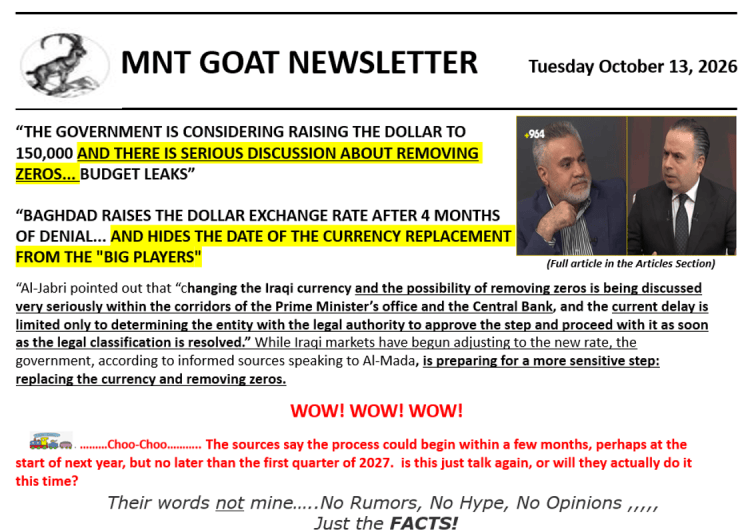

September 8, 2026 Edition Latest Mnt Goat Newsletter

Disclaimer: All information in this newsletter is not intended for investment decisions / purposes. Mnt Goat is not a financial analyst, planner, banker, attorney or associated in any role with giving out professional investment advice.

ABOUT THE NEWSLETTER:

September 8, 2026 Mnt Goat News Brief

Guten Tag everyone:

WOW! WOW! WOW! More news today about removing the zeros. I want to point out that the pressure to do something to alleviate the liquidity crisis at the two major state banks. For example, “merchants and residents in Kirkuk, northern Iraq, are increasingly struggling to obtain 250-dinar ($0.19), 500-dinar ($0.38) and 1,000-dinar ($0.76) banknotes, with traders reporting shortages of small denominations and growing difficulties using worn or damaged notes in daily transactions”. But as importantly, according to preliminary data that is currently being audited, the past period witnessed a significant depletion of liquidity and financial resources, including the funds available at government banks, specifically Al-Rafidain and Al-Rasheed banks. 

A FIFTH CONFIRMATION OF INTENTION TO REMOVE THE ZEROS!

GIVE A GIFT TO MNT GOAT

I decided to allow everyone to give a Free-will GIFT to Mnt Goat on PayPal if you so desire. Here is the link below. Please show your appreciation for all the hard work I do.

I recommend $15-$20 dollars a month or whatever you can afford. Do you realize I write up to eight (8) Newsletters every month. This is like a second job to me. The only way I know that people are reading and appreciating all the FACTUAL news I bring is through their appreciation. If I do not receive equal appreciation for all the hard work I do, I will simply end the Newsletter and save myself endless hours at the computer. You do want to get paid for your job, don’t you? What makes my job any different? Tell me….. I am tired of this RV saga just as you are.

 Let’s all try to chip in!

___________________________________________

1 Peter 4:8

“And above all things have fervent charity among yourselves: for charity shall cover the multitude of sins.”  

STATUS OF THE RV

Okay, so we are quickly advancing into September already. Folks, I have to say the news just keeps getting better and better. So here we go……

When can we expect the CBI to make a decision on their move of removing the zeros? This should happen any day now. One day you will read it on the front cover page of my blog, and this is not too far off.

I was told by my CBI contact that a committee has been set up months ago to study the issue of the feasibility of coming up with a start date and to monitor all the other factors involved. So, they are not just starting on this but months in the making already. But most of you already knew this…didn’t you?

One major factor included meeting with parliament on the necessary laws required to satisfy the GOI. We all know that a draft law was already sent to parliament on this effort to review and pass so they can begin the process. I guess what I am trying to reiterate to you today is that this project to remove the zero is just not at a ‘review’ or ‘considering’ state as in the past, but is moving ahead beyond these past stages to an advanced stage of even determining a date to begin and then announcing it to the public.

As this liquidity crisis worsens, the pressure builds to do something and do it soon. In a recent article titled “SMALL BANKNOTE SHORTAGE CAUSES DAILY DISRUPTION IN KIRKUK MARKETS”

This article is yet more proof of what my CBI contact is telling us is the TRUTH as to what are the majority of the notes horded and the root cause of this liquidity issue. It is almost verbatim of what she told us. WOW! It is these lower denoms namely the 250, 500 and 1000 notes. These are the ones they have to keep re-printing because they are taken out of circulation either due to wear and tear but most importantly hording. The more the CBI prints the more they stash away. Okay, okay,  so I am not going to review in detail this issue causing of the liquidity issue again. We are all adults and so let’s try to remember what I said in my other recent Newsletters about this issue. Here is the link to the Mnt Goat Archives. This is getting boring already, is it not? What we want is for them to do something about it. But we all know how slowwwwwwwwww they can work in Iraq. The point I want to stress today is that new explanations of this issue of these three notes is in the news almost daily now. Is it important? So, we get the message but more importantly we get the urgency too. That is what is going to drive this issue to resolution sooner than later.

I want to point out that I told my readers that removing the zeros project is the ONLY way they can collect this monetary mass back into the system. I said this years ago. Remember? They simply must do it.

Again, we know how slow Iraq works and so this urgency should speed things up. But remember conducting this project of removing the zeros also means moving to FOREX soon afterwards and so are they ready for this follow-up move too? We are told the Trump administration and the IMF now want the reinstatement and so it is supporting the next move too. I am guessing that maybe pressure from the US Treasury might put a fire under them to stop all this stagnation and move it ahead.   

I quote from the article: “Merchants and residents in Kirkuk, northern Iraq, are increasingly struggling to obtain 250-dinar ($0.19), 500-dinar ($0.38) and 1,000-dinar ($0.76) banknotes, with traders reporting shortages of small denominations and growing difficulties using worn or damaged notes in daily transactions.”

“Abbas Ahmed, a shopkeeper in Kirkuk’s Doctors Street market, told Shafaq News that obtaining the three denominations has become increasingly difficult. “When customers pay with larger notes, some shops ask them to buy another item rather than give them their change.” Some small-denomination notes reaching shops are also torn, dirty or heavily worn, making merchants and customers reluctant to accept them.”

Okay so there is many other recent articles on this topic of the 250, 500 and 1000 note depletion / hording. I will just list them and not go into much explanation of them but to highlight what I feel is most important for us to understand:

“THE DISAPPEARANCE OF SMALL DENOMINATION COINS IS CAUSING “DAILY DISRUPTION” IN IRAQI MARKETS.”

“Local markets in Kirkuk Governorate are experiencing increasing difficulty in obtaining small denomination banknotes of 250, 500 and 1000 dinars, amid complaints from traders and citizens about their scarcity in daily transactions. Shop owners say that what is available is often old, worn out or torn, which makes it more difficult to use in buying and selling operations.”

“At first glance, the problem seems to contradict the available figures on the volume of small banknotes in Iraq, as recent data indicates the existence of hundreds of millions of banknotes of these denominations. However, their presence in the monetary data does not necessarily mean that all of them are actually available for circulation or in good condition, which raises questions about the cash cycle and the mechanisms for withdrawing damaged banknotes, replacing them, and injecting new alternatives into the markets.”

Daily confusion

“Abbas Ahmed, a shop owner in the Doctors Street market in Kirkuk, told Shafaq News Agency, “Obtaining 250, 500, and 1000 dinar notes has become more difficult than before, and the problem becomes clear when a customer pays their bill in large denominations, forcing us to ask the customer to buy another item with the remaining amount.”

“SMALL BANKNOTE SHORTAGE CAUSES DAILY DISRUPTION IN KIRKUK MARKETS”

“Merchants and residents in Kirkuk, northern Iraq, are increasingly struggling to obtain 250-dinar ($0.19), 500-dinar ($0.38) and 1,000-dinar ($0.76) banknotes, with traders reporting shortages of small denominations and growing difficulties using worn or damaged notes in daily transactions.”

“Samer Abdullah, a currency exchanger on Republic Street, noted a sharp increase in demand for small denominations, while supplies remain inconsistent.”  

“Describing the shortage as a daily problem, Hamza al-Jubouri, a wholesaler in Kirkuk’s Citadel Market, told Shafaq News that small amounts of change are often needed in wholesale and retail transactions, leaving merchants with limited options when the required denominations are unavailable.”

“Some traders hold on to 250-dinar, 500-dinar, and 1,000-dinar notes rather than spend them, fearing they will be unable to replace them later. This further reduces the number of these notes circulating in the market.”

“IRAQ PROBES STATE BANKS OVER LIQUIDITY DEPLETION”

  “On Saturday, informed sources revealed that the Integrity Commission and the relevant regulatory bodies are conducting investigations and audits regarding a number of financial and banking files, most notably the decline in liquidity levels at government banks, the granting of loans and financing of investment projects, as well as the special and exceptional approvals granted by government banks, particularly Al-Rafidain and Al-Rasheed banks, during the previous period.”

“According to preliminary data that is currently being audited, the past period witnessed a significant depletion of liquidity and financial resources, including the funds available at government banks, specifically Al-Rafidain and Al-Rasheed banks.”    

______________________________________

In this next article titled “THE CENTRAL BANK REASSURES BANK DEPOSITORS” let’s dig deeper into it. Why is the CBI telling the public these kinds of statements? We all know why. They are trying to push the public into getting this horded money back into the banks. Well…well I have news for them this tactic did not work and will not work. It is time to get serious and take more drastic measures. Hint…hint…remove the zeros…..

 “Affirming its pivotal role in protecting the financial system and ensuring a sound banking sector based on competitiveness and the provision of the best traditional and digital financial services, the Central Bank of Iraq wishes to inform and reassure the public of the following facts: You can go read the article in full for yourself, it is nothing more than what we already know….bla, bla,bla… 😊

______________________________________

I find this next recent article ironic almost funny even…lol..lol..lol.. 😊. How stupid can these members of parliament in Iraq be?  This guy sounds like a democrat in the US government…lol..lol..lol.. It is titled “MP: THERE ARE NO ECONOMIC SOLUTIONS OTHER THAN HOW TO SECURE EMPLOYEE SALARIES”

 “MP Abdul Hamza al-Khafaji asserted on Saturday that the government lacks clear economic solutions to address the financial crises, indicating that its primary focus is on securing employee salaries.”  Really? The Finance Committee already told us that the salaries are held up due to the liquidity issue at the banks. Yes, this exact same issue that four (4) articles in the daily news just told us about. So, where is the mind of this MP anyhow. Do you see the problem they are facing in Iraq too – dumb or dumber?  

He stressed the necessity of “adopting economic policies capable of creating job opportunities, stimulating the private sector, and increasing non-oil revenues,” urging the government to “provide sustainable solutions that guarantee the country’s financial and economic stability.”  Okay but the reality is that the liquidity issue is real, is happening now and the salaries must be paid now not 10 years down the road. How about the solution for the problem staring you in the nose, right in front of your face?  

Yes, al-Khafaji you can always support the draft bill now in parliament to remove the zeros and bring in all this cash back into the banking system. The GOI is most aware of the petro-dollar and it ramifications on a ‘rentier’ economy. The process to diversify the economy is underway. Let’s stop talking about it and do something about it. How many more years are you going to kick this can down the road? Aren’t you a member of parliament? You have part of the power al-Khafaji.  

____________________________________

Okay, so what have heard in the news lately about removing the zeros?

Seems we have yet another confirmation from the Iraqi Finance Committee that tells us the intent to move ahead with the project to remove the zeros. It is titled “PARLIAMENTARY FINANCE COMMITTEE: THERE IS AN INTENTION TO ISSUE BANKNOTES IN DENOMINATIONS SMALLER THAN 250 DINARS.”

 This fourth confirmation comes from Jamal Kojar, again yet another a member of the parliamentary finance committee. This news is not rumor or internet hype. So, once again we get a solid confirmation they are going to move ahead with the Project to Delete the Zeros.

Can the CBI do it without legislation thus a new law to do it. In this article we get a sense of confusion as to what the CBI is actually telling us. So, let me clarify it.  

I quote from the article – “According to the official newspaper, Jamal Kojar, a member of the parliamentary finance committee, revealed that “during its recent meeting with the governor of the Central Bank, the finance committee raised several questions related to removing zeros, printing currency, banks that have closed, as well as the general financial situation.”

So, this confirms to us the Finance Committee and the CBI have met and discussed what is needed to do it. Finally, a confirmation on this meeting, which my CBI contact also just told me had to happen.

I quote from the article – “But the issue resurfaced strongly last August, with parliamentary talk of including the “Zero Removal Law” within a package of economic measures, and then proposing other options including changing the currency or issuing new denominations.

Issuing new denominations vs changing the currency:

These are two distinct tasks and I need everyone to understand exactly what they mean by both of them to fully understand this article. What do these last statements mean? What the hell is the difference? After consulting my CBI contact on these statements, I was told the following:

Issuing newer denominations does not mean a redenomination resulting from removing the zeros. And this is the key to understanding. Instead, it means issuing all  brand new denominations not used before like the 100 or bringing back the 50 (which was previously taken out of circulation) not part of removing the zeros project. I know, I know many of you are going to think aren’t the newer lower denominations also brand new notes? Yes, they are but they are part of the list for removing the zeros and are not counted as issuing newer denominations but instead a redenomination. Get it?

I quote from the article – Changing the currency is one of the exclusive powers of the central bank.” Thus it does not need legislation to do it.

Later we also talk about another article where an economist says they will most likely issue a new 100 note and bring back the old 50 note. So, I think this is why this article wants to clarify it to the readers. The CBI can in fact issue these two notes anytime without any legislation.

Changing the Currency: is Removing the zeros and it means for instance, taking the 25,000 notes and swapping them out for 25 notes. This is considered a redenomination. This is NOT considered issuing new currency from this terminology. This is a VERY SPECIFIC project and has been defined as such. These new newer lower denominations are specifically listed and are part of the redenomination project called Deleting the Zeros and not categorized as newer notes because the CBI will be just be bringing back the older type of denominations they once had, get it? The newer 100 is not on the list and never existed before 2003 even. So removing the zeroes is just ‘removing the zeros’ NOT issuing any new currency just back to the old ones they used to have. The removing the zeros project perse, will need legislation while the issuing of the 50 and the new 100 notes (or any other notes they decide later) will not. Get it? I know it gets confusing and this is why I have a contact in the CBI to clarify it for us. I hope this helps.

I quote from the article – While removing zeros requires legislation from the House of Representatives at the request of the government.”

Kujer concluded by saying that “printing the new currency,” if it happens, will be followed by a period of time to withdraw the old currency from circulation, but this period has not yet been determined as the central bank is still studying the details of the process.

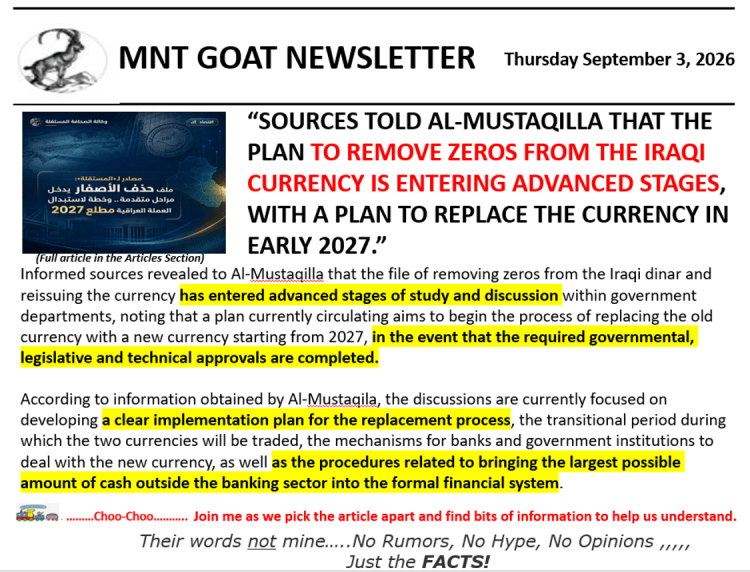
THE ZERO REMOVAL FILE IS BACK IN FULL FORCE. (Their words not mine)

I quote from the article – “The project to remove three zeros dates back after many years, as the Central Bank began studying the idea in 2007, and its former governor, Ali Al-Alaq, said in 2024 that the project “is still in place,” without specifying a date for its implementation.”

_________________________________________

There was one article in particular I need to bring to your attention today. You may again so what is so important about it. Again it is not always about the content but the intent behind it or underlying around it. The article is titled “AN ECONOMIST PREDICTS THE RETURN OF THE 50 AND 100 DINAR DENOMINATIONS WITH THE CURRENCY CHANGE.” This article ties in nicely what I just talked about in the above article.

Yes, the CBI can issue these two notes without any parliament approval, at any time.

 If you recall back in 2015 they told us they were going to begin removing the zeros in early 2016 and that they would issue the 100 dinar then. They DID NOT talk about getting any new law to do it then either. However the effort was later cancelled as the ISIS war dragged on. Then in 2017, when did end, they still never did it. So, this process of issuing the 100 notes comes out again in today’s news. This is a VERY GOOD sign to us. It shows this removing of the zeros is going to come very soon. I do know that the 50 notes were once in circulation but the 100 note is a new. Getting back the 50 notes are also a very good sign.

I quote from the article – “Economic expert Mustafa Hantoush suggested on Sunday that the 50 and 100 dinar denominations would return to circulation if the currency change were to proceed, noting the possibility of issuing new currency denominations with stronger security features . Hantoush said in a televised interview followed by Al-Sa’a Network that “the Central Bank may issue a new currency with advanced security features, with the possibility of introducing currency denominations less than 250 dinars, such as 100 fils .”

He added that “the Central Bank may move towards issuing 50 and 100 dinar denominations in the next stage,” indicating that “the return of these denominations may contribute to supporting the currency and strengthening the position of the Central Bank .”

He explained that “the Central Bank has not yet made a final decision regarding this step, while the government is working on forming a committee to study the issue, pending the completion of the procedures related to it within the House of Representatives 

I can tell you this committee he is referring to has already been formed now for a couple months and the work is well underway. This is why I am telling you we should expect a declaration from the CBI any day about a date to begin removing the zeros.

I have to say I am jumping up and down at this news since I remember the past and what they planned to do and cancelling it due to ISIS. It is now all coming back. I only wish this disarming of the Iranian militia and factions stuff does not interfere.

_______________________________________________

UPDATE: On disarming the militias

Speaking about being a SECURE Iraq what about the militias and factions?

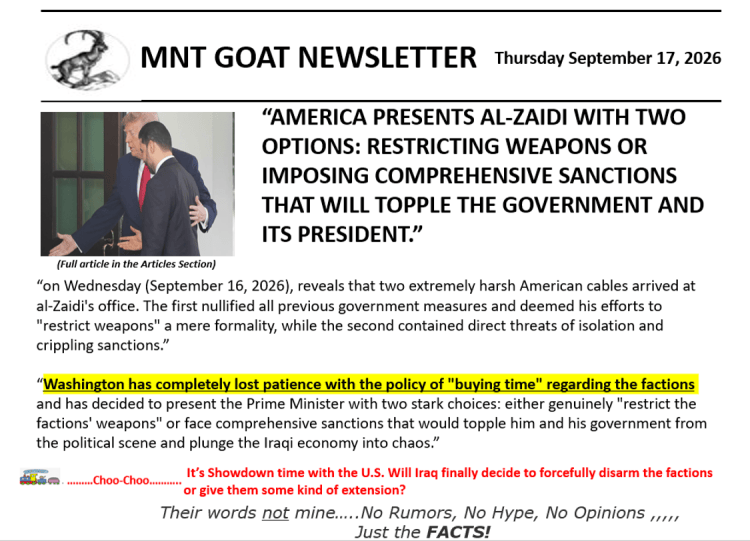
“WASHINGTON’S MESSAGES REACH BAGHDAD… AMERICAN RESERVATIONS HAUNT THE DRAFT LAW ON THE POPULAR MOBILIZATION FORCES.”

 “Revealed by the newspaper “An-Nahar” Lebanese the American side reported Baghdad over the past few days, there have been clear reservations about re-entering bill Popular Mobilization Forces in its previous form, while it requested Washington explicit guarantees that all Popular Mobilization Forces formations will be subject to the authority of the Commander-in-Chief of the Armed Forces, and that no parallel structures or authorities will be allowed to exist alongside the security institutions.”

What do you think will happen to this older bill to support the militia as a ‘legal’ security force in Iraq? You got to be kidding me they can even consider such a bill. This only shows you just how crooked the government has become. But remember this bill as it stands is from the past administration and was tabled. Now they are bringing it back to session to vote on it.

This next article says it all. I rest my case….enough said….

“IRAQ “CANNOT AFFORD TO TAKE RISKS”… STATE ADMINISTRATION WARNS OF THE REPERCUSSIONS OF US SANCTIONS”

“On Saturday, the State Administration Coalition discussed completing the government formation, the draft oil and gas law, and the country’s financial situation, while stressing the need to spare Iraq the repercussions of the US sanctions imposed on some countries, in light of what it described as the “difficult financial circumstances.”

Yes, here is our Oil and Gas law that we need before they reinstate the dinar. I am so glad this popped up again. I was wonder what the heck happened to it.

____________________________________

FUTURE THINKING:

I always like it when we hear news of forward thinking for Iraq. In the midst of all the chaos they still continue to work in the background to bring Iraq forward. Like in the US also in Iraq they are constantly moving ahead in the background. Here are two recent developments worth noting. Remember the Development Road Project and so is FORD Motors going to move in and establish warehouses for parts or maybe even limited productions facilities? Trust me on this one, FORD would not do this if assurances of a secure environment was not made.

“AL-ZAYDI DIRECTS THE ESTABLISHMENT OF A NEW MODERN CITY IN EACH GOVERNORATE”

“Prime Minister Ali Faleh al-Zaidi directed on Thursday that each governorate be responsible for establishing a new modern city with an area ranging between 10,000 and 15,000 dunams. The Prime Minister’s Media Office stated in a press release received by the Information Agency that “al-Zaidi emphasized, during his meeting with the heads of investment authorities in all governorates, in the presence of the Minister of Finance, the Director of the Prime Minister’s Office, the Governor of the Central Bank of Iraq, the Head of the Higher Coordination Committee for Governorates, and the Head of the National Investment Commission, the importance of adopting a new vision for investment and urban development.”

“This vision is based on creating integrated, modern cities in all governorates, which will contribute to expanding investment activity, achieving balanced and sustainable development, and creating new urban environments that can accommodate population and economic growth.”

“FORD OFFICIALLY ENTERS THE IRAQI MARKET ON OCTOBER 1ST.”

 “Ford is officially returning to the Iraqi market starting from October 1st, after appointing North Island Automotive Trading and Commercial Agencies Company (SAT) as its exclusive distributor in the country.”

“The appointment was based on a strategic alliance between March Holding Group and Al-Alayan Group, and North Island Company will be responsible for distributing cars, providing original spare parts, and offering after-sales services throughout the country.”

Ford indicated in a statement received by Kalima News that “North Island Company (SAT) will, under this appointment, be responsible for distributing Ford vehicles, providing original spare parts, and offering after-sales services throughout Iraq.”

__________________________________________

SUMMARY

No, the project to remove the zeros has not yet kicked off. There is no RV yet.

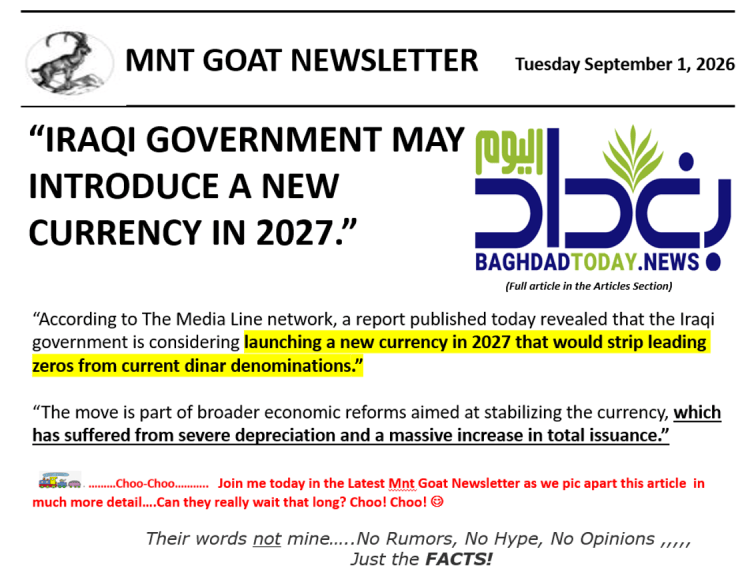
We don’t even have a firm begin date yet to remove the zeros. Some say early 2027 but we all know this is not yet set by the CBI. Right now these economists and MPs are just throwing out ideas and suggestions. It all sound wonderful. I will even take early 2027. Like you, I won’t like it, but at least they would be moving ahead. Yes, many of the ideas are most probable but not yet definite in the CBI policy of the process ahead.

Please do not listen to many of these idiot intel gurus filling your heads with gobbled-goop. They will only confuse you. Please stay on target. Remember that there is no revaluation perse of the ‘official’ CBI rate of 1310 with removing the zeros project. However, if you use your God given commonsense, we clearly see an indirect revaluation to about 0.76 cents per dinar. I explained to everyone many times how I derived this rate in-country. They plan to do this so they can coexist the two sets of notes until they can suck all the three zero notes out of circulation. Remember we have these three zero notes too. They will have to come and get ours too.

Let’s see what will happens in September as we move along. This was all very amazing news over the month of August and it continues. I believe the CBI is going to make an announcement this month to give us a firmer date as to removing the zeros.

Remember to stay focused on the TRUTH. Also, to all my faithful blog followers, please don’t forget what we read in the news from the past, even a decade or more ago. It all has meaning and relevance to today too. It helps to connect the pieces so we can see the larger picture.

Instead of complaining the RV did not yet happen, spend the effort and time reading the ‘RV Status’ and the articles I reference. This will give you a really good idea on the urgency of what the CBI is facing.

____________________________________________________

What do you think will happen next? (Leave a comment)

______________________________

________________________________________

Their words not mine…..No Rumors, No Hype, No Opinions ,,,,,

                                             Just the FACTS!


These prophecies are an important tool we have to lead us on our path. They are more important now than ever. They give us the strength, perseverance and hope that a better time is coming and that God’s Hand is at work behind the scenes. If you just take a second even to look around you at these past three election cycles, how can you deny that God is at work? Are you sleeping or what?

It is amazing and there is no other way that these events could have happened the way they turned out. But there is more to come, much, much more, I assure you! Now that God has his biblical David re-elected, we need to pay attention to what He does next.

NOTE: These prophecies just keep getting better and better, giving us HOPE of a brighter future. They seem to converge now closer and closer to seeing them come to fulfillment. WOW!

Prophetic Words from the prophets:  Julie Green

“Someone Has It All“

Go to the 14:05 mark on the video. Given on  Aug 30th.    

Fr. DON BOSCO EXPOSED THE DARK SECRET BEHIND ISLAM

I keep this one out here to view. Everyone should take the time to watch it. It will awaken you about the Muslim so-called religion (or should we call it for it is — a ‘cult‘.)

— And the truth the world forgot about the so-called Muslim religion.

Fr.Don Bosco, also known as John Bosco, was an Italian Catholic priest and educator, born on August 16, 1815. He founded the Salesian Society in 1859 to help disadvantaged youth,  particularly boys, through education and community service. His teachings emphasized lovekindness, and the importance of education for young people, making him a beloved figure in Catholicism and a patron saint of youth. Don Bosco was canonized in 1934.  

THE PARADIGM IS CHANGING ABOUT HOW TO FUND LOCAL DISTRICTS

Most of you reading this may not live in Texas and so you say it does not apply to you. Oh…. but it does. This is a paradigm shift that is gaining momentum throughout the nation. Property taxes are the worst financial burden on any home owner besides paying a mortgage. Should some have to pay for their property three times over? Think about it.

By the time you pay off your mortgage you would have paid for your house three times over. Really? Yes really- let’s break it down –1. the mortgage principle, 2.the mortgage interest and then 3. the property taxes. Yes, that’s three times over. The ironic part is for seniors your children have probably graduated from the public school system decades ago or worst yet you sent them to a private school not even using the public system. Why are you still paying school tazes at retirement?

So, there are solution to this burden of property taxes and we only need to wake up our preventatives to get creative and find ways to fund the towns without property taxes or a system that if fare and more honest. This is the point of showing you this video today. If Texas and so many other states can do it, so can your state. They just need a ‘push’ from the citizens to do it. If they resist, then replace with in the next elections and find someone who is willing to work to get it done.  

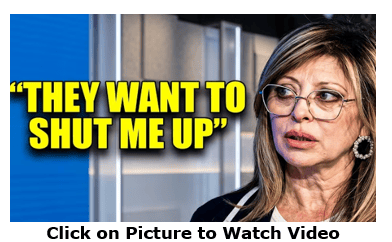
THIS IS WHAT HAPPENS WHEN YOU TAKE JOURNALISM SERIOUSLY

Maria Bartiromo OUSTED by Fox News After 12 Years, Erased From Network After Shocking Split. She was getting too close to too many conspiracies and they didn’t like it. In other words she ruffled too many feathers…. Then they oust you for telling the TRUTH!

THE LARGEST SINGLE OIL RESERVE EVER DISCOVERED IN THE UNITED STATES

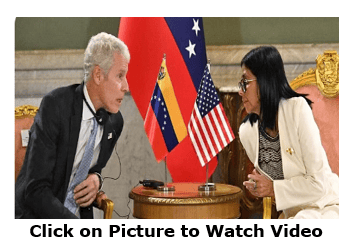
U.S. AND VENEZUELA SIGN NEW OIL DEAL

IRAN OIL PROVINCE: CAN INSIDE REBELS TAKE THE ISLAMIC REGIME DOWN?

America declared Economic War on Iran with Operation Economic Outcast, sanctioning 60 targets in one day. But the real war is inside Iran. In this episode of Decoded, Nikita Kapoor breaks down Khuzestan, the province that produces 80% of Iran’s oil, houses Bushehr nuclear reactor and Abadan refinery, but lives with 50% unemployment and is the world’s most polluted city on earth.

Ahwazi Arabs, armed groups like Arab Struggle Movement for the Liberation of Ahwaz, Ahwaz Falcons and Ahwaz Freedom Brigades have declared open rebellion against the IRGC. Can they blow pipelines, block ports and shut refineries to collapse the regime?

WHAT NOW FOR IRAN?

The U.S. imposes strict broad secondary economic sanctions against Iran on August 24th.  What will Iran do now? Total Meltdown! Iran President Loses ALL Powers As Hardliners Take Over? Civil War Now?

Iran hard liners threaten to choke anyone who partners with the U.S. in this new embargo. Iran’s president says to end the war now that contradicts the hardliners. Who is really in charge?

PPF: (Peoples Fighter Front) A NEW INSIDE REBEL ARMY UNLEASHES CHAOS ON THE ISLAMIC HARDLINERS

I really luv Nikita Kapoor’s updates of what is really happening in Iran. We are not going to get this TRUTH from any western news channels.

ARMY OF JUSTICE: Has a regime change begun from the inside? All the U.S. has to do is wait out the effects of Operation Economic Outcast secondary sanctions and let the PPF overtake the IRGC forces and round up hardlines and bring the regime to its knees. We simply don’t know how this will al play out, but this regime will fall, just not as easy as the Trump Administration thought.

Iran is planning to evacuate its capital, Tehran, due to a severe water drought, moving its government straight into a war zone. As the regime considers relocating to Makran, a powerful new rebel force, the People’s Fighters Front, is striking from within. In this episode of Decoded, Nikita Kapoor reveals why Iran’s biggest threat isn’t foreign air forces, but an internal army rising inside its own borders.

Timing is everything!

CONGRESS IS PUSHING 5 SOCIAL SECURITY BILLS —

Which One Helps You Most?

REMOVING ZEROS FROM THE DINAR: PARLIAMENTARY FINANCE COMMITTEE SETS CONDITIONS FOR PROCEEDING WITH THIS MATTER.

 
(Mnt Goat: this article is just Rahim opinion. We already learned what has to be done to begin the project from many other members of the Finance Committee.)

Member of the Parliamentary Finance Committee, Amer Rahim, confirmed on Saturday that voting on a bill to remove zeros from the local currency requires extensive discussions and the enactment of a package of laws within the Parliament. He indicated that raising this issue at the present time is premature.


Rahim told Al-Maalouma, “The step of removing zeros from the currency cannot be decided hastily; rather, it requires a series of lengthy and in-depth discussions within Parliament.” He explained that “the process is closely linked to the economic reality and requires amending and enacting several supporting financial laws and regulations to ensure market stability.”


He added, “Raising the discussion about this topic at this stage is premature, given the financial challenges that require first providing a comprehensive economic and banking environment before embarking on any structural change to the currency.” He pointed out that “any measure of this kind without careful and prior study may negatively impact the purchasing power of citizens.”

(Mnt Goat: did they not conduct this comprehensive economic and banking environment. What the hell does Rahim think the CBI has been doing for the last 4 years?)


Rahim stressed “the need to focus currently on supporting the stability of the national currency and implementing banking reforms, while leaving the issue of removing zeros until economic conditions are more favorable and full legislative support is available within the House of Representatives.” 

*********************************************************************************************

THE DISAPPEARANCE OF SMALL DENOMINATION COINS IS CAUSING “DAILY DISRUPTION” IN IRAQI MARKETS.

Local markets in Kirkuk Governorate are experiencing increasing difficulty in obtaining small denomination banknotes of 250, 500 and 1000 dinars, amid complaints from traders and citizens about their scarcity in daily transactions. Shop owners say that what is available is often old, worn out or torn, which makes it more difficult to use in buying and selling operations.

At first glance, the problem seems to contradict the available figures on the volume of small banknotes in Iraq, as recent data indicates the existence of hundreds of millions of banknotes of these denominations. However, their presence in the monetary data does not necessarily mean that all of them are actually available for circulation or in good condition, which raises questions about the cash cycle and the mechanisms for withdrawing damaged banknotes, replacing them, and injecting new alternatives into the markets.

Daily confusion

Abbas Ahmed, a shop owner in the Doctors Street market in Kirkuk, told Shafaq News Agency, “Obtaining 250, 500, and 1000 dinar notes has become more difficult than before, and the problem becomes clear when a customer pays their bill in large denominations, forcing us to ask the customer to buy another item with the remaining amount.”

He points out that some of the small bills that arrive at the shops are in poor condition, as they are torn, dirty, or worn out as a result of frequent handling, which makes it difficult for some merchants and citizens to accept them.

He adds: “The continuation of this creates daily confusion in the markets, especially for shops that deal with large numbers of customers,” stressing that the problem is not related to the value of the small banknote as much as it is related to its role in completing commercial transactions.

For his part, Samir Abdullah, the owner of a currency exchange shop on Al-Jumhuriya Street in Kirkuk, told Shafaq News Agency that the demand for small denominations has increased significantly, while it is difficult to provide them in the quantities needed by the market.

It shows that citizens and merchants resort to exchange shops to obtain small denominations, but the available quantities are not stable, and the problem increases when the papers offered for exchange are in a damaged condition. He adds that small banknotes are passed between large numbers of people in a short period, which makes them more susceptible to damage compared to larger denominations, noting that some of the banknotes that reach the banking system need to be replaced instead of being put back into circulation.

Abdullah believes that the solution is not limited to injecting new banknotes only, but also requires withdrawing damaged banknotes from circulation on a regular basis, because their continued existence reduces the amount of usable cash even if official figures indicate the existence of large numbers of these denominations.

In the Citadel market in Kirkuk, wholesalers face the same problem. Hamza al-Jabari, the owner of a wholesale shop, told Shafaq News Agency that the shortage of small denominations has become part of daily transactions in the market. He adds: “Wholesale and retail sales sometimes require returning small amounts to customers, but the lack of these amounts leaves the merchant with limited options, including rounding the price or adding another item instead of the remaining cash amount.”

He points out that some traders keep the 250, 500 and 1000 dinar notes they receive and do not use them in other transactions except when necessary, for fear that they will not be able to obtain them again, which in turn leads to a reduction in the movement of these denominations within the market.

He points out that “the problem seems simple from a financial standpoint, but its effects expand when it is repeated thousands of times daily, especially in popular markets, food stores, bakeries, transportation, and other activities that depend on direct cash transactions.”

Hundreds of millions of papers

The latest estimates published in 2026 indicate that the volume of small denomination banknotes does not necessarily reflect what the average citizen sees in the market.

According to Shafaq News Agency’s monitoring of cash issuance data, the number of 1000 dinar notes increased from 718 million notes in 2022 to 775 million notes in 2026, while the number of 250 dinar notes increased from 795 million notes to 818 million notes during the same period, while the 500 dinar note decreased slightly from 147 million notes to 145.4 million notes.

Thus, the total number of banknotes of the three categories amounts to approximately 1.738 billion banknotes according to these estimates for 2026, compared to approximately 1.660 billion banknotes in 2022, an increase of approximately 78.4 million banknotes. The figures show that the 1,000 dinar denomination recorded an increase of about 57 million notes, while the 250 dinar denomination increased by about 23 million notes, while the 500 dinar denomination decreased by about 1.6 million notes.

However, these figures do not mean that all 1.738 billion banknotes are in citizens’ pockets or store safes and in good condition for circulation. They reflect the number of banknotes within the monetary issuance data and do not represent a field survey of the actual quantity of banknotes in circulation or the percentage of damaged ones. This is a crucial point when explaining the problem of the shortage of small denominations.

The Central Bank of Iraq still includes the 250, 500 and 1000 dinar denominations among the officially circulating banknotes, confirming when issuing the second edition of banknotes that the previous banknotes will continue to circulate alongside the new issues, without any intention of withdrawing them from circulation.

Damaged problem

Economic expert Ali Khalil told Shafaq News Agency that the problem of small denominations should not be measured only by the number of notes issued by the Central Bank, but by the number of notes that are actually valid for circulation.

He says that small batches are subject to high rates of consumption and damage due to their frequent transfer between individuals, and therefore part of the exported quantity may have gone out of circulation or become in need of replacement.

He adds that “the presence of more than one billion banknotes of the three categories within the monetary data does not necessarily mean that there is a surplus of them in the markets, because a banknote that becomes damaged loses its practical ability to perform its function, even if it remains counted within the number of banknotes that were issued.”

He points out that addressing the problem requires strengthening mechanisms for replacing damaged banknotes, ensuring that new banknotes reach the markets continuously, and monitoring the movement of cash between banks, exchange offices, and merchants.

Khalil confirms that “the shortage of small denominations is reflected in daily pricing, and may lead to inaccurate approximation of prices, which can sometimes burden the consumer with small additional amounts, but it becomes significant when it is repeated continuously.”

Central Bank instructions

Official data indicates that the Central Bank of Iraq already has specific mechanisms for dealing with damaged banknotes, as it has published official standards for their replacement, which include different conditions and procedures depending on the nature of the damage to the banknote.

An official electronic service is also available through the Ur portal for submitting requests to replace damaged banknotes at the Central Bank of Iraq, allowing citizens to submit their requests according to the approved procedures.  These procedures indicate that dealing with damaged banknotes is not the responsibility of the citizen alone, but is part of the cash management system that includes banks, the central bank, and mechanisms for withdrawing invalid banknotes and replacing them with banknotes that are negotiable.

In 2020, the Central Bank issued a decision to reinstate the penalty for shortages on small denominations, namely 1000, 500 and 250 dinars, effective from October 1, 2020, in accordance with the instructions on standards for the circulation and exchange of banknotes and counting and sorting mechanisms. This reflects the monetary policy’s interest in providing small denominations in the monetary system, given their widespread use in daily transactions.

Citizens face a “change” crisis

Suhad Ibrahim, an employee, told Shafaq News Agency that citizens are the most affected by the problem because they cannot control the availability of small denominations when they buy their daily needs. She adds that the customer may pay more than the value of the item, but sometimes does not receive the full change, or is forced to buy something else so as not to lose the remaining amount, noting that this problem is repeated in shops, markets and means of transportation.

She explains that providing small change in good condition will make everyday transactions easier, especially for employees and low-income earners who deal with small amounts frequently.

Between numbers and reality

The problem of small change reveals a potential gap between the amount of cash recorded in the monetary issuance data and the cash actually available for daily circulation in good condition. Available figures indicate that there are hundreds of millions of banknotes in denominations of 250, 500 and 1000 dinars, but traders in Kirkuk say they are having difficulty obtaining them, while money changers confirm that part of what they receive is damaged or worn out.

Therefore, the question that arises is not only about the number of notes issued, but also about the volume of notes that are actually valid for circulation, the amount that was withdrawn from the market due to damage, and how quickly it was replaced with new notes. Economists believe that addressing the problem requires more detailed data on the number of damaged banknotes withdrawn annually, the quantities of new banknotes injected into each denomination, and their geographical distribution among the governorates.

With a large segment of Iraqis continuing to rely on cash transactions, small denominations remain an essential part of daily economic life, despite their low nominal value. While available data shows an increase in the number of 250 and 1000 dinar notes since 2022, and a slight decrease in the 500 dinar note, market complaints indicate that the real challenge lies in the availability of these notes in good condition and in the right place and time.

Hence, there seems to be a need to strengthen the cycle of replacing damaged currency, and to ensure that small denominations have access to banks, exchange offices and markets, in order to prevent the problem of “change” from turning into a daily crisis for both the citizen and the merchant.

************************************************************************************

SMALL BANKNOTE SHORTAGE CAUSES DAILY DISRUPTION IN KIRKUK MARKETS

(Mnt Goat: yet more proof of what my CBI contact is telling us is the TRUTH as to what are the majority of the notes horded. It is these lower denoms 250, 500 and 1000 notes. These are the ones they have to keep re-printing. The more the CBI has printed the more they stash away. Printing more and more increases the monetary mass and this could cause massive inflation if not controlled.)

Merchants and residents in Kirkuk, northern Iraq, are increasingly struggling to obtain 250-dinar ($0.19), 500-dinar ($0.38) and 1,000-dinar ($0.76) banknotes, with traders reporting shortages of small denominations and growing difficulties using worn or damaged notes in daily transactions.

Abbas Ahmed, a shopkeeper in Kirkuk’s Doctors Street market, told Shafaq News that obtaining the three denominations has become increasingly difficult. “When customers pay with larger notes, some shops ask them to buy another item rather than give them their change.” Some small-denomination notes reaching shops are also torn, dirty or heavily worn, making merchants and customers reluctant to accept them.

Samer Abdullah, a currency exchanger on Republic Street, noted a sharp increase in demand for small denominations, while supplies remain inconsistent. Residents and merchants often turn to exchange shops for smaller notes, but the quantities available fluctuate. Some notes brought in for exchange are already damaged and need to be replaced rather than returned to circulation. Small-denomination notes change hands more frequently than larger ones, making them more vulnerable to wear and tear, Abdullah explained.

Describing the shortage as a daily problem, Hamza al-Jubouri, a wholesaler in Kirkuk’s Citadel Market, told Shafaq News that small amounts of change are often needed in wholesale and retail transactions, leaving merchants with limited options when the required denominations are unavailable.

Some traders hold on to 250-dinar, 500-dinar, and 1,000-dinar notes rather than spend them, fearing they will be unable to replace them later. This further reduces the number of these notes circulating in the market.

Shafaq News’ review of currency issuance data shows that the number of 1,000-dinar notes rose from 718 million in 2022 to 775 million in 2026. The number of 250-dinar notes increased from 795 million to 818 million, while 500-dinar notes fell slightly from 147 million to 145.4 million.

Together, the three denominations accounted for about 1.738 billion notes in 2026, compared with roughly 1.660 billion in 2022, an increase of about 78.4 million notes.

The figures do not indicate how many of those notes are physically available in shops or remain in good enough condition for daily use. They reflect issuance data rather than the number of notes actually circulating or the proportion that has become damaged.

The Central Bank of Iraq (CBI) continues to list 250-dinar, 500-dinar and 1,000-dinar notes among the country’s officially circulating denominations. It has also stated that older notes remain legal tender alongside newer issues.

In an interview with Shafaq News, Economist Ali Khalil said the availability of small denominations should be measured not only by the number of notes issued but also by the number that remain fit for circulation.

Frequent handling makes small-denomination notes particularly vulnerable to damage, meaning some of the issued supply may have been removed from circulation or require replacement.

Khalil pointed out that the existence of more than one billion notes across the three denominations does not necessarily indicate a surplus in the market. “Damaged notes may no longer be usable even if they remain part of the official issuance figures.”

He called for stronger mechanisms to replace damaged notes, ensure a steady supply of new notes and monitor the movement of cash through banks, exchange shops and merchants.

The CBI has procedures for handling damaged banknotes, including criteria for their replacement depending on the type and extent of damage. An electronic service is also available through the Ur platform to submit requests for the replacement of damaged banknotes.

In 2020, the central bank reinstated penalties related to shortages of 1,000-dinar, 500-dinar, and 250-dinar notes, effective Oct. 1 of that year, under rules governing the circulation and replacement of banknotes and their counting and sorting.

Office worker Suhad Ibrahim told Shafaq News that consumers are among those most affected because they have little control over the availability of small denominations when making everyday purchases.

Customers who pay more than the price of an item sometimes do not receive their full change or are asked to buy another item to avoid losing the remaining amount.

The shortage is particularly noticeable in shops, markets and public transportation, where small cash payments are common.

Despite their low face value, 250-dinar, 500-dinar and 1,000-dinar notes remain an important part of Iraq’s cash-based economy. While official figures show an increase in the number of 250-dinar and 1,000-dinar notes since 2022 and a slight decline in 500-dinar notes, merchants in Kirkuk continue to report difficulty obtaining small denominations in usable condition.

*****************************************************************************************

PARLIAMENTARY FINANCE COMMITTEE: THERE IS AN INTENTION TO ISSUE BANKNOTES IN DENOMINATIONS SMALLER THAN 250 DINARS.

 About the news

The parliamentary finance committee revealed that there is an intention to issue smaller denominations of currency than the 250 dinar note.

This measure comes as a result of what has been described as the currency not having changed for a long time and the occurrence of counterfeiting.

The central bank governor distinguished between changing the currency and removing zeros.

According to the official newspaper, Jamal Kojar, a member of the parliamentary finance committee, revealed that “during its recent meeting with the governor of the Central Bank, the finance committee raised several questions related to removing zeros, printing currency, banks that have closed, as well as the general financial situation.”

Changing the currency is one of the exclusive powers of the central bank.

While removing zeros requires legislation from the House of Representatives at the request of the government.”

Changing the currency becomes necessary after a long period of time has passed since the current currency was introduced and counterfeiting operations have occurred.

There is an intention to issue smaller denominations of currency than 250 dinars, and the reason for this trend is that the currency has not changed for a long time and has been counterfeited.

Kujer concluded by saying that “printing the new currency,” if it happens, will be followed by a period of time to withdraw the old currency from circulation, but this period has not yet been determined as the central bank is still studying the details of the process.

THE ZERO REMOVAL FILE IS BACK IN FULL FORCE.

The project to remove three zeros dates back after many years, as the Central Bank began studying the idea in 2007, and its former governor, Ali Al-Alaq, said in 2024 that the project “is still in place,” without specifying a date for its implementation.

But the issue resurfaced strongly last August, with parliamentary talk of including the “Zero Removal Law” within a package of economic measures, and then proposing other options including changing the currency or issuing new denominations.

********************************************************************************************

THE PLAN IS TO ISSUE NEW BANKNOTES SMALLER THAN 250 DINARS.

 Revealed by a member Finance Committee Parliamentary Jamal Kojer the committee held discussions with the Central Bank Governor regarding the removal of zeros from the currency, currency printing, closed banks, and the overall financial situation, confirming a trend towards issuing new currency denominations smallest from the 250 dinar denomination.

Kujer explained that the Central Bank Governor distinguished between “changing the currency” and “removing zeros,” noting that changing the currency falls within the exclusive powers of the Central Bank and is a necessity after a long period of time since the current issue and the emergence of cases of counterfeiting, while removing zeros requires the enactment of a special law in the House of Representatives based on a government request, according to the official newspaper.

Kujer added that printing the new currency, if approved, would be followed by a period of time to withdraw the old versions from circulation, noting that this period has not yet been determined, given that the central bank is still studying the technical details of the process.

****************************************************************************************

AN ECONOMIST PREDICTS THE RETURN OF THE 50 AND 100 DINAR DENOMINATIONS WITH THE CURRENCY CHANGE.

 (Mnt Goat: If you recall back in 2015 they told us they were going to begin removing the zeros in early 2016 and that they would issue the 100 dinar. It was cancelled as the ISIS war dragged on. The in 2017 when it ended they still never did it.)

Economic expert Mustafa Hantoush suggested on Sunday that the 50 and 100 dinar denominations would return to circulation if the currency change were to proceed, noting the possibility of issuing new currency denominations with stronger security features . Hantoush said in a televised interview followed by Al-Sa’a Network that “the Central Bank may issue a new currency with advanced security features, with the possibility of introducing currency denominations less than 250 dinars, such as 100 fils .”

He added that “the Central Bank may move towards issuing 50 and 100 dinar denominations in the next stage,” indicating that “the return of these denominations may contribute to supporting the currency and strengthening the position of the Central Bank .”

He explained that “the Central Bank has not yet made a final decision regarding this step, while the government is working on forming a committee to study the issue, pending the completion of the procedures related to it within the House of Representatives 

****************************************************************************************

IRAQ PROBES STATE BANKS OVER LIQUIDITY DEPLETION

  On Saturday, informed sources revealed that the Integrity Commission and the relevant regulatory bodies are conducting investigations and audits regarding a number of financial and banking files, most notably the decline in liquidity levels at government banks, the granting of loans and financing of investment projects, as well as the special and exceptional approvals granted by government banks, particularly Al-Rafidain and Al-Rasheed banks, during the previous period.

One of the sources told Shafaq News Agency that the investigations included the mechanisms for granting facilities and loans with amounts starting from one billion dinars upwards, and the extent of their compliance with approved banking controls and instructions, in addition to auditing the entities, companies and individuals benefiting from those facilities, and the nature of the procedures that accompanied the granting of exceptional approvals.

According to preliminary data that is currently being audited, the past period witnessed a significant depletion of liquidity and financial resources, including the funds available at government banks, specifically Al-Rafidain and Al-Rasheed banks.  The source indicated that regulatory authorities are working on reviewing the amount of funds and facilities that were granted, how they were used, and the beneficiaries.

He explained that some of these files date back to the previous stage, including the financial and banking policies and procedures that were followed during the previous government and the management of the Ministry of Finance at that time, stressing that the results of the investigation and audit will determine the extent of responsibilities and any possible violations.

Another source stated that the regulatory measures came in light of the financial challenges facing the state, amid efforts to enhance liquidity management, preserve the financial resources of government institutions, and ensure that they are directed in accordance with the approved legal and economic frameworks.

A third source informed the agency that the competent authorities are continuing to audit the relevant financial and banking files, in preparation for taking the necessary legal and administrative measures in the event that violations or abuses are proven, while stressing the importance of protecting public funds and strengthening oversight of the work of government banks.

An informed source revealed on August 26 that comprehensive administrative assessments were being conducted in a number of government banks and financial institutions linked to the financial and economic sectors, coinciding with the financial crisis and the delay in paying employee salaries. The source indicated that files were opened concerning the waste of public funds, the decline in liquidity, and information and reports that he described as “misleading” submitted by some departments to officials.

*****************************************************************************************

MP: THERE ARE NO ECONOMIC SOLUTIONS OTHER THAN HOW TO SECURE EMPLOYEE SALARIES

 MP Abdul Hamza al-Khafaji asserted on Saturday that the government lacks clear economic solutions to address the financial crises, indicating that its primary focus is on securing employee salaries.


Al-Khafaji told the Information Agency that “the government has no economic solutions other than securing employee salaries,” noting that “the Iraqi economy needs a comprehensive vision that goes beyond addressing monthly obligations.”
He added that “relying on oil as the main source of revenue makes the economy vulnerable to fluctuations and crises,” calling for “the development of concrete plans to diversify income sources and strengthen productive sectors.”


Al-Khafaji pointed out that “addressing the financial crisis requires economic and administrative reforms, reducing waste and corruption, and improving the management of public resources,” emphasizing that “securing salaries should be part of a comprehensive economic plan, not the sole solution to financial problems.”


He stressed the necessity of “adopting economic policies capable of creating job opportunities, stimulating the private sector, and increasing non-oil revenues,” urging the government to “provide sustainable solutions that guarantee the country’s financial and economic stability.”

(Mnt Goat: Hello…. You can always remove the zeros and bring in all this cash back to the banking system.……)

****************************************************************************************

THE CENTRAL BANK REASSURES BANK DEPOSITORS


Affirming its pivotal role in protecting the financial system and ensuring a sound banking sector based on competitiveness and the provision of the best traditional and digital financial services, the Central Bank of Iraq wishes to inform and reassure the public of the following facts:

1. The Central Bank of Iraq’s exercise of its powers to appoint supervisory or trusteeship committees to banks licensed directly by the Central Bank does not imply the bank’s bankruptcy, as has been circulated in some media outlets. Rather, it is a legal and precautionary supervisory measure to ensure the bank’s overall soundness and operational stability, and to protect depositors’ rights in particular.


2. The Central Bank of Iraq applies the best international banking standards to the banking sector to ensure its safety, compliance, and the provision of optimal financial services without compromising the rights of its depositors.


3. All licensed banks participate in the Deposit Guarantee Corporation, which is a cornerstone of banking stability, through its function of compensating depositors in the event of a bank’s inability to meet its obligations in accordance with applicable laws.


4. Depositors’ funds are protected under applicable laws, regulations, and instructions. The Central Bank of Iraq pays close attention to monitoring banks’ procedures, particularly those related to ensuring depositors’ access to their funds at any time without delay.


5- The Iraqi banking system has sufficient liquidity to manage its operations efficiently and under any potential pressures; the ratio of liquid assets to short-term liabilities is more than (60%).

Baghdad – Media Office, 
September 5, 2026

*****************************************************************************************

MP: THE ANTI-CORRUPTION CRACKDOWN MUST INCLUDE CORRUPT LEADERS AND FIGURES.

(Mnt Goat: The day Nouri al-Maliki is arrested and prosecuted is the day I really celebrate! This is also the day Iraq has a real chance to move ahead.)

MP Mohammed Abu Al-Eis affirmed on Thursday that the anti-corruption campaign must include leaders and figures suspected of corruption, clarifying that combating corruption should not be limited to specific entities or levels.

Abu Al-Eis told the Information Agency, “The anti-corruption campaign must include leaders and figures proven to be involved in corruption,” stressing the necessity of handling all cases within the legal framework.

He added, “Combating corruption requires including all individuals accused of corruption without exception or selectivity,” emphasizing the importance of taking the necessary measures against anyone found responsible.

He pointed out that achieving tangible results in this matter necessitates pursuing corruption cases and exposing those involved, thus strengthening efforts to protect public funds and solidify the principle of accountability.
Earlier, MP Ahmed Kain called on the Prime Minister to launch new anti-corruption campaigns and not be satisfied with the measures taken within what was known as “Operation Dawn.”

********************************************************************************************

AL-ZAYDI DIRECTS THE ESTABLISHMENT OF A NEW MODERN CITY IN EACH GOVERNORATE

Prime Minister Ali Faleh al-Zaidi directed on Thursday that each governorate be responsible for establishing a new modern city with an area ranging between 10,000 and 15,000 dunams.

The Prime Minister’s Media Office stated in a press release received by the Information Agency that “al-Zaidi emphasized, during his meeting with the heads of investment authorities in all governorates, in the presence of the Minister of Finance, the Director of the Prime Minister’s Office, the Governor of the Central Bank of Iraq, the Head of the Higher Coordination Committee for Governorates, and the Head of the National Investment Commission, the importance of adopting a new vision for investment and urban development.

This vision is based on creating integrated, modern cities in all governorates, which will contribute to expanding investment activity, achieving balanced and sustainable development, and creating new urban environments that can accommodate population and economic growth.”

The statement added that “al-Zaidi directed that each governorate be responsible for establishing a new modern city with an area ranging between 10,000 and 15,000 dunams, ensuring that its design reflects the governorate’s unique characteristics, history, heritage, and geographical features, and that it bears its name.”

He explained that “Al-Zaydi directed that investment authorities in the governorates be granted investment loans specifically for establishing the infrastructure of the new cities, ensuring the provision of essential services in a comprehensive manner,” emphasizing the necessity for “these cities to become urban development hubs and a qualitative addition to the governorates, providing an attractive environment for residents, investment, and economic and service activities.”

According to the statement, Al-Zaydi also directed “the formation of a specialized committee to study the project urgently and develop appropriate implementation mechanisms, as well as instructing investment authorities in the governorates to submit a comprehensive vision for the project within a week, including plans, proposals, and the necessary requirements to begin implementation.”

He added that “Al-Zaydi directed the Ministry of Finance to facilitate the procedures for sorting and allocating the land needed to establish the new cities, ensuring the swift completion of the project’s requirements and the commencement of implementation.”

*************************************************************************************

AL-MALIKI ON THE ARMS MONOPOLY: THE LANGUAGE OF THREATS BETWEEN THE STATE AND THE FACTIONS HAS ENDED

On Wednesday evening, Nouri al-Maliki, head of the State of Law Coalition, explained the mechanism currently being worked on to restrict weapons to the Iraqi state, noting that the process is to “organize and contain” weapons, and that the issue of “disarmament” could affect the other side (armed factions) as a label.

Al-Maliki said in an interview with Al-Sharqiya channel, which was followed by Shafaq News Agency, regarding the issue of restricting weapons and the controversy surrounding it, that “the language that was prevalent of defiance, threats and intimidation has ended, because it has become clear that threats do not lead to results, just as calling for conflict and attacking headquarters or attacking the government does not lead to results.”

He added: “Neither is the government weak enough to be attacked, nor is it in the interest of the factions to be attacked.”

He continued, “These are the first facts that have come to light, which have opened the door and the field for us and others interested in national affairs and the safety of the internal situation to find an opportunity for discussion and dialogue to reach a formula that resolves the crisis without exposing us to a state of confrontation.”

Regarding the mechanism currently being worked on, Al-Maliki explained that “the term (disarmament) is not used because the other party becomes titled (disarmed), and this has a psychological and practical effect. Therefore, it is about organizing and containing weapons in a way that we are still looking for, but it has priorities, and there is a distinction between heavy, medium, and light weapons.”

He pointed out that “distinguishing between weapons is one of the issues raised. Does the operation, whether it is called preservation, containment, withdrawal, or any other name, include all weapons, or only a type of weapon that is considered an internal and external targeting weapon? This will be resolved by the committee formed with the factions.”

On August 26, Maliki stressed the need to address the issue of restricting weapons to the state without escalation or confrontation, warning that turning this issue into a clash between the state and the factions would be extremely dangerous and could threaten the stability of Iraq and open the door to differing political positions.

In a statement issued by his office, Maliki stressed that any internal confrontation would be a “loss for all of Iraq,” not just for a particular party or group, considering that anyone who imagines that any potential conflict would be “Shia-Shia” is mistaken, because its repercussions will affect the state, society and all groups.

He added that the government and the coordinating framework will not allow the country to slide into internal fighting, calling for the development of a clear national and regional vision that prevents Iraq from being exposed to risks and prevents it from becoming an arena for settling conflicts or regional and international disputes of interests, in order to preserve its security, sovereignty and stability.

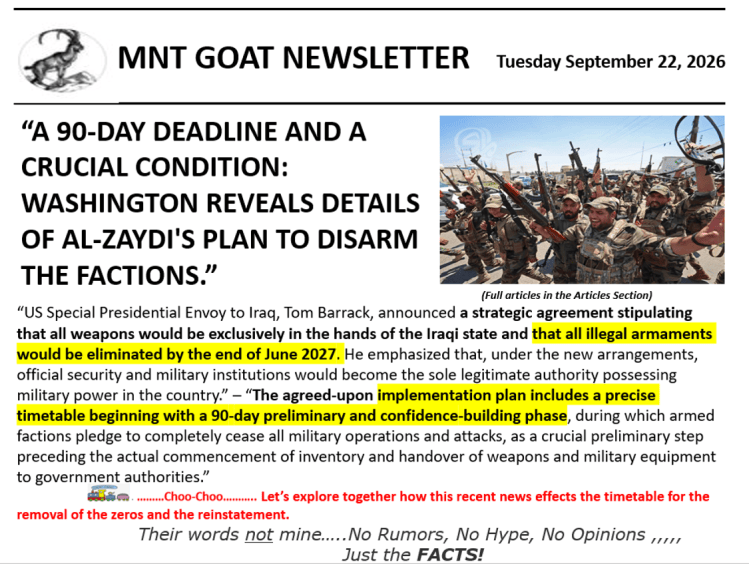
It is worth noting that the state’s monopoly on weapons does not have the consensus of the Iraqi factions, as the Al-Nujaba Movement, Kataib Hezbollah, Kataib Sayyid al-Shuhada and other factions announced their refusal to give up their military capabilities on September 30, the date set by the Iraqi government, which coincides with the end of the international coalition’s military presence in Iraq, as these factions link the future of their weapons to the withdrawal of foreign forces.

The State Administration Coalition, which includes the most prominent Shiite, Sunni and Kurdish political forces in Iraq, had warned that any armed activity outside the framework of the state after September 30 would be dealt with according to the anti-terrorism law.

************************************************************************************

WASHINGTON’S MESSAGES REACH BAGHDAD… AMERICAN RESERVATIONS HAUNT THE DRAFT LAW ON THE POPULAR MOBILIZATION FORCES.

 
Revealed by the newspaper “An-Nahar” Lebanese the American side reported Baghdad over the past few days, there have been clear reservations about re-entering bill Popular Mobilization Forces in its previous form, while it requested Washington explicit guarantees that all Popular Mobilization Forces formations will be subject to the authority of the Commander-in-Chief of the Armed Forces, and that no parallel structures or authorities will be allowed to exist alongside the security institutions.

And the law entered Popular Mobilization Forces a new political round in Iraq more than a year after its passage was thwarted in House of Representatives this comes at a time when the attempt to regulate the situation of the Popular Mobilization Forces intersects with a broader governmental approach to restricting weapons to the state and readjusting the relationship between armed formations and official security institutions.

 
The House of Representatives had completed the first and second readings of the bill during 2025, before the process stalled at the voting stage due to political disagreements, American objections, and reservations from Sunni and Kurdish forces. The American objection at the time focused on articles that it considered…Washington this could grant armed factions greater space within the formal system, and affect the nature of the security partnership with Baghdad

The issue was revived in 2026 after the Speaker of Parliament addressed the government regarding the submission of the draft law, while confirming prime minister Ali Al-Zaidi his government is proceeding with submitting the Popular Mobilization Forces (PMF) law to parliament, based on the premise that the PMF is part of the armed forces.

This coincides with the drafting of a law restricting weapons to the state, placing the government in a complex dilemma. Legally reorganizing the PMF must proceed in parallel with reducing any space for weapons and security decisions outside the official command, especially since the PMF already enjoys legal cover since the enactment of the PMF Law. Popular Mobilization Forces Law No. 40 of 2016 links the Popular Mobilization Forces (PMF) to the Commander-in-Chief of the Armed Forces, according to the newspaper.

The newspaper adds that for this reason, the dispute is not so much about the legitimacy of the PMF’s existence as it is about its internal structure, its chain of command, its funding and command mechanisms, and the boundaries of the relationship between the official institution and the factions that maintain their own political, ideological, and organizational identities.

Washington is setting its conditions.
In this context, an Iraqi government source revealed to the newspaper that the American side had informed Baghdad in recent days of clear reservations about reintroducing the draft law in its previous form, considering that any legislation granting the factions additional influence could directly conflict with the process of disarming the militias.

According to the source, Washington requested explicit guarantees that all PMF formations would be subject to the authority of the Commander-in-Chief of the Armed Forces and that no parallel structures or powers would be allowed to exist alongside the security institutions. American concerns also focus on the articles that might grant some leaders greater independence in decision-making, funding, or command structure, thus reinforcing the separation between the official form of the PMF and the actual reality of some factions within it.

Washington is also sensitive to the timing of the reintroduction of the law, given Baghdad’s ongoing efforts to restrict weapons and end all armed activity outside official institutions. According to the same source, the American message warned that passing a version of the law that contradicts security sector reform could have repercussions on security, military, economic, and financial cooperation between the two countries.

Meanwhile, [the text abruptly ends here ].Iraqi government the review of several articles of the draft law aims to preserve the legal framework of the Popular Mobilization Forces (PMF) and the rights of its members, without granting factions additional space outside the official command structure. The source believes that the coming days will determine whether Baghdad can reach a formula that combines establishing the PMF as an official institution with fulfilling its obligations regarding weapons.

The institution is one thing, and the factions are another.
The newspaper indicated that the main obstacle lies in the fact that legalizing the PMF has not practically led to the complete unification of its constituent formations. Since 2016, most factions have retained their names, structures, bases, and political and ideological affiliations, in addition to their presence in different areas of influence.

This reality, according to the newspaper, has left the transition from a multi-factional structure to a unified military institution incomplete, and has transformed issues of leadership, funding, and the chain of command into the core of the debate surrounding any new legislation.

The expert in strategic affairs, Major General Ahmed Al-Dulaimi the essence of the American observations lies precisely in this point: the necessity of subjecting all formations to the decision of the Commander-in-Chief of the Armed Forces and to a single military chain of command.

The problem, according to…Al-Dulaimi this becomes apparent when certain factions retain the ability to make unilateral decisions or exert their own influence, placing the state in confrontation with armed power centers that do not always operate within the same official framework.

Hence, the value of the law becomes tied to its ability to regulate powers, leadership, funding, and command mechanisms, and to prevent duplication of decision-making, while clearly distinguishing between the Popular Mobilization Forces (PMF) as an official institution and the factions that may adopt independent positions or decisions.

If legislation fails to address this gap, it may transform from a tool for regulating the institution into a legal cover that legitimizes the existing reality rather than changing it.

Weapons determine the fate of the law, and this equation becomes increasingly weighty as we approach 30 September the date related to the weapons inventory and the completion of the mission international coalition. This makes the Popular Mobilization Forces (PMF) law part of a broader debate about the shape of Iraq’s security state and the future of its relationship with Washington.

The newspaper explained that the law’s success will depend not so much on its passage through parliament, but rather on its ability to effectively unify security decision-making within the institution and prevent the continued existence of independent power centers operating under an official umbrella.

Ultimately, the issue remains tied to the broader question facing Baghdad today: Will the new legislation lead to a more tightly integrated PMF into state institutions, or will it solidify the existing fragmentation within the organization under a more robust legal framework?

*************************************************************************************

IRAQ “CANNOT AFFORD TO TAKE RISKS”… STATE ADMINISTRATION WARNS OF THE REPERCUSSIONS OF US SANCTIONS

On Saturday, the State Administration Coalition discussed completing the government formation, the draft oil and gas law, and the country’s financial situation, while stressing the need to spare Iraq the repercussions of the US sanctions imposed on some countries, in light of what it described as the “difficult financial circumstances.”

The State Administration Coalition is the ruling political umbrella that was formed on September 25, 2022 to end the political deadlock that followed the 2021 elections. At its founding, it included key forces from the Shiite, Sunni, and Kurdish components, including the Coordination Framework, the Kurdistan Democratic Party, the Patriotic Union of Kurdistan, the Sovereignty and Determination Alliance, and the Babylon Movement. 

The coalition paved the way for the formation of Mohammed Shia al-Sudani’s government in October 2022, before continuing later as a coordinating framework for the forces participating in running the state and discussing major political, economic, security and legislative issues. 

In a statement issued after its thirty-eighth regular meeting at the Government Palace, the coalition said that the meeting discussed economic, political and legislative issues, in addition to developments in the internal situation and regional and international conditions.

Regarding the completion of the government formation, the attendees agreed to begin dialogue with the blocs entitled to it during the coming week, while emphasizing the continuation of coordination between the components of the coalition and supporting state institutions in facing the current challenges.

The meeting also discussed a draft of the oil and gas law in preparation for sending it to the House of Representatives, in addition to emphasizing the importance of supporting the private sector as a partner in the development process.

On the economic front, the meeting addressed the financial and investment situation, new city projects, and the project to distribute one million residential plots. The Prime Minister announced his directive to halt the demolition of encroachments until the residential land is distributed to those entitled.

The Prime Minister also announced the imminent release of a new financial payment to settle outstanding dues to farmers and contractors.

The coalition discussed the government’s measures related to combating corruption, institutional reform, and the draft law for the Federal Internal Oversight Authority, along with a number of laws that the government needs to implement its program.

The participants renewed their support for the anti-corruption campaign and the prosecution of those involved in it in accordance with the law, while stressing the importance of unifying the national position and preserving Iraq’s stability, sovereignty and higher interests.

The coalition stressed the need to spare Iraq the repercussions of the US sanctions imposed on some countries, noting that the country is going through a financial situation that “cannot tolerate taking risks.” The participants also renewed their adoption of the state’s approach to rejecting sectarian rhetoric and promoting national unity and social peace in accordance with the principles of the constitution.

*************************************************************************************

WITH THE PARTICIPATION OF LOCAL AND FOREIGN INVESTORS, ERBIL WILL HOST AN INTERNATIONAL ECONOMIC FORUM THIS MONTH.

 
The Erbil Chamber of Commerce and Industry announced on Tuesday its readiness to host an international economic forum with the participation of traders and investors from Iraq, Turkey, and Azerbaijan. The Chamber indicated that the forum aims to strengthen trade and economic relations among the three countries.

Ibrahim Agha Gerdi, a member of the Erbil Chamber of Commerce and Industry, told the Iraqi News Agency (INA): “An agreement was reached to hold an international economic conference in Erbil on September 20th, following our visit to Azerbaijan with the head of the Baghdad Chamber of Commerce, and in coordination with the Iraqi Chambers of Commerce.”

He added that “the conference is expected to see broad participation from economic and commercial entities, with the goal of exploring prospects for economic cooperation and strengthening trade and investment relations.”

He explained that “the forum will include more than 130 participants from the central and southern provinces of Iraq and the Kurdistan Region, in addition to approximately 150 traders and business owners from Turkey and Azerbaijan,” noting that “its objective is to develop economic and trade relations among the three countries.”

*******************************************************************************************

A TOUR OF THE PHILATELIC AND NUMISMATIC SOCIETY

Faisal I Dinar for 150 million… Auction of old coins has been ongoing in Baghdad since 1952

 Every Saturday morning, seasoned collectors gather at the Iraqi Philatelic and Numismatic Society building to attend an auction where enthusiasts display coins that have not lost their value despite 70 years having passed since their cancellation. Deals are made for rare specimens. Jawad Kazem, the society’s secretary, says that collectors prefer the money of the royal era, whether paper or metal. The price of the 100 dinar note that contains the image of Faisal I reached 150 million Iraqi dinars. One of them reveals in an interview with 964 Network that interest has reached the small denominations, until a 100 fils note issued in 1955 was sold for one million dinars.

Demand for the king’s money

“The idea behind the auction is to serve stamp and coin collectors, where different stamps and coins are displayed and exchanged,” said Jawad Kazem, secretary of the Iraqi Philatelic and Numismatic Society, in an interview with 964 Network . He explained that the auction opens every Saturday morning at the Society’s headquarters in the auction hall.

Regarding the history of the auction, Jawad says, “The auction appeared in 1952, one year after the establishment of the association, and enthusiasts quickly showed interest in conducting exchange and purchase transactions. Since then, the auction has been active, frequented by enthusiasts coming from Baghdad and the provinces.”

Jawad describes the auction as “a cultural and social meeting place for enthusiasts and collectors of stamps and coins, and it has also become a center for buying and selling the rarest coins.”

Regarding the rarest coins on display, Jawad explains that “the royal paper currency is the rarest, followed by the metal currency. The association has displayed rare items for coin collectors and they have been sold.”

100 dinars is equivalent to 150 million.

Ahmed Kamel, a member of the association’s administrative board, speaks of a huge difference in the prices of the royal currency compared to the republic, due to the short lifespan of the royal era, which arouses the curiosity of enthusiasts and drives them to acquire and learn about it.

Kamel says about prices that the price of “the 100 Royal Dinar note, which includes a picture of Faisal I, starts from 150 million dinars and above, and the prices of some currencies increase if they were issued on important dates, such as the currency of Faisal II that was issued in 1949, or such as the quarter dinar note that was also issued by the Central Bank of Iraq during the reign of Faisal II.”

Regarding methods of detecting forgery, Kamel says, “There are several points that can be relied upon to uncover the tricks of forgers, such as checking the watermark and the type of paper, and I believe it is difficult to forge.”

100 fils equals one million dinars

Abu Ramzi speaks at length about the prices of small denominations, especially coins, and says, “A coin of the 100 fils denomination was sold for 200,000 dinars, while the same denomination, but issued in 1955, was sold for about one million Iraqi dinars.”

****************************************************************************************

FORD OFFICIALLY ENTERS THE IRAQI MARKET ON OCTOBER 1ST.

 Ford is officially returning to the Iraqi market starting from October 1st, after appointing North Island Automotive Trading and Commercial Agencies Company (SAT) as its exclusive distributor in the country.

The appointment was based on a strategic alliance between March Holding Group and Al-Alayan Group, and North Island Company will be responsible for distributing cars, providing original spare parts, and offering after-sales services throughout the country.

Ford indicated in a statement received by Kalima News that “North Island Company (SAT) will, under this appointment, be responsible for distributing Ford vehicles, providing original spare parts, and offering after-sales services throughout Iraq.”

The company added that “this embodies the depth of our long-term strategic commitment to the Republic of Iraq, and our keenness to facilitate our customers’ access to modern Ford models, original spare parts and advanced maintenance services,” explaining that “we are working to strengthen our sales and service network, consolidating the strong bridges of trust that customers in Iraq have built with the brand over the past decades.”

Ford Middle East and North Africa President Ravi Ravichandran said: “Iraq is a key focus of Ford’s growth plans in the region, and we always strive to provide the best services to our customers there in the long term. North Island Company (SAT) shares the same vision that puts the customer first, based on quality standards and sustainable growth, and the company’s experience and deep understanding of the local market will contribute to enhancing the Ford customer experience from the purchase decision to after-sales services.”

For his part, North Island CEO Mohammed Aliyan affirmed that “Ford has a long and distinguished history in the Iraqi market, as it has represented a symbol of reliability and quality for several generations,” adding that “our role today is not limited to distributing cars only, but also includes preserving this legacy and enhancing the trust that the brand has built over the decades.”

Aliyan continued, “We established North Island Company (SAT) on a sophisticated infrastructure, qualified human resources, and a full commitment to delivering the integrated Ford experience that customers in Iraq look forward to and deserve.”

*****************************************************************************************

THE FALL OF NOURI AL-MALIKI

US sources: Maliki is days away from the sanctions list if he does not step down from the leadership of the Coordination Framework, and stop playing the role of the godfather of the deep Iraqi state.

The message reached through the new U.S. envoy: These are the last days of the head of the deep state. What is required is not a site modification. What is needed is a final exit from the political process. Washington no longer treats him as a balance player. It treats it as a penalties file suspended on time. Whoever remains in the frame under his shadow will pay the bill with him.

********************************************************************************************

*******************************************************************************************

Their words not mine…..No Rumors, No Hype, No Opinions ,,,,,

                                             Just the FACTS!

Disclaimer: All information in this newsletter is not intended for investment decisions / purposes. Mnt Goat is not a financial analyst, planner, banker, attorney or associated in any role with giving out professional investment advice.

Auf Wiedersehen

Much love to ya all,

Mnt Goat

September 3, 2026 Edition Latest Mnt Goat Newsletter

a

Disclaimer: All information in this newsletter is not intended for investment decisions / purposes. Mnt Goat is not a financial analyst, planner, banker, attorney or associated in any role with giving out professional investment advice.

ABOUT THE NEWSLETTER:

September 3, 2026 Mnt Goat News Brief

Guten Tag everyone:

WOW! More news today about removing the zeros. This new article gives yet more detail and confirmation of how this swap out may be working and the timing of it. You think they are planning to do it soon? Are you catching up to this SHIFT that is happening. It all has to SHIFT to get this RESET we need. Think about it – we see the property taxes on our homes finally being challenged, hear about the price of gas coming down significantly very soon and possible social security changes that may raise your monthly SS pension payment. Things are moving fast now, hang on!

Yet, more talk of removing the zeros!

GIVE A GIFT TO MNT GOAT

I decided to allow everyone to give a Free-will GIFT to Mnt Goat on PayPal if you so desire. Here is the link below. Please show your appreciation for all the hard work I do.

I recommend $15-$20 dollars a month or whatever you can afford. Do you realize I write up to eight (8) Newsletters every month. This is like a second job to me. The only way I know that people are reading and appreciating all the FACTUAL news I bring is through their appreciation. If I do not receive equal appreciation for all the hard work I do, I will simply end the Newsletter and save myself endless hours at the computer. You do want to get paid for your job, don’t you? What makes my job any different? Tell me….. I am tired of this RV saga just as you are.

 Let’s all try to chip in!

___________________________________________

1 Peter 4:8

“And above all things have fervent charity among yourselves: for charity shall cover the multitude of sins.”  

STATUS OF THE RV

As many of my long term follows of the Newsletter know, I often hike up the mountains on my favorite trail. I sit on my favorite rock, listen to the stream flowing down the mountain and try to put together thoughts of the evidence we are getting for the RV. In fact, I am on my laptop on site right now writing this Newsletter.

One thing I have realized over the years is this is not just a simple RV of the Iraqi dinar but much bigger. It was when I began to tie into the modern prophets, ones like Kim Clement, Julie Green and Hank Kennerman that I began to see the light. The vision of what is happening became clearer. This is not just a political or IMF currency reset situation.

Then the political side with Trump was discovered and the efforts of all the faithful and truly tested patriots and their pieces of information began to take shape and come together. Yes, I could be wrong, but I don’t think so. In our guts we all have a God given feeing when something is pushing you forward. My conclusion soon came that there is also a spiritual side, some element working with the physical world now to make this all happen. Is this the ‘reset’ many talk about?  

Over this long waiting period for the RV, God sees those that lost their homes and cars or could not afford to send their kids to college. He sees those suffering without proper medical care. He sees charity stopping in the churches as personal funds dry up. Even our gasthaus, a once prosperous business, was hit with this foolishness, snares and lies of the devil. God knows all of this suffering could have been avoided with financial help. This was not supposed to happen!

I know now that help is coming and coming much sooner than most believe it could. There is going to be a ‘SHIFT’ that will suddenly occur. It is like when you build something. All the real work goes into the planning, the construction of pieces. When all the pieces finally come together it serves it purpose and you can reap the benefits. With Trump we can clearly see a plan that is taking shape. He is laying the groundwork for an enormous period of prosperity. Most of this wealth and abundance is going to shift from all this groundwork to obvious reality very soon. Many Trump haters will say later that they were fooled by these liberal and so why couldn’t they see? Then trust will come.

The final touches to the plan is gaining the needed momentum but solid control of both houses of the government in needed. This is when I believe the SHIFT is going to happen. WOW! I can almost see it….

In my opening dialogue, if you listened to it carefully, you heard more about this SHIFT from the prophet Hank Kenneman and Kim Clement. Like Kim, I consider Hank one prophet at the same level. Yes, two different personalities but God speaks loudly to both. Kim set the groundwork for what we have seen in this last decade with Trump. Now Hank and Julie keep pace with the revelations going forward. We are told we no longer have to wait years for a revelation to come. These prophetic words are catching up the reality faster and faster. Hank says they seemed to lag behind but now are catching up. They are almost now one and the same. Amazing stuff!

Remember all of Kim’s prophecies about the Iraqi dinar? God does not lie. The evil, dark side will try to postpone and delay but God’s word always prevails. We all need to keep this in mind. If you have been following these wonderful prophecies by Julie, Hank or many your other favorite prophet all along you know exactly what I mean.

Last year in 2025, at about this same time, we heard news of the removal of the zeros too. Do you remember how good this news was back them. So now a year later in 2026 we hear about this project to remove the zeros again but in much more detail. We learned the true reasons why they must do and do it soon. But remember this project to remove the zeros, in itself, is NOT our long-awaited RV. It is just part of the process.

Now that the financial reforms (Pillars of Financial Reform), as in the White Paper, are all but completed, it is time to move on to getting this next step of the process completed- the currency reform.

It is only through the success of these first reforms that they can now move to FOREX by reinstating the IQD, the trading symbol of the Iraqi dinar. This too is a multi-step process.

AGAIN —> What is ‘THE PROBLEM’?

So, in today’s news, beyond my amazement even, they emphasize ONCE again why they need to move ahead to remove the zeros in the currency. Please take a peek at the article titled “TBI DIRECTOR: CASH HELD IN HOMES DISRUPTS THE LIQUIDITY CYCLE AND HALTS SALARY PAYMENTS”

I quote from the article – “The director of the Trade Bank of Iraq (TBI), Ali Abdul-Ridha Alwan, announced on Wednesday (September 2, 2026) that 85% of the Iraqi cash supply is outside the banking system and in people’s homes, indicating that this breaks the cycle of financial liquidity and affects the provision of salaries.”

Are they trying to get public sentiment to push this effort over the edge and get it down of removing the zero sooner than later. Do they need this now in high gear rather than waiting for early 2027?

Has parliament made their decision already when to begin?

WOW! Haven’t we read so many articles in the past and now again this week, about the trouble they are having paying the salaries and pensions? This time this crisis was mainly sparked off by the oil shipping issue through the Strait of Hormuz by Iran. By this issue is not new. Every time there is a hiccup from some event dealing with oil, the salaries are affected. Folks its not just a crisis of a ‘rentier economy’ although this does heighten the crisis. Do these fancy Iraqi economists get is right? These continued crises, tie into so many aspects of still working under a sanctioned-like economy. Do these Iraq politicians even realize this? I think the Trump administration does realize it and we heard the US now wants to remove the zeros and move on with the process.

First problem: the dinar is still solely pegged to the dollar. Can you imagine if Iraq could sell its oil for only Iraqi dinars? The value would skyrocket overnight!!!

Then secondly, this sole peg causes the black market (parallel market) to exist and compete with the official CBI rate.

Third affect, this parallel market lessening the value of the dinar.  

Forth, if the value can be lessened so easily, how do you justify saying the currency is stable?

Everybody wants the almighty US dollar. But the dollar is NOT the currency of Iraq and so can you see the dilemma? More than four years ago we learned of the project to ‘de-dollarize’ the economy. Remember all the articles? Go back to my archives and re-read all of my Newsletters about it at that time. You see this was just another sign to us they were getting serious about these reforms. Then go read the ‘White Paper’ and you quickly saw the path they were taking to get to FOREX. Yes, it’s all about FOREX.

But unless they remove the zeros and get back on FOREX, this current situation will go on and on and on, around and around and around …. Yes, they must remove the zeros and get off the sole peg of the US dollar. But the damned fools have allowed this sole peg to go on too long and now how do you get off it? UN Chapter VII sanctions have been over 4.5 years already. What the hell are they waiting for?  

Opps, here is yet another recent article for today’s news about this salary crisis. It’s titled “CONTRACTORS IN THE LIBERATED AREAS ARE DEMANDING PAYMENT OF THEIR DUES AND WARNING OF PROJECT STOPPAGES.”

 I quote from the article – “The Iraqi Contractors Union called on the Prime Minister, Parliament, and Minister of Finance on Tuesday to intervene urgently to disburse the outstanding financial dues owed to companies and contractors contracted with the Reconstruction Fund for Liberated Areas, noting that the delay of some of these dues for more than two years has caused financial damage to contractors and threatened their ability to continue implementing projects.”

This article tells us this crisis is not just a current crisis but has been mounting for years and is just now at a fever pitch. It is now urgent to get these salaries paid. But how are they going to get all this money back into the banks to help pay these salaries especially now during this time of lessened oil revenues? They have the answer right in front of their noses, its to remove the zeros and draw in these notes back to the banks.

So, is it urgent? Are delays in paying salaries causing more issues? Do you believe me now when I say things are about to SHIFT?

Then just recently yet another article pops about removing the zeros. It is titled “SOURCES TOLD AL-MUSTAQILLA THAT THE PLAN TO REMOVE ZEROS FROM THE IRAQI CURRENCY IS ENTERING ADVANCED STAGES, WITH A PLAN TO REPLACE THE CURRENCY IN EARLY 2027.”

I quote from the article – “Informed sources revealed to Al-Mustaqilla that the file of removing zeros from the Iraqi dinar and reissuing the currency has entered advanced stages of study and discussion within government departments, noting that a plan currently circulating aims to begin the process of replacing the old currency with a new currency starting from 2027, in the event that the required governmental, legislative and technical approvals are completed.

So, we all know how slowwwww Iraq can be with new legislation. Can they find a way to speed this process up? Can they begin this season of all and maybe get back to FOREX on early January instead of just beginning the process then?

The sources said that the currency restructuring file is no longer limited to economic and technical discussions within the Central Bank of Iraq, but has become subject to study at the level of the Prime Minister’s office, within a plan related to the mechanism for moving from the current currency to a new monetary issuance after removing the zeros.”

_________________________________________________

In the second paragraph from the article I want to chop it apart into three separate parts and analyze the parts. It will become apparent to you that certainly this sounds like they are now serious about removing the zeros and doing it as soon as possible?

I quote from the article –

Part 1: “According to information obtained by Al-Mustaqila, the discussions are currently focused on developing a clear implementation plan for the replacement process,”

Part2: “the transitional period during which the two currencies will be traded, the mechanisms for banks and government institutions to deal with the new currency,”

Part3: “as well as the procedures related to bringing the largest possible amount of cash outside the banking sector into the formal financial system.”

This paragraph tells me they have not yet given us the final details because they are still working them out. Let’s wait and watch for what comes next.

_______________________________________________________

Next, they tell us a possible start date which we all, of course, want to know as investors. Again they are telling us they will need legislation on this process. They have told us this so many times already. I know from my CBI contact that the draft law is already written and passed on to parliament.

I quote from the article – “The sources confirmed that 2027 is among the current proposals as a possible start date for the process of replacing the old currency with the new one, but stressed that the date will not become officially effective before the completion of the governmental and legislative process and obtaining the required approvals”.

Does Iraq need the completion of Al-Zaidi’s cabinet prior to getting the final decision?

_____________________________________________________

Remember also that in this new article it reminds us once again that this “new information coincides with previous statements by Iraqi Communications Minister Mustafa Sanad, who said during August that a decision regarding the removal of zeros and the change of currency had been decided at the political level, and linked the move to bringing out hoarded funds and returning them to the economic cycle and the banking system.”

This says past tense, which means its decided at one level. Now they need the formal legislation to go along with it.

_____________________________________________________

So, next I want to bring out other news in this recent article. Why would an article authored by Al-Baiji in the Financial Committee, part of the cabinet, tell us that the newer lower denominations were in fact already printed and even give us a cost of $250 million. I don’t get it? See my 082726 Newsletter. Here is what he told us then. Is the CBI trying to step back and hide something from the public? Did these other authors spill the milk and now they are desperate to get it back in the bottle now, thus this recent article from today is damage control?

I quote from the 082726 article – “According to what Al-Baiji said in a television interview, the government and the Central Bank of Iraq have completed some of the technical preparations related to the new currency, noting that the value of the currency that was prepared and printed amounts to about $250 million, and that its release into the market will be linked to the approval of the legal framework by the House of Representatives.”

Am I missing something?

I quote from this recent article from today – “The Central Bank denies printing… but outlines the course of any future project. On August 26, 2026, the Central Bank of Iraq issued a statement explicitly denying reports that it had printed quantities of new Iraqi currency with zeros removed in preparation for its release into the markets.”

Next within this latest article they give us once again the main reason why the government want to change/swap out the currency?

I quote from the article – “The proposed plans suggest that the project’s objectives are not limited to reducing the number of zeros and facilitating accounting and monetary operations, but could also include reorganizing the large amount of cash that exists outside the banking system. Iraq is one of the economies that relies heavily on cash transactions, and a large percentage of the currency in circulation is outside of banks.”

Yes, these notes outside the banking system are largely the 250, 500, 1000 notes plus the notes we as foreign investors in the dinar physically own in our hands.

“The latest data circulating on monetary indicators indicates that the volume of currency circulating outside the banking sector has reached more than 100 trillion dinars, which reflects the extent of the hoarding phenomenon and reliance on direct cash”.

In this next part from the article we get a sense of the process they will most likely accept and use in removing the zeros. It is not definite yet and so don’t go off half -cocked.

“Currency replacement – ​​if the government adopts clear control mechanisms – would encourage hoarders to deposit their money through banks or exchange centers within a specific time period, giving financial authorities greater ability to know the movement of money and the sources of some large cash blocks”.

Again, I have to correct all these intel gurus on the internet telling their investor listeners that removing the zeros is going to increase purchasing power. It is? You decide!  

I quote from the article – “The main objective of the process is to simplify monetary categories, accounts and transactions, NOT to achieve an automatic increase in the purchasing power of the dinar.”

In this next part from the article again we get a sense of the process they will most likely accept and use. It is not definite yet and so don’t go off half -cocked.

I quote from the article – “If the project is approved, the authorities will likely adopt a transitional phase during which the old and new currencies will circulate simultaneously before the old version is gradually withdrawn.

The coming days for us investors could be decisive. According to sources from “Al-Mustaqilla”, the next stage will be important in determining the final course of the project, while the governmental, legal and technical aspects of the currency replacement plan continue to be studied. The sources confirmed that there is a trend to push the file towards completing the necessary procedures, with the picture to become clearer after the Cabinet’s position and the legislative process are decided.

Just as my CBI contact told me we read now in this article. The plan to start in 2027 is NOT yet final. This means they could go before or even after early 2027. But what we do know for sure is they can’t wait too long as this project is critical and urgent.

I quote from the article – “Accordingly, the information available so far indicates that the project to change the currency and remove zeros is moving within Iraqi institutions, and that 2027 is being considered as a possible start date for the replacement process according to the ideas being discussed. However, this has not yet turned into an official, announced, and binding date from the Central Bank or the Council of Ministers as of the date of this report.”

The Iraqi public is waiting for any official announcement in the coming days that could move one of the most sensitive financial issues in the country from the stage of studies and discussions to the stage of decision and implementation.

_____________________________________

A CONVERGENCE OF EVENTS IS COMING:

If we are paying attention, you are paying attention, aren’t you? We can see the convergence of many events coming in early 2027. Here is yet another events is preparing for this time period. It is titled “THE MINISTER OF FINANCE GIVES INSTRUCTIONS TO FINALIZE THE TECHNICAL PREPARATIONS FOR THE 2027 BUDGET.”

 “Finance Minister Faleh Sari directed on Monday that the technical requirements for completing the preparation of the general budget for 2027 be finalized.

The ministry said in a statement received by (Mawazin News): “The Minister of Finance, Falih Sari, inspected the departments of the Budget Department and reviewed the progress of work in preparing the draft program and performance budget.”

Oh….didn’t they just also tell us that maybe early 2027 they may begin the removing of the zeros? Don’t we also have the accession to the WTO waiting in the wings? WOW.. and did I mention the Development Road Project too. Please take a peek at the article titled “IRAQ, TURKEY, AND SYRIA ARE LAYING OUT THE IMPLEMENTATION PLAN FOR THE FISHKHABUR-OVAKOY BORDER CROSSING AND DEVELOPMENT ROAD.”

“An official Iraqi delegation, headed by the Chairman of the Border Ports Authority, Lieutenant General Omar Al-Waeli, discussed in the Turkish capital, Ankara, the files of transport, border connectivity, trade and transit, foremost among them the executive procedures to activate the “Fishkhabur-Ovakoy” crossing and link it to the vital development road project.”

I don’t want to now seem careless, as I am just as excited as you are. However, remember this is not in our hands, and we must just sit and wait for it. God has also told us many times the SHIFT is coming through his prophets. Then look at what is now happening in Venezuela. Can you help but this maybe the Bolivar might also be a target to get revalued in the near future now that stabilization has come to their country with the help of the U.S. under the Trump administration. Please take a peek at the article titled “US ENERGY SECRETARY ARRIVES IN VENEZUELA TO FINALIZE OIL DEAL GIVING WASHINGTON GREATER CONTROL.”

“Chris Wright says new investment agreements could more than double Venezuela’s oil production as Washington seeks to expand its influence over the country’s vast reserves

US Energy Secretary Chris Wright arrived in Venezuela on Tuesday to finalize a major oil agreement that would give Washington effective control over a significant share of the country’s petroleum production, following approval by Venezuela’s government-dominated National Assembly.

US President Donald Trump announced the agreement last week, saying it would give the United States majority control of operations involving 17 oil fields containing about 65 billion barrels of proven reserves.”

I am certainly NOT telling anyone to go buy the Ven Bolivar. If you are connecting the pieces you certainly can entertain lots of what the prophets are telling us including also the Vietnam Dong too. Our concentration is mainly the Iraqi dinar as we know this is not just speculative but FACTUAL.

______________________________________________________

I want to remind everyone that when all these other intel gurus were telling you all their  negative remarks about the Iranian backed militias in Iraq and then about the elections, so on the so forth. What did I tell you?

I said PRAY and PRAY like never before. Then what happened? Suddenly all these articles pop out about removing the zeros. WOW! WOW! Coincidental? Then Al-Zaidi miraculously gets nominated as the prime minister to form the government. Yes, where did that come from I asked myself…. coincidental?

Remember too that I also told you I learned of a massive economic plan for Iraq by the U.S. under the Trump administration. So, in today’s news we learn more of this plan and willingness to move it ahead. Please take a peek at these two articles:

AL-ZAIDI SEEKS TO STRENGTHEN ECONOMIC PARTNERSHIP WITH WASHINGTON”

  Prime Minister Ali Faleh al-Zaidi affirmed that Iraq possesses a promising investment environment, supported by government measures to provide investment facilities for American companies.

AL-ZAIDI TELLS VICTORIA TAYLOR: IRAQ IS OPEN TO ALL INITIATIVES WITH AMERICA”

 “Prime Minister Ali al-Zaidi affirmed on Wednesday (September 2, 2026) that Iraq is open to all initiatives that contribute to strengthening bilateral relations with the United States, pointing to the promising future of mutual Iraqi-American partnerships, especially those related to the development, energy and economic sectors, during his reception of a delegation from the Atlantic Council Institute headed by the director of the Iraq Initiative, Victoria Taylor.” Now having read these two articles the participation of the US in Iraq is not a one-way street. These US companies will have to make money too as well as enrich the Iraqi economy by creating jobs and salaries. Iraq will have to bow somewhat to conform Iraq into a state that is SECURE and STABLE. Gee whiz … when have we heard this before? Also we recently read that the US now supports moving ahead with the removing of the zeros. Will Iraq delay this too long for the US?

_______________________________________________

UPDATE: On disarming the militias

Speaking about being a SECURE Iraq what about the militias and factions?

Oh boy…. in these recent articles we get an update. This September 30th date is coming quick. I can’t believe for one second the US coalition would pull out with first seeing this through.

They are titled “WASHINGTON PREPARES FOR A SCENARIO IN WHICH FACTIONS REFUSE TO DISARM… STEPHEN FAGIN RETURNS TO BAGHDAD ON DIPLOMATIC MISSIONS.”

“The Israeli newspaper The Jerusalem Post published a report on Wednesday (September 2, 2026) stating that Washington is “aware” of the factions’ refusal to hand over their weapons in reality, despite a large part of them announcing their agreement.

The newspaper, as translated by “Baghdad Today,” said that Washington, “despite its great optimism about the disarmament process, knows that most of the factions are not serious about achieving this and are trying to buy time and postpone the matter as much as possible,” as it described it.”

I guess Washington is VERY serious in  how they are going to mold Iraq.

____________________________________________________

SUMMARY

Okay so enough is enough lying from the CBI. I swear they are trying to cover something up here. Do they intend to start the removing sooner than early 2027?

I also want to say I know it’s getting a bit boring hearing the same news over and over again as to why they need to remove the zeros and do it VERY soon. So read this news today carefully. I will not repeat it again and you can always go back the archives and research it to refresh as it is in all my Newsletters from the past weeks as given from Iraqi news channels.

It seems like we are in a holding pattern until the legislation can be decided upon by parliament. To be honest with you I am having doubts about some of this news as they are not being straight forward with their readers, either that or they are delaying the news intentionally to keep off speculators.

I keep referring you to the ‘White Paper’ because it is amazing in how we can look after-the-fact and actually see the progress. Do you remember four years ago when almost all Iraq talked about were the ‘Pillars of Financial Reform’. Yes, the path to get to FOREX. So, now we hardly hear about these reforms. Why? It is because they are mainly all completed. Now they are moving on to the next stage. Next stage?

I luv these words ‘next stage’ since they always tell us they are moving to the next step in some process. Can you see they are methodically moving ahead, one step at a time. Can you see what step they recently moved to – the currency reform. This too is categorized into a multi-step process. First remove the zeros, then repeg and move to FOREX. Yes, get off this damned US dollar peg which is killing Iraq.

I don’t want to now seem careless, as I am just as excited as you are. However, remember this is not in our hands, and we must just sit and wait for it. God has also told us many times the SHIFT is coming through his prophets. Then look at what is now happening in Venezuela. Can you help but this maybe the Bolivar might also be a target to get revalued in the near future now that stabilization has come to their country with the help of the U.S. under the Trump administration. Please take a peek at the article titled “US ENERGY SECRETARY ARRIVES IN VENEZUELA TO FINALIZE OIL DEAL GIVING WASHINGTON GREATER CONTROL.”

“Chris Wright says new investment agreements could more than double Venezuela’s oil production as Washington seeks to expand its influence over the country’s vast reserves

US Energy Secretary Chris Wright arrived in Venezuela on Tuesday to finalize a major oil agreement that would give Washington effective control over a significant share of the country’s petroleum production, following approval by Venezuela’s government-dominated National Assembly.

US President Donald Trump announced the agreement last week, saying it would give the United States majority control of operations involving 17 oil fields containing about 65 billion barrels of proven reserves.”

I am certainly NOT telling anyone to go buy the Ven bolivar. But if you are connecting the pieces you certainly can entertain lots of what the prophets are telling us.

__________________________________________________

What do you think will happen next? (Leave a comment)

______________________________

________________________________________

Their words not mine…..No Rumors, No Hype, No Opinions ,,,,,

                                             Just the FACTS!


These prophecies are an important tool we have to lead us on our path. They are more important now than ever. They give us the strength, perseverance and hope that a better time is coming and that God’s Hand is at work behind the scenes. If you just take a second even to look around you at these past three election cycles, how can you deny that God is at work? Are you sleeping or what?

It is amazing and there is no other way that these events could have happened the way they turned out. But there is more to come, much, much more, I assure you! Now that God has his biblical David re-elected, we need to pay attention to what He does next.

NOTE: These prophecies just keep getting better and better, giving us HOPE of a brighter future. They seem to converge now closer and closer to seeing them come to fulfillment. WOW!

Prophetic Words from the prophets:  Julie Green

“More Attacks Are Coming Against The United States “

Go to the 11:32 mark on the video. Given on Aug 29th.   

“You Will See Things You May Not Understand“

Go to the 14:33 mark on the video. Given on Aug 14th  

Things are not as they appear to be. You may ask yourself what is going on.

Things that have been hidden will soon be exposed. More understanding will happen once you see what is really going on.

Fr. DON BOSCO EXPOSED THE DARK SECRET BEHIND ISLAM

I keep this one out here to view. Everyone should take the time to watch it. It will awaken you about the Muslim so-called religion (or should we call it for it is — a ‘cult‘.)

— And the truth the world forgot about the so-called Muslim religion.

Fr.Don Bosco, also known as John Bosco, was an Italian Catholic priest and educator, born on August 16, 1815. He founded the Salesian Society in 1859 to help disadvantaged youth,  particularly boys, through education and community service. His teachings emphasized lovekindness, and the importance of education for young people, making him a beloved figure in Catholicism and a patron saint of youth. Don Bosco was canonized in 1934.  

U.S. AND VENEZUELA SIGN NEW OIL DEAL

IRAN OIL PROVINCE: CAN INSIDE REBELS TAKE THE ISLAMIC REGIME DOWN?

America declared Economic War on Iran with Operation Economic Outcast, sanctioning 60 targets in one day. But the real war is inside Iran. In this episode of Decoded, Nikita Kapoor breaks down Khuzestan, the province that produces 80% of Iran’s oil, houses Bushehr nuclear reactor and Abadan refinery, but lives with 50% unemployment and is the world’s most polluted city on earth.

Ahwazi Arabs, armed groups like Arab Struggle Movement for the Liberation of Ahwaz, Ahwaz Falcons and Ahwaz Freedom Brigades have declared open rebellion against the IRGC. Can they blow pipelines, block ports and shut refineries to collapse the regime?

WHAT NOW FOR IRAN?

The U.S. imposes strict broad secondary economic sanctions against Iran on August 24th.  What will Iran do now? Total Meltdown! Iran President Loses ALL Powers As Hardliners Take Over? Civil War Now?

Iran hard liners threaten to choke anyone who partners with the U.S. in this new embargo. Iran’s president says to end the war now that contradicts the hardliners. Who is really in charge?

PPF: (Peoples Fighter Front) A NEW INSIDE REBEL ARMY UNLEASHES CHAOS ON THE ISLAMIC HARDLINERS

I really luv Nikita Kapoor’s updates of what is really happening in Iran. We are not going to get this TRUTH from any western news channels.

ARMY OF JUSTICE: Has a regime change begun from the inside? All the U.S. has to do is wait out the effects of Operation Economic Outcast secondary sanctions and let the PPF overtake the IRGC forces and round up hardlines and bring the regime to its knees. We simply don’t know how this will al play out, but this regime will fall, just not as easy as the Trump Administration thought.

Iran is planning to evacuate its capital, Tehran, due to a severe water drought, moving its government straight into a war zone. As the regime considers relocating to Makran, a powerful new rebel force, the People’s Fighters Front, is striking from within. In this episode of Decoded, Nikita Kapoor reveals why Iran’s biggest threat isn’t foreign air forces, but an internal army rising inside its own borders.

Timing is everything!

CONGRESS IS PUSHING 5 SOCIAL SECURITY BILLS —

Which One Helps You Most?

THE SILVER SUPPLY SHOCK MOST DON’T SEE COMING

A delayed reaction: Is the silver, a precious metal about to have another bubble?

Restricting the oil supply by limiting oil through the Straight of Hormuz causes other downstream supply shortages, other than oil.

HOW COULD A FAMILY TRUST HELP PROTECT YOUR ESTATE

6 STATES CUTTING PROPERTY TAXES TO ZERO

There are actually 16 states now tackling the home ownership property tax issue. They are finding alternatives to funding their district. Even the supreme court (SCOTUS) is now taking up a case to determine if these taxes are even constitutional.

SOURCES TOLD AL-MUSTAQILLA THAT THE PLAN TO REMOVE ZEROS FROM THE IRAQI CURRENCY IS ENTERING ADVANCED STAGES, WITH A PLAN TO REPLACE THE CURRENCY IN EARLY 2027.

Informed sources revealed to Al-Mustaqilla that the file of removing zeros from the Iraqi dinar and reissuing the currency has entered advanced stages of study and discussion within government departments, noting that a plan currently circulating aims to begin the process of replacing the old currency with a new currency starting from 2027, in the event that the required governmental, legislative and technical approvals are completed.

The sources said that the currency restructuring file is no longer limited to economic and technical discussions within the Central Bank of Iraq, but has become subject to study at the level of the Prime Minister’s office, within a plan related to the mechanism for moving from the current currency to a new monetary issuance after removing the zeros.

According to information obtained by Al-Mustaqila, the discussions are currently focused on developing a clear implementation plan for the replacement process, the transitional period during which the two currencies will be traded, the mechanisms for banks and government institutions to deal with the new currency, as well as the procedures related to bringing the largest possible amount of cash outside the banking sector into the formal financial system.

The sources confirmed that 2027 is among the current proposals as a possible start date for the process of replacing the old currency with the new one, but stressed that the date will not become officially effective before the completion of the governmental and legislative process and obtaining the required approvals.

The sources expected that the file would witness developments at the Cabinet level in the coming period, followed – if the project is approved – by moving to the required legislative path before reaching the implementation stage.

Mustafa Sand’s statements bring the issue back to the forefront.

The new information coincides with previous statements by Iraqi Communications Minister Mustafa Sanad, who said during August that a decision regarding the removal of zeros and the change of currency had been decided at the political level, and linked the move to bringing out hoarded funds and returning them to the economic cycle and the banking system.

Sand said that the currency change process could encourage holders of large amounts of cash to reveal their money when exchanging old banknotes, allowing some of the liquidity outside banks to be brought back into the financial system, as well as dealing with money whose owners cannot prove its sources or bring it legally into the exchange process.

Sand’s statements had sparked widespread controversy, especially after the government said on August 17 that the Cabinet had not made a final decision at that time to remove the zeros, and that implementing such a step required a legislative process that went through the House of Representatives.

The Central Bank denies printing… but outlines the course of any future project

On August 26, 2026, the Central Bank of Iraq issued a statement explicitly denying reports that it had printed quantities of new Iraqi currency with zeros removed in preparation for its release into the markets.

However, the bank’s statement did not close the door to a future currency restructuring project, as it confirmed that any such project, if an official decision is made regarding it, will be subject to multiple legal, regulatory and technical stages, and that it will be officially announced and a transition period will be determined that allows citizens, banks and institutions to exchange the currency in an organized and safe manner.

This means that the official denial issued by the Central Bank so far relates to the existence of a new currency that has been printed and is ready for circulation, and not to the cancellation of the project idea or the exclusion of discussing it in the future.

Al-Mustaqilla has been following the case since its inception.

Al-Mustaqilla had published a series of reports in recent days on the issue of removing zeros and restructuring the currency, in which it quoted sources close to decision-making circles as saying that the matter was under serious study, despite the fact that no final government announcement had been issued yet.

Information obtained by “Al-Mustaqila” today confirms that the file is still in existence and under study within the relevant institutions, and that the discussions have moved to more advanced details regarding how to implement the replacement process and not just the idea in principle.

However, the sources confirmed at the same time that the project’s transition to the actual implementation phase will remain linked to the final decision of the Council of Ministers, the legislative procedures required by the file, and the position of the Central Bank, as it is the entity responsible for managing and issuing currency and monetary policy in Iraq.

Why does the government want to change the currency?

The proposed plans suggest that the project’s objectives are not limited to reducing the number of zeros and facilitating accounting and monetary operations, but could also include reorganizing the large amount of cash that exists outside the banking system.

Iraq is one of the economies that relies heavily on cash transactions, and a large percentage of the currency in circulation is outside of banks.

The latest data circulating on monetary indicators indicates that the volume of currency circulating outside the banking sector has reached more than 100 trillion dinars, which reflects the extent of the hoarding phenomenon and reliance on direct cash.

Currency replacement – ​​if the government adopts clear control mechanisms – would encourage hoarders to deposit their money through banks or exchange centers within a specific time period, giving financial authorities greater ability to know the movement of money and the sources of some large cash blocks.

The process can also support anti-money laundering and anti-financing measures if it is accompanied by the application of clear rules regarding deposits, large sums, and sources of funds.

Replacement, not cancellation, of the value of citizens’ money

From an economic standpoint, removing zeros does not mean that citizens’ money will lose its value or that the dinar will automatically become more expensive.

If it is decided – for example – to remove three zeros, then renaming the monetary unit could make every thousand dinars of the old currency equivalent to one dinar of the new currency, in parallel with repricing salaries, prices, debts, contracts and balances at the same rate.

The main objective of the process is to simplify monetary categories, accounts and transactions, not to achieve an automatic increase in the purchasing power of the dinar.

Expected transitional phase

If the project is approved, the authorities will likely adopt a transitional phase during which the old and new currencies will circulate simultaneously before the old version is gradually withdrawn.

The central bank had already confirmed that any future decision of this kind would include a transition period to ensure that citizens, banks and institutions could exchange currency in an orderly manner while preserving all financial rights and obligations.

The process will require resetting banking systems, ATMs, accounting software, pricing, contracts and government records, as well as a broad awareness campaign to prevent the transition from being exploited for fraud or speculation.

The coming days could be decisive.

According to sources from “Al-Mustaqilla”, the next stage will be important in determining the final course of the project, while the governmental, legal and technical aspects of the currency replacement plan continue to be studied.

The sources confirmed that there is a trend to push the file towards completing the necessary procedures, with the picture to become clearer after the Cabinet’s position and the legislative process are decided.

Accordingly, the information available so far indicates that the project to change the currency and remove zeros is moving within Iraqi institutions, and that 2027 is being considered as a possible start date for the replacement process according to the ideas being discussed. However, this has not yet turned into an official, announced, and binding date from the Central Bank or the Council of Ministers as of the date of this report.

The Iraqi public is waiting for any official announcement in the coming days that could move one of the most sensitive financial issues in the country from the stage of studies and discussions to the stage of decision and implementation.

*********************************************************************************************

CONTRACTORS IN THE LIBERATED AREAS ARE DEMANDING PAYMENT OF THEIR DUES AND WARNING OF PROJECT STOPPAGES.

 The Iraqi Contractors Union called on the Prime Minister, Parliament, and Minister of Finance on Tuesday to intervene urgently to disburse the outstanding financial dues owed to companies and contractors contracted with the Reconstruction Fund for Liberated Areas, noting that the delay of some of these dues for more than two years has caused financial damage to contractors and threatened their ability to continue implementing projects.

This came during a conference held in Anbar province, attended by a correspondent from Shafaq News Agency, with the participation of a number of contractors from the liberated provinces to raise their concerns and demand their rights and outstanding financial dues from the Reconstruction Fund for Liberated Areas.

The head of the Iraqi and Arab Contractors Union, Ali Fakher Sanafi, confirmed in a statement during the conference that the Reconstruction Fund for Liberated Areas has played a role in supporting the stability of the liberated governorates over the past years by implementing projects, rebuilding infrastructure, and supporting the people of these governorates who were subjected to damage and destruction as a result of military operations against groups of evil and terrorism.

He pointed out that contractors who contributed to the reconstruction of their cities and bore the burdens of implementation, financing and financial obligations cannot be left to face this crisis without real solutions.

According to Sanafi, the contractors called on the government, the House of Representatives, and the Ministry of Finance to intervene urgently and disburse the dues of companies and contractors contracted with the Reconstruction Fund for Liberated Areas, just like the rest of the contracting parties, and to do justice to this segment that had a fundamental role in the reconstruction of those areas.

In an exclusive interview with Shafaq News Agency, Snafi said that the issue of entitlements is “complex and cannot be resolved so easily.” He added that the state is suffering from a financial crisis and a deficit in paying employee salaries, which is repeated at the beginning of each month, considering that the private sector treats him as if he were “second class”.

Snafi said the country is facing a “real crisis” after the war and the closure of the Strait of Hormuz, noting that Iraq is known for its dependence on oil.

He explained that the Prime Minister granted contractors 600 billion Iraqi dinars, of which amounts ranging between 300 and 350 billion dinars were distributed, while some ministries have not yet received their share of the amount.

He explained that the agreement stipulates allocating at least one trillion Iraqi dinars per month during the current phase, with the possibility of increasing the amount, stressing that the contractors “are optimistic,” but the first 600 billion has not yet been completed.

Snafi stressed that the crisis is not limited to the fund for the reconstruction of liberated areas, but is a “general crisis in all regions of Iraq”. He pointed out that there is communication between the Contractors Union and the sub-unions, warning that stopping projects leads to their demise and harms the citizen, the government and the contractor, expressing that the union does not wish to reach this stage.

Snafi said that contractors “are the children of the state,” and that the relationship with it is similar, as he described it, to “father and son,” adding that disagreements may occur between the two sides, but they do not mean hatred.

He added that the contractors “did their part,” and reached a point where they wanted “only a portion of what they had provided” returned to them.

He pointed out that all projects throughout Iraq have reached completion rates of no less than 30 percent, considering this an achievement for the Iraqi contractor, but he indicated that there is no specific percentage for the stalled projects, although their number is large, and that many projects are now threatened with being stopped due to the financial deficit.

*******************************************************************************************

IRAQ, TURKEY, AND SYRIA ARE LAYING OUT THE IMPLEMENTATION PLAN FOR THE FISHKHABUR-OVAKOY BORDER CROSSING AND DEVELOPMENT ROAD.

An official Iraqi delegation, headed by the Chairman of the Border Ports Authority, Lieutenant General Omar Al-Waeli, discussed in the Turkish capital, Ankara, the files of transport, border connectivity, trade and transit, foremost among them the executive procedures to activate the “Fishkhabur-Ovakoy” crossing and link it to the vital development road project.

A statement issued by Al-Waili’s media office stated that the talks, in which the directors of land transport and railways participated, included bilateral meetings with the Turkish side to implement the memorandum of understanding signed between the two countries regarding rail and road transport through the new crossing, based on the maps and routes specified by the joint technical committees.

The statement added that the Iraqi delegation also participated in a tripartite meeting that included representatives from the Turkish and Syrian sides, which focused on raising the level of trade exchange, revitalizing transit traffic, and facilitating the movement of goods and travelers, in addition to strengthening coordination between border institutions to reduce logistical obstacles.

These moves aim to complete the executive components of the development road project and link it to ports and border crossings, thereby strengthening Iraq’s position as a regional center for transport, trade and transit between the countries of the region and global markets.

*********************************************************************************************

TBI DIRECTOR: CASH HELD IN HOMES DISRUPTS THE LIQUIDITY CYCLE AND HALTS SALARY PAYMENTS

The director of the Trade Bank of Iraq (TBI), Ali Abdul-Ridha Alwan, announced on Wednesday (September 2, 2026) that 85% of the Iraqi cash supply is outside the banking system and in people’s homes, indicating that this breaks the cycle of financial liquidity and affects the provision of salaries. He added that banks need the money to return to the system in order to be able to perform their role in the economic process. He also touched on financial transactions between Iraq and Iran, saying that they are subject to governmental procedures in which several parties participate, but the bank will always be a supporting link in this matter, as he put it.

Alwan said, during a dialogue session with a number of media professionals, which was followed by Network 964 , regarding financial transactions with Iran in light of the imposed sanctions, that “the file of sanctions and economic pressures on Iran and trade between Iraq and Iran includes many details, and is managed by several government agencies, including financial agencies, the Ministry of Foreign Affairs, the Central Bank of Iraq and the Iraqi Trade Bank,” stressing that “the bank will always be a supporting link in this file.”

He added that “the bank is working to clarify the nature of the procedures for international banks,” explaining that “these procedures are very necessary for the banking system, and do not target the customer, but rather aim to implement international standards.”

He pointed out that “some international banks have conducted tests and surveys of Iraqi banks in recent years, with the aim of verifying their compliance with the required standards,” explaining that “the results showed a need for more work to develop the level of compliance with international banking standards.”

Alwan stressed that “adherence to legal instructions, Central Bank instructions, and financial and regulatory controls aims to preserve public funds,” explaining that “the bank seeks to achieve a balance between supporting the private sector and the government and protecting the bank’s funds and its customers.”

He explained that “the bank is working to recover outstanding debts through legal and available means,” stressing that “this represents protection for public funds, the bank’s customers and merchants, as well as preserving the reputation of the merchants and the bank.”

Alwan ruled out the possibility that the media was the reason for imposing sanctions on Iraqi banks, stressing that “American authorities rely on multiple sources when making their decisions.”

He explained that “when the US government imposes sanctions on banks, entities, or individuals, it does not rely solely on media reports, but has its own sources, including intelligence sources, while using media information to verify certain data.”

He added that “the role of the media has not been negative, but has always been positive,” noting that “the bank has received complaints about the banking sector, but a large percentage of them cannot be considered true without verifying them.”

Regarding the challenges facing the banking sector, Alwan pointed out that “the Iraqi banking sector faces a challenge represented by the weakness of citizens’ confidence, due to the accumulation of political and economic crises that Iraq has witnessed during the past decades.”

He explained that “more than 85 percent of the money supply is outside the banking system, and this is a very big problem, because banks need the money to return to the banking system in order to be able to play their role in the economic process.”

He explained that “money outside of banks, including money kept by citizens at home, affects the liquidity cycle,” clarifying that “the economic process depends on an interconnected chain that begins with the injection of liquidity through financial institutions and extends to the payment of salaries and spending, and any disruption in one of the links of this chain may lead to the cessation or disruption of the process.”

Regarding the bank’s development plans, Alwan revealed that “the bank has a roadmap for development,” indicating that “the management has a clear vision of the strengths and weaknesses within the institution, and that the results of the development plan will begin to appear during the next three months and until the end of the year.”

He explained that “the bank is currently working on developing new products and services that are appropriate for the size of the Iraqi market,” noting that “the market’s needs are currently focused on remittances, cards, advances and loans.”

He added that “the bank is working on developing its Internet Banking service,” noting that “its use is still limited and in its early stages compared to the level of digital banking transactions in neighboring countries and the region, which requires more work to develop products and services.”

He pointed out that “introducing any new banking product requires providing a suitable infrastructure,” explaining that “part of this infrastructure relates to the bank itself, while the other part is related to external parties.”

Al-Alwan stressed “the existence of some limitations that the bank’s management is working to overcome,” explaining that “purchasing any new program or system requires adherence to government frameworks and procedures, which sometimes limits the flexibility required to develop banking operations.”

*********************************************************************************************

AL-ZAIDI TELLS VICTORIA TAYLOR: IRAQ IS OPEN TO ALL INITIATIVES WITH AMERICA

 Prime Minister Ali al-Zaidi affirmed on Wednesday (September 2, 2026) that Iraq is open to all initiatives that contribute to strengthening bilateral relations with the United States, pointing to the promising future of mutual Iraqi-American partnerships, especially those related to the development, energy and economic sectors, during his reception of a delegation from the Atlantic Council Institute headed by the director of the Iraq Initiative, Victoria Taylor.

A statement from the Prime Minister’s Media Office, a copy of which was received by 964 Network , stated that “Prime Minister Ali al-Zaidi received a delegation from the Atlantic Council Institute headed by Ms. Victoria Taylor, Director of the Iraq Initiative within the Council’s Middle East Program.”

According to the statement, “Al-Zaydi affirmed during the meeting Iraq’s openness to all initiatives that work to strengthen bilateral relations between Iraq and the United States, and the importance of elevating them in a way that achieves the common interests of the two friendly countries.”

The statement explained that “Al-Zaidi pointed to the promising future of mutual Iraqi-American partnerships in various fields, especially those related to the development, energy and economic sectors, given Iraq’s promising investment environment supported by the government’s measures to provide investment facilities to major American companies.”

*********************************************************************************************

AL-ZAIDI SEEKS TO STRENGTHEN ECONOMIC PARTNERSHIP WITH WASHINGTON

  Prime Minister Ali Faleh al-Zaidi affirmed that Iraq possesses a promising investment environment, supported by government measures to provide investment facilities for American companies.

This came during his meeting on Wednesday with a delegation from the Atlantic Council, headed by Victoria Taylor, director of the Council’s Iraq Initiative within its Middle East program. The Prime Minister affirmed Iraq’s openness to all initiatives that strengthen bilateral relations between Iraq and the United States, emphasizing the importance of elevating these relations to achieve the shared interests of both countries.

He also pointed to the promising future of Iraqi-American partnerships in various fields, particularly those related to development, energy, and the economy. In a separate meeting, Al-Zidi received Kaldo Ramzi Oghna, head of the Christian parliamentary bloc, and members of the bloc, where they discussed several political and economic issues, including the progress of forming a new government.

The meeting also discussed the role of the Iraqi Christian community abroad, and the possibility of utilizing its expertise, energies and capabilities in supporting development paths, and enhancing the contribution of Iraqi talents abroad to the process of building and development.

****************************************************************************************** 

WASHINGTON PREPARES FOR A SCENARIO IN WHICH FACTIONS REFUSE TO DISARM… STEPHEN FAGIN RETURNS TO BAGHDAD ON DIPLOMATIC MISSIONS

The Israeli newspaper The Jerusalem Post published a report on Wednesday (September 2, 2026) stating that Washington is “aware” of the factions’ refusal to hand over their weapons in reality, despite a large part of them announcing their agreement.

The newspaper, as translated by “Baghdad Today,” said that Washington, “despite its great optimism about the disarmament process, knows that most of the factions are not serious about achieving this and are trying to buy time and postpone the matter as much as possible,” as it described it.

She continued, “The US State Department decided to send Steven Fagin to take over the management of Washington’s largest embassy in anticipation of a scenario in which the factions refuse to disarm,” explaining, “The US government’s refusal to appoint a permanent ambassador to Iraq and the accreditation of Joshua Harris as chargé d’affaires was a process of reducing diplomatic and political cooperation with Iraq.”

The newspaper also confirmed that the appointment of Fagin as a replacement for Joshua Harris came about because of his “great experience in dealing with the Iraqi file during the previous years, in addition to being a choice that provides great reassurance to the Kurdish allies in Iraq.”

It is noted that the US Embassy in Baghdad welcomed the return of US Ambassador Steven Fagin as Chargé d’Affaires at the US Embassy, ​​replacing Joshua Harris, who announced the end of his diplomatic mission in the country yesterday.

*********************************************************************************************

US ENERGY SECRETARY ARRIVES IN VENEZUELA TO FINALIZE OIL DEAL GIVING WASHINGTON GREATER CONTROL

Chris Wright says new investment agreements could more than double Venezuela’s oil production as Washington seeks to expand its influence over the country’s vast reserves


US Energy Secretary Chris Wright arrived in Venezuela on Tuesday to finalize a major oil agreement that would give Washington effective control over a significant share of the country’s petroleum production, following approval by Venezuela’s government-dominated National Assembly.

US President Donald Trump announced the agreement last week, saying it would give the United States majority control of operations involving 17 oil fields containing about 65 billion barrels of proven reserves.

Wright said upon his arrival that “several deals” would be announced on Wednesday and predicted that the agreements would lead to more than a doubling of Venezuela’s oil production over the next few years.

“These investment deals in Venezuela are to bring peace, opportunity and prosperity to the people of Venezuela and to the people of the United States,” Wright told reporters.

US oil giant Chevron is also expected to announce a major expansion of its operations in Venezuela on Wednesday.

Washington has defended the agreements as a way to increase Venezuelan oil production, potentially lower energy prices for US consumers and reduce Russian and Chinese influence in a country located close to the United States.

The deal comes after Washington dramatically expanded its influence over Caracas following the removal of Venezuelan President Nicolas Maduro in January.

Washington Seeks Control of Oil Assets

US Secretary of State Marco Rubio said Tuesday that a private company was working with the US government to “normalize the Venezuelan economy.”

“Essentially, this is now an agreement with the US government,” Rubio said in a Spanish-language interview with Venezuelan journalist Sergio Novelli.

He said the US Defense Department would be involved through a special account that would allow Washington to take possession of a percentage of the assets involved in the agreement.

Rubio said the arrangement would enable the company to increase production and attract the private investment required to restore Venezuela’s oil fields. He added that the “vast majority” of the 17 fields had previously been in the hands of Chinese and Russian companies.

The agreement would grant the United States preferential access to oil produced from the 17 fields, including facilities previously operated by Russian and Chinese companies.

In Caracas, some opposition lawmakers abstained from the National Assembly’s show-of-hands vote, arguing that they should first be allowed to examine the agreement’s written terms.

“We need and are obliged to know what is written in the fine print,” opposition lawmaker Luis Emilio Rondon said.

National Assembly President Jorge Rodriguez defended the agreement, arguing that Venezuelans would benefit from increased oil production and investment.

“Who benefits from this oil if it stays underground?” Rodriguez said.

Venezuela’s Defense Minister Gustavo Gonzalez Lopez also backed the deal, describing it as an agreement aimed at bringing “prosperity and well-being” to the country.

“Turning a political difference into an economic cooperation agreement is simply a decision to choose peace; it is not subordination,” he said.

US Government to Take 35% Stake

A major component of the agreement involves North American Blue Energy Partners (NABEP), Venezuela’s second-largest private oil company, run by businessman Alejandro Betancourt.

The US government is set to take a 35 percent stake in NABEP, while Washington will receive the right to purchase 20 percent of the oil produced by the company at production cost, according to the White House.

US citizens will hold a majority of the company’s board seats, giving Washington effective control, while the US government will have veto power over board appointments.

Betancourt has previously faced accusations of involvement in a corruption scheme involving Venezuela’s state-run oil company PDVSA.

A US official nevertheless described him as a “proven operator,” acknowledging that geopolitical agreements can sometimes require dealing with “imperfect” partners.

US officials say American involvement will help combat corruption in Venezuela’s deteriorating oil industry and prevent Caracas from diverting large quantities of oil to its ally Cuba.

The agreement also gives Washington a direct economic stake in restoring Venezuela’s oil production, while reducing the role previously played by Moscow and Beijing in the country’s energy sector.

For the Trump administration, increased Venezuelan production could also have a political dimension, with lower oil prices a key priority ahead of crucial US midterm elections in November, when Republicans are seeking to retain control of Congress.

*********************************************************************************************

THE MINISTER OF FINANCE GIVES INSTRUCTIONS TO FINALIZE THE TECHNICAL PREPARATIONS FOR THE 2027 BUDGET.

 Finance Minister Faleh Sari directed on Monday that the technical requirements for completing the preparation of the general budget for 2027 be finalized.

The ministry said in a statement received by (Mawazin News): “The Minister of Finance, Falih Sari, inspected the departments of the Budget Department and reviewed the progress of work in preparing the draft program and performance budget.”

She added that “the minister met with the working groups concerned with preparing the project, and listened to an explanation of the completed work stages and the technical requirements necessary to complete the preparation of the budget,” stressing “the importance of integrating efforts and intensifying work during the next stage.”

The Minister of Finance stressed “the continuation of communication and coordination with ministries and government institutions, for the purpose of organizing and auditing financial data and providing the necessary information, in order to contribute to the preparation of the draft budget accurately and efficiently.”

He stressed that “the transition to program and performance budgeting requires joint work and continuous coordination among the concerned parties, to ensure the preparation of a budget that links the allocation of resources to programs, objectives and results.”

********************************************************************************************

*******************************************************************************************

Their words not mine…..No Rumors, No Hype, No Opinions ,,,,,

                                             Just the FACTS!

Disclaimer: All information in this newsletter is not intended for investment decisions / purposes. Mnt Goat is not a financial analyst, planner, banker, attorney or associated in any role with giving out professional investment advice.

Auf Wiedersehen

Much love to ya all,

Mnt Goat

September 1, 2026 Edition Latest Mnt Goat Newsletter

Disclaimer: All information in this newsletter is not intended for investment decisions / purposes. Mnt Goat is not a financial analyst, planner, banker, attorney or associated in any role with giving out professional investment advice.

ABOUT THE NEWSLETTER:

September 1, 2026 Mnt Goat News Brief

Guten Tag everyone:

Well…well it looks like the news about removing the zeros is still under discussion but confirmed they plan to do it very soon again. The important part now is the timing of this event. The Iraqi courts may also step in if parliament delays in passing the needed draft law we already talked about. yes, there is way to bypass Parliament on this issue. There is a way to bypass parliament and speed this effort up, if necessary. Let’s pick apart this key article today and see how it all fits together with what is now happening in the middle east. 

Confirmed for a forth time -remove the zeros!

GIVE A GIFT TO MNT GOAT

I decided to allow everyone to give a Free-will GIFT to Mnt Goat on PayPal if you so desire. Here is the link below. Please show your appreciation for all the hard work I do.

I recommend $15-$20 dollars a month or whatever you can afford. Do you realize I write up to eight (8) Newsletters every month. This is like a second job to me. The only way I know that people are reading and appreciating all the FACTUAL news I bring is through their appreciation. If I do not receive equal appreciation for all the hard work I do, I will simply end the Newsletter and save myself endless hours at the computer. You do want to get paid for your job, don’t you? What makes my job any different? Tell me….. I am tired of this RV saga just as you are.

 Let’s all try to chip in!

___________________________________________

1 Peter 4:8

“And above all things have fervent charity among yourselves: for charity shall cover the multitude of sins.”  

STATUS OF THE RV

First to begin, let me say I am reading some confusion in the comments on the blog that I need to clarify today. Let’s not go off half-cocked. Investors tend to do this when they hear good news and all the news has been fantastic. All the great news over these last couple weeks is all about removing the zeros and how they intend to do it. The Finance Committee specifically said there is NO revaluation to the process. This is not the Real Effective Exchange Rate (REER) which comes later when they move back to FOREX (reinstatement to trading platforms), put the dinar on a float and repeg it to an IMF basket of currencies. Everyone needs to know the difference. This process back to FOREX is a multi-step process.

If you are one that also listens to other intel gurus let me explain how they can be so wrong in what they are telling their listeners. I take no pleasure in bashing others but it is obvious they have other motives other than helping you see the TRUTH of this investment. They have made it all into a three-ring circus.

For TNT Tony and his gang of puppets, we all can see now just how idiotic his intel is since there is no way the Iraq dinar could have been exchanged unless it was back on FOREX and OPFAC through the US Treasury has sanctions against the IQD that prohibit is from the foreign currency exchanges and open global trading. He has been talking his nonsense for over a decade now telling listeners every week it would RV. He even told them at one time that removing the zeros did not have to happen and was insignificant to us going to the bank and exchanging. These kind of statements alone tell us so much about who is pumping them with false info and who is deceiving them. Why people continue to follow this idiot is beyond me.  

Then intel guru Frank26 is getting very close to the truth nowadays but still puts too much emphasis in events he does not truly understand. He is another one who has a hard time remembering what was said from Iraq in the past and applying it to recent events. He claims they will remove the zeros but first revalue the dinar in country to $1.30 USD. He thinks they will RV by just by taking the zeros off the CBI official rate of 1310 by moving the zeros over three decimal places. This tells me he truly does not understand how the zeros will be removed. After all the articles he reads on his ‘Youbie Tubies’ you would think he would know better as these articles clearly outline how they are intending to remove the zeros. Why don’t these people listen to what Iraq is telling them? Of course, we all know that there will be NO revaluation in the process of removing the zeros and it has nothing to do with moving the decimal over three places on the official CBI rate. We all should know by now that there will be no formal revaluation and this will allow the two sets of currencies (the 3 zero notes and the newer lower denominations) to coexist in circulation while they slowly swap them out. At least this is what they are now telling us will happen.

If you happen to listen to the idiot Bruce from the BigCall you quickly realize just how bad this idiot is and how foolish is all is. There is so much he does not know. I don’t know how many times he preached that the RV has already happened in Iraq and just has to move around the globe to reach the U.S. banks. How can anyone, never mind someone who claims to be so smart, claim such foolishness. This is a full-grown man spurting out this nonsense. This could never happen and all of us should know why. He is yet another one who bought into some sources that are just lying to him and pretending to be reliable and knowledgeable sources. How can anyone call them reliable when they flat out lie to their listeners with their every day / any day RV stuff for over 2 decades now. And he is proud to be the BigCall too and to be doing this to his listeners for so long.    

Did any of these other intel gurus actually read the Dr Shabibi plan to get to the reinstatement (back on FOREX)? Did any of them actually read and understand the White Paper’ which was a 95-page document basically taking the Dr Shabibi plan of 2011 and then formulating a blue print as to how to get there. It was formally approved by Iraqi Prime Minister Mustafa Al-Kadhimi’s term as provisional prime minister 2020-2022. This is a legacy of Al-Kadhimi’s administration.

But of course getting to the TRUTH with actual documents explaining the TRUTH is not really their objective. They all have other notions of just using the intel as part of their program to draw you in to them sell you something. Just pay attention to what they are selling the their sales pitches to you.

_________________________________________________

Okay so let’s get on with today’s news. 

As I already mentioned the important part now is the timing of this event of removing the zeros. WE now have many confirmations that they are going forward with it now. We know this Project to Remove the Zeros is close at hand and is going to be completed shortly. Time has run out and with many other issues from the past, delays cause consequences due to a corrupt government holding back real progress. The article we are concerned about today in our study of the Iraq dinar RV is titled “IRAQI GOVERNMENT MAY INTRODUCE A NEW CURRENCY IN 2027”

So, once again in this recent article from Baghdad Today – August 30, 2026, we learn of the urgency of completing the removal of the zeros.

I quote from the article – “Iraqi government may introduce a new currency in 2027 with leading zeros removed to address hyperinflation and currency devaluation.”

Then again is this statement we see the urgency – “The move is part of broader economic reforms aimed at stabilizing the currency, which has suffered from severe depreciation and a massive increase in total issuance.”

Then again the urgency in the statements – “This reflects deep liquidity issues and a loss of public trust in the currency.”

So, let’s summarize the urgency:

  • to address hyperinflation;
  • to address currency devaluation;
  • to address severe depreciation of the dinar over the dollar;
  • to address a massive increase in total issuance.;
  • to address deep liquidity issues;
  • to address a loss of public trust in the currency

Folks this is Iraq telling us this not me! Do you think that these six (6) issues are reason enough to remove the zeros and do it now? Can you see the impact they can have on the overall economy of Iraq?

Then in the following statement from today’s article, I can see how Frank26 may be getting confused. I quote from the article – “According to The Media Line network, a report published today revealed that the Iraqi government is considering launching a new currency in 2027 that would strip leading zeros from current dinar denominations.” This statement does not say strip three decimal places from the “official CBI rate” but says from the notes themselves. Frank are you listening?    

Then they tell us that data from the Central Bank of Iraq (CBI) shows that- “by the end of June 2026, the total value of currency issued had reached 111.189 trillion dinars (about $84.5 billion), with 91.7% held outside banks and only 8.3% in bank vaults. This reflects deep liquidity issues.   

Do you think with over 90% of the issued currency outside the banking system they have a problem? Just maybe?  Lol…. Lol…. Lol…. Is it time to get this money back into t the banks to help pay the bills?

Oh…. but in this recent article they are telling us they have a temporary solution and I quote from it – “The government is also exploring loans from U.S. banks as a quicker alternative to printing more money. Imagine that they have to borrow money and pay interest on it while 90% of their funds is outside their reach to use. Wow! Do you see the urgency?  Did they say ‘quicker alternative’. Again, this wording shows us the urgency.

Then they tell us something that we should also pay attention to and I quote –“while preparing temporary legislation on borrowing, grants, and subsidies to cover essential spending until the federal budget is approved.”  

If you recall Iraq cannot get money from their oil revenues until they submit their budget to the US Treasury who them scrutinizes it and if approved, will transfer the needed funds from the Chase/JP Morgan bank in NYC to Iraq for the budget spending. So, a hold up in getting the budget is significant and so how can Iraq pay its bills without it? This is where the banks would help but can’s since they have no singificant money to loan to the CBI to pay salaries and pensions either. The oil companies now get a third of the revenue generated from the wells and so they too will soon stop work if not paid shortly. Then what?

In the ‘Implications’ section of this article we learn that – “This development comes amid ongoing regional and domestic economic pressures, making 2027 a potential turning point for Iraq’s monetary policy.”

__________________________________________________

In another recent article titled “AL-ZAYDI’S FINANCIAL ADVISOR: THERE ARE NO BANKING TRANSACTIONS WITH IRAN… AND WE WILL NOT CHANGE THE EXCHANGE RATE” we learn that the financial advisor to the Prime Minister, Mazhar Muhammad Saleh, “denied the existence of any banking transactions with Iran, stressing that the salaries of state employees require 7.7 trillion dinars per month, while revealing that between 12-14 trillion dinars have been borrowed since the beginning of the financial crisis.”

Saleh said in televised remarks followed by “Ultra Iraq” that “Iraq is the fourth country in the world in terms of state intervention in economic activity due to its rentier nature,” indicating that “the government payroll amounts to 7.7 trillion Iraqi dinars per month and securing it is a mandatory matter.”

Then I quote again – “Regarding the budget, Saleh explained that “the price of a barrel of oil in the budget will be between $50 and $60, and it will focus on electricity,” while noting at the same time that “there is no current decision to amend the exchange rate.”

So again, I want to emphasis we learn that the budget is based on the price of oil and not the exchange rate of the dinar. So much for all these idiot intel gurus telling you the RV rate is in the budget…lol… lol… lol… ☹. This quote, even though small in nature is telling us so much more. It is also telling us it is not yet able to base the budget on the exchange rate and must use the price of oil at this time. Later, when the dinar is priced on FOREX then the exchange rate can be a larger part and used for the budgeting purposes. Remember that Iraq is still using the provisional / manipulated / stiffened rate solely pegged to the dollar and the dollar is still the petro-dollar. Do you see this tie into the dollar has not yet gone away.

________________________________________________

In this next article titled “THE FRAMEWORK ASKED AL-ZAIDI TO FORGET TRUMP… TEHRAN DELEGATIONS: ATTENTION… WE WILL PREVENT ANY CHANGE IN BAGHDAD”

we can clearly see just how corrupt the Coordination Framework is. Will Al-Zaidi bow down to the Framework and change his direction of following advice from the Trump administration for anticorruption measures, partnering with the US for economic development and following his own Iraqi constitution? And if he refuses to follow their instructions what will happen to him? Will he be forced to resign?

I quote from the article – A report by the London-based Asharq Al-Awsat newspaper reveals pressure that appears deeper than what has surfaced, exerted by Tehran through its recent delegations. This pressure has reached the point where Qalibaf is demanding that the framework forces turn the weapons control file into a “formal and symbolic procedure” and urge them to prevent the government from tampering with the capabilities of the factions because Tehran will not accept changing the “balance of power in Baghdad.”

WOW! Really?

“This has prompted some leaders of the framework to try to convince Al-Zaidi to change his plans regarding weapons and even the anti-corruption campaign, and not to fear too much the threats of “isolation and sanctions” brandished by Trump, as they believe that Washington will still need Iraqi oil.”

This the good news and I quote – However, the assessment did not convince Al-Zaidi, who reportedly saw resignation as an option if he was forced to backtrack on commitments he had made.”

So, we can see in this article the pressure from Iran for Al-Zaidi to bend in his reform plan for Iraq. Of course, the pressure is building and is going to be turned up VERY HIGH for Al-Zaidi since the United State’s new plan to economically starve Iran into submission through secondary economic sanctions campaign called Operation Economic Outcast”.

Iran depends on proxy states to funnel monies to them. The Islamic Jahad are leaches. They use these terrorist organizations to control countries and then suck the money from them for Tehran. This is how they have been working all along through Lebanon, Libya and Syria proxy states. They desperately also want to use Iraq as a proxy state but under Trump with the help of Al-Zaidi it is being shut down. Under the U.S. and Israel efforts the Iranian proxy states of Lebanon and Syria have already been shut down or in the making.

Remember that this Islamic movement ruled the Ottoman Empire and was a major Islamic imperial power that emerged in northwestern Anatolia under Osman I around 1299. It grew into one of the world’s most influential empires, lasting more than 600 years until its dissolution in 1922, when it was replaced by the Republic of Turkey. The empire suffered major defeats in the Balkan Wars (1912–13). 

It entered World War I on the side of Germany and the Central Powers; defeat led to partition by Allied powers. In 1922, the sultanate was abolished by Mustafa Kemal Atatürk, ending the empire and paving the way for the Republic of Turkey (1923). 

But today unlike during the Ottoman Empire, the Muslim radicals in Iran are not interested in cultural achievements flourishing in architecture in literature, science, and law. They destroyed the ‘Paris of the middle east, as Iran’s capital Tehran was known as prior to the Islamic revolution.

Instead, they chose control through might, a police state, where as the goal is to make the citizens submissive to their radical ideology using religion to justify their radical platform. So like in 1922 when this Islamic state was torn apart it began a revival again in 1929 and in 1979 Islamic Revolution in Iran overthrew the monarchy of Shah Mohammad Reza Pahlavi and established an Islamic Republic under Ayatollah Ruhollah Khomeini. The revolution was fueled by widespread dissatisfaction with the Shah’s autocratic rule, social inequality, and Western influence in Iran. It was ripe for change but the citizens did not know it would go from bad to worst than what they had under the Shah.  

It is time for yet another fall of the Islamic empire of Iran.

What will Al-Zaidi do in the midst of all these threats from Iran and the Coordination Framework?

Getting back to the article we learn that the spokesman stressed that “the government has taken effective and important steps in the path of (restricting weapons), and it is committed to completing this approach in accordance with the requirements of Iraq’s sovereignty and national interests.”

According to Al-Aboudi, “The government deals with the issue of weapons as a constitutional principle that is addressed through legal institutions and channels in light of the country’s supreme interest, sovereignty, stability and international relations.” Yes, its about following their own constitution. The U.S. is only trying to make them live up to their own constitution which they themselves help put together in 2005.

The government’s stated commitment does not negate the magnitude of the pressures it faces in implementing the plan, especially since al-Zaydi had linked the success of his government from the beginning to its ability to strengthen the authority of the state and fulfill its external obligations.

The President of the Kurdistan Region said in a televised statement in mid-August that international isolation is approaching Baghdad if it does not find a solution to the factions’ weapons.” This is especially true now that “Operation Economic Outcast” is in force.

Bottom line is the U.S. is not putting all its eggs in one basket when it comes to oil. It has secured a 25 year agreement with Venezuela for oil reserves. And with a new U.S. pipeline from Alaska under development, there is enough crude to bypass middle eastern and Canadian oil all together, should the US desire it.

Washington is trying to cling to its opportunity in Baghdad for U.S. Investment opportunities. A spokesperson for the US State Department, speaking to Asharq Al-Awsat on condition of anonymity, said that Iraq has embarked on a new path under al-Zaidi’s leadership in full partnership with the United States,” adding that Washington supports his vision of “an Iraq free of terrorism” and of preventing “attacks from and on Iraqi soil. The U.S. will need this vision to attract U.S. companies to Iraq.

In the article titled “WASHINGTON OUTLINES ITS PARTNERSHIP WITH BAGHDAD: AN IRAQ FREE OF TERRORISM AND WEAPONS IN THE HANDS OF THE STATE” we see the truth of what is taking place with pressure from Washington to help Iraq. Did we forget already the personal meetings between president Trump and Al-Zaidi? I do not believe Al-Zaidi is going to not live up to all the promises made to Trump. He is focused  on these promises. He would rather resign then give in. So, articles with negative news like we recently witnessed from the Coordination Framework and Tehran should not discourage you. It is just news it does not mean Al-Zaidi is going to give in to them.

Now we can also look at this negativity and coordination with Tehran by the Coordination Framework is painting a negative picture too of this so-called majority party partnering with Iran instead of the U.S. as it will come to hurt them in the next election cycle. Take my word on this and remember it! The old paradigm with Iran is changing quickly.

I also at this time want to point out the convergence of events that is about to happen. We will get peace in the middle east, Iran’s influence in Iraq will end, the IQD will be on FOREX, accession to the WTO, and we will be going to the bank.

The only issue we don’t know for certain is the timing of it all. For us we must watch the timing of the removing the zeros. This will be the movement we need to see. There is ABSOLUTELY NO WAY the IQD could EVER go back to FOREX at a rate to attract investors at 1/6 of a penny so it will have to be at least over the 1990 pre-war days of $3.22. At this new rate they can not use the 3 zero notes. Get it? IF they did it would make everyone in Iraq billionaires overnight and hyperinflation would set in and destroy their economy. Some say they might set the initial rate on FOREX as just over a dollar. Why would they do this? This is not all about us investors exchanging. Get it. We are nothing in the scheme of the events. Such a low rate would lose a lot of money for Iraq.

Iraq MUST FIRST REMOVE THE ZEROS thus swap out them out for the newer lower denominations. The ONLY reason why they have not yet done this is due to corruption. Yes, corruption, corruption and more corruption over these last 20 years. The Iranian influence wants the status quo to continue funneling dollars to Iran. This is their goose that lays the golden eggs. They strategically set in motion this corruption through these currency auctions and then through the parallel market. They will fight Al-Zaidi all the way. Shut this corruption with Iran down and then remove the zeros and “away we go”, as Jackie Gleason used to say…lol….lol….lol…. I used to sit on my dad’s lap and watch this show each Sunday night growing up.

When the IQD is reinstated, it ends the sole peg to the US dollar and a lot, if not all, of this corrupt money laundering goes away. The parallel market goes away.

The following article titled “THE RISING DOLLAR IS TESTING BANKING REFORMS; THE CENTRAL BANK IS CHANGING RULES, BUT THE PARALLEL MARKET IS RESISTING.” This article reveals a paradox facing Iraqi monetary policy. But we must remember in reading articles like this one we ask ourselves if the CBI can ever break the parallel market without getting off the sole peg to the US dollar. Remember Iraq told us under Ali Al-Alaq and later also by Saleh, the PM financial advisor, that the parallel market is a temporary market that will disappear later. Their concern now is just to keep it at bay and control it until the reinstatement. They call the monetary policy of Iraq a paradox for many reasons. It is a fake system put in place to coincide with the Iraqi Development Plan (IDF). Why do I call it fake? Why do they call it temporary?

It is fake for many reasons. First the three zero notes and the currency auctions were meant to be temporary. Sources told us that by five years after the issuance of the 3 zero notes, they expected to be back on FOREX. Also, the sole peg to the petro-dollar does not give Iraq the flexibility to manage their own money. If forces the use of the dollar to pay for imports yet the parallel market takes advantage of it to launder money to Iran.

The U.S. is suppressing the dinar’s real value of the dinar called Real Expected Exchange Rate (REER). The Basel III Monetary Implementation Plan calls for currency revaluations based on the true assets of a country and economic indicators not speculation or manipulation. It has been in force since 2019 already. Why is the IQD still heavily manipulated and worst, by the same entities that manage global markets and dictated the Basel III requirements? Where is the REER? Is it now time. Has all this manipulation finally caught up to Iraq?

________________________________________________

Some of my blog readers would like me to cover the EO 13303 and its ramifications to the Iraqi dinar. So I will try to cover this now. Remember that anything that helps Iraq develop and keep the fox out of the hen house is good for us investors in the dinar. As long as they continue to renew this EO they will continue with the petro-dollar and stay in this suppressed version of the Iraqi dinar. At anytime the president can sign a presidential decree to repeal the order. Our concentration should be focused less on the status of this EO and more on the process of how to get the IQD back to FOREX. When it is time OFAC sanctions will be repealed and the IQD will be free again. We must be careful not to get sidetracked on so many other issued taking our attention away from the real process and desire to get to the banks and exchange.

Executive Order 13303 and the Iraqi Dinar

Executive Order 13303, signed by President George W. Bush on May 22, 2003, is titled Protecting the Development Fund for Iraq and Certain Other Property in Which Iraq Has an Interest. It was issued to shield the Development Fund for Iraq—a UN‑nominated fund created to finance Iraq’s reconstruction—and related Iraqi oil and petroleum products from legal attachments, liens, or other judicial processes 

The order was part of a broader U.S. strategy to control Iraqi oil revenues through the Development Fund, which was established with UN approval and supported by the World Bank and IMF.

It aimed to:

  • Prevent foreign or domestic legal actions from blocking U.S.‑linked oil projects in Iraq
  • Protect U.S. corporate interests in Iraq’s oil sector
  • Facilitate the transfer of oil‑for‑food program funds into the fund

Iraqi Dinar Connection

While EO 13303 does not directly regulate the Iraqi dinar (the Iraqi currency), it indirectly affects it because:

  • The Development Fund’s revenues (in Iraqi dinars) are the primary source of funds for reconstruction
  • U.S. sanctions and legal protections under EO 13303 influence how Iraqi oil revenues are managed and transferred
  • The order’s protections can impact the flow of oil‑related funds into Iraq, which in turn affects the dinar’s value and stability
  • It is illegal and unethical to profiteer off of war. EO 13303 allows US citizens to own Iraqi dinar and support the development fund as investors in Iraq, post war.

Renewal

The national emergency declared in EO 13303 has been renewed annually since 2003, most recently in May 2026

The Iraq Fund for Development, primarily known as the Development Fund for Iraq (DFI), was established to manage proceeds from Iraq’s oil exports and support the country’s reconstruction and development efforts following the 2003 invasion.

Overview of the Development Fund for Iraq (DFI)

  • Establishment: The DFI was created in May 2003, shortly after the invasion of Iraq, under the authority of the Coalition Provisional Authority (CPA) and in accordance with United Nations Security Council Resolution 1483. It was designed to administer proceeds from oil sales, funds from the UN Oil-for-Food Program, and other assets seized from the former regime 
  • Purpose: The fund aims to support various development projects in Iraq, including infrastructure improvements, public services, and economic recovery initiatives. It has been used for programs such as wheat purchases, electricity and oil infrastructure, and salaries for civil service employees

_______________________________________________

UPDATE: On disarming the militias

In the recent article titled “AL-DULAIMI: WASHINGTON IS PRESSURING THE LEADERS OF THE BLOCS TO PREVENT THE PASSAGE OF THE POPULAR MOBILIZATION FORCES LAW”. We must ask what is so bad about this law? Let me address this today.

First, is goes against the new Iraq constitution and the sovereignty of Iraq.

Second, the Popular Mobilization Forces law, recognizes the Iranian militia as an official security institution on par with the army, police, and other security agencies. This would legalize the Iranian influence forever in Iraqi affairs. It would also include salaries and pensions. Can Iraq afford more of this burden on the budget?

Third, there are still rockets firing over Iraqi cities from these factions. The U.S. economic policy for Iraq under Trump must disarm these militia if it is to attract U.S. investors.

Forth, I am told by my CBI contact that we will NOT see the reinstatement of the IQD unless these militias and factions are disarmed. This one should hit home to all you investors in the dinar.  

If you remember a year ago they tried to pass this law and it never reached parliament. Now they want to try again in this new government. In the article it tells us that “the US administration is conducting intensive contacts with the Speaker of Parliament before the sessions are held, and is recommending that the Popular Mobilization Forces Law not be included on the agenda or discussed,” noting that there is “near consensus” among members of Parliament to include the law and vote on it.

____________________________________________________

SUMMARY

So, we have two more articles in the news today about removing the zeros. I talked to my CBI contact about them and I was told this decision of 2027 is not yet final. It was just another option discussed by two different authors. She told me she cannot understand how they would even think about waiting that long to swap out the currency. This is something they need to happen now. Even another couple months might prove disastrous.  

I tried to give you a bit of history about this Muslim Islamic group that keeps raising its head throughout history. This resurrected group of radicals must be stopped and its time to end this radical movement that has been the cause of most terrorist movements throughout the world. Countless suffering has occurred, countless people have died under this state of Iran. They now have their eyes on the developed nations and we can see the Muslim movements in all of them. The FBI has already identified the Muslim Brotherhood has infiltrated in the U.S. and has stockpiled military grade weapons in many of the mosque.

We see the mosques creeping up and the conflict of values and life styles is making citizens concerned. The recent exposure of Muslim corruption in Minnesota and Detroit politics and stolen Covid funds does not also help the Muslim cause. Is taking people out of their familiar surroundings and placing them in such different societies really a healthy thing to do? Why is this happening. If you are even a bit curious then read the United Nations Agenda 2030 and 2050. It will be an eye opener for you.

We can see who is orchestrating all this unnecessary migration into our countries. Most of it is unchecked, unvetted and illegal. Most of it happened too under the Covid pandemic and you would think this would be the most restricted time period ever to allow vetting for the virus. But just the opposite occurred and so go figure. Basically there was an opportunity and the country was venerable and so they used it to sneak these people in.

Why  is the UN supporting such efforts? Don’t they realize by now the damage it is doing? We must take a step back and take a hard look at the UN in general and who is running it and what their true objectives are. They like to use terms like ‘Sustainable Development’ but I assure you implementing most of their cockeyed plans are nothing but disastrous and surely not creating sustainable environments for people to live in.

All you need to do it look at the disaster of the climate change initiative and open border policies, these are just two of dozens that are ruining the earth and our society. These careless policies have created humanitarian crises and financial burdens unnecessarily in all our developed countries. They do not develop sound plans as to how to integrate and pay for all this nonsense. They hug trees and kill people! These policies are not transforming the world for the better but instead harming it for the worst. I believe the UN knows it too. Are they really that stupid or just corrupt enough? This is all part of a much larger conspiracy to bring down developed countries and control them.

__________________________________________________

What do you think will happen next? (Leave a comment)

______________________________

________________________________________

Their words not mine…..No Rumors, No Hype, No Opinions ,,,,,

                                             Just the FACTS!


These prophecies are an important tool we have to lead us on our path. They are more important now than ever. They give us the strength, perseverance and hope that a better time is coming and that God’s Hand is at work behind the scenes. If you just take a second even to look around you at these past three election cycles, how can you deny that God is at work? Are you sleeping or what?

It is amazing and there is no other way that these events could have happened the way they turned out. But there is more to come, much, much more, I assure you! Now that God has his biblical David re-elected, we need to pay attention to what He does next.

NOTE: These prophecies just keep getting better and better, giving us HOPE of a brighter future. But the real reason why I listen to them is that we can actually see what God says He will do is taking place right in front of our noses. It is a confirmation to me that God is real and is still with us forever just as in biblical times.

Prophetic Words from the prophets:  Julie Green

“You Will See Things You May Not Understand“

Go to the 14:33 mark on the video. Given on Aug 14th  

Things are not as they appear to be. You may ask yourself what is going on.

Things that have been hidden will soon be exposed. More understanding will happen once you see what is really going on.

“The Deep State Has Left This Nation Venerable and Wide Open For Attack“

Go to the 21:21 mark on the video. Given on Aug 23rd.   

Fr. DON BOSCO EXPOSED THE DARK SECRET BEHIND ISLAM

I keep this one out here to view. Everyone should take the time to watch it. It will awaken you about the Muslim so-called religion (or should we call it for it is — a ‘cult‘.)

— And the truth the world forgot about the so-called Muslim religion.

Fr.Don Bosco, also known as John Bosco, was an Italian Catholic priest and educator, born on August 16, 1815. He founded the Salesian Society in 1859 to help disadvantaged youth,  particularly boys, through education and community service. His teachings emphasized lovekindness, and the importance of education for young people, making him a beloved figure in Catholicism and a patron saint of youth. Don Bosco was canonized in 1934.  

IRAN OIL PROVINCE: CAN INSIDE REBELS TAKE THE ISLAMIC REGIME DOWN?

America declared Economic War on Iran with Operation Economic Outcast, sanctioning 60 targets in one day. But the real war is inside Iran. In this episode of Decoded, Nikita Kapoor breaks down Khuzestan, the province that produces 80% of Iran’s oil, houses Bushehr nuclear reactor and Abadan refinery, but lives with 50% unemployment and is the world’s most polluted city on earth.

Ahwazi Arabs, armed groups like Arab Struggle Movement for the Liberation of Ahwaz, Ahwaz Falcons and Ahwaz Freedom Brigades have declared open rebellion against the IRGC. Can they blow pipelines, block ports and shut refineries to collapse the regime?

WHAT NOW FOR IRAN?

The U.S. imposes strict broad secondary economic sanctions against Iran on August 24th.  What will Iran do now? Total Meltdown! Iran President Loses ALL Powers As Hardliners Take Over? Civil War Now?

Iran hard liners threaten to choke anyone who partners with the U.S. in this new embargo. Iran’s president says to end the war now that contradicts the hardliners. Who is really in charge?

PPF: (Peoples Fighter Front) A NEW INSIDE REBEL ARMY UNLEASHES CHAOS ON THE ISLAMIC HARDLINERS

I really luv Nikita Kapoor’s updates of what is really happening in Iran. We are not going to get this TRUTH from any western news channels.

ARMY OF JUSTICE: Has a regime change begun from the inside? All the U.S. has to do is wait out the effects of Operation Economic Outcast secondary sanctions and let the PPF overtake the IRGC forces and round up hardlines and bring the regime to its knees. We simply don’t know how this will al play out, but this regime will fall, just not as easy as the Trump Administration thought.

Iran is planning to evacuate its capital, Tehran, due to a severe water drought, moving its government straight into a war zone. As the regime considers relocating to Makran, a powerful new rebel force, the People’s Fighters Front, is striking from within. In this episode of Decoded, Nikita Kapoor reveals why Iran’s biggest threat isn’t foreign air forces, but an internal army rising inside its own borders.

Timing is everything!

U.S. BLOCKADE CRIPPLES IRAN ECONOMY

Lt. Col. Jonathan Conricus joins Erick Stakelbeck to break down Trump’s Strait of Hormuz blockade, Iran’s crumbling leverage, the U.S.-Israel military alliance, Hezbollah’s disarmament, Hamas in Gaza, and the path to a new Middle East.

Do we need this peace to move the Iraqi dinar to FOREX later. Let’s only hope Iran falls prior to 2027.

OPERATION ECONOMIC OUTCAST

This will probably finally break the proverbial camel’s back with Iran. We can only hope for the sake of Iraq. Will the U.S. allow limited trade between Iraq and Iran? Iran is a major trading partner with Iraq. Iraq depends on certain food products from Iran.

MASSIVE RECOUNT FOUND FRAUD IN MINNESOTA’S GOVERNOR RACE

They are still doing it to us…. They are still rigging the elections. We need to pass the Save America Act and do it now, then enforce it.

TRUMP’S REAL PLAN TO REBUILD AMERICA 

What is president Trump really up to?

THE SILVER SUPPLY SHOCK MOST DON’T SEE COMING

A delayed reaction: Is the silver, a precious metal about to have another bubble?

Restricting the oil supply by limiting oil through the Straight of Hormuz causes other downstream supply shortages, other than oil.

HOW COULD A FAMILY TRUST HELP PROTECT YOUR ESTATE

6 STATES CUTTING PROPERTY TAXES TO ZERO

There are actually 16 states now tackling the home ownership property tax issue. They are finding alternatives to funding their district. Even the supreme court (SCOTUS) is now taking up a case to determine if these taxes are even constitutional.

IRAQI GOVERNMENT MAY INTRODUCE A NEW CURRENCY IN 2027

Baghdad Today – August 30, 2026

Iraqi government may introduce a new currency in 2027 with leading zeros removed to address hyperinflation and currency devaluation.

According to The Media Line network, a report published today revealed that the Iraqi government is considering launching a new currency in 2027 that would strip leading zeros from current dinar denominations.   

The move is part of broader economic reforms aimed at stabilizing the currency, which has suffered from severe depreciation and a massive increase in total issuance.

Economic Context:

Data from the Central Bank of Iraq (CBI) shows that by the end of June 2026, the total value of currency issued had reached 111.189 trillion dinars (about $84.5 billion), with 91.7% held outside banks and only 8.3% in bank vaults. This reflects deep liquidity issues and a loss of public trust in the currency.

The government is also exploring loans from U.S. banks as a quicker alternative to printing more money, while preparing temporary legislation on borrowing, grants, and subsidies to cover essential spending until the federal budget is approved.

Related Developments:

Corruption crackdown: In a separate major operation, Iraqi security forces arrested 47 people accused of corruption in Baghdad, including several senior officials and lawmakers. 

Political stability: Hadi al-Amiri, Secretary-General of the Badr Organization, assured there would be no confrontation between the state and the IRI resistance, emphasizing unity in fighting corruption.

Implications:

Removing leading zeros from currency denominations is a symbolic and practical step to make the currency more transparent and easier to handle in daily transactions. However, the success of the reform will depend on whether it is accompanied by structural economic measures, such as fiscal discipline, currency board reforms, and improved public confidence.

This development comes amid ongoing regional and domestic economic pressures, making 2027 a potential turning point for Iraq’s monetary policy.

*********************************************************************************************

WHEN WILL THE REMOVAL OF ZEROS BEGIN? A MEMBER OF PARLIAMENT SETS A DATE FOR THE PROJECT’S IMPLEMENTATION.

 
(Mnt Goat: The MP is just making reference and responding to the article we see above in the first article. Nothing new here. This show you however, how uniformed these MPs in parliament are on what is actually happening on the ground and the crisis and urgency of the situation.)

MP Murtadha Afween confirmed on Monday that the project to remove zeros from the Iraqi currency has not yet moved to the implementation phase, indicating that the project does not represent a direct solution to the crises plaguing the Iraqi economy.


He added that “removing zeros from the currency, if it proceeds, should not be considered a sufficient measure to address the economic challenges,” noting “the importance of focusing on issues directly related to the country’s economic and financial reality.”


Afween pointed out that “addressing the economic crises requires concrete steps and measures targeting the root causes of the problems, in addition to developing solutions for issues affecting financial and economic stability,” emphasizing that “monetary measures alone are insufficient to address the accumulated economic problems.”
Earlier, The Media Line network revealed in a report that the Iraqi government will begin issuing a new currency with zeros removed at the beginning of 2027. 

*********************************************************************************************

THE FRAMEWORK ASKED AL-ZAIDI TO FORGET TRUMP… TEHRAN DELEGATIONS: ATTENTION… WE WILL PREVENT ANY CHANGE IN BAGHDAD

 (Mnt Goat: everyone should read this article in full to understand just how bad and crooked these Iranians and Coordination Framework people are. They all need to go! These are the people Al-Zaidi has to deal with on a daily basis. May God Bless him! )

Please say a short prayer for the success of Al-Zaidi and his new government.

Just how bad do you want Iraq to have its riches, how about your riches?

A report by the London-based Asharq Al-Awsat newspaper reveals pressure that appears deeper than what has surfaced, exerted by Tehran through its recent delegations. This pressure has reached the point where Qalibaf is demanding that the framework forces turn the weapons control file into a “formal and symbolic procedure” and urge them to prevent the government from tampering with the capabilities of the factions because Tehran will not accept changing the “balance of power in Baghdad.

This has prompted some leaders of the framework to try to convince Al-Zaidi to change his plans regarding weapons and even the anti-corruption campaign, and not to fear too much the threats of “isolation and sanctions” brandished by Trump, as they believe that Washington will still need Iraqi oil. However, the assessment did not convince Al-Zaidi, who reportedly saw resignation as an option if he was forced to backtrack on commitments he had made.

(Mnt Goat: You can clealy see just corrupt the Coordination Framework is by these last two paragraphs. Will Al-Zaidi change his direction? And if he refuses to follow their instructions what will happen to him? Will president Trump protect him somehow?)

While government spokesman Haider al-Aboudi denies the idea of ​​resignation, stating that it has not been and will not be a way to deal with the issue of the factions, Kazem al-Fartousi, spokesman for the “Sayyid al-Shuhada Brigades,” confirms that the factions “asked the government to find a strong and reliable alternative to the factions’ weapons that can be depended on, so that they would be convinced to give up their arsenal,” as stated in an article published by writer Ali al-Sarai in “Asharq Al-Awsat.”

This is the newspaper report:

The Iraqi government said on Thursday that Prime Minister Ali al-Zubaidi “does not and will not consider submitting his resignation” in the face of increasing pressure regarding the factions, stressing that it is dealing with this issue as a “constitutional principle that is addressed through legal channels.” Meanwhile, officials and sources reported that parties within the “Coordination Framework” alliance are pushing the government to back down from its plans, after Iranian Parliament Speaker Mohammad Baqer Qalibaf called for turning the arms monopoly into “a mere symbolic project.”

Haider al-Aboudi, spokesman for the Iraqi Prime Minister, told Asharq Al-Awsat in an exclusive statement that “al-Zaidi pledged to the Iraqi people in the government’s program to continue strengthening the prestige of the state and enshrining the rule of law.” The spokesman stressed that “the government has taken effective and important steps in the path of (restricting weapons), and it is committed to completing this approach in accordance with the requirements of Iraq’s sovereignty and national interests.”

According to Al-Aboudi, “The government deals with the issue of weapons as a constitutional principle that is addressed through legal institutions and channels in light of the country’s supreme interest, sovereignty, stability and international relations.”

The government’s stated commitment does not negate the magnitude of the pressures it faces in implementing the plan, especially since al-Zaydi had linked the success of his government from the beginning to its ability to strengthen the authority of the state and fulfill its external obligations.

In response to a question regarding al-Zaidi’s future under these pressures, government spokesman Haider al-Aboudi asserted: “Resignation was not and will not be a means of dealing with the issue of restricting weapons.”

Al-Aboudi confirmed to Asharq Al-Awsat that “the Iraqi government is proceeding with its responsibilities and completing the executive steps it has begun, in accordance with a clear national vision that strengthens the authority of the state and preserves the unity of national decision-making and the supreme interests of Iraq.”

The state’s monopoly on weapons was among the commitments previously approved by the forces within the “Coalition for State Administration,” which renewed its support for its implementation on August 6 and called for adherence to the timetable for weapons monopoly steps after September 30, after which, according to the statement, any armed behavior outside the framework of the state will be dealt with under the counter-terrorism law.

Al-Zaidi also pledged, during his visit to the White House on July 14, 2026, not to allow any faction to bear arms in Iraq after the end of the deadline on September 30, which coincides with the withdrawal of US forces.

The symbolic restriction of weapons:

In the past few weeks, the balance of power has shifted following the visit of Iranian Parliament Speaker Mohammad Baqer Qalibaf to Baghdad, according to a leader in the “coordination framework.”

Iranian officials have significantly intensified their visits to Baghdad. Last Monday, Mohsen Qomi, a representative of Iranian Supreme Leader Mojtaba Khamenei, arrived in Baghdad and attended part of a meeting of the ruling coalition in the presence of al-Zaidi. Prior to that, factions had been leaking news of unannounced visits by Ismail Qaani, commander of the Quds Force of the Revolutionary Guard.

Sources told Asharq Al-Awsat that Qalibaf urged the leaders of the “Coordination Framework” not to abandon the factions, and to work to “prevent the government from ending the factions’ ability to retain their weapons.”

Qalibaf was quoted as saying that the “coordination framework” should play its role in turning the arms control project into “a mere symbolic project,” noting that “Iran will not allow the United States to manipulate the balance of power in Baghdad.” At the conclusion of his visit to Najaf, southwest of Baghdad, Qalibaf stated that “a new security system is being formed in the region, and Iraq is Iran’s first partner in it.”

It appears the factions gained negotiating momentum after receiving urgent assistance from Tehran. A senior advisor to the “State Administration” alliance said, “Iranian officials intervened to demand a postponement of the weapons confiscation plan and a change in its approach; replacing the weapons withdrawal with mutual guarantees, including a pledge from the factions not to use the weapons.”

According to Kadhim al-Fartousi, a spokesman for the Sayyid al-Shuhada Brigades, “The resistance factions have asked the government to find a strong and reliable alternative to their weapons, something they can depend on, so that they will be convinced to give up their arsenals.” He told Asharq Al-Awsat, “The factions want guarantees regarding the alternative to their weapons.”

Don’t worry about loneliness:

The talk of guarantees reveals how the tone has finally shifted from restricting weapons to regulating them. Two officials within the “coordination framework” stated that some parties within it “translated Iranian pressure into what appeared to be accelerated efforts to push the government to change its plans.”

One of them told Asharq Al-Awsat that leaders in the coalition informed the Prime Minister, during bilateral meetings and public gatherings, that “Baghdad should not be concerned about American sanctions or international isolation if the plan to restrict weapons does not succeed on time.”

There is a prevailing belief in Iraqi circles that allowing the factions run by the “Revolutionary Guard” in Iraq to keep their weapons “will cost a lot,” to the point that the President of the Kurdistan Region said in a televised statement in mid-August that “international isolation is approaching Baghdad if it does not find a solution to the factions’ weapons.”

However, leaders in the “coordination framework,” according to sources, believe that “sanctions or isolation are very far from Iraq in the current situation, because the United States and other countries will still need Iraqi oil to compensate for what they lost from strategic reserves during the war with Iran, and that this will make it difficult to impose broad economic sanctions on Iraq.”

They suggested to the Prime Minister that he adopt this assessment to back down from his plans to restrict the weapons of the factions, and a number of them went so far as to push for “turning the page on the anti-corruption campaign,” considering that “Iraqi oil will be of strategic value to international markets, which will limit Washington’s ability to use economic sanctions against Baghdad.”

But the prime minister “rejected this assessment,” according to sources. A senior official also told Asharq Al-Awsat that al-Zaidi “considers resignation an option should he find himself forced to renege on his international commitments.”

According to a source close to al-Zaydi who spoke to Asharq Al-Awsat, “al-Zaydi has a feeling that the coordinating framework and the forces allied with him are treating him as a rival party, and not as a party that bears responsibility in the government that he formed about three months ago.”

The factions do not consider al-Zaidi’s fate a priority. Kazem al-Fartousi told Asharq Al-Awsat, “The prime minister’s resignation is a personal right and a political decision; the matter is handled by the (coordination framework), and it has never been a demand of the factions.”

A new direction under Zaidi’s leadership:

There is a gap between the calculations of the government and its allies within the “coordination framework” regarding the cost of backtracking on Iraq’s international commitments, which could affect its political credibility and the future of its government.

From a Western perspective, the constant fluctuation in the positions of the Shiite forces is a reflection of the Iranian style of postponing crucial decisions.

A Western diplomat who worked in Iraq between 2019 and 2023 tends to believe that “Iran’s allies in Iraq are trying as much as possible to buy time for the regime in Tehran.”

Nevertheless, Washington is trying to cling to its opportunity in Baghdad. A spokesperson for the US State Department, speaking to Asharq Al-Awsat on condition of anonymity, said that “Iraq has embarked on a new path under al-Zaidi’s leadership in full partnership with the United States,” adding that Washington supports his vision of “an Iraq free of terrorism” and of preventing “attacks from and on Iraqi soil.”

A political advisor in the “Coordination Framework” reported that the US Chargé d’Affaires, Joshua Harris, informed leaders in the “Coordination Framework” that his country “is eagerly awaiting the end of next September to achieve the primary goal of imposing state authority and ending the influence of uncontrolled weapons.”

*********************************************************************************************

AL-ZAYDI’S FINANCIAL ADVISOR: THERE ARE NO BANKING TRANSACTIONS WITH IRAN… AND WE WILL NOT CHANGE THE EXCHANGE RATE.

The financial advisor to the Prime Minister, Mazhar Muhammad Saleh, denied the existence of any banking transactions with Iran, stressing that the salaries of state employees require 7.7 trillion dinars per month, while revealing that between 12-14 trillion dinars have been borrowed since the beginning of the financial crisis.

Saleh said in televised remarks followed by “Ultra Iraq” that “Iraq is the fourth country in the world in terms of state intervention in economic activity due to its rentier nature,” indicating that “the government payroll amounts to 7.7 trillion Iraqi dinars per month and securing it is a mandatory matter.”

He added that “10 million citizens receive salaries, including employees, retirees, and social protection recipients, and every salary paid by the state is considered to support and affect 4 members of the family or beneficiaries, and therefore about 40 million Iraqi citizens benefit from state salaries.”

Regarding the budget, Saleh explained that “the price of a barrel of oil in the budget will be between $50 and $60, and it will focus on electricity,” while noting at the same time that “there is no current decision to amend the exchange rate.”

He explained that “Iraqi oil production currently exceeds 3 million barrels per day, with one million barrels going to refineries, while more than two million barrels are allocated for export and storage,” indicating that “Iraq’s exports have been stable for the past 10 days at more than one and a half million barrels per day.”

Regarding the energy and trade file with Iran, the financial advisor explained that “the volume of Iranian gas imported to Iraq amounts to 18 million cubic meters, supporting the national grid with 4,500 megawatts,” while emphasizing at the same time “the absence of any banking relations between Iraq and Iran or any electronic payment transactions, and there have also been no dollar payments since 2011.”

He pointed out that “the US sanctions imposed on Iran did not address the issue of importing vegetables and foodstuffs, provided that payment is not made in dollars.”

He revealed that “the size of Iraq’s hard currency reserves amounts to $78 billion,” stressing that “there is currently no external borrowing to support the budget, and we may need it at low costs and with a long repayment period.”

The Prime Minister’s financial advisor indicated that “the total amount borrowed by the state domestically during the crisis ranges between 12-14 trillion dinars.”

*********************************************************************************************

DESPITE PRESSURE AND DEMANDS, THE POPULAR MOBILIZATION FORCES LAW REMAINS LOCKED AWAY IN THE SHADOWS.


Calls have grown louder for the enactment of the Popular Mobilization Forces (PMF) law to do justice to a large segment of the population that defended Iraq and its people, achieved victory over ISIS terrorism, and deserves the greatest credit for the existence of the government and the continued functioning of the economy and other sectors in the country. The PMF law remains stuck in bureaucratic limbo, with some political parties asserting that American interference and the veto imposed by the Trump administration are the primary obstacles to its enactment. Other parties, however, believe there is ongoing political activity to pass the law during the current parliamentary session.


MP Safaa al-Jabri, from the Sadiqun bloc, told Al-Maalouma, “The Sadiqun bloc is continuously monitoring the PMF law file and working to push the government to finalize it and refer it to the legislative authority. The bloc has received promises from Prime Minister Ali Falih al-Zaidi regarding the completion of the law and its submission to the Council of Representatives.”


He added, “There is a governmental inclination to complete the procedures related to the law in the coming period, especially since current indicators suggest the possibility of the draft law reaching the Council of Representatives within a short period after the remaining procedures are completed.”


He explained that “the Popular Mobilization Forces (PMF) law, once it reaches the Council of Representatives, will be referred to the Parliamentary Legal Committee for review and discussion of its articles, and to make any necessary amendments or observations, before completing the legislative process and placing it on the Council’s agenda for a vote.” He indicated that “the Sadiqun bloc will continue to follow up on the matter and exert pressure to ensure the law is not delayed.”


In a related context, Fawaz Muhammad al-Dulaimi, a leader in the Anbar Alliance, confirmed to Al-Maalomah that “the Trump administration and local political entities are working against the passage of the PMF law and its inclusion in the parliamentary agenda. This comes after lengthy meetings held by senior officials at the US Embassy in Baghdad with prominent political figures, who recommended against voting on the law and obstructing its passage for reasons that are transparently self-serving.” 
He continued, “The Trump administration’s attempts to obstruct the passage of the Popular Mobilization Forces (PMF) law align with the views of some Sunni and Kurdish political parties. Meanwhile, there is near-unanimity among members of parliament to include the law on the agenda and vote on its articles, disregarding objections and resorting to a majority vote to pass the resolution despite the opposition of the US and its allies.” He pointed out that “the current parliamentary session will witness a vote on the PMF law, recognizing it as a security institution on par with the police, the army, and other security forces.” 


In a related context, former MP Hussein Ali explained to Al-Maalomah that “the PMF law, which is expected to be passed in the coming days, has not faced any external comments or negative messages from the US administration, despite attempts to thwart its passage during the previous parliamentary session.”


He added, “There have been some messages regarding merging the PMF law with other laws or reintroducing it to parliament under a different title, but the reality is that the law will be enacted in the coming days, and there is a move to pass it in parliament in the near future.”


He added, “The Popular Mobilization Forces will have their own law regardless, whether through legislation specifically for the PMF or through its integration with another entity, in which case it will have its own law. Ultimately, the law will be enacted during the current parliamentary session.”

*********************************************************************************************

AL-DULAIMI: WASHINGTON IS PRESSURING THE LEADERS OF THE BLOCS TO PREVENT THE PASSAGE OF THE POPULAR MOBILIZATION FORCES LAW.

 On Friday, Fawaz Muhammad al-Dulaimi, a leader in the Anbar Alliance, revealed that the administration of US President Donald Trump is exerting pressure on the leaders of political blocs and alliances in order to disrupt and obstruct the passage of the Popular Mobilization Forces Law, noting that there are threats to impose economic sanctions on parties that reject American policies.

Al-Dulaimi told Al-Maalouma that “the Trump administration is exerting great pressure to prevent the inclusion of the Popular Mobilization Forces Law in the agenda of the upcoming parliamentary session, in a move aimed at obstructing its approval,” indicating that the US Embassy in Baghdad is holding meetings with a number of leaders of political alliances before the parliament sessions are held.

He added that “the US administration is conducting intensive contacts with the Speaker of Parliament before the sessions are held, and is recommending that the Popular Mobilization Forces Law not be included on the agenda or discussed,” noting that there is “near consensus” among members of Parliament to include the law and vote on it.

Al-Dulaimi asserted that “Parliament may resort to a majority vote to pass the law despite objections from the US and its allies,” suggesting that the current session will likely witness a vote on the Popular Mobilization Forces law, recognizing it as an official security institution on par with the army, police, and other security agencies.

********************************************************************************************

THE RISING DOLLAR IS TESTING BANKING REFORMS; THE CENTRAL BANK IS CHANGING RULES, BUT THE PARALLEL MARKET IS RESISTING.

 The dollar is still being sold in the Iraqi parallel market at a significant difference from the price announced by the Central Bank, despite a series of banking and regulatory measures implemented by the authorities during the past months in an attempt to restructure the financial sector and expand official channels for obtaining foreign currency.

The selling price of $100 at Baghdad exchange bureaus reached approximately 154,500 dinars at the close of trading on Saturday, August 29, the same price as at the Al-Kifah and Al-Harithiya exchanges. Meanwhile, the Central Bank offers the dollar at 1,310 dinars, equivalent to 131,000 dinars per $100. This leaves a difference of approximately 23,500 dinars, or about 18 percent, between the Central Bank’s rate and the cash selling price in the market.

The figures do not reflect a steady upward trend for the dollar. The selling price in Baghdad reached about 156,000 dinars in some sessions in June before it declined, but at the end of August it remained higher than its level at the end of January when it was selling for about 151,000 dinars per 100 dollars.

This means that the new measures have not yet led to a permanent narrowing of the gap between the two prices to limited levels, despite a major change in the way Iraq manages trade finance and access to foreign currency.

Since the beginning of 2025, Iraq has moved from an electronic platform through which the Central Bank oversaw foreign transfers to a system in which commercial banks rely on their accounts and relationships with correspondent banks abroad, while the Central Bank finances those accounts and oversees compliance.

The International Monetary Fund said last year that the transition to the new system had succeeded in reducing the gap between the official and parallel exchange rates at that stage, but it also said that further narrowing the gap required facilitating access to foreign currency, tightening customs controls to curb smuggling and informal trade, and promoting the use of the dinar in local transactions. But the widening gap again in 2026 indicates that reforming the transfer mechanism alone was not enough to eliminate demand outside the formal system.

The central bank said in June that it was committed to meeting legitimate demand for dollars and maintaining exchange rate stability, and that its reform program included reintegrating Iraqi banks into foreign transfers, expanding their relationships with correspondent banks, improving electronic payments, and complying with anti-money laundering and counter-terrorism financing standards.

In July, Central Bank Governor Nizar Nasser Hussein announced that, following discussions with the US Treasury Department, an understanding had been reached allowing restricted Iraqi banks to return to foreign correspondent banking channels in currencies other than the dollar after they met compliance and governance requirements. The bank said that seven banks have become eligible for this stage, and that they can regain eligibility to deal in dollars later after passing additional requirements.

In the same month, the Central Bank withdrew the licenses of three companies that mediated the buying and selling of foreign currencies, namely Al-Rawajeb, Saba and Al-Nitaq, due to their violation of the sector’s regulatory controls. Then, it held meetings with exchange companies to discuss reorganizing their operations and raising compliance and governance levels.

The policy towards cash dollars also witnessed another change. In July, Iraqi media published a directive from the Central Bank allowing banks to deliver some foreign remittances and incoming dollar deposits to their owners in the same currency, according to specific controls, in a move that would increase the banking system’s ability to meet the legitimate demand for foreign currency.

However, the parallel market did not disappear.

This is partly due to the nature of demand, which does not all pass through the banking system. The IMF stated in its report on Iraq that the remaining difference between the two exchange rates reflects, among other factors, informal trade, demand for dollars for activities that cannot access regulated channels, and speculation.

The central bank itself had previously stated in clarifications that part of the parallel demand comes from traders who do not use official import methods, or from trade that does not pass through regular customs ports, or from prohibited activities, which makes providing dollars for legitimate transactions insufficient on its own to eliminate the informal market.

Iraq’s financial relationship with the United States and its trade with Iran add another layer of complexity.

Reuters reported last week that Iraq’s reliance on the dollar-based financial system gives Washington significant leverage over its financial sector, at a time when Iraq maintains extensive economic ties with Iran. According to figures cited by the agency, Iraqi-Iranian trade exceeded $10 billion in 2025.

In recent years, the United States has also imposed restrictions and sanctions on Iraqi banks that it said were involved in transactions linked to Iran, prompting the central bank to tighten compliance requirements and restructure the relationship of Iraqi banks with the international financial system.

This reveals a paradox facing Iraqi monetary policy: stricter compliance reduces the risks of sanctions and money laundering and brings banks closer to the international financial system, but at the same time it may leave a portion of demand that is unable or unwilling to go through official procedures heading to the parallel market.

Therefore, the market rate alone does not provide a complete measure of the success of banking reform. Restructuring banks, improving governance, expanding their international relationships, and subjecting remittances to scrutiny are objectives that extend beyond the daily exchange rate.

However, a persistent gap approaching 18 percent is at the same time an indicator that is difficult to ignore when measuring the ability of reforms to reach the real economy.

For a trader who cannot finance all of his needs through a correspondent bank, or a citizen who needs cash dollars for purposes other than those specified, the parallel market rate remains the actual rate he faces. Herein lies the most difficult test for the Central Bank and the government of Ali al-Zaidi.

After changing the rules for foreign exchange, reopening banking channels, regulating exchange companies, and expanding dollar transactions through banks, the challenge is no longer limited to building a more compliant financial system, but has become making this system capable of competing with the parallel market in speed, access, and cost.

The experience of the first eight months of 2026 suggests that the parallel market has not yet given up.

The dollar, which was selling for about 151,000 dinars per 100 dollars at the end of January, reached 154,500 dinars at the end of August, although it fell back from the peaks it recorded in June.

Thus, what has been achieved so far seems closer to a reform of the banking structure and channels than to a complete transformation of the exchange market.

Narrowing the gap between the two prices, rather than just the number of instructions or banks that have been rehabilitated, will be one of the clearest tests of the new policy’s ability to transfer reform from the banks to the market.

********************************************************************************************

WASHINGTON OUTLINES ITS PARTNERSHIP WITH BAGHDAD: AN IRAQ FREE OF TERRORISM AND WEAPONS IN THE HANDS OF THE STATE.

 A spokesman for the US State Department confirmed on Sunday that Iraq has begun a new path under the leadership of Prime Minister Ali al-Zaidi, and in full partnership with the United States.

The ministry spokesman told Shafaq News Agency that “Washington, as emphasized by US President Donald Trump during his meeting with Prime Minister al-Zaidi on the historic visit on July 14, strongly supports the Iraqi government’s vision for a better and brighter future for all Iraqis, free from terrorism.”

He added that “the United States clearly supports efforts to prevent the execution or launching of any attacks from within or through Iraqi territory,” noting that “proceeding with the process of controlling and restricting weapons to the state is a fundamental pillar for enhancing security and stability in Iraq.”

The spokesman explained that “restricting weapons to the state would reduce the threats that armed factions and groups may pose, and create a stable security environment that would allow for building a strong and mutually beneficial partnership between Baghdad and Washington.”

The issue of armed factions is one of the most sensitive issues facing the Iraqi government, with the approach of September 30, which the main political forces have set as the deadline for restricting weapons to official institutions.

The State Administration Coalition, which includes the most prominent Shiite, Sunni and Kurdish political forces, stressed during its meeting on August 5 the need to restrict weapons to the state, and considered the parties that carry out activities that threaten the security of the country outside the framework of official institutions as “outlaws and must be fought.”

The coalition warned that any armed activity outside the framework of the state after September 30 would be dealt with according to the anti-terrorism law.

Following this, Iraqi security and military forces raised their readiness level throughout the country, and the leave of a number of commanders and officers was cancelled, while security agencies began implementing field movements and exercises in anticipation of any emergency or friction that might develop into an armed confrontation.

Last week, Baghdad witnessed hours of security tension coinciding with threats by armed factions to retaliate against Saudi Arabia after strikes targeted Popular Mobilization Forces sites, before it ended with contacts and a dawn meeting between Prime Minister Ali Faleh al-Zubaidi and Badr Organization leader Hadi al-Amiri, which led to a mutual calming and opened the way for diplomatic action to address the crisis.

Al-Amiri later called on the “Islamic Resistance” factions to postpone any military response against Saudi Arabia and to prioritize “Iraq’s higher interest,” but he returned and stressed during a meeting with a number of Popular Mobilization Forces leaders the importance of maintaining a high level of readiness.

The plan to restrict weapons does not have a unified stance from the armed factions.

While some forces expressed a willingness to reorganize their military and security relationship with the state, other factions, including Kataib Hezbollah, Harakat al-Nujaba and Kataib Sayyid al-Shuhada, announced their refusal to relinquish their military capabilities, and linked any discussion about their weapons to the end of the presence of foreign forces and ensuring the protection of Iraq from external attacks.

September 30th also coincides with the deadlines related to ending the international coalition’s military presence in Iraq, which some factions use as a basis for linking the future of their weapons to the withdrawal of foreign forces.

*********************************************************************************************

DESERT TOURISM IN IRAQ: A NATURAL RESOURCE AWAITING INVESTMENT

(Mnt Goat: lol… lol.. lol… now all they need to do is get rid of the militias and terrorist factions and secure their country and the tourist may flock in…lol… )

Iraqi tourism is looking for new ways to diversify the tourism product, including desert tourism, which is still in its early stages, despite Iraq having vast areas and natural and cultural sites that can be a destination for tourists, especially in the governorates of Anbar, Muthanna, Najaf, Karbala and Dhi Qar.  

Ali Yassin, spokesman for the Tourism Authority at the Ministry of Culture, Tourism and Antiquities, told Shafaq News Agency that desert tourism is still in its initial stage, but it has begun to receive increasing attention within tourism diversification plans.

Yassin explained that the Iraqi desert regions possess unique natural and cultural resources, but this type of tourism still lacks an organized investment and tourism framework, in addition to the limited products and services directed to tourists in those regions.

He pointed out that current activities are mostly limited to individual trips or trips organized by local and international organizations, in addition to nature and desert photography activities by amateurs.

Yassin believes that the Iraqi desert offers multiple assets that can be transformed into marketable tourism products, taking advantage of its natural diversity, which includes valleys, hills, rocks, sand dunes, and clear skies, as well as the possibility of stargazing away from light pollution.

The most prominent proposed products include desert camping, both traditional and luxury, and the establishment of tents equipped with tourist services and nighttime programs that include local food and music. Astrotourism can also be developed by organizing programs to view stars and planets, using guides who specialize in astronomy, and choosing sites far from sources of light pollution.

The proposed products also include hiking and climbing trips through valleys and sand dunes, with local guides and rest stops provided, along with adventure tourism that includes desert biking, sandboarding and dune racing in four-wheel drive vehicles.

Desert tourism is not limited to nature and adventure, as it can include cultural and tribal tourism through visiting Bedouin communities and learning about traditional hospitality patterns, folklore performances, local cuisine and handicrafts, as well as organizing workshops for desert photography at sunrise and sunset, wildlife photography, holding specialized courses and producing documentaries and geographical programs.

The spokesperson for the Tourism Authority also confirmed that developing desert tourism can contribute to creating job opportunities for local communities in remote areas, in addition to supporting the local economy and diversifying sources of income.

According to the proposed vision, this type of tourism is linked to the concept of sustainable ecotourism, provided that controls are put in place to preserve natural resources, plants and wildlife in desert areas.

Yassin continued, saying that transforming these capabilities into an actual tourism sector requires a clear institutional framework, with the participation of the Tourism Authority, the Ministries of Environment, Interior and Transport, the relevant governorate councils, as well as the private sector, the local community, and environmental and cultural organizations.

Among the proposals put forward is the establishment of a unit specializing in the development of desert tourism within the Tourism Authority, in addition to setting up a licensing system for desert camps, adventure travel companies, and desert guides.

The activity also requires organizing camping, camel riding, desert trips and stargazing trips, ensuring safety, insurance and training requirements.

Opportunities for the private sector to invest in ecotourism and adventure companies, desert camps and eco-hotels, as well as transportation and logistics services within desert areas, are emerging.

It also proposes the establishment of a coordination committee comprising government agencies, governorates, the private sector, the local community, and environmental and cultural organizations, with the adoption of performance indicators to measure the impact of desert tourism, a system for classifying and licensing camps and trips, as well as conducting periodic environmental and security monitoring.

These proposals come within a broader direction of the Tourism Authority to diversify the Iraqi tourism product, as the announced tourism vision includes goals to attract tourists and develop archaeological, heritage, cultural, religious and natural sites, with a focus on integration, sustainability and quality.

While the Iraqi desert possesses vast natural resources, transforming it into a tourist destination requires moving from limited trips and individual initiatives to organized tourism products, supported by infrastructure, legislation and investment, making the desert one of the new paths for diversifying tourism in Iraq.

*********************************************************************************************

MALIKI’S COALITION WITHDRAWS ITS APPEAL TO THE FEDERAL COURT REGARDING THE MINISTERS OF INTERIOR AND EDUCATION, LEAVING THE DECISION TO PARLIAMENT.

 (Mnt Goat: yes folks Maliki has struck again. This has been part of the holdup all along in getting these key ministers seated in Al-Zaidi’s government.)

On Tuesday, Jassim Mohammed Jaafar, a leader in the State of Law Coalition, revealed that his coalition had withdrawn its appeal to the Federal Court regarding doubts about the vote counting process for candidates for the Ministries of Interior and Defense.

Jaafar told Al-Maalomah News Agency that “it was agreed to refer the authority to re-nominate Qasim Atta and Amer Al-Khazai to the House of Representatives, to decide through a voting process on the option of re-nomination or not.”

He added that “if an absolute majority is not obtained to re-nominate the previous candidates, the names of the reserve candidates will be put forward immediately,” while ruling out “the completion of the cabinet in next Monday’s session, due to the lack of clarity regarding the candidates of the political blocs and the continuation of unresolved disputes.” 

It is worth noting that the statement issued after yesterday’s coordination meeting set Monday as the date for finalizing the government formation and voting on the nominated ministers.

******************************************************************************************

SHAHID: POLITICAL DISAGREEMENTS OVER THE CREATION OF DEPUTY PRIME MINISTER POSITIONS

  Member of Parliament, Ahmed Shaheed, confirmed on Tuesday that the issue of appointing deputies to the Prime Minister has not yet been resolved, suggesting that political forces will begin discussions on this issue after the vote to complete Al-Zidi’s cabinet.

Shahid told Al-Maalomah News Agency, “There is a political trend emerging towards appointing deputies for Prime Minister Ali Falih al-Zaidi, but the idea is still under discussion and has not yet taken an official stance.”

He added that “this proposal faces mixed acceptance within political circles, as some reject this approach based on financial and administrative considerations, because it will constitute an additional financial burden on the budget and an extra routine link in the structure of state administration.” 

It is worth noting that the statement issued after yesterday’s coordination meeting set Monday as the date for finalizing the cabinet formation and voting on the nominated ministers.

*******************************************************************************************

Their words not mine…..No Rumors, No Hype, No Opinions ,,,,,

                                             Just the FACTS!

Disclaimer: All information in this newsletter is not intended for investment decisions / purposes. Mnt Goat is not a financial analyst, planner, banker, attorney or associated in any role with giving out professional investment advice.

Auf Wiedersehen

Much love to ya all,

Mnt Goat

August 27, 2026 Edition Latest Mnt Goat Newsletter

Disclaimer: All information in this newsletter is not intended for investment decisions / purposes. Mnt Goat is not a financial analyst, planner, banker, attorney or associated in any role with giving out professional investment advice.

ABOUT THE NEWSLETTER:

August 27, 2026 Mnt Goat News Brief

Guten Tag everyone:

Can you say- ‘remove-the-zeros!’ 😊 Yet a third confirmation from a very creditable cabinet source in Iraq that removal of the zeros is happening and is underway. Today’s news is all WOW! WOW! WOW! news, yes again! Can you say ‘eins, zwei, drei’. Let’a all sing it together…….

Confirmed for a third time -remove the zeros!

GIVE A GIFT TO MNT GOAT

I decided to allow everyone to give a Free-will GIFT to Mnt Goat on PayPal if you so desire. Here is the link below. Please show your appreciation for all the hard work I do.

I recommend $15-$20 dollars a month or whatever you can afford. Do you realize I write up to eight (8) Newsletters every month. This is like a second job to me. The only way I know that people are reading and appreciating all the FACTUAL news I bring is through their appreciation. If I do not receive equal appreciation for all the hard work I do, I will simply end the Newsletter and save myself endless hours at the computer. You do want to get paid for your job, don’t you? What makes my job any different? Tell me….. I am tired of this RV saga just as you are.

 Let’s all try to chip in!

____________________________________

Proverbs 11:25

“Whoever brings blessing will be enriched, and one who waters will himself be watered.”

STATUS OF THE RV

There are not many articles to review today but do you want quantity or quality? Having a Thursday Newsletter again takes a lot of relief from us to read such lengthily Newsletters on Tuesday and having to explain it all and catch up.

Today we are going to pick apart of VERY SPECIAL article that gives us soooooooooo much information and confirms sooooooooo much of what my CBI contact has told me. But now you have it all from their mouths not mine, yes in their writing. There should be no wonder in you minds now if Mnt Goat really has a ‘CREDITABLE’ source in the Central Bank or not. How else could I be passing on information that weeks later comes out in the news and then some?

Welcome back to our Thursday Newsletter!

I hope to keep this one ALIVE too in this critical period of the process to get to FOREX. I want to take this opportunity to thank everyone for your support of the Newsletter and blog, especially Kenneth D., Ashe V., Nancy L., Liz C., Jay P., Robert H., Rodney B.. As you know I take a lot of my time to research, with calls to Iraq and to get the FACTS correct before presenting them to you, at least what we know at the time. Of course, things can change and we all hope and pray they don’t, but it’s not under our control. I have to believe that our prayers are working. Folks, this could have dragged on for another ten or twenty years. President Trump too is making a huge dent in getting this done.  

All we can really do is listen to the news from Iraq and try figure this all out. But I will add there are elements that want to lie to us and many of these intel gurus have bought into these stupid lies of an every day / any day RV bullshit – hook line and sinker. If they were a fish they would be on the supper table….lol.. lol.. 😊. My wish today is that I have made a dent, an impact in helping everyone, even the stupid intel gurus, that read my blog for their own use. I certainly hope that all my readers know better now after over two decades of this nonsense.

THE PROBLEM: Again, in today’s news another recent article defining the problem Iraq is facing and how this coincides with the solution of removing the zeros from the dinar. Like rats facing a nasty cat, they are in a corner, trying to fight their way out as they delayed this project to convert the currency over way too long already. Now they really have little choice but to do it and do it soon. Can they wait a couple years even?

In one of today’s articles titled “ADMINISTRATIVE REVIEWS TARGET IRAQI STATE-OWNED BANKS AMID LIQUIDITY CRISIS AND DELAYED SALARY PAYMENTS” again we clearly see the problem as they define it, not me.

I quote from the article – “An informed source revealed on Wednesday that comprehensive administrative assessments are being conducted in a number of government banks and financial institutions linked to the financial and economic sectors, coinciding with the financial crisis and the delay in paying employee salaries. The source indicated that files have been opened regarding the waste of public funds, the decline in liquidity, and information and reports that he described as “misleading” submitted by some departments to officials.”

Over these past weeks I have shown you so much proof that the Financial Committee and the CBI want to move forward to remove the zeros and reform the currency. In today’s news I bring you yet even juicier news than before, if it can even get any better. Well… it does get better and so hang on to your seats.  

Yes, we have yet a third confirmation that they are now moving ahead removing the zeros (Project to Delete the Zeros) which I will get to shortly. First, if you recall in my 081826 Newsletter we had Al-Zaidi’s cabinet member, Communications Minister Mustafa Sanad told us Iraq had decided to remove zeros from the dinar and reprint the currency. Then many negative articles came out later to defy this news. Many of us got discouraged.

Then secondly, in my 082526 Newsletter just earlier this week Jamal Kojar, a member of the Finance Committee in Parliament, confirmed on Tuesday, August 25th that there is a government trend towards officially removing zeros from the Iraqi dinar and issuing a new paper currency.

In today’s Newsletter we learn of yet a third confirmation from Mansour Al-Baiji, a prominent member of Iraq’s Parliamentary Finance Committee, that the project to transition to the newer lower denominations is real and they are now making a readiness of a new Iraqi currency, and the imminent arrival of the draft law to remove zeros to the House of Representatives for legislation and voting.

Please see a most recent article titled “L-BAIJI: THE NEW IRAQI CURRENCY IS READY… AND THE LAW TO REMOVE ZEROS WILL REACH PARLIAMENT SOON”.

I will quote from the article – “According to what Al-Baiji said in a television interview, the government and the Central Bank of Iraq have completed some of the technical preparations related to the new currency, noting that the value of the currency that was prepared and printed amounts to about $250 million, and that its release into the market will be linked to the approval of the legal framework by the House of Representatives”

So, let’s take this article apart piece by piece. Yes, you can see they have already printed the lower denominations. This is now FACT not rumor.

The next step is getting the DRAFT law through parliament and passed in order for the CBI to begin the process. Time is not on their side. My CBI contact told me last week they intended to pass it to parliament by week end. So this should be completed already.

I want to emphasis again that time is NOT on their side. They can’t dog this effort like other pieces of legislation. The salaries and retirements have to get paid. They might sneak by borrowing funding for August until early September but then September is in their faces too as they delay August into early September and then what about September, which is supposed to be paid also in early September. Do you see where I am going with this?

So, in the article from the Al-Baiji televised interview, there are two options he tells us about that Parliament may go:

One option is a more gradual approach of slowly introducing the newer lower denominations over a period of two years, allowing the three zero notes to coexist since there is NOT going to be a rate change it should not matter.

The second option is to collect the three zeros notes more quickly setting a deadline and then nullifying the three zeros notes in country after the passing of the deadline.

With time being a priority I do not think they can afford to collect these notes slowly but rather must go quickly to liquify the banks in order to pay salaries and retirements that are past due. Remember that these hordes of currency amounts to nearly 80-90% of the M2 currency mass.   

In the article I found it nice that     even presented a list of the tasks needed to complete and the order of them. We have not yet see this kind of detail in any of the articles. This also makes me believe they are really serious about this event.

I quote from the article – “Here, a distinction must be made between three levels:

First: Printing or preparing new banknotes.

Second: Enacting a law that allows for the currency restructuring process.

Third: Actual implementation and currency exchange in the market.

Moving from level one to level three may take months or years, depending on the law and the timetable that the authorities will set.”

So, we can see that depending on the option they take it could take months or years. The option of months fits nicely in the Dr Shabibi plan he laid out in 2012. If you recall he started distributing the coins in September 2012 and then was abruptly stopped by the IMF with false allegations of corruption in the CBI by Nori al-Maliki. Maliki of course did not want to kill the goose that was laying the golden eggs for Iran and his buddies. The reinstatement scheduled for January 2013 would have put an end to all of it at that time.

Oh…. isn’t Iraq as this same spot now as it was in 2012 except that Al-Zaidi is at the helm instead of the crooked Maliki. Al-Zaidi is on a binge to end the corruption and retrieve much of this stolen money. He is not in favor of Iranian influence in Iraq and promised to oppose the corruption unlike in 2012 when Maliki was in power. Yes, times have changed. Of course there is also the current Iranian issue and funding Iran to bypass the current Trump administration embargo and sanctions. Reinstating the IQD would certainly help end this too.      

I also find a part in the article that I could have written myself from the information my CBI contact has been giving me all along. I will quote from it:

Removing zeros does not automatically mean an increase in the value of the dinar. This point will be the most sensitive in the Iraqi market.

If, for example, the exchange rate before the removal of zeros reflected a certain value of the dinar against the dollar, then removing three zeros does not mean that the dinar has actually risen against the dollar.

The Central Bank of Iraq presented in its official data the price of the dollar at 1310 dinars per dollar in data published during 2026. Therefore, renaming the monetary unit should not be confused with revaluing the currency.”

Next, I want to point out that we even now have a laundry list of tasks/items that we need to see as part of the educational process in order to remove the zeros. Folks, this is in amazing detail. I quote from the article again:

If the law is passed, he will have to define practically:

  • The conversion rate between the two currencies.
  • New currency denominations.
  • Joint trading period.
  • Authorized banks and exchange centers.
  • Ceilings and mechanisms for replacing large sums of money.
  • Anti-money laundering and counter-terrorism financing measures.
  • The mechanism for dealing with cash funds located outside the banking system.
  • A plan to withdraw the old currency from circulation.
  • How to protect citizens from forgery and fraud.”

These tasks are where the CBI and Finance Committee must join together as one team to work out. My CBI contact is on the CBI team side responsible for rolling out this process. These are the tasks. The past couple articles have already told us that the banks will scrutinize very large sums of cash being converted. Remember the articles about the ATMs too will play a huge roll in restricted daily cash amounts once they finally get much of these horded funds back into the banks.

Will the U.S. sign off on this project now?

If you recall from my 082526 Newsletter in the article titled “DESPITE GOVERNMENT DENIALS, A MEMBER OF THE FINANCE COMMITTEE CONFIRMS THE IMMINENT REMOVAL OF ZEROS FROM THE DINAR.”

“The network also indicated that “the Iraqi government received recommendations from international bodies, including the United States, to remove zeros from the Iraqi currency,”  

Hey…. Did the author just tell us that the U.S. wants Iraq to remove the zeros and will now sign off on the project to do it?

I encourage everyone to go read that amazing article too.

_____________________________________

Up next is yet a recent article that I find VERY interesting. Iraq finally admitted to a major issue that has faced Iraq for that last 20 years or more. I believe they posted this news in order to set the stage to discourage it and reform parliament too. It is titled: “THE DIRECTION OF THE IRAQI ECONOMY”. I quote from the article below.

“Amid the complex conditions and circumstances that the region and the world are going through, and the negative repercussions they have on the Iraqi economy, the government is trying to move towards a new path aimed at strengthening economic stability and preparing the foundations for the next stage.”

What is this next stage they keep trying to get to?

Why can’t they seem to get there more quickly?

“However, these efforts face challenges rooted in the nature of the Iraqi economic structure, and in the entanglement of relationships governed by a system of laws and legislation that sometimes conflict and contradict the economic approach that is supposed to govern the course of the state, according to what was approved by the constitution.”

“The situation becomes more dangerous as Iraq enters a phase of financial and economic pressures that it has not witnessed with such intensity for years.”  

Yes, this is really a crisis and the urgency comes out again this article too.

“Some might believe the crisis will end once the Strait crisis is resolved and shipping returns to normal, but the economic reality is far more complex. Crises don’t end with the resolution of their immediate causes; rather, they leave behind lasting effects that require time, comprehensive measures, and integrated policies to address and restore the economy to its normal course.”

Faced with this reality, the government is moving at a seemingly slow pace in a challenging economic environment.

Projects and strategies intended to usher in a new era continue to encounter implementation obstacles,  

Time is not on Iraq’s side. Every delay in implementing economic and strategic projects means continued reliance on an economic model whose fragility has been proven by repeated crises, and at the same time means the loss of opportunities that could contribute to building a more diversified economy capable of withstanding shocks.

I think this last paragraph says to us the sense of urgency very well. Enough said….

__________________________________

UPDATE: On disarming the militias

This situation on disarming the Irian factions in Iraq is going to get ‘dicey’ as three of the Hezbollah factions that snuck in since 2014 and mingle with the militia do not want to disarm or give up their rockets and missiles. We must also consider that there are still a few Iranian-backing politicians who are sympathetic to the Islamic Jahad revolution and would want the militias to remain armed and inside Iran to protect their proxy government.

There was not much news about this effort this period but the end of September deadline still looms in the midst of the latest developments between the U.S. and Iran.

Here is the latest article titled “IN FRONT OF KHAMENEI’S EYES… AL-ZAIYDI’S FRAMEWORK: DO NOT REPEAT THE POPULAR MOBILIZATION FORCES’ ARRESTS”. This news comes on the heels of another recent article when Al-Zaidi claimed he would remove the arms forcefully if needed. I can only assume he must have already arrested some and so this was a warning or a threat not to do it again? I have a feeling this could get nasty.

I quote from the article –“ An informed source revealed on Tuesday the behind-the-scenes details of the meeting of the Coordination Framework Forces, which was attended by the representative of the new Iranian Supreme Leader, Mohsen Qomi, where the issue of arrests targeting leaders in the Popular Mobilization Forces topped the agenda”.

“According to the source, the attendees stressed that “the arrest of any wanted member of the Popular Mobilization Forces does not require the use of military force, but can be done through an official notification that obliges him to appear before the judicial authority or the concerned authority.”

____________________________________________________

SUMMARY

I don’t think I need to say very much in the summary today about the Project to Delete the Zeros and we can all now see the writing in on the wall and removing the zeros is urgent and is coming much sooner than most believe.

Again, I will add that my impression of what is going on in Iraq is in parallel with what is going on in the U.S. Does the influence of the Trump administration matter? This period of time in our history is almost uncanny. What a time we live in . Now we know what WW2 period felt like. Yes, like some spiritual entity is now appointing and then guiding certain people to help out to bring a resolution to long standing corruption.

Oh yes, it matters, and those involved in the corruption like the Republican rhinos and the crooked extreme idiot liberals of the Democrat party rival the crooked Coordination Framework members supporting this Iranian proxy state agenda and self-serving greed.

Like president Trump, Al-Zaidi too is cleaning up Iraq’s massive corruption. I only hope this is sincerity and not just words and few good gestures from Iraq to convince us. Al-Zaidi inherited many solid pieces of a rebuilt economy not yet in full play i. e. Development Road project that he can capitalize on in the near future.

Once other pieces are put in place, like what Trump is also doing in the U.S. with industry and trade, both countries are set to ‘reset’ and explode with wealth like we have never yet seen. President Trump sees the potential in Iraq as a solid partner. Folks, it is all about ENERGY and has been always about ENERGY. Those that hold the key to energy supplies will prosper. This is why Trump also capitalized on the U.S. oil energy self-sufficiency and industrial metals.

When can we expect to be at the bank?

I have no secret bank memos, bank personnel sneaking out information….lol… lol or even crystal balls. Unlike TNT, Bruce or Frank26 I simple study the news and listen carefully to what my CBI source tells me. We must go directly to Iraq for the TRUTH. I don’t have to mix cocktails or sell products for intel like Melanie Hinds who is so typical of a bullshitter in this investment.. lol.. lol.. lol… People like her really disgust me.

All I can add is that there are these two options give to us today and Parliament, with the help of the Finance Committee and CBI, will decide the fate of the removing of the zeros project. What option will they choose?

So far, the timing could not be more PERFECT for a January reinstatement since it is August and they need at least 3-4 months to distribute the denominations and monitor for inflation. Will they decide to go this route?

You read the other tasks also that are concerns and my CBI contact told me needed to be completed like the Oil and Gas Law. But this crisis and urgency may override this mandate? This process is way bigger than most investors can see and will not happen overnight. There is also the issue of a revaluation as part of the process to remove the zeros. We now know this is not going to happen and we all should understand fully from today’s article why. It’s because they told us and also they want to comingle the three zero notes with the newer lower denominations. They will need the same rate for both. Get it? So, please let’s get of this in-country RV hype…lol.. lol.. 😊

If they decide to go the quicker path rather than a gradual rollout, we may see the newer lower denominations coming out in October or September even. Even if they do decide the gradual rollout, anytime within the projected two years, they can also decide it is going so smoothly and just move to the reinstatement to FOREX anytime during the process.

They specifically told us they would not want everyone getting rich in Iraq and so a solid bulk of the three zero notes would already have to be collected by the time they do this in between.  

With this very special news from Al-Baiji today we got so much invaluable information that we can all use going forward and so let’s remember what we read today and not forget it. We must learn to tie together the pieces of the puzzle to see the big picture.

Just as a reminder, what we hold outside of Iraq as allowed as investors under U.S. Presidential Exec Order 13303, is also a large part of this cash outside the Iraqi banking system and so how do they intend to get ours? Will they come up with some sort of process to try to retrieve out too while removing the zeros? I don’t believe this is in the past Dr Shabibi plan. Will you exchange yours for $0.76 cents? I don’t know about you but they will have to pry mine from my gripping hands with a nice tasteful rate for encouragement.

Hey… Iraq! GO RV 😊  

_______________________________________________

Let’s keep our prayers alive. There is a deep spiritual dimension at work today bringing about this reset. I believe we are closer than ever for the dinar to get reinstated. They are now even using the words like imminent again. Yes, we have seen this before and something always seems to stop it. I cannot help that and are powerless to prevent such events. All we can do it pray and pray hard that God allows this blessing and this is the time to give it to us. Remember the great modern day prophet Kim Clement and he relayed many Iraqi dinar prophecies to us in the past before his death. Does God lie? He is going to live up to his promises and he always does. But evil is allowed to exist too in is earth. So we must deal with that too. This is where PRAYER comes in. Get it?

click on picture to listen to prophecy

What do you think will happen next? (Leave a comment)

______________________________

________________________________________

Their words not mine…..No Rumors, No Hype, No Opinions ,,,,,

                                             Just the FACTS!


These prophecies are an important tool we have to lead us on our path. They are more important now than ever. They give us the strength, perseverance and hope that a better time is coming and that God’s Hand is at work behind the scenes. If you just take a second even to look around you at these past three election cycles, how can you deny that God is at work? Are you sleeping or what?

It is amazing and there is no other way that these events could have happened the way they turned out. But there is more to come, much, much more, I assure you! Now that God has his biblical David re-elected, we need to pay attention to what He does next.

NOTE: These prophecies just keep getting better and better, giving us HOPE of a brighter future. But the real reason why I listen to them is that we can actually see what God says He will do is taking place right in front of our noses. It is a confirmation to me that God is real and is still with us forever just as in biblical times.

Prophetic Words from the prophets:  Julie Green

“Something Is About To Shake This Nation To It’s Core“

Go to the 13:45 mark on the video. Given on Aug 22nd.  


“Many Unprecedented Things Will Take Place Before the 2028 Elections“

Go to the 15:26 mark on the video. Given on Aug 23rd.    

“You Will See Things You May Not Understand“

Go to the 14:33 mark on the video. Given on Aug 14th  

Things are not as they appear to be. You may ask yourself what is going on.

Things that have been hidden will soon be exposed. More understanding will happen once you see what is really going on.

Fr. DON BOSCO EXPOSED THE DARK SECRET BEHIND ISLAM

I keep this one out here to view. Everyone should take the time to watch it. It will awaken you about the Muslim so-called religion (or should we call it for it is — a ‘cult‘.)

— And the truth the world forgot about the so-called Muslim religion.

Fr.Don Bosco, also known as John Bosco, was an Italian Catholic priest and educator, born on August 16, 1815. He founded the Salesian Society in 1859 to help disadvantaged youth,  particularly boys, through education and community service. His teachings emphasized lovekindness, and the importance of education for young people, making him a beloved figure in Catholicism and a patron saint of youth. Don Bosco was canonized in 1934.  

WHAT NOW FOR IRAN?

The U.S. imposes strict broad secondary economic sanctions against Iran on August 24th.  What will Iran do now? Total Meltdown! Iran President Loses ALL Powers As Hardliners Take Over? Civil War Now?

Iran hard liners threaten to choke anyone who partners with the U.S. in this new embargo. Iran’s president says to end the war now that contradicts the hardliners. Who is really in charge?

PPF: (Peoples Fighter Front) A NEW INSIDE REBEL ARMY UNLEASHES CHAOS ON THE ISLAMIC HARDLINERS

I really luv Nikita Kapoor’s updates of what is really happening in Iran. We are not going to get this TRUTH from any western news channels.

ARMY OF JUSTICE: Has a regime change begun from the inside? All the U.S. has to do is wait out the effects of Operation Economic Outcast secondary sanctions and let the PPF overtake the IRGC forces and round up hardlines and bring the regime to its knees. We simply don’t know how this will al play out, but this regime will fall, just not as easy as the Trump Administration thought.

Iran is planning to evacuate its capital, Tehran, due to a severe water drought, moving its government straight into a war zone. As the regime considers relocating to Makran, a powerful new rebel force, the People’s Fighters Front, is striking from within. In this episode of Decoded, Nikita Kapoor reveals why Iran’s biggest threat isn’t foreign air forces, but an internal army rising inside its own borders.

Timing is everything!

U.S. BLOCKADE CRIPPLES IRAN ECONOMY

Lt. Col. Jonathan Conricus joins Erick Stakelbeck to break down Trump’s Strait of Hormuz blockade, Iran’s crumbling leverage, the U.S.-Israel military alliance, Hezbollah’s disarmament, Hamas in Gaza, and the path to a new Middle East.

Do we need this peace to move the Iraqi dinar to FOREX later. Let’s only hope Iran falls prior to 2027.

OPERATION ECONOMIC OUTCAST

This will probably finally break the proverbial camel’s back with Iran. We can only hope for the sake of Iraq. Will the U.S. allow limited trade between Iraq and Iran? Iran is a major trading partner with Iraq. Iraq depends on certain food products from Iran.

MASSIVE RECOUNT FOUND FRAUD IN MINNESOTA’S GOVERNOR RACE

They are still doing it to us…. They are still rigging the elections. We need to pass the Save America Act and do it now, then enforce it.

TRUMP’S REAL PLAN TO REBUILD AMERICA 

What is president Trump really up to?

IN FRONT OF KHAMENEI’S EYES… AL-ZAYDI’S FRAMEWORK: DO NOT REPEAT THE POPULAR MOBILIZATION FORCES’ ARRESTS

An informed source revealed on Tuesday the behind-the-scenes details of the meeting of the Coordination Framework Forces, which was attended by the representative of the new Iranian Supreme Leader, Mohsen Qomi, where the issue of arrests targeting leaders in the Popular Mobilization Forces topped the agenda.

The source told Shafaq News Agency that the meeting was held Monday evening at the home of the head of the Supreme Islamic Council, Humam Hamoudi, in the presence of Prime Minister Ali Faleh al-Zaidi and leaders of the coordination framework, and witnessed a discussion of developments in the security situation in particular.

According to the source, the attendees stressed that “the arrest of any wanted member of the Popular Mobilization Forces does not require the use of military force, but can be done through an official notification that obliges him to appear before the judicial authority or the concerned authority.”

The leaders of the framework also expressed their displeasure and annoyance at the method of arrests targeting some leaders of the Popular Mobilization Forces, and demanded that al-Zaydi take measures to prevent the recurrence of such operations in a manner that could be understood as provocative, according to the source.

According to the source, the representative of the new Iranian Supreme Leader, Mohsen Qomi, attended part of the meeting, with the aim of introducing his official identity to the Iraqi government and religious and political leaders, within the framework of what the source described as “what is customary and the requirements of the job.”

He pointed out that Qomi informed the leaders of the framework that the head of the Supreme Islamic Council, Humam Hamoudi, had been appointed as a “link” between Iran and Iraq, noting that the representative of the Iranian Supreme Leader left the meeting shortly afterward, and did not attend all the details and topics of the meeting.

The source concluded by saying that “the difficult security situation that Iran witnessed during the past period delayed the visit of the new Supreme Leader’s representative to Baghdad,” before the visit took place at this time.

Prior to the meeting, the leaders of the framework received Ayatollah Mohsen Qomi, the special representative of the Iranian Supreme Leader, along with a large delegation from the Assembly of Experts, which is considered the highest political and religious body in Iran that selects, monitors, and has the right to dismiss the Supreme Leader. 

****************************************************************************************

THE DIRECTION OF THE IRAQI ECONOMY

Amid the complex conditions and circumstances that the region and the world are going through, and the negative repercussions they have on the Iraqi economy, the government is trying to move towards a new path aimed at strengthening economic stability and preparing the foundations for the next stage.

However, these efforts face challenges rooted in the nature of the Iraqi economic structure, and in the entanglement of relationships governed by a system of laws and legislation that sometimes conflict and contradict the economic approach that is supposed to govern the course of the state, according to what was approved by the constitution.

The situation becomes more dangerous as Iraq enters a phase of financial and economic pressures that it has not witnessed with such intensity for years. These pressures are directly affected by regional and international developments, especially the repercussions of conflicts that have affected trade, energy, and supply routes, most notably the Strait of Hormuz, and the resulting disruptions that have extended their effects to markets, energy prices, and the movement of the global economy.

Some might believe the crisis will end once the Strait crisis is resolved and shipping returns to normal, but the economic reality is far more complex. Crises don’t end with the resolution of their immediate causes; rather, they leave behind lasting effects that require time, comprehensive measures, and integrated policies to address and restore the economy to its normal course.

The fundamental problem lies in the very nature of the Iraqi economy, which remains heavily dependent on oil revenues. This makes it extremely sensitive to fluctuations in oil prices, supply disruptions, and changes in global markets. We have repeatedly warned against what can be termed the “oil illusion”—the belief that high oil revenues can permanently address structural imbalances in the economy. The reality is that oil, however high its revenues, cannot alone establish a stable and sustainable economy.

Faced with this reality, the government is moving at a seemingly slow pace in a challenging economic environment.

Projects and strategies intended to usher in a new era continue to encounter implementation obstacles, and the path to development remains stalled. Furthermore, agreements signed between Iraq, the United States, and Turkey face challenges that require immediate attention and swift resolution.

Time is not on Iraq’s side. Every delay in implementing economic and strategic projects means continued reliance on an economic model whose fragility has been proven by repeated crises, and at the same time means the loss of opportunities that could contribute to building a more diversified economy capable of withstanding shocks.

Hence, what is required is not merely managing the current crisis or waiting for the exceptional circumstances to end, but rather investing in it as an opportunity to reconsider the entire structure of the Iraqi economy, and to move from an economy dependent on oil revenues to an economy based on production, investment, energy, transportation, trade, industry, agriculture and services.

*******************************************************************************************

AL-ABOUDI TO THE US CHARGÉ D’AFFAIRES: IRAQ IS COMMITTED TO CONSOLIDATING STABILITY AND CONTROLLING WEAPONS.

National Security Advisor Qasim al-Aboudi informed the US Chargé d’Affaires in Baghdad, Joshua Harris, on Monday that the Iraqi government is proceeding with its plans to consolidate security and stability and reduce escalation in the region, in addition to organizing the process of restricting weapons to the state.

Al-Aboudi, during his meeting with Harris, according to a statement issued by his office and received by Shafaq News Agency, affirmed that Prime Minister Ali Faleh al-Zaidi seeks to build national institutions capable of making independent sovereign decisions, and to embark on a comprehensive development process and build a strong economy capable of achieving the goals of the Iraqi government.

The meeting included a review of the latest developments in the region and discussions on strengthening cooperation between Iraq and the United States, particularly in the areas of combating terrorism and exchanging information and expertise.

For his part, the US Chargé d’Affaires affirmed the United States’ support for the Iraqi government and its plans to strengthen national sovereignty and consolidate security and stability at the level of Iraq and the region.

******************************************************************************************

ADMINISTRATIVE REVIEWS TARGET IRAQI STATE-OWNED BANKS AMID LIQUIDITY CRISIS AND DELAYED SALARY PAYMENTS

An informed source revealed on Wednesday that comprehensive administrative assessments are being conducted in a number of government banks and financial institutions linked to the financial and economic sectors, coinciding with the financial crisis and the delay in paying employee salaries. The source indicated that files have been opened regarding the waste of public funds, the decline in liquidity, and information and reports that he described as “misleading” submitted by some departments to officials.

The source told Shafaq News Agency that the relevant government agencies are conducting performance evaluations of a number of bank administrations and government financial institutions, in conjunction with administrative changes and the opening of files related to incidents that caused the waste of public funds and the spread of corruption, as well as investigating the reasons for and outcomes of the financial liquidity that was available in government banks, in preparation for taking the necessary legal and administrative measures.

He added that the assessments also focus on the ability of some departments to support and assist the government in facing current financial challenges, as well as the level of digital transformation in financial institutions, noting that the continued reliance on paper systems and traditional procedures instead of electronic and digital systems is one of the issues that concerns the relevant authorities.

The source explained that some bank and financial institution administrations submit information, reports, and statistics to officials that do not reflect, according to him, the actual reality of the work of those institutions, while field monitoring reveals a large gap between what is stated in the official reports and the performance on the ground, stressing that this file is subject to auditing and review within the ongoing evaluations.

He pointed out that there is a trend to make administrative changes in a number of banks and government institutions whose management has been in place for about four years, with the possibility of replacing some officials with new competencies with experience and expertise, which will contribute to raising the efficiency of performance and strengthening the role of financial institutions in supporting the economy and addressing financial challenges.

The source indicated that the assessments are not limited to administrative aspects, but also include the efficiency of resource and liquidity management, the level of governance, the accuracy of data and reports submitted to higher authorities, and the extent to which financial institutions are able to keep pace with digital transformation and provide more efficient banking services.

He stressed that these measures come within a governmental direction to reassess the performance of government financial institutions and enhance efficiency, governance and reliance on digital systems, in line with the requirements of the current stage, especially in light of the financial challenges and the delay in paying salaries, while emphasizing the need for official reports and data to reflect the actual reality of the institutions’ performance and financial conditions.

This comes in conjunction with what an informed source revealed yesterday, Tuesday, about the possibility of delaying the payment of state employees’ salaries until the end of this month or the beginning of next month, attributing this to the failure to release the funding for ministries and state institutions so far, despite the end of the month.

The source explained in a statement to Shafaq News Agency that the process of funding and disbursing salaries is carried out for each ministry and institution separately and sequentially, which takes several days and delays the completion of the disbursement process for all employees.

He pointed out that a number of government banks are facing a shortage of cash liquidity as a result of the decline in their cash assets, which limits their ability to provide financing or enter into domestic borrowing operations.

The source added that the absence of credit plans related to the work of some government banks, along with weak management in a number of them, contributed to the decline in the level of banking services, as well as the decrease in withdrawal and deposit activity, which negatively affects the levels of available liquidity.

He stressed that addressing the liquidity crisis requires strengthening the cash assets of government banks and revitalizing banking and credit operations, in addition to developing clear plans to support the banks’ ability to finance the needs of state institutions and ensure the smooth disbursement of salaries on time.

(Mnt Goat:: the only way they are going to get this cash into the banks is to replace the currency with the lower denominations and they knew it all along. Will they take a couple years to slowly do it in transition or do it quickly? Can the banks and the economy wait through this two year period? Also impacts of the black market if they allowed the old notes and new notes to coexist for any long period of time. It will cause havoc later on down the road when they do RV. Doing this quickly with a fixed swap out date, then void out the 3 zero notes altogether is really the only way they can do it 😊. See the article below.)

********************************************************************************************

L-BAIJI: THE NEW IRAQI CURRENCY IS READY… AND THE LAW TO REMOVE ZEROS WILL REACH PARLIAMENT SOON.

The file of reforming the Iraqi currency has entered a more sensitive stage, after statements by the member of the Parliamentary Finance Committee, Mansour Al-Baiji, regarding the readiness of a new Iraqi currency, and the imminent arrival of the draft law to remove zeros to the House of Representatives for legislation and voting.

According to what Al-Baiji said in a television interview, the government and the Central Bank of Iraq have completed some of the technical preparations related to the new currency, noting that the value of the currency that was prepared and printed amounts to about $250 million, and that its release into the market will be linked to the approval of the legal framework by the House of Representatives.

These statements come at a time when the issue of restructuring the Iraqi currency has returned to the forefront of economic discussion, after years of studies and proposals that addressed the project of removing three zeros from the dinar.

But the importance of the current development does not lie merely in issuing new banknotes, but rather in the mechanism that the state will adopt to move from the current currency to the new currency, which is the point that may determine the success of the process or turn it into a source of monetary instability if it is not managed carefully.

From an old project to a potential legislative decision

The idea of ​​removing zeros is not new to Iraqi monetary policy. The Central Bank of Iraq published studies in the past outlining a plan to remove three zeros, explaining that the process is of an accounting and organizational nature, and does not automatically mean an increase in wealth or purchasing power for citizens.

Official data confirms that the Central Bank is the legally authorized entity to issue Iraqi currency, determine its denominations and designs, and make arrangements for its issuance. Therefore, talk of a new currency must be separated from the concept of raising the value of the dinar.

Removing zeros, in essence, means changing the unit of account for the currency. If three zeros are removed, an amount of one million dinars might become one thousand new dinars, while the nominal economic value remains the same if the transaction is carried out at a fixed conversion rate.

This means that a citizen does not become richer simply by changing the shape of the numbers.

Why does the project need a law?

The transition from the old currency to a new currency on the scale of the Iraqi economy cannot be merely an administrative decision to issue new banknotes. The state needs to determine the conversion rate, the dual circulation period, the mechanism for currency exchange, and address contracts, salaries, deposits, loans, prices, taxes, and accounting and banking systems.

(Mnt Goat: This is the educational issues I keep referring to. These have to come out to the citizens.)

Therefore, Al-Baiji’s statements acquire political and economic importance, if true, regarding referring the law to remove zeros to parliament. The scenario suggests that the government may adopt a transitional period of up to two years to replace the old money with the new.

Economically, the two-year period seems closer to a gradual reform model than a sudden replacement model, as it gives banks, companies and citizens time to adjust their systems, accounts, contracts and cash transactions.

$250 million… what does it mean?

The figure mentioned by the congressman, which is $250 million as the value of the printing, needs to be read carefully.

The value of printing in dollars does not mean that the state will add $250 million to its reserves, nor does it mean that the value of the dinar will jump against the dollar by a similar amount.

According to statements attributed to the deputy, it is a cost or value associated with the process of preparing and printing the new banknotes. The economic value of a currency is determined primarily by monetary policy, fiscal policy, the size of liquidity, reserves, inflation, economic activity, and public confidence in the banking system.

Herein lies the most important point: the success of removing zeros is not measured by the appearance of the new banknote, but rather by the ability of the central bank and the government to maintain monetary stability during the transition phase.

The central bank faces its toughest test yet.

The official website of the Central Bank of Iraq currently displays the banknotes in circulation and the legal frameworks related to the currency. The law also confirms that the Central Bank is the entity responsible for issuing currency.

This makes the central bank the key player in any large-scale currency replacement process.

(Mnt Goat: Again, these are the issues the citizens will need to be educated on. We will need to see articles on these topics soon.)

If the law is passed, he will have to define practically:

  • The conversion rate between the two currencies.
  • New currency denominations.
  • Joint trading period.
  • Authorized banks and exchange centers.
  • Ceilings and mechanisms for replacing large sums of money.
  • Anti-money laundering and counter-terrorism financing measures.
  • The mechanism for dealing with cash funds located outside the banking system.
  • A plan to withdraw the old currency from circulation.
  • How to protect citizens from forgery and fraud.

The issue of large sums is of particular importance, especially since Al-Baiji’s statements spoke of a special mechanism for replacing old money, particularly large sums.

Why might two years be necessary?

If the new currency enters circulation, the biggest challenge will not be printing the paper, but managing the transition process.

Iraq has a highly cash-based economy, so withdrawing huge amounts of old dinars and replacing them with a new currency in a short period of time could create pressure on banks, exchange companies, and cash centers. Adopting a transition period of up to two years could allow the process to be divided into stages.

From an economic standpoint, the state could begin by gradually introducing the new currency, while keeping the old currency valid for circulation for a specific period, then reducing its use until it is withdrawn completely.

(Mnt Goat: they can do this because they are NOT changing the rate in-country. Yes, NO revaluation. How many times must they tall us this. Are these idiot intel gurus hearing this? Are they reading this article today?)

However, the success of this mechanism depends on the transparency and clarity of the instructions for the public.

(Mnt Goat: Okay so what have I been saying all along every time these idiot intel gurus tell you its going to RV over the weekend. First of all this couldn not possibily happen without first completing the removal of the zeros and transition the currency from the old to the new notes. Secondly, this transition is not going to happen until they educate the citizens as to how its going to work. Thirdly, when this transition is FULLY completed then they can reinstate the dinar back to FOREX, revalue it and replace the peg with a basket of currencies. Only after the third step do we go the bank to exchange.)

Removing zeros does not automatically mean an increase in the value of the dinar. This point will be the most sensitive in the Iraqi market.

If, for example, the exchange rate before the removal of zeros reflected a certain value of the dinar against the dollar, then removing three zeros does not mean that the dinar has actually risen against the dollar.

The Central Bank of Iraq presented in its official data the price of the dollar at 1310 dinars per dollar in data published during 2026. Therefore, renaming the monetary unit should not be confused with revaluing the currency.

(Mnt Goat: These statements above are exactly what my CBI contact has been telling us all along. WOW! WOW! WOW!)

The two decisions are completely different.

Removing zeros can make accounting, pricing, and financial data easier, but it does not by itself create new production, additional reserves, or an increase in purchasing power.

The real test: inflation and confidence

From a global economic perspective, currency reform succeeds when it is part of a broader program for financial and monetary stability. However, if banknotes are changed without addressing inflation, budget deficits, or weak confidence in the banking system, the underlying problem will remain even if the numbers on the banknotes change.

(Mnt Goat: did I not say that DR Shabibi’s 2011 plan calls for monitoring for inflation and these other factors we now learn about today since.)

Therefore, in the next phase, markets will be watching more than just the announcement of the new currency.

Fiscal policy will monitor the size of government spending, the growth of the money supply, foreign reserves, exchange rate stability, and the percentage of banking system use in payment transactions. These indicators will be more important than the color or design of the banknote.

What does this mean for the citizen?

For the average citizen, the hypothetical scenario of removing zeros means that old money will not become worthless once the new currency is launched, provided a clear legal replacement mechanism is approved.

–à If the government adopts a two-year transition period as stated in the declarations, the replacement is expected to be gradual, in accordance with instructions issued by the competent authorities. But citizens will need to be wary of the informal market, especially since any currency change usually creates a suitable environment for rumors and fraud, such as selling alleged banknotes as the “new currency” or claiming the existence of unofficial exchange rates.

(Mnt Goat: This statements above makes we think that they are not going to do a two year replacement but a short period of swap out like they did in 2003-2004 from Saddam Hussien notes to the three zero notes. The black market will impact how quickly they must transition.)

Economic reading:

If the law to remove zeros is indeed referred to the House of Representatives, then Iraq will have moved from the stage of study and discussion to the stage of possible legislation.

However, the process cannot be considered valid before the issuance of the law and official instructions from the competent authorities.

Here, a distinction must be made between three levels:

First: Printing or preparing new banknotes.

Second: Enacting a law that allows for the currency restructuring process.

Third: Actual implementation and currency exchange in the market.

Moving from level one to level three may take months or years, depending on the law and the timetable that the authorities will set.

(Mnt Goat: My CBI contact is telling me it will take more like months, if they can get parliament to go a long with it. Remember the urgency and crisis of the shortage of the 250, 500 and 1000 notes. They do not want to print and issue more of these. Can you inflation? The CBI and Finance Committee will have to convince Parliament to act quickly on this effort. We will watch and wait to see what happens.)

The central bank itself, in the official pages we reviewed, did not publish any announcement specifying an official date for the removal of zeros or the launch of a new currency with these details. Furthermore, recent reports on the matter indicated that no implementation date has yet been announced.

******************************************************************************************

AL-ZAYDI CALLS FOR A REVOLUTION IN LAWS AND LEGISLATION

Prime Minister Ali Faleh al-Zaidi stressed the importance of developing the legislative system to align with development requirements, noting the need for a “revolution in laws and legislation.” He emphasized the existence of pending files and draft laws requiring approval, including the Popular Mobilization Forces Law, the Development Fund Law, and a number of other draft laws.

(Mnt Goat: And the Oil and Gas Law. What happened to it. I thought it was going to be on the docket for the first session of Parliament?)

For their part, the head and members of the Legal Committee affirmed their support for the government’s reform steps in the legal aspects, combating corruption, implementing the government program, and proceeding with its economic and development policies. They reiterated their commitment to continuing legislative work in a way that serves the interests of the citizen and enhances stability and development.

*******************************************************************************************

Their words not mine…..No Rumors, No Hype, No Opinions ,,,,,

                                             Just the FACTS!

Disclaimer: All information in this newsletter is not intended for investment decisions / purposes. Mnt Goat is not a financial analyst, planner, banker, attorney or associated in any role with giving out professional investment advice.

Auf Wiedersehen

Much love to ya all,

Mnt Goat

August 25, 2026 Edition Latest Mnt Goat Newsletter

a

Disclaimer: All information in this newsletter is not intended for investment decisions / purposes. Mnt Goat is not a financial analyst, planner, banker, attorney or associated in any role with giving out professional investment advice.

ABOUT THE NEWSLETTER:

August 25, 2026 Mnt Goat News Brief

Guten Tag everyone:

Can you say- ‘remove-the-zeros!’ 😊 As I have been leading up to this situation in my last couple Newsletters for us investors to realize the importance of removing the zeros from the dinar and how it has come to a stage of a ‘crisis’ even in paying salaries. Yes, it is urgent now and they have let this project to delete the zeros delay too long already. It has caught up to them. Today we are going to explore this latest news to remove the zeros in detail and review many very recent articles on this topic that shed some light on what is imminent.

Iraq is about ready to remove the zeros!

GIVE A GIFT TO MNT GOAT

I decided to allow everyone to give a Free-will GIFT to Mnt Goat on PayPal if you so desire. Here is the link below. Please show your appreciation for all the hard work I do.

I recommend $15-$20 dollars a month or whatever you can afford. Do you realize I write up to eight (8) Newsletters every month. This is like a second job to me. The only way I know that people are reading and appreciating all the FACTUAL news I bring is through their appreciation. If I do not receive equal appreciation for all the hard work I do, I will simply end the Newsletter and save myself endless hours at the computer. You do want to get paid for your job, don’t you? What makes my job any different? Tell me….. I am tired of this RV saga just as you are.

 Let’s all try to chip in!

____________________________________

Proverbs 11:25

“Whoever brings blessing will be enriched, and one who waters will himself be watered.”

STATUS OF THE RV

There is lots to talk about today. Again so many articles on removing the zeros and what to do about the monetary reform.

There are many who doubt that this reform of the currency is finally here and going to happen shortly. In today’s news, as you can read on the headlines of the Newsletter, that now we have two members of Al-Zaidi’s cabinet the communications director and now a member of the Finance Committee (which is ‘BIG’) that there is a government trend towards officially removing zeros from the Iraqi dinar and issuing a new paper currency. And even as important he denies the effort by others to poo poo the idea and delay it for 3-7 years. Really?

Let’s go through the drama over removing the zeros step by step and you can then clearly see how they are trying to hide the imminent timeframe to get this done and then move to FOREX. Remember that I don’t deal in rumors or hype on my block. I bring you solid evidence and proof of what they say. This is not my words by theirs.

What I am going to show you today actually all started last Tuesday August 18 just after I posted my August 18th Newsletter. At this time more news began to pour out from Iraq about removing the zeros. If you recall we had the same thing happen in the week prior and I posted this news in my August 11th Newsletter. Why in hell would they do this if not a major effort to initiate this event. Remember also I am on the phone with my CBI contact to talk about all these articles and she too confirmed they were getting ready for this event.

THE PROBLEM: First, before I get into the juicy articles for today, another article popped out again in this reporting period reinforcing the problem once again and thus why they need to remove the zeros in the first place and most importantly do it sooner than later. To me anyhow, when I see articles like this one again and again this is pure pressure. Yes pressure, pressure and more pressure on the government to do something and do it much sooner than later. It is titled:

“A CRISIS OF CONFIDENCE AND A CASH ECONOMY: AROUND 97 TRILLION IRAQI DINARS ARE OUTSIDE THE BANKING SYSTEM”

“Cash held outside the banking system constitutes one of the most prominent challenges facing the Iraqi economy, given the continued reliance of a large segment of citizens and merchants on cash transactions and keeping part of their money outside banks.

While money outside the banking system does not necessarily mean that it is entirely hoarded, its sheer size raises questions about the weakness of banking transactions and the ability of banks to attract savings and convert them into loans and financing for projects and investments.”

So, did my CBI contact not use these exact words ‘crisis” and ‘urgent’ in describing this situation to us as in my calls to Iraq from my CBI contact? Do you think its urgent? Later in today’s Newsletter we will read a ridiculous article telling us they will wait 3-7 years more to remove the zeros. We are not that stupid to believe such nonesense, are we?

_________________________________

On with the real juicy articles for today. Here are the articles that popped out about removing the zeros that you might want to reference from this past week alone. They are all located in full in the Articles Section of today’s Newsletter. I will bring you only a short clip of juicy part of them and explain it to you:

😊 “THE CENTRAL BANK OF IRAQ IS DISCUSSING REMOVING ZEROS FROM THE DINAR.”

From August 19, 2026, “Al-Mustaqilla reveals: Removing zeros from the Iraqi dinar is under discussion within the Central Bank. The Independent – The eyes of economic and banking circles in Iraq are turning to the Central Bank of Iraq, amid information about internal discussions regarding the project to remove zeros from the Iraqi dinar and modernize the currency and the monetary and banking system, in a step that, if the decision is made to proceed with it, will be one of the biggest monetary transformations in the history of modern Iraq. According to the source, there is a discussion about preparing a draft law that can be submitted to the House of Representatives if the Central Bank makes an official decision to proceed with the project.”

Of course we all knew about this as my CBI contact told us she was in a meeting to discuss and review this draft law. It is ready for Parliament.

This means that removing zeros does not in itself create new wealth or increase the purchasing power of the citizen.”

This statement in the article again confirms Dr. Shabibi’s plan in that the official CBI provisional rate of 1320 is NOT going to change in country when they remove the zeros. If a 25,000 dinar is worth $19 dollars the newer lower 25 dinar note will be worth $19 dollars. But we all know that INDIRECTLY the dinar just changes to about $0.76 cents from 1/6 of a penny per dinar if you do the math. They did this without changing the 1320 rate. Get it? This is my point. No ‘official” revaluation will happen to the 1320. Get it? I wish all ignorant intel gurus would stop with all their lies about how this will work. They simply do not know. But here is proof again that confirms what I am saying is correct. 😊 Who are you going to believe now?

_________________________________

😊 “REMOVING ZEROS: A CURRENCY RESTRUCTURING OR A STEP TO BOOST CONFIDENCE IN THE DINAR?”

“The issue of removing zeros from the Iraqi currency has resurfaced, amid economic debate about the feasibility of this step and its implications for the value of the dinar and the purchasing power of the citizen, as well as the readiness of the banking and financial sectors to implement it. Economic experts believe that removing zeros, if implemented within a comprehensive study and a clear plan, could contribute to restructuring the currency and simplifying financial and banking transactions, while emphasizing that the measure itself does not mean an increase or decrease in the purchasing power of the dinar, as long as prices, salaries and savings are transformed at the same rate.”  

How many times have these other intel gurus told you that removing the zeros will increase the purchasing power of the citizens? This proofs again that these kinds of statements are NOT correct. How many articles do they have to tell us this is not correct before they believe it. Oh…. but then of course they don’t base their information on FACTS do they?

“He explained that removing zeros could be part of a “broader monetary and banking reform package that enhances confidence in the dinar and supports economic stability.  It is not a single, formal procedure.”

Here we see in this article too yet another confirmation that removing the zeros is just one step in the overall process, the overall plan is to get back to FOREX. These last two paragraphs in the article tell us that removing the zeros is part of a broader plan “It is not a single, formal procedure”. What is this broader plan? It is the next step in the plan after removing the zeros, is reinstating back to FOREX. Their words today again not mine. Dr Shabibi’s words from 2011 not mine.  

_________________________________

😉 “ECONOMIST: REMOVING ZEROS WILL REDUCE INFLATION AND WITHDRAW MONEY FROM CORRUPT OFFICIALS.”

“Economic researcher Haitham al-Khazali believes that removing zeros from the currency will reduce inflation in the financial markets and markets. He added that it will also draw cash held by citizens, merchants, and investors into banks, and compel corrupt individuals to surrender their illicit funds.”

Dagher told Shafaq News Agency that “the amount of cash issued is about 105 trillion dinars, of which about 8 trillion dinars are inside the banking system, while about 97 trillion dinars are outside it.”

He explains that “about two-thirds of the money outside the banking system is used to settle cash payments between merchants, real estate sales and purchases, and pay salaries and wages, while hoarding may represent about a quarter of the money outside banks.”

Okay so now you know why the Finance Committee in yet another article just told us they can’t pay the August salaries until the end of the month which is normally done at the beginning of the month. It is titled “SALARY PAYMENTS IN IRAQ HAVE BEEN DELAYED UNTIL THE END OF THE MONTH OR THE BEGINNING OF NEXT MONTH DUE TO “LIQUIDITY SHORTAGES AND FUNDING DELAYS“.

 “An informed source revealed on Tuesday that the payment of state employees’ salaries may be delayed until the end of this month or the beginning of next month, attributing this to the fact that funding for ministries and state institutions has not yet been released, despite the month having passed.”

Then how will they pay September’s salaries at the beginning of September and so on and so forth? Do you see the problem here why this has become to a crisis/urgent mode in getting this cash back inside the banking system? Can you say PRESSURE?

_________________________________

.  😊 “EXCLUSIVE TO KURDISTAN 24: US PRESSURE ON BAGHDAD TO EXPEDITE THE REMOVAL OF ZEROS FROM THE DINAR TO CURB MONEY LAUNDERING”

WOW! WOW! WOW! Informed sources told “Kurdistan24 today that the United States is exerting increasing pressure on the Iraqi government to expedite the implementation of the “removal of zeros from the Iraqi dinar” project, with the aim of crippling the movement of funds smuggled abroad and recovering cash liquidity hoarded through illegal means.”

Can the news get any better than this article? Looks like the US is ready to sign off on the project. It also means they support the reinstatement because is has to follow.

___________________________________________

So, now here comes the negativity and deception. Either the author is just plain ignorant or this is propaganda about waiting 3-7 years for removing the zeros. Other than this part, the rest of the article explains much of what we already heard in other articles.  

☹ “IRAQ REVIVES PLANS TO REMOVE ZEROS FROM DINAR”

At a Glance

  • The Finance Committee discusses currency reform
  • The Central Bank has prepared new designs
  • Reform would not change purchasing power
  • The process could take up to seven years

Iraq has renewed discussions over a long-planned currency reform that would remove zeros from the dinar, with the Central Bank and Parliament examining the requirements for implementing the proposal.”

This was the meeting that was held that my CBI contact attended that I told you about a few weeks ago.

The parliamentary Finance Committee has held discussions with the Central Bank of Iraq over the proposal to remove zeros from the Iraqi dinar and introduce redesigned banknotes. The proposal remains under discussion and has not received final political approval.”

“Final samples of the proposed banknotes have reportedly been prepared, covering all denominations. The plan would involve printing approximately 7.5 billion individual banknotes, with estimated costs of around 250 billion dinars. Germany, France, Australia, and the United Kingdom have reportedly been selected to handle production of the new currency. The currency reform cannot proceed without a legal framework.”

Remember I told you a year ago that my CBI contact told us she had pictures of the newer lower denominations to someday post on the CBI website and that this was coming soon.

The government would need to submit a special draft law to Parliament before the Central Bank could formally implement the currency change. If approved, the replacement process would be carried out gradually rather than through an immediate withdrawal of existing banknotes.”

My CBI contact also told us about this needed draft law a few weeks ago. Remember? Yes, they already have the updated draft law prepared and it was sent to parliament to put on the docket for discussion sooner than later. Then out pops this article titled: “PARLIAMENT SUPPORTS THE CENTRAL BANK’S EFFORTS TO ENHANCE MONETARY STABILITY AND PLEDGES LEGISLATION TO ACHIEVE THESE GOALS.”

“The full process is expected to take between three and seven years.”

I don’t know what they mean by the words ‘full process’. Simply put they cannot wait 3-7 years to remove the zeros. They are now cornered and must do it maybe even before January 2027. So this statement is not true and Iraq will not be able to survive if they waited. What is it about the crisis or urgency that this author does not understand?

Despite the Central Bank’s preparations, there has been no final decision to implement the currency reform. The project remains dependent on political approval and the passage of the required legislation.

I don’t know if this article is just old news not updated but they printed the article anyway? But a final decision has been made and we read about it in my August 18th Newsletter and again today (see the next article below). In it remember the article by the Communication minister in Al-Zaidi’s cabinet? So, today we get yet anther confirmation from a member in the Finance Committee disputing this news that it is not final. This means the CBI has made a final decision and only needs this draft law passed to begin the process. We wait for it.

😊 “DESPITE GOVERNMENT DENIALS, A MEMBER OF THE FINANCE COMMITTEE CONFIRMS THE IMMINENT REMOVAL OF ZEROS FROM THE DINAR.”

Define imminent:

adjective

im·​mi·​nent ˈi-mə-nənt 

Synonyms of imminent

ready to take place happening soon

Oh…. how I luv this article!!! 😊 😊 😊 WOW! WOW! WOW! So, in this article we get the second confirmation that we will NOT have to wait 3-7 years and that the decision to go ahead is final. Can you say FINAL? Can you say RV? I don’t know how else to tell you they are now aggressively moving ahead with the Project to Delete the Zeros that we have all been waiting for. Remember that this will take some months to complete. But do they even have months as they just told us they are delaying August salaries. What about September’s salaries? Let’s pick this one apart and explain it. The article is in italics and my comments follow.

“It should be noted that “government statements issued earlier denied the existence of efforts to remove zeros from the Iraqi currency, after the Minister of Communications, Mustafa Sand, announced that there was a government intention to remove them.” 

We read about this denial in a couple of articles in my August 18th Newsletter. Many of you got depressed and saddened. I said to hang on since I knew reality.

Jamal Kojar, a member of the Finance Committee in Parliament, confirmed today (Tuesday , August 25 , 2026) that there is a government trend towards officially removing zeros from the Iraqi dinar and issuing a new paper currency.”

“According to The New Arab Network, as translated by Baghdad Today, Kujer said, “The government believes that removing zeros from the currency will bring great benefits to the country, explaining that there are requirements with ‘international’ standards that will be achieved by removing the zeros, including the transition to electronic currency trading, which will bring benefits in terms of combating corruption and developing commercial trading,” according to the network.”

Can you say FOREX? Folks they are not talking about the digital dinar here. That will come much later. They are talking about digital trading meaning FOREX. Get it. They must move to international standards (remove the zeros) before they can reinstate it. Once they move to FOREX much of this corruption will end or be much harder to perpetrate.

“The network also indicated that “the Iraqi government received recommendations from international bodies, including the United States, to remove zeros from the Iraqi currency,”  

Hey…. Did the author just tell us that the U.S. wants Iraq to remove the zeros and will now sign off on the project to do it?

__________________________________

UPDATE: On disarming the militias

I want to present the latest news in this effort of disarming the militia/factions. We know the deadline is September 30th. I find it very saddening that after all the pressure from the U.S. on this topic still many Iranian-backed politicians are trying to find ways to circumvent the disarming and have Iranian influence remain inside Iraq. Yes, we know the culprits, and we can see them clearly in the article titled ☹ “WILL THE (SUDANESE-AMIRI-MALIKI) COMMITTEE SUCCEED IN PASSING THE “WEAPONS MANAGEMENT” INSTEAD OF DISARMING THEM?

 Let’s wait and see what the U.S. is going to do about this proposal. Will they accept it? I doubt it. Meanwhile Sept 30th is coming….  Tick Tock, Tick Tock…

“The deliberations of the Baghdad Dialogue Conference revealed a remarkable shift in the arms issue, with a clear retreat from dealing with September 30 as a final date for restricting weapons to the state, while a trend emerged to deposit the factions’ weapons in the Popular Mobilization Forces’ warehouses instead of the army, which means that missiles and drones will remain within a system led by Abu Fadak al-Muhammadawi, a leader in the Kataib Hezbollah and deputy head of the Popular Mobilization Forces.”

_____________________________________________________

Then this one pops out in the news too it is titled “AL-MALIKI HAS NOT BACKED DOWN”… HIS COALITION SENDS THE NAMES OF ITS CANDIDATES FOR THE INTERIOR AND DEFENSE MINISTRIES”

 “The media office director of Nouri al-Maliki, leader of the State of Law Coalition, denied on Thursday the existence of any understandings or agreements regarding relinquishing the Ministry of Interior, stressing that the issue is “not even on the table.”

Hisham al-Rikabi said in a statement via the website (X) that what some media outlets have reported regarding understandings or agreements related to al-Maliki giving up the Ministry of Interior is “untrue,” stressing that what is being circulated in this regard “is not based on any correct information.”

We know from past elections these two ministries are the most important as they deal with security and lots of money. Defense ministry thus the disputed disarming the militias and how these Iranian politicians want to keep them intact. Then there is lots of MONEY for allocated projects in the budget and the Interior ministry handles it all. Thus this is how they have been stealing billions in allocated oil revenues from Iraq and giving it to Iran as their proxy state. Will they allow this to continue?

___________________________________________________

Then there is this next bit of news which is very scary news and I think you all can see why. “The article it titled “QALIBAF: IRAQ IS IRAN’S FIRST PARTNER IN THE NEW SECURITY SYSTEM FOR THE REGION”

Will the U.S. Trump administration go along with this proposal. I don’t think so! How dare Iran even suggest such a proposal to Iraq to be partners in a new security plan for the region? How desperate Iran must be. Do we want Iran creating any security system in the region? Doesn’t his seem weird to you in light of the Iranian conflict going on between Israel, U.S, and Iran. Really now, Iran will try anything to stay in power. These are all signs they are failing and failing fast… I do not believe a word Iran says as it has proven not live up to its obligations over and over again.

“Iranian Parliament Speaker Mohammad Bagher Ghalibaf stated that economic cooperation between Iran and Iraq has entered the implementation phase. He noted that a delegation from the Iraqi Chamber of Commerce will travel to Iran within the next two weeks to meet with economic experts and activists in the economic sector to discuss the implementation of joint practical projects between the two countries.”

“At the conclusion of his three-day visit to Iraq, Ghalibaf added that discussions with Iraqi officials covered security, political, and economic issues, as well as the issue of armed factions. He emphasized that Iran will “absolutely” not interfere in Iraq’s internal affairs, while also pointing out that Iraq is the primary country with which Iran can play an influential role in the “new security order of the region,” and that its cooperation in this area will expand compared to the past.”

This is what they told Iraq when they came in to fight ISIS in 2014. It is apparent it was all lies. See how they have grown in Iraq like a dark virus that is now hard to kill.

He continued, “God willing, these forces will withdraw from Iraq, and the sovereignty and full independence of the Iraqi people and government will be established without the presence of any foreign forces, and this is a very important event.”

Qalibaf emphasized, “During these meetings, discussions took place regarding security issues and the issue of Iraqi factions. Of course, Iran will never interfere in Iraq’s internal affairs, and any agreement reached by the factions and Iraqi officials within the framework of the constitution, while preserving their independence, will be supported by Iran as a neighboring, friendly, and brotherly country.”

He added, “The brotherly and friendly country, Iraq, is the first country with which we can be very influential in the new security system of the region, and take bigger steps in this area than we have been in the past.”

Oh boy….. this is the last thing we need for Iraq. Oh brotherly love…. really? Stealing billions if not trillions of dollars from the Iraqi people is brotherly? Holding back important legislations and other projects like deleting the zeros and banking reforms in the past is brotherly. I call it self-serving and a betrayal of friendship.  

____________________________________________________

SUMMARY

I don’t think I need to say very much in the summary today about the Project to Delete the Zeros and we can all now see the writing in on the wall and removing the zeros is urgent and is coming much sooner than most believe.

But there are political obstacles and they will need the draft law passed first for the CBI to act upon it. It is apparent that some entities in Iraq are desperately trying to hide and coverup this effort to remove the zeros in the currency reform since the speculators can make a lot of money on it. This they want to avoid. Remember also when they talk about nearly 80-90% of the currency being outside the banking system they are talking about the dinars we hold too. They will have to come and get ours too and pay for it. I don’t know about you but I am not giving up mine too inexpensively….lol..lol.. 😊

As far as the disarming of the militias and factions go, the U.S. Trump administration has put its foot down on this Iranian influence in general and this one issue is just one of many. Finally, a U.S. president addressing these issues in the middle east. Did you watch the video on the U.S. Treasury Secretary about the economic isolation of Iran. Here it is again below in case you missed it. It is titled “US TREASURY CHIEF UNVEILS ‘OPERATION ECONOMIC OUTCAST’ CAMPAIGN AGAINST IRAN”

“Around the globe, our objective is to sever every economic lifeline that sustains this tyrannical regime until Tehran stands alone,” Bessent told reporters.

US Treasury Secretary Scott Bessent on Monday unveiled plans for what he called the “Operation Economic Outcast” of Iran, expanding Washington’s secondary sanctions threats and warning countries and financial institutions that refuse to join the pressure campaign of potentially severe consequences.”

OPERATION ECONOMIC OUTCAST

The US Treasury secretary Bessent announces MAJOR operation targeting Iran’s economy. So, do you actually think the US is going to allow this proposal to go through with Iran and Iraq? Here is why I am saying this article is just foolishness.  

So, do you really believe Iran is going to structure a new security and economic model in the middle east? Is this not what the U.S. is trying to do under the Abraham Accords? What a joke but Iran will try anything since they are desperate.

Yes, the disarming will happen. Al-Zaidi has drafted a new law to disarm them and repurpose them, if needed. Remember there are about 100,000 Iranian Kud forces that came into Iraq in 2014-2015ish to combat ISIS. They did in fact help rid Iraq of ISIS to be fair. later the U.S. Forces stepping in to also help. At that time there was no status of forces agreement between the U.S. and Iraq and president Obama saw to that when he pulled all U.S. troops out in 2011. Was this a setup to embed Iraq with Iranian troops and occupy Iraq when the U.S. left? So, Iranian forces did serve Iraq and so let’s not forget or downplay that either to be fair. But the effort was completed in 2017 and so why do they still remain? It has been 9 years already. They already got paid heavily for their services too. The article is titled “AL-ZAYDI: WE WILL PROCEED WITH PASSING THE POPULAR MOBILIZATION FORCES LAW AS PART OF THE ARMED FORCES.”

“Prime Minister Ali Faleh al-Zaidi affirmed on Thursday that the Popular Mobilization Forces enjoy the attention and care of the government, which will proceed with submitting the Popular Mobilization Forces Law for approval, as it is part of the formations and branches of the armed forces, indicating that Iraq is witnessing today a phase of building after completing the requirements of the process of defending sovereignty.”

Will it pass in parliament leaving time to enact it? September 30th is just around the corner. So, they must enact the provisions now regardless.

Then out pops this article also to reinforce the other one. It is titled “AL-ZAYDI: EMPLOYEES’ SALARIES ARE SECURED AND THERE IS A FINANCIAL PLAN FOR THE COMING YEARS… AND THERE WILL BE NO RETREAT FROM RESTRICTING WEAPONS TO THE STATE.”  

Enough said………

If you recall I removed the Thursday Newsletter from the schedule due to lack of support to help publish it. I would like to return to the Tuesday and Thursday schedule as the news is picking up and there is just too much of a lag waiting for just a weekly Newsletter. If you want to help make this happen please help out. I am getting lots of request to do it but I need support from all of you to make it happen. Please be generous as this takes lots of time to put together and report upon. Calls to Iraq at this critical time are also expensive.

_______________________________________________

Let’s keep our prayers alive. There is a deep spiritual dimension at work today bringing about this reset. I believe we are closer than ever for the dinar to get reinstated. They are now even using the words like imminent again. Yes, we have seen this before and something always seems to stop it. I cannot help that and are powerless to prevent such events. All we can do it pray and pray hard that God allows this blessing and this is the time to give it to us. Remember the great modern day prophet Kim Clement and he relayed many Iraqi dinar prophecies to us in the past before his death. Does God lie? He is going to live up to his promises and he always does. But evil is allowed to exist too in is earth. So we must deal with that too. This is where PRAYER comes in. Get it?

click on picture to listen to prophecy

What do you think will happen next? (Leave a comment)

______________________________

________________________________________

Their words not mine…..No Rumors, No Hype, No Opinions ,,,,,

                                             Just the FACTS!


These prophecies are an important tool we have to lead us on our path. They are more important now than ever. They give us the strength, perseverance and hope that a better time is coming and that God’s Hand is at work behind the scenes. If you just take a second even to look around you at these past three election cycles, how can you deny that God is at work? Are you sleeping or what?

It is amazing and there is no other way that these events could have happened the way they turned out. But there is more to come, much, much more, I assure you! Now that God has his biblical David re-elected, we need to pay attention to what He does next.

NOTE: These prophecies just keep getting better and better, giving us HOPE of a brighter future. But the real reason why I listen to them is that we can actually see what God says He will do is taking place right in front of our noses. It is a confirmation to me that God is real and is still with us forever just as in biblical times.

Prophetic Words from the prophets:  Julie Green

“Everything is Unraveling For Your Enemies“

Go to the 12:22 mark on the video. Given on Aug 13th  


“You Will See Things You May Not Understand“

Go to the 14:33 mark on the video. Given on Aug 14th  

Things are not as they appear to be. You may ask yourself what is going on.

Things that have been hidden will soon be exposed. More understanding will happen once you see what is really going on.

“The Financial System In This Nation is Going To Violently Shake “

Go to the  17:41 mark on the video. Given on Aug 15th 

Another one about our financial system. God has been talking many times about the changes that are to come. Something is about to happen to it. Again God says there is nothing to fear.

IS THERE REALLY FAKE NEWS?

Are they purposely lying to us? I call this propaganda!

Fr. DON BOSCO EXPOSED THE DARK SECRET BEHIND ISLAM

I keep this one out here to view. Everyone should take the time to watch it. It will awaken you about the Muslim so-called religion (or should we call it for it is — a ‘cult‘.)

— And the truth the world forgot about the so-called Muslim religion.

Fr.Don Bosco, also known as John Bosco, was an Italian Catholic priest and educator, born on August 16, 1815. He founded the Salesian Society in 1859 to help disadvantaged youth,  particularly boys, through education and community service. His teachings emphasized lovekindness, and the importance of education for young people, making him a beloved figure in Catholicism and a patron saint of youth. Don Bosco was canonized in 1934.  

OPERATION ECONOMIC OUTCAST

This will probably finally break the proverbial camel’s back with Iran. We can only hope for the sake of Iraq. Will the U.S. allow limited trade between Iraq and Iran? Iran is a major trading partner with Iraq. Iraq depends on certain food products from Iran.

BREAKING: THE SUPREME COURT JUST ACCEPTED A PROPERTY TAX FIGHT

I think we are all going to luv this one. Let this be the beginning of the end to property taxes on individual property, i.e. homes. Already 16 states have taken the initiative to begin more inventive ways to create funding and relieve the funding issue from property taxes. Your district can do it too, but you have to research ways. perhaps a start is learning from other states that have already done it?

TRUMP’S REAL PLAN TO REBUILD AMERICA 

What is president Trump really up to?

HERE WE GO AGAIN…..

FEDERAL GOVT COMPLETES AUDIT OF VIRGINIA VOTER ROLES. And what did they find?

TRAGIC DAY’: GOP rep blasts uncooperative Virginia gov after voter roll finding of hundreds of non-citizens on voter it’s rolls. Is this beginning to sound familiar. Do we know why now the democrats needed open borders and fought president Trump on closing them?

Oh… but we have the most secure voting process, says the democrats….yeh right….

MUSLIM BROTHERHOOD NETWORK IN AMERICA

The ‘over-arm’ of the Muslim Brotherhood in the US.

FARAGE’S HUGE DEPORTATION ANNOUNCEMENT

Oh…. they say in the U.S. it’s just the crazy republicans who want deportation. Really? This is a global issue not just a U.S. democrat or republican issue. We must cut off the head of snake that brought this problem to our nations to begin with….and who is this snake?

PRIME MINISTER’S ADVISOR: DIGITAL DINAR A PROMISING PROJECT TO ENHANCE THE EFFICIENCY OF MONETARY POLICY

The Prime Minister’s advisor, Mazhar Muhammad Salih, confirmed on Monday that the digital dinar is a promising strategic project and not an independent solution to the liquidity crisis. While he pointed out that paying salaries digitally enhances the speed of payments and reduces cash transactions, he indicated that the success of the digital dinar depends on expanding banking services and infrastructure.

Saleh told the Iraqi News Agency (INA): “The proposal to launch the digital Iraqi dinar is one of the ideas that deserves to be studied within the framework of Iraq’s move towards digital transformation and the development of the financial system. 

If the digital dinar is meant to be a digital currency issued by the Central Bank of Iraq and enjoys the same legal force as the paper dinar, then it could represent a modern tool to enhance the efficiency of monetary policy, improve liquidity management, and develop the government payments system, which is what most central banks in the world are working on today.”

He added that “a sovereign digital currency does not mean creating a new currency, but rather issuing a digital form of the Iraqi dinar, so that it becomes available for electronic trading through digital wallets and bank accounts, while its value remains equal to the paper dinar,” explaining that “the importance of the digital currency lies in reducing reliance on cash, lowering printing, transportation and protection costs, speeding up payment processes, enhancing financial inclusion, as well as reducing the unregulated cash economy and its associated tax evasion, money laundering and corruption.”

Saleh pointed out that “the digital dinar should not be blamed for addressing the cash liquidity crisis, as the crisis, if it exists, is primarily linked to structural economic and financial factors, including the structure of the general budget, the level of government spending, citizens’ confidence in the banking sector, the size of deposits, and monetary policy,” stressing that “the digital dinar is a means to improve the efficiency of cash management, and not an independent cure for macroeconomic imbalances.”

He continued:

The Central Bank of Iraq has made significant progress in the digital transformation process by expanding electronic payment systems, digital wallets, point-of-sale devices, and linking banks to modern settlement systems.” He pointed out that “these measures represent the foundation upon which future decisions can be made to issue a sovereign digital currency, but this requires completing the legal and legislative frameworks, strengthening cybersecurity, and providing a technological infrastructure capable of accommodating this transformation.”

He explained that “disbursing salaries to employees and retirees in digital form is technically possible, especially since a large segment of salaries are currently disbursed via bank cards linked to the localization of government salaries and pensions,” noting that “in the future, the possibility of depositing salaries directly into digital wallets or accounts linked to the digital dinar can be studied, which reduces the need for cash transactions, enhances the speed of payment execution, and limits the risks of transferring and handling money in cash.”

Saleh explained that “the success of this transformation depends on several requirements, 

1.most notably expanding the spread of banking services in all governorates,

2.increasing the number of electronic payment devices and ATMs,

3.improving the quality of communications and internet services, and

4.raising the level of digital financial literacy among citizens, in order to ensure that society accepts these modern methods and uses them with confidence and security.”

The Prime Minister’s advisor pointed out that “the launch of the digital Iraqi dinar represents a promising strategic project, but it is not a substitute for economic and financial reforms, rather it is part of them. Its success requires a more diversified economy, a more efficient banking sector, and disciplined financial policies, in addition to an integrated legal and technical framework. When these elements are available, the digital dinar can contribute to enhancing financial stability, improving liquidity management, and supporting the transition towards a more efficient and transparent digital economy, in line with modern global trends in managing monetary systems.”

*****************************************************************************************

IRAN, IRAQ MOVE TO REMOVE BANKING BARRIERS

 Senior Iranian and Iraqi officials discussed ways to remove banking obstacles and facilitate access to Iranian foreign-exchange resources held in Iraq.

Iranian Central Bank Governor Abdolnasser Hemmati held separate meetings with his Iraqi counterpart Nizar Nasser Hussein and Finance Minister Faleh Sari during his visit to Baghdad, focusing on banking and economic cooperation. Hemmati stressed the need to accelerate mechanisms allowing Iran to use its funds held in Iraqi banks and called for easier banking procedures for Iranian traders and exporters, particularly for transferring funds.

The Iranian and Iraqi central bank chiefs agreed to continue consultations to achieve practical solutions for managing and accessing Iran’s foreign-exchange resources. Hemmati also invited Hussein to visit Tehran to finalize banking agreements

In his meeting with the Iraqi finance minister, Hemmati presented technical proposals aimed at speeding up the settlement of Iran’s financial claims. The two sides also discussed expanding economic cooperation and using Iranian contractors’ technical capabilities in Iraqi development projects.

Hussein welcomed closer economic ties, saying Iran and Iraq should make better use of their natural resources and skilled workforce to expand technical, engineering and financial cooperation.

Really? Watch the latest news on this video…… enough said….

OPERATION ECONOMIC OUTCAST

The US Treasury secretary Bessent announces MAJOR operation targeting Iran’s economy. So, do you actually think the US is going to allow this proposal to go through with Iran and Iraq? Here is why I am saying this article is just foolishness and shows just how desperate this radical Iranian regime is.  

*****************************************************************************************

THE CENTRAL BANK OF IRAQ IS DISCUSSING REMOVING ZEROS FROM THE DINAR.

Al-Mustaqilla reveals: Removing zeros from the Iraqi dinar is under discussion within the Central Bank.

August 19, 2026  

The Independent – The eyes of economic and banking circles in Iraq are turning to the Central Bank of Iraq, amid information about internal discussions regarding the project to remove zeros from the Iraqi dinar and modernize the currency and the monetary and banking system, in a step that, if the decision is made to proceed with it, will be one of the biggest monetary transformations in the history of modern Iraq.

According to an informed source who spoke to Al-Mustaqilla, the issue of removing zeros is still under discussion within the Central Bank, and has not yet turned into a final binding decision, while a number of scenarios are being discussed regarding the future of the Iraqi currency and the mechanism for transitioning to the new monetary system.

The source indicates that the Central Bank is preparing to issue a statement or clarification soon explaining its direction regarding the project, and whether it will proceed with changing the currency, or will be content with updating the banking and monetary system while keeping the current currency.

Between removing zeros and changing the value of the dinar:

Economically, there is a fundamental difference between removing zeros and raising the value of the Iraqi dinar.

Removing zeros is essentially a process of renaming a currency, converting large nominal values into smaller monetary units. For example, if three zeros are removed, 1,000 dinars might become one dinar of the new currency, with a similar conversion occurring in prices, wages, deposits, debts, and contracts.

This means that removing zeros does not in itself create new wealth or increase the purchasing power of the citizen.

Raising the value of the dinar against the dollar is a different decision that is linked to monetary policy, the size of foreign reserves, financial balance, trade balance, domestic liquidity, and the central bank’s ability to defend the exchange rate.

Therefore, any serious economic discussion about the project should not confuse the two terms.

Why is Iraq considering removing zeros?

The Iraqi monetary system suffers from inflation in the nominal value of money as a result of decades of accumulated inflation and exchange rate changes.

The presence of banknotes in high denominations, along with transactions amounting to millions and billions of dinars, raises the cost of counting, storing, transporting, and accounting settlement, and increases the need for more advanced electronic systems to manage payments.

From an accounting and banking perspective, restructuring currency denominations can contribute to:

  • Simplifying daily transactions.
  • Facilitating accounting and the preparation of financial statements.
  • Reducing the size of numbers in banking systems.
  • Improving the efficiency of payment and settlement processes.
  • Facilitating the transition to an economy more reliant on electronic payments.
  • Reducing some of the costs associated with printing, transporting, and managing cash.

But the success of this step does not depend solely on changing banknotes, but rather on a comprehensive reform of the monetary and banking system.

The central bank faces a sensitive decision:

Information obtained by “Al-Mustaqila” indicates that the discussion is not only about printing a new currency, but also about the formula through which the transition from the current system to a more efficient monetary system can be made.

Here a number of fundamental economic questions arise:

Will the zeros be removed while keeping the real value of the dinar unchanged?

Will there be a comprehensive repricing of goods and services?

How will bank deposits and loans be processed?

How will the salaries of employees and retirees be transferred?

What will happen to commercial, real estate, and investment contracts?

And how will cash outside the banking system be dealt with?

These details will be more important than the shape of the new currency itself.

Parliament enters the equation:

If the central bank decides to officially proceed with changing the currency or redefining its monetary units, the project will need a clear legal framework.

According to the source, there is a discussion about preparing a draft law that can be submitted to the House of Representatives if the Central Bank makes an official decision to proceed with the project.

This means that if the file moves from the study phase to implementation, it will not be a technical decision related to the central bank alone, but will become a broad national project that requires coordination between the central bank, the government, parliament, the banking sector and financial institutions.

The most dangerous factor: currency circulating outside banks

One of the most difficult issues any project to remove zeros will face is the amount of cash outside the banking system.

The success of the currency restructuring process requires accurate knowledge of the volume of cash in circulation, the mechanisms for replacing old banknotes, the dual circulation period between the old and new currency, and the mechanisms for combating money laundering and the introduction of illicit funds into the banking system.

Therefore, if the project is adopted, it will be an opportunity to reorganize the movement of money within the economy, but at the same time it carries great risks if the replacement process is not governed by precise and transparent procedures.

What about the dollar?

The Iraqi economy is characterized by a high degree of dollarization, as the dollar is used in part of transactions, savings, trade and real estate, in addition to the dinar’s exchange rate being linked to the central bank’s monetary policy.

Therefore, changing the shape of the dinar without addressing the reasons for the preference for the dollar may not, on its own, lead to increased confidence in the local currency.

Confidence in the dinar is ultimately linked to deeper factors, most notably:

Exchange rate stability, inflation control, strong foreign reserves, fiscal discipline, sound banking system, and economic policy stability.

Possible economic scenarios:

The future of the project can be read through three main scenarios:

The first scenario involves modernizing the banking system without changing the currency. This scenario entails focusing on electronic payments, reforming banks, upgrading banking systems, and improving liquidity management, while maintaining the current dinar in circulation.

The second option is to remove zeros while maintaining the real value of the dinar.
In this case, the currency unit, denominations, and nominal numbers are changed, but the process itself is not considered a true revaluation of the dinar’s exchange rate.

Third: Removing zeros in conjunction with a broad monetary and banking reform.
This scenario is the most complex, as it requires restructuring exchange rates, liquidity management, banking systems, prices, wages, contracts, and debt, along with a widespread public awareness campaign.

The real challenge is not the banknote.

Economically, a new currency can be printed within a limited period, but rebuilding confidence in the currency takes years.

If three zeros are removed, for example, a citizen who had 10 million dinars will have 10,000 units of the new currency according to the same conversion rate; that is, the calculation changes, but the real economic value does not change simply by removing the zeros.Therefore, talking about removing zeros as a direct means of “raising the value of the dinar” requires economic scrutiny.

A strong currency is not made by small denominations of currency, but by a strong economy, a stable monetary policy, and reliable financial institutions.

What is the market waiting for?

The Iraqi market is awaiting what the Central Bank will issue in the coming perio:

Any official announcement must clearly answer several questions: the implementation date, the conversion rate, the new categories, the dual trading period, the currency exchange mechanism, the status of deposits and loans, exchange rates, the fate of contracts and salaries, and legal guarantees for citizens and companies.

(Mnt Goat: This is the education part I keep talking about. Do you get it now. Not some TV monitor stuff being show about the removing of the zeros. Unless we get these things from the CBI there is no removing of the zeros. All these current other TV advertisements in Iraq are fine, they give us a hint they may be doing it shortly, but unless we see these items addressed to this the extent listed above in this article, we will not see the removing of the zeros yet. Will we see it in the near future? I believe they are marching towards the 3rd Economic Scenario listed above in the article.)

A clear official message will also be important to prevent speculation and rumors that could exploit any inaccurate talk about a “new currency” or a “sudden increase in the value of the dinar”.

*******************************************************************************************

REMOVING ZEROS: A CURRENCY RESTRUCTURING OR A STEP TO BOOST CONFIDENCE IN THE DINAR?

The issue of removing zeros from the Iraqi currency has resurfaced, amid economic debate about the feasibility of this step and its implications for the value of the dinar and the purchasing power of the citizen, as well as the readiness of the banking and financial sectors to implement it.

Economic experts believe that removing zeros, if implemented within a comprehensive study and a clear plan, could contribute to restructuring the currency and simplifying financial and banking transactions, while emphasizing that the measure itself does not mean an increase or decrease in the purchasing power of the dinar, as long as prices, salaries and savings are transformed at the same rate.

Strengthening the value of the dinar

Economic expert Haider Al-Sheikh told Al-Sabah newspaper: “Changing the Iraqi currency and removing zeros will enhance the value of the Iraqi dinar against foreign currencies,” explaining that “changing the currency will contribute to reviving the economy and providing cash liquidity to the government.”

The sheikh explained that the currency change process, according to the study, requires several months to print specific denominations in batches, in preparation for replacing them with the current currency. He pointed out that this process could contribute to strengthening the balances of government and private banks in Iraqi dinars and providing liquidity. 

The necessary cash.

He added that another benefit of the process is “knowing the amount of currency held by the government and banks, as well as knowing the volume of currency circulating in the market.” The sheikh pointed out that Iraq, after 2003, printed more than 100 trillion dinars, indicating that about 70 percent of the printed cash is outside the government’s control and stored in homes. And it is traded on the market.

(Mnt Goat: Traded on the market means it’s mostly in our hands. Can’t forget about what us investors bought and are hanging on to. They won’t get these dinars back unless they show us a good rate on FOREX. 😊)

Renaming the monetary unit

For his part, economist Mustafa Faraj said that “removing zeros from the Iraqi currency, if implemented according to a comprehensive study and plan, represents a positive step towards restructuring the currency and simplifying financial and banking transactions,” stressing that “the process itself does not necessarily mean an increase or decrease in value.” 

The purchasing power of the dinar.

Faraj explained that removing three zeros, for example, means changing prices, salaries, and balances by the same percentage, and therefore the citizen’s purchasing power does not change as a result of the removal alone.

He added that the main economic benefit is “reducing the volume of circulating figures, facilitating accounting and banking operations, supporting electronic payment systems, and making dealing in dinars more efficient and transparent,” stressing that the success of the step is linked to monetary stability, price control, and broad public awareness.

He explained that removing zeros could be part of a “broader monetary and banking reform package that enhances confidence in the dinar and supports economic stability.” 

It is not a single, formal procedure.

(Mnt Goat: these last two paragraphs of the article tell us that removing the zeros is part of a broader plan to reinstate afterwards. Their words today again not mine. Dr Shabibi’s words from 2011 not mine. This is in preparation for the reinstatement, when the dinar does get a vast revaluation when it goes live again on FOREX.)

Risks of the conversion phase

In contrast, economic researcher Ahmed Eid warned that the most prominent risks that may accompany the removal of zeros are not related to the accounting removal process itself, but rather to the conversion phase and what may accompany it in terms of confusion in the markets and exploitation by some traders, especially in rounding prices upwards.

He explained that goods with small prices may be more likely to increase when converted to the new monetary unit, which, if this is repeated on a large scale, may lead to citizens feeling an actual increase in the cost of living, even though the process of removing zeros is theoretically supposed not to change purchasing power.

Eid pointed to other risks, including the weak financial literacy of some citizens, particularly with regard to converting cash savings, pricing goods and services, contracts and debts, as well as the possibility of speculation and rumors spreading about the value of the dinar.

He stressed that these risks become greater if the operation is carried out during an economic period suffering from financial pressures and problems related to liquidity and confidence.

Dual pricing and oversight

To protect the purchasing power of citizens, Eid called for the adoption of a sufficient transitional period preceding and accompanying the change process, during which dual pricing in the old and new dinars would be adopted, and precise rules would be put in place to prevent arbitrary rounding of prices, in addition to tightening control over markets and implementing a broad awareness campaign.

He stressed the need for the central bank to ensure that all bank accounts, savings, debts, salaries and contracts are converted in the same proportion, with the new currency being made available in an organized manner, and a period of simultaneous circulation of the two currencies being maintained.

He stressed that “the most important thing is that the removal of zeros should be preceded by real financial and monetary stability,” explaining that protecting purchasing power is not achieved by changing the form of the currency, but rather by controlling inflation, stabilizing the exchange rate and addressing financial and economic imbalances.

*******************************************************************************************

ECONOMIST: REMOVING ZEROS WILL REDUCE INFLATION AND WITHDRAW MONEY FROM CORRUPT OFFICIALS.

Economic researcher Haitham al-Khazali believes that removing zeros from the currency will reduce inflation in the financial markets and markets. He added that it will also draw cash held by citizens, merchants, and investors into banks, and compel corrupt individuals to surrender their illicit funds.


Al-Khazali told Al-Maalouma, “The government’s move to remove zeros from the currency would be a step in the right direction if it proceeds with such a transformation, as it would restore the Iraqi currency’s strength and reduce the inflation rate.”
He added, “Removing zeros opens the door to the reintroduction of smaller denominations, such as dirhams and fils, which were previously in circulation. Furthermore, it will force those holding cash, including merchants and investors, to deposit it in banks.”


He explained that “removing zeros will reveal the size of the cash held by citizens and will also recover funds acquired by corrupt individuals, ensuring their return to the state.”

******************************************************************************************

A CRISIS OF CONFIDENCE AND A CASH ECONOMY: AROUND 97 TRILLION IRAQI DINARS ARE OUTSIDE THE BANKING SYSTEM

Cash held outside the banking system constitutes one of the most prominent challenges facing the Iraqi economy, given the continued reliance of a large segment of citizens and merchants on cash transactions and keeping part of their money outside banks.

While money outside the banking system does not necessarily mean that it is entirely hoarded, its sheer size raises questions about the weakness of banking transactions and the ability of banks to attract savings and convert them into loans and financing for projects and investments.

This reality reopens the file on the relationship between citizens and banks, the reasons for the continued preference for cash, and the repercussions of a cash economy on the movement of money and economic activity, especially with the presence of dozens of banks operating in the country.

Money outside banks

The Prime Minister’s financial advisor, Mazhar Muhammad Saleh, told Shafaq News Agency that “the fact that some cash remains outside the banking system represents one of the challenges facing the Iraqi economy, given the limited benefit the banking sector derives from these funds in deposit and credit operations, and in financing projects and investments.”

Saleh explains that “money hoarded in cash, whether by households or companies, remains outside the scope of financial intermediation, which limits the ability of banks to employ savings in financing economic activity, and increases reliance on cash and the informal economy, in addition to the high cost of cash transactions and weak financial transparency.”

He emphasizes that “the problem does not lie in the use of cash itself, but rather in its transformation into a means of hoarding savings instead of directing them through financial channels towards investment and production.”

He points out that “returning these funds to the economic cycle requires building trust in banks and providing real incentives for saving, through developing savings products, offering competitive returns on deposits, enhancing depositor protection, improving banking services, reducing the cost and procedures for opening accounts and transfers, and expanding electronic payments, digital wallets, and points of sale.”

Saleh concludes that “the process should not stop at the transfer of money from homes to banks, but should move from deposits to credit, from credit to investment, and ultimately to production and job creation.”

The amount of money outside banks 

In contrast, financial expert and former Director General of the Central Bank, Mahmoud Dagher, offers a different interpretation of the nature of funds outside banks, stressing that they do not all represent hoarded funds.

Dagher told Shafaq News Agency that “the amount of cash issued is about 105 trillion dinars, of which about 8 trillion dinars are inside the banking system, while about 97 trillion dinars are outside it.”

He explains that “about two-thirds of the money outside the banking system is used to settle cash payments between merchants, real estate sales and purchases, and pay salaries and wages, while hoarding may represent about a quarter of the money outside banks.”

Dagher links the continued reliance on cash to “insufficient trust in banks, along with prevailing customs in Iraqi society and the slow transition to electronic payment,” noting that “the transition to a broad electronic payment system requires a long period of time, with the continued development of banks and payment tools.”

The figures for monetary issuance highlight the importance of the discussion regarding the amount of money circulating outside banks. However, monetary issuance does not necessarily mean that the entire amount represents money hoarded by citizens, nor does its increase automatically mean the printing of new money.

According to Dagher’s reading, the majority of money outside banks enters the market and settles cash payments, which makes distinguishing between circulating cash and hoarded money essential when assessing the size of the problem.

Cash presence 

Despite the presence of a large number of banks, cash transactions still occupy a large part of economic activity in Iraq.

The number of operating banks reached 72, including 7 government banks and 65 private banks. However, the large number of banks does not necessarily mean a high level of banking transactions, as the main challenge remains the extent to which citizens and companies use banks for saving, payment and financing.

The Central Bank is working to promote financial inclusion and expand the customer base of the banking system, in addition to expanding electronic payment methods and spreading financial literacy.

First choice for Iraqis

Economic expert and professor of political science at Dhi Qar University, Najm Abdul Tarish, told Shafaq News Agency that “the continuation of the cash economy is linked to a set of overlapping factors, including weak confidence in banks, deeply rooted habits of dealing in cash, the expansion of the informal economy, as well as the limited use of electronic payment in some activities.”

He adds that “the problem does not lie in the existence of cash within the economy, as it is a natural part of any financial system, but rather in cash becoming the primary means of settling transactions and holding savings, which reduces the money that passes through banks and limits their ability to create credit and finance economic activity.”

Available data indicates that the number of payment cards in Iraq has exceeded 20 million, but their actual use is still less than their widespread use, while a number of cardholders primarily use the accounts to withdraw salaries rather than use them for daily purchases and payments.

Possible solutions

Addressing the problem does not stop at returning the funds to the banks, as the ultimate goal is to bring them back into the economic cycle more efficiently.

When money is converted into deposits, it can give banks greater ability to provide credit, and when credit is converted into investment and productive projects, this can be reflected in growth, job creation, and increased economic activity.

Therefore, the challenge facing Iraq is not only the amount of money outside the banks, but also building a banking system that makes the citizen and the merchant find in the bank a safer, more useful and easier way than keeping money and dealing with it in cash.

Ultimately, the large amount of cash outside the banking system reveals the continued dependence of the Iraqi economy on cash transactions, at a time when the banking sector is seeking to increase its role in savings, credit, and financing the economy.

While Mazhar Muhammad Saleh believes that returning funds to the banking system requires restoring confidence and stimulating savings, Mahmoud Dagher points out that the largest portion of funds outside banks actually moves in the market and does not represent complete hoarding, while Najm Abdul Tarish links the continuation of the cash economy to weak confidence, prevailing habits, and the limited use of electronic payment.

The transition from a cash-based economy to one more reliant on banks and electronic payments remains linked to the banking sector’s ability to restore confidence, provide more efficient services, and transform funds from mere cash transactions into deposits, credit, investment, and production.

*********************************************************************************************

IRAQ REVIVES PLANS TO REMOVE ZEROS FROM DINAR

At a Glance

  • The Finance Committee discusses currency reform
  • The Central Bank has prepared new designs
  • Reform would not change purchasing power
  • The process could take up to seven years

Iraq has renewed discussions over a long-planned currency reform that would remove zeros from the dinar, with the Central Bank and Parliament examining the requirements for implementing the proposal.


Key Statements and Focus Area

  • No change in value: The Finance Committee considers the removal of zeros an accounting and monetary reform rather than a change in the actual value of the currency. Under the proposal, removing zeros would simplify the figures used in commercial transactions, government budgets, and banking operations without changing the purchasing power of the dinar. The measure is also intended to reduce calculation and accounting errors associated with the large denominations currently used in Iraq.
  • Banking system: One of the main objectives is to bring an estimated 8 to 10 trillion dinars currently outside the formal banking system back into circulation through banks. The information provided indicates that a large proportion of Iraq’s cash is held outside banks, creating challenges for liquidity management and efforts to track monetary flows. The proposed currency change is therefore also being viewed as part of a wider effort to strengthen the banking system and improve control over cash circulation.

The parliamentary Finance Committee has held discussions with the Central Bank of Iraq over the proposal to remove zeros from the Iraqi dinar and introduce redesigned banknotes. The proposal remains under discussion and has not received final political approval.

According to information obtained by Channel8, the Central Bank has completed preparations for the proposed currency, including the designs and specifications of the new banknotes. The Central Bank said preparations for the currency reform have been underway since 2012.

Final samples of the proposed banknotes have reportedly been prepared, covering all denominations. The plan would involve printing approximately 7.5 billion individual banknotes, with estimated costs of around 250 billion dinars. Germany, France, Australia, and the United Kingdom have reportedly been selected to handle production of the new currency.

The currency reform cannot proceed without a legal framework. The government would need to submit a special draft law to Parliament before the Central Bank could formally implement the currency change. If approved, the replacement process would be carried out gradually rather than through an immediate withdrawal of existing banknotes.

The full process is expected to take between three and seven years. Despite the Central Bank’s preparations, there has been no final decision to implement the currency reform. The project remains dependent on political approval and the passage of the required legislation.

*********************************************************************************************

DESPITE GOVERNMENT DENIALS, A MEMBER OF THE FINANCE COMMITTEE CONFIRMS THE IMMINENT REMOVAL OF ZEROS FROM THE DINAR.

(Mnt Goat: More proof again they are moving ahead sooner not later with the project to delete the zeros. Now we have not just one member of Al-Zaidi’s cabinet but two members confirming this.)

It should be noted that “government statements issued earlier denied the existence of efforts to remove zeros from the Iraqi currency, after the Minister of Communications, Mustafa Sand, announced that there was a government intention to remove them.” 

Jamal Kojar, a member of the Finance Committee in Parliament, confirmed today (Tuesday , August 25 , 2026) that there is a government trend towards officially removing zeros from the Iraqi dinar and issuing a new paper currency.

According to The New Arab Network, as translated by Baghdad Today, Kujer said, “The government believes that removing zeros from the currency will bring great benefits to the country, explaining that there are requirements with ‘international’ standards that will be achieved by removing the zeros, including the transition to electronic currency trading, which will bring benefits in terms of combating corruption and developing commercial trading,” according to the network.

(Mnt Goat: They don’t need the newer lower denominations to trade the dinar as Vietnam is trading the Dong and they also have the three zeros left over from the Vietnam era war. What this is saying and confirming to us again they fully intend to remove the zeros as the first step in the process which is going to lead shortly afterwards to FOREX , where the dinar can be traded internationally.)

He added that “the Iraqi market also needs small denominations for local use, which is not currently possible with the presence of zeros,” stressing that “the main goal is to prevent currency smuggling abroad, and to limit its circulation outside the Iraqi banking system, and thus reduce corruption.”

He explained that “all criminal activities in the world are carried out through money that is traded outside the country’s banking system,” adding, “The government may put in place safeguards that enhance transparency in financial transactions by digitizing the currency after removing zeros from it, which helps in the process of combating financial corruption.”

The network also indicated that “the Iraqi government received recommendations from international bodies, including the United States, to remove zeros from the Iraqi currency, arguing that this would help to strengthen confidence in the Iraqi dinar and thus contribute to attracting more foreign investments,” while also confirming in its report that the Central Bank of Iraq “has not yet provided a timetable for implementing the process of removing zeros,” as it described it.

*********************************************************************************************

PARLIAMENT SUPPORTS THE CENTRAL BANK’S EFFORTS TO ENHANCE MONETARY STABILITY AND PLEDGES LEGISLATION TO ACHIEVE THESE GOALS.

 The president received House of Representatives Hebat Al-Halbousi on Sunday, the governor of the central bank Nizar Nasser Hussein he and his accompanying delegation, while emphasizing the importance of developing the performance of the banking sector and raising the efficiency of financial institutions.

A statement from the office Al-Halbousi the meeting discussed a number of issues related to monetary policy and the banking sector, and prospects for developing the financial system in Iraq”


The president confirmed House of Representatives during the meeting, he expressed his support for the visions and directions adopted by the Central Bank, which contribute to strengthening monetary and financial stability, developing the performance of the banking sector, and raising the efficiency of financial institutions, in line with the requirements of the next phase. He stressed the importance of continuing to update and develop legislation related to banking and financial operations, in order to provide a suitable legal environment for implementing reforms and keeping pace with economic and technological developments.

He also indicated the Council’s readiness to support the necessary legislative amendments that contribute to achieving these goals, noting the importance of accelerating the steps of digital transformation in the banking and financial sector and expanding the use of technology and digital financial solutions, in order to enhance financial inclusion and raise efficiency. Banking services. This will reduce cash transactions, contribute to enhancing transparency and combating money laundering, and curb manifestations of financial corruption.

He also emphasized the need to strengthen coordination between the legislative authority, the central bank, and relevant government entities to ensure unified efforts in addressing financial and banking challenges, supporting the investment environment, revitalizing the private sector, and achieving sustainable economic growth.

For his part, the governor of the central bank reviewed the bank’s key directions and plans for developing the banking sector and enhancing digital transformation and financial services, stressing the importance of institutional and legislative cooperation to achieve the desired goals.

**************************************************************************************** 

IRAQ FINANCE COMMITTEE AND CBI DISCUSS CRISIS RESOLUTION STRATEGIES

At a Glance

  • Iraqi Parliamentary committee hosted CBI officials over the financial crisis.
  • Discussions focused on optimizing deficit-financing strategies and engineering proactive economic crisis solutions.
  • Agenda items included addressing public sector payroll delays, inflation metrics, and foreign exchange reserves.

The Iraqi Parliamentary Finance Committee hosted Central Bank officials on Sunday to discuss strengthening monetary policy, financing the budget deficit, and implementing reforms to resolve the financial crisis.


Key Statement and Focus Area

  • Lawmaker Uday Awad Kadhim stressed “the importance of establishing advanced mechanisms to strengthen monetary policy, support financial and monetary stability, and work on maximizing revenues to help boost the country’s financial economy.”
  • The CBI Governor provided a detailed explanation regarding the bank’s direction in monetary policy for the upcoming fiscal years.

Uday Awad Kadhim chaired a meeting of the Finance Committee, during which the Governor of the Central Bank of Iraq, Nizar Nasser Hussein, the Deputy Governor, Shaimaa Abbas, and the senior staff were in attendance.

The high-level session focused on evaluating monetary frameworks, optimizing deficit-financing strategies, and engineering proactive fiscal solutions to navigate the ongoing economic crisis.

The committee reviewed inflation metrics, foreign exchange reserves, and the underlying factors causing public sector payroll delays.

The lawmakers evaluated the Central Bank’s revenue-generation strategy, foreign currency auction data, local exchange rates, and subsidized dollar distribution channels for travelers.

Additionally, the committee examined mechanisms for financing the budget deficit, including the possibility of lending to the government or discounting treasury bills to finance the deficit, along with its impact on the monetary system and the national economy.

The committee also examined deficit-financing options like government lending and treasury bill discounting to assess their impact on the national economy.

During the meeting, the CBI Governor detailed the bank’s monetary policy direction for upcoming fiscal years, outlining “mechanisms to maintain monetary stability, manage liquidity, and enhance the role of the policy interest rate, explaining the impact of monetary policy on economic activity and the importance of a gradual transition to support the real economy.

Discussions examined banking sector development and structural economic reforms to bolster financial stability.

The panel further analyzed the Central Bank’s 2025 fiscal records to verify reserve sustainability and strengthen economic resilience.

FYI

Iraq is experiencing a severe fiscal crisis, shifting from a budget surplus to a 21.24 trillion IQD deficit in the first half of 2026. 

This shortfall stems from regional disruptions in the Strait of Hormuz, which have bottlenecked southern crude oil exports. Consequently, falling revenues have caused lengthy public sector salary delays and widespread market stagnation. 

While some officials are pushing for emergency measures like printing money, experts warn this could destabilize the country’s current inflation rate. 

Earlier, Lawmaker Dilan Ghafoor told Channel8 that the Iraqi Council of Representatives will conduct the reading of the Borrowing and Grants Bill of 2026, which defines the borrowing authorities of the Prime Minister and the Minister of Finance.

The Iraqi government is also reportedly seeking to pass a bill to delete zeros from the currency, aiming to restore liquidity to banks and activate the electronic system for financial transactions in the country.

*********************************************************************************************

AL-ZAYDI CALLS ON TURKISH COMPANIES TO INVEST IN AIRPORT AND RAILWAY CONSTRUCTION AND OPERATION PROJECTS AS PART OF THE DEVELOPMENT PATH

Prime Minister Ali Faleh al-Zaidi affirmed to a delegation of Turkish businessmen on Tuesday that Iraq is witnessing a promising development phase, urging Turkish companies to capitalize on available investment opportunities.


A statement from his office indicated that “Prime Minister Ali Faleh al-Zaidi received on Tuesday the former Turkish Deputy Prime Minister and Minister of Treasury and Finance, Lutfi Elvan, and his accompanying delegation, which included a number of Turkish officials and businessmen.”


During the meeting, they discussed “prospects for bilateral cooperation between the two countries, particularly in the economic and investment sectors, and ways to strengthen the partnership, thereby opening up broader avenues for joint work and encouraging Turkish companies to participate in implementing strategic projects across various development sectors in Iraq.”


The Prime Minister emphasized that “Iraq is experiencing a promising development phase, calling on Turkish companies to take advantage of available investment opportunities, especially in airport construction and operation projects, railway projects within the Development Road project, and the construction of a metro line connecting the holy cities of Najaf and Karbala. He also highlighted investment opportunities in the electricity sector through the construction of thermal power plants and solar energy projects, as well as dam projects and the development of the agricultural sector.”


For his part, the former Turkish Deputy Prime Minister expressed the readiness of major Turkish companies to enter the Iraqi market and invest in it, stressing the growing confidence in the investment environment in Iraq, in light of the support and facilities provided by the government to enhance development paths and achieve economic growth.

******************************************************************************************

LIFTING SUBSIDIES AND TIGHTENING TAX COLLECTION: AL-ZAIDI’S GOVERNMENT APPROVES A NEW PACKAGE OF ECONOMIC DECISIONS.

 On Tuesday evening, Prime Minister Ali Faleh Al-Zaidi chaired the fifteenth regular session of the Council of Ministers, which witnessed a discussion of the latest developments in the general situation in the country, a review of the files on the agenda, and the adoption of a number of necessary decisions and measures regarding them.

The Prime Minister’s Media Office stated in a statement received by Noon News Agency that, as part of the government’s measures to increase export and import capacities, the recommendation regarding the purchase of crude oil was approved, based on the price of the State Oil Marketing Company (SOMO) or the price set in the general budget, whichever is lower, with a discount of (30%), to be determined annually, starting from September 1, 2026, and paid to the public treasury, provided that its financial effects are reviewed in detail, with the implementation of the aforementioned study being based on lifting subsidies on the prices of petroleum products for all sectors, with the exception of the main products supplied exclusively to citizens (gasoline, gas oil, kerosene, and liquefied gas) from September 1, 2026.

He added that “any support granted to any sector reduces the share of the public treasury, and the proposed mechanism will be presented to the Federal Board of Financial Control for the purpose of adopting the amended accounting policy to avoid future audit observations.”

In the oil sector as well, the council voted, according to the statement, to approve the mechanisms for exporting Iraqi oil through specialized international and local companies, and through different outlets, provided that the contracts are for a period of (3) working months starting from September 1, 2026.

The recommendation regarding exceptional approvals to increase export and import capacities was also approved, authorizing the Minister of Oil to create additional transport routes for the contracts concluded and currently in force, and the authority to renew those contracts, in addition to authorizing him to approve the import of petroleum products when needed to ensure the stability of their supply and prevent crises, provided that the Oil Pipelines Company completes the work of expanding the loading platforms.

The statement indicated that the council approved the commencement of work before signing the contract for the projects to rehabilitate the (IT2A) station and a supporting unloading station for the (IT1) station with a capacity of (300,000 barrels/day) in a way that ensures the speed of preparing imported raw materials, and in a way that does not affect the principles of competition and transparency.

Regarding the procedures for regulating oil sales mechanisms, the Council approved the recommendation related to the mechanisms for advance payment of the prices of Iraqi oil sales, and the methods for companies purchasing the value of shipments to deposit, and advance payments into the relevant accounts belonging to the Ministry of Finance and the Central Bank of Iraq.

He explained that the Council also approved the continuation of payments to the Basra Gas Company for the value of its products delivered to the South Gas Company, as it is a self-financing company, and that Cabinet Resolution (308 of 2026) be amended, in addition to approving the donation of the Ministry of Oil, with an amount of 5 billion dinars to the Ministry of Health, allocated for the purchase of medicines, medical and laboratory supplies.

In the electricity sector, the statement confirmed the approval of the recommendation of the Central Review and Approval Committee for Referrals at the Ministry of Electricity, regarding the adoption of Request for Proposals (RFP) documents in the electricity distribution sector.

According to the same statement, the Council approved the adoption of the principle of prepayment of customs duties and estimated tax deposits on imported goods, starting from October 1, 2026. The importer is required to deposit the foreign exchange transfer funds for import purposes with authorized banks, and these funds will not be transferred until the importer has paid the estimated customs duties and tax deposits through the ASYCUDA system and approved electronic payment mechanisms, and transferred them to the public treasury accounts and the relevant accounts at the Ministry of Finance, within (15) days.

He continued: “The calculation of customs duties and estimated tax deposits shall be based on the initial data provided by the importer, including the commercial invoice, shipping documents, or import and customs classification, type of goods, their origin and value, in accordance with the approved customs tariff schedules.”

As part of the government’s efforts for administrative and financial reform, the Council voted to amend the instructions for regulating write-off procedures and accounting treatments, which include sending all government entities the minutes of write-off of debts and assets to the Federal Financial Control Bureau for auditing before the decision to write off is taken by the authorized entity, and the Ministry of Finance amended the instructions for regulating write-off procedures and accounting treatments (1 of 2022) to ensure the aforementioned amendment, according to the statement.

The Cabinet approved the Ministry of Transport/Air Navigation Company funding the Ministry of Finance with an amount of 15 billion dinars, allocated to border crossings, to develop the infrastructure of the Rabia, Al-Walid and Safwan crossings, in addition to suspending the implementation of Cabinet Resolution (963 of 2025) until the end of 2026, provided that the local market is monitored during the suspension period. 

The statement concluded by saying that “the Council voted to approve the extension of the Independent High Electoral Commission’s occupancy of school buildings until December 31, 2027, provided that the Commission submits a plan that includes time limits for vacating the occupied classrooms and school buildings in stages. The Minister of Trade or his designee was also authorized to negotiate and sign the draft agreement for economic, trade, scientific, cultural, artistic and sports cooperation between Iraq and the Republics of Nigeria and Zambia.”

****************************************************************************************

AL-ZAYDI: WE WILL PROCEED WITH PASSING THE POPULAR MOBILIZATION FORCES LAW AS PART OF THE ARMED FORCES.

Prime Minister Ali Faleh al-Zaidi affirmed on Thursday that the Popular Mobilization Forces enjoy the attention and care of the government, which will proceed with submitting the Popular Mobilization Forces Law for approval, as it is part of the formations and branches of the armed forces, indicating that Iraq is witnessing today a phase of building after completing the requirements of the process of defending sovereignty.

This came according to a statement from the Prime Minister’s Media Office, which was received by Shafaq News Agency, during Al-Zaydi’s reception of the head of the Badr parliamentary bloc, Hammam Ali Mahdi Al-Tamimi, and members of the bloc.

The office added in its statement that the meeting included discussions on the general situation in the country, politically, economically and in terms of security, and the government’s efforts in implementing its reform and development programs.

According to the statement, Al-Zaydi stressed the important role of the legislative authority in combating corruption and prosecuting corrupt individuals, explaining that “the government’s project is based on building a state based on a solid economy,” and emphasizing “the importance of finding radical solutions to problems with a new and innovative vision, and not postponing them.” 

For their part, the head and members of the Badr bloc affirmed their absolute support for the government in all its reform steps and procedures, especially in the field of combating corruption and regulating weapons in accordance with constitutional mechanisms.

While some forces expressed a willingness to reorganize their military and security relationship with the state, other factions, including Kataib Hezbollah, Harakat al-Nujaba and Kataib Sayyid al-Shuhada, announced their refusal to relinquish their military capabilities, and linked any discussion about their weapons to the end of the presence of foreign forces and ensuring the protection of Iraq from external attacks.

September 30th also coincides with the deadlines related to ending the international coalition’s military presence in Iraq, which some factions use as a basis for linking the future of their weapons to the withdrawal of foreign forces.

********************************************************************************************

AL-ZAYDI: EMPLOYEES’ SALARIES ARE SECURED AND THERE IS A FINANCIAL PLAN FOR THE COMING YEARS… AND THERE WILL BE NO RETREAT FROM RESTRICTING WEAPONS TO THE STATE.

  • Al-Zaydi: A new budget focuses on electricity and solar energy… and a plan to reach 10 million barrels of oil within 6 years.
  • The government is working to activate border crossings and has put in place more than one solution to the economic problems facing the country.
  • The government has worked to activate border crossings and enhance the alternatives available for trade, which will help Iraq deal with the repercussions of regional developments and maintain economic stability.
  • The government will send the draft budget law soon. It will be a roadmap for Iraq’s economic future and will focus on the electricity sector in production, distribution and transmission, and expanding the use of solar energy.
  • Al-Zaidi: We were able to secure salaries and find alternative routes for oil exports, aiming to reach 10 million barrels per day and push for an increase in Iraq’s share in OPEC.
  • The government is working to expand exports through the Turkish port of Ceyhan, and through Banias and Aqaba, and there are efforts to increase Iraq’s export quota through the “OPEC” organization.
  • The government’s interest in the private sector means “the door is open” to it, and the development fund will have a capital of $100 billion through the contribution of the central bank and public subscription.

Al-Zaydi said during a speech at the opening of the eighth “Baghdad Dialogue” conference organized by the Iraqi Institute for Dialogue that “closing the Strait of Hormuz represents a major challenge,” noting that the strait was not closed even during the days of the embargo.

He pointed to the project of one million residential plots of land, which will extend for three years and the last recipients will be in 2029. It was emphasized that there would be no retreat from the fight against corruption, and that the government enjoys broad support from political forces to proceed with restricting weapons to the state.

Regarding foreign relations, the Prime Minister said that Iraq supported transforming its role “from an arena of conflict to a bridge for negotiation and understanding,” stressing that “our country’s weight is influential and decisive in the stability of the region.”

********************************************************************************************

QALIBAF: IRAQ IS IRAN’S FIRST PARTNER IN THE NEW SECURITY SYSTEM FOR THE REGION

(Mnt Goat: will the US go along with this proposal. I don’t think so. Do we want Iran creating any security system in the region? Doesn’t his seem weird to you in light of the Iranian conflict going on between Israel, U.S, and Iran. Really now, Iran will try anything to stay in power. These are all signs they are failing and failing fast…)

Iranian Parliament Speaker Mohammad Bagher Ghalibaf stated that economic cooperation between Iran and Iraq has entered the implementation phase. He noted that a delegation from the Iraqi Chamber of Commerce will travel to Iran within the next two weeks to meet with economic experts and activists in the economic sector to discuss the implementation of joint practical projects between the two countries.

At the conclusion of his three-day visit to Iraq, Ghalibaf added that discussions with Iraqi officials covered security, political, and economic issues, as well as the issue of armed factions. He emphasized that Iran will “absolutely” not interfere in Iraq’s internal affairs, while also pointing out that Iraq is the primary country with which Iran can play an influential role in the “new security order of the region,” and that its cooperation in this area will expand compared to the past.

Qalibaf stated in remarks carried by the official IRNA news agency, and reviewed by 964 Network , that “it was decided to begin actual work on economic cooperation between Iran and Iraq during the visit of a delegation from the Iraqi Chamber of Commerce to Iran, and the meeting with experts from the Chamber and economic activists.”

He added on Friday night at the conclusion of his three-day visit to Iraq, “The atmosphere in the talks with senior Iraqi officials indicated a friendly and fraternal atmosphere, and the meetings and discussions showed that Iraq is on the verge of the final and decisive withdrawal of foreign forces from it, which have remained in it for many years after occupying Iraq’s land and skies.”

He continued, “God willing, these forces will withdraw from Iraq, and the sovereignty and full independence of the Iraqi people and government will be established without the presence of any foreign forces, and this is a very important event.”

He explained that “this visit was an opportune moment to discuss security, political, economic and cultural issues with Iraqi officials, and a detailed memorandum of understanding was signed between Iran and Iraq in the field of security and border security during this visit.”

Qalibaf emphasized, “During these meetings, discussions took place regarding security issues and the issue of Iraqi factions. Of course, Iran will never interfere in Iraq’s internal affairs, and any agreement reached by the factions and Iraqi officials within the framework of the constitution, while preserving their independence, will be supported by Iran as a neighboring, friendly, and brotherly country.”

He added, “The brotherly and friendly country, Iraq, is the first country with which we can be very influential in the new security system of the region, and take bigger steps in this area than we have been in the past.”

He said, “The sanctions have put pressure on both countries, but at the same time they are a great opportunity for close cooperation. Accordingly, a delegation from the Iraqi Chamber of Commerce will travel to Iran in the next two weeks to meet with experts from the Chamber and economic activists from the country.”

He explained that “with the presence of officials from the relevant ministries at these meetings, practical and field-based economic work will certainly be carried out in various fields in cooperation between the two countries.”

Qalibaf began his visit to Iraq on Wednesday (August 20) at the head of a parliamentary delegation to consult and discuss with Iraqi officials political, economic, security and cultural issues. After arriving at Baghdad Airport, Qalibaf visited the site of the martyrdom of the leaders of victory, Hajj Qassem Soleimani and Abu Mahdi al-Muhandis, and paid tribute to their memory.

During his visit to Iraq, the Speaker of the Islamic Consultative Assembly met with Speaker of Parliament Hebat al-Halbousi, President Nizar Amidi, Prime Minister Ali Faleh al-Zaidi, National Security Advisor Qasim al-Aboudi, and Chief Justice Faiq Zaidan. He also delivered a speech at a meeting of Iranian and Iraqi economic activists.

***************************************************************************************

WILL THE (SUDANESE-AMIRI-MALIKI) COMMITTEE SUCCEED IN PASSING THE “WEAPONS MANAGEMENT” INSTEAD OF DISARMING THEM?

(Mnt Goat: let’s wait and see what the U.S. is going to do about this proposal. Will they accept it? I doubt it. Meanwhile Sept 30th is coming…. )

The deliberations of the Baghdad Dialogue Conference revealed a remarkable shift in the arms issue, with a clear retreat from dealing with September 30 as a final date for restricting weapons to the state, while a trend emerged to deposit the factions’ weapons in the Popular Mobilization Forces’ warehouses instead of the army, which means that missiles and drones will remain within a system led by Abu Fadak al-Muhammadawi, a leader in the Kataib Hezbollah and deputy head of the Popular Mobilization Forces.

Meanwhile, Prime Minister Ali al-Zubaidi appeared more frustrated than ever, expressing his wish that “time would fly by” to hasten the end of his term, while denying any intention of seeking a second term. On the issue of corruption, his striking statement was that Iraq no longer has money for corrupt officials to steal, alluding to the months-long halt in oil exports.

The data indicates that the forces of the Coordination Framework and the leaders of the Popular Mobilization Forces are trying to contain the situation by granting the government the right to conduct surprise inspections of the Popular Mobilization Forces’ warehouses, with the possibility of counting missiles and drones and verifying that they are not being used outside the decision of the Commander-in-Chief of the Armed Forces, in a settlement that seems closer to monitoring weapons than handing them over.

Following the visit of Iranian Parliament Speaker Mohammad Baqer Qalibaf to Baghdad, a committee comprising Hadi al-Amiri, Mohammed al-Sudani, and Nouri al-Maliki moved within the coordination framework to discuss the fate of the factions’ weapons, amid messages from armed forces seeking a formula to prevent sliding into a direct confrontation.

Deputy Speaker of Parliament Adnan Faihan affirmed that weapons would remain under the command of the Commander-in-Chief, denying the possibility of a “Shia-Shia war” and indicating that the leaders of the framework had been tasked with organizing the inventory of weapons. However, he emphasized that weapons would be stored within the Popular Mobilization Forces’ depots, as they are part of the state, thus making the core of the crisis related to the control mechanism, not merely the storage location.

The most controversial proposal involves registering all faction weapons with the Weapons Inventory Committee, granting the government and the committee the right to jointly inspect warehouses operated by the Popular Mobilization Forces and the factions.

Meanwhile, negotiations continue to avoid addressing the issue of individuals and elements affiliated with the factions, leaving one of the most sensitive aspects of the weapons issue outside the current settlement.

**********************************************************************************

AL-MALIKI AND AL-FAWADI DISCUSS THE ISSUE OF RESTRICTING WEAPONS TO THE STATE.

 Baghdad/Al-Masalla: On Sunday, Nouri al-Maliki, head of the State of Law Coalition, and MP Haider al-Fawadi, head of the political bureau of the Reconstruction and Development Coalition, stressed the importance of continued communication and coordination between political forces to confront challenges.

The media office of the State of Law Coalition stated in a statement received by Al-Masalla Agency that “the head of the State of Law Coalition, Nouri al-Maliki, received in his office the head of the political office of the Reconstruction and Development Coalition, MP Haider al-Fawadi, and the delegation accompanying him.”

He noted that “the meeting discussed the latest developments on the political scene, and the importance of coordinating positions and strengthening relations between the various national forces, in order to support political stability and consolidate joint national action.”

The statement continued: “The meeting also addressed the issue of restricting weapons to the state, and the need to continue efforts aimed at strengthening the authority of the state and its institutions, in addition to discussing economic challenges and ways to address them in a manner that ensures the protection of citizens’ interests and supports economic stability in the country.”

According to the statement, both sides emphasized “the importance of continued communication and coordination between political forces, and joint action to confront the challenges facing Iraq, in a way that serves the supreme national interest.”

****************************************************************************************

“AL-MALIKI HAS NOT BACKED DOWN”… HIS COALITION SENDS THE NAMES OF ITS CANDIDATES FOR THE INTERIOR AND DEFENSE MINISTRIES

 The media office director of Nouri al-Maliki, leader of the State of Law Coalition, denied on Thursday the existence of any understandings or agreements regarding relinquishing the Ministry of Interior, stressing that the issue is “not even on the table.”

Hisham al-Rikabi said in a statement via the website (X) that what some media outlets have reported regarding understandings or agreements related to al-Maliki giving up the Ministry of Interior is “untrue,” stressing that what is being circulated in this regard “is not based on any correct information.”

For his part, MP Othman Al-Shaibani, from the State of Law Coalition, said in a brief statement to Shafaq News Agency that the coalition had sent the names of its candidates for the portfolios of the Ministry of Interior and the Ministry of Higher Education to Prime Minister Ali Al-Zaidi, in preparation for deciding on the selection of the two ministers in the coming days.

A source told Shafaq News Agency that Prime Minister and Commander-in-Chief of the Armed Forces Ali al-Zaidi is still committed to managing the Ministries of Defense and Interior “on an acting basis,” given his satisfaction with the performance of the current leadership, denying the existence of any political agreement or intention to decide on the names of the two ministers at the present time.

On May 14, 2026, the Iraqi parliament granted confidence to the government of Ali Faleh al-Zaidi and its ministerial program, and voted on 14 ministers out of 23, while nine portfolios remained postponed due to disagreements over names and quotas, including the Interior, Defense, Higher Education and Planning ministries.

************************************************************************************

AL-ZAYDI RECEIVES THE NAMES OF THE CANDIDATES FOR THE MINISTRIES OF INTERIOR AND EDUCATION

The State of Law Coalition announced on Saturday that it had sent the names of its candidates for the Interior and Education portfolios to Prime Minister Ali al-Zubaidi.

In a statement, MP Othman Al-Shaibani, from the State of Law Coalition, said that “the State of Law Coalition has sent the names of its candidates for the portfolios of the Ministry of Interior and the Ministry of Higher Education to Prime Minister Ali Al-Zaidi, in preparation for finalizing the selection of the two ministers in the coming days.”

****************************************************************************************

MUZHIR MUHAMMAD SALIH: THE 2027 BUDGET IS BASED ON AN OIL PRICE BETWEEN $50 AND $60.

  The Prime Minister’s financial advisor, Mazhar Muhammad Salih, described the 2027 budget as one of the most complex budgets in terms of planning, given the geopolitical challenges surrounding Iraq, suggesting the adoption of a hypothetical oil price ranging between $50 and $60 per barrel.

Saleh said in a press statement that the upcoming budget will place salaries, wages, grants, pensions and the social welfare network at the top of

its priorities, stressing that these items represent a “red line” that cannot be crossed.

He added that operational spending will focus on key sectors, including the maintenance of electricity networks, national security, and the provision of medicines and food baskets, which he described as “a safety valve for the Iraqi people.”

On the investment side, Saleh stressed that the electricity sector will be given top priority, noting that “electricity today is a matter of life or death for the economy and society,” and that the government program attaches great importance to the reconstruction and maintenance of power networks and addressing the electricity crisis that has been ongoing for years.

Regarding oil revenues, he explained that adopting a price between $50 and $60 per barrel comes as a precautionary measure to counter the fluctuations in global oil markets and the risks to trade routes, especially developments related to the Strait of Hormuz and its potential impact on Iraqi exports.

Saleh predicted that Iraq would return to exporting more than 3 million barrels per day after the end of the Strait of Hormuz crisis, suggesting the possibility of preparing a supplementary budget in the middle of 2027 if financial revenues improve.

Regarding the preparation of the budget, he indicated that the draft budget law will be transferred from the Ministry of Finance to the Cabinet in the coming days, and will then be referred to the House of Representatives to complete the procedures and legislative readings.

He pointed out that the state is moving towards implementing program and performance budgeting in a partial and gradual manner, with the aim of enhancing spending efficiency and linking government spending to the results achieved, instead of being satisfied with traditional oversight of spending.

Finance Minister Faleh Sari had previously announced the formation of five ministerial committees to prepare the draft general budget law for 2027, in cooperation with the World Bank.

*****************************************************************************************

SALARY PAYMENTS IN IRAQ HAVE BEEN DELAYED UNTIL THE END OF THE MONTH OR THE BEGINNING OF NEXT MONTH DUE TO “LIQUIDITY SHORTAGES AND FUNDING DELAYS”.

 An informed source revealed on Tuesday that the payment of state employees’ salaries may be delayed until the end of this month or the beginning of next month, attributing this to the fact that funding for ministries and state institutions has not yet been released, despite the month having passed.

The source explained in a statement to Shafaq News Agency that the process of funding and disbursing salaries is carried out for each ministry and institution separately and sequentially, which takes several days and delays the completion of the disbursement process for all employees.

He pointed out that a number of government banks are facing a shortage of cash liquidity as a result of the decline in their cash assets, which limits their ability to provide financing or enter into domestic borrowing operations.

The source added that the absence of credit plans related to the work of some government banks, along with weak management in a number of them, contributed to the decline in the level of banking services, as well as the decrease in withdrawal and deposit activity, which negatively affects the levels of available liquidity.

He stressed that addressing the liquidity crisis requires strengthening the cash assets of government banks and revitalizing banking and credit operations, in addition to developing clear plans to support the banks’ ability to finance the needs of state institutions and ensure the smooth disbursement of salaries on time.

*****************************************************************************************

US TREASURY CHIEF UNVEILS ‘OPERATION ECONOMIC OUTCAST’ CAMPAIGN AGAINST IRAN

“Around the globe, our objective is to sever every economic lifeline that sustains this tyrannical regime until Tehran stands alone,” Bessent told reporters.

US Treasury Secretary Scott Bessent on Monday unveiled plans for what he called the “Operation Economic Outcast” of Iran, expanding Washington’s secondary sanctions threats and warning countries and financial institutions that refuse to join the pressure campaign of potentially severe consequences.

Bessent’s remarks came nearly six months into the war between the United States, Israel and Iran, which has reached a stalemate amid stalled peace talks and restrictions on shipping through the strategic Strait of Hormuz.

“Around the globe, our objective is to sever every economic lifeline that sustains this tyrannical regime until Tehran stands alone,” Bessent told reporters.

“We are going to hold everyone accountable, and this is economic asphyxiation of this regime,” he said.

Bessent warned that countries that decline to participate in the US sanctions campaign would “share in the isolation” of Iran. He also said US President Donald Trump was calling foreign leaders and asking them to halt economic interactions with Tehran.

The US Treasury Department said it had issued determinations targeting five sectors — digital assets, technology, gold, aviation and shipping — that it accused the Iranian government of using to support its economy.

Bessent also warned that any entity facilitating money laundering on behalf of Iran would be “removed from the US dollar system.”

Asked whether Chinese banks conducting business with Iran could face sanctions, Bessent said, “no one is above the reach of US sanctions.”

Earlier, Bessent described the campaign as an “economic D-Day” against Tehran in an opinion article published by the Financial Times.

The measures mark a shift in Washington’s approach as the conflict enters its sixth month, with the Trump administration increasingly emphasizing economic pressure after months of military confrontation.

Trump on Monday said Iran was “completely collapsing” in a post on his Truth Social platform, as his administration shifted its focus from military action toward a broader economic campaign aimed at weakening Tehran.

The United States and Israel launched their military offensive against Iran on February 28, triggering Iranian retaliation across the region and disrupting energy and maritime trade.

Iran has since restricted most traffic through the Strait of Hormuz, a critical global energy route, while negotiations aimed at ending the conflict have stalled.

In Tehran, the Islamic Revolutionary Guard Corps (IRGC) said Monday it was ready to strengthen cooperation with the Iranian government to confront what it described as an economic war and broad sanctions imposed by Iran’s adversaries.

According to Iran’s Tasnim News Agency, the IRGC said coordination with the government was essential to overcoming sanctions and strengthening national resilience, signaling closer cooperation between Iran’s military establishment and the government as Washington intensifies its economic pressure.

*******************************************************************************************

Their words not mine…..No Rumors, No Hype, No Opinions ,,,,,

                                             Just the FACTS!

Disclaimer: All information in this newsletter is not intended for investment decisions / purposes. Mnt Goat is not a financial analyst, planner, banker, attorney or associated in any role with giving out professional investment advice.

Auf Wiedersehen

Much love to ya all,

Mnt Goat

August 18, 2026 Edition Latest Mnt Goat Newsletter

s

Disclaimer: All information in this newsletter is not intended for investment decisions / purposes. Mnt Goat is not a financial analyst, planner, banker, attorney or associated in any role with giving out professional investment advice.

ABOUT THE NEWSLETTER:

August 18, 2026 Mnt Goat News Brief

Guten Tag everyone:

Can you say- ‘remove-the-zeros!’ As I have been leading up to this situaiton in my last Newsletter to realize the importance of removing the zeros from the dinar and how it has come to a stage of urgency. Today we are going to explore this is detail and review many very recent articles on this topic that have come to light.

Is Iraq about ready to remove the zeros or not?

GIVE A GIFT TO MNT GOAT

I decided to allow everyone to give a Free-will GIFT to Mnt Goat on PayPal if you so desire. Here is the link below. Please show your appreciation for all the hard work I do.

I recommend $15-$20 dollars a month or whatever you can afford. Do you realize I write up to eight (8) Newsletters every month. This is like a second job to me. The only way I know that people are reading and appreciating all the FACTUAL news I bring is through their appreciation. If I do not receive equal appreciation for all the hard work I do, I will simply end the Newsletter and save myself endless hours at the computer. You do want to get paid for your job, don’t you? What makes my job any different? Tell me….. I am tired of this RV saga just as you are.

 Let’s all try to chip in!

____________________________________

Proverbs 11:25

“Whoever brings blessing will be enriched, and one who waters will himself be watered.”

STATUS OF THE RV

I don’t want to labor on this point but as we move further into the August timeframe, it is apparent that many still have not decided to help out in keeping the Newsletter alive. Have you already helped out with the Newsletter? There are over 20,000 hits each month on my blog yet only a handful of followers still decide to help out. Composing the Newsletter is not just a quick update, if you haven’t noticed. It is chock-full of information to teach my readers just what is happening in Iraq and why we are not yet seeing the reinstatement. Yes, it takes effort on you part to read it but even more on my part to call Iraq, research, translate and then compose something that my readers can understand and absorb easily.

Remember that I don’t need to publish anything for anyone. I do this because I care about the public and because I don’t agree with the bizarre, stupid stuff that is going on to wrongly promote this Iraqi dinar investment as a three-ring circus. Yes, there are many idiots making a lot of money off their nonsense, yet, I bring FACTUAL and HONEST news and I can hardly afford to do it any longer. Can you help?

____________________________________

There is lots of news for this period of reporting again. The news is just flowing from Iraq like an over poured bier flows from it’s stein. Hang on to your seat as this is going to be a very long one today AGAIN. Get your cup of coffee or tea, sit back, relax and slowly read every bit of it to get exactly what is being said today. You might want to spend the time, this time, reading this a couple times. It is so amazing what is going on now as we are about to see the removal of the zeros from the Iraqi dinar.

I will try to connect the pieces from the articles and a conversation with my CBI contact for you and how they relate to the articles what we all want – the RV. The pressure to conduct the Project to Delete the Zeros is enormous. I will explain.

Oh Boy! Oh Boy! Oh Boy ! Do I have some important news for everyone today. I hope everyone had a wonderful weekend and I think it’s about to get much better even.

However, before we all go off half-cocked lets read the articles and analyze all of them to make sense of this picture being painted of removing the zeros soon. The basis for my Status of the RV’ today is this news of removing the zeros. It was sparked by one article in particular titled “IRAQ TO DROP ZEROS FROM ITS CURRENCY AS DINAR ‘REDENOMINATION RETURNS?” Note the question mark in the title. In the article it says that “Iraq’s Communications Minister Mustafa Sanad says Iraq has decided to remove zeros from the dinar and reprint the currency, but the Central Bank remains the country’s monetary authority and has not publicly confirmed a timetable. Is Iraq preparing to remove zeros from its currency after years of discussion over a possible dinar redenomination?” Please go to the Articles Section and read the entire article. Please do it now and then come back here.

What are the ramifications of this for our investment? Did the CBI actually give us a timeline yet? Are they about to start the educational phase for the process of how this swap-out will occur?

These are all questions we will most probably read about or hear about in the very near future. I look forward to bringing this news to you. This news, when it comes, will validate what we are now hearing. Since we have read so many articles in the past about this effort of removing the zeros, I tend now to relax and just let it play out one way or the other. I am always skeptical however the wording in the news in many of todays articles I will present to you there is a VERY STRONG emphasis that this is going to happen and has been at least authorized and decide on to go forward now from the GOI Finance Committee side and now they need parliament to pass the new law to remove the zeros. Then the CBI needs tell us they are moving ahead. These last parts we don’t yet have confirmation since this wonderful news just broke recently.

What I want to hear about MOST is from the CBI, which has not spoken publicly yet about this announcement. Is this really true? Are they going to remove the zeros now? However, as I will tell you later, the CBI did send a representative to an important meeting with Al-Zaidi and the head of the Finance Committee to discuss changes to a long-standing law to remove the zeros. There were amendments needed to the law and it has been forwarded to parliament already for implementation. So, this is the latest news in a nutshell, sort of speaking….lol…. 😊

Now let’s get to the details of how we got here and the articles to back up the news. Remember we don’t operate on hype, bank memos, rumors, opinions or information from some idiots hiding behind the scenes passing out roll-coaster rides. Here we stick with FACTS. I also want to add I did have a conversation with my CBI contact once I heard about this news. She was the representative from the CBI that attending the all important meeting with the GOI on Tuesday to discuss the new law and its amendments. So there is one confirmation already by the CBI, sort of. She has taken this information back to the CBI.

___________________________________

So, let’s get on with the details…

First, let me say that there is no country that has a cash reserve mass of 113 trillion dinars, and what is in its possession does not exceed 20 trillion, and it does not know where the other reserve is. Do think that this is a major problem? Daaaa! ☹

I have to tell everyone that there are new events that lead us to strongly believe that there is once again a target of January 2027 for a reinstatement. This means they will have to remove the zeros in the later part of 2026 (the fall season) in preparation for this later event early next year to occur. If you recall the significance of removing the zeros will set the stage for the reinstatement at much higher rate over the dollar. By removing the zeros in-country in itself will need a new rate of some sort (a revaluation) or these newer lower denominations will be almost worthless at 1/6 of a penny 1320 rate. I hope everyone understands this concept?  

In connection with these coming events, I need to explain my most recent conversation from my Saturday call on 8/15 with my contact in the CBI.

But first, let me recap from my prior Newsletter dated August 11, 2026 so what I am about to tell you today makes even more sense. At this time, I presented some information from a conversation with my contact in the CBI from 8/8. Remember what she said?

She told us it was ‘critical’ and even ‘urgent’ that something be done about the currency and the shortage of the 250, 500 and 1000 notes in circulation, as well as the stolen stashes of currency due to corruption. She also said they know that these three categories are the main culprit for the hording of currency outside the banking system, not so much the stolen funds as result of corruption. This could amount to almost 8 trillion dinars. As a result of this hording the CBI has to keep printing more and more of these three categories to keep them in circulation at the pace, they are horded. This causes liquidity issues as 80-90% of the notes issued and should be in circulation are these lower denominations. They are now not in direct circulation, thus not in the banks.

Since there is no other way to make change in the marketplace for those not using electronic banking or point of sale (POS) debit cards, these notes must exist. Since there is no steady flow of 24/7 electricity the citizens must use cash in many districts. Thus, the CBI then has to keep printing more of these denominations to supply the marketplace with sufficient supply notes. Remember this situation did not happen overnight and took years to culminate where it is today. But this must now be controlled as part of the Al-Zaidi financial reforms and is part of yet a bigger picture to fix the economy.  Yes, round and a round they go. There is no other alternative solution but to remove the zeros and they know it.

She said the problem is not getting the money into the banks but keeping it in the banks which is a misconception of the problem by many. So right from the start many are attacking the problem not knowing the real problem. Get it? This hording is a slow process as the citizens take cash out of the ATMs, purchase something and then takes the change (in the form of these three notes) and hordes it. Why do they do this? Do they know something?

Yes, they do know something very important. To answer this question is the key to understanding what is happening here. They do this because they know that these three lower notes (250, 500 and 1000) are not going away when they remove the zeros. Really? yes, really. Don’t you remember that in 2012 Dr Shabibi laid out what would happen to all the three zero notes when redenominated. The citizens were educated. They knew these three denominations would be redenominated, but will also remain in circulation, thus will be revalued once the dinar does move to the nominal rate or Real Effect Exchange Rate (REER).  The REER will not happen until they execute the reinstatement.

Yes, these three notes will be redenominated to 25 cents (250), 50 cents (500) and 1 dinar (1000) but the 250, 500 and 1000 will also remain as part of the circulated notes even though they have been redenominated. These will be the larger notes the banks will need for larger cash transactions.

The urgency arises with this situation for many reasons. I will review some. One most critical reason is the inability to pay salaries with the lack of oil revenues due to the ongoing Iranian conflict in the straight. Next because there is a strong potential to create a hyperinflationary crisis if all these horded notes should suddenly show up again in circulation, without collecting them as part of a programmed project. They have not yet caused inflation because they are still horded and thus do not impact the economy as much as of yet. So, there is a strategy of the CBI that I need to explain to everyone today, from my recent Saturday call to my CBI contact.  They are planning to resolve this situation by removing the zeros from all the notes. They will give a timeline to turn them in. If still horded they will lose all this horded currency. then the CBI will replace these horded, nullified notes with fresh lower denominations along with the coins. The monetary mass will be restored and the plan is to liquify the banks with this missing currency from the monetary mass. I hope this makes sense to everyone?

I know we have all heard this over and over again that January is being targeted. Januarys come and Januarys go with no reinstatement. So, from what I just described you can clearly see the urgency of this coming January and it has a VERY STRONG possibility to be much different. Like you, I also get discouraged when it doesn’t happen.

So, my CBI contact told me she attended a meeting in the cabinet conference room of al-Zaidi on Tuesday afternoon 08/11 and so I will fill you in on what happened in this meeting. This meeting involved many of the government officials mainly between the Finance Committee, Al-Zaidi’s financial advisors and the CBI. The main topic was restructuring the Iraqi economy and the role that the removing of the zeros would play in it. My jaw dropped when I heard this news from her.

Is this really going to happen this time and what can stop it, I asked?

Remember this article titled “THE IRAQI DINAR WITHOUT ZEROS: THE CENTRAL BANK OF IRAQ LAUNCHES A HISTORIC REFORM.” It is from November 10, 2025, Written by Dr. Subhi Jabara. I present it again in the Articles Section of today’s Newsletter. It’s now August 2026. Do you think they have made any progress in events needed to begin this financial reform now? Almost a year later, do you think perhaps they are now ready to move to the next stage of this reform process? Read the article is it worded such that we all thought it was going to happen even then in last January 2025. But it did not happen. And so now we know the reason why. It was the insecurity and instability caused by the Iranina militia and factions inside Iraq. Could this really be our time now?

I need everyone to quickly move ahead to my section just below on the ”UPDATE: On Disarming Militias and Factions‘ and read through it. Then take a look at the recent article titled “MINISTER OF COMMUNICATIONS: THE DECISION TO REMOVE ZEROS AND CHANGE THE IRAQI CURRENCY HAS BEEN FINALIZED.” This is a WOW! 😊 WOW! 😊 WOW! 😊 article. But let’s not get carried away, at least not yet…… They are still working hard to find a way to disarm these factions as there are three groups that do not want to disarm. They may have to forcefully disarm them. The U.S. forces are still sticking around just in case they can help.

It sounds to me like as far as the GOI is concerned this project is going forward but they first need success in disarming these militia. I quote from the article – “Communications Minister Mustafa Sand said that the decision to remove zeros from the Iraqi currency and change it has been finalized, noting that implementing this step will contribute to bringing hoarded funds out of the banking system and returning them to the economic cycle .” Is Mustafa Sand being premature in his announcement? Should he have waiting to see how it goes with disarming the militia first? Are they that certain they can disarm all of them?

He pointed out that “the value of the money that may not be exchanged could reach, according to his estimates, about 8 trillion dinars,” considering that “its non-return practically means that the state will not be obliged to issue its equivalent in new currency.”

Did Communications Minister Mustafa Sand really means ‘finalized’ altogether meaning the CBI agreed to do it too? Or does he simply mean finalized from the standpoint of the GOI deciding to do it now? We also know from talking to my CBI contact the urgency of the situation in getting this liquidity back into the banks.

___________________________________

A CONVERGENCE OF EVENTS:

Usually in my analysis I look for trends. I also look for events lining up to occur in a timeframe. As I have said before there are always other events or projects happening in the background slowly moving Iraq ahead. Many of these projects don’t pay much attention to because we are busy reading just the headlines of the day, such as removing the militia and factions from Iraq. But I assure you there is much more going on. Let’s peak at the article titled “DESPITE THE DECLINE IN THE CENTRAL BANK’S RESERVES, AN ECONOMIST TOLD IRAQ OBSERVER: AL-ZAIDI IS LAUNCHING FINANCIAL REFORMS AND ATTRACTING INVESTMENTS TO BOOST THE IRAQI ECONOMY.”

😊 I want also to mention the convergence of other events too besides this news of attracting investors or removing the zeros. Lots happening very quickly. Convergence of other events like the ASCUNDA system and its final phase of implementation happening now in the Kurdistan region. Then there is the new Performance Budgeting process that promises to have the budget for 2027 ready by Oct 1 to Parliament. This has never happened before. See recent article titled “FINANCE MINISTER: IRAQ IS MOVING TOWARDS APPROVING ITS FIRST PROGRAM AND PERFORMANCE BUDGET”. Finance Minister Faleh Sari confirmed on Sunday that Iraq is moving towards approving its first program and performance-based budget in its history.

😊 Also, we all know that the Iraqi new Fiscal Year begins January 1st. Then news also pops out about accession to the WTO. Why does this WTO issue always pop out when they talk about removing the zeros? Really the WTO at this time? Is there a connection? Does the WTO want a new rate for the IQD? Take a peak at the recent article titled “INTENSIVE EFFORTS TO JOIN THE WORLD TRADE ORGANIZATION”. Iraq has made significant progress in its bid to join the World Trade Organization, after completing a number of key files related to goods and services and responding to questions from member states, in preparation for holding the fourth meeting of the working group on Iraq’s accession to the organization.

“The official spokesman for the Ministry of Trade, Mohammed Hanoun, said that a delegation from the ministry visited the headquarters of the World Trade Organization last July, and held a series of official meetings with officials of the organization, the secretariat, and the head of the working group on Iraq, in addition to representatives of a number of member states.”

Okay so let’s sum up what I mean by convergence of events that may take place. First we need the Iranian militias neutralized, then they kick off the removal of the zeros, leading to the reinstatement in January and the WTO accession can also occur.

Let’s next address this all-important question now if the CBI has bought into the idea of removing the zeros, okay.

_______________________________________

Remember also that they always told the public that this move of removing the zeros will take legislation, meaning a law in parliament to do it. If we read the newest more recent article titled “THE CENTRAL BANK REMAINS SILENT ON THE REMOVAL OF ZEROS AMID MARKET CONFUSION.” From August 17, 2026. In it is stated and I quote – “This is supported by what the Central Bank officially announced in 2022, when it said that restructuring the currency and removing zeros requires a law to be enacted by the House of Representatives, and that a draft law had been prepared years ago and needed amendments.” Their words not mine….

The Central Bank Law (not the removal of the zeros law) dictates how the Central Bank operates, also stipulates that the bank alone has the right to issue currency, determine its denominations, standards, and designs, and make arrangements for its issuance, which makes the absence of its direct position more important than statements issued by other government entities.

What I am telling you is this new law to remove the zeros is completed and has been passed on to the House of Representatives (Parliament) already. But now it is in the hands of the Central Bank to perform the tasks of removing the zeros and replacing the currency. They will not do it if they feel the conditions are not right. Are the conditions right?

Also in the article it states and I quote – “The silence of the Central Bank of Iraq regarding the escalating news about changing the currency and removing three zeros from the dinar has left an information gap in one of the most sensitive monetary files, at a time when conflicting statements continue to come from officials, deputies and experts regarding a decision that the body authorized to issue the currency has not yet announced whether it has actually been taken, or is still under study, or what its implementation mechanisms are.”

The question that needs answering from the central bank remains simpler than the ongoing debate: **Was the decision to remove zeros actually made?**

This is key —-> If a change has been made, the market expects the entity responsible for the currency, not ministers, members of parliament, or social media platforms, to announce its timing, the mechanism of the exchange, its limits, the fate of funds outside banks, and the guarantees that prevent market disruption or harm to citizens’ savings.

We have been waiting to see this new law for a long time. Even though the CBI works independently, it still takes the effort to work as a partner with the prime minister, Finance Committee and parliament in order to have everyone as a stakeholder in this historic move. Based on this, my CBI contact told me she heard in the meeting from Tuesday that legislation has been written to conduct removing the zeros and is now being moved to parliament to pass it. Thus, the purpose of this meeting was to review the bill before it was passed on to parliament.

So, I asked if the CBI can reject removing the zeros if this law to remove the zeros passes in Parliament? She said yes, however at this stage it is not very likely and the CBI governor would have to come before parliament to explain why they reject it at this time. She said in reality the CBI does not work in a vacuum and they already has discussions with the GOI on this topic. She does not believe the GOI would have made this move if support from the CBI was not likely.

Hey! Can the news get any better?

____________________________________________

REMOVING THE ZEROS: THE TIE TO ASYCUDA: 

During this call my contact also talked about a couple more issues related to removing the zeros. This included the salary issue and the ASYCUDA System.

First let’s take a look at the functionality of ASYCUDA and so why have it?

The ASCUNDA system is designed to:

  • Streamline financial transactions between different districts and regions.
  • Integrate banking and customs operations to improve efficiency and transparency.
  • Support digital transformation in Iraq’s financial sector, aligning with national goals for modernization 

In the Kurdistan context, the system is being finalized to enable unified digital customs operations across the region, which could reduce delays, lower costs, and improve trade compliance 

Related Digital Initiatives

Iraq has been advancing several digital reforms:

  • Unified digital customs system between Baghdad and Erbil to harmonize import/export processes 
  • Banking system modernization to improve access, security, and interoperability 

These efforts are part of a wider push to digitize government services, enhance cross-border trade, and strengthen financial governance.

Current Status of ASYCUDA:

As of recent reports, the ASYCUDA system is in the finalization phase in Kurdistan districts, the only a few districts remaining to complete. Its success will depend on the seriousness and coordination of implementation, as well as integration with other national digital platforms. If you need to engage with the system, the (General Customs Authority) in Iraq provides official access and guidance 

Now let’s take a look at a recent article on this subject matter of ASYCUDA. It is titled “ASYCUDA IMPLEMENTATION MINUTES FINALIZED, AWAITING CABINET GREEN LIGHT”.  I have to ask is ASYCUDA system friendly to these large three zero dinar note numbers as in the three zero notes? Are they trying to normalize denominations across ASYCUDA platforms? Will they do the same with the Vietnam Dong. It too is way overdue to redenominate. Just saying….. 😊

Then another recent article titled “BAGHDAD AND ERBIL RESOLVE THE “ASYCUDA” DISPUTE… BORDER CROSSINGS ENTER A NEW CUSTOMS PHASE”.

 The Interior Minister of the Kurdistan Regional Government, Reber Ahmed, announced that Erbil and Baghdad have reached a final agreement on the implementation of the ASYCUDA global system and the sharing of customs revenues, while criticizing the federal government’s “hesitation” in compensating the victims of the attacks that targeted the region, stressing that the resumption of oil production is linked to providing air defense systems and security guarantees for foreign companies.

____________________________________

UPDATE: On Disarming Militias and Factions

It is somewhat comforting to finally witness that Iraq is making necessary changes to policies that we all witnessed over these last decades that literally almost tore that country apart and would have if the U.S. hadn’t stepped in to clarify its stance on Iraq. No, Iraq was not going to be just another proxy state for Iran. Or should I say like a trophy for Iran as yet another conquest in this insane Muslim Islamic Brotherhood Global Terrorist Revolution.

I don’t think I have to remind everyone that the new 2005 Iraqi constitution forbids armed groups inside Iraq other than the security forces of Iraq. So, this is not the ‘bid bad’ Trump saying they must be removed but by Trump enforcing their own constitution upon them. Why didn’t Obama or Biden do it? Yes, making them live up to what they all agreed to do in 2005. We all should wonder just what Obama was really up to when it came to foreign policy with Iran.

I today’s news you might want to take a peak at the recent articles on this subject matter. One is titled “LATE-NIGHT MEETING OF THE FOUR PRESIDENCIES TO DISCUSS THREE “SERIOUS” ISSUES IRAQ”. The problem is going to stem from the extreme factions that infiltrated the militias and refuse to disarm. What will Al-Zaidi do?

The four presidencies held an important meeting on Monday evening, focusing on the issue of limiting weapons and options for confronting factions that refuse to disarm after the September 30 deadline.

According to an informed source who spoke to Shafaq News Agency, the meeting to be held between Prime Minister Ali al-Zubaidi, Speaker of Parliament Hebat al-Halbousi, President Nizar Amidi, and Head of the Supreme Judicial Council Faiq Zaidan will focus on two issues: first, restricting weapons, and second, continuing the fight against corruption and ensuring there are no red lines in pursuing any person accused of corruption, regardless of their governmental or political position.

I also just want to add that eventually they will have to go after Nouri al-Maliki if they are sincere in what they say about “pursuing any person accused of corruption, regardless of their governmental or political position”. I fully believe this will happen for his crimes against humanity, constitutional violations and the money he has stolen.

The next article is titled “AL-ZAIDI TO CENTCOM COMMANDER: BY OCTOBER, IRAQ WILL BE FREE OF ANY FOREIGN MILITARY PRESENCE.” Prime Minister Ali al-Zaidi confirmed on Wednesday evening to US Central Command chief Charles Brad Cooper that Iraq will be free of any foreign military presence on October 1st.

He explained that the first of next October will be “a new day in the course of the Iraqi state, as Iraq will be free of any foreign military presence, and will have completed its national sovereignty over its lands, and continued to build its security and military capabilities, enabling it to protect its security and stability on its own.”

Now, having read this statement above and you know that it will take months to prepare and conduct the removing of the zeros, wouldn’t you begin right about now if you plan to reinstate the dinar in January?

Then this article soon pops out titled “AL-ZAIDI’S MESSAGE TO THE FACTIONS: CONFRONTATION AND CLASHES IF THE DEADLINE EXPIRES WITHOUT WEAPONS BEING SURRENDERED”. An Iraqi security official revealed to AFP on Wednesday (August 12, 2026) that he had been in contact with the Iranian Revolutionary Guard regarding armed factions and limiting their weapons to the Iraqi state, while two political sources reported that Prime Minister Ali al-Zubaidi had informed political leaders of his readiness to “confront” and “clash” with factions that refuse to cooperate after the deadline expires.

Oh…so Iraq has the proverbial ‘balls’ to confront Iran after all?

Regarding linking the issue of restricting weapons to the American position, Barzani said, “The issue of restricting weapons to the state is not an obligation to America, but rather an obligation to Iraq,” adding, “America came to this country one day, and one day it will leave, but we are the ones who will remain in Iraq. We are the people of Iraq and we will remain here.”

Barzani warned of the repercussions of the continued presence of armed factions, saying: “I say to all political forces and the Iraqi people, I swear that if Iraq does not resolve the issue of armed factions, it will face international isolation and will also be subjected to regional isolation.”  

____________________________________________________

SUMMARY

Lots of moving parts that all need to converge at some point and we can see it may be January 2027. I want to say that I think our prayers are working. Again, I need to say to PRAY, PRAY and PRAY somemore. Pray like cheering on a racer about to cross the finish line. We are almost there.

We are almost there and God sincerely wants us to have this blessing but there are very dark elements keeping it from us and the Iraqi people. But most importantly terroristims in the middle east is destroying cultures in the name of Alah and it needs to end. All this news today is so terrific. Could it get any better other than being told we can now go to the banks and exchange? Yes, the milk was spilled from the bottle and oops, you can’t put it back.

Now, having said all this I also have to tell you about another article that came out on 8/17 that contradicts all these other many recent articles about removing the zeros. Who are we to believe?

It is hard to understand why we would be told all this good news then to tell us it was all not correct news. I don’t get it. Anyhow here is the article and so you can judge for yourself. It is titled “GOVERNMENT SPOKESPERSON: THE CABINET HAS NOT MADE ANY DECISION REGARDING THE ISSUE OF REMOVING ZEROS FROM THE IRAQI CURRENCY”.

The fact that this article talks mostly about disarming the Iranian backed militias and factions I believe that the process to begin removing the zeros is dependent on first removal of these militias. But of course, we all knew that, didn’t we? You have to read the article over and over again to see it. Also remember why would my CBI contact tell me about this meeting to review the new law to remove the zeros, the same law this article says we need to have, but it appears we have it. I quote from the article – “Regarding the issue of removing zeros from the currency, Al-Aboudi stressed that “the Council of Ministers has not made a decision to remove zeros from the currency, nor has the Central Bank, and the matter requires legislation from the House of Representatives.”

Who is Al-Aboudi anyhow? Are we going to believe him/her or a representative of the government that is sitting on the council of ministers in Al-Zaidi’s cabinet?  I could he be wrong, but it sure sounded like a ‘final’ decision had been made by Iraq’s Communications Minister Mustafa Sanad when he says and I quote from the articles – “Iraq has decided to remove zeros from the dinar and reprint the currency

But….does this mean they are going to do it now or still later, but the decision has been made to do it. Is this all it means?

Our focus now should be watching for this new law to remove the zeros being passed in parliament and news from the Central Bank as to how they will swap out the currency, educate the citizens, etc, etc. We can already see some education taking place in the article titled “IRAQ STRUGGLES TO CONTAIN VOLATILE DINAR CURRENCY DISPARITY”

and then again in

“THE EVOLUTION OF THE ISSUED CURRENCY AND CIRCULATING MONEY IN IRAQ 2004–2026”

How much longer are they going to try to hide this event from us? Are they even hiding it or now just trying to wipe up spilt milk, maybe they shouldn’t have spilt?

We know that once this removal of the zeros is completed, the Central Bank will monitor for inflation for a short time, longer if needed, then make the move back to FOREX by reinstating the IQD. We should also expect Iraq to gain full accession to the WTO about this timeframe too.

Remember that I do not expect any in-country formal revaluation on the dinar. This could change, as they might decide to create a motivation for the stashes to come into the banks, but I believe they don’t need this incentive as the incentive will be ‘to lose the money stashes or swap it out’. This alone will force the citizen to swap it out. I know many of these intel gurus out there will argue with me all day long. They will bash me. I am only telling you what my CBI contact has told me many times will most probably occur.

Of course, by default the dinar will increase in value as a matter of course of redenominating. In other words, a 25,000 dinar note today worth about $19 USD today and after the redenomination the 25 notes will be worth $19 USD, no change. But if you base it on USD value per dinar it is $19 / 25 = .76 cents per dinar. You see no formal revaluation only an indirect change as a matter of course. So when they tell you that there will be no revaluation this is what they are talking about. So, we know better.

Let’s wait to hear further news from the CBI as I am sure news is to come shortly.

_______________________________________________

Let’s keep our prayers alive. There is a deep spiritual dimension at work today bringing about this reset. I believe we are closer than ever for the dinar to get reinstated. But first things first. Part of the mess in the US must be cleaned up too. Then certain laws in Iraq must be passed. Certainly, reviving the economy to at least 45%-50% non-oil revenues could make a huge difference for Iraq and the IMF. Let’s also let the Abraham Accords take effect as more Arab countries join in. By now everyone should be fully aware of these events that caused delays in the currency reform process. This is not rocket science to understand. We are not in control over these obstacles. We need to STOP spreading rumors and over speculating.

What do you think will happen next? (Leave a comment)

______________________________

________________________________________

Their words not mine…..No Rumors, No Hype, No Opinions ,,,,,

                                             Just the FACTS!


These prophecies are an important tool we have to lead us on our path. They are more important now than ever. They give us the strength, perseverance and hope that a better time is coming and that God’s Hand is at work behind the scenes. If you just take a second even to look around you at these past three election cycles, how can you deny that God is at work? Are you sleeping or what?

It is amazing and there is no other way that these events could have happened the way they turned out. But there is more to come, much, much more, I assure you! Now that God has his biblical David re-elected, we need to pay attention to what He does next.

NOTE: These prophecies just keep getting better and better, giving us HOPE of a brighter future. But the real reason why I listen to them is that we can actually see what God says He will do is taking place right in front of our noses. It is a confirmation to me that God is real and is still with us forever just as in biblical times.

Prophetic Words from the prophets:  Julie Green

“Big Exposures Are Coming And Big Changes Are On The Horizon“

Go to the 11:02  mark on the video. Given on Aug 8th  

 “Liars Are Being Exposed“

Go to the 15:16 mark on the video. Given on Aug 9th  

We can relate to this frustration when things don’t go our way and we have to wait a bit longer for God to bring us what we need. Go RV!

IS THERE REALLY FAKE NEWS?

Are they purposely lying to us? I call this propaganda!

Fr. DON BOSCO EXPOSED THE DARK SECRET BEHIND ISLAM

I keep this one out here to view. Everyone should take the time to watch it. It will awaken you about the Muslim so-called religion (or should we call it for it is — a ‘cult‘.)

— And the truth the world forgot about the so-called Muslim religion.

Fr.Don Bosco, also known as John Bosco, was an Italian Catholic priest and educator, born on August 16, 1815. He founded the Salesian Society in 1859 to help disadvantaged youth,  particularly boys, through education and community service. His teachings emphasized lovekindness, and the importance of education for young people, making him a beloved figure in Catholicism and a patron saint of youth. Don Bosco was canonized in 1934.  

MUSLIM BROTHERHOOD NETWORK IN AMERICA

The ‘over-arm’ of the Muslim Brotherhood in the US.

FARAGE’S HUGE DEPORTATION ANNOUNCEMENT

Oh…. they say in the U.S. it’s just the crazy republicans who want deportation. Really? This is a global issue not just a U.S. democrat or republican issue. We must cut off the head of snake that brought this problem to our nations to begin with….and who is this snake?

VP VANCE JUST OVERRULED THE PARLIAMENTARIAN — THE SAVE ACT PASSES WITH 51 VOTES

FAUCI HIT WITH SUBPOENAS FROM MULTIPLE STATES

The TRUTH will be told somehow, yes one way or the other. Either through testimony or jail time. I don’t believe he is going to get away with decades of deception and lying about this biological warfare he has been waging on the planet. People have had enough of this and there must be accountability for your actions.

FAUCI AND HIS COUNTERPARTS GOE MUCH DEEPER THAN JUST THE COVID VIRUS

The Fauci Story You Never Heard and is unveiled today– Dr. Jan Halper-Hayes.

Oh boy are you in for an awakening…..

I have created a brand-new “Post RV Workshop” page in the blog. I included my own personal tips on investing post-RV and also organizing and protecting your estate. Here is the LINK. Going forward I will only post new and exciting information and opportunities here on the Latest Newsletter as they come along. Later I will transfer it to the ‘Post RV Workshop’ page in subsequent Newsletters for your future reference.

Just so you know I absolutely DO NOT adhere to high-risk investments where I can lose it all in a flash. Look at it this way – you are going to have all this money from your dinar exchange. Then why blow it! Most of us investors waited decades for this RV to happen and so why would you even think about pissing is all away in some high-risk gamble of an investment. Yes, there are going to be scammers out there but let’s talk about legitimate investment opportunities only. These scammers can suck you dry and there is not a damned thing you can do about it.

Go to a legitimate wealth manager associated with your bank. Let the licensed experts advise you. Please, please stay away from idiots like MarkZ, TNT Tony, Bruce (on the Big Stupid Call), etc. , etc. Go to professionals. It doesn’t mean you have to follow everything they advise you but it’s a great start. Remember they too are selling investment products and get commissions.

IRAQ OPENS THE FILE ON PUBLIC FUNDS: STRIKING AT PRIVILEGES AND REMOVING ZEROS

Amid the financial and economic pressures facing the Iraqi state, the files of public funds, privileges, double salaries, and reforming the monetary system are returning to the forefront of discussion within the House of Representatives, with a set of proposals aimed at rearranging government spending, tightening control over the wealth of officials, and strengthening the position of the Iraqi dinar.

The proposals put forward do not stop at amending one law, but open a wider discussion about the form of the state’s financial management, the size of spending on officials, and the extent to which regulatory institutions are able to uncover illicit funds, leading up to a controversial proposal related to removing zeros from the Iraqi currency.

At the forefront of the files is the proposal to amend the Integrity and Illicit Gains Authority Law, with the aim of tightening the procedures for disclosing financial assets and holding accountable those taxpayers who show a large and unjustified increase in their funds.

This issue is of particular importance in a country that has been suffering for years from the challenges of corruption and abuse of power, since combating illicit enrichment does not depend solely on penalties after the violation has occurred, but requires an effective system to monitor the growth of wealth and link financial declarations to banking, real estate and commercial information.

The proposals also aim to tighten procedures against those who refuse to submit financial disclosure statements, with violators being referred to the judiciary if illicit gains are proven.

The most politically and popularly sensitive issue is related to double salaries and financial privileges, where it was proposed to prevent one person from receiving more than one salary under any title, in addition to reorganizing a set of benefits that officials and employees in state institutions receive.

The idea here is based on a simple principle: Citizens cannot be asked to rationalize their spending while the doors of government privileges remain open without clear limits.

In the same context, one of the proposals includes setting a fixed monthly salary for a member of the House of Representatives worth five million dinars, while regulating allowances and privileges, reducing the number of employees, security personnel, escorts and advisors, in addition to controlling the use of government cars and aircraft and subjecting spending to the control of the competent authorities.

These measures, if they are turned into effective legislation and actually implemented, could provide significant sums for the treasury, but at the same time they will face a difficult political test, because reforming privileges often clashes with the interests of those who benefit from them.

In a parallel track, another proposal emerged concerning the reform of the financial and monetary system, which includes combating money laundering, restricting the movement of funds within official banking channels, recovering smuggled funds, and bringing informal capital into the economic cycle.

But the most controversial proposal is to remove zeros from the Iraqi dinar, or what is known as renaming the currency, as part of a broader strategy to reform the monetary system.

Here, a distinction must be made between removing zeros and increasing the real value of the currency. Removing three zeros, for example, does not automatically mean that citizens have become wealthier or that the purchasing power of the dinar has increased; the success of this step depends on economic stability, controlling inflation, managing the money supply, the strength of the banking system, and citizens’ confidence in the currency.

Therefore, any project to rename the dinar needs careful study and a clear transition mechanism that ensures there is no confusion in prices, contracts, salaries, savings, and commercial transactions.

The Iraqi problem is not just in the form of the currency, but in an entire economic system that needs simultaneous reforms that include banks, non-oil revenues, government spending, tax evasion, money laundering, the exchange market, and the monetary economy.

Hence, removing zeros, if done alone, may be a mere arithmetic change, whereas if it comes as part of an integrated economic program, it may become part of a broader monetary reform process.

Ultimately, Iraq has an opportunity to reopen the public finance file from a different angle: reducing privileges, combating illicit gains, controlling double salaries, recovering smuggled funds, and reforming the monetary system. But the success of these ideas will not be measured by the number of proposals that reach parliament, but rather by the state’s ability to turn them into fair laws that apply to everyone without exception.

True financial reform does not begin with simply removing three zeros, nor with reducing an official’s salary, but rather with building a state that knows where its money goes, who receives it, and how to protect it from waste and corruption.

The real battle is not with the zeros on the currency, but with the zeros in the accounts of oversight and accountability.

******************************************************************************************

NECHIRVAN BARZANI: I CAME FROM TEHRAN WITH A MESSAGE TO RESTRICT WEAPONS… THE STATE PAYS BOTH THE POPULAR MOBILIZATION FORCES AND THE FACTIONS.


The President of the Kurdistan Region, Nechirvan Barzani, revealed that Prime Minister Ali Zaidi asked him to speak with Iranian officials about restricting weapons during his recent visit to Tehran, revealing that the Iranian side officially informed him of its readiness to help Baghdad in this matter.

Barzani explained, in an interview with journalist Hisham Ali, which was followed by 964 Network , “The Iranian officials told me: Tell Prime Minister Zaidi, we are ready to help him in this matter,” noting that he asked them: “Is this your official position?” They said: “Yes, this is our official position.”

The Popular Mobilization Forces and factions:

Regarding the Kurdistan Region’s position on the Popular Mobilization Forces, Barzani explained that the region “has special respect for the sacrifices of the Popular Mobilization Forces and the Iraqi army, along with their Peshmerga comrades in Kurdistan, who are defending the Iraqi people.”

In response to a question about his view of the difference between the Popular Mobilization Forces and the factions, Barzani said: “Many times when we visit Baghdad, we talk about the difference between the Popular Mobilization Forces and the factions, but ultimately, the factions or the Popular Mobilization Forces, their budget comes from the Iraqi state.”

He added that the region’s position on the factions “is not that we are against these factions, but the fundamental question is: Where is Iraq headed? We are all in the same boat, whether in Baghdad, Basra or Zakho, and we see that these actions carried out by the factions are not in the interest of Iraq or its future.”

He continued: “These factions threaten neighboring countries and attack Arab countries with drones. Is it reasonable for there to be a force inside Iraq that is a source of threat to neighboring countries? In addition, it is a source of threat to the Kurdistan Region.”

Who rules Iraq?

Regarding the government program and the restriction of weapons, Barzani said, “The government program presented by Prime Minister Ali al-Zaidi clearly states: Weapons must be restricted to the state,” considering that these forces “must be under the umbrella of the Commander-in-Chief of the Armed Forces.”

Therefore, Barzani asked: “Who rules in Iraq? Is it the Prime Minister? Is it the political forces that rule? Or are they outlaw groups?”

International and regional isolation

Regarding linking the issue of restricting weapons to the American position, Barzani said, “The issue of restricting weapons to the state is not an obligation to America, but rather an obligation to Iraq,” adding, “America came to this country one day, and one day it will leave, but we are the ones who will remain in Iraq. We are the people of Iraq and we will remain here.”

He pointed out that “the Kurdistan region has been bombed a thousand times, and Iraqi security headquarters inside Baghdad have been bombed,” asking: “Why do we link the issue of restricting weapons to America?”

Barzani warned of the repercussions of the continued presence of armed factions, saying: “I say to all political forces and the Iraqi people, I swear that if Iraq does not resolve the issue of armed factions, it will face international isolation and will also be subjected to regional isolation.”

He added, “Arab countries and neighboring countries want to help Iraq, and I know how much the Gulf countries want to invest in Iraq, but this is not happening in this way.”

We know who is bombing Kurdistan regarding the attacks targeting the Kurdistan Region, Barzani said that “most of the bombing operations were launched from inside Iraq, and some attacks were launched from Iran during the forty-day war.”

He explained that “the attacks from inside Iraq were launched from Mosul, Kirkuk, Salah al-Din and Tal Afar,” adding: “We have 100% information about the parties carrying out these attacks, and we even know the units that carry out these attacks, and this information is very accurate.”

*****************************************************************************************

QAANI HOLDS BAGHDAD TALKS ON FUTURE OF IRAQI ARMED GROUPS

Iran’s IRGC Quds Force chief meets Coordination Framework leaders as Sept. 30 deadline for state control of weapons approaches

Islamic Revolutionary Guard Corps (IRGC) Quds Force Commander Esmail Qaani has arrived in Baghdad for talks with senior Iraqi political and armed-group leaders, with discussions reportedly focusing on the future of weapons held by factions outside the state security structure.

An informed source told Kurdistan24 that Qaani is leading a high-level military and security delegation and has already met with figures from the Coordination Framework, including Badr Organization leader Hadi al-Amiri, as Baghdad approaches a Sept. 30 deadline to place all weapons under state control.

The unannounced visit comes at a politically sensitive moment for Iraq, where the government is attempting to resolve the status of powerful armed factions while preventing regional tensions from spilling onto Iraqi territory.

Qaani’s Baghdad meetings

According to the source, Qaani has held a series of meetings with Coordination Framework leaders and commanders of several armed groups, with further talks expected during his stay.

The discussions are reportedly centered on two major issues: the fate of weapons held by Iraqi armed factions and arrangements concerning Iraq’s ability to export oil through the Strait of Hormuz.

The weapons issue has become one of Baghdad’s most difficult political and security challenges.

Iraqi political forces have set Sept. 30 as the deadline for bringing weapons exclusively under the authority of the state and its official institutions.

The timing of Qaani’s visit has therefore drawn particular attention, as Iran maintains close political and security relationships with several of the Iraqi factions affected by the government’s policy.

Baghdad presses for state control:

Iraqi government spokesperson Haider al-Aboudi said Monday that no institution or organization should control weapons outside the framework of the state.

Speaking at a press conference, al-Aboudi called for armed groups operating outside official security institutions to return under state authority, saying the process requires a “deep and comprehensive dialogue.”

He said there was a high degree of understanding between the government and armed groups and that Baghdad remained committed to advancing and monitoring the process.

The government’s position reflects a broader effort to reinforce the authority of Iraqi state institutions amid regional instability and competing security arrangements.

Al-Aboudi also said the government expects the planned September withdrawal of US forces to proceed according to an agreed timetable, with responsibilities transferred to the Iraqi army.

Factions remain divided

Despite Baghdad’s push for a unified weapons policy, Iraqi armed factions remain divided over whether and how they should surrender or regularize their arsenals.

Some groups have indicated a willingness to bring their activities into a formal state framework.

Others, including Kata’ib Hezbollah, Harakat al-Nujaba and Kata’ib Sayyid al-Shuhada, have reportedly linked any disarmament to the complete withdrawal of foreign forces from Iraq. The disagreement presents a significant challenge for the government, particularly as the September deadline draws closer.

The State Administration Coalition has previously warned that armed activity outside state institutions after the deadline could be treated as terrorism, while Iraqi security forces have raised their readiness levels amid concerns over possible escalation.

Iran seeks to contain regional tensions:

Qaani’s visit also follows heightened tensions involving Iraq, Saudi Arabia and Iran-aligned armed factions.

Abdul Rahman al-Jazairi, head of the political bureau of the Iraqi National Current and a leading Coordination Framework figure, told Kurdistan24 that senior IRGC officials had recently conveyed a message to Hadi al-Amiri urging Iraqi armed groups to halt attacks against Saudi Arabia.

According to Jazairi, the message was directed toward factions including Harakat al-Nujaba, Kata’ib Hezbollah and the group led by Abu Ala al-Walai. He said Tehran was encouraging the factions to pursue political and diplomatic channels rather than military action.

The reported intervention comes as Baghdad prepares for Prime Minister Ali al-Zaidi’s expected visit to Saudi Arabia, which Jazairi said would address several sensitive issues, including arms control, the economy and corruption.

The development suggests that the question of Iraqi armed groups is increasingly linked not only to Baghdad’s domestic security policy but also to wider regional efforts to prevent Iraq from becoming a launchpad for attacks against neighboring states.

A broader test for Baghdad

The government faces a delicate balancing act: enforcing state authority over weapons while maintaining political support among factions that form an important part of Iraq’s governing system.

The issue is further complicated by the future of US forces in Iraq.

Al-Aboudi said the September withdrawal deadline must be respected, while Jazairi separately claimed that undisclosed understandings could link the withdrawal of US forces to guarantees that armed factions keep their weapons under state control and halt drone operations from Iraqi territory.

Those claims have not been independently confirmed.

Qaani’s meetings in Baghdad therefore come at a critical juncture. His discussions with Iraqi political and armed-group leaders could influence how Iran-aligned factions respond to the government’s September deadline and whether Baghdad can achieve a negotiated transition toward greater state control.

For the Iraqi government, the challenge is no longer simply establishing a legal principle that weapons belong under state authority. It is determining whether that principle can be implemented without triggering a political or security confrontation with factions that retain significant military and political influence.

With the deadline approaching, Qaani’s Baghdad talks are likely to be closely watched as Iraq attempts to reconcile the demands of state sovereignty, armed-group influence, the US military presence and the wider regional struggle for influence.

********************************************************************************************

AL-ZAYDI: THE GOVERNMENT IS WORKING TO BUILD A NEW ECONOMIC IRAQ.


Prime Minister Ali Faleh al-Zaidi stressed the importance of the role of the House of Representatives and the Finance Committee in supporting the work of the government and its reform program, pointing to the heavy legacy of files and challenges it inherited. While he indicated that the government is working on preparing a strategy that is to build a new economic Iraq and corruption-free departments, he pointed out that the electricity file will receive exceptional attention.

This comes at a time when al-Zaidi received, on Monday, an official invitation from the Prime Minister of Japan, Sanae Takaichi, to visit the Japanese capital, Tokyo.

A statement from the Prime Minister’s Media Office, received by Al-Sabah newspaper, indicated that “Al-Zidi hosted the Chairman and members of the Parliamentary Finance Committee yesterday, Monday, in the presence of the Minister of Finance and the Governor of the Central Bank of Iraq, to ​​discuss financial and economic plans and policies, and coordination between the executive and legislative branches on priority issues.” Al-Zidi emphasized the importance of the role of Parliament and the Finance Committee in supporting the government’s work and its reform program, noting the heavy legacy of issues and challenges it inherited, which it is working to address according to a clear vision. He added that the government has begun, for the first time, preparing a program and performance budget, which represents a roadmap for Iraq’s economic future, linking government spending to objectives and results and improving the efficiency of public funds use.

The Prime Minister affirmed that the electricity sector would receive exceptional attention, urging members of Parliament to exercise their oversight role in supporting the government’s efforts to combat corruption and eliminate its sources. He emphasized that there would be no red lines in pursuing corrupt individuals. Al-Zaydi also explained that the government is working on a state-building strategy that includes establishing a new economic Iraq, corruption-free institutions, and constitutional security bodies. He noted the strong interest and interest of major international companies in investing in Iraq and the readiness of global financial institutions to support its economy. He affirmed the government’s commitment to creating a suitable environment for attracting investments and revitalizing various economic sectors. The Prime Minister directed the preparation of a schedule for regular meetings and consultations with parliamentary committees to enhance coordination and institutional communication between the government and Parliament.

For his part, the head of the parliamentary finance committee affirmed his absolute support for the government. Members of the committee also put forward a number of proposals to legislate the necessary laws to activate non-oil economic activities, support the government’s efforts in economic reform and combating corruption, as well as stressing the importance of proceeding with the implementation of oil projects, paying attention to the investment environment and attracting reputable international companies, in a way that contributes to driving the wheel of development, encouraging industry and creating job opportunities.

In addition, Al-Zaidi received an official invitation yesterday, Monday, from the Prime Minister of Japan, Sanae Takaichi, to visit the Japanese capital, Tokyo.

A statement from the Prime Minister’s Media Office, received by Al-Sabah, stated that “Al-Zidi received the Japanese Ambassador to Iraq, Akiro Endo, who conveyed to him the invitation of the Japanese government, expressing his country’s keenness to strengthen cooperation and partnership relations with Iraq.”

The Prime Minister appreciated the Japanese invitation, stressing the importance and depth of Iraqi-Japanese relations, and Iraq’s keenness to develop them in various fields, especially investment and economic ones.

*******************************************************************************************

AL-ZAIDI TO CENTCOM COMMANDER: BY OCTOBER, IRAQ WILL BE FREE OF ANY FOREIGN MILITARY PRESENCE.


Prime Minister Ali al-Zaidi confirmed on Wednesday evening to US Central Command chief Charles Brad Cooper that Iraq will be free of any foreign military presence on October 1st.

Al-Zaydi’s media office stated in a statement received by Shafaq News Agency that during his meeting with the CENTCOM commander, he emphasized the commitment to the agreed-upon timelines, which stipulate that September 30th will be a fixed and final date for ending the international coalition’s military mission in Iraq and completing the departure of its forces.

He explained that the first of next October will be “a new day in the course of the Iraqi state, as Iraq will be free of any foreign military presence, and will have completed its national sovereignty over its lands, and continued to build its security and military capabilities, enabling it to protect its security and stability on its own.”

In this context, the Prime Minister called for adherence to the principles of the constitution and the constants upon which the state is based, preserving its supreme interests, and directing the energies of the people towards construction, reconstruction and development, stressing that Iraq today needs the efforts of all its people to build a strong economy, a stable state, and a better future for future generations.

He stressed that restricting weapons to the state, in accordance with the law, protects everyone, strengthens the state’s authority and sovereignty, ensures security and stability, and represents a fundamental condition for moving Iraq to a new stage of development and prosperity.

Both sides confirmed the full and final agreement to end the military mission of the international coalition, in accordance with what was agreed upon during the Prime Minister’s visit to Washington in mid-July.

They stressed that Iraqi-American relations will move towards cooperation and partnership in the economic, developmental and security fields, based on mutual respect for sovereignty and the common interests of the two countries.

Earlier today, during his chairmanship of a meeting of the National Security Council, Al-Zaydi confirmed that the decision to end the mission of the international coalition in Iraq on September 30 is a final and irreversible date, and stressed the implementation of the highest level of security plans, support for internal stability, and guaranteeing national sovereignty.

******************************************************************************************

AL-ZAYDI’S MESSAGE TO THE FACTIONS: CONFRONTATION AND CLASHES IF THE DEADLINE EXPIRES WITHOUT WEAPONS BEING SURRENDERED


An Iraqi security official revealed to AFP on Wednesday (August 12, 2026) that he had been in contact with the Iranian Revolutionary Guard regarding armed factions and limiting their weapons to the Iraqi state, while two political sources reported that Prime Minister Ali al-Zubaidi had informed political leaders of his readiness to “confront” and “clash” with factions that refuse to cooperate after the deadline expires.

The Iraqi security official told AFP, as reported by 964 Network, that “communication is currently taking place with the Iranian Revolutionary Guard at a high level, and is being conducted intensively regarding the factions and limiting their weapons” to the Iraqi state.

Two Iraqi political sources told AFP that al-Zaidi informed political leaders of his readiness for “confrontation” and “clash” with the factions that cling to their weapons, should they insist on refusing to cooperate after the deadline expires.

Informed sources revealed to Asharq Al-Awsat newspaper the outlines of a forthcoming government plan to encircle and restrict the movement of armed factions’ strongholds after the deadline for weapons collection expires on September 30, with the aim of gradually dismantling them and avoiding direct clashes. The newspaper’s report, published today, Wednesday (August 12, 2026), stated that security forces will impose a tight cordon around the factions’ headquarters without armed confrontation, noting that the main focus will be on Jurf al-Sakhr, the stronghold of “Kataib Hezbollah,” and Jurf al-Nadaf, the stronghold of “Harakat al-Nujaba,” amidst Iranian pressure to obstruct or postpone the plan.

The President of the Kurdistan Region, Nechirvan Barzani, revealed that Prime Minister Ali Zaidi asked him to speak with Iranian officials about restricting weapons during his recent visit to Tehran, revealing that the Iranian side officially informed him of its readiness to help Baghdad in this matter.

Barzani explained, in an interview with journalist Hisham Ali, which was followed by 964 Network, “The Iranian officials told me: Tell Prime Minister Zaidi, we are ready to help him in this matter,” noting that he asked them: “Is this your official position?” They said: “Yes, this is our official position.”

Regarding linking the issue of restricting weapons to the American position, Barzani said, “The issue of restricting weapons to the state is not an obligation to America, but rather an obligation to Iraq,” adding, “America came to this country one day, and one day it will leave, but we are the ones who will remain in Iraq. We are the people of Iraq and we will remain here.”

He pointed out that “the Kurdistan region has been bombed a thousand times, and Iraqi security headquarters inside Baghdad have been bombed,” asking: “Why do we link the issue of restricting weapons to America?”

Barzani warned of the repercussions of the continued presence of armed factions, saying: “I say to all political forces and the Iraqi people, I swear that if Iraq does not resolve the issue of armed factions, it will face international isolation and will also be subjected to regional isolation.” He added, “Arab countries and neighboring countries want to help Iraq, and I know how much the Gulf countries want to invest in Iraq, but this is not happening in this way.”

*********************************************************************************

IRAQI PRIME MINISTER MEETS CENTCOM CHIEF OVER COALITION WITHDRAWAL

At a Glance

  • Prime Minister Ali Faleh al-Zaidi meets with U.S. CENTCOM Commander Charles Brad Cooper.
  • Sept. 30 confirmed as the final deadline to end the international coalition’s military mission.
  • Oct. 1 set to mark full national sovereignty with zero foreign military presence.
  • Transition shifts U.S.-Iraq relations toward economic, security, and development partnerships.

Iraqi Prime Minister Ali Faleh al-Zaidi received the Commander of United States Central Command, General Charles Brad Cooper, on Wednesday, explicitly confirming September 30 as the final, non-negotiable deadline for ending the military mission of the U.S.-led international coalition and completing the exit of foreign troops from Iraqi territory.


Key Statements and Focus Area

  • Firm Exit Deadline: “September 30 will be a fixed and final date for ending the military mission of the international coalition in Iraq and completing the departure of its forces,” Prime Minister Ali Faleh al-Zaidi declared during the bilateral meeting.
  • Full Sovereignty Reclaimed: “October 1 will be a new day in the trajectory of the Iraqi state, Iraq will be free of any foreign military presence, having completed its full national sovereignty and built up its security capabilities to protect its own stability,” al-Zaidi stated.
  • Monopoly on Arms: “Restricting arms exclusively to the hand of the state under the law protects everyone, strengthens state authority, and serves as an essential prerequisite for Iraq’s transition toward development and prosperity,” the Prime Minister emphasized.
  • Bilateral Strategic Shift: “Iraqi-American relations will transition toward cooperation and partnership across economic, developmental, and security domains based on mutual respect for sovereignty,” both parties affirmed.

Commitment to Final Withdrawal Schedule

During high-level talks in Baghdad, Prime Minister Ali Faleh al-Zaidi and CENTCOM Commander Charles Brad Cooper reviewed the logistical and operational framework governing the international coalition’s drawdown. The Iraqi government emphasized strict adherence to the agreed-upon timelines established during al-Zaidi’s mid-July visit to Washington. Both sides confirmed that the mission to defeat ISIS in its current military configuration will officially conclude by September 30, paving the way for complete territorial independence.

National Governance and Domestic Security

Prime Minister al-Zaidi framed the impending departure of foreign troops as a critical moment for internal reform and constitutional adherence. Calling on the Iraqi population to direct their energies toward economic construction and development, al-Zaidi underlined that enforcing state control over weaponry is vital to ensuring long-term political stability. The Prime Minister stressed that consolidating military authority solely under state institutions protects national interests and establishes the foundation for sustainable prosperity.

Future Framework of U.S.-Iraq Relations

Both delegations agreed that the conclusion of the coalition’s combat role does not signal an end to bilateral engagement, but rather a structural transformation. In alignment with previous diplomatic understandings reached in Washington, future ties between Iraq and the United States will focus on bilateral security arrangements, joint economic development, and institutional capacity-building built upon shared interests and mutual respect for national sovereignty.

FYI

The announcement marks the culmination of multi-year negotiations conducted via the U.S.-Iraq Higher Military Commission (HMC), established to evaluate the operational status of ISIS, environmental risks, and local security force capabilities. As part of a phased transition agreement finalized earlier in 2026, the military footprint of the Combined Joint Task Force – Operation Inherent Resolve (CJTF-OIR) is scheduled to wind down in Iraq by late 2026, while advisory and security cooperation activities in neighboring Syria will remain operational through mid-2027 to prevent any resurgence of the extremist group across the border.

*****************************************************************************************

INTENSIVE EFFORTS TO JOIN THE WORLD TRADE ORGANIZATION

Iraq has made significant progress in its bid to join the World Trade Organization, after completing a number of key files related to goods and services and responding to questions from member states, in preparation for holding the fourth meeting of the working group on Iraq’s accession to the organization.

The official spokesman for the Ministry of Trade, Mohammed Hanoun, said that a delegation from the ministry visited the headquarters of the World Trade Organization last July, and held a series of official meetings with officials of the organization, the secretariat, and the head of the working group on Iraq, in addition to representatives of a number of member states.

Hannon added that the visit saw the resolution of key files related to goods and services, as well as the completion of answers to the 175 questions from member states, in addition to other files related to the memorandum on the foreign trade system, agriculture, technical barriers to trade, health and phytosanitary procedures, and other technical files related to the requirements for accession.

He explained that the member states welcomed the achievement made by Iraq in submitting these files, noting that, in light of the meetings that continued for a full week at the organization’s headquarters, the files were adopted, officially circulated, and published on the World Trade Organization’s website, to allow member states to review them, make their comments, and negotiate them.

Hannon explained that work is currently underway to arrange an official visit by the Minister of Trade, who is also the head of the National Committee concerned with Iraq’s accession to the World Trade Organization, to the organization’s headquarters, with the aim of holding official meetings and discussions in preparation for holding the fourth meeting of the working group on Iraq’s accession in the coming period.

He pointed out that the upcoming meeting represents an important milestone in the course of negotiations, as it is hoped that it will contribute to resolving the remaining issues and negotiations and completing the required procedures leading to Iraq’s accession as a full member of the World Trade Organization.

In the same context, Hanoun pointed out that Baghdad is simultaneously witnessing the holding of a technical workshop with the participation of international experts, with the aim of fully preparing for the fourth meeting of the working group, as well as preparing the Iraqi negotiating team from a technical standpoint and enabling it to complete negotiations with the member states.

This development comes at a time when the Ministry of Trade and relevant government agencies are continuing to work on completing the technical and legislative requirements related to the accession process, which will enhance Iraq’s integration into the global trading system and open the way for expanding its trade relations. With the member states.

********************************************************************************************

BAGHDAD AND ERBIL RESOLVE THE “ASYCUDA” DISPUTE… BORDER CROSSINGS ENTER A NEW CUSTOMS PHASE

The Interior Minister of the Kurdistan Regional Government, Reber Ahmed, announced that Erbil and Baghdad have reached a final agreement on the implementation of the ASYCUDA global system and the sharing of customs revenues, while criticizing the federal government’s “hesitation” in compensating the victims of the attacks that targeted the region, stressing that the resumption of oil production is linked to providing air defense systems and security guarantees for foreign companies.

In a press statement, Reber Ahmed explained that the implementation of the ASYCUDA customs system came under the direct supervision of the Prime Minister of the region, Masrour Barzani, and after a series of intensive meetings.

He noted that the last point of contention regarding the distribution of border crossing revenues has been resolved, as it was agreed, in accordance with the constitution, to distribute them at a rate of 50% to Erbil and 50% to Baghdad.

In this context, Iraqi parliament member Ghalib Muhammad, from the Al-Mawqif bloc, believes that there are several benefits to implementing the ASYCUDA system at the region’s border crossings.

He explained to Al-Mada that “the first expected benefit is reducing the time and costs associated with the entry of goods. Instead of relying on paper transactions and multiple procedures, customs data becomes electronic, and a large part of the transactions can be completed through the system.”

He added that “the second benefit relates to transparency and the electronic recording of data, which reduces the scope of human intervention in determining fees and procedures, and allows for clearer tracking of customs transactions, which can limit manipulation and customs evasion, enhance the fight against corruption, and end the state of chaos in the management of Kurdistan’s ports.”

He stressed that “the most important benefit is the increase in public revenues. When the movement of goods and the fees due on them become clearer, the state can collect revenues better, especially since the region has more than 20 border crossings.”

********************************************************************************************

THE IRAQI DINAR WITHOUT ZEROS: THE CENTRAL BANK OF IRAQ LAUNCHES A HISTORIC REFORM.

(From November 10, 2025)

Research and writing by: Dr. Subhi Jabara

The Central Bank of Iraq has officially confirmed that it is moving forward with its long-awaited “zero-zero” project, a massive financial reform that will fundamentally reshape the country’s economy and its standing on the global stage.

In a series of statements, the Central Bank Governor emphasized that the project is not mere speculation but a concrete initiative that has generated considerable enthusiasm and interest in international financial circles. This ambitious project aims to rename the Iraqi dinar by removing three zeros from its nominal value to better reflect the country’s growing economic strength. This move, which has been the subject of rumors for years, is currently under active development, with comprehensive studies and simulations having been completed. According to the Governor, the process will be gradual and meticulously planned to ensure financial stability while unlocking the currency’s true potential. 

For years, the Iraqi dinar has suffered from a decline in its nominal value as a result of decades of conflict and economic instability. The current exchange rate, hovering around an unofficial rate of 1,415 dinars to the US dollar, forces citizens to carry large amounts of cash for their daily transactions and complicates international trade and investment. The “zero-zero” project was designed to address this problem by simplifying the currency and aligning it with the country’s strong economic fundamentals, including robust oil revenues, expanding gold reserves, and deepening trade partnerships with global powers such as China, the United States, and the European Union. While the Central Bank has been careful not to commit to a specific timeline, the confirmation that the project has begun marks a pivotal moment for Iraq. This represents a transition from post-war recovery to a new era of economic independence.

Signs of Reform: How Will “Removing Zeros” Work? The phrase “removing zeros” may sound alarming, but it is a standard monetary policy tool known as currency revaluation. It is not a confiscation of wealth, but rather a recalibration of the currency’s nominal value. In essence, 1,000 old Iraqi dinars will become 1 new dinar. Crucially, all prices, wages, and savings will be adjusted proportionally, ensuring that individuals’ purchasing power remains stable at the moment of the shift .

The real shift occurs in the subsequent adjustment of the exchange rate. The Central Bank has developed several scenarios, with internal studies predicting that the floating dinar could stabilize automatically at a value in the distant future between 3.22 and 4.25 dinars to the dollar. The governor clarified that these figures are not a declared rate but rather an indicator of the currency’s potential if it is allowed to float freely based on market demand and Iraq’s economic fundamentals. Two main paths are being considered for the next phase.

Economists close to the central bank indicate that both options remain on the table. The choice will depend on the government’s strategic priorities, whether it favors a gradual, market-driven adjustment or a swift and decisive reset. Either path would trigger one of the most significant currency transformations in the modern Middle East. The economic driver: Why is now the right time for a stronger dinar?

The timing of this reform is not coincidental. The Iraqi economy is at an evolutionary turning point. The country’s fiscal position has steadily improved, driven by several key factors: Strong oil revenues: As a leading producer in OPEC, Iraq’s steady oil revenues provide a stable foundation for its economy and strong support for its currency. Growing gold reserves: The central bank is actively expanding its gold reserves, a traditional safe asset that enhances monetary stability and international credibility. Deepening trade partnerships: Iraq has developed strong trade relations with major global economies, including China, the United States, and the European Union, diversifying its economic interactions and reducing its dependence on any single partner.

Despite this strength, the nominal value of the dinar has been lagged, widening the gap between the official exchange rate and its true value. Each time Iraq’s GDP grows or its foreign reserves increase, this discrepancy becomes more pronounced. The “zero-zero” project is the mechanism to close this gap, allowing the currency to finally reflect the country’s true wealth and economic progress. This reform is expected to have profound global implications. Revaluing the Iraqi dinar would:

• Boost regional investment: A stable and strong currency would make Iraq a more attractive destination for foreign investment, thereby fostering economic growth throughout the region.

• Reduces dependence on the dollar: By re-pegging its currency into a diversified basket of currencies or commodities, Iraq can reduce its reliance on the US dollar for oil settlements, a move with significant geopolitical implications. • Inspires monetary reform: It could inspire neighboring economies to reassess their monetary structures, potentially triggering a wave of fiscal modernization across the Middle East. For Iraq itself, this is more than just an economic adjustment; It is a step toward a historic fiscal renaissance, signaling Iraq’s transition from post-war recovery to a future of economic independence and self-determination. A new chapter for Iraq:

The way forward. The central bank governor has emphasized that this reform is not a rash or hasty move; Every step is carefully measured, documented, and designed to maintain stability and public confidence. While the precise implementation timeline remains confidential, the confirmation that the project has begun and the preliminary studies are complete indicates that implementation is closer than ever. When the reform takes place, whether through a gradual float or a sudden restructuring, it will permanently alter Iraq’s fiscal identity.

The phrase “removing zeros,” as simple as it sounds, represents one of the most ambitious and complex financial engineering projects in the country’s modern history. The central bank is not just changing numbers; It is redefining how Iraq interacts with the global economy. The world is watching closely. The potential shift in the dinar’s value, with projections ranging between 3.22 and 4.25 to the dollar, has captured the attention of investors, economists, and governments worldwide. This is not just an economic story; it is history in motion. As Iraq stands on the precipice of this financial transformation, the message is clear: the nation is ready to transcend its past and write a new chapter of prosperity and strength.

******************************************************************************************

MINISTER OF COMMUNICATIONS: THE DECISION TO REMOVE ZEROS AND CHANGE THE IRAQI CURRENCY HAS BEEN FINALIZED.

Communications Minister Mustafa Sand said that the decision to remove zeros from the Iraqi currency and change it has been finalized, noting that implementing this step will contribute to bringing hoarded funds out of the banking system and returning them to the economic cycle .

During a televised interview followed by Al-Sa’a Network, Sand added that “the currency exchange process will push those who hoard money to disclose it, while other amounts will remain outside the exchange process, especially money that its owners cannot show,” referring to money obtained from corruption or illegal activities, in addition to money that is lost or belongs to deceased people, which may reduce the size of the circulating cash mass.

He pointed out that “the value of the money that may not be exchanged could reach, according to his estimates, about 8 trillion dinars,” considering that “its non-return practically means that the state will not be obliged to issue its equivalent in new currency.”

Sand’s statements come after a wide controversy she stirred up regarding changing the Iraqi currency and removing zeros, as the “Eco Iraq” observatory denounced the announcement of sensitive economic and monetary decisions through unqualified entities, while the Central Bank of Iraq and the Ministry of Finance remained silent .

The observatory said in a statement received by Al-Sa’a Network that managing a file as large as the national currency through scattered statements, instead of official statements issued by the competent monetary and financial authorities, reflects a weakness in government coordination, warning that ambiguity may open the door to rumors and speculation and affect citizens’ confidence in the national currency, and demanding that the Central Bank and the Ministry of Finance issue an official clarification regarding the truth of the decision, its implementation mechanisms and its timetable .

******************************************************************************************

THE CENTRAL BANK REMAINS SILENT ON THE REMOVAL OF ZEROS AMID MARKET CONFUSION.

Last updated: August 17, 2026

The silence of the Central Bank of Iraq regarding the escalating news about changing the currency and removing three zeros from the dinar has left an information gap in one of the most sensitive monetary files, at a time when conflicting statements continue to come from officials, deputies and experts regarding a decision that the body authorized to issue the currency has not yet announced whether it has actually been taken, or is still under study, or what its implementation mechanisms are.

The silence surrounding the issue has become even more sensitive after Communications Minister Mustafa Sand stated in a televised interview that the decision to change the currency and remove zeros had been “issued,” just days after a member of the parliamentary finance committee spoke of a discussion regarding the proposal to remove zeros during a meeting that included the prime minister, the finance minister, and the central bank governor. The government spokesperson had denied on June 22 the existence of any official decision or proposal in this regard.

Despite the Central Bank continuing to publish its usual news and announcements, including announcements of financial auctions on Sunday, August 16, no clarification regarding the currency change or the removal of zeros appeared in its official data list until Monday morning.

Three economic experts, who spoke to Al-Mustaqila and asked not to be named, said that the absence of a clear statement from the bank left markets and citizens with questions that the monetary authority is supposed to answer before any decision of this magnitude is made.

The first expert said that the problem is no longer about agreeing or disagreeing about the feasibility of removing zeros, but rather about the “irresponsible statements” that preceded any official announcement, considering that they confused the market and left basic questions unanswered, including whether the designs of the new currency were completed, the size of the amounts that can be exchanged, whether the exchange will be in cash or through bank accounts, and how large sums of money will be dealt with.

He added that the uncertainty may push some savers to increase their demand for dollars, especially in a country where large amounts of money are still outside the banking system, and where a segment of the public does not trust banks to the degree that would allow them to suddenly transfer their cash savings to them.

The second expert said that the currency restructuring project is not new, and that it went through study phases within the Central Bank years ago, but he added that moving from study to implementation requires extensive arrangements that include designing the new denominations, contracting with international printing houses, preparing sites to receive, sort and destroy the old currency, preparing banks to open accounts and deal with exchange operations, as well as setting rules for funds that require disclosure of their source.

This is supported by what the Central Bank officially announced in 2022, when it said that restructuring the currency and removing zeros requires a law to be enacted by the House of Representatives, and that a draft law had been prepared years ago and needed amendments.

The Central Bank Law also stipulates that the bank alone has the right to issue currency, determine its denominations, standards, and designs, and make arrangements for its issuance, which makes the absence of its direct position more important than statements issued by other government entities.

The third expert said that dealing with funds of unknown origin does not necessarily require removing zeros, and suggested instead subjecting large cash blocks when they are introduced into the banking system to source verification procedures, and linking the purchase or transfer of ownership of large assets, such as real estate and cars, to anti-money laundering controls when transactions raise suspicious indicators.

The three experts, despite their disagreement on the feasibility of changing the currency, believe that the issue cannot tolerate fragmented media management, because removing zeros does not automatically increase the purchasing power of the dinar, but rather it is a renaming of the monetary unit that requires changing prices, salaries, debts and contracts in the same proportion if it is implemented properly.

The question that needs answering from the central bank remains simpler than the ongoing debate: **Was the decision to remove zeros actually made?**

If a change has been made, the market expects the entity responsible for the currency, not ministers, members of parliament, or social media platforms, to announce its timing, the mechanism of the exchange, its limits, the fate of funds outside banks, and the guarantees that prevent market disruption or harm to citizens’ savings.

******************************************************************************************

AFTER TALK OF REMOVING ZEROS… WHY DID THE DOLLAR RISE IN IRAQ

The exchange rate for 100 dollars in the Al-Kifah and Al-Harithiya exchanges reached 154,800 dinars, after it was around 151,000 dinars two days ago. This move came after the Minister of Communications, Mustafa Sand, spoke about finalizing the decision to change the Iraqi currency and remove its zeros .

In a televised interview followed by Al-Sa’a Network, Sand said, The currency exchange process will push those who have hoarded money to disclose it, while other amounts will remain outside the exchange process, especially money that its owners cannot show,” estimating the amount of money that may not be returned for exchange at about 8 trillion dinars .

The rise of the dollar does not prove that the owners of these funds actually moved to it, but it draws attention to the effect of any talk about replacement before announcing its date and rules. Until the time of preparing the report, the Central Bank or the Cabinet had not issued a schedule that clarifies the period of trading of the two currencies, or audit controls, or mechanisms to protect the market from speculation .

The discussion does not begin with the form of the new paper, but with the volume of cash circulating outside the state’s ability to monitor it .

A mass that the state does not see

Member of Parliament’s Finance Committee, MP Jamal Kojar, said that the issue is not just about stolen money or cash stored in homes, adding: “There is no country that has a cash reserve of 113 trillion dinars, and what is in its possession does not exceed 20 trillion, and it does not know where the other reserve is,” indicating that “this is a disaster from a security, economic, financial and banking perspective . ”

This difference means that the state is not facing a limited issue related to a specific category, but rather a broad cash economy operating outside of banks. Among these funds are legitimate trade and family savings, in addition to funds whose owners may not be able to explain their sources. Therefore, the replacement process appears, on the surface, to be an opportunity to return part of the cash to official channels .

But this opportunity depends on whether banks and regulators are able to track the money as it enters, not just as its paper money is exchanged .

Betting on the new dinar

Economic expert Ziad Al-Hashemi believes that the plan could give the state more room to monitor illicit funds, explaining that “despite the reservations about this measure, it will ultimately help to a great extent in keeping money in the hands of the Central Bank and the government, and will prevent corruption funds from circulating within the economy through its back doors, and will leave room only for the legitimate dinar to move.”

Al-Hashemi added that “those with large sums of money may try to buy assets during the transition period, but he links the impact of this to the seriousness of the auditing,” noting that “those with corrupt money may try to launder what can be laundered by buying assets, but this attempt will remain limited in impact as long as there is an audit of the sources of funds offered to buy tangible assets such as real estate.”

The expert does not rule out the possibility of resorting to the dollar or gold, but he believes that “this path will not be open without limits because the purchase of the dollar and gold will also remain limited due to the auditing requirements on the one hand and the limited supply of those assets on the other hand compared to the huge amount of corruption funds.”

This interpretation places a heavy responsibility on the state, as the success of the replacement, according to this view, does not come from the new currency alone, but from the existence of auditing in banks, monitoring of large transactions, and rules that prevent the use of intermediaries to take the money out of the control process .

But it is precisely these conditions that, if absent, raise concerns among other experts about the timing of the move .

An economy that is not yet ready

Economic expert Ahmed Al-Hathal stressed that “removing zeros does not provide an economic solution in itself, because its motives are primarily psychological and organizational. As for the belief that this step will force corrupt individuals to reveal their money and disclose its sources, this is not true.”

Al-Hathal pointed out that “a large part of commercial activity takes place outside of banks, but it is not necessarily illegal,” adding that “about 50% of commercial activity in the market is not known to the government, yet it is legitimate activity practiced by traders and the private sector who own money and real estate; so should everyone be required to prove the sources of their money?”

The expert proposes a different order of the required steps, saying: “First, a database should be created, a structural reform of the economy should be carried out, governance should be established, the monetary system and the banking system should be developed, and then the currency should be adjusted; this is how the countries of the world operate.”

Al-Hathal’s warning is not limited to auditing procedures, as he fears that implementing them without sufficient banking preparation will confuse the private sector, which is accustomed to dealing in cash, and push some of it away from banks, thus opening the door to fluctuations in the market and prices as the replacement approaches.

sensitive transition period

Financial and banking expert Abdullah Al-Bandar warned of the sensitivity of the transitional phase, saying that “the currency replacement period will be very delicate, because those with large fortunes are the most experienced in dealing with such transformations, at a time when a period of time must be given to complete the replacement process.”

Al-Bandar linked the transitional phase to the possibility of some cash being transferred to assets, adding: “People’s money may be directed towards real estate, cars and investments, which will raise demand for them and drive their prices up significantly.”

Al-Bandar stressed that “this possibility requires prior preparation for the decision and in-depth studies,” explaining that “the rise in the price of the dollar or the increase in demand for real estate and gold are not an inevitable result of the replacement, but they are a possibility if the market enters a waiting phase without knowing the timing of implementation, its mechanisms and controls.”

This effect is not only visible in the accounts of traders and large holders of liquidity, because the citizen does not get a direct benefit from removing zeros unless prices stabilize and control tools improve.

What changes for the citizen?

For his part, MP Ahmed Al-Sharmani explained that “removing the zeros will not strengthen the economy or automatically revive the citizen; whoever receives 5 million dinars will receive 5,000 new dinars after the removal, without his purchasing power or living conditions changing.”

However, he believes that the potential benefit lies in tracking the movement of money, explaining that “the process may contribute to tracking stolen and hidden funds, as their owners may resort to using intermediaries or relatives and dividing the amounts to buy real estate, cars or gold, which is what the competent authorities are supposed to follow up on.”

This argument confirms that changing the currency does not reveal the sources of funds on its own, but it may give the competent authorities an opportunity to monitor its movement, provided that they are prepared for monitoring before and during the exchange begins.

The experiences of other countries show that currency change works when it is part of a broader reform, not a replacement for it .

Experience, not a prescription

Türkiye removed six zeros from the lira on January 1, 2005, following a course of action aimed at reducing inflation, improving monetary stability, and enhancing policy predictability.

Zimbabwe removed 3 zeros in 2006, then 10 zeros in 2008, and 12 zeros in 2009, before moving to a multi-currency system.

In Venezuela, 6 zeros were removed in October 2021, replacing one million sovereign bolivars with one digital bolivar.

These experiences do not make Iraq a copy of any country, but they confirm that removing zeros alone does not change the economy or reduce corruption. Its success is linked to people’s confidence in banks, the state’s ability to track illicit funds, and the clarity of instructions before the market enters a phase of anticipation and speculation.

With details of the replacement absent from official data, the success of the decision remains contingent on clearly announcing its regulatory rules and mechanisms, before hoarded funds move towards the dollar, gold, or other assets away from the state’s sight.

******************************************************************************************

GOVERNMENT SPOKESPERSON: THE CABINET HAS NOT MADE ANY DECISION REGARDING THE ISSUE OF REMOVING ZEROS FROM THE IRAQI CURRENCY.

Iraqi government spokesman Haider al-Aboudi confirmed on Monday that the issue of restricting weapons to the state is a sovereign Iraqi matter and there are no external dictates, while noting that the Council of Ministers has not made any decision regarding the issue of removing zeros from the Iraqi currency.

Al-Aboudi said in a televised interview monitored by Al-Mirbad that “what was raised about a plan to target the head of the Supreme Judicial Council is currently under investigation.”

He added, on the other hand, that “the Prime Minister is giving special attention to the air defense file and has put in place the procedural and financial environment to implement its requirements.”

He added that “the international coalition is in the process of accelerating its procedures in the context of ending its mission in Iraq at the end of next September.”

Regarding the issue of restricting weapons, Al-Aboudi stressed that “the file of restricting weapons to the state is a sovereign Iraqi file that spared Iraq serious repercussions and no external dictates, and it is an indication of the Iraqi government’s seriousness in completing the requirements of Iraqi sovereignty.”

He pointed out that “Iraq was almost subjected to isolation because of the issue of restricting weapons, and the government’s decisions are intended to spare Iraqis further repercussions.”

He also indicated that “all formations within the Popular Mobilization Forces will be restructured and renamed within the same organization,” while clarifying that “the arrest of Abbas Hussein al-Yaqubi was carried out pursuant to a judicial order.”

Regarding the issue of removing zeros from the currency, Al-Aboudi stressed that “the Council of Ministers has not made a decision to remove zeros from the currency, nor has the Central Bank, and the matter requires legislation from the House of Representatives.”

(Mnt Goat: This last statement contradicts many other articles telling us that Communications Minister Mustafa Sand said that the decision to remove zeros from the Iraqi currency and change it has been finalized. Why did he announce this if not true? Is there a communication issue and the author of this article is not getting his facts straight. After all is said and done we as investors are still left with uncertainty and doubts. Let’s just see what happens next.)

*******************************************************************************************

THE EVOLUTION OF THE ISSUED CURRENCY AND CIRCULATING MONEY IN IRAQ 2004–2026

The development of the issued currency and the currency circulating outside the banking system is one of the important monetary indicators that help in assessing the size of the cash liquidity and the trends of monetary transactions in the Iraqi economy during the period from 2004 until May 2026, based on the monthly data for the recent period and the annual data for the previous period.

These indicators are of particular importance because they show the relationship between the issuance of money on the one hand, and the amount of money held by the banking system on the other, as well as the amount of currency circulating outside banks, which represents the largest part of the money circulating in the economy.

FIRST: THE GENERAL DEVELOPMENT OF THE ISSUED CURRENCY

The volume of currency issued took a clear upward trend during most of the period between 2004 and 2026, as it rose from about 8.02 trillion dinars in 2004 to 10.26 trillion dinars in 2005, then continued to rise to reach 21.30 trillion dinars in 2008, before reaching 35.78 trillion dinars in 2012 and 40.63 trillion dinars in 2013.

The year 2014 saw a slight decline in the issued currency of 1.84%, reaching approximately 39.88 trillion dinars. This decline continued in 2015 with a 3.26% decrease. However, 2016 witnessed a strong increase of 17.23%, bringing the issued currency to approximately 45.23 trillion dinars. After a slight decrease in 2017, it stabilized almost in 2018 before resuming its growth trajectory in 2019 and 2020.

The period 2019–2022 was characterized by a relative acceleration in the volume of currency issuance; the currency issued rose from 51.83 trillion dinars in 2019 to 66.03 trillion dinars in 2020, then to 76.56 trillion dinars in 2021 and 87.56 trillion dinars in 2022, which shows a significant expansion in the volume of currency issued during this period.

As for 2023, the issued currency exceeded the 100 trillion dinar mark for the first time in the data presented, reaching about 102.14 trillion dinars in October, before decreasing to 101.48 trillion dinars in December 2023. In 2024, the issued currency generally fluctuated around the 100–104 trillion dinar level, and reached about 100.54 trillion dinars at the end of the year.

During 2025, the movement was characterized by fluctuation around the level of 100 trillion dinars, falling to 97.96 trillion dinars in May before returning to 101.01 trillion dinars in October, and ending the year at 99.80 trillion dinars. In the first months of 2026, the issued currency took a remarkable upward trend, rising from 101.43 trillion dinars in January to 113.56 trillion dinars in May 2026, recording an increase of nearly 11.98% in just five months.

SECOND: CURRENCY DEVELOPMENT IN COMMERCIAL BANKS

THIRD: THE EVOLUTION OF CURRENCY OUTSIDE BANKS

The majority of the issued currency remained outside banks during the years 2004-2026. The currency outside banks increased from about 9.11 trillion dinars in 2005 to 18.49 trillion dinars in 2008, then to 30.59 trillion dinars in 2012 and 34.99 trillion dinars in 2013.

Despite the decline in the issued currency in 2014 and 2015, the currency outside banks remained at high levels, reaching 36.07 trillion dinars in 2014 and 34.86 trillion dinars in 2015, then rising strongly to 42.08 trillion dinars in 2016, before declining slightly in 2017 and stabilizing almost in 2018.

Since 2019, currency outside banks has begun a clear expansion phase, rising from 47.64 trillion dinars to about 59.99 trillion dinars in 2020, then 71.53 trillion dinars in 2021 and 82.03 trillion dinars in 2022. This development represents a significant expansion in the volume of cash outside the banking system.

During 2023, the currency held outside banks continued its upward trend, reaching 85.78 trillion dinars in January, exceeding 90 trillion dinars in May, and then reaching 94.62 trillion dinars in December. In 2024, it remained at high levels, reaching 95.70 trillion dinars in September before ending the year at 93.40 trillion dinars.

In 2025, the currency outside banks ranged between about 90 and 94 trillion dinars, ending the year at 92.56 trillion dinars. In the first five months of 2026, it recorded a strong increase, reaching 94.15 trillion dinars in January, then 97.03 trillion dinars in February, and 101.58 trillion dinars in March, before reaching 106.81 trillion dinars in May 2026.

FOURTH: THE RELATIONSHIP BETWEEN THE ISSUED CURRENCY AND THE CURRENCY OUTSIDE BANKS

According to the data, the relationship between the issued currency and the currency outside banks was strong and relatively stable; the currency outside banks represents the largest part of the total issued currency, while the cash held by banks represents the remaining part.

For example, in May 2026, the issued currency amounted to about 113.56 trillion dinars, while the currency outside banks amounted to 106.81 trillion dinars, compared to 6.75 trillion dinars with commercial banks. Thus, the currency outside banks accounted for about 94.1% of the total issued currency, compared to only about 5.9% with commercial banks.

These figures indicate a continued relatively high reliance on cash outside the banking system, which has been an important feature of the monetary circulating structure over

the past 22 years.

FIFTH: RECENT TRENDS DURING 2023–MAY 2026

The monthly data reveals a clear difference between monetary developments in 2023, 2024, 2025 and the first months of 2026. In 2023, there was a clear upward trend in the currency outside banks, despite some monthly fluctuations. In 2024, the issued currency stabilized around the level of 100 trillion dinars, while the currency at the banks was characterized by fluctuation.

As for 2025, it was characterized by relative stability in the issued currency and the currency outside banks, with limited monthly changes compared to 2023. Meanwhile, 2026 until May showed a strong upward trend in the issued currency and the currency outside banks, as the currency outside banks rose from 94.15 trillion dinars in January to 106.81 trillion dinars in May, an increase of approximately 13.45%.

During the same period, the currency issued rose from 101.43 trillion dinars to 113.56 trillion dinars, while the currency held by commercial banks fell from 7.28 trillion dinars in January to 6.75 trillion dinars in May. This means that the increase in currency issuance during this period was directed more towards outside the banking system.

Economic indicators

The time series reveals a long-term upward trend in the volume of currency issued and currency outside banks in Iraq. Currency issued moved from 8.02 trillion dinars in 2004 to 113.56 trillion dinars in May 2026, while currency outside banks rose from 9.11 trillion dinars in 2005 to 106.81 trillion dinars in May 2026.

The continued rise of currency outside banks indicates that a large proportion of cash liquidity remains outside the banking system, and the large gap between currency outside banks and currency held by banks reveals the low relative weight of bank cash compared to cash circulating outside the banking system.

On the other hand, the large fluctuations in the currency at commercial banks, especially during some months such as May 2026, indicate periodic changes in the amount of cash held by banks, while the general trend of the currency outside banks remained more strong and continuous.

The most important trends also concluded that the issued currency has seen significant long-term growth, while the currency outside banks has remained the main component of cash liquidity, and the currency outside banks has risen particularly since 2019, and continued to record rlevels during the first months of 2026.

******************************************************************************************

ASYCUDA IMPLEMENTATION MINUTES FINALIZED, AWAITING CABINET GREEN LIGHT 

At a Glance

  • ASYCUDA execution minutes are finalized and await Council of Ministers approval.
  • A KRG customs official confirmed the protocol will be circulated post-approval.
  • Customs officials state prices on daily necessities will actually decrease.
  • Border income has dropped due to regional U.S.-Iran military tensions.

The implementation minutes for the ASYCUDA custom system are finalized and pending Council of Ministers approval, amid declining customs revenues and reduced trade at the Ibrahim Khalil border crossing.


Key Statement and Focus Area

  • A KRG customs official told Channel8 that the ASYCUDA minutes will be officially circulated following approval by the government. 
  • Customs officials point out that this system will not increase the price of all goods, and tariffs on certain daily necessities will actually decrease.

Customs revenues at Kurdistan Region border crossings have dropped due to regional military tensions and the conflict between the U.S. and Iran. 

This decline coincides with a Central Bank decision to deny official-rate dollars to Kurdistan traders, stalling trade at the Ibrahim Khalil border crossing. 

To counter the resulting deficit, customs officials revealed that a new revenue-sharing mechanism is being implemented with Baghdad. Speaking to Channel8, an official at the Kurdistan Region Directorate General of Customs said that border revenues at the Iranian crossings have decreased due to wartime repercussions. 

The official confirmed that an agreement has been reached on a 50-50 customs revenue split between Baghdad and Erbil. To execute this, he added, separate bank accounts for federal and regional customs authorities will open. 

Regarding the implementation of the border tracking system, the official noted that the surge in collections stems directly from government anti-corruption campaigns and tax evasion crackdowns. The source also stressed that the ASYCUDA system is a registration and organization database, not a magic wand.

FYI

Iraq began fully operating the ASYCUDA electronic system at its federal border crossings in January 2026, and the KRG is scheduled to join the process in September.

Erbil and Baghdad spent several months of intensive negotiations before achieving a draft breakthrough. 

The Kurdistan Region currently utilizes 14,000 customs tariff classifications, which will be restructured under the ASYCUDA system to align precisely with international standards. Despite the agreement on the automated customs data, both governments are still negotiating final regulatory alignment regarding regional tax collection authority versus central treasury reallocation, alongside the legal recognition or closure of six unofficial border crossings operating within the Kurdistan Region.

*******************************************************************************************

ECONOMIC OBSERVATORY: GOVERNMENT SILENCE REGARDING “CURRENCY CHANGE” IS CONFUSING THE IRAQI DINAR MARKET

On Sunday, the Economic Observatory of Iraq criticized the confusion in the government’s discourse, which is represented in announcing sensitive economic and monetary decisions, such as changing the currency, through unqualified entitiesamid the silence of the Central Bank of Iraq and the Ministry of Finance.

The observatory stated in a statement received by Shafaq News Agency that “managing a file as large as the national currency through scattered statements, instead of clear official conferences and statements issued by the competent monetary and financial authorities, reflects a weakness in government coordination,” explaining that “such confusion opens the door to rumors, speculation, market disruption, and harm to citizens and the country.”

The observatory warned that “this ambiguity affects the economic security of citizens and may affect their confidence in the national currency and increase the demand for foreign currencies and gold, thus exacerbating the state of anxiety in the market.”

Eco Iraq held the Central Bank and the Ministry of Finance “responsible for clarifying the truth about the decision and any confusion in the Iraqi market resulting from their silence,” demanding that the competent authorities “issue an official statement explaining the reasons for changing the currency, the implementation mechanisms, the timetable, and guarantees to protect citizens’ savings and market stability.”

*****************************************************************************************

IRAQ STRUGGLES TO CONTAIN VOLATILE DINAR CURRENCY DISPARITY

At a Glance

  • The Iraqi dinar reached its peak value during the 1970s when one dinar was worth four U.S. dollars.
  • Conflict and economic embargoes during the 1990s caused the currency to crash to 3,000 dinars per dollar.
  • The Central Bank fixed the official rate at 1,320 IQD, but parallel market rates remain high at 1,530 IQD.
  • The government has failed to contain the significant price gap between official state channels and open market vendors.

Channel8 has learned that decades of geopolitical conflict, sanctions, and market resistance have left Iraq unable to bridge the gap between its official 1,320 IQD peg and parallel market rates exceeding 1,530 IQD, cementing a historic decline from its four-dollar peak in the 1970s. 


Key Statements and Focus Area

  • On current market disparity: A persistent, wide gap remains between Iraq’s official and market exchange rates, with open markets trading at 1,530 IQD despite the Central Bank’s 1,320 IQD official peg.
  • On structural historical declines: This modern monetary disparity mirrors the volatile historical trajectory of the Iraqi dinar, which collapsed from its historic peak of four dollars per dinar to some of its lowest historical levels.
  • On modern monetary interventions: Although the government devalued the dinar to 1,460 IQD in 2021 due to crashing oil revenues and later revalued it to 1,320 IQD in 2023, the market resisted, with street prices occasionally spiking to 1,700 IQD.

CHRONOLOGICAL ERAS OF THE IRAQI DINAR VALUE

  • 1968–1979 (The Peak): The currency maintained its absolute highest valuation, trading at a stable rate of 1 IQD to $4.00 USD.
  • 1980–1988 (The Iran-Iraq War): Wartime economic strain caused a minor depreciation, adjusting the value to 1 IQD to $3.30 USD.
  • 1991–2003 (The Sanctions Era): Under a crushing economic blockade and excessive domestic printing, the currency collapsed to 3,000 IQD to $1 USD.
  • 2004–2021 (Post-War Stabilization): The introduction of a new currency stabilized the market, keeping exchange rates steady between 1,180 IQD and 1,200 IQD per dollar.

In recent weeks, the Iraqi dinar strengthened against the U.S. dollar, with the exchange rate dropping from a peak of nearly 160,000 IQD to 153,000 IQD per 100 dollars.

This decline was driven by the U.S. government lifting restrictions on several private Iraqi banks and the Central Bank of Iraq addressing rumors of currency devaluation.

Market traders told Channel8 that ongoing government financial stabilization measures, including organized customs duty collections via the ASYCUDA system, helped restore public sector confidence, keeping the dollar from climbing back to its June peaks.

Speaking to Channel8 today, Jabar Goran, spokesperson for the Slemani Currency Exchange Market, highlighted that deleting zeros from the dinar would compel holders of hidden cash reserves to disclose their origins, effectively rendering tens of trillions in illicit funds unusable.

Goran also dismissed rumors of an Iraqi dinar exchange-rate adjustment, stating that a devaluation is unnecessary because rising revenues have offset increased expenditures.

The spokesperson previously predicted that if regional geopolitical tensions ease and vital maritime trade channels like the Strait of Hormuz remain stable, the parallel market exchange rate could significantly strengthen, potentially dropping down to a range between 146,000 and 147,000 IQD per $100 USD.

FYI

The Iraqi dinar was originally introduced into circulation in 1932. Following the regime change in 2003, the Coalition Provisional Authority introduced an entirely overhauled banknote series widely known as the “Bremer Print.”

This new issue systematically replaced both the pre-1991 high-quality “Swiss Print” and the poorly printed, easily counterfeited banknotes produced locally during the 1990s sanctions era.

This monetary timeline demonstrates that prolonged foreign wars, domestic mismanagement, and geopolitical shifts remain the primary drivers behind the dynamic instability of the dinar against global currencies.

*************************************************************************************

IRAQ TO DROP ZEROS FROM ITS CURRENCY AS DINAR REDENOMINATION RETURNS?

Iraq’s Communications Minister Mustafa Sanad says Iraq has decided to remove zeros from the dinar and reprint the currency, but the Central Bank remains the country’s monetary authority and has not publicly confirmed a timetable.

Is Iraq preparing to remove zeros from its currency after years of discussion over a possible dinar redenomination?

The question returned to the forefront Sunday after Communications Minister Mustafa Sanad said the decision had been made and that Iraq’s currency would soon undergo changes and be reprinted.

“The decision to remove the zeros from the Iraqi currency has been made; the Iraqi currency will soon undergo changes and be reprinted,” Sanad said in an interview with INews Iraq. The statement would represent a major development in a monetary reform proposal discussed in Iraq for more than a decade. But it also raises questions over timing and implementation because the Central Bank of Iraq (CBI), rather than the Communications Ministry, is the country’s monetary authority.

The CBI has not, in the material reviewed for this report, announced a specific timetable for removing zeros. In June, the bank stressed its commitment to supporting the dinar and maintaining monetary and economic stability, while warning against inaccurate reporting about currency-related measures.

What Would Removing Zeros Mean?

Removing zeros, commonly referred to as redenomination, would change the numerical denominations of Iraq’s banknotes without necessarily changing the currency’s real purchasing power.

For example, under a hypothetical three-zero adjustment, 1,000 old dinars could become one new dinar, with prices, wages, bank balances, contracts and other financial values adjusted proportionally.

The policy would therefore be fundamentally different from a devaluation or revaluation of the dinar.

Earlier discussions by the Central Bank have presented deleting zeros as a technical and administrative reform intended to simplify accounting, reduce the volume of cash in circulation and make financial transactions more efficient.

The CBI’s broader reform agenda has also focused on strengthening the banking sector and expanding international banking relationships.

In July, Prime Minister Ali Falih al-Zaidi said seven Iraqi banks had been prepared to return to international correspondent-banking channels after meeting compliance and governance requirements.

Why Is the Idea Returning Now?

The proposal comes as Iraq attempts to modernize a heavily cash-dependent economy while managing significant fiscal and monetary pressures.

The country remains highly dependent on oil revenues, leaving government finances sensitive to fluctuations in crude prices and production.

At the same time, the amount of currency circulating in the economy has grown substantially, making the physical handling of large-denomination dinar payments increasingly cumbersome.

A redenomination could make everyday accounting and financial reporting more straightforward.

It could also complement efforts to move transactions into the formal banking system, particularly if the replacement of banknotes encourages citizens and businesses to deposit large cash holdings rather than keeping them outside financial institutions.

Not a Shortcut to a Stronger Dinar

A critical distinction is that removing zeros would not automatically make the dinar more valuable.

If the conversion were purely proportional, an item costing 50,000 old dinars could simply be priced at 50 new dinars after three zeros were removed.

Salaries and bank deposits would undergo the same mathematical adjustment.

The reform would therefore simplify the currency rather than instantly increase Iraqis’ purchasing power.

The CBI has previously emphasized the importance of monetary stability, and in June it rejected misleading claims surrounding currency and state financing operations.

The bank said its strategy remained focused on supporting the dinar and maintaining financial and economic stability.

A Reform With Political and Practical Risks

Any decision to redenominate the currency would require extensive preparation.

The government and central bank would need to coordinate the printing of new notes, establish a conversion period, adjust accounting and payment systems, update contracts and financial records, and conduct a large public information campaign.

Businesses, banks and government institutions would also need sufficient time to adapt.

The transition could be particularly sensitive in Iraq because of the size of the informal cash economy.

Authorities would need to ensure that counterfeit notes, unregistered wealth and illicit funds do not enter the financial system during the exchange process.

At the same time, political agreement would be needed across Baghdad’s fragmented political landscape, including coordination between the Central Bank, Finance Ministry, Parliament and other state institutions.

Banking Reform Moves in Parallel

The currency debate comes as Iraq’s financial sector is already undergoing a broader reform process.

The CBI said in February that Iraqi commercial and Islamic banks and branches of foreign banks had completed a major stage of a comprehensive reform program, with institutions choosing among paths including remaining independent, merging or exiting the market.

The bank said further work would focus on addressing identified deficiencies and achieving full compliance.

The bank has also been working to expand the ability of compliant Iraqi banks to conduct international transactions in currencies including the euro, UAE dirham, Chinese yuan and Jordanian dinar.

Those reforms are relevant to a potential redenomination because changing the physical currency without strengthening the banking infrastructure would address only part of the problem.

What Happens Next?

Sanad’s statement has revived a proposal that has circulated through Iraqi economic policy debates for years.

But the key question now is whether the statement represents a finalized government decision ready for implementation or a political announcement ahead of formal action by the country’s monetary authorities.

The Central Bank will ultimately be central to determining how, and whether, the reform proceeds.

For Iraqis, the practical significance will depend less on the number of zeros printed on a banknote than on what accompanies the change: monetary stability, functioning banks, transparent conversion rules and confidence that the new currency will retain its purchasing power.

Until those elements are established, the prospect remains best framed as a major policy signal rather than an immediate change in the value of the Iraqi dinar.

*****************************************************************************************

DESPITE THE DECLINE IN THE CENTRAL BANK’S RESERVES, AN ECONOMIST TOLD IRAQ OBSERVER: AL-ZAIDI IS LAUNCHING FINANCIAL REFORMS AND ATTRACTING INVESTMENTS TO BOOST THE IRAQI ECONOMY.

Prime Minister Ali Faleh al-Zaidi’s recent actions have highlighted significant economic achievements. He announced a program and performance-based budget for the first time, linking government spending to results in a move aimed at improving the efficiency of public finances. He also launched a series of financial reforms, including austerity measures and salary restructuring, along with initiatives to encourage employees to take extended leave at half pay to ease pressure on the budget.


Economist Idris Ramadan emphasized that Prime Minister al-Zaidi’s initiatives to attract global investment and implement financial reforms came despite the decline in the Central Bank’s reserves to 102 trillion dinars.


Ramadan told Iraq Observer that “sovereign expenditures, including employee salaries, are increasing year after year, hindering the government’s efforts to achieve monetary stability.”
He added that “the government has initiated reform measures such as granting employees five-year leave at half pay, adopting austerity policies, and opening the door to foreign investment, including American investment, to alleviate pressure on foreign currency reserves.”


He continued, “These steps aim to protect the Central Bank from depletion and ensure the sustainability of reserves, at a time when the Iraqi economy remains hostage to fluctuating oil prices and high government spending.


Ramadan concluded by saying that “the Prime Minister has focused on attracting global investment, with major companies, including American and European ones, expressing interest in entering the Iraqi market, which enhances opportunities for economic diversification and reducing dependence on oil. He also emphasized combating corruption and creating a secure investment environment, as all these reforms aim to protect the Central Bank’s foreign currency reserves and ensure financial stability.”

*****************************************************************************************

LATE-NIGHT MEETING OF THE FOUR PRESIDENCIES TO DISCUSS THREE “SERIOUS” ISSUES IRAQ

The four presidencies will hold an important meeting this evening, Monday, focusing on the issue of limiting weapons and options for confronting factions that refuse to disarm after the September 30 deadline.

According to an informed source who spoke to Shafaq News Agency, the meeting to be held between Prime Minister Ali al-Zubaidi, Speaker of Parliament Hebat al-Halbousi, President Nizar Amidi, and Head of the Supreme Judicial Council Faiq Zaidan will focus on two issues: first, restricting weapons, and second, continuing the fight against corruption and ensuring there are no red lines in pursuing any person accused of corruption, regardless of their governmental or political position.

The source explained that the meeting will also discuss the economic situation and the serious financial crisis that Iraq is going through due to the halt in its oil exports through the Strait of Hormuz, and possible solutions to confront the crisis in the coming period.

The issue of armed factions is one of the most sensitive issues facing the Iraqi government, with the approach of September 30, which the main political forces have set as the deadline for restricting weapons to official institutions.

In September 2024, Iraq and the United States agreed to end the military mission of the US-led international coalition against ISIS in Iraq, as part of a phased plan to move the security relationship between the two countries from the framework of the coalition to a bilateral partnership.

On Sunday, the State of Law coalition, led by Nouri al-Maliki, submitted a proposal to separate the date of the withdrawal of US forces from Iraq from the issue of disarming the factions, within the framework of a vision that is still “under study”.

Regarding the fight against corruption, a campaign of arrests was launched in Iraq in late June, targeting political officials, members of parliament, and businessmen, as part of a campaign called “Operation Dawn,” which Prime Minister Ali al-Zubaidi described as the “first phase” of broader measures to recover public funds, while tasking oversight bodies with receiving any indications related to cases of corruption or negligence in state institutions.

On the financial level, Iraq is experiencing a serious financial crisis, which has resulted in the delay in paying the salaries of a number of Iraqi state employees for the month of July, amidst accumulated living expenses and increasing economic pressures that have begun to be clearly reflected in the Iraqi markets.

*********************************************************************************************

FINANCE MINISTER: IRAQ IS MOVING TOWARDS APPROVING ITS FIRST PROGRAM AND PERFORMANCE BUDGET


Finance Minister Faleh Sari confirmed on Sunday that Iraq is moving towards approving its first program and performance-based budget in its history.


The ministry said in a statement received by the Information Agency that “the Finance Minister confirmed during his meeting with the British Ambassador that Iraq is moving towards approving its first program and performance-based budget in its history, according to a new methodology in managing public spending that links resource allocation to objectives, programs, and results, thus enhancing the efficiency of public funds use.”


He pointed out that “the closure of the Strait of Hormuz has had direct effects on the Iraqi economy, given the link between trade and oil flows and developments in the region,” stressing that “the ministry is proceeding to overcome the current circumstances by strengthening non-oil revenues, developing financial management tools, and continuing the reform process.”

*******************************************************************************************

Their words not mine…..No Rumors, No Hype, No Opinions ,,,,,

                                             Just the FACTS!

Disclaimer: All information in this newsletter is not intended for investment decisions / purposes. Mnt Goat is not a financial analyst, planner, banker, attorney or associated in any role with giving out professional investment advice.

Auf Wiedersehen

Much love to ya all,

Mnt Goat

August 11, 2026 Edition Latest Mnt Goat Newsletter

Disclaimer: All information in this newsletter is not intended for investment decisions / purposes. Mnt Goat is not a financial analyst, planner, banker, attorney or associated in any role with giving out professional investment advice.

ABOUT THE NEWSLETTER:

August 11, 2026 Mnt Goat News Brief

Guten Tag everyone:

Today’s news it is certain now that Iraqi banks have entered a dangerous liquidity crisis. What will the Central Bank due to remedy the situation? What is the ONLY solution that can resolve this crisis? Can you say- remove-the-zeros!

GIVE A GIFT TO MNT GOAT

I decided to allow everyone to give a Free-will GIFT to Mnt Goat on PayPal if you so desire. Here is the link below. Please show your appreciation for all the hard work I do.

I recommend $15-$20 dollars a month or whatever you can afford. Do you realize I write up to eight (8) Newsletters every month. This is like a second job to me. The only way I know that people are reading and appreciating all the FACTUAL news I bring is through their appreciation. If I do not receive equal appreciation for all the hard work I do, I will simply end the Newsletter and save myself endless hours at the computer. You do want to get paid for your job, don’t you? What makes my job any different? Tell me….. I am tired of this RV saga just as you are.

 Let’s all try to chip in!

____________________________________

Galatians 5:13

“For you were called to freedom, brothers. Only do not use your freedom as an opportunity for the flesh, but through love serve one another.” 

STATUS OF THE RV

As we move to the mid-August timeframe, it is a new month. Have you already helped out with the Newsletter? The Latest Mnt Goat Newsletter will only be published if my viewers support it. If you have not yet shown you appreciation, please try to help out for this month. We are already down to one Newsletter a week due to non-participation by the majority of viewers.

Remember that I don’t need to publish anything for anyone. I do this because I care about the public and because I don’t agree with the bizarre, stupid stuff that is going on to wrongly promote this Iraqi dinar investment as a three-ring circus. Yes, there are many idiots making a lot of money off their nonsense, yet, I bring FACTUAL and HONEST news and I can hardly afford to do it any longer. Can you help?

____________________________________

There is lots of news for this period of reporting. Hang on to your seat as this is going to be a very long one today. Get your cup of coffee or tea, sit back, relax and slowly read every bit of it to get exactly what is being said today.

I will try to connect the pieces from the articles and a conversation with my CBI contact for you and how they relate to what we all want – the RV. The pressure to conduct the Project to Delete the Zeros is enormous. I will explain.

We have heard and still continue to hear news about the stashes of currency outside the banking system in Iraq and how this is creating a liquidity crisis. This is cash that can be used elsewhere in the economy, such as to pay salaries, loans, etc.

A recent article titled “CURRENCY PRINTING IS KNOCKING ON IRAQ’S DOOR… WARNINGS OF AN ECONOMIC CATASTROPHE” explains the extent of the crisis. I quote from it. –

Al-Mada newspaper revealed in a report followed by Al-Mustaqilla, “the escalation of the financial liquidity crisis in Iraq, after the Parliamentary Finance Committee proposed the option of resorting to printing currency to secure employee salaries and avoid a financial crisis that some MPs described as potentially leading to a “revolt of hungry stomachs”, at a time when economists warn that this option may open the door to a dangerous wave of inflation if it is not accompanied by a real increase in production.

This recent article is the main issue for today’s Newsletter. Will it get us the RV? Let’s keep this issue in our minds as we read the rest of the news.

_____________________________

In today’s news once again a ‘jackass’ economists comes forward to suggest a remedy to resolve the situation of this crisis. Why do I call him a ‘jackass’. I am trying to make everyone realize that many in Iraq don’t yet even have a handle of what is causing the hording of the currency and so if you can’t understand the problem fully, then how can you resolve it?

Let’s first take a peek at the latest advised solution by Former MP Abbas Sarout, who claims the solution is to build confidence in the citizens and a need to reconsider the strategy for attracting funds to the banking system. It is titled “80% OF MONEY IS OUTSIDE BANKS… FORMER MP CALLS FOR A NEW STRATEGY TO ATTRACT HOARDED FUNDS”. Oh yes…. I have to laugh at how many times we have read articles just like this one. So why am I laughing? 😊

I am laughing sarcastically, of course, since we all know this to be true but this is not a solution only another statement of the problem. Yes, Saroout, how do we get these funds back into the banks?

In yet another article titled “MP PROPOSES DIGITAL DINAR TO FIX IRAQ’S CASH SHORTAGE” we get yet another smartie claiming he too has a proposal to get this cash into the banks. Oh..really?

MP Saad al-Awadi, deputy head of the National Approach parliamentary bloc, proposed on Friday “a plan to secure salary payments for state employees and retirees through a “digital dinar” and end Iraq’s ongoing cash crisis. In a statement, al-Awadi said the initiative represents “a comprehensive economic plan to address the liquidity crisis and ensure stable salary disbursement through the launch of a digital Iraqi dinar,” easing access to financial entitlements for employees without requiring paper cash transactions.” 

I took these articles and others (as you will see) and talked about them with my CBI contact over the weekend. So, today I wanted to bring you what we discussed.  

This is a summary of what was said:

My CBI contact told me to institute a digital dinar you will need some sort of digital wallets. To have a digital wallet platform you will need electricity 24/7 which Iraq does not yet have and won’t have probably for another couple years. Can the liquidity crisis wait that long? Yes, Apple I- phones have just been selected as a preferred technology in Iraq as we just learned and they will probably consider Apple Wallets at some point too.

Next, she said, salaries are already electronically deposited in the banks by the CBI. So, there is no need to find solutions to getting the money into the banks since it was already there. The problem is keeping it there.

This last statement was not a revelation to me as I remembered the mandatory electronic deposits from an article years ago and that parts of Kurdistan was the only obstacle to fully implementing it. The Kurds always seem to run last in many of these efforts.   

I then asked how does all this cash get stashed then, meaning outside the banking system?

She then said that there are economists and MPs who simply can’t address the issue because they don’t understand the problem, So, this too is at the heart of the crisis. It is not the problem in getting the money into the banks but rather the problem is in keeping it in the banks.  She asked if I remembered that in order to receive their salaries the citizens must now have a bank account and the CBI electronically deposits their salaries and retirements money into the accounts. This is similar in the west when social security checks are deposited electronically each month to citizens. It is automatic and reoccurring and this is the  format  the IMF wanted Iraq to implement as part of its past consultation sessions. Do you remember these sessions.

Ok, I said I get it!  

Next, she elaborated that the problem stems in getting the money out of the bank, once in it. She said they limit the ATMs to a daily limit, so this is not an issue.

I said I hear all about the Point of Sale and electronic purchases. Doesn’t this help keep money in the banks? She said yes, but many shops are remote and don’t have electricity 24/7 to complete such purchases so they revert to cash. Cash is still a necessity in the marketplace.    

Then my contact when on to describe what is really happening. It is not complicated once you understand the nature of how people think. This is why most simply do not get it or understand it.

This is at the heart of the REAL problem she explained:

Most of the money stashed has been in the lower denominations 200, 250 and 1000 bills, which is also why the CBI has to keep printing more and more of these lower denominations. It’s not large amounts of stolen funds or funds stolen converted in to physical assets that’s the ongoing problem here. But rather these are the denominations they have to keep printing and are increasing the money supply each time they do it. They are not printing the larger notes, except to replace those that are damaged. How many articles on these printing of the lower denoms already must we all read, she said. Why is the CBI not addressing it properly, I asked?

She then went on to say this is why they keep telling us there is shortage in the lower denominations over the past decades. This is nothing new. In 2004 the CBI issued coins to help but this was not successful.

Oh… I get it now, I said, they have gotten these lower denoms stashed in response from ‘making change’ from the higher notes (5k, 10k, 25k and 50k) when shopping.

Yes, she said that’s right.

She then said, they just take them home and stash them. I compared this taking lose change from my pocket when I get home and placing it in a can. They are getting ‘short changed’ because the merchant does not have enough change in the lower denoms to make proper change for the purchase of the item, thus they are paying more. This is a source of inflation too. She said it is not really anymore so much a confidence issue of the banks but an educational and logistical issue.  

But it goes beyond education even. She said let me explain:   

This is NOT an issue of not trusting in the banks but a ‘logistical’ issue on the part of the CBI. It was able to swap out the older Saddam Hussen lower denominations notes back in 2004 and so the process will be the reverse. We read an article all about this not too long ago, remember? It explains clearly why the deletion of the zeros is so important. She said it will also null and void any very large stashes of dinars outside the banking system once the turn-in date has expired. This will fight corruption.

My contact then went on to give a solution and said this is the ONLY solution that will work and the longer they procrastinate in implementing it the larger the problem will manifest.

But here’s the clincher, she said. They (CBI, IMF, World Bank, US Treasury) all know that once the currency is converted back to all lower denominations it must be followed by a revaluation. With the revaluation the currency must come back online (FOREX). The real nominal value must be recognized they call this the REER. She suspects that the powers controlling this are going to use the Iraqi dinar for other purposes too and so the REER rate must be very high. They are trying to secure this new rate with the economy. But here is the dilemma, Dr Shabibi told us way back in 2012 the dinar could withstand up to a market $16 rate on FOREX. If this was true back in 2012 then why is it still at 1/6 of a penny in 2026?  

She said simply that the CBI needs to convert/swap these large 3 zero notes to the newer lower denominations and issue coins and get on with it. I can’t believe they are still holding this up so long. There must be something very powerful behind it all. She said she has been in multiple meetings in the past and they know the real issue and also the realistic solution to it. They are not idiots, they see the problem. These 3 zeros notes were meant to be a temporary solution to prevent hyperinflation that began in 1990 and then got much worst during the sanctions and then from the 2003 post war. Anti-inflationary measures are key to a sound economy. Hyperinflation is now knocking at their door as a result of not swapping out these notes back earlier.  It is causing and always has caused logistical issues within the marketplace. The issue now is time. Time is no longer on our side, she said. Over time this problem will be manifested to the point that now it is a crisis since it has not been addressed properly. Corruption in the government has held up the deletion project for over a decade. She said she only hopes that the new prime minister Al-Zaidi can correct the corruption to the extent necessary.

She commented, that instead of preventing inflation, now they are causing it by delaying this project any longer. If they continue to print more and more of these lower denominations (250, 500, 1000) this process will keep increasing the monetary mass, a dangerous  path they seem to have taken. This will cause massive inflation something these larger notes were supposed to avoid.  She said they keep denying the real problem and dwell on the symptoms and do not address the heart of the real cause. Here are typical articles showing us this. They are the same old rhetoric we have been hearing for years. They are titled:

 “REMOVING ZEROS TO WITHDRAW LOOTED FUNDS AND ADDRESS SALARY ISSUES… EXPERTS WARN AGAINST A “MAKEOVER”

“REFORMING THE DINAR BEGINS WITH THE ECONOMY, NOT THE BANKNOTES… WARNINGS ABOUT THE COST OF CURRENCY CHANGE”

Everyone should take the time to read these two articles today. I ask you then, after reading them,  do they address the real issues or are they just giving us the same old, same old once again?

In both of these articles, she said for instance, they talk about the need “to avoid treating the proposal to change the national currency as a purely technical or monetary measure, explaining that this issue reflects the depth of the structural crisis that the economy is suffering from, and cannot be a substitute for the required financial, monetary and economic reforms.”  

“that changing the currency is not a solution in itself, but rather a mirror that reflects the state of the economy, warning against confusing the treatment of symptoms with the treatment of the causes of the problem.”

This last part of the statement in the articles I totally agree with, she said. Yes, financial, monetary and economic reforms are required but have been underway for decades now, heightening during the last four years, but when do we address the inflationary part that is going to cause a major crisis if not solved soon.

How many structural reforms before we go ahead with the project do we need? She said to once again remember that Dr. Shabibi was going to delete the zeros way back in 2012-2013 and yet almost none of these reforms were in place. So, when is enough? She made reference to the petro-dollar and the expectation or goal of getting to 45-55% of revenues outside of the oil revenues is ridiculous and she feels this is also not a fair assessment of the state of the Iraqi economy. I felt her frustration for the first time in many years. Something was really making her angry.       

She went on to say that again many MPs are calling for a change in the exchange rate as a solution to the problem but this again will only be inflationary as it will rise prices. We also recently read an article on a proposed solution to only drop one zero. She said this was a ridiculous proposal by someone who clearly does not understand the problem or what comes next.

Today the 250 note is worth about 2 cents USD, the 500 note about 5 cents USD and the 1000 note about 90 cents USD. I also reminded my contact that the 250, 500 and 1000 notes will remain as notes in circulation after the swap out of currency and so I asked if this does impact anything. She said this still applies and could be a part of the reason why they are hording them. Could it be the citizens are holding on to these notes because they are special? At a $4 new rate the 250 will be worth $1,000, the 500 worth $2,000 and the 1000 worth $4,000.   

I then made reference to a couple articles in my Mnt Goat archives titled “IN LIGHT OF THE LIQUIDITY CRISIS… WHY DOESN’T IRAQ RESORT TO PRINTING MORE CURRENCY?” This is from February 11, 2015. I included in today’s Newsletter. I read them on the call to her. It hit home today as the crisis of liquidity is real and worsening. They did not do anything about it then but talk about it and it’s been over many years already of printing more and more of these lower notes.

Then yet another from my archives titled “AN IMMINENT PROCESS TO CHANGE THE SKIN OF THE IRAQI DINAR.. REMOVING ZEROS WILL REVEAL THE EXTENT OF CURRENCY MANIPULATION”. This one goes back even further to September 24, 2024. What are they waiting for I asked her?  

She then reminded me that CBI also has a plan but they need a buy-in from all entities such as the World Bank, the IMF and the US Treasury to implement it. They will not allow it until certain security issues are addressed namely the militia and factions. This plan is basically the Dr Shabibi plan of 2011 and is still on the table that also will include the reinstatement of the currency for trading. She told me there are actually only two main obstacles – the need the Oil and Gas law to become law and the issue of the Iranian militia and factions inside Iraq disarmed. The coalition considered that whoever engages in this behavior is committing a crime of threatening the security of the country, and will be among the outlaws who must be fought, in accordance with the articles of the constitution that prohibit the use of weapons outside the will of the state, or the formation of any armed organization outside the official armed forces.

(Mnt Goat:: it’s about time they follow their new constitution! Too bad it was the U.S. that has to come in and force it on them.)

_________________________________

What else is in the news?

UPDATE: On disarming the militias and factions

In today’s news we learn a some more information as the process of disarming the militias is underway. There are couple important article. The first one is titled “WHAT HAPPENS TO IRAQ’S ARMED FACTIONS AFTER SEPTEMBER 30?”

 Any armed activity conducted outside state authority after September 30, 2026, will be prosecuted under Iraq’s anti-terrorism law, the State Administration Coalition (SAC) stated on Wednesday, describing parties that threaten national security as outlaws who must be confronted.

The coalition, which brings together the country’s main Shiite, Sunni and Kurdish blocs, linked the position to its commitment to placing all weapons under exclusive state control, and expressed support for restricting arms to the state under a ministerial program that parliament has approved and that is now in force as law.

The other article is titled “CHANGING THE UNIFORMS, RANKS, AND INSIGNIA OF THE POPULAR MOBILIZATION FORCES… TRANSFERS AND RETIREMENTS BY LOTTERY AND 5 DECISIONS BEFORE BAGHDAD”. Informed sources told Network 964 that Prime Minister Ali al-Zaidi’s committee for weapons control is engaged in extensive discussions addressing five key issues. Please go read these key issues to help resolving this militia issue in Iraq. This is happening now not months or years away. We can see the urgency as the end of September is arriving soon.  

There are also a number of other articles in the Articles Section related to this effort to disarm the militias. You can read them as I will not explain each in much detail. They are as follows:

😊“IN ITS REGULAR MEETING HOSTED BY PRESIDENT AL-ZAYDI, THE STATE ADMINISTRATION DECLARED THAT THOSE CARRYING WEAPONS OUTSIDE THE FRAMEWORK OF THE STATE WILL BE TREATED AS OUTLAWS.”

 On Wednesday evening, August 5, 2026, Prime Minister Ali Faleh al-Zaidi hosted the thirty-seventh periodic meeting of the State Administration Coalition.

The attendees affirmed their support for efforts to maintain security and stability and to restrict weapons to the state in accordance with the ministerial program that was voted on by the House of Representatives and became an effective law, and to prevent the use of Iraqi lands as a launching pad for attacks on neighboring countries or to drag Iraq into conflicts that do not serve the interests of its people, considering those who engage in behavior that threatens the security of the country as outlaws who must be fought in accordance with the articles of the constitution that prohibit the use of weapons outside the will of the state or the formation of any armed organization outside the official armed forces.

The attendees condemned the attacks on Iraqi armed forces units that resulted in the killing of a number of its members, calling for adherence to the deadline set for the confiscation of weapons, which ends on September 30, 2026.

😊“IRAQ DECLARES “WAR” ON ARMED GROUPS OUTSIDE THE STATE”

Its’ finally happening! 😊 On Wednesday evening, the State Administration Coalition declared that entities engaging in behavior that threatens the country’s security outside the framework of official institutions are “outlaws and must be fought,” and warned that any armed activity after September 30, 2026, will be subject to the provisions of the Counter-Terrorism Law.  

“FACTIONAL WEAPONS OR “COLLAPSE”: AL-ZAYDI’S GOVERNMENT FACES AN IMPOSSIBLE EQUATION”

The Italian ” Special Eurasia ” report highlighted Iraq’s transformation into a central arena for regional conflict, and painted a very pessimistic picture of the future of the Iraqi government under American pressure and Iranian influence.  

The report, translated by Shafaq News Agency, concluded that Baghdad is experiencing a state of political and security paralysis between Washington’s demands to disarm the factions, and the Iranian influence that is deeply rooted within Iraqi political, security and economic institutions.

The Italian report considered Prime Minister Ali al-Zaidi’s demand to disarm the factions to be a strategic dilemma, because the government “does not have the military capability or sufficient political influence to carry this out without causing a widespread internal crisis.”

I absolutely do not agree with the author of this article. We are witnessing  the disarmament effort in daily reports coming from Iraq. No one said this was going to be easy.

“EXCLUSIVE: FACTIONS SET FOUR CONDITIONS FOR FREEZING THEIR RESPONSE TO SAUDI ARABIA”

An informed source revealed on Thursday that the armed factions have “temporarily” frozen their decision to respond to Saudi Arabia, and have put forward their demands, which include an official apology and compensation from Saudi Arabia, otherwise they will proceed with a response.  The source told Shafaq News Agency that “the factions that threatened to respond to the Saudi bombing that targeted a number of Popular Mobilization Forces headquarters in some provinces have frozen their decision to respond, and have made its implementation or non-implementation contingent on the extent of Saudi Arabia’s response to the event.”

What the article does not tell you is that the factions uncontrollably targeted Saudi Arabia with a missile attack. Why did they do this in light of the sensitivity of the occupation inside Iraq. They did it in support of Iran and attacked US friends in the region. There was no justification for Iran’s attack other than craziness. These radicals are dark and evil people. This incident just proves once again why they must be removed from Iraq. They just reinforced their own demise.

__________________________________

Kudos to Iraq:

I want to show you that even though we are reading daily articles about all the issues with the final formation of the new government and the disarming of the factions, there is still other good work being completed in the background that deserves to be noted. These are all signs of what is to come. Here are a couple nice awards given to Iraq for these efforts in the banking reforms.

“GLOBAL FINANCE AWARDS AN IRAQI BANK A GLOBAL PRIZE IN RECOGNITION OF ITS PERFORMANCE”

The National Bank of Iraq announced on Monday that it had won the “Best Bank in Iraq for 2026” award, granted by the international magazine “Global Finance”, as part of its annual Best Bank Awards 2026 , which honors the most distinguished banking institutions worldwide. All I can say is WOW! WOW! WOW! and where is the RV?

😊“IRAQ REGAINS ITS SEAT AT THE WORLD TABLE… BAGHDAD IS ADVANCING IN ARAB DIPLOMACY AND INTERNATIONAL PARTNERSHIPS”

In a new indication of the expanding Iraqi presence abroad, Iraq ranked 12th in the Arab world and 94th globally in a ranking that measures the level of diplomacy and the ability of countries to build international relations and partnerships, according to data from the American magazine “U.S. News & World Report” .

Iraq has moved up in the rankings, ahead of Lebanon, which came in 13th place in the Arab world and 96th globally, while the UAE topped the list of Arab countries, ranking 28th globally, followed by Kuwait, Qatar, Saudi Arabia and Bahrain.

In the Arab world, Egypt came in sixth place, followed by Tunisia, Morocco, Oman, Jordan and Algeria, while Iraq continued to be among the Arab countries most open and capable of building international partnerships. The ranking does not measure only military strength or the size of the economy, but focuses on international relations, openness, partnerships, and diplomatic presence and influence, which are indicators that reflect a country’s ability to operate in the international arena and build a network of relationships that extends beyond its borders.

This last paragraph is WOW! WOW! WOW! again…. 😊 😊 😊

What is the value of the currencies in these other countries mentioned above?

____________________________________

SUMMARY

You have to ask why these two articles in today’s news about deleting the zeros? This was a question that began my most recent conversation with my CBI contact over the weekend. If you haven’t noticed this question was also at the center of my ‘Status Of The RV’ today. I only hope that everyone appreciates the efforts I take to bring you the latest and most accurate, honest news about this investment in the dinar.

The FACTS speak for themselves. Iraq will have to do something in the VERY near future to resolve this liquidity crisis before it turns into an inflation crisis, which could get out of hand real quick. They cannot continue to print more currency. I have never heard my CBI contact talk in such urgency before. In fact, is appeared to be an attitude of disgust and was almost angry at the establishment for not taking action up to this time. Over the months we have read article after article on solutions to the crisis of liquidity. Most of these solutions are certainly on the table, as any solution might be, but are they really feasible due to other factors. What will happen we don’t know for sure but what we do know is something has to resolve this liquidity issue before this get to a crisis mode.  

So, you see the CBI is stuck between a rock and a hard place. It will have to decide which option will resolve these banking issues, yet which one will give them the least fallback.

Can they get the disarmament of the factions and militias completed in time? Why is parliament not taking up the Oil and Gas Law in their sessions, as they told us was such a high priority? So, here we go yet again. In a recent article titled “THE KURDISTAN REGION IS DEMANDING 14.1% OF THE FEDERAL BUDGET.”

Channel 8 has obtained information indicating that the Kurdistan Regional Government has begun preparations for the 2027 budget and is seeking to increase the Kurdistan Region’s share from 12.6% to 14.1%.

Shame, shame on parliament for not passing the Oil and Gas Law by now. So, here we go again. More disputes on the proceeds from the oil. More boycotting of parliament? Who gets what and how much? If parliament had passed the new law there would not be a dispute as it would be clear. I  know, I know the new census just came out and it appears Kurdistan deserves this new amount. But now they will have to fight for it as before.  

This new is a very good example of what economic expert Ziad Al-Hashemi said on Tuesday in his August 4, 2026, article. See above article titled “AN ECONOMIST SAYS IRAQ HAS ENTERED A PHASE OF “PAYING THE PRICE” AS A RESULT OF ACCUMULATED MISMANAGEMENT AND CORRUPTION – URGENT”

The Kurdistan Region is demanding 14.1% of the federal budget based on the new population census.

The 2027 budget will include promotions and the hiring of 100,000 people. (these salaries could be private sector hiring off the govt payrolls, if they had gotten the economy going over the last 20 years.)

_______________________________________________

Let’s keep our prayers alive. There is a deep spiritual dimension at work today bringing about this reset. I believe we are closer than ever for the dinar to get reinstated. But first things first. Part of the mess in the US must be cleaned up too. Then certain laws in Iraq must be passed. Certainly, reviving the economy to at least 45%-50% non-oil revenues could make a huge difference for Iraq and the IMF. Let’s also let the Abraham Accords take effect as more Arab countries join in. By now everyone should be fully aware of these events that caused delays in the currency reform process. This is not rocket science to understand. We are not in control over these obstacles. We need to STOP spreading rumors and over speculating.

What do you think will happen next? (Leave a comment)

______________________________

________________________________________

Their words not mine…..No Rumors, No Hype, No Opinions ,,,,,

                                             Just the FACTS!


These prophecies are an important tool we have to lead us on our path. They are more important now than ever. They give us the strength, perseverance and hope that a better time is coming and that God’s Hand is at work behind the scenes. If you just take a second even to look around you at these past three election cycles, how can you deny that God is at work? Are you sleeping or what?

It is amazing and there is no other way that these events could have happened the way they turned out. But there is more to come, much, much more, I assure you! Now that God has his biblical David re-elected, we need to pay attention to what He does next.

NOTE: These prophecies just keep getting better and better, giving us HOPE of a brighter future. But the real reason why I listen to them is that we can actually see what God says He will do is taking place right in front of our noses. It is a confirmation to me that God is real and is still with us forever just as in biblical times.

Prophetic Words from the prophets:  Julie Green

“You Will See A Complete RED Wave For The 2026 Midterms”

Go to 12:54 mark for prophecy. From July 19th.  “Get Prepared Something Big Is Coming”

“The Side Of The Left Is At War With Each Other“

Go to the 13:16 mark on the video. Given on July 25th, first one.

“A Political Storm Is Upon Your Enemies And It Will Wipe Them All Out”

Go to 14:13 mark for prophecy. From July 25th second one.   

Trump is about to use a trump card on the establishment.

“More Countries Are Willing To Help Expose And Destroy The Deep State”

Go to 12:43 mark for prophecy. From July 26th.  

The money is drying out for the deep state to support the illegal migrants.  They can’t keep their promises to take care of them, if they came here. The immigration scam to destroy our countries is over as more and more are being deported.

PERSPECTIVES ON THE IRAQI DINAR PROPHECIES


Fr. DON BOSCO EXPOSED THE DARK SECRET BEHIND ISLAM

I keep this one out here to view. Everyone should take the time to watch it. It will awaken you about the Muslim so-called religion (or should we call it for it is — a ‘cult‘.)

— And the truth the world forgot about the so-called Muslim religion.

Fr.Don Bosco, also known as John Bosco, was an Italian Catholic priest and educator, born on August 16, 1815. He founded the Salesian Society in 1859 to help disadvantaged youth,  particularly boys, through education and community service. His teachings emphasized lovekindness, and the importance of education for young people, making him a beloved figure in Catholicism and a patron saint of youth. Don Bosco was canonized in 1934.  

FAUCI MADE 4 MISTAKES WHILE PLEADING 5TH’

If the federal government does not get him there are many states that can prosecute him outside of the so-called autopen pardon by Biden.

FAUCI HIT WITH SUBPOENAS FROM MULTIPLE STATES

The TRUTH will be told somehow, yes one way or the other. Either through testimony or jail time. I don’t believe he is going to get away with decades of deception and lying about this biological warfare he has been waging on the planet. People have had enough of this and there must be accountability for your actions.

FAUCI AND HIS COUNTERPARTS GOE MUCH DEEPER THAN JUST THE COVID VIRUS

The Fauci Story You Never Heard and is unveiled today– Dr. Jan Halper-Hayes.

Oh boy are you in for an awakening…..

IT’S SATURDAY AUG 8TH, THE SAVE ACT IS SUDDENLY MOVING AGAIN…..its not over until its over….

6 Democrats Just Voted With republicans.

DR. FAUCI HELD IN CONTEMPT OF SENATE, WHAT NEXT?

It’s official’: DOJ receives Fauci contempt referral after Senate Committee vote.

DEMOCRAT PARTY STRATEGY: CREATE CHAOS GOING INTO MIDTERMS

POLITICAL BATTLE IS TEARING THROUGH THE DEMOCRATIC PARTY

CHILLING WARNING ABOUT DEMOCRAT SOCIALISM

The takeover of the Democrat party.

Remember the U.S. is a ‘Constitutional Republic not a democracy. I know, I know the democrats keep screaming about saving our democracy, but we conservatives are all about saving our republic not the democracy, which they want desperately to make us. But the U.S. is not a democracy. This so-called democracy the democrats scream for would eliminates the constitution (the law of the land) and makes the majority the law, which we all know they rig. At the same time they rig the elections, which is our ‘democratic’ principles of electing our leaders. So, you can’t have it both ways.

We only use democratic principles to select our leaders who will in return promise to uphold the constitution ( the law of the land for 250 years now) and protect us from all invasions of foreigners who seek to destroy our way of life. It is our Supreme Court that is set up to ensure any laws enacted by any body of the government is adhering to the constitution. Yes, they now tell us they also want to abolish the supreme court. Oh… this has gone too far already.

HISTORIC LOWE & FARAGE PACT?

Can they save the UK together? The pact is just on the table. Not yet confirmed.

NOT COMPATIBLE WITH WESTERN WORLD VALUES

When the Berqa becomes a smirka! What the hell !!!! ☹

Did it ever occur to someone that some cultures are just not meant to co-exist?

Finally, an outward pushback from Australians on these uncontrolled global migration mandates. Why is this so bad for our culture? Again, I will say that we have not yet exposed fully and publicly, and with the needed emphasis, the organization causing these immigrants to come to our countries in the first place. How did this occur? Who is funding them? Who are the politicians going along with these ‘volunteer’ mandates from the United Nations. We need to cut the head off the snake.

Is the United Nations the head of the snake?

I’ve showed you today in the news what the UK is doing and now this part is Australia.  What did the prophecies tell us was going to happen about these globalist policies? God told this movement to stop and reverse it will begin first in the U.S. and then move outward to the other countries. These prophecies are being fulfilled as I write this Newsletter today.

The future is ours for the taking but we must first grasp the severity of what is actually going on and who is behind it all. What is this conspiracy to ruin our countries and why?

SENATE EXAMINES ALLEGED MUSLIM BROTHERHOOD NETWORK IN AMERICA

We must all remember that this ‘war on terrorism’ started in 2001 is still in place and has not yet ended.

I am very glad to say that any followers of the Jesus Christ that I follow, do not steal massive amounts of money from forced proxy governments and other wise, then go around blowing up people in the name of ‘Alla’, if they don’t cooperate. Oh…. you are a peaceful Muslim religion, really?

Okay, so if that is the case, and you say it is, then if you truly are a peaceful Muslim religion and don’t go along with these extremists, then it is your responsibility to clean up your so-called religion and put these extremists in their place. Why do we, the western Christian and Jewish cultures now have to do all your dirty work for you. You should do it, publicly denounce these radical groups, and prove to us you are actually a peaceful religion and not just a radical cult in disguise as a religion.

I hope all you Muslims get this message today. I am not spreading hatred of Muslims but if what you believe is truly a good religion you must prove it. You must confront those radical Muslims and fight your own battle with them. Why does the western cultured world have to do your dirty work for you?

I have created a brand-new “Post RV Workshop” page in the blog. I included my own personal tips on investing post-RV and also organizing and protecting your estate. Here is the LINK. Going forward I will only post new and exciting information and opportunities here on the Latest Newsletter as they come along. Later I will transfer it to the ‘Post RV Workshop’ page in subsequent Newsletters for your future reference.

Just so you know I absolutely DO NOT adhere to high-risk investments where I can lose it all in a flash. Look at it this way – you are going to have all this money from your dinar exchange. Then why blow it! Most of us investors waited decades for this RV to happen and so why would you even think about pissing is all away in some high-risk gamble of an investment. Yes, there are going to be scammers out there but let’s talk about legitimate investment opportunities only. These scammers can suck you dry and there is not a damned thing you can do about it.

Go to a legitimate wealth manager associated with your bank. Let the licensed experts advise you. Please, please stay away from idiots like MarkZ, TNT Tony, Bruce (on the Big Stupid Call), etc. , etc. Go to professionals. It doesn’t mean you have to follow everything they advise you but it’s a great start. Remember they too are selling investment products and get commissions.

IRAQ REGAINS ITS SEAT AT THE WORLD TABLE… BAGHDAD IS ADVANCING IN ARAB DIPLOMACY AND INTERNATIONAL PARTNERSHIPS

In a new indication of the expanding Iraqi presence abroad, Iraq ranked 12th in the Arab world and 94th globally in a ranking that measures the level of diplomacy and the ability of countries to build international relations and partnerships, according to data from the American magazine “U.S. News & World Report” .

Iraq has moved up in the rankings, ahead of Lebanon, which came in 13th place in the Arab world and 96th globally, while the UAE topped the list of Arab countries, ranking 28th globally, followed by Kuwait, Qatar, Saudi Arabia and Bahrain.

In the Arab world, Egypt came in sixth place, followed by Tunisia, Morocco, Oman, Jordan and Algeria, while Iraq continued to be among the Arab countries most open and capable of building international partnerships.

The ranking does not measure only military strength or the size of the economy, but focuses on international relations, openness, partnerships, and diplomatic presence and influence, which are indicators that reflect a country’s ability to operate in the international arena and build a network of relationships that extends beyond its borders.

******************************************************************************************

AL-MOUSSAWI CRITICIZES RESORTING TO AMERICAN COMPANIES, SAYING IT WILL TIE THE IRAQI ECONOMY TO THE UNITED STATES.

 
Political analyst Haider al-Moussawi criticized the Iraqi government’s reliance on American companies in various sectors, despite the Iraqi people’s lack of trust and negative experiences with these companies. He pointed out that relying on American companies will tie the Iraqi economy to the United States.


Al-Moussawi told Al-Maalouma, “American companies, whether in the economic or security sectors, have a bad history in Iraq, especially since the people do not trust their work, and they have been involved in the bloodshed of Iraqis in recent years.”

He added, “Granting confidence to American companies to operate again in Iraq raises many questions among the people about why other countries were not chosen to diversify the economy and investment sources.”


He explained that “linking all Iraqi sectors and agreements to American companies will be tantamount to tying the economy to the United States,” noting that “Iraq has had an unsuccessful experience with American companies, which leads to a lack of trust in them.” 

**************************************************************************************

IRAN: OUR RELATIONS WITH IRAQ ARE AT THEIR BEST, AND COOPERATION INCLUDES THE ECONOMY, SECURITY, AND BORDERS.

(Mnt Goat: I have never heard of such bullshit. You see when you know the truth you can spot  lies a mile away.)

Iranian Foreign Minister Abbas Araqchi affirmed on Monday that relations between Iran and Iraq are at their best, noting the close cooperation between the two countries in the political, economic, security and border fields.

During his visit to Iraq to participate in the Arbaeen pilgrimage of Imam Hussein (peace be upon him), Araqchi said that the Arbaeen pilgrimage represents a major maneuver that reflects the unity of the Iraqi and Iranian peoples and the depth of the religious and ideological ties between them.

He added that the recent visit of the Iraqi Prime Minister to Tehran witnessed fruitful discussions, stressing that joint cooperation includes coordinating political positions, economic and trade files, securing borders and regulating movement across them, as well as developing joint transit routes.

***********************************************************************************

CURRENCY PRINTING IS KNOCKING ON IRAQ’S DOOR… WARNINGS OF AN ECONOMIC CATASTROPHE

Al-Mada newspaper revealed in a report followed by “Al-Mustaqilla”, the escalation of the financial liquidity crisis in Iraq, after the Parliamentary Finance Committee proposed the option of resorting to printing currency to secure employee salaries and avoid a financial crisis that some MPs described as potentially leading to a “revolt of hungry stomachs”, at a time when economists warn that this option may open the door to a dangerous wave of inflation if it is not accompanied by a real increase in production.

According to the report, Jamal Kojar, a member of the parliamentary finance committee, said that printing currency has become one of the options being considered to overcome the current liquidity crisis, despite the awareness of the economic risks involved. He explained that the government is facing a time gap due to the delay in receiving oil revenues, which are received two or three months after the sales.

Kujer explained that the options available to the government have become limited, noting the difficulty of relying on recovering funds from corruption cases within a short period, as well as the fact that increasing non-oil revenues or activating other resources requires a long time.

He explained that the halt or decline in export activity as a result of security and regional developments has directly affected revenues, noting that Iraq is now facing difficulty in maintaining normal export levels, which has led to significant pressure on government liquidity.

The report indicated that the Finance Committee believes the government faces difficult choices between using part of the cash reserve or taking exceptional measures to provide the necessary funds for operational expenses, primarily employee salaries.

In contrast, economic experts warned of the dangers of printing money without real economic growth, stressing that the problem facing Iraq is not financial bankruptcy, but rather mismanagement of resources and excessive reliance on oil as a primary source of revenue.

Economic expert Jalil Al-Lami said that Iraq possesses significant financial resources, including foreign reserves, gold reserves, and a huge oil wealth, but the problem lies in the structure of the economy, which relies heavily on oil in contrast to weak non-oil revenues and high operational spending.

Al-Lami warned that issuing large quantities of currency without increasing production will lead to higher inflation, a decline in the purchasing power of the dinar, and an increase in demand for the dollar, which may be reflected in the prices of goods and local markets.

He pointed out that the experiences of countries such as Zimbabwe and Venezuela have shown the danger of resorting to printing money as a solution to financial crises, stressing that this measure could turn from an attempt to address a temporary crisis into a cause of a deeper economic crisis.

Economists have suggested other alternatives, including domestic borrowing through government bonds, reprioritizing spending, strengthening tax and customs revenue collection, increasing oil exports, and activating the private sector.

The controversy over printing currency comes at a time when the Iraqi economy is facing increasing pressure due to its heavy reliance on oil revenues and the ballooning wage bill and operating expenses, amid warnings that continuing to address crises temporarily without structural reforms could exacerbate financial challenges in the coming period.

*****************************************************************************************

80% OF MONEY IS OUTSIDE BANKS… FORMER MP CALLS FOR A NEW STRATEGY TO ATTRACT HOARDED FUNDS

Former MP Abbas Sarout confirmed on Thursday that 80% of Iraqi money is hoarded in homes, away from banks, noting the need to reconsider the strategy for attracting funds to the banking system.


Sarout explained to Al-Maalouma that “Iraq is suffering from a liquidity crisis that has begun to affect salary distribution, given that 80% of the money is hoarded outside banks. This requires serious attention to adopt a strategy that creates incentives to encourage citizens from all walks of life to deposit their money in banks and adopt electronic payment methods, a strategy used in most countries worldwide.”


He added that “this mechanism ensures the government’s ability to distribute salaries, grant loans and advances, and conduct financial transactions,” pointing out that “the majority of financial transactions in Iraq still rely on traditional methods, and this has many drawbacks.”


He stressed “the necessity of citizens having confidence to deposit their money in banks, as this will create balance, sustain the flow of funds, and foster greater flexibility, particularly in ensuring the financial capacity to meet obligations.”

*****************************************************************************************

THE CURRENCY ISSUED IN IRAQ ROSE TO 113.6 TRILLION DINARS BY THE END OF LAST MAY

The currency issued in Iraq recorded an increase to reach more than 113 trillion dinars by the end of May 2026, coinciding with the continued rise in cash circulating outside banks, according to official data from the Central Bank of Iraq. Dailynews reports

Data seen by Shafaq News Agency showed that the currency issued amounted to 113.560 trillion dinars at the end of May, compared to 112.896 trillion dinars at the end of April, and 99.799 trillion dinars at the end of 2025.

The net currency in circulation outside banks also rose to 106.812 trillion dinars, compared to 104.542 trillion dinars at the end of April, and 92.560 trillion dinars at the end of 2025.

In contrast, the currency held by banks decreased to 6.748 trillion dinars by the end of May, after reaching 8.354 trillion dinars at the end of April, while it recorded 7.239 trillion dinars at the end of 2025.

For his part, economist Mohammed Al-Hassani told Shafaq News Agency that the increase in the issued currency means that the Central Bank has injected a larger amount of cash, noting that the most important thing is how this cash mass is distributed within the economic cycle.

He added that the continued concentration of the majority of currency outside banks, compared to the decline in cash held within them, reflects the continued reliance of individuals and companies on keeping money in cash rather than depositing it in the banking system, which limits the ability of banks to expand lending and boost economic activity.

**************************************************************************************

COULD RAISING THE DOLLAR EXCHANGE RATE BE A WAY TO SECURE SALARIES?

(Mnt Goat: I know, I know, it can get confusing. When they talk about raising the exchange rate of the dollar they are talking about dollars per dinar. So to raise it is a devaluation of the dinar not a revaluation. For example: 1320 to 1450 dinars per dollar has been proposed. Please keep in mind when you read these articles like this one)

The Iraqi political scene has recently witnessed a surge in discussions about the financial crisis facing the government, coinciding with delays in salary payments in some institutions, declining oil revenues, and a widening gap between revenues and operational expenses, particularly the salaries of employees and retirees. Officials have acknowledged the existence of financial pressures and limited liquidity, as the government seeks internal solutions to secure salaries.

Amid these circumstances, news and analyses have begun circulating in political and economic circles suggesting the government might resort to raising the exchange rate of the US dollar against the Iraqi dinar as a means of bolstering revenues denominated in dinars, especially since most of the state’s revenues come in dollars from oil exports and are then converted to dinars when funding the budget. However, to date, there has been no official announcement or decision confirming the government’s intention to raise the dollar exchange rate, and what is being discussed remains within the realm of media analysis and speculation, not declared policy.

Experts believe that any adjustment to the exchange rate might provide the public treasury with greater revenues in dinars, but it could also lead to higher prices for imported goods, increased inflation rates, and a decline in citizens’ purchasing power, making this option a highly costly economic and social measure. The current crisis once again reveals the extent to which the Iraqi economy relies on oil as its primary source of revenue. This makes public finances highly vulnerable to any drop in oil prices or decline in exports.

Therefore, the real solution lies not only in changing the exchange rate but also in reforming the economic structure, diversifying income sources, rationalizing spending, combating waste and corruption, and boosting investment and local production. Ultimately, the Iraqi citizen remains the weakest link in any financial crisis, awaiting sustainable solutions that guarantee the regular payment of salaries while simultaneously preserving the value of the dinar and price stability, avoiding measures that could increase the burden on Iraqi families. May God protect Iraq and the Iraqi people from the corrupt and the hypocrites.

********************************************************************************************

AN ECONOMIST SAYS IRAQ HAS ENTERED A PHASE OF “PAYING THE PRICE” AS A RESULT OF ACCUMULATED MISMANAGEMENT AND CORRUPTION – URGENT

Economic expert Ziad Al-Hashemi said on Tuesday (August 4, 2026) that Iraq has entered a phase of “paying the price” for what he described as the accumulation of failures, corruption and mismanagement over more than twenty years, considering that the current crisis is the result of the policies of successive governments, in addition to the responsibility of political parties, parliament and oversight institutions.

Al-Hashemi said, in a statement followed by “Baghdad Today”, that financial and administrative losses and failures have accumulated during the past years without real treatment, accusing political forces of being preoccupied with “dividing the spoils”, while the regulatory and legislative bodies were unable or negligent in performing their role in accountability and reform.

He added that, in his view, the responsibility is not limited to governments, but extends to the parliament that approved large budgets, the political forces that dealt with the state according to the logic of power-sharing, as well as regulatory institutions, elites, media and the public, some of whom he said contributed, to varying degrees, to the continuation of the existing approach.

Al-Hashemi pointed out that Iraq is not facing a temporary liquidity crisis, but rather is going through the repercussions of what he described as an economic and political system that relied on quotas, corruption and buying loyalties, considering that the reform opportunities that were available during the years of financial abundance were not invested in building a diversified economy that is more capable of facing crises.

He warned that continuing to address the crisis through borrowing or postponing payments, without implementing structural reforms, could prolong the economic challenges, stressing that the cost of this would be borne by the citizens.

Economic and political experts offer differing views on the causes of the crisis and ways to address it, amid repeated calls for the implementation of financial and economic reforms, diversification of income sources, and a reduction in dependence on oil.

(Mnt Goat: I could not have said it any better than Al-Hashemi. I think he is spot on.)

*******************************************************************************

80% OF MONEY IS OUTSIDE BANKS… FORMER MP CALLS FOR A NEW STRATEGY TO ATTRACT HOARDED FUNDS

Former MP Abbas Sarout confirmed on Thursday that 80% of Iraqi money is hoarded in homes, away from banks, noting the need to reconsider the strategy for attracting funds to the banking system.

Sarout explained to Al-Maalouma that “Iraq is suffering from a liquidity crisis that has begun to affect salary distribution, given that 80% of the money is hoarded outside banks. This requires serious attention to adopt a strategy that creates incentives to encourage citizens from all walks of life to deposit their money in banks and adopt electronic payment methods, a strategy used in most countries worldwide.”

He added that “this mechanism ensures the government’s ability to distribute salaries, grant loans and advances, and conduct financial transactions,” pointing out that “the majority of financial transactions in Iraq still rely on traditional methods, and this has many drawbacks.”

He stressed “the necessity of citizens having confidence to deposit their money in banks, as this will create balance, sustain the flow of funds, and foster greater flexibility, particularly in ensuring the financial capacity to meet obligations.” MiddleEast news

(Mnt Goat: I got an idea….what about making the dinar higher then the dollar and then introduce the newer lower denominations. This would collect all of these three zero notes. Once turned in, mandate they get deposited into the banks to swap out, then allow only so much a month to withdraw using ATMs so it stays in the banks. Oh… what a brilliant idea…lol…lol..lol.. 😊 )

***********************************************************************************

MP PROPOSES DIGITAL DINAR TO FIX IRAQ’S CASH SHORTAGE

MP Saad al-Awadi, deputy head of the National Approach parliamentary bloc, proposed on Friday a plan to secure salary payments for state employees and retirees through a “digital dinar” and end Iraq’s ongoing cash crisis.

In a statement, al-Awadi said the initiative represents “a comprehensive economic plan to address the liquidity crisis and ensure stable salary disbursement through the launch of a digital Iraqi dinar,” easing access to financial entitlements for employees without requiring paper cash transactions.

The plan aims directly to shield employees from the effects of salary delays and liquidity bottlenecks at banks and disbursement outlets, he explained, by depositing salaries as encrypted, protected digital currency into designated financial wallets, allowing citizens to immediately use their salaries for purchases and electronic payments without waiting for cash to become available.

(Mnt Goat: This was the topic with my CBI contact last week. We talked about this article. This is what she told me. This news is nothing new. There are obstacles to this. To do these digital wallets you will need electricity 24/7 which they do not yet have. Yes, Apple I phones have just been selected as the preferred technology that can be used for Apple Wallets.

First, salaries are supposed to be already electronically deposited in the banks by the CBI. How many articles did we read about this. So this is not the problem getting the money into the banks. The problem is keeping it there.

Citizens have to have a bank account already.

Second, the problem stems in getting the money out of the bank, once in it. They limit the ATMs to so much a day, so this also is not the issue so much. They need to prevent the money from getting out of the banks, once in it.

This is the REAL Problem:

Most of the money stashed has been in the lower denominations 200, 250 and 1000 bills, which is also why they have to  keep printing more lower denominations, get it? How many articles on this already?

This is why they keep telling us there is shortage in the lower denominations, get it? They have gotten these lower denoms stashed in response from change from the higher notes (5k, 10k, 25k and 50k) when shopping. Then they just take them home and stash them. The citizens figure when they have enough of these lower denoms they can shop and now worry about getting ripped off because the merchant does not have enough change of the lower denoms to make proper change for the purpose.

This is NOT an issue of not trusting in the banks but a ‘logistical’ issue on the part of the CBI. We read an article all about this not too long ago, remember?

SOLUTION

They need to convert these 3 zero  notes to the newer lower denominations and coins and get on with it. I can’t believe for a second they don’t see the problem and solution to it just as I described. They are not totally moronic, or are they? These 3 zeros notes were meant to be a temporary solution to prevent hyper inflation that began in the 1990 war and then go much worst in from the 2003 war. Instead of preventing, now they are going to cause inflation of they continue to print them and keep increasing the monetary mass on the path they seem to have taken.)

The current cash bottleneck does not stem from a lack of resources but from paper currency being withheld and hoarded outside the banking system at record rates,” al-Awadi stressed, adding that reliance on a central bank-issued digital dinar would eliminate salary delays, reduce the operational costs of printing and transporting cash, and protect citizens’ purchasing power without resorting to domestic borrowing policies.

(Mnt Goat: they keep describing the effect not the cause. Their solutions just skate around what really needs to be done.)

His proposed roadmap also includes requiring service and commercial sectors to accept digital transactions, along with incentive packages and government guarantees to restore confidence in the banking sector.

Al-Awadi called on the government, the Central Bank, and the relevant parliamentary committees to hold an urgent joint session to establish the legislative and technical frameworks needed to implement the project.

Iraq still lacks official digital payment platforms or electronic trading systems, and globally circulated cryptocurrencies, most notably Bitcoin, the most widely used, remain unadopted in practice for buying, selling, and cash transactions in the country.

********************************************************************************

THE MINISTRY OF FINANCE IS CONSIDERING THREE OPTIONS TO OVERCOME THE EMPLOYEE SALARY CRISIS.

Former member of the parliamentary finance committee, Sherwan Mirza, revealed on Monday that the Ministry of Finance has begun studying three scenarios to get out of the liquidity crisis, foremost among them being external borrowing, printing currency, or recovering the cash mass, which amounts to about 90 billion dollars.

Mirza explained to Al-Maalomah News Agency that “the government, represented by the Ministry of Finance, is trying to address the financial problem through several scenarios, foremost among them being the move towards external borrowing, as well as recovering the cash mass held by citizens and companies, which is estimated at $90 billion, and also finding alternatives for exporting Iraqi oil.”

The former representative for Sulaimaniyah Governorate in the Kurdistan Region called on the government to bolster and prioritize non-oil revenues during this period as part of overcoming the current economic crisis.

********************************************************************************

DOES THE INCREASED MONEY SUPPLY THREATEN THE STABILITY OF THE IRAQI ECONOMY? AL-ZAYDI’S ADVISOR EXPLAINS.

The Prime Minister’s financial and economic advisor, Mazhar Muhammad Salih, revealed on Wednesday the impact of increased currency issuance in Iraq on economic and financial stability.

Salih stated in a press interview, which was reviewed by the Video News Agency, that “currency issuance in Iraq witnessed a significant increase during the first five months of 2026, reaching approximately 113.560 trillion dinars by the end of May, an increase of 13.761 trillion dinars, or 13.8%, compared to the end of 2025.”

He added that “this development occurred amidst an exceptional financial crisis that accompanied the decline in oil exports as a result of the repercussions of the Strait of Hormuz crisis and war, with Iraqi exports falling to approximately 15% of their usual levels before gradually improving to reach about 30% of those levels.”

Saleh explained that “the increase in the money supply should not be viewed in isolation from the circumstances that produced it. It was not the result of monetary expansion aimed at stimulating demand or financing regular spending, but rather a response to the government’s need to provide the necessary liquidity to cover salaries and basic expenditures in light of the sharp decline in oil revenues.”

He pointed out that “the majority of these needs were financed through the expansion of domestic public debt by issuing treasury bills, which were subscribed to by government banks before being rediscounted at the central bank. This provided the necessary liquidity to finance public spending, and as a result, the central bank now holds more than 60% of government debt instruments within its investment portfolio.”

Saleh continued, saying, “While this development reflects an expansion in the money supply, its risk assessment should be based on monetary stability indicators, not solely on the size of the money supply. In monetary policy literature, the foreign exchange reserve coverage ratio is considered one of the most important indicators of the strength of the monetary position. International practices indicate that a coverage ratio of at least 75% is an indicator of the efficiency of foreign reserves in supporting price and exchange rate stability and enhancing confidence in the national currency.”

The government advisor also noted that “this ratio, according to available data, remains in place, and the annual inflation rate has remained stable at around 4.5%. This indicates that the increase in the money supply has not yet translated into widespread inflationary pressures, reflecting the continued ability of monetary policy to absorb the effects of monetary expansion and maintain monetary stability.”

He added, “However, the continuation of this course for an extended period may entail increasing risks, as the repeated reliance on monetizing public debt through the central bank could lead to inflationary pressures in the future, or to a decline in the level of foreign exchange reserve coverage if oil revenues do not recover sufficiently.”

According to Saleh, the success of monetary policy in the next phase will depend, in coordination with fiscal policy, on its ability to maintain adequate foreign reserves, limit the continued expansion of monetary financing of the deficit, and rebuild the balance between public revenues and government spending as oil conditions improve.

Saleh concluded by saying that “the current increase in monetary issuance does not, in itself, represent an indication of a serious monetary or financial imbalance, but rather reflects an exceptional response to a temporary external financial shock. The final judgment on the soundness of this course remains linked to the sustainability of foreign reserves, continued control over inflation, and the government’s success in reducing reliance on monetary financing of the deficit as oil revenues recover. Therefore, the main challenge facing monetary policy does not lie in the size of monetary issuance itself, but rather in maintaining the efficiency of covering the money supply with foreign reserves and sustaining monetary stability in close coordination with fiscal policy.”

********************************************************************************

REMOVING ZEROS TO WITHDRAW LOOTED FUNDS AND ADDRESS SALARY ISSUES… EXPERTS WARN AGAINST A “MAKEOVER”.

Economic and financial experts are discussing proposals to solve the liquidity crisis and salary delays plaguing Iraq, most notably changing the currency and removing zeros from the Iraqi dinar, or introducing additional denominations that correspond to the noticeable expansion in the size of the circulating money supply.

However, they agree on one point that confirms that these measures in economic equations are merely cosmetic solutions, “more like makeup,” that may treat the symptoms but not the causes of the problem. They warn that the large looted fortunes often do not remain in the form of local currency that can be traced, but rather have been converted into real estate, foreign assets, and accounts in safe financial havens, and are therefore immune to the government’s internal measures.

Financial expert Nabil Al-Abadi calls for the need to avoid treating the proposal to change the national currency as a purely technical or monetary measure, explaining that this issue reflects the depth of the structural crisis that the economy is suffering from, and cannot be a substitute for the required financial, monetary and economic reforms.

He adds in a statement to the official newspaper, which was followed by Network 964 , that changing the currency is not a solution in itself, but rather a mirror reflecting the state of the economy, warning against confusing the treatment of symptoms with the treatment of the causes of the problem.

Al-Abadi explains that removing zeros, as the most widely discussed scenario, essentially represents a reorganization of monetary units and a simplification of arithmetic and accounting operations, without necessarily meaning an increase in the citizen’s purchasing power or a rise in the real value of the currency. He points out that changing the currency cannot be dealt with as a tool to recover looted funds, but may turn into a double-edged sword in some contexts if it is not managed within a comprehensive reform system.

He warns that large looted fortunes often do not remain in traceable local cash, or have long since migrated to real estate, foreign assets and accounts in safe financial havens, indicating that their transformation makes them largely immune to any internal monetary measures.

He continues: “The biggest challenge in such measures is managing the transitional phase, especially with regard to psychological expectations in the market and the possibility of some traders and speculators exploiting the transition period to raise prices under various pretexts, which may lead to inflationary pressures and dissipate the expected administrative benefits of the process of removing zeros. He stressed that the success of any step in this direction requires the existence of solid monetary and economic stability before its implementation, and not considering it as a means to achieve that stability.”

He emphasizes that the essence of a currency’s strength is not related to its form or the number of zeros it contains, but rather to the strength of the institutions and the economy upon which it is based.

Al-Abadi makes any project to change the currency contingent on genuine financial reform that reduces chronic imbalances in the general budget, along with strengthening the independence of the Central Bank and ensuring its ability to manage monetary policy away from financial pressures, as well as building a productive economy capable of diversifying sources of income and generating foreign currency, explaining that a strong currency is a reflection of a strong economy and not its creator.

He concludes that addressing economic imbalances requires moving from superficial solutions to fundamental reforms that include public finance, the banking sector, production and investment, and diversifying revenue sources, noting that changing the currency without reforming these issues could turn into a costly and confusing procedure for the citizen and the market, without addressing the root of the economic problem.

Economic researcher Imad Al-Muhammadawi considers the proposal to change the currency or issue a new currency denomination to withdraw illicit funds from circulation a theoretically positive proposal, noting that it is insufficient to reduce corruption or compensate for the shortage of liquidity.

Al-Muhammadi explains that, from an economic standpoint, the problem is not the form of the currency, but rather how to convince those who possess large sums of money to disclose their source when exchanging it. He points out that if the currency is changed without strict banking and tax auditing procedures, those with illicit funds can exchange it like the rest of the citizens, and thus the main purpose of the project is lost.

He adds that there is no consensus with the proposal, for several reasons, foremost among them the hesitation that the procedure will turn into a tool for freezing legitimate funds if the specified and explained mechanisms for proving the source of funds are not followed, as well as the possibility of exploiting some loopholes by corruption networks to circumvent the change before it begins, accompanied by its impact on the monetary system of citizens, if it is done suddenly, not to mention the cost and complexities of currency replacement.

Turning these proposals into effective tools depends on them being accompanied by a system that requires large sums to be deposited in banks, their sources to be verified and linked to banking and tax data, with a time period granted for replacement, and serious work to uncover the source of the funds.

He points out that changing the currency, identifying illicit funds, and exchanging banknotes will not solve the crises unless it is accompanied by a regulatory system capable of uncovering the source of the funds and prosecuting their owners. He adds that it could be an opportunity to regulate monetary masses and bring funds circulating outside the banking system into the formal financial system by establishing clear and transparent rules.

He points out that the lack of consensus on the proposal does not mean its rejection, but rather requires the establishment of legal, banking and regulatory guarantees, and an integrated system to detect those who manipulate public funds and the corrupt, and to know the source of the funds before granting it legitimacy, stressing that if the conditions are met, the project will gain its importance and the purpose for which it was created.

********************************************************************************************

REFORMING THE DINAR BEGINS WITH THE ECONOMY, NOT THE BANKNOTES… WARNINGS ABOUT THE COST OF CURRENCY CHANGE

 Experts warn that any change to the Iraqi currency without reforming the budget, the banking sector, and diversifying revenue sources could turn into a costly and confusing measure, stressing that the strength of the dinar is linked to the strength of the economy and the institutions on which the currency is based.

Financial and economic experts are discussing a number of proposals aimed at strengthening economic reform and modernizing the state’s financial and monetary structure, and at raising the efficiency of economic performance and developing monetary policy tools, including putting forward ideas and proposals related to restructuring the Iraqi currency and removing zeros from the Iraqi dinar, while others have proposed issuing new currency denominations that are compatible with current economic changes and the noticeable expansion in the size of the circulating money supply.

The proposals from experts and economic stakeholders came in the wake of the liquidity crisis the government is suffering from, which has caused delays in the distribution of salaries to public sector employees and affected the implementation of a number of projects, prompting the Minister of Finance to request that the House of Representatives host him in order to explain the repercussions of the financial crisis.

STRUCTURAL CRISIS

Financial expert Dr. Nabil Al-Abadi called for the need to avoid treating the proposal to change the national currency as a purely technical or monetary measure, explaining that this issue reflects the depth of the structural crisis that the economy is suffering from, and cannot be a substitute for the required financial, monetary and economic reforms.

Al-Abadi said that changing the currency is not a solution in itself, but rather a mirror that reflects the state of the economy, warning against confusing the treatment of symptoms with the treatment of the causes of the problem.

PURCHASING POWER

Al-Abadi explained that removing zeros, as the most widely discussed scenario, essentially represents a reorganization of monetary units and a simplification of arithmetic and accounting operations, without necessarily meaning an increase in the citizen’s purchasing power or a rise in the real value of the currency. He pointed out that changing the currency cannot be dealt with as a tool to recover looted funds, but may turn into a double-edged sword in some contexts if it is not managed within a comprehensive reform system.

The financial expert warned that large looted fortunes often do not remain in traceable local cash, or have long since migrated to real estate, foreign assets and accounts in safe financial havens, indicating that their transformation makes them largely immune to any internal monetary measures.

MANAGING THE TRANSITION PHASE

He added that the biggest challenge in such measures is managing the transitional phase, especially with regard to psychological expectations in the market and the possibility of some traders and speculators exploiting the transition period to raise prices under various pretexts, which may lead to inflationary pressures and dissipate the expected administrative benefits of the process of removing zeros, stressing that the success of any step in this direction requires the existence of solid monetary and economic stability before its implementation, and not considering it as a means to achieve that stability.

He stressed that the essence of a currency’s strength is not related to its form or the number of zeros it has, but rather to the strength of the institutions and the economy on which it is based.

CHRONIC DISORDERS

Al-Abadi made any project to change the currency contingent on genuine financial reform that would reduce chronic imbalances in the general budget, along with strengthening the independence of the central bank and ensuring its ability to manage monetary policy away from financial pressures, as well as building a productive economy capable of diversifying sources of income and generating foreign currency.

He explained that a strong currency is a result of a strong economy, not its creator. He concluded that addressing economic imbalances requires moving from superficial solutions to fundamental reforms encompassing public finances, the banking sector, production and investment, and diversifying revenue sources. He added that changing the currency without reforming these areas could become a costly and confusing measure for citizens and the market, without addressing the root of the economic problem.

ISSUANCE OF CURRENCY DENOMINATIONS

For his part, economic researcher Imad Al-Muhammadawi considered the proposal to change the currency or issue a new currency denomination to withdraw illicit funds from circulation a theoretically positive proposal, noting that it is insufficient to reduce corruption or compensate for the shortage of liquidity.

Al-Muhammadi explained that from an economic standpoint , the problem is not the form of the currency, but rather how to convince those who possess large sums of money to disclose their source when exchanging it. He indicated that if the currency is changed without strict banking and tax auditing procedures, those with illicit funds can exchange it like the rest of the citizens, and thus the main purpose of the project is lost.

He added that there is no consensus with the proposal, for several reasons, foremost among them the hesitation that the procedure will turn into a tool for freezing legitimate funds if the specified and explained mechanisms for proving the source of funds are not followed, as well as the possibility of exploiting some loopholes by corruption networks to circumvent the change before it begins, accompanied by its impact on the monetary system of citizens, if it is done suddenly, in addition to the cost and complexities of currency replacement.

The transformation of these proposals into effective tools depends on their being accompanied by a system that requires large sums to be deposited in banks, their sources to be verified and linked to banking and tax data, with a time period granted for replacement, and serious work to uncover the source of the funds.

************************************************************************************

IRAQ: BETWEEN OIL WEALTH AND A LACK OF ECONOMIC VISION

 Iraq possesses one of the world’s largest oil reserves, yet its economy continues to fluctuate and decline whenever oil prices fall or export volumes decrease. This paradox reveals that the problem lies not in the size of the wealth, but in how it is managed. The country remains dependent on oil as its primary source of revenue, accounting for approximately 90% of treasury receipts, while other productive sectors remain largely dormant.

In 2022, with the surge in oil prices, Iraq generated revenues exceeding $115 billion, among the highest in its modern history. This period could have been a springboard for building a diversified economy, but most of these funds went to operational expenses and salaries, while real investment remained limited. Following the decline in oil prices and export volumes, revenues fell again, and the economy returned to the same cycle, as the state had failed to develop alternative sources of income to protect it from the volatility of the global market.

Iraq today exports almost all of its crude oil, but in return, it imports thousands of goods that could be produced locally, from foodstuffs and electrical appliances to medicines, spare parts, building materials, and various manufactured products. This means that billions of dollars leave the country annually instead of being invested in factories, jobs, and domestic investment.

This is not the Iraq we knew in the past. It used to have an industrial and agricultural base capable of producing and exporting many products, but it has lost a large part of this capacity over the past decades, until importing has become the easier option, and production the more difficult one.

One of the most glaring examples of resource mismanagement is the associated gas sector. While Iraq flares large quantities of associated gas during oil extraction, it continues to import gas to fuel its power plants. If this gas were utilized domestically, it could power the plants, reduce the import bill, and establish petrochemical and fertilizer industries, as well as other gas-based projects. This would generate additional revenue and create thousands of jobs for engineers, technicians, and laborers.

Furthermore, restarting idle government factories and opening the door for the private sector to establish modern plants will give the Iraqi economy a real opportunity to recover. Instead of importing spare parts for cars and machinery, a large portion of these could be manufactured within Iraq. And instead of importing many medicines and medical supplies, national pharmaceutical companies could be supported to produce them locally according to international standards. Every product manufactured in Iraq means hard currency remaining within the country, a new company, new jobs, and industrial expertise that accumulates year after year.

No economic revival is possible without addressing the electricity crisis, as it is the backbone of any industry, agriculture, or investment. No factory can operate without a stable electricity supply, and no investor will risk their capital in an energy-poor environment.

Therefore, Iraq needs an integrated national vision in the energy sector, starting with investing in local gas to operate existing power plants, then expanding solar energy projects, not just importing solar panels, but establishing Iraqi factories to produce and assemble them locally, which would create a new industrial sector, provide thousands of job opportunities, and reduce the cost of projects in the future.

In the long term, Iraq could consider establishing a peaceful nuclear energy program for electricity generation, in accordance with international standards and under the supervision of the International Atomic Energy Agency. Peaceful nuclear reactors have become an important energy source in many countries and could form part of a future electricity mix for decades to come.

Building a strong economy is not achieved by increasing taxes or continuous borrowing, but rather by building a national industry, modern agriculture, stable energy, real investment in natural resources, encouraging the private sector, and fighting administrative and financial corruption that has drained billions of dollars and hindered the implementation of projects.

Iraq does not need to discover new wealth; it already possesses resources both above and below ground. What it needs is a courageous political and economic decision that will transform the country from an economy dependent on selling crude oil to one that produces, manufactures, and exports. When flared gas is converted into energy, closed factories into production lines, imports into domestic industries, and electricity becomes a source of stability rather than a constant crisis, only then can Iraq move towards a strong economy that guarantees the dignity of its citizens and the independence of its national decision-making, and transforms its resources into a source of development rather than a cause of perpetual crises.

*************************************************************************************

THE KURDISTAN REGION IS DEMANDING 14.1% OF THE FEDERAL BUDGET.

(Mnt Goat: Shame, shame on parliament for not passing the Oil and Gas Law. So, here we go again. More disputes on the proceeds from the oil. Who gets what and how much. This is a perfect example of what economic expert Ziad Al-Hashemi said on Tuesday August 4, 2026, article. See above article titled “AN ECONOMIST SAYS IRAQ HAS ENTERED A PHASE OF “PAYING THE PRICE” AS A RESULT OF ACCUMULATED MISMANAGEMENT AND CORRUPTION – URGENT”)

Channel 8 has obtained information indicating that the Kurdistan Regional Government has begun preparations for the 2027 budget and is seeking to increase the Kurdistan Region’s share from 12.6% to 14.1%.

  • The Kurdistan Region is demanding 14.1% of the federal budget based on the new population census.
  • The 2027 budget will include promotions and the hiring of 100,000 people. (these salaries could be private sector hiring off the govt payrolls, if they had gotten the economy going over the last 20 years.)
  • The Kurdistan Region’s requirements for salaries, investment, and oil expenditures amount to 25 trillion dinars.
  • Ministries have been instructed to submit reports on their expenditure and revenue estimates by the end of this week.

This step, based on the general population census data, is not limited to salaries, but also includes promotions that have been pending since 2016, as well as spending by oil companies and development projects in the provinces. A technical delegation is scheduled to visit Baghdad next month to confirm these demands.

  • The Ministries of Finance and Planning in the Kurdistan Region:
  • The call to increase the Kurdistan Region’s share of the Iraqi general budget to 14.1%.
  • The aim is to appoint 100,000 employees, including 81,000 contract workers and teachers who will be made permanent staff.

The federal government and the budget proposal

Iraq is preparing its 2027 budget with a new classification of revenues and expenditures that differs from what it was in previous years.

Although the Kurdistan Region’s budget has not been fully disbursed since 2014, Baghdad will only set a general classification of data for the coming year; in return, the Kurdistan Regional Government insists on the need to review government and provincial expenditures and provide the Kurdistan Region’s provinces with their share of the development and investment budget.

The financial allocations for promoting civil servants are estimated at 1 trillion and 150 billion dinars. Annual salary expenditures in the budget are set at 14 trillion dinars. The Kurdistan Region’s total share is 25 trillion dinars, including investments, oil revenues (petrodollars), and oil company expenditures.

**************************************************************************************

AL-ZAYDI DIRECTS THE ADOPTION OF PRE-AUDIT PROCEDURES FOR CONTRACTS AND THE DETECTION OF LOOPHOLES BEFORE THEY TURN INTO CORRUPTION.

Prime Minister Ali Faleh al-Zaidi directed on Tuesday the adoption of a pre-audit mechanism before signing contracts, while also calling for the identification of loopholes before they escalate into corruption cases.

The Prime Minister’s office stated in a press release received by the Information Agency that “al-Zaidi, during a meeting with the Federal Board of Supreme Audit and the Integrity Commission, directed the adoption of the principle of pre-audit for contracts before their signing, as a preventative measure aimed at addressing problems before they occur, because it represents a safeguard for institutions.”

According to the statement, al-Zaidi emphasized that “responsibility requires hard work, achievement, and fulfilling duties to the fullest extent,” stressing “the necessity for everyone to bear their legal and national responsibilities.”

He called on the Federal Board of Supreme Audit and the Integrity Commission to “act as the eyes of the state in discovering loopholes and addressing them before they develop into problems or corruption cases.”

In this regard, he directed the formation of a specialized team from the Federal Board of Supreme Audit to conduct pre-audit reviews of contracts within a period not exceeding ten working days. He also directed the establishment of ceilings and values ​​for contracts subject to this type of review, ensuring both speed of execution and efficiency of oversight.


He emphasized the necessity for government contracts to be legally and technically sound and based on fair and reasonable prices. He explained that inflated costs are among the most prominent avenues for corruption, requiring a firm response while guaranteeing the implementation of projects according to the specifications and quality stipulated in the contracts.

He called for the consolidation of a preventative mindset in oversight work, alongside the traditional oversight role, affirming that the Federal Board of Supreme Audit and the Integrity Commission represent the state’s shield in protecting public funds and guaranteeing citizens’ rights—a national and ethical responsibility.

He emphasized “the importance of keeping the Federal Board of Supreme Audit free from any political considerations or quotas, and that the criteria of competence, integrity, professionalism, and impartiality should be the foundation of its work,” reiterating “the government’s commitment to providing all forms of support to the Board and the Integrity Commission to enable them to perform their duties efficiently and independently.”

********************************************************************************************

FACTIONAL WEAPONS OR “COLLAPSE”: AL-ZAYDI’S GOVERNMENT FACES AN IMPOSSIBLE EQUATION

The Italian ” Special Eurasia ” report highlighted Iraq’s transformation into a central arena for regional conflict, and painted a very pessimistic picture of the future of the Iraqi government under American pressure and Iranian influence.  

The report, translated by Shafaq News Agency, concluded that Baghdad is experiencing a state of political and security paralysis between Washington’s demands to disarm the factions, and the Iranian influence that is deeply rooted within Iraqi political, security and economic institutions.

The Italian report considered Prime Minister Ali al-Zaidi’s demand to disarm the factions to be a strategic dilemma, because the government “does not have the military capability or sufficient political influence to carry this out without causing a widespread internal crisis.”

He pointed out that Washington has a financial pressure card through the American financial system and Iraqi accounts, while Tehran has countercards represented by the Strait of Hormuz and gas and electricity supplies.

He warned that Baghdad’s full compliance with US pressure could prompt Iran to use economic and energy tools to pressure the government, while rejecting US demands could lead to harsher sanctions or financial restrictions.

The report went on to say that attempting to disarm the factions by force could lead to a split in the military establishment, paralysis of parliament, and the fall of the government, due to the connection of some groups to political and economic networks within the state.

According to the Italian report, Iran is using Iraq as a strategic depth and an arena to absorb military pressures, and it may prefer a weak or paralyzed Iraqi government to one that is completely aligned with Washington.

He warned that cutting off US financial flows entirely could backfire, as it might push Iraq towards expanding non-dollar trade and relying more on the Iranian economy.

In conclusion, the report suggested that “if a diplomatic settlement is not reached,” the al-Zaidi government would face “the risks of political collapse, escalating internal conflict, and economic isolation” before the end of the year.

******************************************************************************************

IRAQ DECLARES “WAR” ON ARMED GROUPS OUTSIDE THE STATE

On Wednesday evening, the State Administration Coalition declared that entities engaging in behavior that threatens the country’s security outside the framework of official institutions are “outlaws and must be fought,” and warned that any armed activity after September 30, 2026, will be subject to the provisions of the Counter-Terrorism Law.  

This came during the 37th periodic meeting of the coalition, which was held at the Government Palace in the presence of the President of the Republic, the Prime Minister, the Speaker of Parliament, the President of the Supreme Judicial Council, and the President of the Kurdistan Region, Nechirvan Barzani, along with the leaders of the forces affiliated with the coalition.

The State Administration Coalition was established on September 25, 2022, as a political umbrella that brought together the Coordination Framework, the Kurdistan Democratic Party, the Patriotic Union of Kurdistan, the Sovereignty and Determination Alliances, and the Babylon Movement.

The coalition paved the way for the formation of the government headed by Mohammed Shia al-Sudani in October of the same year, before it turned into a coordinating framework for the forces participating in running the country, holding periodic meetings to discuss political, security and economic issues and to follow up on the implementation of agreements and the government program.

The coalition said in a statement received by Shafaq News Agency that the meeting discussed the political, security, economic and service conditions in the country, in addition to regional developments and their repercussions on Iraq.

During the meeting, the Prime Minister reviewed efforts to enhance security and stability, improve services, and implement the ministerial program, as well as government measures to address economic and financial challenges, stressing that the interests of citizens are at the forefront of priorities.

The attendees affirmed their support for efforts to maintain security and stability and to restrict weapons to the state in accordance with the ministerial program that was voted on by the House of Representatives and became an effective law, and to prevent the use of Iraqi lands as a launching pad for attacks on neighboring countries or to drag Iraq into conflicts that do not serve the interests of its people, considering those who engage in behavior that threatens the security of the country as outlaws who must be fought in accordance with the articles of the constitution that prohibit the use of weapons outside the will of the state or the formation of any armed organization outside the official armed forces.

The attendees condemned the attacks on Iraqi armed forces units that resulted in the killing of a number of its members, calling for adherence to the deadline set for the confiscation of weapons, which ends on September 30, 2026.

The statement added that any armed activity outside the framework of the state after this date “will be dealt with in accordance with the counter-terrorism law.”

On the economic front, the meeting discussed the measures necessary to ensure the continuity of essential services and projects, diversify oil export outlets, enhance non-oil revenues, and combat waste, smuggling, and corruption.

The coalition affirmed Iraq’s support for efforts to promote calm and dialogue, and rejected the use of force in settling disputes, expressing Baghdad’s readiness to play a role in bringing together the views of the parties to regional conflicts in a way that preserves the security of the region and common interests.

The meeting also discussed developments in neighboring countries and ways to enhance border security, combat terrorism, drugs and organized crime, and develop Iraq’s foreign relations on the basis of mutual interests, respect for sovereignty and non-interference in internal affairs.

At the conclusion of the meeting, the State Administration Coalition called for expediting the formation of the government and sending the government program to the House of Representatives for discussion and approval.

*******************************************************************************************

IN ITS REGULAR MEETING HOSTED BY PRESIDENT AL-ZAYDI, THE STATE ADMINISTRATION DECLARED THAT THOSE CARRYING WEAPONS OUTSIDE THE FRAMEWORK OF THE STATE WILL BE TREATED AS OUTLAWS.


On Wednesday evening, August 5, 2026, Prime Minister Ali Faleh al-Zaidi hosted the thirty-seventh periodic meeting of the State Administration Coalition, in the presence of the President of the Republic, the Speaker of Parliament, the President of the Supreme Judicial Council, the President of the Kurdistan Region of Iraq, and the leaders of the coalition from the Iraqi national forces, where the overall political, security, economic and service conditions in the country were discussed, as well as regional developments and their repercussions on Iraq.

At the start of the meeting, the Prime Minister reviewed the efforts to enhance security and stability, improve services, implement the ministerial program, and address economic and financial challenges, stressing that the government places the protection of citizens’ interests at the forefront of its priorities.

The State Administration Coalition affirmed its support for continuing efforts to maintain security and stability, and efforts aimed at restricting weapons to the state in accordance with the ministerial program voted on by the House of Representatives, which became an effective law, and preventing the use of Iraqi lands as a launching pad for attacks on neighboring countries or dragging Iraq into conflicts that do not serve the interests of its people.

The coalition considered that whoever engages in this behavior is committing a crime of threatening the security of the country, and will be among the outlaws who must be fought, in accordance with the articles of the constitution that prohibit the use of weapons outside the will of the state, or the formation of any armed organization outside the official armed forces.

(Mnt Goat:: it’s about time they follow their new constitution! Too bad it was the U.S. that has to come in and force it on them.)

While the attendees condemned the attacks on Iraqi armed forces units and the martyrdom of a number of its members, they called for adherence to the timelines for the steps to restrict weapons after September 30, 2026, after which any armed behavior outside the framework of the state will be dealt with according to the anti-terrorism law.

The meeting also discussed the economic and financial situation, and the need to take measures to ensure the continuity of basic services and projects, diversify oil export outlets, enhance non-oil revenues, and combat waste, smuggling, and corruption.

On the regional level, the meeting affirmed Iraq’s support for efforts to promote calm and dialogue in the region, its rejection of the use of force in settling disputes, and its readiness to play a positive role in bringing together the viewpoints of the conflicting parties, in a way that contributes to preserving regional security and protecting common interests.

The participants also discussed developments in neighboring countries, and stressed the importance of strengthening border security, combating terrorism, drugs and organized crime, and developing Iraq’s relations with neighboring, regional and international countries on the basis of mutual interests, respect for sovereignty and non-interference in internal affairs.

At the conclusion of the meeting, the coalition called for expediting the formation of the government and sending the government program to the House of Representatives for discussion and approval.

*******************************************************************************************

WHAT HAPPENS TO IRAQ’S ARMED FACTIONS AFTER SEPTEMBER 30?


Any armed activity conducted outside state authority after September 30, 2026, will be prosecuted under Iraq’s anti-terrorism law, the State Administration Coalition (SAC) stated on Wednesday, describing parties that threaten national security as outlaws who must be confronted.

The coalition, which brings together the country’s main Shiite, Sunni and Kurdish blocs, linked the position to its commitment to placing all weapons under exclusive state control, and expressed support for restricting arms to the state under a ministerial program that parliament has approved and that is now in force as law.

The September 30 date corresponds to a government timetable to bring all arms under state control, a process that coincides with the scheduled end of the US-led Global Coalition mission in Iraq. Iranian-backed factions, many of them formally part of the Popular Mobilization Forces (PMF), an umbrella of predominantly Shiite armed groups, are the principal focus of that effort.

What The Anti-Terrorism Law Defines

Iraq’s Counter-Terrorism Act, Law No. 13 of 2005, defines terrorism as any criminal act committed by an individual or an organized group that targets people, or official or unofficial institutions, and that damages public or private property with the aim of undermining security, stability or national unity, spreading terror among the population, or fomenting chaos for terrorist ends. The law was promulgated by the Presidency Council under the Law of Administration for the State of Iraq during the Transitional Period, the framework that governed the country at the time.

Article 2 enumerates the acts the law classifies as terrorism. They include violence or threats intended to spread terror or endanger lives; deliberate sabotage or seizure of public buildings, state institutions and public facilities; organizing or leading an armed terrorist group; and using violence to provoke sectarian strife or civil war by arming, inciting, or financing others.

The same article covers armed attacks on the army, police and security services; armed attacks on embassies, diplomatic premises and foreign or international organizations operating in Iraq; the use of explosive, incendiary, chemical, biological or radioactive materials to kill or to spread terror; and abduction or unlawful detention for political, sectarian, national, religious or material ends.

A separate provision classifies certain acts as crimes against state security, among them attempts to overthrow the constitutional system by force, armed confrontation with state forces, and instigating armed insurrection.

Penalties

Under Article 4, anyone who commits, as a primary perpetrator or accomplice, any of the terrorist acts set out in the law is subject to the death penalty. The same penalty applies to anyone who incites, plans, finances or enables such acts. Anyone who intentionally conceals a terrorist act or harbors a person who has committed one is subject to life imprisonment.

The law exempts from punishment anyone who alerts the authorities before a crime is discovered or during its planning, where the information helps arrest the perpetrators or prevent the act, and it provides a reduced, custodial sentence for those who cooperate afterward in a way that leads to other participants’ arrest. Funds and materials linked to an offense are confiscated, and offenses under the law are classified as ordinary crimes of moral turpitude.

The government’s timetable to place all weapons under state control runs to September 30, after which SAC said armed activity outside state authority will be handled under the anti-terrorism law.

**********************************************************************************

CHANGING THE UNIFORMS, RANKS, AND INSIGNIA OF THE POPULAR MOBILIZATION FORCES… TRANSFERS AND RETIREMENTS BY LOTTERY AND 5 DECISIONS BEFORE BAGHDAD

Informed sources told Network 964 that Prime Minister Ali al-Zaidi’s committee for weapons control is engaged in extensive discussions addressing five key issues:

1.changing the Popular Mobilization Forces’ uniform and providing them with new clothing, insignia, and ranks to give them a different “visual identity”;

2.retiring older members of the Popular Mobilization Forces and integrating army officers into their ranks;

3.redefining the security tasks of the Popular Mobilization Forces and their deployment map; and

4.redistributing fighters among brigades and governorates by entering personnel data into a system similar to an electronic lottery,

5.transferring them between new brigades so that the old brigades do not remain in one human mass, and then a real link can be established with the leadership of the armed forces, not with the leadership of the formations that emerged during the war against ISIS.

According to the sources, the head of the Badr Organization, Hadi al-Amiri, who plays a major role in calming tensions between the government and the factions (and who commands more than 20 brigades in the Popular Mobilization Forces), held a meeting with a number of brigade commanders. During the meeting, they discussed developments related to the next phase and the nature of the changes that could affect the work of the formations.

A new visual identity:

On another front, the meetings, according to sources, discussed the possibility of formulating a new visual identity for the Popular Mobilization Forces in the next phase, including uniforms, badges, general appearance, and naming, within a framework intended to move from the image of formations that emerged during the war to an official security institution with a clear structure and a single military reference.

Crowd algorithm

A security source said that “one of the most prominent proposals is to redistribute field fighters among brigades and formations, instead of keeping individuals within cohesive human groups that were formed during the years of the war on ISIS, and which still follow well-known political and religious leaders, with the aim of building more integrated formations that are less connected to the previous leadership, while keeping employees and administrators within their career paths according to the needs of the new institution.”

The sources say that “the idea under study is based on entering the data of field fighters into an electronic system, and then conducting a new distribution according to criteria determined by the institution, including the governorates, the numerical need, and the nature of the tasks, which allows for the restructuring of the brigades in a different way from the current map, and at the same time limits the fighters remaining within closed groups linked to one leader or one region.”

She adds that “the discussion is not only about the fighters, but extends to the form of leadership itself, as the inclusion of officers from the military establishment within the structure of the Popular Mobilization Forces was discussed intensively and clearly, and the expansion of the presence of military specialties in the command centers, which may gradually change the nature of brigade management and the mechanisms for issuing orders and deployment.”

According to the sources, “among the proposals is the preparation of a new structure for ranks and leadership positions, and the reassessment of the ages of affiliates, with those who have exceeded the age or the required conditions being referred to retirement according to legal mechanisms, in exchange for opening the way for new generations of officers and affiliates.”

**********************************************************************************

EXCLUSIVE: FACTIONS SET FOUR CONDITIONS FOR FREEZING THEIR RESPONSE TO SAUDI ARABI

An informed source revealed on Thursday that the armed factions have “temporarily” frozen their decision to respond to Saudi Arabia, and have put forward their demands, which include an official apology and compensation from Saudi Arabia, otherwise they will proceed with a response.  

The source told Shafaq News Agency that “the factions that threatened to respond to the Saudi bombing that targeted a number of Popular Mobilization Forces headquarters in some provinces have frozen their decision to respond, and have made its implementation or non-implementation contingent on the extent of Saudi Arabia’s response to the event.”

He added that “the demands of the factions include Saudi Arabia acknowledging that it made a mistake in the bombing and paying financial compensation to the families of the victims, in addition to granting compensation for the damages inflicted on public property, and calming the Saudi media discourse against the factions in general, otherwise the factions will respond.”

This afternoon, the Security Media Cell announced on Thursday that it had raised the security readiness and combat preparedness in Iraq.

The cell said in a statement received by Shafaq News Agency: “Under the direction of the Commander-in-Chief of the Armed Forces, it was decided to raise the level of security readiness and combat preparedness of the security and military forces, including the implementation of training exercises and troop movements.”

She added, “This is within the framework of maintaining the high level of readiness of all security forces formations and enhancing their ability to perform their duties, which contributes to consolidating security and stability and protecting citizens and public interests.”

Regarding the position of the factions and their conditions, political researcher Ghaleb Al-Daami believes that “there is an Iraqi-Saudi rapprochement, and a genuine desire between the two countries to improve political, economic and security relations, including that Iraq should control weapons and not allow them to be directed against any Arab country.”

Al-Daami continues, during his interview with Shafaq News Agency, that “the conditions of the factions are not governmental, but rather they are from parties outside the state system and have no relation to the political system, and therefore they are not acceptable, because such matters are resolved only through the state, and Iraq has economic relations and common interests with Saudi Arabia in addition to oil and energy files, which the Prime Minister will discuss with Saudi officials during his upcoming visit.”

Prior to the official statement, a security source told Shafaq News Agency that orders had been issued by senior leaders to raise the level of readiness among the various branches of the security and military forces throughout Iraq.

The source said the orders included cancelling the leave of commanders and officers and keeping them on high alert. She added that the precautionary measures coincide with the end of a deadline set by armed factions for the Iraqi government to take a position on Saudi Arabia, as well as preparations to carry out new arrests of those accused in corruption cases.

According to the sources, raising the level of preparedness is also linked to the decision taken by the State Administration Coalition regarding restricting weapons to official institutions and ending the activity of armed factions by September 30.

On Wednesday evening, the State Administration Coalition declared that entities engaging in behavior that threatens the country’s security outside the framework of official institutions are “outlaws and must be fought,” warning that any armed activity after September 30, 2026, will be subject to the provisions of the Counter-Terrorism Law.

On July 29, groups calling themselves the “Iraqi Resistance” announced that they had given the Iraqi government a deadline, ending this Thursday, to take action against Saudi Arabia, following accusations that it had targeted headquarters belonging to armed factions, threatening to retaliate if Baghdad did not take a stand.

************************************************************************************

GLOBAL FINANCE AWARDS AN IRAQI BANK A GLOBAL PRIZE IN RECOGNITION OF ITS PERFORMANCE

The National Bank of Iraq announced on Monday that it had won the “Best Bank in Iraq for 2026” award, granted by the international magazine “Global Finance”, as part of its annual Best Bank Awards 2026 , which honors the most distinguished banking institutions worldwide.

************************************************************************************

IN LIGHT OF THE LIQUIDITY CRISIS… WHY DOESN’T IRAQ RESORT TO PRINTING MORE CURRENCY?

(From February 11, 2025)

Iraq is facing increasing challenges due to the scarcity of cash liquidity, which negatively affects the markets and daily financial transactions. While some are looking for quick solutions to overcome this crisis, the option of printing more local currency remains controversial, given the serious economic repercussions that may result from it. 

The Iraqi government faces challenges in managing cash liquidity in dinars, as it suffers from a chronic shortage of this currency, which affects its ability to meet its financial obligations to pay employee salaries, repay debts, and finance projects. 

Since the 1990s, and specifically during the period of the economic blockade, Iraq has witnessed hyperinflation in its national currency (the dinar). This situation prompted the ruling regime at the time to take the decision to print the currency locally. 

After 2003, the previously circulating currency was disposed of, new denominations with updated designs were issued, and the exchange rate of the Iraqi dinar was fixed against the US dollar based on a decision by the then civil governor of Iraq, Paul Bremer, who in turn announced the details of the new currency and its official exchange rate. 

Iraq currently has a range of paper denominations that cater to various daily transactions, starting from small denominations such as 250, 500 and 1,000 dinars, all the way to larger denominations such as 5,000, 10,000, 25,000 and even 50,000 dinars that are used in major transactions.

Where is the Iraqi currency printed?

On January 19, 2025, the Central Bank of Iraq revealed new security features on circulating banknotes, with the aim of reducing counterfeiting and protecting the national currency.

According to economic observers, the Central Bank has included these signs in the new banknotes to raise awareness among the public, companies and banks alike.

A source in the Central Bank of Iraq spoke about details related to the process of printing Iraqi banknotes, indicating that “the currency was previously printed in Switzerland, but the printing is currently done at the British Institute in London,” which is considered one of the most prominent institutions specialized in printing currencies globally.

In an interview with Al-Jabal platform, the source explained that “Iraqi banknotes are manufactured according to high-quality specifications, aiming to prevent their rapid damage and ensure their ability to withstand daily use for long periods, through the use of modern materials and technologies that increase their lifespan.”

According to the same source, “the cost of printing one banknote ranges between 4 and 5 US cents, a cost that includes the use of the latest security technologies to prevent counterfeiting,such as watermarks, optically variable inks, and security threads.

In contrast, the Central Bank confirms that currency printing operations are subject to strict standards to ensure their quality and durability. The design of banknotes is also updated from time to time according to technical and security needs, to ensure the currency is protected from counterfeiting and improve its technological properties.

An option on the government’s table

In addition, Mazhar Mohammed Saleh, the economic advisor to the Iraqi Prime Minister, says, “Financing the deficit in the general budget through the issuance of cash is a cautious approach, but it remains a possible option in light of the availability of high foreign reserves, capable of covering the money supply of the national currency by no less than 75%.”

Saleh added, during his interview with the “Al-Jabal” platform, that “resorting to this method is temporary and periodic, as 40% to 50% of the issued cash is directed towards internal transactions, not just external transactions, which makes it an available option when needed, provided that the coverage rate remains high according to the mentioned standards.”

Saleh continues his talk by saying: “The monetary policy in Iraq is proceeding according to balanced standards with the fiscal policy, and is consistent with the cycle of oil assets. In the event that oil prices fall to low levels, it is possible to resort to financing the deficit by borrowing from banks and deducting the borrowings from the monetary issuance authority, provided that the coverage equation is maintained until the end of the cycle of falling prices.”

Saleh points out that “the decline in oil prices to below their real value in energy markets is not unusual, and it happens sometimes, which requires dealing with it through balanced monetary and financial mechanisms to ensure the stability of the national economy.”

It is noteworthy that the Central Bank of Iraq issued, in 2018, a second edition of banknotes in denominations (25,000, 10,000, 1,000, 500, 250).

The Central Bank also previously added some technical and technological updates to the 2003 issue for all types of local currency, except for the (50) dinar category, which was withdrawn from circulation in 2015, while at the end of 2015 it issued the (50,000) dinar category to complete the current series in circulation.

Pros and cons of printing

In this regard, financial expert Jalil Al-Lami said, during his interview with Al-Jabal platform, that “the issue of printing local currency is one of the most sensitive economic policies, given its direct impact on the financial and economic stability in the country.”

Iraq, according to Lami, sometimes faces cash liquidity crises due to economic and political challenges. Technically, it can resort to printing currency to cover the deficit, but this does not depend only on technical capacity, but is subject to complex economic determinants such as the level of foreign exchange reserves, the monetary policy of the Central Bank of Iraq, and general economic stability.

Al-Lami added that “the Central Bank of Iraq, as the only body authorized to issue the currency, adheres to strict standards to ensure that it does not harm the national economy,” warning against “unstudied monetary expansion, which could lead to dire economic consequences. 

Regarding the positives of printing currency, Al-Lami reviewed some of the potential positives of printing currency, including providing quick cash liquidity, which helps finance salaries and projects and pay urgent obligations, in addition to supporting the economy in crises such as wars or epidemics, in addition to stimulating local demand by increasing the money supply.

Regarding the negatives of printing currency, Al-Lami believes that it may lead to hyperinflation, as when currency is issued without real economic cover, it leads to an uncontrolled rise in prices, in addition to a loss of confidence in the national currency, in addition to the deterioration of the exchange rate as a result of the increase in the money supply without sufficient economic support, and the gap between wages and prices may widen.

Al-Lami suggested a number of sustainable solutions that could help Iraq confront liquidity crises without resorting to printing currency, including “reforming the tax system by improving tax collection and reducing tax evasion to increase government revenues and diversify sources of income, in addition to internal and external borrowing and reducing unnecessary expenses.”

Other proposals, according to Al-Lami, include “enhancing foreign investment and reforming the financial and banking sector.”

The former governor of the Central Bank, Mustafa Makhif, announced in 2022 that “the bank is working on completing a new denomination worth 20,000 dinars based on a study and comparative research with neighboring countries, and is working on completing the shape of the note and it will be announced in the coming days.”

At the time, he also spoke about the “issue of deleting zeros from the local currency,” and stressed that “the process of deleting zeros from the currency requires enacting a law and making some amendments.”

Numbers and statistics

The Iraqi government decided to change the exchange rate of the Iraqi dinar against the US dollar in 2020, as the price was adjusted from 1,182 dinars per dollar to 1,450 dinars per dollar.

This decision sparked widespread popular discontent, especially after the prices of food and all commodities in the markets witnessed a significant increase, and this change was confirmed in the federal budget approved by the Iraqi Council of Representatives on March 31, 2021.

Data from economist Nabil Al-Tamimi indicate that printing any currency clearly contributes to increasing inflation, as the increase in the volume of cash in circulation leads to an increase in prices. Therefore, countries are keen to avoid printing money to cover the deficit in their budgets except in limited and studied proportions, through which they try to achieve a balance between the volume of cash circulation and economic activity, i.e. the gross domestic product, which is known as natural inflation.

Al-Tamimi continued, in his interview with Al-Jabal platform, saying: “In some cases, monetary authorities may resort to withdrawing part of the cash and drying up the markets to control inflation, despite the economic slowdown that may result from that.”

According to Al-Tamimi, “Increasing the volume of printing leads to an increase in demand for hard currency, especially in countries that depend on importing goods and services, such as Iraq. The more local currency in circulation in dinars, the higher consumer spending, and most of this spending goes to imported goods and services that are paid for in foreign currency, which leads to an increase in demand for the dollar.”

In a free market, Tamimi said, “this could lead to fluctuations in the exchange rate, but if the central bank intervenes through a currency auction, the daily sales volume will increase to maintain monetary stability.” Data indicates that the Iraqi central bank’s dollar sales have reached about $300 million a day, compared with about $180 million a day in previous years.

He added, “The Central Bank of Iraq relies on its foreign currency reserves on government revenues from oil sales, which change according to the fluctuations of the oil market, as the reserve ranges between 50 and 100 billion dollars. To ensure monetary stability, the Central Bank’s accounts must be based on the minimum reserve, i.e. 50 billion dollars, to cover imports and control local demand for hard currency at approximately this level.”

Al-Tamimi concluded his speech by saying, “The period from 2003 to 2019 witnessed a relatively balanced monetary policy regarding printing currency, as the total issued currency during this period amounted to about 55 trillion dinars. However, the monetary policy during 2020 and 2021 led to clear inflation, with the volume of issued currency doubling to more than 100 trillion dinars. This was reflected in a significant increase in prices, as the inflation rate reached about 15%.”

Many years ago, the Director of Issuance at the Central Bank, Ihsan Al-Yasiri, said, “The Central Bank of Iraq prints a thousand 25,000-dinar notes in the most reliable international companies at a cost of less than $60,” noting that “the bank will not spend a large amount of cash to print the new banknotes, because their cost is low.”

(Yes, so you just heard it “the bank will not spend a large amount of cash to print the new banknotes, because their cost is low.” So no more excuses as to why you can’t do the Project to Delete the zeros due to a high cost of printing the new lower denominations, which we know are partly already printed anyhow.)

****************************************************************************************

AN IMMINENT PROCESS TO CHANGE THE SKIN OF THE IRAQI DINAR.. REMOVING ZEROS WILL REVEAL THE EXTENT OF CURRENCY MANIPULATION

September 24, 2024

(Here we go again. Another article outlining yet another opinion from an economists. Do they even know the entire plan and process to get the reinstatement of the IQD and the necessity of conducting the swap out?)

Government advisor: It must be preceded by political and economic stability.

There has been talk once again about the possibility of removing zeros from the local currency, as the government is studying a bold option of changing the Iraqi dinar to its skin. Although this step carries promises of simplifying financial transactions, it raises concerns about its effects on the economy and citizens, especially in light of the inflation that the markets have been witnessing for a long time .

During the current month, the Governor of the Central Bank of Iraq, Ali Mohsen Al-Alaq, revealed new information regarding the project to delete zeros in Iraq, indicating that “the project is undergoing continuous review and study, taking into consideration the existence of an issued currency volume that has exceeded 100 trillion dinars, after it was 6 trillion in 2004. ”

Many countries take the step of removing zeros from their currency to revalue their national currency , and facilitate financial transactions by removing a certain number of zeros from the nominal value of the currency, making it appear less inflationary and more stable .

60  countries experience

Removing zeros from the local currency is a process that has taken place in more than 60 countries over the past years,” said Mazhar Mohammed Saleh, the Prime Minister’s financial advisor. “This step comes after economic inflation occurs in countries, and therefore they resort to deleting zeros in order to keep up with prices in the markets,” he explained. 

In an interview with Al-Jabal, Saleh continued, saying, “The abundance of zeros has doubled the monetary value of the currency now,” adding, “Political and economic stability must be achieved before resorting to deleting zeros.” 

(Really, “must be achieved”? Hasn’t Iraq already achieved the necessary stability on all fronts? Parliamentary Finance Committee member MP Jamal Kojer, said in an interview with “Al-Sabah” followed by “Al-Eqtisad News”, downplayed concerns about the decline in oil prices on the economic reality, stressing that Iraq’s financial and economic conditions are good, and that revenues exceed the size of concerns resulting from the possibility of a decline in global oil prices. Go read the entire article below titled “PARLIAMENTARY FINANCE: IRAQ IS EXPERIENCING GOOD AND STABLE ECONOMIC CONDITIONS”. These economists need to start changing their perception of Iraq’s reality.)

According to Saleh, the process of deleting zeros will facilitate the financial trading process, in addition to facilitating the calculations, and will not affect the value of the currency and all goods in the market, pointing out that this process will also allow the issue of trading small currencies in the markets, which supports the poor class of society .

The Iraqi Council of Ministers (February 7, 2023) approved the decision of the Board of Directors of the Central Bank to adjust the exchange rate of the dollar against the dinar, equivalent to 1,300 dinars per dollar, after it was 1,480 dinars per dollar, which, according to observers, caused a significant decline in the value of the Iraqi dinar in the markets .

What about the value of the dinar?

In this regard, financial expert Mahmoud Dagher told Al-Jabal, “There is a high committee formed within the Central Bank that is continuing discussions and studying the deletion of zeros from the local currency of Iraq,” indicating that “the numbers on the currency have become very large, which is the main reason behind this process.” 

Dagher, a candidate for a senior position at the Central Bank, added, “The most prominent positive aspect of removing zeros from the currency is strengthening the psychological aspect of the currency by reducing the volume of transactions,” adding, “Removing zeros does not change the value of the money nor does it affect the volume of demand and the monetary mass.” 

” Iraq currently has a currency issue exceeding 100 trillion dinars,” said Dagher, who pointed out that “there is a negative point resulting from this process, which is the large financial costs to cover this process, and therefore the committee needs to study all economic aspects before making the final decision.” 

According to Dagher, changing the currency will lead to the Central Bank controlling the amount of cash liquidity outside the banking system and knowing the amount of currency available, stressing that this process will work to uncover manipulation, financial theft, and other things .

According to the circulated data, the foreign reserves of the Central Bank of Iraq cover 83.62% of the broad money supply, which is enough to cover the cost of imports for 15 months, while the global standard rate is 20 %.

EXPECTED EFFECTS


According to the specialists’ view, the process of deleting zeros from the Iraqi local currency has many positives, as well as negatives, which can be summarized as follows :

The positives include: First: Simplifying calculations, as removing zeros will contribute to simplifying calculations and facilitating dealing with money .

Second: Improving the image of the currency, as deleting zeros may give the impression that the Iraqi currency has become more stable and stronger .

Third: Attracting investments, as this process may encourage investors to invest their money in the Iraqi economy . 

As for the negatives:

First: High costs, as implementing this project requires large costs to change banknotes and coins, and update electronic payment systems .

Second: Temporary confusion, as citizens may face some confusion in the first period after implementing the decision .

Third: The reform is not sufficient, as deleting zeros is only one of many measures necessary to achieve economic stability .

Steps to strengthen the dinar

In this regard, Drid Al-Shaker Al-Anzi, an economic expert, told Al-Jabal, “The Central Bank’s attempts to improve the reality of the local currency are many, but they always come to no avail.”

The Central Bank owns about $115 billion, 140 tons of gold, in addition to $43 billion in central treasury bonds, and $36 billion accumulated in savings at the Federal Reserve deposited in (JP Morgan), but they “did not and will not affect the strength of the Iraqi currency,” according to the economic expert .

(I have to ask why not? Still 1/6 of a penny? What is going on here?)

Al-Anzi believes that “linking the Iraqi currency’s evaluation completely to the dollar through negotiations with the US Federal Reserve will allow for improving the strength of the Iraqi dinar,” stressing that this step will make the Iraqi dinar “stronger than the Jordanian dinar . ”

Al-Anzi points out that “the step of deleting zeros is not useful in improving the value of the Iraqi dinar compared to the countries of the region,” considering that “it is a step that will only change digital transactions and has no positive value .”

(Al-Anzi forgets that if you revalue the currency and reinstate it, you must redenominate as there is no other choice. He does not understand the entire picture. He is only thinking about inside Iraq and not the entire process.)

*******************************************************************************************

Their words not mine…..No Rumors, No Hype, No Opinions ,,,,,

                                             Just the FACTS!

Disclaimer: All information in this newsletter is not intended for investment decisions / purposes. Mnt Goat is not a financial analyst, planner, banker, attorney or associated in any role with giving out professional investment advice.

Auf Wiedersehen

Much love to ya all,

Mnt Goat

July 21, 2026 Edition Latest Mnt Goat Newsletter

aa

Disclaimer: All information in this newsletter is not intended for investment decisions / purposes. Mnt Goat is not a financial analyst, planner, banker, attorney or associated in any role with giving out professional investment advice.

ABOUT THE NEWSLETTER:

July 21, 2026 Mnt Goat News Brief

Guten Tag everyone:

Today’s news is all very good as Iraq made commitments to Washington that, if completed, we will finally see what we all have desired as investors in the Iraqi dinar.

GIVE A GIFT TO MNT GOAT

I decided to allow everyone to give a Free-will GIFT to Mnt Goat on PayPal if you so desire. Here is the link below. Please show your appreciation for all the hard work I do.

I recommend $15-$20 dollars a month or whatever you can afford. Do you realize I write up to eight (8) Newsletters every month. This is like a second job to me. The only way I know that people are reading and appreciating all the FACTUAL news I bring is through their appreciation. If I do not receive equal appreciation for all the hard work I do, I will simply end the Newsletter and save myself endless hours at the computer. You do want to get paid for your job, don’t you? What makes my job any different? Tell me….. I am tired of this RV saga just as you are.

Let’s all try to chip in!

____________________________________

1 Corinthians 13:3

Charity is rooted in love: In, love is described as the greatest gift, surpassing even material giving. Without love, giving is meaningless” 

STATUS OF THE RV

Can the news get any better than this other than getting news of the reinstatement is done. Folks, this visit by al-Zaidi to Washington is beginning to pay off for Iraq. Do you remember I told you months ago, during all the chaos of the Iraqi election cycle, that President Trump has his eyes on Iraq and a plan to revolutionize their economy, but only if they let him. Coinciding with the Trump plan were five (5) issues that needed to be addressed. See my 9/16/26 Newsletter.

Later in today’s Newsletter I want to give everyone an update on Saturdays conversation with my CBI contact. I asked a lot of questions on your behalf and mine.

I know, I know, I am beginning to sound repetitious but am trying to make some points here today so everyone can understand the importance of these five issues and why they are so important to executing Trump’s plan. Did I mention this is not only for Iraq but the entire middle east. Iraq is going to play a MAJOR role in the plan. All the emphasis now seems to be focused on regime change in Iran and cleaning up the Iranian influence in Iraq. This is the stage in the revolution we are in. It is all being pieced together only more slowly than us investors want. Major players/investors are NOT going to want to come into Iraq under the threats of terrorism or a corrupt government. Oh…. did they say SECURITY and STABILITY again?

So, look at what just happened. Let me bring some clarity to the absolute insanity of the Iranian factions stationed in Iraq. Take a peek at the article titled “THE INTERNATIONAL COALITION THWARTED AN ATTACK ON ERBIL, SHOOTING DOWN EIGHT EXPLOSIVE-LADEN DRONES IN 27 MINUTES.”  

So, who’s driving these drones? Who is shooting them at Iraqi cities? Yes, this is all Iranian backed once again. You would think that in the midst of all the ongoing talk to disarm them inside Iraq, they would behave themselves. Nope, so how foolish and idiotic to attack inside Iraq which would only lead to yet more pressure to enforce even more what Trump knows needs to happen, to disarm them. Now all the people in Iraq know it too. Remember that as of September 30th the International Coalition in Iraq will be departing so this brings up two important points:

1) shows the vulnerability of the security situation that still exists in Iraq as long as Iranian terrorist hold any power or leverage. They must be disarmed in Iraq and thrown out of government positions,

2)Al-Zaidi, in his Washington trip, promoted a desire for a new security agreement with the U.S. since the international coalition will be leaving in September. The US will need this to protect US investors inside Iraq. So, no, there will be no void again like president Obama left when he pulled out in 2011 then allowing ISIS, then Iran to come in.   

Next, we see another reason for yet more ongoing reforms in Iraq. But we must ask if this event happen already happen before the reforms were in place…something to think about. Headlines can be catchy but sometimes deceiving. The U.S. administration is pressuring or pressured these reforms on Iraq. You can clearly see why now the critical importance of these kinds of monetary reforms due to the magnitude of money stolen we learn about today. See article titled “DOCUMENTS REVEAL THAT THE JUDICIARY HAS ORDERED AN INVESTIGATION INTO THE FATE OF $140 BILLION IN IRAQI REVENUES.” Folks, this is in US dollars not dinars.

Member of the Legal Committee in the Iraqi Parliament, MP Mohammed Jassim Al-Khafaji, announced on Tuesday that an official move has been made by the Public Prosecution to open a judicial investigation into suspicions of the disappearance and fate of $140 billion of the country’s revenues.   Mama, Mia…. that’s-a-lot of money!!!! According to official documents obtained by Shafaq News Agency, the legal action came in response to an official request and notification submitted by MP Al-Khafaji on June 27 to the head of the Public Prosecution Service, demanding the opening of a proper investigation based on recorded statements (on a CD) by the former Undersecretary of the Ministry of Finance, Masoud Haider, who spoke about not knowing the ways in which $140 billion of Iraq’s revenues were spent over three years.

This one blows my mind. Folks this is a lot of money with no accountability for it. Really?

Do you see the problem here? What would happen if they already reinstated with this kind of corruption going on. I am dying to find out what happened to this revenue, how about you?

_______________________________________

Is the Oil and Gas Law passed? I am a bit disappointed with the first two sessions of parliament under this new administration. During the election cycle we read multiple articles on how they would put a ‘high priority’ on the Oil and Gas Law and other laws. Yet it has not been taken up. We need to keep a close eye on this law.

this law.

                         ________________________________________

PRESIDENT DONALD TRUMP MEETS IRAQI PRIME MINISTER ALI AL-ZAIDI AT WHITE HOUSE 

I have multiple articles on what took place during these meetings with the Iraqi delegation to Washington and how this could all lead to the Reinstatement. It is looking very promising.

Next, let’s summarize this onslaught of news coming from Iraq as a result of the new prime minister al-Zaidi on his recent trip to Washington. If all of these headlines hold to true, I can not see how we can not see something significant with the dinar in the very near future. I am talking about a reinstatement and what we all want. Let’s take a dive into this today.

Am I talking just about a January 2027 reinstatement? This could be a significant timeframe for us once again and it is dependent still with the resolution of the five issues first in my 09/16/25 Newsletter. Are these resolved already?   

If we read the captions on these newest of the news articles from today you can conclude that these are not additional issues but the execution of the means to set the stage for president Trumps plan for a major economic revolution in Iraq. I am not adding additional issues to my 9/16/25 list but rather showing you that this is going to be the next stage and these past issues are going to allow this economic revolution to take hold.

Let’s review them and dig deeper on each. Each article in its entirety can be found in the Articles Section of today’s Newsletter. The headlines are in RED as usual.

  • EXCLUSIVE: BAGHDAD SEEKS TO ESTABLISH A NEW ECONOMIC ERA WITH WASHINGTON

The government seeks to capitalize on the current political momentum to transform the relationship with the United States into a productive partnership that opens the door for major American companies to participate in strategic projects within Iraq, particularly in the oil, energy and infrastructure sectors.

He explained that a number of major American companies have shown a clear response to the government’s vision, stressing that some of them have already entered into understandings with the Iraqi side, and that the results of these agreements, which are based on common interests,  

August 4, 2026 Edition Latest Mnt Goat Newsletter

a

Disclaimer: All information in this newsletter is not intended for investment decisions / purposes. Mnt Goat is not a financial analyst, planner, banker, attorney or associated in any role with giving out professional investment advice.

ABOUT THE NEWSLETTER:

August 4, 2026 Mnt Goat News Brief

Guten Tag everyone:

Today’s news is all very good as Iraq made commitments to Washington that, if completed, we will finally see what we all have desired as investors in the Iraqi dinar.

GIVE A GIFT TO MNT GOAT

I decided to allow everyone to give a Free-will GIFT to Mnt Goat on PayPal if you so desire. Here is the link below. Please show your appreciation for all the hard work I do.

I recommend $15-$20 dollars a month or whatever you can afford. Do you realize I write up to eight (8) Newsletters every month. This is like a second job to me. The only way I know that people are reading and appreciating all the FACTUAL news I bring is through their appreciation. If I do not receive equal appreciation for all the hard work I do, I will simply end the Newsletter and save myself endless hours at the computer. You do want to get paid for your job, don’t you? What makes my job any different? Tell me….. I am tired of this RV saga just as you are.

 Let’s all try to chip in!

____________________________________

Galatians 5:13

“For you were called to freedom, brothers. Only do not use your freedom as an opportunity for the flesh, but through love serve one another.” 

STATUS OF THE RV

Willkommen im Monat August.

Still no RV. So much news today about many important topics. Where do I begin?

____________________________________

It is the beginning of a new month. The Latest Mnt Goat Newsletter will only be published if my viewers support it. If you have not yet shown you appreciation, please try to help out for this month. We are already down to one Newsletter a week due to non-participation by the majority of viewers.

Remember that I don’t need to publish anything for anyone. I do this because I care about the public and because I don’t agree with the bizarre, stupid stuff that is going on to wrongly promote this Iraqi dinar investment as a three-ring circus. Yes, there are many idiots making a lot of money off their nonsense, yet, I bring FACTUAL and HONEST news and I can hardly afford to do it any longer. Can you help?

____________________________________

First, I would like to clarify all these rumors and so many lies about the recent article from the economists Al-Sheikh’s plan to delete 1 zero from the dinar currency. You can read my all important information about this article in my July 28, 2026 Newsletter. They say it’s going to RV any day as a result of deleting only 1 zero.. Really? Yet more lies. Let me show why this is just more nonsense by idiots. Let’s take a peek at a couple important recent articles published since Al-Sheikh’s plan . The first one is titled “AL-ZAYDI’S ADVISOR TO RUDAW: THERE IS NO DECISION TO REMOVE ZEROS FROM THE DINAR”

 I will quote from the article. This one remember is from Salih not the CBI. “The financial advisor to the Iraqi Prime Minister , Mazhar Muhammad Salih , confirmed that there is currently no official decision to remove zeros from the Iraqi currency . He pointed out that Iraq lost 85 % of its oil revenues due to the war (recent Iranian conflict, while its currency and gold reserves remained stable.  

The next article is from the prime minister and is titled “MONETARY STABILITY MAP: AL-ZAYDI’S ADVISOR REVEALS THE TRUTH ABOUT REMOVING ZEROS AND THE REASONS FOR THE SCARCITY OF SMALL DENOMINATIONS”

The financial advisor to the Prime Minister put an end to the growing debate in Iraq, asserting that talk of removing zeros from the currency or the existence of a cash crisis is merely baseless rumor. While attributing the scarcity of small denominations to their rapid deterioration due to frequent circulation, he emphasized that the problem lies not in printing new currency, but rather in the way liquidity is managed and circulated within banks.

Zero Removal Project

The Prime Minister’s financial advisor, Mazhar Muhammad Saleh, told Al-Alam Al-Jadeed on Wednesday (July 29, 2026) that “Iraq does not currently have any official indications or decisions regarding removing zeros from the Iraqi currency,”

I also want to remind everyone that we also had a recent article from the CBI  on this subject matter also explaining that there is no deletion of any zeros now planned, not to dismiss that the project still does exist.

________________________________

In this next article read it carefully. I have presented some tidbits of information that show use just how Iraq is still financially strong to overcome the Oil blockade through the straits and survive. It is titled “HOW LONG CAN IRAQ RELY ON THE CENTRAL BANK’S RESERVES, MONEY-PRINTING SCHEME TO SURVIVE?”

For four months, despite an 83 percent decrease in its revenue, Iraq has still been able to cover its monthly expenses; above all, seven trillion Iraqi dinars (about $5.3 billion) for wage earners, including the Kurdistan Region.

They did this through two ways:

1.It is true that the delayed return of oil revenue through the national marketer’s mechanism, the State Organization for Marketing of Oil (SOMO), resolved some of the imbalance between revenue and spending during the ongoing war, 

2.but what has sustained the Iraqi government financially is the Central Bank of Iraq (CBI) by introducing 43 trillion dinars (about $32.6 billion). This was done by injecting newly printed money and reducing the reserves it had accumulated over two decades. 

Now the truth also comes out as to a reason why the new PM changed the director of the CBI from Ali Al-Alaq to Nizar Hussein. Remember that Al-Alaq did not want to print new currency and wanted to reduce and the money supply and worked towards the Project to Delete the Zeros and not against setting up for the success of this project.

If this crisis goes on much longer Iraq could face a inflation crisis if they continue to print more money. This will cause inflation regardless of the downward trend of the dollar. There reason why they already have not experienced it is because the dinar was so low against the dollar to begin with and is bouncing back. But this will only last so long and them the impact will happen, if they continue printing more. Printing this hard currency and infusing it into the economy is going against their plan to reduce the currency by 2/3 in circulation which makes the Project to Delete the Zeros much harder or longer to complete. We must be aware of this impacts on these actions due to the Iranian conflict. In the previous article they came right out and told us it is the Iran conflict that hindering the start of the project to remove the zeros.

All I can say is “I told you so”. Yes, if it’s not one thing its another. But my CBI contact is keeping us informed. They do want to target January 2027 again. Can they do it? There is lots of cleanup still to do with these Iranian backed militia and factions but this is supposed to be completed by end of September 2026. The US coalition just announced they are now moving out of Iraq as their part of the deal to disarm the militia. Also, now Saudis are helping by bombing sites in Iraq held by factions that are being used to attack them from based in Iraq. Its all good.

See article titled “WASHINGTON BEGINS WITHDRAWING ITS LAST TROOPS FROM IRAQ AND KURDISTAN, ENDING ITS MILITARY PRESENCE.”  A report published by Al-Monitor on Saturday (August 1, 2026) revealed that the US military has begun implementing the final phase of its military withdrawal from Iraq by withdrawing its last remaining forces in the Kurdistan Region, along with air defense systems and related military equipment, in a move that represents the conclusion of the plan to end the US military presence in the country.

Check out this article. This concept really get my goat. They are using your tax dollars to stop the RV. I don’t mean directly or consciously even. What I mean is these funds being paid to Iraq are your tax dollars, yet by supporting the militia using these funds they are actually holding up the RV process.

😊The article is titled “CONGRESS COMMENTS ON THE BOMBING OF THE POPULAR MOBILIZATION FORCES: WE FUND THE IRAQI GOVERNMENT AND IT PAYS SALARIES TO THE MILITIAS. What? I can hardly believe the US would be so stupid! Finally, someone in the senate doing their job. We read about this in the news years ago. This is why we vote for conservatives. Yes, he is addressing these kind of important issues rather than worrying about people supporting transgender rights or letting them in the ladies toilet… lol,lol,lol.

US Congressman Senator Joe Wilson commented on Wednesday (July 29, 2026) on the US-Saudi bombing of Popular Mobilization Forces (PMF) headquarters inside Iraq, saying that the support provided by the United States to the Iraqi government, which pays salaries to the PMF, must stop, especially after US forces were subjected to attacks by Iraqi militias supported by Iran, in an indication of the PMF’s involvement.

He also praised the inclusion of a clause in the National Defense Authorization Act in the US Congress to cut off funding to Iraq unless the government “disarms all Iranian-backed militias.” 

WOW! WOW! WOW! for this last paragraph statement.

I proposed to cut off funding to Iraq unless the government disarms, demobilizes, and reintegrates all Iranian-backed militias.”

Don’t you find it hypocritical how Iran can tell every other country they can provides air space or bases for the US operations against them however they are using in Iraq, Iranian occupied bases with militias to conduct attacks on other countries surrounding Iraq.  Simply put I have been saying this all along. Why does Iran get a pass and the U.S. is always subject to all the criticism? Now we are seeing the tide turn, finally and Iran is being pushed out of Iraq and the truth is coming out thanks to U.S. Senator Wilson.

“media outlets circulated images of bombings of camps said to belong to the factions on the borders of Iran and Basra, as well as several cities in Wasit, Karbala and Nineveh.”

“This is the first admission of Saudi participation in striking Iraq since the Second Gulf War in 1991, when it participated in the international coalition to expel Saddam Hussein from Kuwait. Riyadh has been known for its high level of restraint, and it is believed that its announcement of participation in the attack”  

________________________________

AN UPDATE: The Development Road’ Project:

Let’s move on to a different topic. I have talked about this project all throughout Al-Sudani’s as prime minister. This one involves attracting massive investors to Iraq. But for what? It is money needed to kickstart the ‘Development Road’ Project. They have to build the roads and rail lines. This take big bucks.

In today’s articles we also get a glimpse as to when they intend to get this project moving ahead. I mean really moving ahead not just a lot of talk like before. Remember this project? This was a pet project for Al-Sudani and I believe he would have loved to continue it in his second term as prime minister, which he did not get. Also remember al-Sudani is still around and not going anywhere. I totally expect him to get his second term in the future but unfortunately for him he did not follow the Coordination Frame work directives when it came to Iranian militias and so he got hurt in the past election. Al-Zaidi too is also now getting negativity and push back now from the Coordination Framework who feel he owes them some loyalty, as we will see in a later article.  

So now meetings with the neighboring country of Turkey are underway which is a vital partner to have for this project, in fact MAJOR partner. It is looking VERY promising that Turkey will invest and assist.

Here is are the articles:

😊The first one is titled “AL-ZAYDI AND ERDOGAN AGREE TO BEGIN IMPLEMENTING THE “DEVELOPMENT ROAD” AND TO ORGANIZE MEETINGS OF THE “WATER COMMITTEE”. I have to say this- did the recent trip to Turkey made by president Trump to see Erdogan have anything to do with this? 😊 😊 😊 it all ties together for peace in the middle east. Get it? If there is peace our chances for an RV go up substantially, I mean really HUGE!

“Iraqi Prime Minister Ali al-Zaidi and Turkish President Recep Tayyip Erdogan agreed on Tuesday evening to begin implementing the “Strategic Development Road” project and to continue regular meetings of the joint standing committee between the two countries concerned with the water issue.”  So, it looks promising that the al-Sudani legacy moves on into al-Zaidi’s term. 😊

😊The second article is titled “AL-ZAYDI: “THE DEVELOPMENT ROUTE” TRANSFORMS IRAQ AND TURKEY INTO A LINK BETWEEN ASIA AND EUROPE”. I have included some snipits from the article for you. This article also gives us a good idea of the importance of the project and where it could lead Iraq. Will the future be brighter and more prosperous once completed?

Prime Minister Ali al-Zaidi affirmed on Tuesday that “the vital development road project transforms Iraq and Turkey into a link connecting Asia and Europe, while also calling for joint management of the water issue between the two countries.”

stressing that Turkey “possesses an advanced industrial base, a strategic location, and extensive experience in the fields of infrastructure, energy and transportation.”

Al-Zaydi said that “the potential of the two countries together is not just shared borders, but a wide space to build one of the most important economic partnerships in the region,” noting that

 “Iraq and Turkey have a historic opportunity to transform their geographical location into economic value, making them a link between the Gulf, Asia and Europe.”

He pointed out that “the development route is not just an Iraqi project, but a regional one that redefines the concept of economic connectivity in the Middle East,”  

“In April 2024, Iraq, Turkey, the UAE and Qatar signed a four-way agreement for the Iraq Development Road project, under the auspices of former Prime Minister Mohammed Shia al-Sudani and Turkish President Recep Tayyip Erdogan.”

“The project’s investment budget is approximately $17 billion, divided between $6.5 billion for the highway and $10.5 billion for the electric railway. It will be implemented in three phases, ending in 2028, 2033, and 2050.”

The project is expected to provide around 100,000 job opportunities in the first phase and one million job opportunities upon completion, and will promote economic growth and regional and international cooperation.”

😊Yet more news on this subject that I believe is going to relate nicely to the Development Road Project. It titled “AL-YASSIRI: THE NEXT PHASE WILL WITNESS A QUALITATIVE SHIFT IN THE MANAGEMENT OF THE INVESTMENT PORTFOLIO.” Folks, it all tied together.

The head of the National Investment Commission, Adel Dakhel Mohammed Al-Yassiri, began his duties as head of the commission on Sunday, stressing that the next stage will witness a qualitative shift in the mechanism for managing the investment file in Iraq.”

“Al-Yasiri  added that “investment represents a fundamental pillar in the state’s new strategic vision”  

But we all knew this already, didn’t we!  I find it funny to read this last paragraph because foreign investment has ALWAYS been the fundamental pillar in the state’s strategic vision. It is nothing new. I don’t know why they do this. They spark up hype for an issue that has been a long-standing issue only they did want to complete the challenges that hindered any real progress in it in the past.. This investment money push has been in article after article during the last 15 years, but nonsuccess has been the norm. Why?

How many investment forums have they had? I only hope now they take it seriously and address the OTHER ISSUES HINDERING IT from coming to reality, like the Iranian threat and all the corruption like from the Nouri al-Maliki gang and the like.

___________________________________

A CHOICE: Al-Zaidi’s Sovereign Iraq OR an Iranian backed proxy state of Iraq?

Now remember what we read in my last Newsletter. Al-Zaidi told president Trump while visiting Washington a few weeks ago, he did not want a ‘failed state of Iraq’. So, we know where he is coming from. It seems from all the news resulting from his visit with Trump he is going to work with the U.S. to rebuild Iraq and move ahead, hopefully very quickly. Here is the article from my July 28, 2026 Newsletter. Its titled “AL-ZAIDI REVEALS THE “ADVICE” HE GAVE TO TRUMP: WE DON’T WANT IRAQ TO BE A FAILED STATE. In it Prime Minister Ali al-Zubaidi affirmed that his government rejects Iraq becoming a “failed state,” stressing the need to continue fighting corruption and bear “all the consequences,” while revealing that he advised US President Donald Trump against launching a military strike against Iran.  Later we will also read a more recent news about a push back from the Coordination Framework in that is seems they don’t care for Al-Zaidi’s attitude and are pushing back on it. Iraq can no longer hide behind an excuse that they are in charge and use the ‘sovereign state’ defense for not wanting to listen to the U.S. which is only trying to help them and at the same time create an atmosphere conducive to peace in the middle east. Yes, Iraq can obey Iran that has stolen trillions of dollars (not dinars) from Iraq but that is not interfering in their affairs? I think its time to take it to the serious level and push back on Iran.

😊The showdown has begun. The momentum is picking up, the paradigm is changing slowly in Iraq. We can see it in this next article titled “AL-SHAMMARI CALLS ON AL-ZAYDI TO REVEAL THE NAMES OF THE “CORRUPTION KINGPINS” INVOLVED IN STEALING PUBLIC FUNDS.”  On Tuesday, MP Mohammed Al-Shammari, from the parliamentary services bloc, called on Prime Minister Ali Al-Zidi to reveal the names of the “corruption kingpins” involved in looting and stealing public funds. I think this one got the attention of big shots in the Coordination Framework….lol..lol..lol.. See the next article,.,.. WOW!

😊This next article is probably the most important one today in which you will realize once you read it. It is titled “I WILL LEAVE IF I REMAIN SHACKLED”… AL-ZAYDI’S RESIGNATION SHAKES THE COORDINATION FRAMEWORK, AND THE WEAPONS ISSUE IGNITES THE CONFRONTATION.”

This is a love / Hate article. You have to love al-Zaidi is what he is trying to do for Iraq but at the same time, if he resigns, that will create a mess for us and any real progress sooner than later for the RV. You need to read the article below to see why he is feeling this way. Who is pressuring him to act a certain way? Does he have the power he wants and needs to make the significant changes that need to happen?

In a remarkable political development, sources within the coordination framework, as reported by Al-Araby TV and followed by Al-Mustaqilla, revealed an escalating, undeclared crisis between Iraqi Prime Minister Ali Faleh al-Zaidi and the political forces supporting his government, reaching the point of hinting at the option of resignation.”

Oh….. could it be al-Zaidi is ruffling some proverbial feathers in the Coordination Framework with his fight against corruption in Iraq? Finally…. someone willing to stick his neck out and risk it. We see this too in the U.S. as many democrat politicians hate Trump for what he is doing to clean up their corruption in politics in the U.S. Yes many parallels to the U.S. between these two countries.

According to the sources, Al-Zaydi expressed his dissatisfaction with the lack of response to his vision on a number of crucial issues, stressing that the continued obstruction of his government’s decisions may push him to take a decisive political stance”.

“These developments put the Al-Zaidi government in front of one of its most difficult crises since its formation, as the dispute is no longer about administrative details or differences in viewpoints, but rather about the nature of the security and sovereign decision and who has the final say in state matters”.

1.The weapons issue: the flashpoint between al-Zaydi and the factions

According to the information circulating, the issue of restricting weapons to the state has become one of the most prominent causes of tension, after some factions did not respond to the Prime Minister’s directives regarding reorganizing the status of weapons and armed forces under the official state framework.

Observers believe that this issue of the militias represents the biggest test for al-Zaydi, as any attempt to redefine the relationship between the state and the factions will clash with complex political and security balances that have formed over the past years.

“The al-Zaidi crisis raises a major question about the ability of Iraqi governments to make independent decisions on sovereign matters”  

I find it hypocritical that these same Iranian backed political leaders will always come and talk about protecting Iraq sovereignty when it comes to U.S. interference yet they and their policies are the ones threatening it’s sovereignty the most.

“A political resignation or a warning message?

Politicians believe that al-Zaydi’s threat to resign may be a pressure tactic to rearrange the rules of the relationship with his partners, but at the same time it reveals the extent of the tension within the coalition that leads the government.”

“If the crisis turns into an open confrontation, Iraq may be facing a new phase of political conflict, the title of which is: Who has the final say… the government or the forces behind itThe coming days will be crucial in determining whether al-Zaidi’s threat is merely a bargaining chip, or the beginning of a political crisis that could redraw the map of power in Baghdad.”

WARNING: I just want emphasize we may end up with yet more political turbulence in the near future inside Iraq as this plays out. Let’s remember this article and what it just told us.

____________________________________

SUMMARY

There is no bad news today. No RV! Lots of smiles .,..lol..lol..lol.. My point today is they (the CBI) always push for an RV target, however there are always a series of issues to resolve along the way, hopeful they can do it. I can say with all my heart that “i told you so” about these militias and factions and how they would hold up the RV. It is like constantly running uphill. Yes, a struggle. But I have to say they did it to themselves by letting the Iranians stay in their country post ISIS war. The government back then should have IMMEDIATELY in 2017 told the Iranian militias to leave. So, you can see competition for occupation of Iraq either by the U.S. or Iran. Iran found a window of opportunity to occupy Iraq through the war with ISIS and took it. Now if you tell me Iraq couldn’t expel Iran after the ISIS war, now that’s a different story altogether. Maybe the forces of Iranian militias at that time were stronger than the Iraqi security forces and it simply was not possible? Or the idiots running Iraq did not realize just how bad the Iranians could be. Now they are getting a taste of it.

I believe that our ‘saving grace’ for a future reinstatement is held in the progress and non-oil revenues they can derive from the ‘Development Road’ Project. Diversification of the economy with non-oil revenues is coming and in part is moving ahead now. We can see evidence of this with the Turkey/U.S.(Trump) talks and now the Turkey/Iraq talks. There is a bill each month of over $5 billion dollars to keep Iraq going. This is not moving ahead, just paying the socialist salaries and benefits. Iraq must get out of this socialist like economy and move quicker to a capitalistic, private sector economy.

_______________________________________________

Let’s keep our prayers alive. There is a deep spiritual dimension at work today bringing about this reset. I believe we are closer than ever for the dinar to get reinstated. But first things first. Part of the mess in the US must be cleaned up too. Then certain laws in Iraq must be passed. Certainly, reviving the economy to at least 45%-50% non-oil revenues could make a huge difference for Iraq and the IMF. Let’s also let the Abraham Accords take effect as more Arab countries join in. By now everyone should be fully aware of these events that caused delays in the currency reform process. This is not rocket science to understand. We are not in control over these obstacles. We need to STOP spreading rumors and over speculating.

What do you think will happen next? (Leave a comment)

______________________________

________________________________________

Their words not mine…..No Rumors, No Hype, No Opinions ,,,,,

                                             Just the FACTS!
                                         

These prophecies are an important tool we have to lead us on our path. They are more important now than ever. They give us the strength, perseverance and hope that a better time is coming and that God’s Hand is at work behind the scenes. If you just take a second even to look around you at these past three election cycles, how can you deny that God is at work? Are you sleeping or what?

It is amazing and there is no other way that these events could have happened the way they turned out. But there is more to come, much, much more, I assure you! Now that God has his biblical David re-elected, we need to pay attention to what He does next.

NOTE: These prophecies just keep getting better and better, giving us HOPE of a brighter future. But the real reason why I listen to them is that we can actually see what God says He will do is taking place right in front of our noses. It is a confirmation to me that God is real and is still with us forever just as in biblical times.

Prophetic Words from the prophets:  Julie Green

“You Will See A Complete RED Wave For The 2026 Midterms ”

Go to 12:54 mark for prophecy. From July 19th.  “Get Prepared Something Big Is Coming”

PERSPECTIVES ON THE IRAQI DINAR PROPHECIES


Fr. DON BOSCO EXPOSED THE DARK SECRET BEHIND ISLAM

I keep this one out here to view. Everyone should take the time to watch it. It will awaken you about the Muslim so-called religion (or should we call it for it is — a ‘cult‘.)

— And the truth the world forgot about the so-called Muslim religion.

Fr.Don Bosco, also known as John Bosco, was an Italian Catholic priest and educator, born on August 16, 1815. He founded the Salesian Society in 1859 to help disadvantaged youth,  particularly boys, through education and community service. His teachings emphasized lovekindness, and the importance of education for young people, making him a beloved figure in Catholicism and a patron saint of youth. Don Bosco was canonized in 1934.  

DEMOCRAT PARTY STRATEGY: CREATE CHAOS GOING INTO MIDTERMS

POLITICAL BATTLE IS TEARING THROUGH THE DEMOCRATIC PARTY

HOW MAMDANI IS LEADING DEMOCRATS STRAIGHT OFF A CLIFF….

Only many of the democrats are too dumb to realize what the final outcome of Mamdani is going to be for their party. Later, they will regret ever supporting him or at the least not speaking out about him. They are still hopeful someone, anyone, can pull them through these next two elections. It is not looking very good for the democrats.

HOW COVID WAS HANDLED? IT’S THE LYING PART WE CAN’T LIVE WITH.

“TRUMP IS ABOUT TO DO WHAT NO ONE EVER EXPECTED…”

HOW MUCH TROUBLE IS DR. FAUCI REALLY IN?

SENATE POSTPONES TODD BLANCHE AG VOTE

I believe he will be confirmed prior to November mid-terms. After mid-terms we are going to see a wave (a RED wave) of inditements come out. Then the trials begin. Will the executive branch decide to go to martial law in many of these larger cities using military style like tribunals to prosecute their crimes? Remember what the prophets told us.

RUDY GULIANI JUST CONNECTS THE DOTS ABOUT NYC MUSLIM MAYOR MAMDANI

DEMOCRATS PAID A FORTUNE TO BURY THIS…

I have created a brand-new “Post RV Workshop” page in the blog. I included my own personal tips on investing post-RV and also organizing and protecting your estate. Here is the LINK. Going forward I will only post new and exciting information and opportunities here on the Latest Newsletter as they come along. Later I will transfer it to the ‘Post RV Workshop’ page in subsequent Newsletters for your future reference.

Just so you know I absolutely DO NOT adhere to high-risk investments where I can lose it all in a flash. Look at it this way – you are going to have all this money from your dinar exchange. Then why blow it! Most of us investors waited decades for this RV to happen and so why would you even think about pissing is all away in some high-risk gamble of an investment. Yes, there are going to be scammers out there but let’s talk about legitimate investment opportunities only. These scammers can suck you dry and there is not a damned thing you can do about it.

Go to a legitimate wealth manager associated with your bank. Let the licensed experts advise you. Please, please stay away from idiots like MarkZ, TNT Tony, Bruce (on the Big Stupid Call), etc. , etc. Go to professionals. It doesn’t mean you have to follow everything they advise you but it’s a great start. Remember they too are selling investment products and get commissions.

AL-ZAYDI’S ADVISOR TO RUDAW: THERE IS NO DECISION TO REMOVE ZEROS FROM THE DINAR

The financial advisor to the Iraqi Prime Minister , Mazhar Muhammad Salih , confirmed that there is currently no official decision to remove zeros from the Iraqi currency . He pointed out that Iraq lost 85 % of its oil revenues due to the war (recent Iranian conflict, while its currency and gold reserves remained stable . Speaking to Rudaw Media Network on Thursday ( July 30, 2026) regarding rumors about changing the Iraqi currency and removing zeros , Salih said , ” There is no official decision . This is a delicate technical procedure that requires favorable economic conditions and extensive preparations within the banking system .” 

Regarding the dollar, the Prime Minister ‘s financial advisor indicated that Iraq possesses strong reserves , but political events have had their impact, explaining that “the war deprived Iraq of 80% to 85% of its foreign currency revenues .” Muzhir Muhammad Salih reassured employees and salary recipients , saying, ” There is no problem with the availability of cash for salaries. The Central Bank and the government have the full capacity to meet their financial obligations to employees , retirees, and the social safety net . The pressures we sometimes see are only related to cash management; they are temporary and not a financial crisis .” Muzhir Muhammad Salih also indicated that reserves

Currency and gold formed a strong shield to protect the value of the dinar and the stability of the market, despite the decline in Iraqi oil exports to 10% of their previous level due to the Strait of Hormuz crisis .

*********************************************************************************************

MONETARY STABILITY MAP: AL-ZAYDI’S ADVISOR REVEALS THE TRUTH ABOUT REMOVING ZEROS AND THE REASONS FOR THE SCARCITY OF SMALL DENOMINATIONS

The financial advisor to the Prime Minister put an end to the growing debate in Iraq, asserting that talk of removing zeros from the currency or the existence of a cash crisis is merely baseless rumor. While attributing the scarcity of small denominations to their rapid deterioration due to frequent circulation, he emphasized that the problem lies not in printing new currency, but rather in the way liquidity is managed and circulated within banks.

Zero Removal Project

The Prime Minister’s financial advisor, Mazhar Muhammad Saleh, told Al-Alam Al-Jadeed on Wednesday (July 29, 2026) that “Iraq does not currently have any official indications or decisions regarding removing zeros from the Iraqi currency,” explaining that “this measure is part of a comprehensive monetary reform, and it cannot proceed except after creating a stable economic and financial environment and fulfilling the necessary technical and institutional requirements.”

He adds that “removing zeros, if implemented in the future, is a regulatory measure aimed at simplifying monetary transactions and accounting systems, and does not in itself result in an increase in the real value of the dinar or an improvement in the purchasing power of the citizen, because purchasing power remains linked to economic performance, production and financial stability.”

small denominations

Saleh explains the scarcity of small denominations of currency by their paper nature and high rate of circulation, which leads to their being damaged within a short period of time. He clarifies that this phenomenon is not related to a shortage in issuance, but rather to the characteristics of their daily use.

He points out that Iraq, unlike many countries that rely on coins for small denominations, still uses paper denominations, noting that the lifespan of these denominations does not exceed about one year according to international standards, due to the intensity of their use and their continuous transfer between hands, at a time when reliance on paper money remains high while electronic payment methods continue to grow.

The issue of small denominations of currency has resurfaced after increasing questions about the reasons for their scarcity in Iraqi markets, amid ongoing debate about cash liquidity management and mechanisms to meet daily trading needs.

Printing a new currency

Saleh believes that “it cannot be said that Iraq is suffering from a shortage of money supply in the sense that necessitates printing new currency, as the Central Bank has the ability to provide cash in accordance with the needs of the economy, and the size of the currency issuance is linked to specific technical and economic factors.”

He continues, “The most prominent challenge is managing and distributing liquidity efficiently within the banking sector, in addition to encouraging banking and electronic transactions to reduce hoarding outside the banking system and improve the efficiency of cash circulation.”

Saleh emphasizes that “issuing a new edition of currency is not just a technical decision, but rather an integrated process that requires a careful study of monetary needs, costs, and the characteristics of the new currency, as well as coordination between the Central Bank and relevant government agencies.”

The Prime Minister’s financial advisor points out that “no official announcement has yet been issued regarding the adoption of a new currency issue, which means that any steps in this direction remain subject to the monetary authority’s assessments and market needs, and are not related to the existence of a currency crisis. What is being raised in this regard is based on statements issued by non-specialized sources.”

Official assurances

Amid growing talk of liquidity pressures and delays in releasing some salaries, governmental and parliamentary assurances emerged that the current crisis is temporary and does not represent a structural flaw in the economy, coinciding with moves to address financial obligations, complete the preparation of the draft general budget, and initiate legislative reforms related to public finance management.

The parliamentary finance committee affirmed that the government possesses the necessary tools and capabilities to overcome the current stage, noting that the financial pressures came as a result of regional economic repercussions and a decline in oil exports, but they do not amount to a structural crisis, and that the government measures aim to contain the immediate challenges while continuing to implement the economic reform path, and ensuring the continuation of government obligations, foremost among them the salaries of employees and social entitlements.

Regarding the issue of salaries, the Finance Committee reassured employees about their entitlements, explaining that any delay in releasing salaries is due to an emergency and temporary shortage of financial liquidity, and that the concerned authorities are working to address it within a short period.

Jamal Kojar, a member of the parliamentary finance committee, said in a press statement followed by “Al-Alam Al-Jadeed” that the government places the issue of salaries among its priorities, expecting the disbursement procedures to be completed before the end of the week, and pointing out the readiness of the Ministry of Finance to work during Friday and Saturday to complete the necessary administrative orders and expedite the arrival of entitlements and prevent any further delays.

2026 Budget Project

In parallel, the Finance Committee revealed that the government intends to send the draft general budget law to the House of Representatives during the month of October, with the parliament to begin discussing it as soon as it arrives, with the aim of approving it before the end of the year. This step aims to provide a more flexible financial framework to deal with fluctuations in oil prices, given the continued heavy reliance of the Iraqi economy on oil revenues to finance public spending and government projects.

Between temporary liquidity pressures, preparations for budget approval, and the move towards new legislative reforms, the next stage appears to be a test of the ability of financial institutions to turn promises into practical measures, since the success of resource management will not be measured only by the speed of salary disbursement, but also by the extent to which the state is able to build a more stable financial system that is less affected by fluctuations in oil revenues.

******************************************************************************************

HOW LONG CAN IRAQ RELY ON THE CENTRAL BANK’S RESERVES, MONEY-PRINTING SCHEME TO SURVIVE?

For four months, despite an 83 percent decrease in its revenue, Iraq has still been able to cover its monthly expenses; above all, seven trillion Iraqi dinars (about $5.3 billion) for wage earners, including the Kurdistan Region.

It is true that the delayed return of oil revenue through the national marketer’s mechanism, the State Organization for Marketing of Oil (SOMO), resolved some of the imbalance between revenue and spending during the ongoing war, but what has sustained the Iraqi government financially is the Central Bank of Iraq (CBI) by introducing 43 trillion dinars (about $32.6 billion). This was done by injecting newly printed money and reducing the reserves it had accumulated over two decades. 

According to data from the federal oil ministry and SOMO, the combined oil revenues of Iraq and the Kurdistan Region over the past two months still do not reach one-third of a single pre-war month’s revenue.

Data shared by SOMO show that in May and June 2026 (61 days), total revenue stood at $2.33 billion, whereas in just the 28 days of February, it was $6.8 billion. This is despite the fact that 17 to 24 percent of the revenue reported by SOMO goes to foreign companies operating in Iraq. In other words, over the past two months, Iraq had approximately 2.5 trillion dinars (about $1.9 billion) in oil revenue, but its monthly expenditure was seven times that amount.

Since the beginning of the Iran war in late February, the question that constantly arose was whether the Iraqi government would be unable to cover its expenses, particularly salary expenses, due to the decrease in oil exports and revenue, but now the government is distributing salaries for July 2026. How did this happen, and where did the money originate from?

While many questions linger, four stand out: 

1.How can Iraq sustain expenses where 90 percent goes toward operational costs and salaries without sufficient revenue? 

2.Why has the dinar appreciated against the US dollar despite increased liquidity injection? 

3.Can Iraq live off its foreign reserves, and for how long? 

4.To what extent can it continue printing dinar currency (from 50,000 to 250 dinar notes) for the market?

Expenditure amid appreciation

In the first half of this year, Iraq’s monthly expenditure roughly mirrored that of last year. Finance ministry data puts total expenditure for the first five months at 46.69 trillion dinars (about $35.35 billion), projected to reach approximately 55.56 trillion dinars (about $42.07 billion) over six months – on par with the 56.7 trillion dinars (about $42.92 billion) spent in the first half of last year.

In contrast, total revenue for the first six months of last year stood at 62 trillion dinars (about $46.94 billion) – 57 trillion oil (about $43.15 billion), five trillion non-oil (about $3.79 billion) – whereas in the first half of this year, it barely reached approximately 35.56 trillion dinars (about $26.92 billion) – roughly half of last year’s figure.

Iraq sustained these expenses by utilizing reserves, issuing new currency into circulation, cutting operational and investment spending, and attempting to recover billions of dinars and millions of dollars hidden in barrels, cans, walls, and pits – as seen in Operation Dawn and the case of Adnan Al-Jumaili, former deputy oil minister for refining affairs, who was awarded “Best Manager of the Year” by the former Iraqi prime minister and oil minister just last year. 

The answer to the second question – why the dinar has appreciated against the US dollar despite increased liquidity injection – is simple: the Iraqi dinar does not maintain a standard direct relationship with the US dollar, nor does Iraq’s currency market react rapidly to bank interest rates and market shifts like Turkey or Iran. Instead, the CBI directly sets and maintains the exchange rate.

By standard economic metrics, injecting excess dinars without backing from production and GDP growth should weaken the currency. However, as observed recently, the dinar’s value against the dollar appreciated rather than depreciated.

Statistics show that at the end of last year, total currency printed by the CBI was 99.79 trillion dinars (about$76.14 billion) – 92.56 trillion held in banks, 7.24 trillion outside. By May end, total printed currency reached 113.56 trillion dinars (about $86.66 billion) – 6.75 trillion in banks, 106.8 trillion in circulation outside. Over the first five months of this year, the CBI injected an extra 2.75 trillion dinars (about $2.1 billion) per month. Consequently, the exchange rate dropped from above 157,000 dinars to 149,500 dinars per $100.

Moreover, CBI figures through July 2 show that the US had not sent any cash dollars to Iraq this year, causing foreign cash reserves at the Bank to drop to $84 million before rebounding to over $500 million. By July 16, cash reserves stood at $319 million – meaning the US sent only a single shipment of $500 million in physical cash to Iraq up to mid-July 2026.

Ultimately, what moves the dollar-dinar market is big merchants and capitalists holding massive reserves of both currencies accumulated over the past two decades, rather than basic supply-and-demand laws or CBI monetary policy alone. 

Monetary expansion risks

Iraq’s foreign currency reserves have experienced major ups and downs over the past two decades, continuously rising and accumulating until late 2022. At the beginning of 2014, it reached 90 trillion dinars (about $68.49 billion), later dropping to 50 trillion (about $38.05 billion) due to the war on the Islamic State (ISIS), rising to 80 trillion (about $60.88 billion) before COVID, and dropping to 64 trillion (about $48.70 billion) during the COVID era.

At the beginning of 2023, it reached 150 trillion dinars (about $114.14 billion), and now (July 16, 2026) it has dropped to 102.5 trillion dinars (about $78 billion). 

Over the past six months or so, since late January through July 16, reserves have dropped by 29.4 trillion dinars (about $22.37 billion) – falling from 131.89 trillion (about $100.36 billion) to 102.5 trillion. If Iraq receives very low income, it can rely on its reserves for at most six more months. Reserves cannot be drawn down to zero; dropping below half of their current level signals national insolvency.

Furthermore, 29 trillion dinars (about $22.07 billion) of these reserves consist of gold – whose value keeps fluctuating with world market prices (losing 6.4 trillion dinars, or about $4.87 billion, in value this year) – while the rest is tied up in financial bonds, which have decreased by 20 trillion dinars (about $15.22 billion) since the start of the year as funds were drawn down.

The CBI’s financial system requires money printing to be backed by labor, production and services – areas where Iraq faces severe structural deficits. Over the past six months, the CBI expanded the currency supply by approximately 13.7 trillion dinars (about $10.43 billion).

The only dangerous consequence of printing money without domestic product (GDP) growth is rising inflation; on April 1 of last year the rate was 0.4 percent and on April 1 of this year it reached 4.7 percent, while last month it reached 3 percent.

If currency printing continues without output-backed revenue, inflation will enter double digits. Commodity price controls will collapse, pushing poverty, unemployment, and financial hardship higher while further undermining real GDP growth.

Iraq’s revenues and expenditures in the first half of this year were severely unbalanced. However, the CBI bailed out the government and prevented a liquidity crisis by injecting 43 trillion dinars (about $32.56 billion) into circulation – raising printed currency from 99.79 trillion (about $75.56 billion) to 113.56 trillion dinars (about $85.98 billion) while depleting reserves from 131.89 trillion (about $99.86 billion) to 102.5 trillion dinars (about $77.61 billion).

The budget deficit was covered by printing money and eroding reserves – not through structural reform, revenue diversification, operational cost cuts, productive sector activation, or recovering the trillions lost to corruption

Iraq can likely limp along to the end of this year, however, what it will do next year remains to be seen. 

*********************************************************************************************

AL-YASSIRI: THE NEXT PHASE WILL WITNESS A QUALITATIVE SHIFT IN THE MANAGEMENT OF THE INVESTMENT PORTFOLIO.

The head of the National Investment Commission, Adel Dakhel Mohammed Al-Yassiri, began his duties as head of the commission on Sunday, stressing that the next stage will witness a qualitative shift in the mechanism for managing the investment file in Iraq. The commission stated in a statement received by Al-Maalomah Agency that “Al-Yasiri held a meeting immediately upon assuming his duties with senior staff and general managers, during which he reviewed the progress of work on existing investment projects and the challenges facing their implementation.”

He added that “investment represents a fundamental pillar in the state’s new strategic vision, as it is the main driver of economic development and diversification of income sources, noting that the government is working to create an attractive investment environment based on transparency, the rule of law, simplifying administrative procedures and reducing bureaucracy.”

(Mnt Goat: I find it funny to read this last paragraph because foreign investment has ALWAYS been the fundamental pillar in the state’s strategic vision. It is nothing new. I don’t know why they do this. They spark up hype for an issue that has been a long-standing issue. This investment money push has had article after article for it during the last 15 years. How many investment forums have they had? I only hope now they take it seriously and address the OTHER ISSUES HINDERING IT from coming to reality, like the Iranian threat and the corrupt people like Nouri al-Maliki in their government.)

He indicated that “the next phase will focus on launching major strategic and developmental projects that contribute to developing infrastructure and providing thousands of job opportunities for young people in various governorates, thus strengthening the goals of sustainable development and restoring Iraq to its position as a major investment destination in the region.” 

********************************************************************************************

WHY HAVE SMALL DENOMINATIONS DISAPPEARED FROM THE MARKETS? AL-ZAYDI’S ADVISOR REVEALS THE REASONS.

(Mnt Goat: Again they are NOT talking about the newer smaller denomination that we want as part of the Project to Delete the Zeros.)

The Prime Minister’s financial advisor, Mazhar Muhammad Salih, revealed on Wednesday the reasons for the scarcity of small denominations of currency in Iraqi markets, stressing that this is mainly related to their paper nature and the high speed of their circulation, which leads to their deterioration within a short period of time.

(Mnt Goat: Oh…. what happened to the hording issue he talked about not too long ago for a reason. He said it in a past article.)

Saleh told Shafaq News Agency that issuing currency in its various denominations is one of the core tasks of the Central Bank of Iraq, which is responsible for managing the currency and providing the necessary liquidity to meet the needs of economic activity and ensure the smooth flow of payments and the stability of cash transactions.

He explained that small denominations of currency represent the primary tool for conducting low-value daily transactions, which makes them the most commonly traded among citizens and markets, and therefore the most susceptible to wear and tear.

Saleh added that Iraq, unlike many countries that rely on coins for small denominations, still uses paper denominations, noting that the lifespan of these denominations does not exceed about one year according to international standards, due to the intensity of their use and their continuous transfer between hands, at a time when reliance on paper money remains high while electronic payment methods continue to grow.

He pointed out that the Central Bank has accurate indicators and statistics to measure the demand for different denominations of currency, and it is the first entity to sense the market’s need to issue or reprint any denomination, especially the small denominations, which are characterized by their rapid circulation compared to the large denominations, which tend to be more towards saving or hoarding.

The government advisor concluded his remarks by saying that “providing small denominations is not just about issuing currency, but also represents one of the indicators of efficient cash management, and contributes to ensuring the smooth flow of economic activity and the stability of the payments system,” stressing that “these denominations are continuously monitored by the Central Bank of Iraq.”

Iraqi markets are experiencing ongoing suffering due to the scarcity of small denominations of currency, such as 250 and 500 dinars, which puts citizens and shop owners in front of frequent difficulties in completing daily buying and selling transactions.

Sellers often resort to compensating for the shortage by giving alternative goods such as gum, tissues, or sweets instead of returning the change as in the markets, while others are forced to round up or down prices, which provokes consumer dissatisfaction.

*********************************************************************************

AL-ZAYDI AND ERDOGAN AGREE TO BEGIN IMPLEMENTING THE “DEVELOPMENT ROAD” AND TO ORGANIZE MEETINGS OF THE “WATER COMMITTEE”.

Iraqi Prime Minister Ali al-Zaidi and Turkish President Recep Tayyip Erdogan agreed on Tuesday evening to begin implementing the “Strategic Development Road” project and to continue regular meetings of the joint standing committee between the two countries concerned with the water issue.  

Al-Zaydi’s media office stated in a statement received by Shafaq News Agency that extensive joint talks took place between the two sides at the Presidential Complex in the Turkish capital, Ankara, which included initiating the implementation of the “Strategic Development Road” project, as well as files related to the oil, water, energy, security, trade, transportation and education sectors, and strengthening cooperation and developing projects between the two countries, in addition to agreeing on the regularity of meetings of the Standing Committee concerned with the water file.

According to the statement, Al-Zaydi expressed his thanks and appreciation to Erdogan and the Republic of Turkey for the warm welcome and hospitality, noting that Iraq and Turkey share geography and civilization, and that the Iraqi government seeks to establish an effective economic partnership in various economic and developmental fields.

The Prime Minister affirmed the government’s commitment to proceeding with the strategic development plan, which will be an important economic route for both countries, and reiterated the government’s desire for Turkish companies to participate in implementing investment projects in Iraq.

*******************************************************************************************

AL-ZAYDI: “THE DEVELOPMENT ROUTE” TRANSFORMS IRAQ AND TURKEY INTO A LINK BETWEEN ASIA AND EUROPE

Prime Minister Ali al-Zaidi affirmed on Tuesday that the vital development road project transforms Iraq and Turkey into a link connecting Asia and Europe, while also calling for joint management of the water issue between the two countries.

In an article for the official Turkish news agency Anadolu, Al-Zaydi wrote that “during the past decades, the relationship between Iraq and Turkey was presented from the angle of files that need management: security, water, trade, and border movement,” indicating that the region “stands today before a different opportunity, which requires us to look to the future with a more ambitious eye.”  

He added that “Iraq has chosen the path of stability, reform and development, and has prioritized building a strong economy, an effective state, and balanced foreign relations that make regional cooperation a pillar of growth,” stressing that Turkey “possesses an advanced industrial base, a strategic location, and extensive experience in the fields of infrastructure, energy and transportation.”

Al-Zaydi said that “the potential of the two countries together is not just shared borders, but a wide space to build one of the most important economic partnerships in the region,” noting that “Iraq and Turkey have a historic opportunity to transform their geographical location into economic value, making them a link between the Gulf, Asia and Europe.”

He pointed out that “the development route is not just an Iraqi project, but a regional one that redefines the concept of economic connectivity in the Middle East,” explaining that “the development route not only shortens the time for transporting goods, but also creates new cities, industrial zones, investment opportunities, thousands of jobs, and gives the region a new economic artery that connects ports to global markets.”

In April 2024, Iraq, Turkey, the UAE and Qatar signed a four-way agreement for the Iraq Development Road project, under the auspices of former Prime Minister Mohammed Shia al-Sudani and Turkish President Recep Tayyip Erdogan.

The project, which includes a 1,200-kilometer road and railway within Iraq, aims to promote economic integration between East and West, increase international trade, and facilitate the movement of goods.

The project’s investment budget is approximately $17 billion, divided between $6.5 billion for the highway and $10.5 billion for the electric railway. It will be implemented in three phases, ending in 2028, 2033, and 2050.

The project is expected to provide around 100,000 job opportunities in the first phase and one million job opportunities upon completion, and will promote economic growth and regional and international cooperation.

******************************************************************************************

THE DEMOCRATIC PARTY: TEHRAN REJECTED BAGHDAD’S REQUEST TO ALLOW SHIPS CARRYING IRAQI OIL TO PASS THROUGH THE STRAIT OF HORMUZ.

A politician from the Kurdistan Democratic Party confirmed on Tuesday that Tehran rejected Baghdad request allowing ships loaded with Iraqi oil to pass through Strait of Hormuz.

Party member Wafaa Mohammed told Alsumaria News, that “Iran Iraq’s request to allow ships carrying Iraqi oil to pass through was rejected. Strait of Hormuz “Is this how you repay kindness?” he asked.

He added that Iraq It was the lifeblood of the Iranian economy and provided significant assistance to Iran during the sanctions. Iranian oil was sold using forged Iraqi documents, yet today we see no benefit from the Iranian side, which is currently insisting on Iraq paying $12 billion for Iranian gas at inflated prices.
He continued, “We mustn’t forget that Iraqi interests have been targeted repeatedly by Iranian drones and missiles in the Strait of Hormuz.”

(Mnt Goat: looks like the tide is turning on Iran from all directions. Now Iraq. The leaders of Iraq are finally speaking out against Iran. This is a VERY promising news for us. We need Iran out of Iraq.)

*****************************************************************************************

AL-SHAMMARI CALLS ON AL-ZAYDI TO REVEAL THE NAMES OF THE “CORRUPTION KINGPINS” INVOLVED IN STEALING PUBLIC FUNDS.

On Tuesday, MP Mohammed Al-Shammari, from the parliamentary services bloc, called on Prime Minister Ali Al-Zidi to reveal the names of the “corruption kingpins” involved in looting and stealing public funds.

Al-Shammari told Al-Maalouma News Agency that “the Prime Minister must take bold and direct steps in the fight against corruption, by announcing the identities of the entities and individuals involved in major cases to the public.”

He added that “delaying the disclosure of these names gives corrupt individuals an opportunity to evade responsibility,” stressing the importance of “public accountability and the recovery of looted funds to support the national economy and enhance citizens’ confidence in the regulatory and executive system.”  

These statements coincide with escalating popular and political calls directed at the Prime Minister to expand the government’s anti-corruption campaign to include opening major cases and removing corrupt figures in order to end the chronic crisis plaguing the country.

(Mnt Goat: looks like the tide is turning on Iran from all directions now the corruption clean up has begun. Can they keep it going or is it just a temporary show for the U.S. and Trump? Now Iraq. The leaders of Iraq are finally taking action not just words against the corrupt in Iraq. When will they go after Maliki and his gang of thugs?)

*********************************************************************************************

CONGRESS COMMENTS ON THE BOMBING OF THE POPULAR MOBILIZATION FORCES: WE FUND THE IRAQI GOVERNMENT AND IT PAYS SALARIES TO THE MILITIAS.

US Congressman Senator Joe Wilson commented on Wednesday (July 29, 2026) on the US-Saudi bombing of Popular Mobilization Forces (PMF) headquarters inside Iraq, saying that the support provided by the United States to the Iraqi government, which pays salaries to the PMF, must stop, especially after US forces were subjected to attacks by Iraqi militias supported by Iran, in an indication of the PMF’s involvement.

He also praised the inclusion of a clause in the National Defense Authorization Act in the US Congress to cut off funding to Iraq unless the government “disarms all Iranian-backed militias.” 

(Mnt Goat: WOW! WOW! WOW! for this last paragraph statement.)

The National Defense Authorization Act, passed by Congress on June 22, is awaiting approval from the US Senate. Then, the House of Representatives and the Senate must reach a unified and consolidated version of the law, and finally, it must be signed by US President Donald Trump for implementation.

Wilson stated in a blog post, which was followed by 964 Network , that “the United States provides funding to the Iraqi government, which pays the salaries of the Popular Mobilization Forces, while Iranian-backed militias launch attacks on American forces, and this must stop.”

He continued: “I am grateful that the National Defense Authorization Act (NDAA) in the House of Representatives included the provision I proposed to cut off funding to Iraq unless the government disarms, demobilizes, and reintegrates all Iranian-backed militias.”

This comes after the US Central Command announced, at dawn on Wednesday (July 29, 2026), that it had carried out joint airstrikes with the Saudi armed forces against sites of “Iranian-backed militias” across various areas in eastern Iraq, saying that this was in response to more than 30 drone attacks that struck Saudi Arabia during the past 72 hours.

(Mnt Goat:; Don’t you find it hypocritical how Iran can tell every other country they can provides air space or bases for the US operations against them however they are using in Iraq, Iranian occupied bases with militias to conduct attacks on other countries surrounding Iraq.  Simply put I have been saying this all along. Why does Iran get a pass and the U.S. is always subject to all the criticism? Now we are seeing the tide turn, finally and Iran is being pushed out of Iraq and the truth is coming out thanks to U.S. Wilson.)

Riyadh then confirmed the US military statement shortly afterward, announcing its participation in the attacks inside Iraq, stressing that it “does not want escalation.” Amid this, media outlets circulated images of bombings of camps said to belong to the factions on the borders of Iran and Basra, as well as several cities in Wasit, Karbala and Nineveh.

This is the first admission of Saudi participation in striking Iraq since the Second Gulf War in 1991, when it participated in the international coalition to expel Saddam Hussein from Kuwait. Riyadh has been known for its high level of restraint, and it is believed that its announcement of participation in the attack will have significant repercussions, especially with the expectation of a visit by Prime Minister Ali al-Zaidi to Saudi Arabia very soon.

The Saudi Ministry of Defense announced that its forces, in coordination with the US Central Command, carried out targeted strikes against “militia” targets linked to attacks on oil facilities in the Eastern Province and Riyadh.Saudi Arabia has confirmed that it is not seeking escalation, but will respond to any aggression it faces.

Eyewitnesses told Network 964 that the strikes targeted sites in four Iraqi provinces: Karbala, Basra, Nineveh, and Wasit, in the first direct Saudi strike inside Iraq since the Iraq War under Saddam Hussein.

*********************************************************************************************

WASHINGTON BEGINS WITHDRAWING ITS LAST TROOPS FROM IRAQ AND KURDISTAN, ENDING ITS MILITARY PRESENCE.

A report published by Al-Monitor on Saturday (August 1, 2026) revealed that the US military has begun implementing the final phase of its military withdrawal from Iraq by withdrawing its last remaining forces in the Kurdistan Region, along with air defense systems and related military equipment, in a move that represents the conclusion of the plan to end the US military presence in the country.

The report, which was followed up by “Baghdad Today”, stated that the withdrawal includes forces stationed in bases within the Kurdistan Region, which represented the last American military presence after the completion of the evacuation of bases located within the areas under the control of the Iraqi federal government at the beginning of this year.

In September 2024, Baghdad and Washington announced an understanding to end the mission of the international coalition in Iraq and move to a bilateral security relationship, with Iraqi forces taking full control of the Ain al-Asad base in Anbar after the withdrawal of US forces from it. The Iraqi Ministry of Defense also announced the completion of the evacuation of bases located within federal areas.

(Mnt Goat: By the way we were just told less than a month ago about this deal to end the coalition mission inside Iraq. So, this deal was made 2 years ago? Just do you know.)

*********************************************************************************************

AGREEMENT TO OPEN A NATO MISSION OFFICE IN BAGHDAD

National Security Advisor Qasim al-Aboudi and the commander of the NATO mission in Iraq, Lieutenant General Ramon Armada, agreed on Sunday to open a NATO mission office in Baghdad.

The media office of the National Security Advisor said in a statement received by Al-Mirbad that “National Security Advisor, Qasim Al-Aboudi, received today, Sunday, a call via closed-circuit television from the commander of the NATO mission in Iraq, Lieutenant General Ramon Armada.”

He added that “during the call, ways to reduce escalation were discussed, and the need to reach solutions to the recurring crises in the region was emphasized through dialogue and diplomatic channels. Ways to continue NATO’s support for the Iraqi armed forces in the areas of consultation, training, and exchange of information and expertise were also discussed.”

*******************************************************************************************

“I WILL LEAVE IF I REMAIN SHACKLED”… AL-ZAYDI’S RESIGNATION SHAKES THE COORDINATION FRAMEWORK, AND THE WEAPONS ISSUE IGNITES THE CONFRONTATION.

(Mnt Goat: This is a love / Hate article. You have  to love al-Zaidi is what he is trying to do but at the same time  if he resigns that creates a mess for us and any real progress soon. You need to read the article below to see why he is feeling this way. Who is pressuring him to act a certain way? Does he have the power he wants and needs to make the significant changes that need to happen?)

In a remarkable political development, sources within the coordination framework, as reported by Al-Araby TV and followed by Al-Mustaqilla, revealed an escalating, undeclared crisis between Iraqi Prime Minister Ali Faleh al-Zaidi and the political forces supporting his government, reaching the point of hinting at the option of resignation.

(Mnt Goat: Oh….. could it be al-Zaidi is ruffling some proverbial feathers in his fight against corruption in Iraq? Finally someone willing to stick his head out and risk it. We see this too in the U.S. as many democrat politicians hate Trump for what he is doing to clean up their corruption in politics in the U.S. Yes many parallels to the U.S. between these two countries.)

According to the sources, Al-Zaydi expressed his dissatisfaction with the lack of response to his vision on a number of crucial issues, stressing that the continued obstruction of his government’s decisions may push him to take a decisive political stance.

These developments put the Al-Zaidi government in front of one of its most difficult crises since its formation, as the dispute is no longer about administrative details or differences in viewpoints, but rather about the nature of the security and sovereign decision and who has the final say in state matters.

1.The weapons issue: the flashpoint between al-Zaydi and the factions

According to the information circulating, the issue of restricting weapons to the state has become one of the most prominent causes of tension, after some factions did not respond to the Prime Minister’s directives regarding reorganizing the status of weapons and armed forces under the official state framework.

Observers believe that this issue represents the biggest test for al-Zaydi, as any attempt to redefine the relationship between the state and the factions will clash with complex political and security balances that have formed over the past years.

2.The unity government faces a moment of truth

The current escalation points to a deeper crisis within the Iraqi political equation, where the Prime Minister finds himself facing a difficult dilemma: either to proceed with implementing his program and strengthening the powers of the state, or to confront the pressures of the forces that contributed to his coming to power.

The al-Zaidi crisis raises a major question about the ability of Iraqi governments to make independent decisions on sovereign matters, especially when those decisions conflict with the interests of influential forces within the political and security landscape.

(Mnt Goat: but these same Iranian backed political leaders will always come and talk about protecting Iraq sovereignty when it comes to U.S. interference yet they and their policies are the ones threatening it’s sovereignty the most.)

3. A political resignation or a warning message?

Politicians believe that al-Zaydi’s threat to resign may be a pressure tactic to rearrange the rules of the relationship with his partners, but at the same time it reveals the extent of the tension within the coalition that leads the government.

If the crisis turns into an open confrontation, Iraq may be facing a new phase of political conflict, the title of which is: Who has the final say… the government or the forces behind it?  The coming days will be crucial in determining whether al-Zaidi’s threat is merely a bargaining chip, or the beginning of a political crisis that could redraw the map of power in Baghdad.

(Mnt Goat: I just want emphasize we may end up with yet more political turbulence in the near future inside Iraq as this plays out. Let’s remember this article and what it just told us.)

*******************************************************************************************

Their words not mine…..No Rumors, No Hype, No Opinions ,,,,,

                                             Just the FACTS!

Disclaimer: All information in this newsletter is not intended for investment decisions / purposes. Mnt Goat is not a financial analyst, planner, banker, attorney or associated in any role with giving out professional investment advice.

Auf Wiedersehen

Much love to ya all,

Mnt Goat

July 28, 2026 Edition Latest Mnt Goat Newsletter

aa

Disclaimer: All information in this newsletter is not intended for investment decisions / purposes. Mnt Goat is not a financial analyst, planner, banker, attorney or associated in any role with giving out professional investment advice.

ABOUT THE NEWSLETTER:

July 28, 2026 Mnt Goat News Brief

Guten Tag everyone:

Today’s news is all very good as Iraq made commitments to Washington that, if completed, we will finally see what we all have desired as investors in the Iraqi dinar.

GIVE A GIFT TO MNT GOAT

I decided to allow everyone to give a Free-will GIFT to Mnt Goat on PayPal if you so desire. Here is the link below. Please show your appreciation for all the hard work I do.

I recommend $15-$20 dollars a month or whatever you can afford. Do you realize I write up to eight (8) Newsletters every month. This is like a second job to me. The only way I know that people are reading and appreciating all the FACTUAL news I bring is through their appreciation. If I do not receive equal appreciation for all the hard work I do, I will simply end the Newsletter and save myself endless hours at the computer. You do want to get paid for your job, don’t you? What makes my job any different? Tell me….. I am tired of this RV saga just as you are.

 Let’s all try to chip in!

____________________________________

1 John 3:17

“But if anyone has the world’s goods and sees his brother in need, yet closes his heart against him, how does God’s love abide in him?”

STATUS OF THE RV

Today I have some VERY interesting information for my readers concerning the Project to Delete the Zeros. At the heart of this information, is a most recent article. I have to use the term ‘intent’ to describe it best. The article is titled “ECONOMIC EXPERT: IRAQI GOVERNMENT STUDYING CURRENCY CHANGE PROPOSAL TO BOOST LIQUIDITY AND STRENGTHEN THE DINAR”

So, first I have to ask why now, why NOW this article? What is the intent?

“Economic expert Haider al-Sheikh Speaking to Channel8 said Prime Minister Ali Faleh al-Zaidi’s recent visit to the United States produced several economic outcomes, one of which was a proposal to overhaul Iraq’s currency as part of efforts to improve financial liquidity.”

Yes, to get these stashes of currency from the homes into the banks, to liquify them with money that they can then loan out to customers. In many past articles from the CBI they talked about these stashes of cash and how they amounted to nearly 80-90% of the monetary mass. WOW! Then in one of my Newsletters, I took a deeper dive into this issue and presented you many plans by the CBI already implemented in an attempt to bring large amounts of cash held outside the banking system back into circulation. Apparently very few of them were successful. Could this plan accomplish all the needed goals?

“Al-Sheikh plan talked about in this article is also linked the proposal to al-Zaidi’s anti-corruption “Dawn Campaign,” which has already led to the arrest of more than 40 suspects and the discovery of large quantities of cash allegedly hidden in private properties.”

So, now we have economic expert Haider al-Sheikh giving us yet more suggestions to to overhaul Iraq’s currency as part of efforts to improve financial liquidity.  

According to al-Sheikh, the proposal currently being studied includes two possible approaches.

1.The first would introduce a redesigned Iraqi currency with new banknote designs across existing denominations. Okay, so nothing new as this is also in Dr Shabibi’s plan of 2011 to issue almost all new lower denomination notes leaving only the 250, 500 and 1,000 in circulation. But wait a second. In practice you can’t do this if you only delete one zero from the notes. It no longer becomes a simply redenomination and can get complicated as you can see in my chart below.

2.The second would remove one zero from the currency as part of a redenomination process. He stressed that the proposal does not involve printing larger denominations, such as IQD 50,000 or IQD 100,000 banknotes, but instead focuses on replacing the existing currency. I do not see why he even mentioned this issue of these larger notes if he didn’t plan to use many of the existing three zero notes and issue newer notes just taking off one zero. Is this the new currency he suggests. I am showing you in the chart below what I believe these new notes would look like along with the derivation from the existing three zero notes.

3.Under his proposal, authorities would establish a limited period during which citizens could exchange existing banknotes for the new currency through government banks. Okay, so nothing new as this is also in Dr Shabibi’s plan of 2011.

4.He said unusually large exchanges would be subject to scrutiny, allowing authorities to investigate the source of the funds and identify assets linked to corruption.

Okay, so again nothing new as this is also in Dr Shabibi’s plan of 2011

Al-Sheikh said changing the currency could help increase government liquidity, stabilize the exchange market, and strengthen the Iraqi dinar against the U.S. dollar. I do not agree with him as we can see in the chart below the dinar would get a massive boost in purchasing power and this would be subject to inflationary pressures, something the CBI has always cautioned about.

I quote from the article – “Al-Sheikh noted that a separate proposal to adjust Iraq’s official exchange rate had been discussed under former Prime Minister Mohammed Shia al-Sudani, including the possibility of setting the rate at IQD 140,000 per $100. He said that proposal is no longer being pursued, and the current government’s focus has shifted toward changing the currency itself rather than altering the exchange rate.”  

So, this is describing only an adjustment to the program rate, something the CBI has done back and forth over the years according to the effects of the parallel market not the official CBI rate. I don’t believe this is really what al-Sudani said in his speeches. If I recall his speeches under al-Sudani plan he specifically told us that the dinar would be greater than the dollar. This did not sound like what al-Sheikh is now telling us. So this statement is inaccurate.

I want to note that according to al-Sheikh, “this currency proposal remains under study and will be reviewed by the Ministerial Council for the Economy, the Ministry of Finance, the Central Bank of Iraq, and a joint consultative committee before being submitted to the Council of Ministers and later to Parliament if approved. He estimated that, if adopted, implementation could take approximately five to six months.

Well, well, well that 5-6 months brings us to January 2027 doesn’t it, coincidental? Again we see the same target for a revaluation at the beginning of the fiscal year. These little tidbits are important to pick up on.

He emphasized that the proposal remains under government review and has not yet been formally approved.

I want to conclude that now we know of a plan to redenominate and why now. Let’s concentrate more on the intent than the plan as I do not believe his plan, as it stands, will be approved anyhow. However, the plan also did not mention moving back to FOREX and allowing the dinar to float on the global currency exchanges again. Does this plan include this future for the dinar too? Why did he not mention this part?

As readers of this proposal we must NOT go off halfcocked and maybe even disappointed in only deleting one zero and not all three, which we truly want. Again this effect is only for an in-country rate no matter how high it is. What we want is the FOREX revaluation.

Again, let me mention this is just another proposal, a plan by an economist. It is not coming from the CBI.

I also want to mention that within this article it mentions and I quote – “this currency proposal remains under study and will be reviewed by the Ministerial Council for the Economy, the Ministry of Finance, the Central Bank of Iraq, and a joint consultative committee before being submitted to the Council of Ministers and later to Parliament if approved”

Yes, this certainly does not sound to me the CBI can just RV anytime they desire, like many of these ridiculous intel gurus are telling you. So why do they persist in their nonsense? They persist because they do not actually study the dinar, do they?  So we learned once again that instead it is a joint decision to revalue or make changes to the currency and they are telling us the path as to how it must be approved.

My summary of this article is that at least the author is asking the GOI and the CBI to take a serious look at the deletion of the zeros again. But it also sounds to me like they are already doing this and is why he is even submitting his plan in the first place.

Below is a chart I composed of what the notes might look like under Al-Sheikh’s plan as he does not tell us. I am comparing his plan to Dr Shabibi’s plan of deleting three zeros. Please take a hard look at the chart.

So, once you look at the chart above, you can see that Al-Sheikh’s plan would increase the purchasing power of the dinar by a lot. But would still need some sort of significant revaluation since it would still not meet our needs as investors. I will explain this last statement better. Read on.

Let’s analyze the chart further and you can then clearly see that if you wanted to meet Dr Shabibi’s plan for the initial in-country swap of larger notes with the newer smaller denominations you must have the LEAST impact on inflation, you certainly would choose deleting three zeros over Al-Sheikh’s plan of deleting only one zero.   

I also want to point out that with Al-Sheikh’s plan he does not specify what lower denominations, if any, would be printed to meet his redenomination effort, so we must assume he is going to utilize as many of the existing notes as possible now in circulation.  

He does not specify how much of a revaluation, if any even. I quote from his article – “He said that proposal is no longer being pursued, and the current government’s focus has shifted toward changing the currency itself rather than altering the exchange rate.”

Again, the emphasis as with deleting the 3 zeros is as it would be with deleting 1 zero would not focus on a revaluation. The revaluation would come as a matter of course.  

SUMMARY:

We can see as far investors go, that Al-Sheikh’s plan does give significant increases across the denominations much more than the Dr Shabibi’s plan. This could also be detrimental to causing inflation when at a time the deleting of any zeros is only transitory meaning it is just a temporary in-country change, a precursor to the FOREX change that comes or should come next. Al-Sheikh’s plan does not mention this next step and so what notes would be left behind after his plan is executed? These notes are  not the notes the IMF wants to be in circulation as the final stage. The CBI has already told us what this set of notes would be and they do not match the Al-Sheikh’s plan.

According to DR Shabibi any plan to delete the zeros should do four things:

  1. Help swap out the three zero notes back to the lower denominations (the first stage in finally ‘normalizing’ the dinar prior to 2003
  2. Collect the stashes of currency be horded and get it into the banks
  3. Not cause for a revalued change in the CBI rate directly
  4. Not cause inflation

So we can clearly see something is brewing and I don’t think its going to be only one zero deleted. I firmly believe it they do anything it will be all three zeros and then move to FOREX, pending no high inflation as a result of the changes. They will stick to the Dr Shabibi plan. This is what they actually talked about during Al-Zaidi’s visit to Washington not Al-Sheikh’s plan.

____________________________________

So, now we have yet another article proving to you that the U.S. has to approve any significant RV of the Iraqi dinar. There is no denying this again. Take a peek at the article titled “THE DOLLAR’S JOURNEY FROM “MANHATTAN” TO “AL-RASHID”: A READING INTO THE SECRETS OF MONETARY DEPENDENCE AND THE FUTURE OF “IRAQ 2”

In the article and I quote – “Iraq is a major economic paradox; while it sits atop the world’s fourth-largest oil reserves, it finds itself shackled by a series of monetary crises that raise a pressing sovereign question: Why are our wealth deposited in the US Federal Reserve Bank of New York instead of our national treasuries? And why does every Iraqi dollar pass through US scrutiny before finding its way to Baghdad?”

So, after reading this paragraph and poking around the entire article in the Articles Section for yourself, do you really think the U.S. is not going to have a significant say if the dinar goes back in the global currency exchanges i.e. FOREX? Can it even go back unless the US Treasury releases all these funds back to Iraq into their own national treasuries? I believe some sort of arrangement will be made in accommodate both angles. They can get creative. Let’s watch and see how they do this.

As a side note. To answer this question, we must realize why this process of holding oil revenues by the U.S. still exists in the first place. We have to go back to the Iranian backed politicians, militias and factions based in Iraq.

___________________________________

UPDATE: About disarming the Factions inside Iraq

Some factions have already handed over their weapons, while others are waiting for a timetable to decide their position. However, the scene does not appear to be in such harmony. The US and Iraq agreed on a timetable of September 30th to complete this task. On July 10, the “Islamic Resistance” and Hezbollah Brigades surprised everyone with fiery statements declaring that their weapons are “a doctrine and a covenant, not a bargaining chip,” and renewing their allegiance to the new Supreme Leader in Tehran. Why are these factions holding back?

Another article in today’s news may give us the answer to this question as to why they are holding back in giving up their weapons. It is titled “AL-ABOUDI: THREE FACTIONS HAVE BEGUN HANDING OVER THEIR WEAPONS TO THE STATE, AND TALKS ARE UNDERWAY WITH WASHINGTON AND TEHRAN TO SUPPORT THE MONOPOLY OF ARMS” gives us the reason why some of the factions were reluctant to give up their arms.

I quote from the article – “stressing that the government held talks with the United States and Iran to support this path, while announcing that three factions have begun procedures to hand over their weapons to official institutions.”

He explained that the issue of restricting weapons to the state requires dialogue with the various concerned parties, noting that some factions were linking their continued possession of weapons to the presence of American forces, and that an understanding regarding the end of their presence removes one of the justifications that were being put forward in this context.”

I don’t want to bore anyone with this effort to disarm the factions but I thought it would be good to learn what is going on and to add that many of you thought this was going to take years not months. So we need to relax and just let it all play out. There is not anything we can do about it, other than listen. When a timeline arises for the RV we will know because my contact in the CBI will be on top of it.

Here is more information to the important of disarming the factions. It is titled “AL-ZAIDI TRAVELS TO TEHRAN SEEKING (removal of ) EIGHT BALLISTIC MISSILES BELONGING TO THE FACTIONS… AND TRUMP IS WATCHING.”

I look at these past visits as reporting in to Iran. Iran must then agree to whatever Iraq and US agreed to accomplish or else it does not get done. Have you noticed this too especially under the 8 years of Nouri al-Maliki. Let’s hope this trip to Iran is different not the same. But we can already see the meeting of commander Qaani with the factions is different. It is really all about disarming the factions inside Iraq.

In a true test of his promises to US President Donald Trump and his return to the country yesterday, Prime Minister Ali al-Zaidi is preparing to visit Tehran on July 23, a trip reminiscent of his predecessors’ (as Tehran has traditionally been the next stop for any prime minister after Washington). According to Al-Mada newspaper, information indicates that al-Zaidi will ask the Iranian side to exert pressure on armed factions (groups outside state control that refuse to disarm) to release what is known as the “ballistic missile card” and hand over the hidden missiles (estimated at about 8 ballistic missiles and hundreds of drones) before September 30, the deadline set by the government to resolve the issue of uncontrolled weapons.

Here is yet more news on disarming the factions. It is titled “QAANI CANCELS THE “RESISTANCE COORDINATION” AND REDRAWS THE MAP OF FACTIONS IN IRAQ.”

 Do you remember who Qaani is?

Iraqi security sources revealed what they described as “important” organizational changes within the armed factions loyal to Iran, represented by the directive of the commander of the Quds Force in the Iranian Revolutionary Guard, Ismail Qaani, to cancel what is known as the “Coordination of Resistance in Iraq,” according to the “Eram News ” website.

The website stated in a report seen by Al-Sa’a Network, quoting sources, that “the changes stipulate that the factions move to a stage in which they operate independently, in response to the security and political changes that Iraq is witnessing, coinciding with the approaching end of the mission of the international coalition forces .”

In other words the coalition forces are set to leave by September 30th therefore Qaani is telling them to gauge your disarming when they leave. This sound sensible to me.

There are some other goodies in this article about disarming and how they intend to do it, if you wish to go read it. My point is that it is happening now and will conclude by September 30, 2026 to coincide with the coalition security forces leaving Iraq. But what will the news status of forces agreement between Iraq and the US look like? Al-Zaidi already told the US he wanted a new agreement but did not yet give specifics. I think he is waiting for Iran to leave Iraq.

I have a sneaky suspicion that Al-Zaidi agrees totally with Trump on the aspects of not having these armed militia and factions inside Iraq, at least for the sake of getting US investors.

___________________________________

UPDATE: Iraq / US partnership in the middle east

I need everyone to shake the cobwebs off your brain and remember once again what I have been telling you concerning the President Trump administration’s plan to turn the middle east around to a peaceful place. In the article titled “AN AMERICAN PLOY TO IMPLEMENT THE NEW MIDDLE EAST PROJECT… WILL IRAQ SWALLOW THE BAIT?”

But we don’t really need this article do we? We can already begin to see serious groundwork being laid for this reality to happen.  

This article today, I feel, is significant because it is telling us without any reservations that Iraq is part of the bigger plan and will be a direct player in this Trump plan. But Trump will also need the cooperation of the Iraq officials to be successful. Folks we can already see the RV taking shape with Al-Sheikh’s plan and the intent behind it. The proverbial cat is out of the bag now just like my CBI contact told me they would begin a campaign once again to educate the citizens of the process to swap out their currency to a new set. It is coming. It is still July and we can expect this to gear up more and more as we approach December. Trump will need the IQD back on FOREX for his plan. Get it?

So, remember Iraq needs SECURITY and STABILITY. This article today goes hand in hand with addressing both of these issues.

This quote is loaded – “The recent security changes at the level of military and security leadership have raised many questions about the nature and timing of these measures, and whether they fall within the context of normal administrative rotation of security positions, or whether they came in response to external directives and pressures aimed at finding alternatives capable of implementing agendas that are consistent with the American vision in the region.”

the discussion is focused on what are said to be moves backed by American pressure to make changes affecting the Chief of Staff of the Popular Mobilization Forces, Abdul Aziz al-Muhammadawi, and the Chief of Staff of the Army, Lieutenant General Abdul Amir Rashid Yarallah, within the framework of efforts believed to be aimed at removing any obstacles to the new American project in the Middle East”  

Oh boy, Oh Boy this next paragraph in the article really says it all. It needs no explanation from me. I quote – “Observers believe that the United States is moving rapidly to create the necessary conditions for launching its new project in the Middle East, placing Iraq at the forefront of its priorities, given its strategic geographical location and its vast wealth and economic potential, as well as its efforts to tighten the noose and increase the siege on the Islamic Republic of Iran.”

_________________________________

Okay so here is yet another article addressing the economic partnership with the US and Iraq. It is titled “AL-ZAIDI REVEALS THE “ADVICE” HE GAVE TO TRUMP: WE DON’T WANT IRAQ TO BE A FAILED STATE”.

“Prime Minister Ali al-Zubaidi affirmed on Wednesday that his government rejects Iraq becoming a “failed state,” stressing the need to continue fighting corruption and bear “all the consequences,” while revealing that he advised US President Donald Trump against launching a military strike against Iran.”  

“He added that a military presence does not create ties between peoples, and that economic engagement is the guarantor of building those relationships, noting that Iraq is looking for an investment partnership with the United States that extends for 30 years instead of a military presence.”

Oh…. so here is yet more news of this desire to be partners with the US in economic development. It is titled “IRAQ IS PREPARING TO TRANSLATE THE OUTCOMES OF THE WASHINGTON TALKS INTO DEVELOPMENT PROJECTS.”

Iraq and the United States of America launched an economic partnership that represented a highly important strategic transitional phase, especially after the two countries signed 48 agreements and memoranda of understanding worth more than $60 billion, aimed at expanding the prospects of cooperation in the energy, oil, electricity, industry, technology and financial sectors, a step that specialists considered necessary to achieve developmental leaps in various economic sectors.”

Remember this article says have already launched not something to kick the can down the road. The partnership is made. Like planting a seed, now we just need it to grow.

Here is yet more news from the speaker of Parliament. It is titled “AL-HALBOUSI RECEIVES THE US CHARGÉ D’AFFAIRES AND EMPHASIZES THE IMPORTANCE OF THE ECONOMIC PARTNERSHIP WITH WASHINGTON.”

The head of the Progress Party, Mohammed al-Halbousi, discussed today, Sunday (July 26, 2026), with the US Chargé d’Affaires, Joshua Harris, the political developments and the economic partnership, and explained that the meeting addressed the results of the Prime Minister’s visit to Washington and the regional and international challenges.

____________________________________

One more item to cover today. It concerns the non-oil revenues. The article is titled “IRAQ: NON-OIL REVENUES HIT RECORD HIGH”.

We were told in recent past articles that the GOI and CBI have a goal of 45-55% of non-oil revenues. Seems they already reached 16%. Does Iraq have to reach this goal prior to any RV. I am being told it would certainly help but it is not the main cause of holding back the reinstatement. My contact told me it mostly about the militias, factions and getting the Oil and Gas Law in place.  

The Eco Iraq Observatory announced on Saturday that the contribution of non-oil revenues to Iraq’s total financial revenues has risen to 16%, the highest percentage recorded so far.

The observatory said in a statement received by Al-Sa’a that “this is the first time that the percentage of non-oil revenues has risen to 16% during the months of May and June, after it had remained for years not exceeding 5%.” The observatory explained that “non-oil revenues include commodity taxes and production fees, general fees, taxes on income and wealth, transfer revenues, as well as other revenues.”

He pointed out that “the revenues of the Kurdistan Region represent about 5.5% of the total non-oil revenues, through the funds that the region delivers to the federal government.”

____________________________________

SUMMARY

There is no bad news today. All the news is pointing in one direction, aimed at the end of the year. They even told us this year will be different for the budget and they are using a new method of budgeting and the 2027 budget will be ready by Oct 1st and hopes to pass by December. I still say this will be a miracle if they can do and I will believe it when I see it. But my point today is they always push for a target with a series of issues to resolve. However, they are always too slow and stagnant. I believe this was caused by the Iranian influence to keep Iraq stagnant. Iran does not need a fruitful country only a controlled and corrupt country to keep as their proxy state. Why? To fund the Iranian factions around the globe and to fund the development of their military. Yes, sad but true. Now that maybe we are seeing an end to all this nonsense with Iran can we finally see some major progress?  The real key to Iraq as far as Washington is concerned is the disarmament of the factions inside Iraq. I believe that post September 30th we will see Iraq just take off.

_______________________________________________

Let’s keep our prayers alive. There is a deep spiritual dimension at work today bringing about this reset. I believe we are closer than ever for the dinar to get reinstated. But first things first. Part of the mess in the US must be cleaned up too. Then certain laws in Iraq must be passed. Certainly, reviving the economy to at least 45%-50% non-oil revenues could make a huge difference for Iraq and the IMF. Let’s also let the Abraham Accords take effect as more Arab countries join in. By now everyone should be fully aware of these events that caused delays in the currency reform process. This is not rocket science to understand. We are not in control over these obstacles. We need to STOP spreading rumors and over speculating.

What do you think will happen next? (Leave a comment)

Leave a comment

______________________________

________________________________________

Their words not mine…..No Rumors, No Hype, No Opinions ,,,,,

                                             Just the FACTS!


These prophecies are an important tool we have to lead us on our path. They are more important now than ever. They give us the strength, perseverance and hope that a better time is coming and that God’s Hand is at work behind the scenes. If you just take a second even to look around you at these past three election cycles, how can you deny that God is at work? Are you sleeping or what?

It is amazing and there is no other way that these events could have happened the way they turned out. But there is more to come, much, much more, I assure you! Now that God has his biblical David re-elected, we need to pay attention to what He does next.

NOTE: These prophecies just keep getting better and better, giving us HOPE of a brighter future. But the real reason why I listen to them is that we can actually see what God says He will do is taking place right in front of our noses. It is a confirmation to me that God is real and is still with us forever just as in biblical times.

Prophetic Words from the prophets:  Julie Green

God is sending yet more prophecies on the elections in today’s word.

“OBAMA IS STILL FIGHTING TO TAKE BACK THIS NATION”

 Go to the 12:14 mark. From July 17th.    

I find it pathetic how the democrats accused Trump in 2020 that if he lost the election (which they knew they were rigging) that he would not leave the office of the presidency. Now in this prophecy we learn that God is telling us the Obama, using an actor in Biden’s place did exactly that. He wanted a third term and got it working behind the scenes. I am going to tell you a story today, most may already know it. I need everyone to listen carefully to what I am about to tell you.

They tried to rig the 2024 election too like in 2020 but with the candidates the democrats allowed to run against Trump it would be way to obvious that the elections were rigged again. Get it? Do actually believe that Harris and Waltz team could legitimately win an election without massive voting fraud?

This is also why in the 2020 election, even though the vice president Joe Biden died before the election, the democrats had to salvage the election somehow. They had to put someone in, as an actor, a look alike, to take his place. They had no other alternative since no other viable candidate other than Joe was available. Remember it was the actor, not the real Joe Biden, that picked Kamala Harris as his VP.

The body double was easy to fool the American population since no one really paid much attention to the real Joe as VP anyway. The only time they began paying attention to his figure was when he was nominated by the DNC for president. By then the real Joe was already dead so they actually nominated the actor, the fake Joe Biden. It was this fake Joe Biden, the actor, that took the oath of office in January 2021 too and served four years in the Whitehouse with the former Obama secretly dictating policy to him. All the fake Joe had to do is stay alive and make a few speeches every now and then when he was not bathing in the sun on the beach in Delaware, eating ice cream or in his office in the basement. He even took the dead Joe’s wife, Jill as his first lady. How about that?

If you take the time to look at real pictures of the actor as Biden in the early months of his presidency (Not AI generated) you can see many discrepancies in his face and body language movements. These were then compared to the real Joe before his death. Yes, just months later these pictures were all over the internet. This was a challenge to Obama then to cover up these changes. Quickly they changed how he parted his hair and his ear lobes where surgically changed. The they worked on his face a bit. But you can change the voice and mannerism. Go back to old film clips of the real Joe and watch. Then compare to the film clips of the actor Biden during his campaign and very early presidency. The differences stand right out. You don’t age that much in a year, sorry!

There is solid evidence that everything I just said is the TRUTH and so why has this not yet come out in the open? The fact is it has but the news media will not publish it or talk about it. It is being covered up.

The Problem:

The mental cognitive ability of the actor Joe Biden began to decline ever before he took the office as president. This only continued and worsened as pressures from the office and age took its toll on him. Did you ever wonder why he always tried to convince the public that he was still vibrant and athletic like when he tried to ride his bike and fell, or when he used to do those running sprints or how he would fall often or trip. What about the stories of his youth that he mostly messed up since he couldn’t even remember the stuff they briefed him on about the real Joe Biden. Did you notice too that most of his later speeches were told in dark surroundings as to prevent as much exposure as possible.  

So the former president Obama is still trying to recover from the disastrous days of the actor Biden. It was all a mess and they are still paying the price for the coupe on the presidency. Should Obama and everyone else who was knowingly involved be tried for TREASON? Is it time for justice? Can we finally get justice on this episode of American corruption and ensure it never happens again?

 ___________________________________

“The Entire Establishment Will Be Gutted”

Go to 11:10 mark for prophecy. From July 11th.  

_______________________________________________

“You Will See A Complete RED Wave For The 2026 Midterms ”

Go to 12:54 mark for prophecy. From July 19th.  “Get Prepared Something Big Is Coming”

PERSPECTIVES ON THE IRAQI DINAR PROPHECIES


Fr. DON BOSCO EXPOSED THE DARK SECRET BEHIND ISLAM

I keep this one out here to view. Everyone should take the time to watch it. It will awaken you about the Muslim so-called religion (or should we call it for it is — a cult.)

— And the Truth the World Forgot about the so-called Muslim religion. Fr.Don Bosco, also known as John Bosco, was an Italian Catholic priest and educator, born on August 16, 1815. He founded the Salesian Society in 1859 to help disadvantaged youth,  particularly boys, through education and community service. His teachings emphasized lovekindness, and the importance of education for young people, making him a beloved figure in Catholicism and a patron saint of youth. Don Bosco was canonized in 1934.  
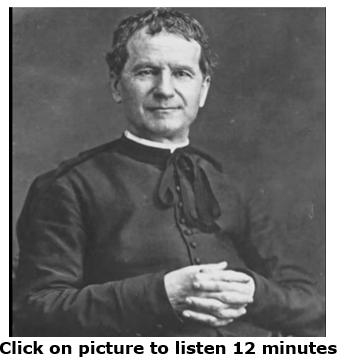
HAVE WE HAD SECUREST ELECTIONS IN THE U.S. HISTORY?

After auditing only four states by DHS, 278,000 non-citizens were discovered to be registered to vote. Remember that the US Constitution clearly says that only US citizens have the privilege to vote in the elections. This is also just common sense. On this premise alone, how can anyone possibly state that the 2020 election was “the most secure election ever” without even digging into the FACTS of how the voting process worked, the scandals exposed and by looking at the voter rolls.

THE STATE OF NEW JERSEY CONFESSES TO VOTER FRAUD

WOW! WOW! WOW! It finally comes out after years of denial by the democrats. What the heck do you think President Trump has been talking about? Yes, in Georgia they even tried to indite people for crimes for trying to expose their voter fraud. Remember what they did to Rudy Guilliano and many others? Since when is it a crime to expose crime?

So, here we have the confessions of voter fraud in the state of New Jersey. What about Arisona, Penn, Wisconsin, ect.. New Jeresy is one of the states, of many, who refused to let the federal govt review their voter roles. Gee Whiz… I wonder why… Now we see an admission of blatant corruption in the last election. But there is much more to be exposed too. It is all coming to roost….. lol…. PASS THE SAVE AMERICA ACT NOW!

Oh…but they say its only 400 fraudulent voters in NJ? Well… I have to tell you it may be even a little for each state, and it all adds up to making someone lose or win an election. Get it? Do you really get my point here today?

I want to add one more note here today. Didn’t I say the federal govt should have come in an audited each state, state by state prior to the 2020 elections. This is now being done, late but being done. This along with the Save America Act could have saved so much from going in the hole that the Trump now has to overcome to climb out of that Biden created. Yes, Obama wanted a third term and thought he could finally end the United States as we now know it with a third term. But its now working out that way and you know why? It because of people like you and me who have awakened to what is going on. Let’s end this democrat party push for Socialist Communist once and for all in the midterms.

HOW MAMDANI IS LEADING DEMOCRATS STRAIGHT OFF A CLIFF….

Only many of the democrats are too dumb to realize what the final outcome of Mamdani is going to be for their party. Later, they will regret ever supporting him or at the least not speaking out about him. They are still hopeful someone, anyone, can pull them through these next two elections. It is not looking very good for the democrats.

TRUMPS TELEVISED THURSDAY SPEECH: RECENTLY DECLASSIFIED DOCUMENTS: SOLID PROOF OF U.S. ELECTION INTERFERENCE BY A FOREIGN POWER.

So much worst that any of us predicted. The democrat conspiracy to rig the election by China. Why would China do this? Now what? I believe this speech by president Trump last Thursday just scratched the surface. It is just the beginning of what is to come. There are thousands of inditements to be served from this 2020 election fraud.

THE SHOCKING TRUTH ABOUT WHAT HAS BEEN HAPPENING WITH U.S. ELECTIONS.

Why did Trump give his speech on Thursday. Everyone needs to know this and listen carefully. Trumps speech was not about losing the 2020 election (sore loser) but rather election integrity and an orchestrated attack on him by the democrat party through foreign powers. Remember Trump was the president in 2020 and the intelligence agency intentionally filtered information from him about the foreign intervention in their briefings to him. This is the major issue here. RememberTrump also put in place an executive order that states any interference by a foreign power in an election could make it null and void.

A REVOLUTION FOR REGIME CHANGE IN IRAN IS UNDERWAY

IRAN’S HIDDEN URANIUM LOCATED

U.S. VOWS TO DESTROY IRAN’S PICKAXE MOUNTAIN NUCLEAR SITE

Iran declares all out war with the US. Will Israel join forces with the US? Would the US use a 5 mega ton nuclear bomb to do the job?

I have created a brand-new “Post RV Workshop” page in the blog. I included my own personal tips on investing post-RV and also organizing and protecting your estate. Here is the LINK. Going forward I will only post new and exciting information and opportunities here on the Latest Newsletter as they come along. Later I will transfer it to the ‘Post RV Workshop’ page in subsequent Newsletters for your future reference.

Just so you know I absolutely DO NOT adhere to high-risk investments where I can lose it all in a flash. Look at it this way – you are going to have all this money from your dinar exchange. Then why blow it! Most of us investors waited decades for this RV to happen and so why would you even think about pissing is all away in some high-risk gamble of an investment. Yes, there are going to be scammers out there but let’s talk about legitimate investment opportunities only. These scammers can suck you dry and there is not a damned thing you can do about it.

Go to a legitimate wealth manager associated with your bank. Let the licensed experts advise you. Please, please stay away from idiots like MarkZ, TNT Tony, Bruce (on the Big Stupid Call), etc. , etc. Go to professionals. It doesn’t mean you have to follow everything they advise you but it’s a great start. Remember they too are selling investment products and get commissions.

ECONOMIC EXPERT: IRAQI GOVERNMENT STUDYING CURRENCY CHANGE PROPOSAL TO BOOST LIQUIDITY AND STRENGTHEN THE DINAR

An economic expert has told Channel8 that the Iraqi government is studying a proposal to change the country’s currency as part of broader economic reforms aimed at recovering hidden cash, increasing state liquidity, and strengthening the Iraqi dinar against the U.S. dollar.

Proposal Emerged After U.S. Visit

Speaking to Channel8, economic expert Haider al-Sheikh said Prime Minister Ali Faleh al-Zaidi’s recent visit to the United States produced several economic outcomes, including the lifting of U.S. sanctions on seven Iraqi banks, allowing them to resume international transactions and rejoin the correspondent banking system.

Al-Sheikh said discussions following the visit also led to a proposal to overhaul Iraq’s currency as part of efforts to improve financial liquidity. According to al-Sheikh, the proposal currently being studied includes two possible approaches.

The first would introduce a redesigned Iraqi currency with new banknote designs across existing denominations.

The second would remove one zero from the currency as part of a redenomination process. He stressed that the proposal does not involve printing larger denominations, such as IQD 50,000 or IQD 100,000 banknotes, but instead focuses on replacing the existing currency.

Recovering Hidden Cash

Al-Sheikh said the primary objective is to bring large amounts of cash held outside the banking system back into circulation.

He argued that much of Iraq’s liquidity is held by individuals rather than the state, while government cash reserves remain limited.

Under the proposal, authorities would establish a limited period during which citizens could exchange existing banknotes for the new currency through government banks.

He said unusually large exchanges would be subject to scrutiny, allowing authorities to investigate the source of the funds and identify assets linked to corruption.

Al-Sheikh linked the proposal to al-Zaidi’s anti-corruption “Dawn Campaign,” which has led to the arrest of more than 40 suspects and the discovery of large quantities of cash allegedly hidden in private properties.

Expected Economic Impact

Al-Sheikh said changing the currency could help increase government liquidity, stabilize the exchange market, and strengthen the Iraqi dinar against the U.S. dollar.

He added that the government hopes the measure would improve public confidence in the national currency and reduce the volume of cash circulating outside the formal banking system.

Al-Sheikh noted that a separate proposal to adjust Iraq’s official exchange rate had been discussed under former Prime Minister Mohammed Shia al-Sudani, including the possibility of setting the rate at IQD 140,000 per $100. He said that proposal is no longer being pursued, and the current government’s focus has shifted toward changing the currency itself rather than altering the exchange rate.

Additional Financing and Legislative Process

Al-Sheikh also claimed that Iraq secured between $2 billion and $3 billion in loans and financial grants from the United States during the prime minister’s visit. He added that Qatar, the United Arab Emirates, and other countries are also expected to provide additional financing.

According to al-Sheikh, the currency proposal remains under study and will be reviewed by the Ministerial Council for the Economy, the Ministry of Finance, the Central Bank of Iraq, and a joint consultative committee before being submitted to the Council of Ministers and later to Parliament if approved.

He estimated that, if adopted, implementation could take approximately five to six months.

Al-Sheikh said Iraq’s currency remains among the weakest-performing in the Middle East and argued that a well-planned currency reform, supported by research from the Central Bank and the Ministry of Finance, could contribute to increasing the value of the Iraqi dinar against the U.S. dollar.

He emphasized that the proposal remains under government review and has not yet been formally approved.

******************************************************************************************** 
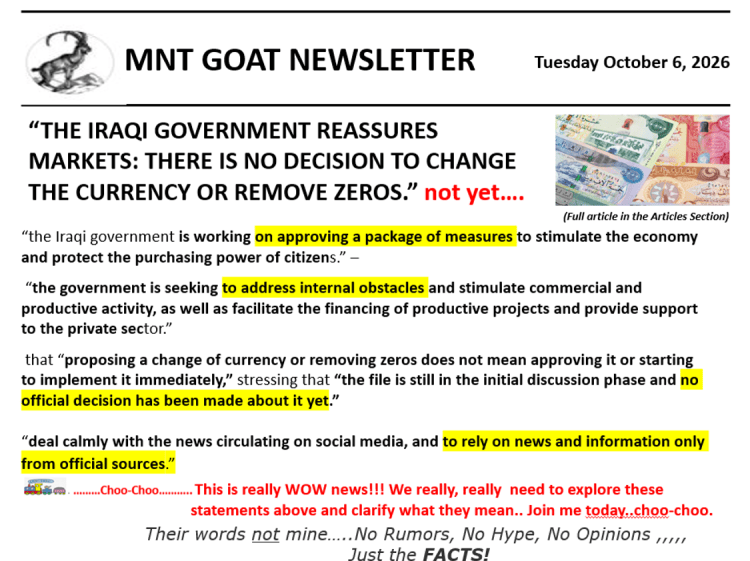
THE DOLLAR’S JOURNEY FROM “MANHATTAN” TO “AL-RASHID”: A READING INTO THE SECRETS OF MONETARY DEPENDENCE AND THE FUTURE OF “IRAQ 2”

Iraq is a major economic paradox; while it sits atop the world’s fourth-largest oil reserves, it finds itself shackled by a series of monetary crises that raise a pressing sovereign question: Why are our wealth deposited in the US Federal Reserve Bank of New York instead of our national treasuries? And why does every Iraqi dollar pass through US scrutiny before finding its way to Baghdad?

In this analytical reading, we delve into the profound facts presented by Dr. Mazhar Muhammad Saleh, the financial advisor to the Prime Minister and the foremost authority on Iraqi monetary policies, to reveal how the “American treasury” is managed, and what are the costs of “systemic waste” that devour the development budget.

First: “Iraq 2” – New York as a bank for global operations

The journey toward monetary dependency began with UN Security Council Resolution 1483 in May 2003, which established the Development Fund for Iraq (DFI). The choice of the New York branch of the Federal Reserve was not only political, but also because it serves as the “International Operations Bank,” managing international liquidity. Today, this fund has legally been transformed into the “Iraq 2” account.

For many years, this account served as a source for paying the $52.4 billion in Kuwait war reparations, which officially ended in 2021, but it remained a crucial financial buffer. Here, a technical distinction must be made between two types of accounts: the “Oil Receipts Account,” into which export revenues are deposited, and the Central Bank’s “Foreign Reserves Account,” where “monetary sterilization” operations are carried out by absorbing Iraqi dinars and injecting dollars to finance trade.

“The US Presidential Executive Order (EO 13303) provides unique legal immunity for Iraqi funds against any legal action or seizures by international and private creditors. It is an international umbrella of protection that ensures the continuity of cash flows, but in essence it entrenches a monetary dependency that makes the US Federal Reserve the primary overseer of liquidity.”

Second: The “petrodollar” trap and compliance with the “SWIFT” system

Iraq technically belongs to the “dollar zone,” and is part of the “petrodollar” system that serves the American financial empire. The decision to price oil in dollars is not merely a technical choice; it is a cornerstone of stabilizing global demand for the greenback.

The idea of ​​a “monetary rebellion” or breaking free from the dollar’s ​​dominance clashes with the reality of “institutional compliance.” The financial world today is governed by the SWIFT system and transparency rules, and any attempt to circumvent the dollar would mean isolation from financing imports, which are vital to the daily lives of Iraqi citizens.

Third: “The Cost of Iraq” and Systemic Corruption

Dr. Mazhar revealed a shocking concept known as the “Cost of Iraq,” an undeclared tax that consumes between 40% and 45% of the value of any project implemented in the country. This waste is not merely individual theft, but rather “systemic corruption” where poor planning combines with extortion and exorbitant insurance costs.

• Feasibility crisis: A startling fact indicates that 90% of projects in Iraq lack genuine economic or technical feasibility studies, turning the investment budget into “wasteful economics”.

• Waste as an alternative to corruption: Dr. Mazhar believes that “waste economics” is the most dangerous face of corruption, where the efficiency of institutions declines and the costs of stalled projects multiply due to conflicting decisions.

“We are not just fighting bribery; we are facing a system of waste resulting from the low efficiency of institutions. Transforming the economy from a ‘waste economy’ to an ‘efficiency economy’ is the real battle to restore the state.”

Fourth: The battle over “white markets” and the restructuring of banks

The Iraqi banking sector recently witnessed the suspension of 28 banks from dealing in US dollars. It is important to distinguish between these banks and those sanctioned by OFAC for financial crimes; rather, they were suspended due to institutional non-compliance with international money transfer standards.

Today, the global firm Oliver Wyman is leading a reform plan to ensure “international compliance,” which includes:

1. Mergers: Creating robust, competitive banking entities instead of “front” banks.

2. Capital adequacy: Raising the minimum capital requirement for banks to 400 billion Iraqi dinars as a condition for survival.

3. Strategic Partner: Connecting local banks with international correspondents to ensure transparency and a complete transition from the “grey market” to the “white market”.

Fifth: “Economic Geography” and the Challenge of the Strait of Hormuz

For years, Iraq has been held captive by geopolitics, but the new vision prioritizes geoeconomics. Tensions in the Strait of Hormuz have exposed the fragility of relying on a single waterway; direct oil losses (loss of volume, not price) are estimated at around $39 billion since last February, while macroeconomic losses reach $45 billion, according to Dr. Mazhar’s “non-orthodox estimates.”

The lost “opportunity cost” of relying on a threatened waterway for exports makes diversifying export routes (such as the Banias pipeline and the Turkish pipeline) an existential necessity, not merely a strategic option. The “collapse in volumes” that Iraq is currently facing is more dangerous than the collapse in prices because it strikes at the very heart of the state’s financial capacity.

Summary:

Trust as a “tangible asset” that generates wealth

The crisis in Iraq is not a lack of resources, but rather a deep “trust gap.” As Dr. Mazhar describes it, “trust is an intangible asset”; if it is present and the working environment is improved, it immediately transforms into tangible assets and productive wealth.

The institutional reforms Iraq is currently undertaking, from the Higher Investment Council to the program and performance budget, are an attempt to curb systemic corruption. But the question remains: Will Iraq succeed in transforming trust into a national currency stronger than the dollar that resides in Manhattan, New York? It is a battle to restore the state’s efficiency, a battle in which Iraq will not accept compromise.

*********************************************************************************************
IRAQI DINAR STRENGTHENS AS IRANIAN TOMAN PLUNGES AMID TENSIONS

The Iraqi dinar has recorded notable gains against the U.S. dollar, while the Iranian toman continues to lose value due to escalating conflict conditions. Market analysts anticipate further volatility in both currencies.

Dinar’s Rise Against the Dollar

Last week, the dinar showed a sharp upward trend. At the start of the week, 100 dollars traded for 153,500 dinars, but by Tuesday, July 21, 2026, it had dropped to 149,500 dinars, and in some cities like Baghdad and Basra even to 149,000. Currently, the rate is stable between 150,000 and 151,000 dinars. Since the beginning of the month, the dinar has regained about 4,000 dinars per 100 dollars.

Political and Banking Factors

Ali Faleh al-Zaidi’s visit to Washington and the announcement of an energy-sector economic agreement, along with the lifting of sanctions on seven Iraqi banks, had a direct impact. Analysts believe that if the Central Bank injects more dollars into the market, the dinar will strengthen further. Market commentator Keyfi Khushnaw stated: “If stricter measures are applied, the price of 100 dollars could fall below 150,000 dinars.”

Trading Volume in Erbil

Khushnaw revealed that daily transactions in Erbil’s currency market reach 30–40 million dollars, much of it domestic, tied to oil and real estate deals. Around 70% of the dollars purchased are used by traders for imports. If the government supplies dollars at the official rate of 132,000 dinars, demand in the parallel market will decline.

Toman’s Decline Due to Conflict

 In contrast, the Iranian toman has suffered heavy losses amid ongoing U.S.–Iran tensions. Within just one week, the rate for 100 dollars fell from 17,500,000 tomans to 19,400,000. Previously, during negotiations, the toman had strengthened to 11,000,000 per 100 dollars, but renewed conflict has halved its value.

Demand for Million-Toman Notes

Currency dealer Dana Mawlud in Sulaymaniyah noted that “the value of the toman is directly tied to the war situation.” He explained that one million-toman notes are in high demand because they are easier to handle, with one billion tomans equating to only 5,000,000 Iraqi dinars.

Historical Comparison

Currently, one billion tomans equals just 51,280 dollars. Fifteen years ago, the same amount was worth one million dollars. This stark contrast highlights the deep depreciation of the Iranian currency over the past decade and a half.

*********************************************************************************************
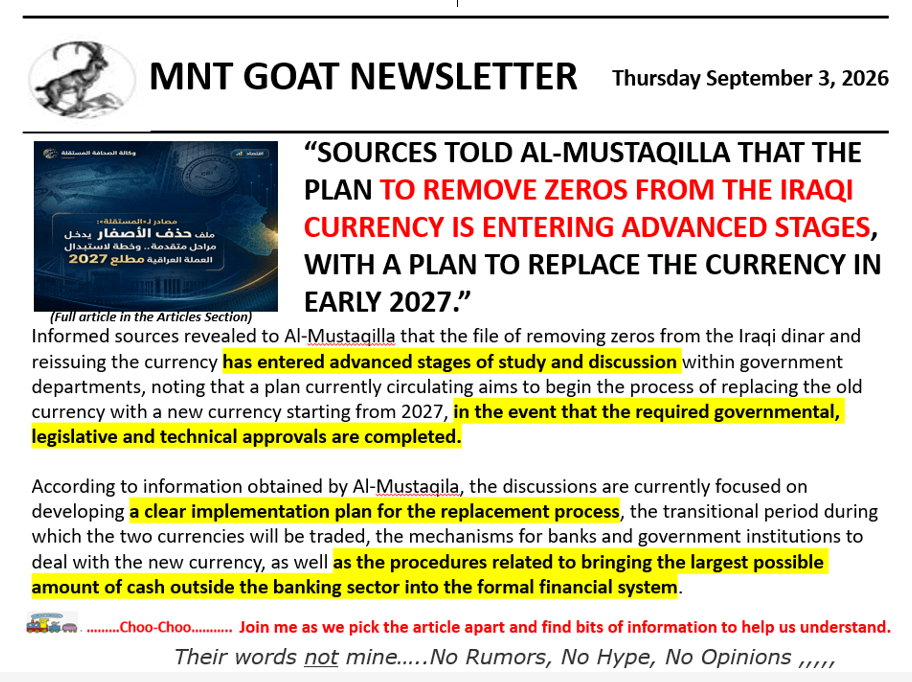
AL-HALBOUSI RECEIVES THE US CHARGÉ D’AFFAIRES AND EMPHASIZES THE IMPORTANCE OF THE ECONOMIC PARTNERSHIP WITH WASHINGTON.

The head of the Progress Party, Mohammed al-Halbousi, discussed today, Sunday (July 26, 2026), with the US Chargé d’Affaires, Joshua Harris, the political developments and the economic partnership, and explained that the meeting addressed the results of the Prime Minister’s visit to Washington and the regional and international challenges.

The media office of the Progress Party, as reported by Network 964, stated that Al-Halbousi “received today, Sunday, the Chargé d’Affaires of the US Embassy in Iraq, Mr. Joshua Harris.”

He added that “the meeting addressed the political situation in the country, and supported the recent visit of the Prime Minister to the United States of America, which contributed to launching a comprehensive and diversified economic partnership that supports the Iraqi economy and expands investment opportunities.”

He added that “the meeting discussed developments in regional and international affairs, the challenges facing the region, and a number of topics of common interest.”

***************************************************************************************

AL-ZAIDI TRAVELS TO TEHRAN SEEKING (removal of ) EIGHT BALLISTIC MISSILES BELONGING TO THE FACTIONS… AND TRUMP IS WATCHING.

(Mnt Goat:I look at these visits as reporting in to Iran. Iran must then agree whatever to Iraq and US agreed to accomplish or else it does not get done. Let’s hope this trip to Iran is not the same and is really all about disarming the factions inside Iraq)

In a true test of his promises to US President Donald Trump and his return to the country yesterday, Prime Minister Ali al-Zaidi is preparing to visit Tehran on July 23, a trip reminiscent of his predecessors’ (as Tehran has traditionally been the next stop for any prime minister after Washington). According to Al-Mada newspaper, information indicates that al-Zaidi will ask the Iranian side to exert pressure on armed factions (groups outside state control that refuse to disarm) to release what is known as the “ballistic missile card” and hand over the hidden missiles (estimated at about 8 ballistic missiles and hundreds of drones) before September 30, the deadline set by the government to resolve the issue of uncontrolled weapons.

This move comes in coordination with the diplomatic arrangements witnessed in Baghdad yesterday, Sunday, through the meeting of the Undersecretary of the Ministry of Foreign Affairs, Muhammad Hussein Bahr al-Uloom, with the Iranian Ambassador, Kazem Al-Sadiq, to ​​discuss the agenda of the visit, at a time when political circles warn that any failure of Al-Zaidi to dismantle this weapon will negatively affect the overall great gains he brought back from Washington, which included the signing of 48 agreements and memoranda of understanding in the energy, finance and technology sectors, as well as the return of Iraqi banks to the global correspondent network.

Statement

After five busy days in Washington, Prime Minister Ali Faleh al-Zaidi returns to the destination that has traditionally been the next stop for any Iraqi prime minister: Tehran. But this time the visit does not appear to be an extension of protocol, but rather a test of whether the promises he brought from the American capital will hold up at the first Iranian turn.

Informed political sources told Al-Mada that Al-Zaidi will request, during his visit to Iran scheduled for July 23, that Tehran exert pressure on the armed factions to release what the sources describe as the “ballistic card,” and hand over the missiles in their possession before September 30, the date set by the government to end the issue of weapons outside the state.

The sources add that the meetings in Tehran will focus primarily on the groups that are now described within government circles as “rebels,” who refuse to disarm, while estimates indicate that they are hiding hundreds of drones, in addition to at least “8 ballistic missiles,” which they obtained from Iran, and refuse to hand them over at the instigation of Tehran.

The sources believe that the government is now facing a crucial test. If al-Zaidi is unable to fulfill his pledge to disarm the militias by the end of September, many of the gains he brought back from Washington will be threatened.

“An opportunity to get rid of Iran’s influence”

For his part, former diplomat Ghazi Faisal believes that al-Zaidi’s visit represents a qualitative shift in Iraqi-American relations after years of stagnation, noting that relations were affected by the failure to appoint an American ambassador in Baghdad, the continuation of rocket attacks on the American embassy and the Kurdistan Region, and more than 600 attacks targeting American interests and attributed to factions allied with the Iranian Revolutionary Guard.

Faisal tells Al-Mada that Iraq has suffered in recent years from the difficulty of achieving a balance between its relations with Tehran and Washington, and that Iranian influence has been strongly present in political decision-making. He adds that the current visit gives Baghdad a wider opportunity for political, economic and security independence.

*******************************************************************************************

CENTRAL BANK OF IRAQ OUTLINES ROADMAP TO REDUCE CASH RELIANCE AND EXPAND DIGITAL SERVICES

The Central Bank of Iraq (CBI) held an expanded meeting on Tuesday with licensed electronic payment providers to accelerate the nation’s digital financial transformation, strengthen financial inclusion, and curb card misuse. Chaired by CBI Governor Nizar Nasser Hussein, the meeting centered on executing the regulator’s strategic roadmap to modernize Iraq’s payment ecosystem and transition away from a cash-heavy economy.

Addressing representatives from the sector, Al-Alaq stated that the upcoming phase demands a noticeable increase in service quality, efficiency, and system reliability to build public trust in digital transactions.

Key Objectives and Strategic Focus

During the session, the central bank outlined several operational and regulatory priorities:

  • Compliance with Global Standards: The CBI urged payment firms to adhere strictly to international frameworks, particularly regarding cross-border financial transactions. Compliance is expected to enable higher card transaction limits and facilitate the rollout of new financial products.
  • Countering Card Misuse: Regulators and payment companies discussed joint enforcement procedures to prevent card misuse and enhance payment network security.
  • Expanding Acceptance Networks: Al-Alaq called on providers to expand POS (Point-of-Sale) acceptance networks, streamline digital collection processes, and deepen integration with licensed commercial banks.

The initiative comes as part of broader government efforts to modernize the national economy, reduce cash dependency, and implement modern financial infrastructure across both the public and private sectors.

***************************************************************************************

PARLIAMENTARY FINANCE COMMITTEE: THE VALUE OF THE DOLLAR WILL DECREASE FURTHER.

Confirmed Finance Committee Parliamentarians said on Monday that the value of the dollar will decrease further.

The committee chairman said Ady Awadfor Alsumaria News“Lifting sanctions on a number of banks will affect the price of the dollar, its flow, and the parallel market,” he said, adding that “this measure will serve the Iraqi market.”

He added that “this will reduce the value of the dollar,” noting that “we will host the Central Bank Governor in the committee to clarify the vision and mechanisms he will adopt regarding this matter.”
He stated that “banks will resume dealing in dollars.”

Regarding the budget, he explained “The government has begun preparing the 2027 budget, which will reach parliament in October,” he noted, adding that “the budget will be approved before the end of the year.”

(They say this about the budget every year. Let’s hope with the new budgeting process (program budgeting) they finally worked the kinks out of the process. It usually takes till March, if even, to get a budget. It would be proper to have it at the beginning the budgeted year, don’t you think?)

******************************************************************************************* 
QAANI CANCELS THE “RESISTANCE COORDINATION” AND REDRAWS THE MAP OF FACTIONS IN IRAQ.

Iraqi security sources revealed what they described as “important” organizational changes within the armed factions loyal to Iran, represented by the directive of the commander of the Quds Force in the Iranian Revolutionary Guard, Ismail Qaani, to cancel what is known as the “Coordination of Resistance in Iraq,” according to the “Eram News ” website.

The website stated in a report seen by Al-Sa’a Network, quoting sources, that “the changes stipulate that the factions move to a stage in which they operate independently, in response to the security and political changes that Iraq is witnessing, coinciding with the approaching end of the mission of the international coalition forces .”

He explained that “during his recent visit to Iraq, Qaani held a closed meeting with a number of leaders of armed factions, during which he informed them of the termination of what is known as the Resistance Coordination, and the suspension of the previous coordination mechanism between the factions during the current stage, so that each group would manage its decisions individually according to the developments of the stage .”

He added that “the Iranian directive came after the changes that occurred on the Iraqi scene, most notably the involvement of a number of factions, which were participating within the coordination, in the process of restricting weapons to the state, and their expression of agreement to hand over their weapons and rearrange their situations in line with the directions of the Iraqi government .”

The report indicated that “Iranian assessments now indicate that the continuation of the coordination in its previous form is no longer compatible with the new reality, after the factions’ positions on the weapons issue differed, as well as the approaching end of the international coalition’s mission, which prompted the adoption of a more flexible formula based on each faction moving independently .”

The coordination committee was the umbrella organization that adopted the majority of military operations targeting foreign forces and international coalition forces in Iraq, especially since the outbreak of the regional war on February 28, and it issued unified statements in the name of the “Islamic Resistance in Iraq” following most of the attacks .

This coordination included the factions of “Kataib Hezbollah”, “Harakat al-Nujaba”, “Kataib Sayyid al-Shuhada”, and “Asaib Ahl al-Haq”, in addition to other factions, and during the past period it formed the media and military framework that claimed responsibility for many of the attacks that targeted bases containing American forces .

*****************************************************************************************

IRAQ IS PREPARING TO TRANSLATE THE OUTCOMES OF THE WASHINGTON TALKS INTO DEVELOPMENT PROJECTS.

Iraq and the United States of America launched an economic partnership that represented a highly important strategic transitional phase, especially after the two countries signed 48 agreements and memoranda of understanding worth more than $60 billion, aimed at expanding the prospects of cooperation in the energy, oil, electricity, industry, technology and financial sectors, a step that specialists considered necessary to achieve developmental leaps in various economic sectors.

Partnership pillars

Despite the diverse agreements and partnerships signed between the two countries during Prime Minister Ali Faleh al-Zaidi’s recent visit to Washington, Dr. Nagham Hussein, Dean of the College of Business Economics at Al-Nahrain University, believes that the most prominent aspect of the Iraqi-American economic partnership is in the energy sector, explaining that this sector is the cornerstone of the partnership and aims to invest in reducing associated gas flaring will increase revenues, lower imports, boost electricity production, improve energy security, attract US companies to invest in oil, gas, and renewable energy projects, and facilitate the transfer of modern technology and management expertise. Natural resources.

Banking and digital systems

In an interview with Al-Sabah, Hussein added that the second pillar of the partnership between the two countries aims to build a more efficient and transparent financial sector by modernizing banking and digital systems, enhancing compliance with international standards in combating money laundering and terrorist financing, expanding financial inclusion and increasing the use of electronic payment methods, as well as improving the investment climate and connecting Iraqi banks to the global financial system. She noted that the economic partnership aims to develop human resources, modernize educational curricula and align them with labor market needs, expand cooperation between Iraqi and American universities, and thus support scientific research and innovation, preparing qualified personnel capable of leading the transformation. Digital and knowledge economy.

She explained that the focus of sustainable economic development can be activated through economic diversification and reducing dependence based on oil, supporting the private sector and small and medium enterprises, improving infrastructure, attracting foreign investment, creating sustainable job opportunities and achieving inclusive economic growth.

Free zone

In a related context, the academic, Dr. Amr Hisham, pointed out that the topic of economic partnership between countries is an important concept that has existed since ancient times, indicating that this concept is governed by political relations, but in reality there are successful models. 

Hisham explained to Al-Sabah that the partnership could be through the creation of a free zone, such as the economic partnership between America and Canada, as well as Mexico. This economic partnership could then develop into a customs union, then a common market, and finally reach an economic union like the European Union.

Successful models

Hisham stated that there are stages to partnership, and there are also successful models such as the United Arab Emirates, which established an economic partnership with America. Singapore also succeeded in establishing an economic partnership with America, and Singapore followed the same path, indicating that this means that many countries in the world are exploiting the American umbrella politically, militarily, and economically.

He called for the need to move towards reducing customs barriers between the two countries on goods and services and to benefit from investments entering and leaving, noting that Iraq has an investment law that allows foreign investments to enter.

Global energy power

He stated that Iraq is a global energy power and is the third or fourth largest oil producer in the world, noting that it could also be a source of gas to South Asian markets. He stressed the need to develop the oil and gas industry and shift towards petrochemical industries while increasing oil storage and absorption capacities, calling for finding alternatives to the Strait of Hormuz by establishing large and expanded oil pipeline networks.

*******************************************************************************************
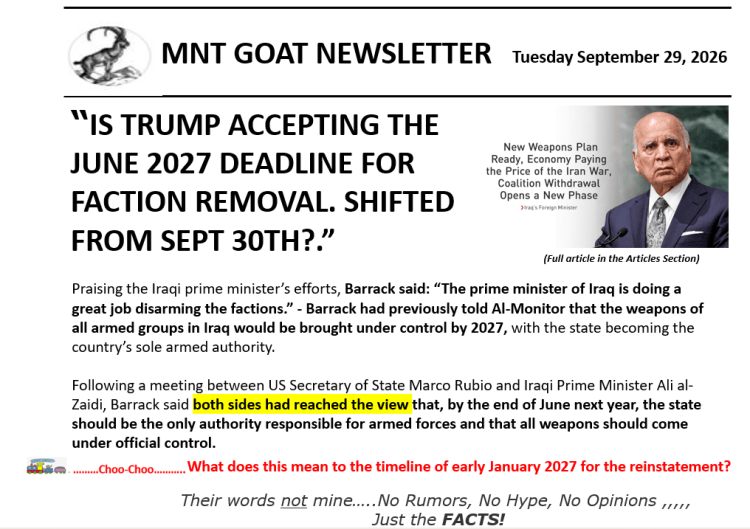
AL-ZAIDI REVEALS THE “ADVICE” HE GAVE TO TRUMP: WE DON’T WANT IRAQ TO BE A FAILED STATE.

Prime Minister Ali al-Zubaidi affirmed on Wednesday that his government rejects Iraq becoming a “failed state,” stressing the need to continue fighting corruption and bear “all the consequences,” while revealing that he advised US President Donald Trump against launching a military strike against Iran.  

In an interview with The Atlantic, al-Zaidi said he advised Trump against launching a military strike against Iran, stressing that Iraq should be a meeting point, not an arena of hostility, between Washington and Tehran.

He added that a military presence does not create ties between peoples, and that economic engagement is the guarantor of building those relationships, noting that Iraq is looking for an investment partnership with the United States that extends for 30 years instead of a military presence.

Al-Zaydi stressed that “there is no option but to surrender the weapons,” emphasizing that his government rejects the transformation of Iraq into a failed state and is committed to fighting corruption.

He pointed out that economic development and job creation are the path to stability in Iraq, noting that the recent war and the closure of the Strait of Hormuz have inflicted heavy losses on the Iraqi economy, even though Iraq still represents a promising investment opportunity.

Al-Zaydi concluded by emphasizing his readiness to bear the consequences of his reform project.

Al-Zaidi, accompanied by a high-level delegation, concluded last Saturday a five-day official visit to the United States of America , which focused on launching a comprehensive and diversified economic partnership to support the Iraqi economy, expand investment opportunities, revitalize the local labor market, as well as enabling Iraq to open new outlets for exporting crude oil and increase production and refining capacities.

*********************************************************************************************

AL-ABOUDI: THREE FACTIONS HAVE BEGUN HANDING OVER THEIR WEAPONS TO THE STATE, AND TALKS ARE UNDERWAY WITH WASHINGTON AND TEHRAN TO SUPPORT THE MONOPOLY OF ARMS.

National Security Advisor Qasim al-Aboudi revealed new developments in the file of restricting weapons to the state, stressing that the government held talks with the United States and Iran to support this path, while announcing that three factions have begun procedures to hand over their weapons to official institutions.

Al-Aboudi said in a televised statement that Prime Minister Ali Faleh al-Zaidi’s visit to Washington contributed to developing the course of Iraqi-American relations and moving them to the framework of economic partnership and security cooperation, indicating that the two sides agreed to resume training programs and security coordination, as well as discussing a number of joint files.

He explained that the issue of restricting weapons to the state requires dialogue with the various concerned parties, noting that some factions were linking their continued possession of weapons to the presence of American forces, and that an understanding regarding the end of their presence removes one of the justifications that were being put forward in this context.

He added that the government discussed the issue with the Iranian side, noting that Tehran expressed its readiness to support efforts to restrict weapons after being convinced of the withdrawal of US forces, stressing that Baghdad emphasized during the meetings its rejection of the use of Iraqi territory or targeting it in any conflict.

Al-Aboudi stressed that the government is committed to ending the presence of any weapons outside the framework of the state, noting that the next phase will witness new steps to strengthen the authority of official security institutions and consolidate the state’s monopoly on weapons.

*********************************************************************************************

IRAQ: NON-OIL REVENUES HIT RECORD HIGH

The Eco Iraq Observatory announced on Saturday that the contribution of non-oil revenues to Iraq’s total financial revenues has risen to 16%, the highest percentage recorded so far.

(Mnt Goat:I believe they told us their goal is between 45-55%)

The observatory said in a statement received by Al-Sa’a that “this is the first time that the percentage of non-oil revenues has risen to 16% during the months of May and June, after it had remained for years not exceeding 5%.”

He explained that “non-oil revenues rose for the first time to about 10% during the government of Mustafa Al-Kadhimi, and stabilized at this level during the government of Mohammed Shia Al-Sudani, before recently recording its highest percentage.”

The observatory explained that “non-oil revenues include commodity taxes and production fees, general fees, taxes on income and wealth, transfer revenues, as well as other revenues.”

He pointed out that “the revenues of the Kurdistan Region represent about 5.5% of the total non-oil revenues, through the funds that the region delivers to the federal government.”

****************************************************************************************

AN AMERICAN PLOY TO IMPLEMENT THE NEW MIDDLE EAST PROJECT… WILL IRAQ SWALLOW THE BAIT?

The recent security changes at the level of military and security leadership have raised many questions about the nature and timing of these measures, and whether they fall within the context of normal administrative rotation of security positions, or whether they came in response to external directives and pressures aimed at finding alternatives capable of implementing agendas that are consistent with the American vision in the region.

According to political opinions and observations, the discussion is focused on what are said to be moves backed by American pressure to make changes affecting the Chief of Staff of the Popular Mobilization Forces, Abdul Aziz al-Muhammadawi, and the Chief of Staff of the Army, Lieutenant General Abdul Amir Rashid Yarallah, within the framework of efforts believed to be aimed at removing any obstacles to the new American project in the Middle East, which observers believe is primarily aimed at ensuring the interests of the Zionist entity and strengthening its influence in the region.

Observers believe that the United States is moving rapidly to create the necessary conditions for launching its new project in the Middle East, placing Iraq at the forefront of its priorities, given its strategic geographical location and its vast wealth and economic potential, as well as its efforts to tighten the noose and increase the siege on the Islamic Republic of Iran.

In this context, Jassim Mohammed Jaafar, a leader in the State of Law Coalition, confirmed in a statement to Al-Maalomah that “any change made by the Prime Minister in the security leadership must be done after consultation with the coordination framework and prioritizing the country’s interest in it,” explaining that “the leaders of the Popular Mobilization Forces must be close to the PMF, and it is not possible to impose leaders who are far from its orientations, as the Popular Mobilization Forces are a striking force and defender of the country, and it is necessary for them to remain, and no one has the right to dissolve them.”

Jaafar pointed out that “not everything imposed will be implemented,” referring to American pressure on Iraq to dissolve the Popular Mobilization Forces (PMF). He explained that “changes must be made according to a mechanism that aligns with the orientations, ideas, and requirements, and leaders cannot be imposed on the PMF who do not belong to it or belong to other groups.” He expressed his astonishment at attempts to impose American dictates on Iraq, stressing that any “security file must be an internal matter, free from any external interference.”

For his part, political analyst Atheer Al-Sharaa told Al-Maalouma that “US President Donald Trump is continuing the military escalation in the region and deploying his forces in several countries with the aim of achieving his goal of tightening the noose around Iran,” noting that Trump is working to raise the level of escalation in the region, through issuing threats and continuous bombing.”

He added that “the American escalation coincided with a move by Trump to strengthen the American military presence in countries close to Iran, especially in the region, in addition to the American movement in the military bases controlled by the United States inside Turkey.”

He explained that “Trump is using Zionist forces in Azerbaijan to achieve some of his goals, in addition to his continued efforts to control the Strait of Hormuz, which is pushing him to continue the military escalation and the continuous bombing of Iranian territory.” 

The United States, under President Donald Trump, seeks to bolster its influence in the region and bring its countries within the American sphere of influence, whether directly or indirectly. Observers believe that several Gulf states have become launching pads for American forces to carry out military operations and attacks against the Islamic Republic. Meanwhile, warnings are mounting about the extension of this approach to Iraq through attempts to integrate it into the Washington-led security system. This integration is being pursued through projects and plans presented under the guise of “security cooperation,” which are believed to aim at expanding American influence within the country and serving its regional agenda.

*********************************************************************************************

WHY IS THE “ASYCUDA” SYSTEM CONTROVERSIAL IN IRAQ? AN ADVISOR REVEALS THE REASONS.

Nabil Al-Khafaji, advisor to the head of the Baghdad Chamber of Commerce, revealed the reasons for the controversy surrounding the “ASYCUDA” system adopted in customs procedures, considering that the main problem lies in the difficulty of modifying data after it has been entered, despite the possibility of developing a more efficient local system.

Al-Khafaji said during a televised interview followed by Al-Sa’a Network that Iraq possesses the competencies and technical capabilities that qualify it to establish a better customs system, indicating that the ASYCUDA system is old and it is difficult to make modifications to it after the data has been recorded.

He added that “many developed countries do not adopt this system,” noting that “Iraq was able to develop a local system that links all financial benefits and procedures more efficiently.”

(Mnt Goat: we had been told in the recent past in articles that many of the developed countries do adopt and use the ASYCUDA system. So this statement is a contradiction of past news. Why?)

He explained that “the problem does not lie in entering the data, but in the mechanism for modifying it after it has been recorded,” noting that “any error in the shipment information or the goods code (HS Code) becomes complicated to correct within the system.”

Al-Khafaji explained that “errors are often caused by the data submitted by the source or exporting company, but the ASYCUDA mechanism makes dealing with these errors more difficult, which is reflected in the speed of completing customs transactions.”

(Mnt Goat: I believe all the resistance to ASYCUDA is also from one thing called CHANGE. Merchants don’t want to pay import duties. Citizens don’t like the cost of these duties passed on to them in the marketplace. The use of ASYCUDA tightens these fees and more accurately collects them, something Iraq did not have in the past.)

*******************************************************************************************
Their words not mine…..No Rumors, No Hype, No Opinions ,,,,,

                                             Just the FACTS!

Disclaimer: All information in this newsletter is not intended for investment decisions / purposes. Mnt Goat is not a financial analyst, planner, banker, attorney or associated in any role with giving out professional investment advice.

Auf Wiedersehen

Much love to ya all,

Mnt Goat

*********************************************************************************************