

Disclaimer: All information in this newsletter is not intended for investment decisions / purposes. Mnt Goat is not a financial analyst, planner, banker, attorney or associated in any role with giving out professional investment advice.
ABOUT THE NEWSLETTER:

October 20, 2026 Mnt Goat News Brief
Guten Tag everyone:
We need to clarify some news today.
GIVE A GIFT TO MNT GOAT
I decided to allow everyone to give a Free-will GIFT to Mnt Goat on PayPal if you so desire. Here is the link below. Please show your appreciation for all the hard work I do.

I recommend $15-$20 dollars a month or whatever you can afford. Do you realize I write up to eight (8) Newsletters every month. This is like a second job to me. The only way I know that people are reading and appreciating all the FACTUAL news I bring is through their appreciation. If I do not receive equal appreciation for all the hard work I do, I will simply end the Newsletter and save myself endless hours at the computer. You do want to get paid for your job, don’t you? What makes my job any different? Tell me….. I am tired of this RV saga just as you are.

Let’s all try to chip in!

___________________________________________
Acts 20:35
“In all things, I have shown you that by working hard in this way, we must help the weak and remember the words of the Lord Jesus, how he himself said, ‘It is more blessed to give than to receive.“
STATUS OF THE RV
Seriously folks, I can only report on the news I do not create the events. Do you want to know the truth or listen to lies?
We can look at today’s news as the glass half-full or half-empty. It is up to you. I see it as half-full as we all knew the FACTS and knew the parallel market had to be dealt with. Come ‘on folks, I have been saying this since my September 16, 2025 Newsletter blog, especially since in it, I outlined the fie (5) major issues needing resolution prior to any reinstatement. Was my CBI contact correct back then? She said these issue would be the headlines. Aren’t they? They are there because they are all important must be resolved prior the reinstatement, just as we were told. So, let’s get off our sadness and see how they are attempting to resolve these issues. I know, I know, you too are sick and tired of hearing about these five issues but folks we are NOT going anywhere until they are solved satisfactorily to the IMF and the US Treasury.
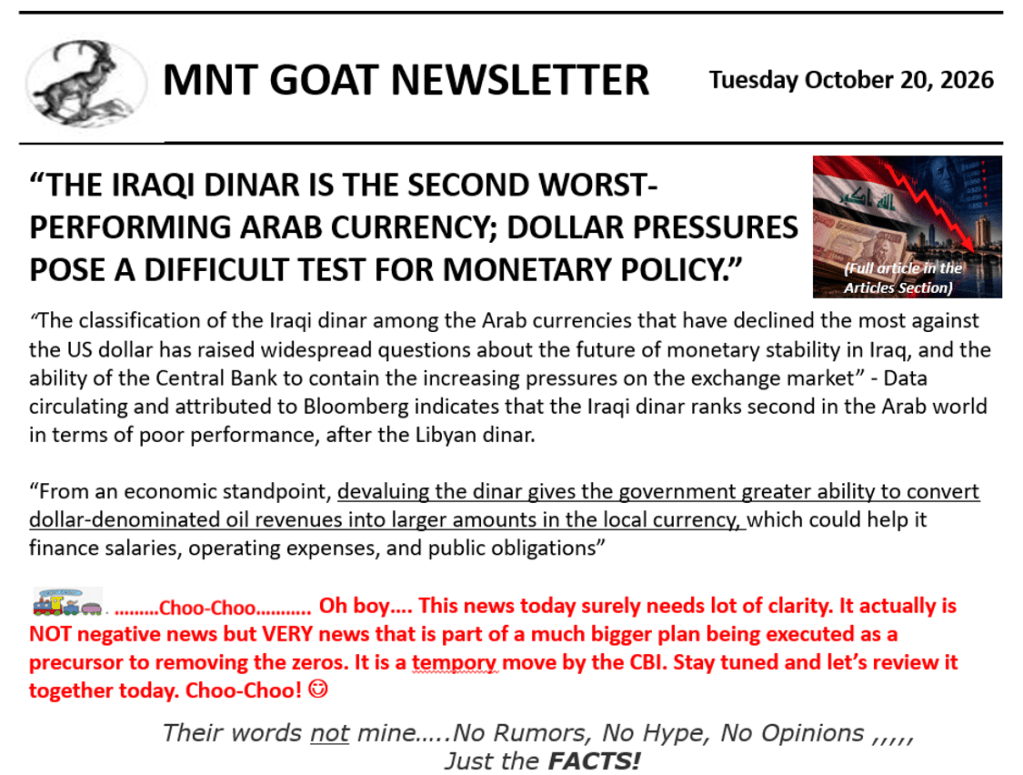
So, the huge news of last week was the devaluation of the dinar to 1520. In today’s news we get more insight as to how this happened, why it happened and how it all fits together in this new reform plan by the Finance Committee. Do you remember the announcement of this new Reform Plan. They did not give much details about it for if they did, speculators would flock to buying dinars. So let’s break it down today.
The new 1520 is to help control or get rid of the parallel market, something that the IMF has consulted with Iraq just recently on again. We all knew this parallel market needed to be ‘defused’ didn’t we? But let’s go deeper today into this subject matter.
But why did the IMF come out now at this time and recommend this action of a devaluation of the dinar? There are two basic reasons.
This devaluation is not loss hope for us and the reinstatement. Actually, it is a bright side if your glass is half full.
1)An attempt to create revenue out of thin air by devaluing the dinar since Iraq had lost nearly $60 billion from when the closing of the Strait of Hormuz. Devaluing the dinar gives them more dinars per dollars as they are solely pegged to the dollar. The currency of Iraq is dinars not dollars. It has to pay its bills. They are desperate.
2)Trying to prepare for the removing of the zeros just as they said would most likely begin in the first quarter of 2027. To do this they need to neutralize the effects of the parallel market on the dinar. They want it to begin in 2027 and need it to begin then but also need it to be successful.
3)The CBI wants to collect these stashes of cash outside the banking system while executing the project to delete the zeros but do it at a discounted rate of 1520 not 1320. This is a 200 dinar devaluation (or some might say a discount for the CBI) to retrieve this cash. I know this goes totally contrary to what you have heard from all these intel gurus on how they would incentives the citizens by first raising the rate. I told you many times this would NOT happen. I was only passing on their news not mine. Who are you going to listen to- these idiot internet jerks or the CBI itself?
To be successful in the collection of these stashes, the CBI will have to set VERY tight, strict deadlines to turning in the larger three zero notes, just as they did with converting from the Saddam Hussen notes to the three zeros way back in 2004. Its going to be a VERY similar process, either turn them in or lose them.
Again I want to caution many that the three zero notes will actually stay as valid currency for some time after the project to remove the zeros, only they will be restricted tightly in their use. They are NOT going to null and void altogether them like they did with the Saddam Hussen notes. This is why our notes outside Iraq will be completely exchangeable at the rate on FOREX when reinstated.
Will they move the rate back to 1320 around that time of removing the zero? I will answer a question with question. Why would the CBI do this? As I described the CBI went to 1520 as one of the reasons is to collect these stashes at a discount.
How will they gauge this success?
Success will be gauged on how many notes are turned in, thus exchanged for the newer lower denominations. They DO NOT intend to hand out paper money in exchange but rather insist on electronic deposits. They have plenty of the newer lower denominations already printed to satisfy the public demand for them once converted over, so they told us already in a couple articles, remember?
Also remember a lot of these stashes are corrupt money and so the CBI has to act fast once they do announce the final plan implementation start of removing the zeros. I am told by my CBI contact that even if they collect just half of these stashes it would be a success story, which would amount to about $40-45 billion dollars back into the banking system. Inflation is also going to be a concern and so they will closely monitor it for a period. If all is successful, they plan then to move to FOREX with a new basket of currencies as the new dinar peg. I suspect we will be hearing more about this new basket in the coming months.
Why do they use terms like ‘most likely’ in the CBI commetaries? They use these kinds of terms because, as we all should know by now, nothing is certain. As we watched over the years the CBI makes plans and then something always seems to spoil the plans and they cancel the removing of the zeros. Will they do it this time?
Oh…. so many questions!! 😊 😊 Hang on folks we will get to the answers…..
As I have showed you many times in the news, from Iraq and the CBI, that there is an utmost urgency to get these stashes of cash back into the banks. Again, in today’s news they tell us that nearly 40% of the issued currency is outside the banks. I thought they just told us not too long ago it was nearly 80-90%. So what happened? If this recent article titled “45 TRILLION OUTSIDE THE BANKS… PARLIAMENTARY FINANCE COMMITTEE REVEALS THE EXTENT OF THE CRISIS OF CONFIDENCE IN BANKS” How did they reach this number of 45 trillion when it seems it should read 99-108 trillion, if what they told us in the past still holds true?
They told us in the past their monetary mass is about 110-120 trillion dinars. They then told us that 80-90% of that is out side the banking system. So that is about 99-108 trillions dinars outside the banking system. So when did they reduce it to 45 trillion? That is only about half or 50% not 80-90% outside the banking system. is this Reform Plan already working? Did they already fix something that they are not telling us about?
Please correct me if I am wrong in my math but that is what they told us in many past articles. So what has changed?
I quote from the article – “The head of the parliamentary finance committee, Uday Awad, revealed the existence of a cash mass ranging between 40 and 45 trillion dinars outside the Iraqi banking system, attributing this to the weak confidence of citizens in banks, while stressing the work to find solutions to return these funds to the banking cycle” .
“Awad said during a televised interview followed by Al-Sa’a Network that “there is a cash mass estimated at about 40 to 45 trillion dinars outside the banking system,” noting that “the lack of confidence in banks has led citizens to keep their money away from them.”
Everyone needs to realize that we can’t blame the citizens too much for feeling the way they do about the banks. Heck….in 2014 ISIS came into Iraq and in most providences where they occupied, the first thing they did is raid the banks. The government has not yet even reimbursed the citizens entirely for their losses. Remember it was irresponsible under Nori al-Maliki, in the first place, at that time, to let ISIS infiltrate Iraq, He was hoping to use them as his strong arm to force the government into his bidding for a dictatorship. So the people also don’t trust the government either.
This backfired on Maliki as ISIS has no allegiance to Iraq. They only pilfer and pillage as they go. But later, as Iran came to the rescue to fight ISIS, the Iranian backed politicians, including Maliki decided to use the Iranian backed-terrorists Kud forces instead of ISIS as their strong arm, as we see still in place today. We are reading many recent articles on just how bad they really are. They are brainwashed in this Islamic Jahad ideology and that is the problem.
So, these pieces are all inter-connected keeping the factions in Iraq, combating the parallel market and trying to get these stashes of currency back into the banks. I hope everyone see the connections and knows that they all need to be resolved prior to the reinstatement. However, I believe by news in the articles, that the IMF wants the parallel market either controlled and dissolved prior to removing the zeros. Remember that we have been told many times that a 2% over or under the ‘official’ CBI rate is acceptable so we don’t need exact rates.
I was also told by my CBI contact that the 1520 rate is ‘temporary’ and being set to mainly combat and break the parallel market as well as provide some funding for the government. But how long do they want this to continue? I am told just for a few months. We know that the CBI reserves are also now declining at a rate that could soon reach unacceptable levels by the IMF. This is why the CBI and the IMF are now stepping in to take the necessary actions to stop this downward drift of the reserves.
Here is another article worth paying attention to. It is titled “DOES IRAQ HAVE ENOUGH DOLLARS TO COVER ITS NEEDS?”
READ CAREFULLY this next paragraph:
No, they don’t have enough money to cover their needs in the long-run and don’t let anyone fool you. What Iraq has is a diminishing CBI reserves once again like the Covid era and they must do something about it and do it fast. Like we learned today that 45 Trillion dinars is outside the banking system. WOW! How are they going to retrieve it? Remember also our dinars are outside the banking system too. When will they want to come get ours? We are told we must wait for FOREX. However can they even wait for FOREX to allow us to exchange at our banks outside Iraq or will they come up with some scheme with the US Treasury to allow us to exchange our dinar outside of normal OFAC sanctions, outside of FOREX even? Never say never when you are dealing with Iraq. These next 2-3 months is going to be pivotal for our investment in the dinar.
“Economic expert Mustafa Hantoush confirmed on Monday that the dollars available in Iraq are sufficient to cover its commercial needs, indicating that about 95 to 97% of dollar usage is through money transfers, while the share of direct cash transactions does not exceed 3 to 5%.”
“Hantoush said in a televised interview followed by Al-Sa’a Network that “importers use dollars through remittances to finance the purchase of goods from abroad, as the funds are transferred to the beneficiary through banks, in exchange for paying their value in dinars within Iraq .”
I need you to remember that in the last couple Newsletters the CBI talked about a new reform plan and they would be rolling out its measures soon. Well… this 1520 devaluation is part of the plan. It just didn’t happen but was well calculated and for a purpose. But now the IMF wants to see tangible results from this plan as it talks about it in the article titled “IRAQI ECONOMIC REFORMS: INTERNATIONAL PRAISE AWAITS TANGIBLE RESULTS”
“The financial advisor to the Prime Minister, Mazhar Muhammad Saleh, confirmed that the Iraqi economic reforms enhance confidence in the economy and improve the management of public finances, but he stressed that their success is measured by sustainable results that include spending efficiency, financial stability, and reducing the impact of oil price fluctuations.”
All of which we know have not yet happened! ☹
“Financial pressures on Iraq are increasing as the budget deficit widens, amid a move towards external borrowing after the International Monetary Fund announced its readiness to provide financial support to Baghdad at the official request. This development raises questions about the effectiveness of government economic measures, particularly the decision to raise the dollar exchange rate, which Prime Minister Ali Faleh al-Zaidi had previously confirmed was aimed at avoiding external borrowing and doubling debts.”
“Amid talk of an imminent borrowing plan, the Prime Minister’s financial advisor, Mazhar Muhammad Salih, presented a vision that addresses international praise for economic reforms, without confirming or denying Baghdad’s actual intention to borrow from the International Monetary Fund”
Saleh added that “the true measure of the success of these reforms depends on their ability to achieve tangible and sustainable results that reflect on the strength of the financial situation, improve the efficiency of government spending, enhance economic stability, and reduce the repercussions of oil price fluctuations on the general budget.”
Saleh continues to point out that “the success of these reforms is linked to…. bla, bla, bla and more bla…. How many times are we going to hear this? It is now over 20 years since Iraq began these reforms. When are we going to read about tangible results in the news?
Drum roll please…… Here it is. The article is titled “AL-MADA REVEALS IRAQI MOVES TO BORROW $5.4 BILLION FROM THE IMF”

“The Independent Press Agency reported that the Iraqi newspaper Al-Mada revealed preliminary negotiations between Iraq and the International Monetary Fund to obtain external financing that could reach $5.4 billion, amid increasing financial pressures and a widening budget deficit, amid economic warnings about the potential impact of loans on government spending and citizens’ purchasing power.”
So, let’s think about what is being borrowed. Let’s break this article down. We know that 40-45 trillion dinars is outside the banking system and thus can’t be used in the economy. Used for what? To pay the bills such as salaries, right? The 40-45 trillion is about $40-45 billion dollars. So, Iraq is now going to borrow $5.4 billion dollars when they know they have almost $45 billion sitting outside the banking system. Seems weird to me, how about you? Does this sound foolish to you?
Remember also that the new prime minister Al-Zaidi, like Ali Al-Alaq from the CBI, said he would not resort to more borrowing of funds, as the considered their rates blackmail. So, the fact they are borrowing shows desperation.
How many times can they go the IMF and borrow? It is said this $5.4 billion dollars will get Iraq through up to December 2026. What happens afterwards? Again, can you see the URGENCY of removing the zeros and trying to retrieve this 40-45 trillion dinars after this period of the end of 2026? But why are they waiting until January 2027 anyhow to remove the zeros and attempt to retrieve these stashes of dinars if they need the money now to pay the bills?
The answer to this last question comes from the IMF who, according to my CBI contact told me that it needs the parallel market to plus or minus of the official CBI rate. By raising the rate they made it much harder for the parallel market to do business. The merchants simply can’’ afford 1750 kind of rates while they could 1520 before the hike. So why not simply go the bank. For legitimate needs of dollars yes the banks would be the best option. For illegitimate dollars, still who wants to pay these kinds of spreads when they can see it is only a temporary hike. Yes, temporary is the key word here and Iraqi citizens know it.
Again, before the rate hike: we see a 200 dinar spread. 1320 (official CBI rate) to 1520 (prior parallel market rate) 200 spread.
Again, after the rate hike: we see a 200 dinar spread. 1520 (official CBI rate) to 1720 (prior parallel market rate) still a 200 spread.
____________________________________
😊 Okay, so here’s some news on this new plan to help reform the economy. It is titled “GOVERNMENT PLAN TO BRING THE EXCHANGE RATE DOWN TO 1550 DINARS”
“Government spokesman Haider al-Aboudi announced on Wednesday a plan to bring the dollar exchange rate in the parallel market to 1,550 dinars, while economic experts called for diversifying revenue sources, rationalizing public spending, and supporting the private sector, stressing the importance of working to bridge the gap between the official and parallel exchange rates.”
Al-Aboudi said in a statement to the Iraqi News Agency (INA):
“The government and the Central Bank are working according to a well-thought-out plan to bring the price of the dollar in the parallel market to 1,550 dinars per dollar in the near term.”
He added, “This path is based on secure and sufficient funds at the Central Bank that allow for the financing of foreign trade with high smoothness and to meet import needs.”
Regarding the previous transfers based on the current exchange rate, Al-Aboudi confirmed that “sufficient financial allocations have been secured to complete them in light of the previous rate and to fulfill the associated obligations.”
I will say this much more on the topic of the nee 1520 rate. Iraq has just Nov and Dec to bring the price of the dollar in the parallel market to 1,550 dinars per dollar. They tells us “ in the near term.” And to me this says not years down the road but maybe just months, knowing their intentions for January 2027.
We must remember the overall Dr. Shabibi / IMF plan. First the removing of the zeros, then the reinstatement. So, by removing the zeros Iraq then must be in a good position to reinstate, if that project is successful. They will postpone removing the zeros again if the reinstatement is not seen to be able to happen shortly afterwards.
What is the success criteria?
Iraq must:
- able to control inflation
- keep the parallel market controlled (+ or – 2% of official rate)
- maintain a level of Security and Stability, as required by the gatekeepers
😊 In the following article we see the common theme once again. It is titled “SECURITY STABILITY IS THE KEY TO ECONOMIC RECOVERY: A MEMBER OF PARLIAMENT REVEALS TO IRAQ OBSERVER THE GATEWAY TO ATTRACTING INVESTMENTS TO IRAQ”
I quote from the article – “Iraq’s ability to balance consolidating security and enhancing economic performance is crucial, given the interconnectedness and mutual influence of national issues. Sustainable security is a fundamental pillar for creating an attractive investment environment capable of drawing in companies and capital and driving development. Meanwhile, economic reforms require a stable political and security climate to ensure tangible results.”
Yes, western companies are biting-at-the-bit to come into Iraq but they need assurances of Security and Stability. Iranian-backed politicians inside Iraq don’t want western companies inside Iraq. They like the status quo as it is – “corrupt money funneled to Iran”.
Now you can see why it is important to disarm and disband these militias and factions inside Iraq. They are the necessary strong arm of the Iranian-backed politicians to keep their corrupt schemes of money laundering to Iran going. This is how Iranian proxy states work.
You can see why they need to control the parallel market too.
Iraq will need investment capital to maintain the rate of the dinar on FOREX. Get it?
Yes, it all ties together and these issues are inter-connected.
Oh boy… read this next article!!!! Do you see what president Trump wants to do for Iraq using the capitalistic system and not the tyranny of Iran. This is NOT about pillaging the wealth of Iraq but about common sense business for investors. Yes, investors need to make a profit too. The lack of understanding of these basic economic principles by Iranians inside Iraq shows their lack of how a capitalistic system works. Instead, they settle of just making countries their ‘proxy’ states and then stealing their wealth not earning it. This is their tactic. This is what the Nazi’s used to do when they forcefully took over a country too in WW2. Go read history? So, we can’t listen to such unreasonable rhetoric and garbage from these Iranian terrorist factions and Iranian politicians inside Iraq. They must go!
Look at how the Iranian influence has kept the suppressed development of Iraq over these last 23 years. Yes, it is 23 years already. It was not Trump or the U.S. but Iran that did this. Where is the growth and wealth to the people under a proxy Iranian state? Where is the prosperity and abundance for the people from all this oil revenue? Are they any better off under their new government than they were under a Saddam Heisen regime?
Iraq must get this right and learn who is truly on their side. It is the U.S. or Iran?
Here is the article titled “US STATE DEPARTMENT: THE IRAQI MARKET OFFERS PROMISING INVESTMENT OPPORTUNITIES FOR AMERICAN COMPANIES.”
“The US State Department affirmed that the Iraqi market offers promising trade and investment opportunities for American companies and exporters, noting that strengthening economic cooperation between the two countries requires improving the business environment and addressing regulatory challenges, in addition to implementing reforms that support Iraq’s path to joining the World Trade Organization.”
With the necessary SECURITY and STABILITY is this why the WTO is holding off making the announcement of the ‘full accession’ of Iraq to the WTO…. just saying…..
To stop this surge and turn the page for Iraq, Iran must be stopped. Here is yet another article to help articulate what must be done to stop Iran in the middle east and bring peace to the region. It is titled “US SANCTIONS IRAQI BANK OVER ALLEGED FINANCIAL LINKS TO IRAN”
“The designation is part of Operation Economic Outcast, a U.S. campaign aimed at cutting off Iran’s financial networks and limiting its ability to fund its military and regional allies. The designation is part of Operation Economic Outcast, a U.S. campaign aimed at cutting off Iran’s financial networks and limiting its ability to fund its military and regional allies.”
“The U.S. Department of the Treasury on Thursday sanctioned Iraq-based International Development Bank (IDB), accusing it of facilitating Iran’s access to the international financial system and maintaining ties with Iranian government entities and Iran-aligned militia groups in Iraq.”
“According to the Treasury Department, IDB has used Iranian capital to conduct business and allegedly transferred profits back to Iran in U.S. dollars. The department also accused the bank of exploiting Iraq’s former U.S. dollar wire auction system to facilitate financial transactions for Iran.”
We must remember that the U.S. has every right to do Operation Economic Outcast and the blockade on Iranian ships and fight the terrorist country of Iran when it makes death threats to Americans, carries out these terrorist actions and comes flat out and tells us, if it does build a nuclear warhead, it will use it against the U.S. What are we to do? What are we to think?
Are we going to be preemptive now or stupid later and suffer the consequences? Isn’t this in part why we fought a WW2? Have we become so complacent now that we can’t see the threat? Do we have our eyes closed to this threat? Do we not study history?
We already know Iran has a ballistic missile capability and so will they use it to deliver their weapons of mass destruction if they can’t have their ways with the world in the future. Didn’t the Nazi’s try this same thinking too with their nuclear development program? What if they obtained the nuclear bomb? Why did we stop them?
And what is the Iranian regime’s Islamic way? It is the Islamic Revolution through the Muslim Brotherhood. It is Sharia Law. It is suppression of the liberties and justice. They want our countries and our wealth. The nuclear threat will be their coming threat to get these things installed in our countries or else. This is just the same thinking of the Nazi’s too during WW2, no different. Just another nasty, dark, cult like ideology that should not be acceptable to our way of life.
This Islamic ideology goes against every principle of a Constitutional Republic, a Democracy as well as the economic system of capitalism. Oh….did I mention the U.S. is a Christian based country not Muslim? Yes, against the very fabric of our societies of the western culture. So why do they want to come and live here with us? Why not stay in the cesspool of their own country? This is what we fight to maintain them outside our countries. They allow these terrorists organizations to destroy their own countries, then when it gets too bad to live and raise a family, they want to migrate into our countries and start it all over again here.
They want to bring the same culture that is destroying any resemblance of freedom. It is a bad culture and is hard to separate the bad apples from the good. They become parasites on our social welfare programs designed to help the truly needy and give them a leg to stand on while they get established. Yes, it is a Godly thing to help the poor. However, they must learn that their culture is not working in the west. If you want our loving charity, then you must assimilate. Having lived in our countries now for decades and most still they have not assimilated. It is a drain on our society. They are not taxpayers but welfare recipients. Why continue wearing the desert-like wardrobe when you are in a North American climate. Is the wardrobe now becoming a religious symbol, something they believe keeps them apart and makes them special from the rest of us? This is dangerous territory! This causes resentment because they are putting targets on themselves rather than just assimilating like other cultures have done in past migrant waves. Also we must mention this constant need to bolster their anti-American, pro-Palestinian, anti-Jewish rhetoric and activism. We simply don’t need to stand for this. Go back to your country if you don’t like it here in ours.

________________________________
Update on removing the Militias and Factions:
“IRAQI MILITIA LEADER: WE WILL FIGHT IF IRAN FACES EXISTENTIAL THREAT, RELATIONS WITH US WILL NEVER BE NORMAL”
“US-designated militia leader calls American withdrawal a military defeat, warns Kurdish and Sunni parties Washington will abandon them, and says his faction conducted twice as many operations against US forces as Washington acknowledged.”
Sounds like admitted guilt on these conducted operations against the U.S. forces by the factions on those stationed in Iraq, something they denied in the past. Truth always eventually comes out.
“Abu Alaa al-Walai, secretary-general of Kata’ib Sayyid al-Shuhada, the Iranian-backed Iraqi armed faction designated a Foreign Terrorist Organization by the United States in September 2025, gave a rare and wide-ranging interview in which he declared that his group will fight alongside Iran if Tehran faces a genuine existential threat, that relations with the United States will never be normal as long as Washington is regarded as the Great Satan, that the American withdrawal from Iraq was a military defeat rather than a goodwill gesture, and that his faction conducted far more than the 600 operations against American forces and bases that Washington itself acknowledged during the conflict.“
I quote from the article again – “If Iran faces a genuine threat to its existence, we will certainly participate in that battle,” al-Walai said.
The oncoming ‘blood bath’:
It may come down to a blood bath in Iraq over these factions but certainly the Iranian regime will fall, is falling. What will the factions do then when their support is cut off? There will be a new Iranian government in place in the following years ahead. What will these factions inside Iraq do.
The US can’t come into Iraq unless invited and so the US will need a new agreement to do so. Iran forgets to say that the U.S. was also invited into Iraq to fight ISIS only they left according to their agreement while the Iranians insist on staying ‘indefinitely’.
_______________________________________
SUMMARY
So, we take the bad news with the goods news today. We must get through it to get to it. Yes, someone moved our cheese again. But come’on folks no one really moved our cheese it only looks that way because you may not see the overall plan behind the scenes being played out to get to the reinstatement. Remember:
These five (5) issues must be resolved first. The zeros must be deleted first. Iraq can’t move to FOREX with a huge revaluation unless they first shrink down their monetary mass and change over their sanction-like notes to nominal value reflected notes.
I am still hearing from Iraq that the CBI fully intends to remove the zeros from their dinar as early as the FIIRST quarter of 2027. We all know what this ultimately means to us.
But we must be patient and realize lots can still happen to slow it down or delay it too. We must pray that nothing goes wrong. Speaking of going wrong? We already learned in my previous recent Newsletters that some slack has been given to delay the disarmament and disbanding of the terrorist Hezbollah factions inside Iraq from the September deadline. So, this will delay other issues too from being fully resolved. Will they really wait until June. All I can add is if the war in Iran takes a serious regime change in the meantime things could change fast. I suspect this Iranian regime change will be forced from within and not from some ground attack by the U.S. or its allies. This may take longer than we like. But like I have said before, the important part is the final result of stopping this Islamic Revolution which had ended and started up again in the early 1970’s. Let put it to rest again. In fact, lets tear it apart at it’s roots so it can NEVER rise up again.
😊 We learn in the news from the article titled “PRESIDENT AL-ZAYDI: THE CABINET FORMATION IS COMPLETE AND WE HAVE FILLED THE VACANT PORTFOLIOS” that finally the Al-Zaidi government is fully formed.
Folks, it’s a month short of an entire YEAR since the November 2025 elections and they just now have their govt completed? It is nothing to celebrate! In fact, it is VERY SAD and SHAMEFUL! They should be ashamed! ☹ I’d say this is a dysfunctional process of forming any government.
“Prime Minister Ali Faleh al-Zaidi confirmed on Thursday that the cabinet formation is complete five months after the government was formed, stressing the commitment to implementing the government program’s priorities and responding to the aspirations of Iraqis.”
😊 Then for more good news we read the article titled “AFTER HALF A CENTURY OF ABSENCE, PRESIDENT AL-ZAIDI BRINGS IRAQI SHIPPING BACK TO THE SEAS AND OPENS A NEW GATEWAY FOR GLOBAL TRADE.”
“The Iraqi government, headed by Ali al-Zaidi, is preparing to reinstate the national shipping line to regional trade routes after an absence of more than half a century.”
“This move signals a trend toward reviving the maritime transport sector and strengthening Iraq’s presence in commercial shipping, coinciding with efforts to expand cooperation with Asian and Gulf countries and diversify the routes for goods reaching Iraqi ports. This will contribute to developing the transport system and reducing reliance on foreign companies.”
“This comes after the cessation of Iraqi cargo ship activity in the region since the mid-1960s, and aims to provide a national option for transporting containers and goods and enhance Iraq’s ability to participate in regional trade.”
I call this normalization. Yes, another move to bring Iraq back to the “glory days.”
But almost unbelievable I read an article from an MP in Iraq stating it is foolish to embark on such nonsense as this and Iraq does not need it. Really? I could hardly believe anyone in Iraqi politics would say such nonsense. This is a perfect example of the stalling by these Iranian with their backwards thinking to help save their corrupt proxy influence over Iraq. It is a constant uphill battle for Iraq to make any real progress. Can you see why it is taking so long to remove the zeros or get back to FOREX? Can you see what is causing most of the delays from Iraq moving ahead much more quickly?
Folks, they will need this to join the World Trade Organization (WTO). It’s coming….
All VERY Good news!
The we also read in the news about the new prime minister establishing trade relations with the Saudis in the article titled “A SAUDI EXPERT SAYS PRESIDENT AL-ZAIDI’S VISIT TO SAUDI ARABIA IS “KEY TO SOLUTIONS” AND A PROMISING STEP TOWARDS REGIONAL STABILITY”.
“Saudi expert and political analyst Ashiq bin Mohammed bin Saeedan stated that the Iraqi Prime Minister’s visit to Riyadh carries promising positive dimensions and represents a significant strategic step towards strengthening regional stability.
In a statement to Iraq Observer, he explained that this visit constitutes a genuine gateway to opening new horizons of robust diplomatic and economic cooperation between Baghdad and Riyadh, thus contributing to establishing strong foundations for bilateral partnership.”
Folks, this effort to diversify Iraqi revenues is working and making progress. Also we recently read about Turkey and how it will help finance the Development Road Project. Once all this is in place we will witness an explosion of revenues into Iraq along side the oil revenues.
But Iraq needs to get off their asses and realize the entity that have been holding them back now for 23 years is NOT their friends. I am talking about Iran.
____________________________________________
PRAYER WORKS: As I have declared so many times before. It is our prayers that will help this investment come to reality sooner than later. They are working and we must continue. We must continue to pray and pray harder than before even. Are we willing to even make this little of a sacrifice for God to tell him what we desire?
_______________________________________________
What do you think will happen next? (Leave a comment)
______________________________

________________________________________
Their words not mine…..No Rumors, No Hype, No Opinions ,,,,,
Just the FACTS!

These prophecies are an important tool we have to lead us on our path. They are more important now than ever. They give us the strength, perseverance and hope that a better time is coming and that God’s Hand is at work behind the scenes. If you just take a second even to look around you at these past three election cycles, how can you deny that God is at work? Are you sleeping or what?
It is amazing and there is no other way that these events could have happened the way they turned out. But there is more to come, much, much more, I assure you! Now that God has his biblical David re-elected, we need to pay attention to what He does next.
NOTE: These prophecies tell us also of things happening in the background that either the main stream news media does not know about or the crooked news media refuses to talk about. They do this to keep us in the dark to continue the Trump hating senario and for us to keep thinking that nothing is changing, thus Trump is not successful. But it is just the opposite happening. The proof is all around us if we look for it.
Prophetic Words from the prophets: Julie Green
“The Military is Doing More Than You Realize”
Go to the 9:36 mark on the video. Given on Oct 11th.
This prophecy today is very important because it tells us the days of the secret governments is over. This means the Coordination Framework too in Iraq. They are now dismantling this too as I write this Newsletter. We see this especially in the targeting of early 2027 to remove the zeros. The last three pieces are getting the Oil and Gas Law, destroying the Parallel black currency market and dismantling the armed terrorists inside Iraq. We can now see these efforts increasing as just a year ago many of you thought this could never happen. Ye of little faith….. lol…. 😊“

“YOUR ENEMIES ARE WALKING INTO TRAPS EVERY DAY “
Go to the 9:58 mark on the video. Given on Oct 10th.

“YOU WILL BE DISRUPTED“
Go to the 10:44 mark on the video. Given on Oct 14th.
Get ready!
These are very important prophetic words to remember today. For instance, we need to confront this Islamic Revolution movement, but when we do confront it, it’s nuclear threat and terrorism and then rising oil prices, we complain. We complain and bitch.
Oh… wait till martial law is enacted in some major cities too. What if we do have public executions? What will you think then? Will you be strong enough to stand steadfast and support the process of cleaning up the corruption? You do want to clean this stuff up? it is not going to be easy, says God. Yes, the prophets tell us there is going to be pain involved. Change is not easy and they certainly don’t want to end the slush funds and all they have been stealing from us. They also want to institute this highly controlled global governance “New World Order”. But aren’t we a sovereign nation? How can our politicians get away with this in accepting this stuff? Don’t they take an “oath of office.”
When Julie Green talks about these ‘birth pains” you really need to read the prophecy Pheonix Rising by Mary Summer Rain. Then you can see the shift and it’s coming. it is hear already.

PLEASE READ THIS BOOK. It will blow you mind as you will see all of the predictions coming to reality as we move through time. Read about the worst predictions – two nuclear warheads hit the U.S. They come from an unexpected source. Enough said……
But why the physical shaking of the earth? This earth shaking she talks about is going to come from the culmination of the energy changes from our psyche, from our thinking and prayers. All events happen in the spirit world first and so the shaking starts there. It has to happen as its birth pains that is going to birth the new golden age. It is not coincidence Trump started his last inaugural speech with the words “The Golden Age of America Begins Right Now”.

________________________________________________
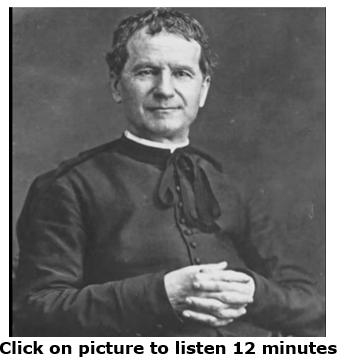
Fr. DON BOSCO EXPOSED THE DARK SECRET BEHIND ISLAM
I keep this one out here to view. Everyone should take the time to watch it. It will awaken you about the Muslim so-called religion (or should we call it for it is — a ‘cult‘.)
— And the truth the world forgot about the so-called Muslim religion.
Fr.Don Bosco, also known as John Bosco, was an Italian Catholic priest and educator, born on August 16, 1815. He founded the Salesian Society in 1859 to help disadvantaged youth, particularly boys, through education and community service. His teachings emphasized loverkindness, and the importance of education for young people, making him a beloved figure in Catholicism and a patron saint of youth. Don Bosco was canonized in 1934.
SILVER GETTING SLAMMED TO SHAKE YOU OUT – ‘DON’T BELIEVE THE LIES’

THIS IS THE ‘MOST IMPORTANT’ PIECE OF EVIDENCE IN OMAR PROBE
FAMILY SECRETS
NIDAL HASAN AND THE RETURN OF THE MILITARY FIRING SQUAD
Do you doubt now that when the prophets tell us about the coming public executions that they are not going to happen? They will be Nuremburg trials style executions as from the Nazi executions of WW2. Yes, it is really that bad in America and they will be cleaned out.

THE REAL REASON YOU PAY $4.50+ A GALLON GAS IN AMERICA
WE ARE NOT ALONE!
Please watch till the end. Do you see it now?
__________________________________________________
TRAPS : TRAPS : AND MORE TRAPS
Now let’s look at some of the traps that Julie Green was talking about in her prophetic words for this period of time. She titled her recent October 10, 2026 prophecy called “YOUR ENEMIES ARE WALKING INTO TRAPS EVERY DAY“
WHAT CAN BE EXPOSED, WILL BE EXPOSED… SAYS GOD THROUGH HIS PROPHETS.
Trap: This time for Maxine Waters
We think Iraq is bad? We have worse in our own U.S. It is time to clean these people out of our government and serve justice, if applicable. This has been going on way too long already. Claiming my time, Claiming my time, Claiming my time, Claiming my time, Claiming my time!
_______________________________________
Another Trap, this time for Shifty-Schiff
SHIFTY-SCHIFF HAD NO ANSWER
___________________________________________
Another Trap, this time for Ihan Omar:
TED CRUZ VS ILHAN OMAR: SIX FOLDERS TURN A HEATED HEARING INTO A RECORDS SHOWDOWN

AFTER HALF A CENTURY OF ABSENCE, PRESIDENT AL-ZAIDI BRINGS IRAQI SHIPPING BACK TO THE SEAS AND OPENS A NEW GATEWAY FOR GLOBAL TRADE.
The Iraqi government, headed by Ali al-Zaidi, is preparing to reinstate the national shipping line to regional trade routes after an absence of more than half a century. This move signals a trend toward reviving the maritime transport sector and strengthening Iraq’s presence in commercial shipping, coinciding with efforts to expand cooperation with Asian and Gulf countries and diversify the routes for goods reaching Iraqi ports. This will contribute to developing the transport system and reducing reliance on foreign companies.
The Ministry of Transport announced that October 15th will witness the launch of the first voyage of the Iraqi Shipping Line from the Jebel Ali port in the UAE to the Umm Qasr port in Basra Governorate. This comes after the cessation of Iraqi cargo ship activity in the region since the mid-1960s, and aims to provide a national option for transporting containers and goods and enhance Iraq’s ability to participate in regional trade.
This return comes within the Ministry of Transport’s plans to activate national carriers and develop their operational capabilities, in parallel with expanding maritime and land transport routes. The General Company for Iraqi Ports had previously announced that it was conducting talks with the Sultanate of Oman to enhance trade links between the two countries, and to facilitate the movement of goods from Omani ports to the port of Umm Qasr, with the possibility of linking these routes to the Grand Faw Port and the Development Road project.
In this context, the spokesman for the General Company for Maritime Transport, Talib Al-Badiri, affirmed that “the ongoing moves to develop maritime transport lines and link Iraqi ports to Asian markets represent an important step to enhance foreign trade, especially in light of the challenges facing international navigation,” noting that “diversifying shipping routes and cooperating with countries that have advanced ports and transport networks would facilitate the arrival of goods to Iraq and reduce the impact of regional unrest on import and export activity.”
Al-Badiri told Iraq Observer that “strengthening trade ties with China, India, Oman, and the UAE opens up broader horizons for Iraqi ports, especially Umm Qasr Port, particularly with the move to revitalize national shipping lines and develop transport capabilities.” He explained that “the importance of these routes is not limited to receiving imported goods, but extends to the possibility of expanding export activity and enhancing Iraq’s role in regional and international trade.”
These moves reinforce the government’s efforts to capitalize on Iraq’s geographical location in building an integrated transport network linking southern ports to regional markets, especially since developing national shipping lines can give Iraqi companies additional options for transporting goods and help revitalize port operations and related logistics services.
The General Company for Iraqi Ports had previously announced the opening of a direct shipping line linking the UAE’s Rashid Port to Umm Qasr Port, and the arrival of the first ship on this route last December, indicating expanding maritime cooperation with the UAE. The anticipated return of the Iraqi shipping line represents a further step in restoring the national carrier to this activity.
The return of the Iraqi maritime line after more than fifty years constitutes a new milestone in the rehabilitation of the national transport system, with the launch of its first voyages expected tomorrow, Thursday. The success and continuation of this step will enhance Iraq’s presence in the maritime shipping market and give foreign trade broader options in the coming period.
********************************************************************************
A SAUDI EXPERT SAYS PRESIDENT AL-ZAIDI’S VISIT TO SAUDI ARABIA IS “KEY TO SOLUTIONS” AND A PROMISING STEP TOWARDS REGIONAL STABILITY.
Saudi expert and political analyst Ashiq bin Mohammed bin Saeedan stated that the Iraqi Prime Minister’s visit to Riyadh carries promising positive dimensions and represents a significant strategic step towards strengthening regional stability.
In a statement to Iraq Observer, he explained that this visit constitutes a genuine gateway to opening new horizons of robust diplomatic and economic cooperation between Baghdad and Riyadh, thus contributing to establishing strong foundations for bilateral partnership.
In his analysis of the political aspects, Bin Saeedan described the visit as “key to solutions,” explaining that it reflects a shared desire to coordinate efforts and strive earnestly to find peaceful and sustainable solutions to the crises facing the region during this sensitive and complex period. He indicated that the step lays the foundation for an advanced stage of constructive dialogue aimed at achieving comprehensive regional security and prosperity.
Bin Saeedan also highlighted the humanitarian and political significance of the visit, considering it a genuine show of solidarity with the Kingdom of Saudi Arabia following the recent attacks targeting civilian sites, holy sites, and airports, reaffirming Iraq’s unwavering stance against terrorism. On the security front, he noted that security and political issues topped the agenda, particularly regarding the establishment of intelligence cooperation and direct coordination for information sharing and preventing any future border violations.
In his analysis, he emphasized the importance of the economic file in the bilateral talks, pointing to their focus on stimulating mutual investments in vital sectors including energy, electricity interconnection, and agriculture.
“Bin Saeedan” stressed that creating a safe and successful investment environment is a prerequisite for attracting Saudi and Gulf funds to the Iraqi market, stressing that these factors promise a bright future and strong and fruitful partnerships at all levels.
*******************************************************************************************
GOVERNMENT PLAN TO BRING THE EXCHANGE RATE DOWN TO 1550 DINARS
Government spokesman Haider al-Aboudi announced on Wednesday a plan to bring the dollar exchange rate in the parallel market to 1,550 dinars, while economic experts called for diversifying revenue sources, rationalizing public spending, and supporting the private sector, stressing the importance of working to bridge the gap between the official and parallel exchange rates.
Al-Aboudi said in a statement to the Iraqi News Agency (INA): “The government and the Central Bank are working according to a well-thought-out plan to bring the price of the dollar in the parallel market to 1,550 dinars per dollar in the near term.”
He added, “This path is based on secure and sufficient funds at the Central Bank that allow for the financing of foreign trade with high smoothness and to meet import needs.”
Regarding the previous transfers based on the current exchange rate, Al-Aboudi confirmed that “sufficient financial allocations have been secured to complete them in light of the previous rate and to fulfill the associated obligations.”
He added that “the Cabinet, in its twenty-third session, decided to exempt imported food and medicines from customs duties starting from October 7, 2026.”
STRATEGIC NECESSITY
In this regard, economist Hadi Hindas stressed that diversifying revenues is a strategic necessity to enhance the stability of the Iraqi economy and reduce the significant repercussions of economic shocks, especially in light of the widespread reliance on oil revenues and the fluctuations in energy prices in global markets, noting that the change in the exchange rate of the Iraqi dinar against the dollar is a result of the failure to work on diversifying financial revenues from the productive and service sectors.
Hindas added, in an interview with Al-Sabah, that building a balanced economy requires developing the productive sectors, foremost among them industry, agriculture and tourism, as well as activating investment, along with developing the tax system and improving the efficiency of collecting non-oil revenues. He pointed out that diversifying sources of income gives the state greater flexibility in managing crises, reduces pressure on the general budget, and contributes to protecting development spending, enhancing job opportunities and achieving long-term economic sustainability.
ECONOMIC SITUATION
In a related context, financial expert Dr. Ahmed Hadhil Al-Humaidawi described the Iraqi economic situation as “critical,” especially with the decrease in exported oil quantities by a percentage ranging between 40 and 50%.
Al-Humaidawi told Al-Sabah that “this reality is reflected in the structure of the gross domestic product, which is largely dependent on oil, while the contribution of the agricultural and industrial sectors, at best, represents only about 10 percent in the years following 2003, stressing the inevitability of moving towards economic diversification to reduce the absorption of external shocks, and working to establish sovereign funds and sufficient reserves to confront crises.”
GOVERNMENT DEBT
He added that “government debt rose from 32 trillion dinars in 2015 to 70 trillion dinars in 2023, before the approval of the three-year budget, and then to 109 trillion dinars,” indicating that the Prime Minister’s talk about the debt reaching 208 trillion dinars includes, according to his estimate, the debts of contractors, which amount to about 100 trillion dinars, as a result of large contracts with the private sector during the previous government.
Regarding the exchange rate adjustment, he noted that “the government resorted to this measure for financial reasons, not to achieve economic goals, as the exchange rate tool is usually used to support local production and achieve balance in the balance of payments,” pointing out that Iraq’s reliance on imports to meet about 90% of domestic consumption limits the ability of changing the exchange rate to stimulate local production.
He indicated that the financial impact of adjusting the exchange rate could provide the Ministry of Finance with additional liquidity of approximately 10 to 11 trillion dinars, according to his estimates.
The Prime Minister’s financial advisor, Mazhar Muhammad Saleh, had previously stated that the exchange rate adjustment was a precautionary measure to protect economic and financial stability, noting that foreign trade financing was proceeding in a regular and stable manner.
Saleh said: “The exchange rate of the Iraqi dinar against the dollar and other foreign currencies represents the external value of the dinar, and therefore its stability is closely linked to the availability of foreign currency and the economy’s ability to finance foreign trade needs.”
He explained that the repercussions of regional and international crises, especially the effects of war and unrest that may affect the movement of oil exports through the Strait of Hormuz, necessitate dealing with the potential repercussions on oil revenues, the general budget and foreign currency flows in a precautionary and well-thought-out manner.
*********************************************************************************************
PRESIDENT AL-ZAYDI: THE CABINET FORMATION IS COMPLETE AND WE HAVE FILLED THE VACANT PORTFOLIOS.
(Mnt Goat: Folks, it’s a month short of the November 2025 elections and they just now have their govt completed. Nothing to celebrate. They should be ashamed! ☹ I’d say this is a dysfunctional process. How about you?)
Prime Minister Ali Faleh al-Zaidi confirmed on Thursday that the cabinet formation is complete five months after the government was formed, stressing the commitment to implementing the government program’s priorities and responding to the aspirations of Iraqis.
Al-Zaydi said in a statement received by Iraq Observer that the government has worked diligently and persistently over the past months under extremely complex internal and external circumstances, explaining that the war in the region has imposed, and continues to impose, exceptional economic challenges on Iraq, in addition to security challenges that require the highest levels of responsibility and vigilance.
He added that the government continued to implement its ministerial program approved by the House of Representatives, worked to address complex issues and confront corruption, and took steps to strengthen the country’s sovereignty and independence of decision, leading to the end of the international coalition’s military presence in Iraq.
He explained that the completion of the cabinet formation and the appointment of deputies to the Prime Minister represent support for the government’s ability to manage national issues, and enhance coordination to implement the commitments and programs that citizens are waiting for.
He pointed out that the next stage requires doubling efforts and turning plans and decisions into tangible results that are reflected in the daily lives of citizens.
Al-Zaydi thanked the House of Representatives and the political forces for their contribution to completing the formation of the government, calling on the Deputy Prime Ministers and the ministers who gained the confidence of the Council to bear their responsibilities with the highest degrees of commitment, efficiency and integrity, and to harness their capabilities to serve the citizens and work in the spirit of one team to achieve the government’s goals.
*******************************************************************************************
US SANCTIONS IRAQI BANK OVER ALLEGED FINANCIAL LINKS TO IRAN
The designation is part of Operation Economic Outcast, a U.S. campaign aimed at cutting off Iran’s financial networks and limiting its ability to fund its military and regional allies. The designation is part of Operation Economic Outcast, a U.S. campaign aimed at cutting off Iran’s financial networks and limiting its ability to fund its military and regional allies.
The U.S. Department of the Treasury on Thursday sanctioned Iraq-based International Development Bank (IDB), accusing it of facilitating Iran’s access to the international financial system and maintaining ties with Iranian government entities and Iran-aligned militia groups in Iraq.
According to the Treasury Department, IDB has used Iranian capital to conduct business and allegedly transferred profits back to Iran in U.S. dollars. The department also accused the bank of exploiting Iraq’s former U.S. dollar wire auction system to facilitate financial transactions for Iran.
The Treasury said IDB was initially established by Iranian companies to support Iran’s economy and provide it with access to U.S. dollars. It also alleged that the bank received capital from the now-closed Bank Melli branch in Iraq following U.S. sanctions against the Iranian lender.
“The noose is tightening around Iran’s economy, and not even Iran’s so-called allies can save it,” U.S. Treasury Secretary Scott Bessent said, vowing to continue targeting financial channels that support Iran’s military and allied groups.
In a related move, the U.S. State Department designated Cuba-based Banco Internacional de Comercio S.A. (BICSA), citing its provision of services to Iran’s sanctioned Karafarin Bank since at least 2022.
The Treasury said the measures also target Iran-linked shadow banking networks, offshore institutions, and front companies allegedly used to evade sanctions, move funds internationally, and finance military activities.
Washington announced Operation Economic Outcast on August 24, warning that entities facilitating money laundering or sanctions evasion on Iran’s behalf risk losing access to the U.S. financial system.
********************************************************************************************
US STATE DEPARTMENT: THE IRAQI MARKET OFFERS PROMISING INVESTMENT OPPORTUNITIES FOR AMERICAN COMPANIES.
The US State Department affirmed that the Iraqi market offers promising trade and investment opportunities for American companies and exporters, noting that strengthening economic cooperation between the two countries requires improving the business environment and addressing regulatory challenges, in addition to implementing reforms that support Iraq’s path to joining the World Trade Organization.
The ministry stated that government contracts, particularly in the energy sector, provide opportunities for commercial and investment expansion, as Iraq seeks to attract foreign investment and strengthen local industries.
In a related context, data from the Office of the US Trade Representative showed that the volume of trade between Iraq and the United States declined to about $10.4 billion during 2025, compared to 2024, which recorded a higher level of about $1.6 billion.
Trade in goods between the two countries amounted to about $7.9 billion, distributed between US exports to Iraq worth $1.7 billion, and US imports of Iraqi goods worth about $6.3 billion.
U.S. imports of Iraqi goods fell by 16.8% year-on-year, while U.S. exports to Iraq declined by 1.2%, shrinking the U.S. trade deficit in goods with Iraq to $4.6 billion, a decrease of 21.2%.
As for trade in services, its volume reached about $2.4 billion, with US service exports to Iraq declining by 15.5% to reach $1.9 billion, compared to an increase in US imports of Iraqi services by 2.1% to $541 million.
The United States’ surplus in services trade with Iraq also decreased by 21%, to about $1.4 billion during 2025. The US State Department stressed that Iraq’s accession to the World Trade Organization requires fundamental regulatory reforms that would create a
business environment and expand the integration of the Iraqi economy into the global trading system.
***************************************************************************************
SECURITY STABILITY IS THE KEY TO ECONOMIC RECOVERY: A MEMBER OF PARLIAMENT REVEALS TO IRAQ OBSERVER THE GATEWAY TO ATTRACTING INVESTMENTS TO IRAQ
Iraq’s ability to balance consolidating security and enhancing economic performance is crucial, given the interconnectedness and mutual influence of national issues. Sustainable security is a fundamental pillar for creating an attractive investment environment capable of drawing in companies and capital and driving development. Meanwhile, economic reforms require a stable political and security climate to ensure tangible results.
MP Taha al-Difai emphasized that security, political, and economic issues are closely intertwined, and a genuine economic revival cannot be achieved without political and security stability. He pointed out that providing a safe and stable environment would encourage local and foreign companies to enter the Iraqi market and invest their capital in projects that contribute to revitalizing the national economy.
Al-Difai told Iraq Observer, “The government has succeeded in working simultaneously to strengthen security and monopolize weapons in the hands of the state, alongside taking practical steps to stimulate the economy and attract investments, particularly in the energy sector, by providing suitable investment opportunities and offering the necessary facilities to companies wishing to operate in Iraq.”
He added that “ensuring a stable business environment is a crucial factor in boosting investor confidence, paving the way for project implementation, job creation, and more effective economic activity,” emphasizing the importance of coordination between security and economic tracks to guarantee the achievement of development goals.
Given the challenges facing the Iraqi economy, there is a pressing need for a comprehensive government vision that links security stability with economic reform, translates the measures taken into tangible investment opportunities that positively impact citizens’ lives, contributes to diversifying income sources, and reduces dependence on oil revenues, thereby enhancing the national economy’s capacity for growth and sustainability.
********************************************************************************************
IRAQI MILITIA LEADER: WE WILL FIGHT IF IRAN FACES EXISTENTIAL THREAT, RELATIONS WITH US WILL NEVER BE NORMAL
US-designated militia leader calls American withdrawal a military defeat, warns Kurdish and Sunni parties Washington will abandon them, and says his faction conducted twice as many operations against US forces as Washington acknowledged
Abu Alaa al-Walai, secretary-general of Kata’ib Sayyid al-Shuhada, the Iranian-backed Iraqi armed faction designated a Foreign Terrorist Organization by the United States in September 2025, gave a rare and wide-ranging interview in which he declared that his group will fight alongside Iran if Tehran faces a genuine existential threat, that relations with the United States will never be normal as long as Washington is regarded as the Great Satan, that the American withdrawal from Iraq was a military defeat rather than a goodwill gesture, and that his faction conducted far more than the 600 operations against American forces and bases that Washington itself acknowledged during the conflict.
“If Iran faces a genuine threat to its existence, we will certainly participate in that battle,” al-Walai said.
If the threat is not existential, however, we will not participate, as we demonstrated during the recent war against Iran.
The American Withdrawal
Al-Walai rejected the framing of the September 30, 2026, US military withdrawal from Iraq as a concession or goodwill gesture toward his faction and others. “We believe the American withdrawal is intended to create a vacuum, destabilize Iraq’s security, and drag us into infighting and instability,” he said. “We believe that the Americans did not withdraw but were defeated in Iraq.”
He pointed to operational data as evidence. “During the forty-day war they acknowledged that resistance factions had carried out 600 military operations against them and their bases. We say the number is much higher, perhaps twice as high.” He also referenced Kurdistan Region Prime Minister Masoud Barzani’s statement that the Kurdistan Region had been subjected to more than 1,000 operations, and claimed his faction’s operations extended beyond Iraq. “Our operations pursued them even beyond their bases, following them to hotels and homes after they left those bases,” he said.
Relations With The US: Never Normal
On the question of whether Iranian-aligned factions could ever have a normal relationship with the United States, al-Walai was categorical. “Relations with the United States will never be normal as long as it is regarded as the Great Satan and continues policies that harm Iraq,” he said. He described the US embassy in Baghdad as a source of evil that blatantly interferes in Iraqi political decision-making and exerts pressure on political forces.
Al-Walai also issued a direct warning to Kurdish and Sunni political parties in Iraq. “There is also a clear message to Kurdish and Sunni parties: America will abandon them, just as it abandoned the SDF, Afghanistan, and others,” he said.
Ties To Iran
Al-Walai described his faction’s relationship with Iran in terms that go beyond political alignment. “Our relationship with Iran is historical, religious, and sectarian. We see Iran as a neighbor and a friend. It provided support in every form during the war against ISIS, from logistical support, training, and weapons to the participation of Iranian personnel,” he said. “This is a deeply rooted relationship based on religion and neighborly ties that cannot be severed. Our blood has mingled on the same battlefields and in the same trench.”
On Disarmament
When asked whether his faction would comply with Prime Minister Ali al-Zaidi’s repeated demands that militia weapons be handed over to the state, al-Walai stopped short of outright refusal but attached conditions. “We have complied with the decisions of the Quadripartite Committee and the provisions of the Sovereignty Document, conditional on the other party’s compliance,” he said, referencing the internal Iraqi agreement between the government, four armed factions, and the Coordination Framework designed to regulate faction weapons and restrict them to the state.
The Sovereignty Document and Quadripartite Committee framework represents the existing internal Iraqi mechanism for militia disarmament, distinct from the June 2027 deadline that al-Zaidi announced at the UN General Assembly in September. Al-Walai’s conditional compliance with the Sovereignty Document framework suggests his faction views the existing internal process, rather than al-Zaidi’s external deadline linked to Washington’s dollar transfer ultimatum, as the legitimate mechanism for any weapons handover.
On The $10 Million US Reward
Al-Walai addressed the US Rewards for Justice program’s $10 million bounty for information about him directly. “This has not curtailed my activities or movements. Nor has it diminished my role in bringing opposing views closer together, defusing crises at times, and preventing conflicts and disputes from escalating, particularly between the government and certain factions,” he said.
Who Is Abu Alaa Al-Walai?
Hashim Finyan Rahim al-Sarraji, known as Abu Alaa al-Walai, is the secretary-general of Kata’ib Sayyid al-Shuhada, an Iraqi armed group founded in 2013 and active in Iraq and Syria. Born in Baghdad, he was arrested during the 1990s under Baath Party rule and released in 2002. After 2003 he became associated with Shia armed factions including Kata’ib Hezbollah, was arrested by American forces and held for several years before being released in 2010, and subsequently became associated with the establishment and development of Kata’ib Sayyid al-Shuhada. The United States placed al-Walai and the group under terrorism-related designations in November 2023 and designated the group a Foreign Terrorist Organization in September 2025. The US Rewards for Justice program announced a $10 million reward for information about al-Walai in 2026.
*********************************************************************************************
SWIFT CREDITS REACH LOCAL BANKS, BUT TRADERS ARE STUCK BETWEEN TWO EXCHANGE RATES – URGENT
The SWIFT transfers of foreign credits arrived at the local banks on Sunday, but the local banks are still refraining from releasing them to traders and importers, amid uncertainty about the approved exchange rate.
A source told Baghdad Today that private banks attribute their refusal to the lack of clarity regarding the final pricing from the Central Bank, and whether the dollar price will be calculated on the basis of 132,000 or 152,000 dinars per 100 dollars.
He added that the Central Bank of Iraq noted, in a letter dated October 7, the adoption of the previous exchange rate for amounts deposited before the change in the dollar exchange rate.
The source pointed out that the delay in launching the SWIFTs and the ambiguity regarding the exchange rate coincided with a noticeable rise in the dollar prices in the parallel market.
***********************************************************************************
IN RESPONSE TO WHAT BAGHDAD TODAY PUBLISHED, THE CENTRAL BANK DIRECTS BANKS TO FACILITATE FOREIGN TRANSFERS – URGENT
The Central Bank of Iraq directed all licensed banks to facilitate foreign transfer procedures for their customers and completed transactions, while strengthening their account balances abroad according to their needs.
According to a letter issued by the Investment Department of the Central Bank and received by “Baghdad Today”, the bank will work to strengthen banks’ balances abroad according to their needs, while exempting them from the deposit period requirement through the RTGS system.
The directive comes in response to what was published by Baghdad Today regarding the delay in releasing the SWIFTs of foreign credits for traders and importers, amid ambiguity about the approved exchange rate.
************************************************************************************
AL-MADA REVEALS IRAQI MOVES TO BORROW $5.4 BILLION FROM THE IMF
The Independent Press Agency reported that the Iraqi newspaper Al-Mada revealed preliminary negotiations between Iraq and the International Monetary Fund to obtain external financing that could reach $5.4 billion, amid increasing financial pressures and a widening budget deficit, amid economic warnings about the potential impact of loans on government spending and citizens’ purchasing power.
The newspaper stated that these developments bring back to the forefront questions about the effectiveness of the economic measures taken by the government, especially the adjustment of the dollar exchange rate against the dinar, after Prime Minister Ali Faleh al-Zaidi confirmed in previous statements that this measure aims to avoid external borrowing and reduce the accumulation of debt.
According to the report, the Iraqi government has not yet announced details of the potential loan program, its value, or its conditions, despite the IMF Managing Director Kristalina Georgieva announcing the Fund’s readiness to provide financial support and economic advice to Iraq upon request for a financing program.
On Saturday, October 17, 2026, during the annual meetings of the International Monetary Fund and the World Bank in Bangkok, Georgieva announced that the international institution intends to strongly support Iraq through financing and assistance with economic policies, without announcing the amount of the loan or the date of concluding a final agreement.
Al-Mada quoted the Prime Minister’s financial advisor, Mazhar Muhammad Saleh, as confirming that the praise of international financial institutions for the Iraqi reforms represents a positive indicator of the course of economic policies, but he stressed that the success of the reforms should be measured by their ability to achieve tangible results, including improving the management of public finances, reducing dependence on oil, and enhancing non-oil revenues.
Saleh explained that developing the tax and customs systems, rationalizing public spending, and enhancing transparency and digital transformation are necessary steps to address financial imbalances, noting the importance of developing the banking sector, creating an investment environment, and revitalizing productive sectors.
The financial advisor, according to the newspaper, did not confirm proceeding with a specific loan agreement, nor did he deny the existence of talks with the International Monetary Fund, merely emphasizing the importance of continuing technical and institutional cooperation with the Fund.
In contrast, economist Nabil Al-Marsoumi revealed in a statement to Al-Mada newspaper that Iraq is conducting preliminary negotiations to obtain a financing tranche estimated at about $5.4 billion, noting that the need for external financing is increasing with the widening of the expected deficit in the 2027 budget.
Al-Marsoumi pointed out that the expected deficit could reach about 43 trillion dinars, given the high expenditures and limited local funding sources, in addition to the pressures facing foreign reserves.
He warned that reaching an agreement with the International Monetary Fund might require a commitment to a package of financial and economic reforms, likely including controlling expenditures, adjusting government support mechanisms, and activating electricity fee collection, as well as other measures that could affect public spending.
According to the report, these conditions remain expectations put forward by economic specialists, and are not official conditions announced by the International Monetary Fund regarding Iraq.
For his part, economic and financial researcher Jalil Al-Lami warned in an interview with the newspaper that the increasing reliance on foreign loans could lead to a rise in the size of the public debt and the costs of servicing it, especially if the funds are used to finance current expenditures instead of addressing structural imbalances in the economy.
Al-Lami explained that obtaining a hypothetical loan of $10 billion with an annual interest rate of 5% means bearing interest of up to $500 million annually, without taking into account the principal installments and other fees.
He stressed that these figures represent a mathematical example to illustrate the risks of borrowing, and are not the value or benefit of a financing program that has already been agreed upon.
The report addressed the implications of adjusting the dollar exchange rate, as Al-Lami pointed out that raising the official rate from 1300 to 1500 dinars, according to the example he presented, gives the government additional revenues valued in dinars when converting dollar oil revenues, but it does not represent a real increase in the oil revenues themselves.
He added that such measures may contribute to easing the pressure on the budget in terms of accounting, but they may, on the other hand, lead to an increase in the costs of imported goods and affect the purchasing power of citizens.
He stressed that addressing the fiscal deficit sustainably requires diversifying income sources, improving tax and customs revenues, reforming the banking sector, and developing industry, agriculture, and investment, instead of relying on borrowing as a permanent solution.
These developments raise economic questions about the Iraqi government’s ability to balance financing its financial obligations with maintaining necessary spending levels, particularly salaries, public services, and social protection programs.
A question also arises regarding the nature of the funding required from the International Monetary Fund, and whether it will be allocated to support financial and monetary stability, or to address a broader funding gap within an agreed economic reform program.
Observers believe that the main challenge lies not in obtaining the loan alone, but in the government’s ability to turn any external financing into an opportunity to reform public finances and enhance sustainable revenues, without imposing additional economic burdens on citizens.
In the absence of a final agreement or official financing terms, the external borrowing file remains open to multiple possibilities, while the need for government clarification regarding the size of expected financial commitments, loan repayment mechanisms, and the nature of reforms that may accompany any new program with the International Monetary Fund is increasing.
This issue brings back to the forefront the most prominent question raised by Al-Mada: If the adjustment of the dollar exchange rate was aimed at avoiding external borrowing, what is driving Iraq today to seek new international financing, and what is the cost of that to the economy and the citizen?
*********************************************************************************************
IRAQI ECONOMIC REFORMS: INTERNATIONAL PRAISE AWAITS TANGIBLE RESULTS
The financial advisor to the Prime Minister, Mazhar Muhammad Saleh, confirmed that the Iraqi economic reforms enhance confidence in the economy and improve the management of public finances, but he stressed that their success is measured by sustainable results that include spending efficiency, financial stability, and reducing the impact of oil price fluctuations.
Financial pressures on Iraq are increasing as the budget deficit widens, amid a move towards external borrowing after the International Monetary Fund announced its readiness to provide financial support to Baghdad at the official request. This development raises questions about the effectiveness of government economic measures, particularly the decision to raise the dollar exchange rate, which Prime Minister Ali Faleh al-Zaidi had previously confirmed was aimed at avoiding external borrowing and doubling debts.
While no decisive government position has been issued confirming or denying the continuation of the lending program, economic specialists warn of the consequences of the potential reform conditions, interest costs and their impact on the livelihood of citizens.
Amid talk of an imminent borrowing plan, the Prime Minister’s financial advisor, Mazhar Muhammad Salih, presented a vision that addresses international praise for economic reforms, without confirming or denying Baghdad’s actual intention to borrow from the International Monetary Fund, a matter on which, as of the writing of this report, no official statement has been issued by the Iraqi government clarifying its position.
IMF praise
Saleh said that “the praise from IMF officials for the efforts made by the Iraqi government in implementing financial and economic reforms reflects the importance of the reform path adopted by Iraq to enhance economic stability, consolidate the foundations of sound public finance management, and raise the efficiency of financial and monetary policies.”
He explained that “this praise represents a positive indicator of the importance of the measures taken to enhance confidence in the Iraqi economy and develop its relations with international financial institutions.”
He added that “the true measure of the success of these reforms depends on their ability to achieve tangible and sustainable results that reflect on the strength of the financial situation, improve the efficiency of government spending, enhance economic stability, and reduce the repercussions of oil price fluctuations on the general budget.”
Saleh added that “the reforms being worked on by the Ministry of Finance are of strategic importance, as they are a fundamental pillar for restructuring the national economy, diversifying revenue sources, and reducing excessive dependence on oil resources,” explaining that “this requires developing the tax and customs system, raising collection efficiency, expanding the base of non-oil revenues, enhancing digital transformation and transparency, in addition to rationalizing public spending and directing resources towards development priorities and economically viable projects.”
He pointed out that “the success of these reforms is linked to creating a stable and attractive investment environment based on clear legislation, simplified procedures, development of the banking sector, and expanding financing opportunities for small and medium enterprises, which enhances the contribution of the private sector to economic activity, supports productive sectors, provides real job opportunities, and paves the way for a transition towards a diversified economy that is more capable of growth and sustainability.”
*******************************************************************************************
45 TRILLION OUTSIDE THE BANKS… PARLIAMENTARY FINANCE COMMITTEE REVEALS THE EXTENT OF THE CRISIS OF CONFIDENCE IN BANKS
The head of the parliamentary finance committee, Uday Awad, revealed the existence of a cash mass ranging between 40 and 45 trillion dinars outside the Iraqi banking system, attributing this to the weak confidence of citizens in banks, while stressing the work to find solutions to return these funds to the banking cycle .
Awad said during a televised interview followed by Al-Sa’a Network that “there is a cash mass estimated at about 40 to 45 trillion dinars outside the banking system,” noting that “the lack of confidence in banks has led citizens to keep their money away from them.”
He explained that “addressing the problem requires restoring the citizen’s confidence in the banking system and developing its working mechanisms,” noting that “automating the banking sector represents one of the main paths to moving from traditional collection methods to a more organized financial system.”
The head of the Finance Committee addressed the exchange rate crisis, explaining that “the Central Bank pledged to take measures to reduce the gap in dollar prices, including raising the sales ceiling to cover citizens’ needs related to travel, study and treatment.”
Awad’s remarks come in conjunction with the financial pressures facing the state, as he revealed that “the budget was prepared based on an oil price of $58 per barrel, with a deficit exceeding 50 trillion dinars,” stressing that “the Finance Committee will work on making transfers and reducing unnecessary expenditures to reduce the size of the deficit without putting pressure on the Central Bank’s reserves.”
According to Awad, “Addressing financial imbalances is not only related to the budget, but also includes reforming the banking sector and bringing funds outside banks back into the financial system, allowing for the expansion of banking activity and reducing reliance on traditional cash transactions.”
******************************************************************************************
NOT A SINGLE IRANIAN ORGANIZATION”: AN ECONOMIC EXPERT REVEALS THE INTERNATIONAL ENTITIES FUNDING IRAQI PROJECTS.
Economic expert Mustafa Hantoush revealed on Monday that Iraq continues its dealings with international financing institutions, including the World Bank, the Japan International Cooperation Agency (JICA), and French and Korean financing institutions, indicating that resorting to the International Monetary Fund does not necessarily mean obtaining a loan conditional on economic measures .
Hantoush said in a televised interview followed by Al-Sa’a Network that “Iraq has significant dealings and ongoing projects with international financing institutions, including the Japan International Cooperation Agency (JICA), as well as French and Korean financing institutions,” noting that “the volume of financing and cooperation with these entities is large and ongoing .”
He explained that “the International Monetary Fund offers more than one type of loan, including development loans allocated to specific projects, such as electricity and education, and they are financed based on the project’s objectives, its study, and the ability to achieve the required results .”
He added that “this type of loan differs from programs that include direct management or economic conditions, and also differs from commercial loans with high interest rates,” stressing that “dealing with the International Monetary Fund does not necessarily mean submitting to dictates or conditions, as it depends on the type of loan and the financing mechanism .”
Hantoush noted that “cooperation with international financing institutions has not stopped,” pointing out that “evaluating any new loan requires knowing its nature, objectives and conditions, especially in light of the discussions related to the budget and borrowing in Iraq.
******************************************************************************************
DOES IRAQ HAVE ENOUGH DOLLARS TO COVER ITS NEEDS?
Economic expert Mustafa Hantoush confirmed on Monday that the dollars available in Iraq are sufficient to cover its commercial needs, indicating that about 95 to 97% of dollar usage is through money transfers, while the share of direct cash transactions does not exceed 3 to 5 %.
Hantoush said in a televised interview followed by Al-Sa’a Network that “importers use dollars through remittances to finance the purchase of goods from abroad, as the funds are transferred to the beneficiary through banks, in exchange for paying their value in dinars within Iraq .”
He added that “the prevailing perception among citizens that cash dollars represent the entirety of the country’s needs does not reflect the reality of transactions,” explaining that “cash constitutes a limited percentage of total dollar usage, while remittances cover the largest part of Iraqi trade .”
Hantoush pointed to “the delay in the arrival of cash dollars during some months,” saying that “its shipments may not arrive on their usual dates,” noting “the existence of American observations on this matter.”
*******************************************************************************************
THE IRAQI DINAR IS THE SECOND WORST-PERFORMING ARAB CURRENCY; DOLLAR PRESSURES POSE A DIFFICULT TEST FOR MONETARY POLICY.
The classification of the Iraqi dinar among the Arab currencies that have declined the most against the US dollar has raised widespread questions about the future of monetary stability in Iraq, and the ability of the Central Bank to contain the increasing pressures on the exchange market, at a time when the economy is facing challenges related to oil revenues, government spending and the heavy reliance on imports.
Data circulating and attributed to Bloomberg indicates that the Iraqi dinar ranks second in the Arab world in terms of poor performance, after the Libyan dinar. This development reflects the magnitude of the challenges facing monetary policy, but it does not necessarily mean that Iraq has the second weakest currency in the world in terms of its nominal value.
These indicators are of particular importance given the sensitivity of the Iraqi economy to dollar movements, due to the country’s reliance on oil revenues denominated in US dollars, while local markets depend on imports to meet a large part of citizens’ needs.
According to a report published by Asharq Bloomberg on October 19, 2026, the currencies of four Arab countries were among the worst-performing currencies since the beginning of the year. Data reports indicated that the Libyan dinar declined by 15.6%, followed by the Iraqi dinar at 14.2%. However, this ranking alone is insufficient to prove that the Iraqi dinar is the second worst-performing currency globally.
This classification comes after the decision taken by the Iraqi authorities on October 7 to amend the official selling price of the dollar to the public from 1320 to 1520 dinars, in response to the economic and financial conditions the country is going through, particularly the disruptions that have affected oil exports through the Strait of Hormuz.
Under the new pricing, the Ministry of Finance set the dollar purchase price at 1,500 dinars and the selling price to banks at 1,510 dinars, reaching 1,520 dinars for the end user. This represents an increase in the official dollar exchange rate of approximately 15.2%, while the dinar’s value, when calculated in dollar terms, has decreased by about 13.2%.
From an economic standpoint, devaluing the dinar gives the government greater ability to convert dollar-denominated oil revenues into larger amounts in the local currency, which could help it finance salaries, operating expenses, and public obligations. However, these financial gains are offset by a cost borne by the consumer, due to higher prices for imported goods and a decline in the purchasing power of incomes denominated in dinars.
The danger of this shift lies in the fact that the Iraqi economy is heavily reliant on imports, including food, medicine, electrical appliances, and production inputs. Therefore, the increased cost of obtaining dollars could gradually be passed on to the prices of goods and services, even in sectors that do not directly deal in US currency.
In this context, economic experts who spoke to Asharq Bloomberg warned of the transfer of the effects of the exchange rate adjustment to local markets, with the possibility that some traders may resort to raising prices as a precaution in anticipation of further fluctuations, which may lead to increases that exceed the direct impact of the exchange rate change.
The challenges do not stop at the official rate, as the difference between the rate adopted by the central bank and the rates traded in the parallel market is an important indicator of the level of demand for the dollar and the extent to which official banking channels are able to meet market needs.
The wider the gap between the two exchange rates, the greater the pressure on traders, importers, and citizens, and the higher the likelihood of speculation and price volatility. Conversely, narrowing this gap requires consistent financing of foreign trade, strengthening confidence in banks, and providing clear mechanisms for obtaining foreign currency within legal frameworks.
Despite these pressures, the Central Bank of Iraq, when announcing the exchange rate adjustment, affirmed that its foreign reserves were sufficient to finance foreign trade, settle international bank card transactions, and meet the cash needs of travelers. This assertion indicates that the exchange rate adjustment does not necessarily mean that reserves have been depleted or that the country is unable to finance its imports.
Recent developments reveal a deeper economic problem: Iraq’s financial stability is linked to oil price movements and export volumes, while non-oil productive sectors contribute only to providing sustainable sources of foreign currency.
The heavy reliance on government spending also means that any decrease in oil revenues is quickly passed on to the general budget, and puts decision-makers in front of difficult choices regarding spending, borrowing, monetary policy and the exchange rate.
The future trajectory of the dinar is expected to depend on a number of key factors, most notably the regularity of oil exports, the volume of dollar revenues, the level of foreign reserves, the central bank’s ability to manage demand for dollars, and the government’s success in controlling spending and boosting non-oil resources.
If pressure on oil revenues persists and the gap between the official and parallel exchange rates widens, markets could face increased volatility and higher living costs. However, improved dollar inflows, stable exports, and strengthened confidence in the banking system could help alleviate these pressures without necessarily requiring a further adjustment to the exchange rate.
The ranking of the Iraqi dinar among the worst-performing Arab currencies during 2026 puts economic policy to a test that goes beyond simply defending the value of the currency, to include the state’s ability to protect the purchasing power of citizens and achieve a balance between the requirements of the budget and monetary stability.
The most important question remains: Does the decline of the dinar represent an exceptional measure imposed by economic circumstances, or is it an indication of structural imbalances that call for deeper reforms in the management of public finances, the banking sector, and the Iraqi economy?
Between these two possibilities, the movement of the dollar, commodity prices, and the level of oil revenues during the coming months will be crucial indicators for assessing the results of the decision and its repercussions on the economy and the citizen.
********************************************************************************************
Their words not mine…..No Rumors, No Hype, No Opinions ,,,,,
Just the FACTS!
Disclaimer: All information in this newsletter is not intended for investment decisions / purposes. Mnt Goat is not a financial analyst, planner, banker, attorney or associated in any role with giving out professional investment advice.
Auf Wiedersehen
Much love to ya all,
Mnt Goat
*********************************************************************************************


Leave a Reply