

Disclaimer: All information in this newsletter is not intended for investment decisions / purposes. Mnt Goat is not a financial analyst, planner, banker, attorney or associated in any role with giving out professional investment advice.
ABOUT THE NEWSLETTER:

August 27, 2026 Mnt Goat News Brief
Guten Tag everyone:
Can you say- ‘remove-the-zeros!’ 😊 Yet a third confirmation from a very creditable cabinet source in Iraq that removal of the zeros is happening and is underway. Today’s news is all WOW! WOW! WOW! news, yes again! Can you say ‘eins, zwei, drei’. Let’a all sing it together…….
Confirmed for a third time -remove the zeros!
GIVE A GIFT TO MNT GOAT
I decided to allow everyone to give a Free-will GIFT to Mnt Goat on PayPal if you so desire. Here is the link below. Please show your appreciation for all the hard work I do.

I recommend $15-$20 dollars a month or whatever you can afford. Do you realize I write up to eight (8) Newsletters every month. This is like a second job to me. The only way I know that people are reading and appreciating all the FACTUAL news I bring is through their appreciation. If I do not receive equal appreciation for all the hard work I do, I will simply end the Newsletter and save myself endless hours at the computer. You do want to get paid for your job, don’t you? What makes my job any different? Tell me….. I am tired of this RV saga just as you are.
Let’s all try to chip in!

____________________________________
Proverbs 11:25
“Whoever brings blessing will be enriched, and one who waters will himself be watered.”
STATUS OF THE RV
There are not many articles to review today but do you want quantity or quality? Having a Thursday Newsletter again takes a lot of relief from us to read such lengthily Newsletters on Tuesday and having to explain it all and catch up.
Today we are going to pick apart of VERY SPECIAL article that gives us soooooooooo much information and confirms sooooooooo much of what my CBI contact has told me. But now you have it all from their mouths not mine, yes in their writing. There should be no wonder in you minds now if Mnt Goat really has a ‘CREDITABLE’ source in the Central Bank or not. How else could I be passing on information that weeks later comes out in the news and then some?
Welcome back to our Thursday Newsletter!
I hope to keep this one ALIVE too in this critical period of the process to get to FOREX. I want to take this opportunity to thank everyone for your support of the Newsletter and blog, especially Kenneth D., Ashe V., Nancy L., Liz C., Jay P., Robert H., Rodney B.. As you know I take a lot of my time to research, with calls to Iraq and to get the FACTS correct before presenting them to you, at least what we know at the time. Of course, things can change and we all hope and pray they don’t, but it’s not under our control. I have to believe that our prayers are working. Folks, this could have dragged on for another ten or twenty years. President Trump too is making a huge dent in getting this done.

All we can really do is listen to the news from Iraq and try figure this all out. But I will add there are elements that want to lie to us and many of these intel gurus have bought into these stupid lies of an every day / any day RV bullshit – hook line and sinker. If they were a fish they would be on the supper table….lol.. lol.. 😊. My wish today is that I have made a dent, an impact in helping everyone, even the stupid intel gurus, that read my blog for their own use. I certainly hope that all my readers know better now after over two decades of this nonsense.
THE PROBLEM: Again, in today’s news another recent article defining the problem Iraq is facing and how this coincides with the solution of removing the zeros from the dinar. Like rats facing a nasty cat, they are in a corner, trying to fight their way out as they delayed this project to convert the currency over way too long already. Now they really have little choice but to do it and do it soon. Can they wait a couple years even?
In one of today’s articles titled “ADMINISTRATIVE REVIEWS TARGET IRAQI STATE-OWNED BANKS AMID LIQUIDITY CRISIS AND DELAYED SALARY PAYMENTS” again we clearly see the problem as they define it, not me.
I quote from the article – “An informed source revealed on Wednesday that comprehensive administrative assessments are being conducted in a number of government banks and financial institutions linked to the financial and economic sectors, coinciding with the financial crisis and the delay in paying employee salaries. The source indicated that files have been opened regarding the waste of public funds, the decline in liquidity, and information and reports that he described as “misleading” submitted by some departments to officials.”
Over these past weeks I have shown you so much proof that the Financial Committee and the CBI want to move forward to remove the zeros and reform the currency. In today’s news I bring you yet even juicier news than before, if it can even get any better. Well… it does get better and so hang on to your seats.
Yes, we have yet a third confirmation that they are now moving ahead removing the zeros (Project to Delete the Zeros) which I will get to shortly. First, if you recall in my 081826 Newsletter we had Al-Zaidi’s cabinet member, Communications Minister Mustafa Sanad told us Iraq had decided to remove zeros from the dinar and reprint the currency. Then many negative articles came out later to defy this news. Many of us got discouraged.
Then secondly, in my 082526 Newsletter just earlier this week Jamal Kojar, a member of the Finance Committee in Parliament, confirmed on Tuesday, August 25th that there is a government trend towards officially removing zeros from the Iraqi dinar and issuing a new paper currency.
In today’s Newsletter we learn of yet a third confirmation from Mansour Al-Baiji, a prominent member of Iraq’s Parliamentary Finance Committee, that the project to transition to the newer lower denominations is real and they are now making a readiness of a new Iraqi currency, and the imminent arrival of the draft law to remove zeros to the House of Representatives for legislation and voting.
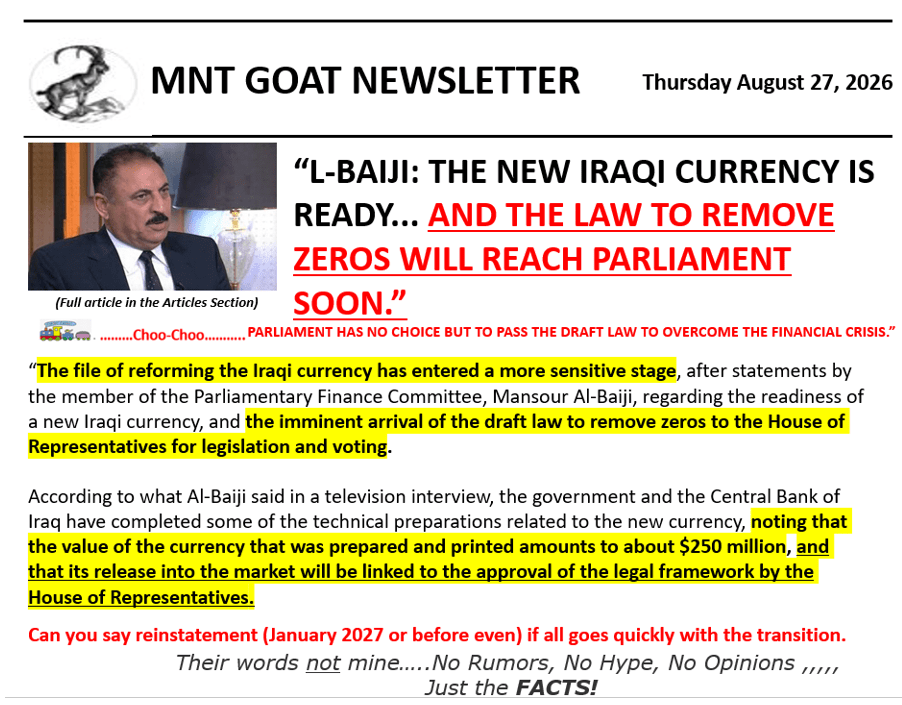
Please see a most recent article titled “L-BAIJI: THE NEW IRAQI CURRENCY IS READY… AND THE LAW TO REMOVE ZEROS WILL REACH PARLIAMENT SOON”.
I will quote from the article – “According to what Al-Baiji said in a television interview, the government and the Central Bank of Iraq have completed some of the technical preparations related to the new currency, noting that the value of the currency that was prepared and printed amounts to about $250 million, and that its release into the market will be linked to the approval of the legal framework by the House of Representatives”
So, let’s take this article apart piece by piece. Yes, you can see they have already printed the lower denominations. This is now FACT not rumor.
The next step is getting the DRAFT law through parliament and passed in order for the CBI to begin the process. Time is not on their side. My CBI contact told me last week they intended to pass it to parliament by week end. So this should be completed already.
I want to emphasis again that time is NOT on their side. They can’t dog this effort like other pieces of legislation. The salaries and retirements have to get paid. They might sneak by borrowing funding for August until early September but then September is in their faces too as they delay August into early September and then what about September, which is supposed to be paid also in early September. Do you see where I am going with this?
So, in the article from the Al-Baiji televised interview, there are two options he tells us about that Parliament may go:
One option is a more gradual approach of slowly introducing the newer lower denominations over a period of two years, allowing the three zero notes to coexist since there is NOT going to be a rate change it should not matter.
The second option is to collect the three zeros notes more quickly setting a deadline and then nullifying the three zeros notes in country after the passing of the deadline.
With time being a priority I do not think they can afford to collect these notes slowly but rather must go quickly to liquify the banks in order to pay salaries and retirements that are past due. Remember that these hordes of currency amounts to nearly 80-90% of the M2 currency mass.
In the article I found it nice that even presented a list of the tasks needed to complete and the order of them. We have not yet see this kind of detail in any of the articles. This also makes me believe they are really serious about this event.
I quote from the article – “Here, a distinction must be made between three levels:
First: Printing or preparing new banknotes.
Second: Enacting a law that allows for the currency restructuring process.
Third: Actual implementation and currency exchange in the market.
Moving from level one to level three may take months or years, depending on the law and the timetable that the authorities will set.”
So, we can see that depending on the option they take it could take months or years. The option of months fits nicely in the Dr Shabibi plan he laid out in 2012. If you recall he started distributing the coins in September 2012 and then was abruptly stopped by the IMF with false allegations of corruption in the CBI by Nori al-Maliki. Maliki of course did not want to kill the goose that was laying the golden eggs for Iran and his buddies. The reinstatement scheduled for January 2013 would have put an end to all of it at that time.
Oh…. isn’t Iraq as this same spot now as it was in 2012 except that Al-Zaidi is at the helm instead of the crooked Maliki. Al-Zaidi is on a binge to end the corruption and retrieve much of this stolen money. He is not in favor of Iranian influence in Iraq and promised to oppose the corruption unlike in 2012 when Maliki was in power. Yes, times have changed. Of course there is also the current Iranian issue and funding Iran to bypass the current Trump administration embargo and sanctions. Reinstating the IQD would certainly help end this too.
I also find a part in the article that I could have written myself from the information my CBI contact has been giving me all along. I will quote from it:
“Removing zeros does not automatically mean an increase in the value of the dinar. This point will be the most sensitive in the Iraqi market.
If, for example, the exchange rate before the removal of zeros reflected a certain value of the dinar against the dollar, then removing three zeros does not mean that the dinar has actually risen against the dollar.
The Central Bank of Iraq presented in its official data the price of the dollar at 1310 dinars per dollar in data published during 2026. Therefore, renaming the monetary unit should not be confused with revaluing the currency.”
Next, I want to point out that we even now have a laundry list of tasks/items that we need to see as part of the educational process in order to remove the zeros. Folks, this is in amazing detail. I quote from the article again:
“If the law is passed, he will have to define practically:
- The conversion rate between the two currencies.
- New currency denominations.
- Joint trading period.
- Authorized banks and exchange centers.
- Ceilings and mechanisms for replacing large sums of money.
- Anti-money laundering and counter-terrorism financing measures.
- The mechanism for dealing with cash funds located outside the banking system.
- A plan to withdraw the old currency from circulation.
- How to protect citizens from forgery and fraud.”
These tasks are where the CBI and Finance Committee must join together as one team to work out. My CBI contact is on the CBI team side responsible for rolling out this process. These are the tasks. The past couple articles have already told us that the banks will scrutinize very large sums of cash being converted. Remember the articles about the ATMs too will play a huge roll in restricted daily cash amounts once they finally get much of these horded funds back into the banks.
Will the U.S. sign off on this project now?
If you recall from my 082526 Newsletter in the article titled “DESPITE GOVERNMENT DENIALS, A MEMBER OF THE FINANCE COMMITTEE CONFIRMS THE IMMINENT REMOVAL OF ZEROS FROM THE DINAR.”
“The network also indicated that “the Iraqi government received recommendations from international bodies, including the United States, to remove zeros from the Iraqi currency,”
Hey…. Did the author just tell us that the U.S. wants Iraq to remove the zeros and will now sign off on the project to do it?
I encourage everyone to go read that amazing article too.
_____________________________________
Up next is yet a recent article that I find VERY interesting. Iraq finally admitted to a major issue that has faced Iraq for that last 20 years or more. I believe they posted this news in order to set the stage to discourage it and reform parliament too. It is titled: “THE DIRECTION OF THE IRAQI ECONOMY”. I quote from the article below.
“Amid the complex conditions and circumstances that the region and the world are going through, and the negative repercussions they have on the Iraqi economy, the government is trying to move towards a new path aimed at strengthening economic stability and preparing the foundations for the next stage.”
What is this next stage they keep trying to get to?
Why can’t they seem to get there more quickly?
“However, these efforts face challenges rooted in the nature of the Iraqi economic structure, and in the entanglement of relationships governed by a system of laws and legislation that sometimes conflict and contradict the economic approach that is supposed to govern the course of the state, according to what was approved by the constitution.”
“The situation becomes more dangerous as Iraq enters a phase of financial and economic pressures that it has not witnessed with such intensity for years.”
Yes, this is really a crisis and the urgency comes out again this article too.
“Some might believe the crisis will end once the Strait crisis is resolved and shipping returns to normal, but the economic reality is far more complex. Crises don’t end with the resolution of their immediate causes; rather, they leave behind lasting effects that require time, comprehensive measures, and integrated policies to address and restore the economy to its normal course.”
Faced with this reality, the government is moving at a seemingly slow pace in a challenging economic environment.
Projects and strategies intended to usher in a new era continue to encounter implementation obstacles,
Time is not on Iraq’s side. Every delay in implementing economic and strategic projects means continued reliance on an economic model whose fragility has been proven by repeated crises, and at the same time means the loss of opportunities that could contribute to building a more diversified economy capable of withstanding shocks.
I think this last paragraph says to us the sense of urgency very well. Enough said….
__________________________________
UPDATE: On disarming the militias

This situation on disarming the Irian factions in Iraq is going to get ‘dicey’ as three of the Hezbollah factions that snuck in since 2014 and mingle with the militia do not want to disarm or give up their rockets and missiles. We must also consider that there are still a few Iranian-backing politicians who are sympathetic to the Islamic Jahad revolution and would want the militias to remain armed and inside Iran to protect their proxy government.
There was not much news about this effort this period but the end of September deadline still looms in the midst of the latest developments between the U.S. and Iran.
Here is the latest article titled “IN FRONT OF KHAMENEI’S EYES… AL-ZAIYDI’S FRAMEWORK: DO NOT REPEAT THE POPULAR MOBILIZATION FORCES’ ARRESTS”. This news comes on the heels of another recent article when Al-Zaidi claimed he would remove the arms forcefully if needed. I can only assume he must have already arrested some and so this was a warning or a threat not to do it again? I have a feeling this could get nasty.
I quote from the article –“ An informed source revealed on Tuesday the behind-the-scenes details of the meeting of the Coordination Framework Forces, which was attended by the representative of the new Iranian Supreme Leader, Mohsen Qomi, where the issue of arrests targeting leaders in the Popular Mobilization Forces topped the agenda”.
“According to the source, the attendees stressed that “the arrest of any wanted member of the Popular Mobilization Forces does not require the use of military force, but can be done through an official notification that obliges him to appear before the judicial authority or the concerned authority.”
____________________________________________________
SUMMARY
I don’t think I need to say very much in the summary today about the Project to Delete the Zeros and we can all now see the writing in on the wall and removing the zeros is urgent and is coming much sooner than most believe.

Again, I will add that my impression of what is going on in Iraq is in parallel with what is going on in the U.S. Does the influence of the Trump administration matter? This period of time in our history is almost uncanny. What a time we live in . Now we know what WW2 period felt like. Yes, like some spiritual entity is now appointing and then guiding certain people to help out to bring a resolution to long standing corruption.
Oh yes, it matters, and those involved in the corruption like the Republican rhinos and the crooked extreme idiot liberals of the Democrat party rival the crooked Coordination Framework members supporting this Iranian proxy state agenda and self-serving greed.
Like president Trump, Al-Zaidi too is cleaning up Iraq’s massive corruption. I only hope this is sincerity and not just words and few good gestures from Iraq to convince us. Al-Zaidi inherited many solid pieces of a rebuilt economy not yet in full play i. e. Development Road project that he can capitalize on in the near future.
Once other pieces are put in place, like what Trump is also doing in the U.S. with industry and trade, both countries are set to ‘reset’ and explode with wealth like we have never yet seen. President Trump sees the potential in Iraq as a solid partner. Folks, it is all about ENERGY and has been always about ENERGY. Those that hold the key to energy supplies will prosper. This is why Trump also capitalized on the U.S. oil energy self-sufficiency and industrial metals.
When can we expect to be at the bank?
I have no secret bank memos, bank personnel sneaking out information….lol… lol or even crystal balls. Unlike TNT, Bruce or Frank26 I simple study the news and listen carefully to what my CBI source tells me. We must go directly to Iraq for the TRUTH. I don’t have to mix cocktails or sell products for intel like Melanie Hinds who is so typical of a bullshitter in this investment.. lol.. lol.. lol… People like her really disgust me.

All I can add is that there are these two options give to us today and Parliament, with the help of the Finance Committee and CBI, will decide the fate of the removing of the zeros project. What option will they choose?
So far, the timing could not be more PERFECT for a January reinstatement since it is August and they need at least 3-4 months to distribute the denominations and monitor for inflation. Will they decide to go this route?
You read the other tasks also that are concerns and my CBI contact told me needed to be completed like the Oil and Gas Law. But this crisis and urgency may override this mandate? This process is way bigger than most investors can see and will not happen overnight. There is also the issue of a revaluation as part of the process to remove the zeros. We now know this is not going to happen and we all should understand fully from today’s article why. It’s because they told us and also they want to comingle the three zero notes with the newer lower denominations. They will need the same rate for both. Get it? So, please let’s get of this in-country RV hype…lol.. lol.. 😊
If they decide to go the quicker path rather than a gradual rollout, we may see the newer lower denominations coming out in October or September even. Even if they do decide the gradual rollout, anytime within the projected two years, they can also decide it is going so smoothly and just move to the reinstatement to FOREX anytime during the process.
They specifically told us they would not want everyone getting rich in Iraq and so a solid bulk of the three zero notes would already have to be collected by the time they do this in between.
With this very special news from Al-Baiji today we got so much invaluable information that we can all use going forward and so let’s remember what we read today and not forget it. We must learn to tie together the pieces of the puzzle to see the big picture.
Just as a reminder, what we hold outside of Iraq as allowed as investors under U.S. Presidential Exec Order 13303, is also a large part of this cash outside the Iraqi banking system and so how do they intend to get ours? Will they come up with some sort of process to try to retrieve out too while removing the zeros? I don’t believe this is in the past Dr Shabibi plan. Will you exchange yours for $0.76 cents? I don’t know about you but they will have to pry mine from my gripping hands with a nice tasteful rate for encouragement.
Hey… Iraq! GO RV 😊
_______________________________________________
Let’s keep our prayers alive. There is a deep spiritual dimension at work today bringing about this reset. I believe we are closer than ever for the dinar to get reinstated. They are now even using the words like imminent again. Yes, we have seen this before and something always seems to stop it. I cannot help that and are powerless to prevent such events. All we can do it pray and pray hard that God allows this blessing and this is the time to give it to us. Remember the great modern day prophet Kim Clement and he relayed many Iraqi dinar prophecies to us in the past before his death. Does God lie? He is going to live up to his promises and he always does. But evil is allowed to exist too in is earth. So we must deal with that too. This is where PRAYER comes in. Get it?

click on picture to listen to prophecy
What do you think will happen next? (Leave a comment)
______________________________

________________________________________
Their words not mine…..No Rumors, No Hype, No Opinions ,,,,,
Just the FACTS!

These prophecies are an important tool we have to lead us on our path. They are more important now than ever. They give us the strength, perseverance and hope that a better time is coming and that God’s Hand is at work behind the scenes. If you just take a second even to look around you at these past three election cycles, how can you deny that God is at work? Are you sleeping or what?
It is amazing and there is no other way that these events could have happened the way they turned out. But there is more to come, much, much more, I assure you! Now that God has his biblical David re-elected, we need to pay attention to what He does next.
NOTE: These prophecies just keep getting better and better, giving us HOPE of a brighter future. But the real reason why I listen to them is that we can actually see what God says He will do is taking place right in front of our noses. It is a confirmation to me that God is real and is still with us forever just as in biblical times.
Prophetic Words from the prophets: Julie Green
“Something Is About To Shake This Nation To It’s Core“
Go to the 13:45 mark on the video. Given on Aug 22nd.

“Many Unprecedented Things Will Take Place Before the 2028 Elections“
Go to the 15:26 mark on the video. Given on Aug 23rd.

“You Will See Things You May Not Understand“
Go to the 14:33 mark on the video. Given on Aug 14th
Things are not as they appear to be. You may ask yourself what is going on.
Things that have been hidden will soon be exposed. More understanding will happen once you see what is really going on.

Fr. DON BOSCO EXPOSED THE DARK SECRET BEHIND ISLAM
I keep this one out here to view. Everyone should take the time to watch it. It will awaken you about the Muslim so-called religion (or should we call it for it is — a ‘cult‘.)
— And the truth the world forgot about the so-called Muslim religion.
Fr.Don Bosco, also known as John Bosco, was an Italian Catholic priest and educator, born on August 16, 1815. He founded the Salesian Society in 1859 to help disadvantaged youth, particularly boys, through education and community service. His teachings emphasized lovekindness, and the importance of education for young people, making him a beloved figure in Catholicism and a patron saint of youth. Don Bosco was canonized in 1934.

WHAT NOW FOR IRAN?
The U.S. imposes strict broad secondary economic sanctions against Iran on August 24th. What will Iran do now? Total Meltdown! Iran President Loses ALL Powers As Hardliners Take Over? Civil War Now?
Iran hard liners threaten to choke anyone who partners with the U.S. in this new embargo. Iran’s president says to end the war now that contradicts the hardliners. Who is really in charge?
PPF: (Peoples Fighter Front) A NEW INSIDE REBEL ARMY UNLEASHES CHAOS ON THE ISLAMIC HARDLINERS
I really luv Nikita Kapoor’s updates of what is really happening in Iran. We are not going to get this TRUTH from any western news channels.
ARMY OF JUSTICE: Has a regime change begun from the inside? All the U.S. has to do is wait out the effects of Operation Economic Outcast secondary sanctions and let the PPF overtake the IRGC forces and round up hardlines and bring the regime to its knees. We simply don’t know how this will al play out, but this regime will fall, just not as easy as the Trump Administration thought.
Iran is planning to evacuate its capital, Tehran, due to a severe water drought, moving its government straight into a war zone. As the regime considers relocating to Makran, a powerful new rebel force, the People’s Fighters Front, is striking from within. In this episode of Decoded, Nikita Kapoor reveals why Iran’s biggest threat isn’t foreign air forces, but an internal army rising inside its own borders.
Timing is everything!
U.S. BLOCKADE CRIPPLES IRAN ECONOMY
Lt. Col. Jonathan Conricus joins Erick Stakelbeck to break down Trump’s Strait of Hormuz blockade, Iran’s crumbling leverage, the U.S.-Israel military alliance, Hezbollah’s disarmament, Hamas in Gaza, and the path to a new Middle East.
Do we need this peace to move the Iraqi dinar to FOREX later. Let’s only hope Iran falls prior to 2027.
OPERATION ECONOMIC OUTCAST
This will probably finally break the proverbial camel’s back with Iran. We can only hope for the sake of Iraq. Will the U.S. allow limited trade between Iraq and Iran? Iran is a major trading partner with Iraq. Iraq depends on certain food products from Iran.

MASSIVE RECOUNT FOUND FRAUD IN MINNESOTA’S GOVERNOR RACE
They are still doing it to us…. They are still rigging the elections. We need to pass the Save America Act and do it now, then enforce it.

TRUMP’S REAL PLAN TO REBUILD AMERICA
What is president Trump really up to?


IN FRONT OF KHAMENEI’S EYES… AL-ZAYDI’S FRAMEWORK: DO NOT REPEAT THE POPULAR MOBILIZATION FORCES’ ARRESTS
An informed source revealed on Tuesday the behind-the-scenes details of the meeting of the Coordination Framework Forces, which was attended by the representative of the new Iranian Supreme Leader, Mohsen Qomi, where the issue of arrests targeting leaders in the Popular Mobilization Forces topped the agenda.
The source told Shafaq News Agency that the meeting was held Monday evening at the home of the head of the Supreme Islamic Council, Humam Hamoudi, in the presence of Prime Minister Ali Faleh al-Zaidi and leaders of the coordination framework, and witnessed a discussion of developments in the security situation in particular.
According to the source, the attendees stressed that “the arrest of any wanted member of the Popular Mobilization Forces does not require the use of military force, but can be done through an official notification that obliges him to appear before the judicial authority or the concerned authority.”
The leaders of the framework also expressed their displeasure and annoyance at the method of arrests targeting some leaders of the Popular Mobilization Forces, and demanded that al-Zaydi take measures to prevent the recurrence of such operations in a manner that could be understood as provocative, according to the source.
According to the source, the representative of the new Iranian Supreme Leader, Mohsen Qomi, attended part of the meeting, with the aim of introducing his official identity to the Iraqi government and religious and political leaders, within the framework of what the source described as “what is customary and the requirements of the job.”
He pointed out that Qomi informed the leaders of the framework that the head of the Supreme Islamic Council, Humam Hamoudi, had been appointed as a “link” between Iran and Iraq, noting that the representative of the Iranian Supreme Leader left the meeting shortly afterward, and did not attend all the details and topics of the meeting.
The source concluded by saying that “the difficult security situation that Iran witnessed during the past period delayed the visit of the new Supreme Leader’s representative to Baghdad,” before the visit took place at this time.
Prior to the meeting, the leaders of the framework received Ayatollah Mohsen Qomi, the special representative of the Iranian Supreme Leader, along with a large delegation from the Assembly of Experts, which is considered the highest political and religious body in Iran that selects, monitors, and has the right to dismiss the Supreme Leader.
****************************************************************************************
THE DIRECTION OF THE IRAQI ECONOMY
Amid the complex conditions and circumstances that the region and the world are going through, and the negative repercussions they have on the Iraqi economy, the government is trying to move towards a new path aimed at strengthening economic stability and preparing the foundations for the next stage.
However, these efforts face challenges rooted in the nature of the Iraqi economic structure, and in the entanglement of relationships governed by a system of laws and legislation that sometimes conflict and contradict the economic approach that is supposed to govern the course of the state, according to what was approved by the constitution.
The situation becomes more dangerous as Iraq enters a phase of financial and economic pressures that it has not witnessed with such intensity for years. These pressures are directly affected by regional and international developments, especially the repercussions of conflicts that have affected trade, energy, and supply routes, most notably the Strait of Hormuz, and the resulting disruptions that have extended their effects to markets, energy prices, and the movement of the global economy.
Some might believe the crisis will end once the Strait crisis is resolved and shipping returns to normal, but the economic reality is far more complex. Crises don’t end with the resolution of their immediate causes; rather, they leave behind lasting effects that require time, comprehensive measures, and integrated policies to address and restore the economy to its normal course.
The fundamental problem lies in the very nature of the Iraqi economy, which remains heavily dependent on oil revenues. This makes it extremely sensitive to fluctuations in oil prices, supply disruptions, and changes in global markets. We have repeatedly warned against what can be termed the “oil illusion”—the belief that high oil revenues can permanently address structural imbalances in the economy. The reality is that oil, however high its revenues, cannot alone establish a stable and sustainable economy.
Faced with this reality, the government is moving at a seemingly slow pace in a challenging economic environment.
Projects and strategies intended to usher in a new era continue to encounter implementation obstacles, and the path to development remains stalled. Furthermore, agreements signed between Iraq, the United States, and Turkey face challenges that require immediate attention and swift resolution.
Time is not on Iraq’s side. Every delay in implementing economic and strategic projects means continued reliance on an economic model whose fragility has been proven by repeated crises, and at the same time means the loss of opportunities that could contribute to building a more diversified economy capable of withstanding shocks.
Hence, what is required is not merely managing the current crisis or waiting for the exceptional circumstances to end, but rather investing in it as an opportunity to reconsider the entire structure of the Iraqi economy, and to move from an economy dependent on oil revenues to an economy based on production, investment, energy, transportation, trade, industry, agriculture and services.
*******************************************************************************************
AL-ABOUDI TO THE US CHARGÉ D’AFFAIRES: IRAQ IS COMMITTED TO CONSOLIDATING STABILITY AND CONTROLLING WEAPONS.
National Security Advisor Qasim al-Aboudi informed the US Chargé d’Affaires in Baghdad, Joshua Harris, on Monday that the Iraqi government is proceeding with its plans to consolidate security and stability and reduce escalation in the region, in addition to organizing the process of restricting weapons to the state.
Al-Aboudi, during his meeting with Harris, according to a statement issued by his office and received by Shafaq News Agency, affirmed that Prime Minister Ali Faleh al-Zaidi seeks to build national institutions capable of making independent sovereign decisions, and to embark on a comprehensive development process and build a strong economy capable of achieving the goals of the Iraqi government.
The meeting included a review of the latest developments in the region and discussions on strengthening cooperation between Iraq and the United States, particularly in the areas of combating terrorism and exchanging information and expertise.
For his part, the US Chargé d’Affaires affirmed the United States’ support for the Iraqi government and its plans to strengthen national sovereignty and consolidate security and stability at the level of Iraq and the region.
******************************************************************************************
ADMINISTRATIVE REVIEWS TARGET IRAQI STATE-OWNED BANKS AMID LIQUIDITY CRISIS AND DELAYED SALARY PAYMENTS
An informed source revealed on Wednesday that comprehensive administrative assessments are being conducted in a number of government banks and financial institutions linked to the financial and economic sectors, coinciding with the financial crisis and the delay in paying employee salaries. The source indicated that files have been opened regarding the waste of public funds, the decline in liquidity, and information and reports that he described as “misleading” submitted by some departments to officials.
The source told Shafaq News Agency that the relevant government agencies are conducting performance evaluations of a number of bank administrations and government financial institutions, in conjunction with administrative changes and the opening of files related to incidents that caused the waste of public funds and the spread of corruption, as well as investigating the reasons for and outcomes of the financial liquidity that was available in government banks, in preparation for taking the necessary legal and administrative measures.
He added that the assessments also focus on the ability of some departments to support and assist the government in facing current financial challenges, as well as the level of digital transformation in financial institutions, noting that the continued reliance on paper systems and traditional procedures instead of electronic and digital systems is one of the issues that concerns the relevant authorities.
The source explained that some bank and financial institution administrations submit information, reports, and statistics to officials that do not reflect, according to him, the actual reality of the work of those institutions, while field monitoring reveals a large gap between what is stated in the official reports and the performance on the ground, stressing that this file is subject to auditing and review within the ongoing evaluations.
He pointed out that there is a trend to make administrative changes in a number of banks and government institutions whose management has been in place for about four years, with the possibility of replacing some officials with new competencies with experience and expertise, which will contribute to raising the efficiency of performance and strengthening the role of financial institutions in supporting the economy and addressing financial challenges.
The source indicated that the assessments are not limited to administrative aspects, but also include the efficiency of resource and liquidity management, the level of governance, the accuracy of data and reports submitted to higher authorities, and the extent to which financial institutions are able to keep pace with digital transformation and provide more efficient banking services.
He stressed that these measures come within a governmental direction to reassess the performance of government financial institutions and enhance efficiency, governance and reliance on digital systems, in line with the requirements of the current stage, especially in light of the financial challenges and the delay in paying salaries, while emphasizing the need for official reports and data to reflect the actual reality of the institutions’ performance and financial conditions.
This comes in conjunction with what an informed source revealed yesterday, Tuesday, about the possibility of delaying the payment of state employees’ salaries until the end of this month or the beginning of next month, attributing this to the failure to release the funding for ministries and state institutions so far, despite the end of the month.
The source explained in a statement to Shafaq News Agency that the process of funding and disbursing salaries is carried out for each ministry and institution separately and sequentially, which takes several days and delays the completion of the disbursement process for all employees.
He pointed out that a number of government banks are facing a shortage of cash liquidity as a result of the decline in their cash assets, which limits their ability to provide financing or enter into domestic borrowing operations.
The source added that the absence of credit plans related to the work of some government banks, along with weak management in a number of them, contributed to the decline in the level of banking services, as well as the decrease in withdrawal and deposit activity, which negatively affects the levels of available liquidity.
He stressed that addressing the liquidity crisis requires strengthening the cash assets of government banks and revitalizing banking and credit operations, in addition to developing clear plans to support the banks’ ability to finance the needs of state institutions and ensure the smooth disbursement of salaries on time.
(Mnt Goat:: the only way they are going to get this cash into the banks is to replace the currency with the lower denominations and they knew it all along. Will they take a couple years to slowly do it in transition or do it quickly? Can the banks and the economy wait through this two year period? Also impacts of the black market if they allowed the old notes and new notes to coexist for any long period of time. It will cause havoc later on down the road when they do RV. Doing this quickly with a fixed swap out date, then void out the 3 zero notes altogether is really the only way they can do it 😊. See the article below.)
********************************************************************************************
L-BAIJI: THE NEW IRAQI CURRENCY IS READY… AND THE LAW TO REMOVE ZEROS WILL REACH PARLIAMENT SOON.
The file of reforming the Iraqi currency has entered a more sensitive stage, after statements by the member of the Parliamentary Finance Committee, Mansour Al-Baiji, regarding the readiness of a new Iraqi currency, and the imminent arrival of the draft law to remove zeros to the House of Representatives for legislation and voting.
According to what Al-Baiji said in a television interview, the government and the Central Bank of Iraq have completed some of the technical preparations related to the new currency, noting that the value of the currency that was prepared and printed amounts to about $250 million, and that its release into the market will be linked to the approval of the legal framework by the House of Representatives.
These statements come at a time when the issue of restructuring the Iraqi currency has returned to the forefront of economic discussion, after years of studies and proposals that addressed the project of removing three zeros from the dinar.
But the importance of the current development does not lie merely in issuing new banknotes, but rather in the mechanism that the state will adopt to move from the current currency to the new currency, which is the point that may determine the success of the process or turn it into a source of monetary instability if it is not managed carefully.
From an old project to a potential legislative decision
The idea of removing zeros is not new to Iraqi monetary policy. The Central Bank of Iraq published studies in the past outlining a plan to remove three zeros, explaining that the process is of an accounting and organizational nature, and does not automatically mean an increase in wealth or purchasing power for citizens.
Official data confirms that the Central Bank is the legally authorized entity to issue Iraqi currency, determine its denominations and designs, and make arrangements for its issuance. Therefore, talk of a new currency must be separated from the concept of raising the value of the dinar.
Removing zeros, in essence, means changing the unit of account for the currency. If three zeros are removed, an amount of one million dinars might become one thousand new dinars, while the nominal economic value remains the same if the transaction is carried out at a fixed conversion rate.
This means that a citizen does not become richer simply by changing the shape of the numbers.
Why does the project need a law?
The transition from the old currency to a new currency on the scale of the Iraqi economy cannot be merely an administrative decision to issue new banknotes. The state needs to determine the conversion rate, the dual circulation period, the mechanism for currency exchange, and address contracts, salaries, deposits, loans, prices, taxes, and accounting and banking systems.
(Mnt Goat: This is the educational issues I keep referring to. These have to come out to the citizens.)
Therefore, Al-Baiji’s statements acquire political and economic importance, if true, regarding referring the law to remove zeros to parliament. The scenario suggests that the government may adopt a transitional period of up to two years to replace the old money with the new.
Economically, the two-year period seems closer to a gradual reform model than a sudden replacement model, as it gives banks, companies and citizens time to adjust their systems, accounts, contracts and cash transactions.
$250 million… what does it mean?
The figure mentioned by the congressman, which is $250 million as the value of the printing, needs to be read carefully.
The value of printing in dollars does not mean that the state will add $250 million to its reserves, nor does it mean that the value of the dinar will jump against the dollar by a similar amount.
According to statements attributed to the deputy, it is a cost or value associated with the process of preparing and printing the new banknotes. The economic value of a currency is determined primarily by monetary policy, fiscal policy, the size of liquidity, reserves, inflation, economic activity, and public confidence in the banking system.
Herein lies the most important point: the success of removing zeros is not measured by the appearance of the new banknote, but rather by the ability of the central bank and the government to maintain monetary stability during the transition phase.
The central bank faces its toughest test yet.
The official website of the Central Bank of Iraq currently displays the banknotes in circulation and the legal frameworks related to the currency. The law also confirms that the Central Bank is the entity responsible for issuing currency.
This makes the central bank the key player in any large-scale currency replacement process.
(Mnt Goat: Again, these are the issues the citizens will need to be educated on. We will need to see articles on these topics soon.)
If the law is passed, he will have to define practically:
- The conversion rate between the two currencies.
- New currency denominations.
- Joint trading period.
- Authorized banks and exchange centers.
- Ceilings and mechanisms for replacing large sums of money.
- Anti-money laundering and counter-terrorism financing measures.
- The mechanism for dealing with cash funds located outside the banking system.
- A plan to withdraw the old currency from circulation.
- How to protect citizens from forgery and fraud.
The issue of large sums is of particular importance, especially since Al-Baiji’s statements spoke of a special mechanism for replacing old money, particularly large sums.
Why might two years be necessary?
If the new currency enters circulation, the biggest challenge will not be printing the paper, but managing the transition process.
Iraq has a highly cash-based economy, so withdrawing huge amounts of old dinars and replacing them with a new currency in a short period of time could create pressure on banks, exchange companies, and cash centers. Adopting a transition period of up to two years could allow the process to be divided into stages.
From an economic standpoint, the state could begin by gradually introducing the new currency, while keeping the old currency valid for circulation for a specific period, then reducing its use until it is withdrawn completely.
(Mnt Goat: they can do this because they are NOT changing the rate in-country. Yes, NO revaluation. How many times must they tall us this. Are these idiot intel gurus hearing this? Are they reading this article today?)
However, the success of this mechanism depends on the transparency and clarity of the instructions for the public.
(Mnt Goat: Okay so what have I been saying all along every time these idiot intel gurus tell you its going to RV over the weekend. First of all this couldn not possibily happen without first completing the removal of the zeros and transition the currency from the old to the new notes. Secondly, this transition is not going to happen until they educate the citizens as to how its going to work. Thirdly, when this transition is FULLY completed then they can reinstate the dinar back to FOREX, revalue it and replace the peg with a basket of currencies. Only after the third step do we go the bank to exchange.)
Removing zeros does not automatically mean an increase in the value of the dinar. This point will be the most sensitive in the Iraqi market.
If, for example, the exchange rate before the removal of zeros reflected a certain value of the dinar against the dollar, then removing three zeros does not mean that the dinar has actually risen against the dollar.
The Central Bank of Iraq presented in its official data the price of the dollar at 1310 dinars per dollar in data published during 2026. Therefore, renaming the monetary unit should not be confused with revaluing the currency.
(Mnt Goat: These statements above are exactly what my CBI contact has been telling us all along. WOW! WOW! WOW!)
The two decisions are completely different.
Removing zeros can make accounting, pricing, and financial data easier, but it does not by itself create new production, additional reserves, or an increase in purchasing power.
The real test: inflation and confidence
From a global economic perspective, currency reform succeeds when it is part of a broader program for financial and monetary stability. However, if banknotes are changed without addressing inflation, budget deficits, or weak confidence in the banking system, the underlying problem will remain even if the numbers on the banknotes change.
(Mnt Goat: did I not say that DR Shabibi’s 2011 plan calls for monitoring for inflation and these other factors we now learn about today since.)
Therefore, in the next phase, markets will be watching more than just the announcement of the new currency.
Fiscal policy will monitor the size of government spending, the growth of the money supply, foreign reserves, exchange rate stability, and the percentage of banking system use in payment transactions. These indicators will be more important than the color or design of the banknote.
What does this mean for the citizen?
For the average citizen, the hypothetical scenario of removing zeros means that old money will not become worthless once the new currency is launched, provided a clear legal replacement mechanism is approved.
–à If the government adopts a two-year transition period as stated in the declarations, the replacement is expected to be gradual, in accordance with instructions issued by the competent authorities. But citizens will need to be wary of the informal market, especially since any currency change usually creates a suitable environment for rumors and fraud, such as selling alleged banknotes as the “new currency” or claiming the existence of unofficial exchange rates.
(Mnt Goat: This statements above makes we think that they are not going to do a two year replacement but a short period of swap out like they did in 2003-2004 from Saddam Hussien notes to the three zero notes. The black market will impact how quickly they must transition.)
Economic reading:
If the law to remove zeros is indeed referred to the House of Representatives, then Iraq will have moved from the stage of study and discussion to the stage of possible legislation.
However, the process cannot be considered valid before the issuance of the law and official instructions from the competent authorities.
Here, a distinction must be made between three levels:
First: Printing or preparing new banknotes.
Second: Enacting a law that allows for the currency restructuring process.
Third: Actual implementation and currency exchange in the market.
Moving from level one to level three may take months or years, depending on the law and the timetable that the authorities will set.
(Mnt Goat: My CBI contact is telling me it will take more like months, if they can get parliament to go a long with it. Remember the urgency and crisis of the shortage of the 250, 500 and 1000 notes. They do not want to print and issue more of these. Can you inflation? The CBI and Finance Committee will have to convince Parliament to act quickly on this effort. We will watch and wait to see what happens.)
The central bank itself, in the official pages we reviewed, did not publish any announcement specifying an official date for the removal of zeros or the launch of a new currency with these details. Furthermore, recent reports on the matter indicated that no implementation date has yet been announced.
******************************************************************************************
AL-ZAYDI CALLS FOR A REVOLUTION IN LAWS AND LEGISLATION
Prime Minister Ali Faleh al-Zaidi stressed the importance of developing the legislative system to align with development requirements, noting the need for a “revolution in laws and legislation.” He emphasized the existence of pending files and draft laws requiring approval, including the Popular Mobilization Forces Law, the Development Fund Law, and a number of other draft laws.
(Mnt Goat: And the Oil and Gas Law. What happened to it. I thought it was going to be on the docket for the first session of Parliament?)
For their part, the head and members of the Legal Committee affirmed their support for the government’s reform steps in the legal aspects, combating corruption, implementing the government program, and proceeding with its economic and development policies. They reiterated their commitment to continuing legislative work in a way that serves the interests of the citizen and enhances stability and development.
*******************************************************************************************
Their words not mine…..No Rumors, No Hype, No Opinions ,,,,,
Just the FACTS!
Disclaimer: All information in this newsletter is not intended for investment decisions / purposes. Mnt Goat is not a financial analyst, planner, banker, attorney or associated in any role with giving out professional investment advice.
Auf Wiedersehen
Much love to ya all,
Mnt Goat
*********************************************************************************************




 LATEST MNT GOAT NEWSLETTER
Leave a comment