
s

Disclaimer: All information in this newsletter is not intended for investment decisions / purposes. Mnt Goat is not a financial analyst, planner, banker, attorney or associated in any role with giving out professional investment advice.
ABOUT THE NEWSLETTER:

August 18, 2026 Mnt Goat News Brief
Guten Tag everyone:
Can you say- ‘remove-the-zeros!’ As I have been leading up to this situaiton in my last Newsletter to realize the importance of removing the zeros from the dinar and how it has come to a stage of urgency. Today we are going to explore this is detail and review many very recent articles on this topic that have come to light.
Is Iraq about ready to remove the zeros or not?
GIVE A GIFT TO MNT GOAT
I decided to allow everyone to give a Free-will GIFT to Mnt Goat on PayPal if you so desire. Here is the link below. Please show your appreciation for all the hard work I do.

I recommend $15-$20 dollars a month or whatever you can afford. Do you realize I write up to eight (8) Newsletters every month. This is like a second job to me. The only way I know that people are reading and appreciating all the FACTUAL news I bring is through their appreciation. If I do not receive equal appreciation for all the hard work I do, I will simply end the Newsletter and save myself endless hours at the computer. You do want to get paid for your job, don’t you? What makes my job any different? Tell me….. I am tired of this RV saga just as you are.
Let’s all try to chip in!


____________________________________
Proverbs 11:25
“Whoever brings blessing will be enriched, and one who waters will himself be watered.”
STATUS OF THE RV
I don’t want to labor on this point but as we move further into the August timeframe, it is apparent that many still have not decided to help out in keeping the Newsletter alive. Have you already helped out with the Newsletter? There are over 20,000 hits each month on my blog yet only a handful of followers still decide to help out. Composing the Newsletter is not just a quick update, if you haven’t noticed. It is chock-full of information to teach my readers just what is happening in Iraq and why we are not yet seeing the reinstatement. Yes, it takes effort on you part to read it but even more on my part to call Iraq, research, translate and then compose something that my readers can understand and absorb easily.
Remember that I don’t need to publish anything for anyone. I do this because I care about the public and because I don’t agree with the bizarre, stupid stuff that is going on to wrongly promote this Iraqi dinar investment as a three-ring circus. Yes, there are many idiots making a lot of money off their nonsense, yet, I bring FACTUAL and HONEST news and I can hardly afford to do it any longer. Can you help?
____________________________________
There is lots of news for this period of reporting again. The news is just flowing from Iraq like an over poured bier flows from it’s stein. Hang on to your seat as this is going to be a very long one today AGAIN. Get your cup of coffee or tea, sit back, relax and slowly read every bit of it to get exactly what is being said today. You might want to spend the time, this time, reading this a couple times. It is so amazing what is going on now as we are about to see the removal of the zeros from the Iraqi dinar.

I will try to connect the pieces from the articles and a conversation with my CBI contact for you and how they relate to the articles what we all want – the RV. The pressure to conduct the Project to Delete the Zeros is enormous. I will explain.
Oh Boy! Oh Boy! Oh Boy ! Do I have some important news for everyone today. I hope everyone had a wonderful weekend and I think it’s about to get much better even.
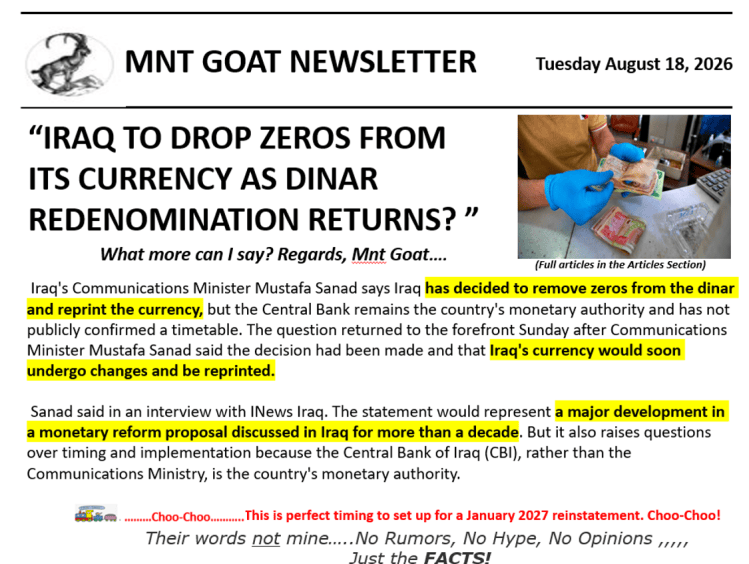
However, before we all go off half-cocked lets read the articles and analyze all of them to make sense of this picture being painted of removing the zeros soon. The basis for my Status of the RV’ today is this news of removing the zeros. It was sparked by one article in particular titled “IRAQ TO DROP ZEROS FROM ITS CURRENCY AS DINAR ‘REDENOMINATION RETURNS?” Note the question mark in the title. In the article it says that “Iraq’s Communications Minister Mustafa Sanad says Iraq has decided to remove zeros from the dinar and reprint the currency, but the Central Bank remains the country’s monetary authority and has not publicly confirmed a timetable. Is Iraq preparing to remove zeros from its currency after years of discussion over a possible dinar redenomination?” Please go to the Articles Section and read the entire article. Please do it now and then come back here.
What are the ramifications of this for our investment? Did the CBI actually give us a timeline yet? Are they about to start the educational phase for the process of how this swap-out will occur?
These are all questions we will most probably read about or hear about in the very near future. I look forward to bringing this news to you. This news, when it comes, will validate what we are now hearing. Since we have read so many articles in the past about this effort of removing the zeros, I tend now to relax and just let it play out one way or the other. I am always skeptical however the wording in the news in many of todays articles I will present to you there is a VERY STRONG emphasis that this is going to happen and has been at least authorized and decide on to go forward now from the GOI Finance Committee side and now they need parliament to pass the new law to remove the zeros. Then the CBI needs tell us they are moving ahead. These last parts we don’t yet have confirmation since this wonderful news just broke recently.
What I want to hear about MOST is from the CBI, which has not spoken publicly yet about this announcement. Is this really true? Are they going to remove the zeros now? However, as I will tell you later, the CBI did send a representative to an important meeting with Al-Zaidi and the head of the Finance Committee to discuss changes to a long-standing law to remove the zeros. There were amendments needed to the law and it has been forwarded to parliament already for implementation. So, this is the latest news in a nutshell, sort of speaking….lol…. 😊
Now let’s get to the details of how we got here and the articles to back up the news. Remember we don’t operate on hype, bank memos, rumors, opinions or information from some idiots hiding behind the scenes passing out roll-coaster rides. Here we stick with FACTS. I also want to add I did have a conversation with my CBI contact once I heard about this news. She was the representative from the CBI that attending the all important meeting with the GOI on Tuesday to discuss the new law and its amendments. So there is one confirmation already by the CBI, sort of. She has taken this information back to the CBI.
___________________________________
So, let’s get on with the details…
First, let me say that there is no country that has a cash reserve mass of 113 trillion dinars, and what is in its possession does not exceed 20 trillion, and it does not know where the other reserve is. Do think that this is a major problem? Daaaa! ☹
I have to tell everyone that there are new events that lead us to strongly believe that there is once again a target of January 2027 for a reinstatement. This means they will have to remove the zeros in the later part of 2026 (the fall season) in preparation for this later event early next year to occur. If you recall the significance of removing the zeros will set the stage for the reinstatement at much higher rate over the dollar. By removing the zeros in-country in itself will need a new rate of some sort (a revaluation) or these newer lower denominations will be almost worthless at 1/6 of a penny 1320 rate. I hope everyone understands this concept?
In connection with these coming events, I need to explain my most recent conversation from my Saturday call on 8/15 with my contact in the CBI.
But first, let me recap from my prior Newsletter dated August 11, 2026 so what I am about to tell you today makes even more sense. At this time, I presented some information from a conversation with my contact in the CBI from 8/8. Remember what she said?
She told us it was ‘critical’ and even ‘urgent’ that something be done about the currency and the shortage of the 250, 500 and 1000 notes in circulation, as well as the stolen stashes of currency due to corruption. She also said they know that these three categories are the main culprit for the hording of currency outside the banking system, not so much the stolen funds as result of corruption. This could amount to almost 8 trillion dinars. As a result of this hording the CBI has to keep printing more and more of these three categories to keep them in circulation at the pace, they are horded. This causes liquidity issues as 80-90% of the notes issued and should be in circulation are these lower denominations. They are now not in direct circulation, thus not in the banks.
Since there is no other way to make change in the marketplace for those not using electronic banking or point of sale (POS) debit cards, these notes must exist. Since there is no steady flow of 24/7 electricity the citizens must use cash in many districts. Thus, the CBI then has to keep printing more of these denominations to supply the marketplace with sufficient supply notes. Remember this situation did not happen overnight and took years to culminate where it is today. But this must now be controlled as part of the Al-Zaidi financial reforms and is part of yet a bigger picture to fix the economy. Yes, round and a round they go. There is no other alternative solution but to remove the zeros and they know it.
She said the problem is not getting the money into the banks but keeping it in the banks which is a misconception of the problem by many. So right from the start many are attacking the problem not knowing the real problem. Get it? This hording is a slow process as the citizens take cash out of the ATMs, purchase something and then takes the change (in the form of these three notes) and hordes it. Why do they do this? Do they know something?
Yes, they do know something very important. To answer this question is the key to understanding what is happening here. They do this because they know that these three lower notes (250, 500 and 1000) are not going away when they remove the zeros. Really? yes, really. Don’t you remember that in 2012 Dr Shabibi laid out what would happen to all the three zero notes when redenominated. The citizens were educated. They knew these three denominations would be redenominated, but will also remain in circulation, thus will be revalued once the dinar does move to the nominal rate or Real Effect Exchange Rate (REER). The REER will not happen until they execute the reinstatement.
Yes, these three notes will be redenominated to 25 cents (250), 50 cents (500) and 1 dinar (1000) but the 250, 500 and 1000 will also remain as part of the circulated notes even though they have been redenominated. These will be the larger notes the banks will need for larger cash transactions.
The urgency arises with this situation for many reasons. I will review some. One most critical reason is the inability to pay salaries with the lack of oil revenues due to the ongoing Iranian conflict in the straight. Next because there is a strong potential to create a hyperinflationary crisis if all these horded notes should suddenly show up again in circulation, without collecting them as part of a programmed project. They have not yet caused inflation because they are still horded and thus do not impact the economy as much as of yet. So, there is a strategy of the CBI that I need to explain to everyone today, from my recent Saturday call to my CBI contact. They are planning to resolve this situation by removing the zeros from all the notes. They will give a timeline to turn them in. If still horded they will lose all this horded currency. then the CBI will replace these horded, nullified notes with fresh lower denominations along with the coins. The monetary mass will be restored and the plan is to liquify the banks with this missing currency from the monetary mass. I hope this makes sense to everyone?
I know we have all heard this over and over again that January is being targeted. Januarys come and Januarys go with no reinstatement. So, from what I just described you can clearly see the urgency of this coming January and it has a VERY STRONG possibility to be much different. Like you, I also get discouraged when it doesn’t happen.
So, my CBI contact told me she attended a meeting in the cabinet conference room of al-Zaidi on Tuesday afternoon 08/11 and so I will fill you in on what happened in this meeting. This meeting involved many of the government officials mainly between the Finance Committee, Al-Zaidi’s financial advisors and the CBI. The main topic was restructuring the Iraqi economy and the role that the removing of the zeros would play in it. My jaw dropped when I heard this news from her.
Is this really going to happen this time and what can stop it, I asked?
Remember this article titled “THE IRAQI DINAR WITHOUT ZEROS: THE CENTRAL BANK OF IRAQ LAUNCHES A HISTORIC REFORM.” It is from November 10, 2025, Written by Dr. Subhi Jabara. I present it again in the Articles Section of today’s Newsletter. It’s now August 2026. Do you think they have made any progress in events needed to begin this financial reform now? Almost a year later, do you think perhaps they are now ready to move to the next stage of this reform process? Read the article is it worded such that we all thought it was going to happen even then in last January 2025. But it did not happen. And so now we know the reason why. It was the insecurity and instability caused by the Iranina militia and factions inside Iraq. Could this really be our time now?
I need everyone to quickly move ahead to my section just below on the ”UPDATE: On Disarming Militias and Factions‘ and read through it. Then take a look at the recent article titled “MINISTER OF COMMUNICATIONS: THE DECISION TO REMOVE ZEROS AND CHANGE THE IRAQI CURRENCY HAS BEEN FINALIZED.” This is a WOW! 😊 WOW! 😊 WOW! 😊 article. But let’s not get carried away, at least not yet…… They are still working hard to find a way to disarm these factions as there are three groups that do not want to disarm. They may have to forcefully disarm them. The U.S. forces are still sticking around just in case they can help.
It sounds to me like as far as the GOI is concerned this project is going forward but they first need success in disarming these militia. I quote from the article – “Communications Minister Mustafa Sand said that the decision to remove zeros from the Iraqi currency and change it has been finalized, noting that implementing this step will contribute to bringing hoarded funds out of the banking system and returning them to the economic cycle .” Is Mustafa Sand being premature in his announcement? Should he have waiting to see how it goes with disarming the militia first? Are they that certain they can disarm all of them?
He pointed out that “the value of the money that may not be exchanged could reach, according to his estimates, about 8 trillion dinars,” considering that “its non-return practically means that the state will not be obliged to issue its equivalent in new currency.”
Did Communications Minister Mustafa Sand really means ‘finalized’ altogether meaning the CBI agreed to do it too? Or does he simply mean finalized from the standpoint of the GOI deciding to do it now? We also know from talking to my CBI contact the urgency of the situation in getting this liquidity back into the banks.
___________________________________
A CONVERGENCE OF EVENTS:
Usually in my analysis I look for trends. I also look for events lining up to occur in a timeframe. As I have said before there are always other events or projects happening in the background slowly moving Iraq ahead. Many of these projects don’t pay much attention to because we are busy reading just the headlines of the day, such as removing the militia and factions from Iraq. But I assure you there is much more going on. Let’s peak at the article titled “DESPITE THE DECLINE IN THE CENTRAL BANK’S RESERVES, AN ECONOMIST TOLD IRAQ OBSERVER: AL-ZAIDI IS LAUNCHING FINANCIAL REFORMS AND ATTRACTING INVESTMENTS TO BOOST THE IRAQI ECONOMY.”
😊 I want also to mention the convergence of other events too besides this news of attracting investors or removing the zeros. Lots happening very quickly. Convergence of other events like the ASCUNDA system and its final phase of implementation happening now in the Kurdistan region. Then there is the new Performance Budgeting process that promises to have the budget for 2027 ready by Oct 1 to Parliament. This has never happened before. See recent article titled “FINANCE MINISTER: IRAQ IS MOVING TOWARDS APPROVING ITS FIRST PROGRAM AND PERFORMANCE BUDGET”. Finance Minister Faleh Sari confirmed on Sunday that Iraq is moving towards approving its first program and performance-based budget in its history.
😊 Also, we all know that the Iraqi new Fiscal Year begins January 1st. Then news also pops out about accession to the WTO. Why does this WTO issue always pop out when they talk about removing the zeros? Really the WTO at this time? Is there a connection? Does the WTO want a new rate for the IQD? Take a peak at the recent article titled “INTENSIVE EFFORTS TO JOIN THE WORLD TRADE ORGANIZATION”. Iraq has made significant progress in its bid to join the World Trade Organization, after completing a number of key files related to goods and services and responding to questions from member states, in preparation for holding the fourth meeting of the working group on Iraq’s accession to the organization.
“The official spokesman for the Ministry of Trade, Mohammed Hanoun, said that a delegation from the ministry visited the headquarters of the World Trade Organization last July, and held a series of official meetings with officials of the organization, the secretariat, and the head of the working group on Iraq, in addition to representatives of a number of member states.”
Okay so let’s sum up what I mean by convergence of events that may take place. First we need the Iranian militias neutralized, then they kick off the removal of the zeros, leading to the reinstatement in January and the WTO accession can also occur.
Let’s next address this all-important question now if the CBI has bought into the idea of removing the zeros, okay.
_______________________________________
Remember also that they always told the public that this move of removing the zeros will take legislation, meaning a law in parliament to do it. If we read the newest more recent article titled “THE CENTRAL BANK REMAINS SILENT ON THE REMOVAL OF ZEROS AMID MARKET CONFUSION.” From August 17, 2026. In it is stated and I quote – “This is supported by what the Central Bank officially announced in 2022, when it said that restructuring the currency and removing zeros requires a law to be enacted by the House of Representatives, and that a draft law had been prepared years ago and needed amendments.” Their words not mine….
The Central Bank Law (not the removal of the zeros law) dictates how the Central Bank operates, also stipulates that the bank alone has the right to issue currency, determine its denominations, standards, and designs, and make arrangements for its issuance, which makes the absence of its direct position more important than statements issued by other government entities.
What I am telling you is this new law to remove the zeros is completed and has been passed on to the House of Representatives (Parliament) already. But now it is in the hands of the Central Bank to perform the tasks of removing the zeros and replacing the currency. They will not do it if they feel the conditions are not right. Are the conditions right?
Also in the article it states and I quote – “The silence of the Central Bank of Iraq regarding the escalating news about changing the currency and removing three zeros from the dinar has left an information gap in one of the most sensitive monetary files, at a time when conflicting statements continue to come from officials, deputies and experts regarding a decision that the body authorized to issue the currency has not yet announced whether it has actually been taken, or is still under study, or what its implementation mechanisms are.”
The question that needs answering from the central bank remains simpler than the ongoing debate: **Was the decision to remove zeros actually made?**
This is key —-> If a change has been made, the market expects the entity responsible for the currency, not ministers, members of parliament, or social media platforms, to announce its timing, the mechanism of the exchange, its limits, the fate of funds outside banks, and the guarantees that prevent market disruption or harm to citizens’ savings.
We have been waiting to see this new law for a long time. Even though the CBI works independently, it still takes the effort to work as a partner with the prime minister, Finance Committee and parliament in order to have everyone as a stakeholder in this historic move. Based on this, my CBI contact told me she heard in the meeting from Tuesday that legislation has been written to conduct removing the zeros and is now being moved to parliament to pass it. Thus, the purpose of this meeting was to review the bill before it was passed on to parliament.
So, I asked if the CBI can reject removing the zeros if this law to remove the zeros passes in Parliament? She said yes, however at this stage it is not very likely and the CBI governor would have to come before parliament to explain why they reject it at this time. She said in reality the CBI does not work in a vacuum and they already has discussions with the GOI on this topic. She does not believe the GOI would have made this move if support from the CBI was not likely.
Hey! Can the news get any better?
____________________________________________
REMOVING THE ZEROS: THE TIE TO ASYCUDA:
During this call my contact also talked about a couple more issues related to removing the zeros. This included the salary issue and the ASYCUDA System.
First let’s take a look at the functionality of ASYCUDA and so why have it?
The ASCUNDA system is designed to:
- Streamline financial transactions between different districts and regions.
- Integrate banking and customs operations to improve efficiency and transparency.
- Support digital transformation in Iraq’s financial sector, aligning with national goals for modernization
In the Kurdistan context, the system is being finalized to enable unified digital customs operations across the region, which could reduce delays, lower costs, and improve trade compliance
Related Digital Initiatives
Iraq has been advancing several digital reforms:
- Unified digital customs system between Baghdad and Erbil to harmonize import/export processes
- Banking system modernization to improve access, security, and interoperability
These efforts are part of a wider push to digitize government services, enhance cross-border trade, and strengthen financial governance.
Current Status of ASYCUDA:
As of recent reports, the ASYCUDA system is in the finalization phase in Kurdistan districts, the only a few districts remaining to complete. Its success will depend on the seriousness and coordination of implementation, as well as integration with other national digital platforms. If you need to engage with the system, the (General Customs Authority) in Iraq provides official access and guidance
Now let’s take a look at a recent article on this subject matter of ASYCUDA. It is titled “ASYCUDA IMPLEMENTATION MINUTES FINALIZED, AWAITING CABINET GREEN LIGHT”. I have to ask is ASYCUDA system friendly to these large three zero dinar note numbers as in the three zero notes? Are they trying to normalize denominations across ASYCUDA platforms? Will they do the same with the Vietnam Dong. It too is way overdue to redenominate. Just saying….. 😊
Then another recent article titled “BAGHDAD AND ERBIL RESOLVE THE “ASYCUDA” DISPUTE… BORDER CROSSINGS ENTER A NEW CUSTOMS PHASE”.
The Interior Minister of the Kurdistan Regional Government, Reber Ahmed, announced that Erbil and Baghdad have reached a final agreement on the implementation of the ASYCUDA global system and the sharing of customs revenues, while criticizing the federal government’s “hesitation” in compensating the victims of the attacks that targeted the region, stressing that the resumption of oil production is linked to providing air defense systems and security guarantees for foreign companies.
____________________________________
UPDATE: On Disarming Militias and Factions
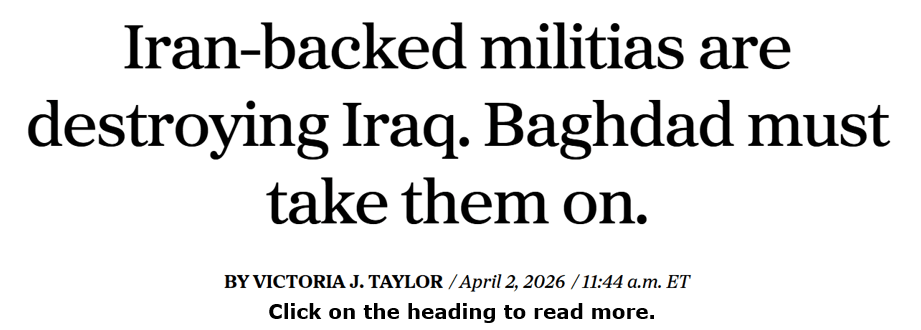
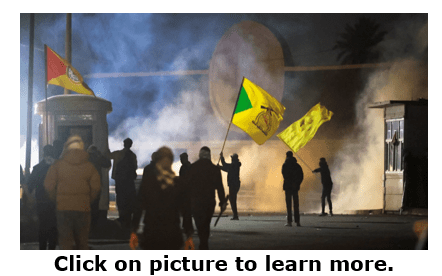
It is somewhat comforting to finally witness that Iraq is making necessary changes to policies that we all witnessed over these last decades that literally almost tore that country apart and would have if the U.S. hadn’t stepped in to clarify its stance on Iraq. No, Iraq was not going to be just another proxy state for Iran. Or should I say like a trophy for Iran as yet another conquest in this insane Muslim Islamic Brotherhood Global Terrorist Revolution.
I don’t think I have to remind everyone that the new 2005 Iraqi constitution forbids armed groups inside Iraq other than the security forces of Iraq. So, this is not the ‘bid bad’ Trump saying they must be removed but by Trump enforcing their own constitution upon them. Why didn’t Obama or Biden do it? Yes, making them live up to what they all agreed to do in 2005. We all should wonder just what Obama was really up to when it came to foreign policy with Iran.
I today’s news you might want to take a peak at the recent articles on this subject matter. One is titled “LATE-NIGHT MEETING OF THE FOUR PRESIDENCIES TO DISCUSS THREE “SERIOUS” ISSUES IRAQ”. The problem is going to stem from the extreme factions that infiltrated the militias and refuse to disarm. What will Al-Zaidi do?
The four presidencies held an important meeting on Monday evening, focusing on the issue of limiting weapons and options for confronting factions that refuse to disarm after the September 30 deadline.
According to an informed source who spoke to Shafaq News Agency, the meeting to be held between Prime Minister Ali al-Zubaidi, Speaker of Parliament Hebat al-Halbousi, President Nizar Amidi, and Head of the Supreme Judicial Council Faiq Zaidan will focus on two issues: first, restricting weapons, and second, continuing the fight against corruption and ensuring there are no red lines in pursuing any person accused of corruption, regardless of their governmental or political position.
I also just want to add that eventually they will have to go after Nouri al-Maliki if they are sincere in what they say about “pursuing any person accused of corruption, regardless of their governmental or political position”. I fully believe this will happen for his crimes against humanity, constitutional violations and the money he has stolen.
The next article is titled “AL-ZAIDI TO CENTCOM COMMANDER: BY OCTOBER, IRAQ WILL BE FREE OF ANY FOREIGN MILITARY PRESENCE.” Prime Minister Ali al-Zaidi confirmed on Wednesday evening to US Central Command chief Charles Brad Cooper that Iraq will be free of any foreign military presence on October 1st.
He explained that the first of next October will be “a new day in the course of the Iraqi state, as Iraq will be free of any foreign military presence, and will have completed its national sovereignty over its lands, and continued to build its security and military capabilities, enabling it to protect its security and stability on its own.”
Now, having read this statement above and you know that it will take months to prepare and conduct the removing of the zeros, wouldn’t you begin right about now if you plan to reinstate the dinar in January?
Then this article soon pops out titled “AL-ZAIDI’S MESSAGE TO THE FACTIONS: CONFRONTATION AND CLASHES IF THE DEADLINE EXPIRES WITHOUT WEAPONS BEING SURRENDERED”. An Iraqi security official revealed to AFP on Wednesday (August 12, 2026) that he had been in contact with the Iranian Revolutionary Guard regarding armed factions and limiting their weapons to the Iraqi state, while two political sources reported that Prime Minister Ali al-Zubaidi had informed political leaders of his readiness to “confront” and “clash” with factions that refuse to cooperate after the deadline expires.
Oh…so Iraq has the proverbial ‘balls’ to confront Iran after all?
Regarding linking the issue of restricting weapons to the American position, Barzani said, “The issue of restricting weapons to the state is not an obligation to America, but rather an obligation to Iraq,” adding, “America came to this country one day, and one day it will leave, but we are the ones who will remain in Iraq. We are the people of Iraq and we will remain here.”
Barzani warned of the repercussions of the continued presence of armed factions, saying: “I say to all political forces and the Iraqi people, I swear that if Iraq does not resolve the issue of armed factions, it will face international isolation and will also be subjected to regional isolation.”
____________________________________________________
SUMMARY
Lots of moving parts that all need to converge at some point and we can see it may be January 2027. I want to say that I think our prayers are working. Again, I need to say to PRAY, PRAY and PRAY somemore. Pray like cheering on a racer about to cross the finish line. We are almost there.

We are almost there and God sincerely wants us to have this blessing but there are very dark elements keeping it from us and the Iraqi people. But most importantly terroristims in the middle east is destroying cultures in the name of Alah and it needs to end. All this news today is so terrific. Could it get any better other than being told we can now go to the banks and exchange? Yes, the milk was spilled from the bottle and oops, you can’t put it back.

Now, having said all this I also have to tell you about another article that came out on 8/17 that contradicts all these other many recent articles about removing the zeros. Who are we to believe?

It is hard to understand why we would be told all this good news then to tell us it was all not correct news. I don’t get it. Anyhow here is the article and so you can judge for yourself. It is titled “GOVERNMENT SPOKESPERSON: THE CABINET HAS NOT MADE ANY DECISION REGARDING THE ISSUE OF REMOVING ZEROS FROM THE IRAQI CURRENCY”.
The fact that this article talks mostly about disarming the Iranian backed militias and factions I believe that the process to begin removing the zeros is dependent on first removal of these militias. But of course, we all knew that, didn’t we? You have to read the article over and over again to see it. Also remember why would my CBI contact tell me about this meeting to review the new law to remove the zeros, the same law this article says we need to have, but it appears we have it. I quote from the article – “Regarding the issue of removing zeros from the currency, Al-Aboudi stressed that “the Council of Ministers has not made a decision to remove zeros from the currency, nor has the Central Bank, and the matter requires legislation from the House of Representatives.”
Who is Al-Aboudi anyhow? Are we going to believe him/her or a representative of the government that is sitting on the council of ministers in Al-Zaidi’s cabinet? I could he be wrong, but it sure sounded like a ‘final’ decision had been made by Iraq’s Communications Minister Mustafa Sanad when he says and I quote from the articles – “Iraq has decided to remove zeros from the dinar and reprint the currency”
But….does this mean they are going to do it now or still later, but the decision has been made to do it. Is this all it means?
Our focus now should be watching for this new law to remove the zeros being passed in parliament and news from the Central Bank as to how they will swap out the currency, educate the citizens, etc, etc. We can already see some education taking place in the article titled “IRAQ STRUGGLES TO CONTAIN VOLATILE DINAR CURRENCY DISPARITY”
and then again in
“THE EVOLUTION OF THE ISSUED CURRENCY AND CIRCULATING MONEY IN IRAQ 2004–2026”
How much longer are they going to try to hide this event from us? Are they even hiding it or now just trying to wipe up spilt milk, maybe they shouldn’t have spilt?
We know that once this removal of the zeros is completed, the Central Bank will monitor for inflation for a short time, longer if needed, then make the move back to FOREX by reinstating the IQD. We should also expect Iraq to gain full accession to the WTO about this timeframe too.
Remember that I do not expect any in-country formal revaluation on the dinar. This could change, as they might decide to create a motivation for the stashes to come into the banks, but I believe they don’t need this incentive as the incentive will be ‘to lose the money stashes or swap it out’. This alone will force the citizen to swap it out. I know many of these intel gurus out there will argue with me all day long. They will bash me. I am only telling you what my CBI contact has told me many times will most probably occur.
Of course, by default the dinar will increase in value as a matter of course of redenominating. In other words, a 25,000 dinar note today worth about $19 USD today and after the redenomination the 25 notes will be worth $19 USD, no change. But if you base it on USD value per dinar it is $19 / 25 = .76 cents per dinar. You see no formal revaluation only an indirect change as a matter of course. So when they tell you that there will be no revaluation this is what they are talking about. So, we know better.
Let’s wait to hear further news from the CBI as I am sure news is to come shortly.
_______________________________________________
Let’s keep our prayers alive. There is a deep spiritual dimension at work today bringing about this reset. I believe we are closer than ever for the dinar to get reinstated. But first things first. Part of the mess in the US must be cleaned up too. Then certain laws in Iraq must be passed. Certainly, reviving the economy to at least 45%-50% non-oil revenues could make a huge difference for Iraq and the IMF. Let’s also let the Abraham Accords take effect as more Arab countries join in. By now everyone should be fully aware of these events that caused delays in the currency reform process. This is not rocket science to understand. We are not in control over these obstacles. We need to STOP spreading rumors and over speculating.
What do you think will happen next? (Leave a comment)
______________________________

________________________________________
Their words not mine…..No Rumors, No Hype, No Opinions ,,,,,
Just the FACTS!


These prophecies are an important tool we have to lead us on our path. They are more important now than ever. They give us the strength, perseverance and hope that a better time is coming and that God’s Hand is at work behind the scenes. If you just take a second even to look around you at these past three election cycles, how can you deny that God is at work? Are you sleeping or what?
It is amazing and there is no other way that these events could have happened the way they turned out. But there is more to come, much, much more, I assure you! Now that God has his biblical David re-elected, we need to pay attention to what He does next.
NOTE: These prophecies just keep getting better and better, giving us HOPE of a brighter future. But the real reason why I listen to them is that we can actually see what God says He will do is taking place right in front of our noses. It is a confirmation to me that God is real and is still with us forever just as in biblical times.
Prophetic Words from the prophets: Julie Green
“Big Exposures Are Coming And Big Changes Are On The Horizon“
Go to the 11:02 mark on the video. Given on Aug 8th “

“Liars Are Being Exposed“
Go to the 15:16 mark on the video. Given on Aug 9th
We can relate to this frustration when things don’t go our way and we have to wait a bit longer for God to bring us what we need. Go RV!“

IS THERE REALLY FAKE NEWS?
Are they purposely lying to us? I call this propaganda!

Fr. DON BOSCO EXPOSED THE DARK SECRET BEHIND ISLAM
I keep this one out here to view. Everyone should take the time to watch it. It will awaken you about the Muslim so-called religion (or should we call it for it is — a ‘cult‘.)
— And the truth the world forgot about the so-called Muslim religion.
Fr.Don Bosco, also known as John Bosco, was an Italian Catholic priest and educator, born on August 16, 1815. He founded the Salesian Society in 1859 to help disadvantaged youth, particularly boys, through education and community service. His teachings emphasized lovekindness, and the importance of education for young people, making him a beloved figure in Catholicism and a patron saint of youth. Don Bosco was canonized in 1934.

MUSLIM BROTHERHOOD NETWORK IN AMERICA
The ‘over-arm’ of the Muslim Brotherhood in the US.
FARAGE’S HUGE DEPORTATION ANNOUNCEMENT
Oh…. they say in the U.S. it’s just the crazy republicans who want deportation. Really? This is a global issue not just a U.S. democrat or republican issue. We must cut off the head of snake that brought this problem to our nations to begin with….and who is this snake?

VP VANCE JUST OVERRULED THE PARLIAMENTARIAN — THE SAVE ACT PASSES WITH 51 VOTES

FAUCI HIT WITH SUBPOENAS FROM MULTIPLE STATES
The TRUTH will be told somehow, yes one way or the other. Either through testimony or jail time. I don’t believe he is going to get away with decades of deception and lying about this biological warfare he has been waging on the planet. People have had enough of this and there must be accountability for your actions.

FAUCI AND HIS COUNTERPARTS GOE MUCH DEEPER THAN JUST THE COVID VIRUS
The Fauci Story You Never Heard and is unveiled today– Dr. Jan Halper-Hayes.
Oh boy are you in for an awakening…..


I have created a brand-new “Post RV Workshop” page in the blog. I included my own personal tips on investing post-RV and also organizing and protecting your estate. Here is the LINK. Going forward I will only post new and exciting information and opportunities here on the Latest Newsletter as they come along. Later I will transfer it to the ‘Post RV Workshop’ page in subsequent Newsletters for your future reference.
Just so you know I absolutely DO NOT adhere to high-risk investments where I can lose it all in a flash. Look at it this way – you are going to have all this money from your dinar exchange. Then why blow it! Most of us investors waited decades for this RV to happen and so why would you even think about pissing is all away in some high-risk gamble of an investment. Yes, there are going to be scammers out there but let’s talk about legitimate investment opportunities only. These scammers can suck you dry and there is not a damned thing you can do about it.
Go to a legitimate wealth manager associated with your bank. Let the licensed experts advise you. Please, please stay away from idiots like MarkZ, TNT Tony, Bruce (on the Big Stupid Call), etc. , etc. Go to professionals. It doesn’t mean you have to follow everything they advise you but it’s a great start. Remember they too are selling investment products and get commissions.

IRAQ OPENS THE FILE ON PUBLIC FUNDS: STRIKING AT PRIVILEGES AND REMOVING ZEROS
Amid the financial and economic pressures facing the Iraqi state, the files of public funds, privileges, double salaries, and reforming the monetary system are returning to the forefront of discussion within the House of Representatives, with a set of proposals aimed at rearranging government spending, tightening control over the wealth of officials, and strengthening the position of the Iraqi dinar.
The proposals put forward do not stop at amending one law, but open a wider discussion about the form of the state’s financial management, the size of spending on officials, and the extent to which regulatory institutions are able to uncover illicit funds, leading up to a controversial proposal related to removing zeros from the Iraqi currency.
At the forefront of the files is the proposal to amend the Integrity and Illicit Gains Authority Law, with the aim of tightening the procedures for disclosing financial assets and holding accountable those taxpayers who show a large and unjustified increase in their funds.
This issue is of particular importance in a country that has been suffering for years from the challenges of corruption and abuse of power, since combating illicit enrichment does not depend solely on penalties after the violation has occurred, but requires an effective system to monitor the growth of wealth and link financial declarations to banking, real estate and commercial information.
The proposals also aim to tighten procedures against those who refuse to submit financial disclosure statements, with violators being referred to the judiciary if illicit gains are proven.
The most politically and popularly sensitive issue is related to double salaries and financial privileges, where it was proposed to prevent one person from receiving more than one salary under any title, in addition to reorganizing a set of benefits that officials and employees in state institutions receive.
The idea here is based on a simple principle: Citizens cannot be asked to rationalize their spending while the doors of government privileges remain open without clear limits.
In the same context, one of the proposals includes setting a fixed monthly salary for a member of the House of Representatives worth five million dinars, while regulating allowances and privileges, reducing the number of employees, security personnel, escorts and advisors, in addition to controlling the use of government cars and aircraft and subjecting spending to the control of the competent authorities.
These measures, if they are turned into effective legislation and actually implemented, could provide significant sums for the treasury, but at the same time they will face a difficult political test, because reforming privileges often clashes with the interests of those who benefit from them.
In a parallel track, another proposal emerged concerning the reform of the financial and monetary system, which includes combating money laundering, restricting the movement of funds within official banking channels, recovering smuggled funds, and bringing informal capital into the economic cycle.
But the most controversial proposal is to remove zeros from the Iraqi dinar, or what is known as renaming the currency, as part of a broader strategy to reform the monetary system.
Here, a distinction must be made between removing zeros and increasing the real value of the currency. Removing three zeros, for example, does not automatically mean that citizens have become wealthier or that the purchasing power of the dinar has increased; the success of this step depends on economic stability, controlling inflation, managing the money supply, the strength of the banking system, and citizens’ confidence in the currency.
Therefore, any project to rename the dinar needs careful study and a clear transition mechanism that ensures there is no confusion in prices, contracts, salaries, savings, and commercial transactions.
The Iraqi problem is not just in the form of the currency, but in an entire economic system that needs simultaneous reforms that include banks, non-oil revenues, government spending, tax evasion, money laundering, the exchange market, and the monetary economy.
Hence, removing zeros, if done alone, may be a mere arithmetic change, whereas if it comes as part of an integrated economic program, it may become part of a broader monetary reform process.
Ultimately, Iraq has an opportunity to reopen the public finance file from a different angle: reducing privileges, combating illicit gains, controlling double salaries, recovering smuggled funds, and reforming the monetary system. But the success of these ideas will not be measured by the number of proposals that reach parliament, but rather by the state’s ability to turn them into fair laws that apply to everyone without exception.
True financial reform does not begin with simply removing three zeros, nor with reducing an official’s salary, but rather with building a state that knows where its money goes, who receives it, and how to protect it from waste and corruption.
The real battle is not with the zeros on the currency, but with the zeros in the accounts of oversight and accountability.
******************************************************************************************
NECHIRVAN BARZANI: I CAME FROM TEHRAN WITH A MESSAGE TO RESTRICT WEAPONS… THE STATE PAYS BOTH THE POPULAR MOBILIZATION FORCES AND THE FACTIONS.
The President of the Kurdistan Region, Nechirvan Barzani, revealed that Prime Minister Ali Zaidi asked him to speak with Iranian officials about restricting weapons during his recent visit to Tehran, revealing that the Iranian side officially informed him of its readiness to help Baghdad in this matter.
Barzani explained, in an interview with journalist Hisham Ali, which was followed by 964 Network , “The Iranian officials told me: Tell Prime Minister Zaidi, we are ready to help him in this matter,” noting that he asked them: “Is this your official position?” They said: “Yes, this is our official position.”
The Popular Mobilization Forces and factions:
Regarding the Kurdistan Region’s position on the Popular Mobilization Forces, Barzani explained that the region “has special respect for the sacrifices of the Popular Mobilization Forces and the Iraqi army, along with their Peshmerga comrades in Kurdistan, who are defending the Iraqi people.”
In response to a question about his view of the difference between the Popular Mobilization Forces and the factions, Barzani said: “Many times when we visit Baghdad, we talk about the difference between the Popular Mobilization Forces and the factions, but ultimately, the factions or the Popular Mobilization Forces, their budget comes from the Iraqi state.”
He added that the region’s position on the factions “is not that we are against these factions, but the fundamental question is: Where is Iraq headed? We are all in the same boat, whether in Baghdad, Basra or Zakho, and we see that these actions carried out by the factions are not in the interest of Iraq or its future.”
He continued: “These factions threaten neighboring countries and attack Arab countries with drones. Is it reasonable for there to be a force inside Iraq that is a source of threat to neighboring countries? In addition, it is a source of threat to the Kurdistan Region.”
Who rules Iraq?
Regarding the government program and the restriction of weapons, Barzani said, “The government program presented by Prime Minister Ali al-Zaidi clearly states: Weapons must be restricted to the state,” considering that these forces “must be under the umbrella of the Commander-in-Chief of the Armed Forces.”
Therefore, Barzani asked: “Who rules in Iraq? Is it the Prime Minister? Is it the political forces that rule? Or are they outlaw groups?”
International and regional isolation
Regarding linking the issue of restricting weapons to the American position, Barzani said, “The issue of restricting weapons to the state is not an obligation to America, but rather an obligation to Iraq,” adding, “America came to this country one day, and one day it will leave, but we are the ones who will remain in Iraq. We are the people of Iraq and we will remain here.”
He pointed out that “the Kurdistan region has been bombed a thousand times, and Iraqi security headquarters inside Baghdad have been bombed,” asking: “Why do we link the issue of restricting weapons to America?”
Barzani warned of the repercussions of the continued presence of armed factions, saying: “I say to all political forces and the Iraqi people, I swear that if Iraq does not resolve the issue of armed factions, it will face international isolation and will also be subjected to regional isolation.”
He added, “Arab countries and neighboring countries want to help Iraq, and I know how much the Gulf countries want to invest in Iraq, but this is not happening in this way.”
We know who is bombing Kurdistan regarding the attacks targeting the Kurdistan Region, Barzani said that “most of the bombing operations were launched from inside Iraq, and some attacks were launched from Iran during the forty-day war.”
He explained that “the attacks from inside Iraq were launched from Mosul, Kirkuk, Salah al-Din and Tal Afar,” adding: “We have 100% information about the parties carrying out these attacks, and we even know the units that carry out these attacks, and this information is very accurate.”
*****************************************************************************************
QAANI HOLDS BAGHDAD TALKS ON FUTURE OF IRAQI ARMED GROUPS
Iran’s IRGC Quds Force chief meets Coordination Framework leaders as Sept. 30 deadline for state control of weapons approaches
Islamic Revolutionary Guard Corps (IRGC) Quds Force Commander Esmail Qaani has arrived in Baghdad for talks with senior Iraqi political and armed-group leaders, with discussions reportedly focusing on the future of weapons held by factions outside the state security structure.
An informed source told Kurdistan24 that Qaani is leading a high-level military and security delegation and has already met with figures from the Coordination Framework, including Badr Organization leader Hadi al-Amiri, as Baghdad approaches a Sept. 30 deadline to place all weapons under state control.
The unannounced visit comes at a politically sensitive moment for Iraq, where the government is attempting to resolve the status of powerful armed factions while preventing regional tensions from spilling onto Iraqi territory.
Qaani’s Baghdad meetings
According to the source, Qaani has held a series of meetings with Coordination Framework leaders and commanders of several armed groups, with further talks expected during his stay.
The discussions are reportedly centered on two major issues: the fate of weapons held by Iraqi armed factions and arrangements concerning Iraq’s ability to export oil through the Strait of Hormuz.
The weapons issue has become one of Baghdad’s most difficult political and security challenges.
Iraqi political forces have set Sept. 30 as the deadline for bringing weapons exclusively under the authority of the state and its official institutions.
The timing of Qaani’s visit has therefore drawn particular attention, as Iran maintains close political and security relationships with several of the Iraqi factions affected by the government’s policy.
Baghdad presses for state control:
Iraqi government spokesperson Haider al-Aboudi said Monday that no institution or organization should control weapons outside the framework of the state.
Speaking at a press conference, al-Aboudi called for armed groups operating outside official security institutions to return under state authority, saying the process requires a “deep and comprehensive dialogue.”
He said there was a high degree of understanding between the government and armed groups and that Baghdad remained committed to advancing and monitoring the process.
The government’s position reflects a broader effort to reinforce the authority of Iraqi state institutions amid regional instability and competing security arrangements.
Al-Aboudi also said the government expects the planned September withdrawal of US forces to proceed according to an agreed timetable, with responsibilities transferred to the Iraqi army.
Factions remain divided
Despite Baghdad’s push for a unified weapons policy, Iraqi armed factions remain divided over whether and how they should surrender or regularize their arsenals.
Some groups have indicated a willingness to bring their activities into a formal state framework.
Others, including Kata’ib Hezbollah, Harakat al-Nujaba and Kata’ib Sayyid al-Shuhada, have reportedly linked any disarmament to the complete withdrawal of foreign forces from Iraq. The disagreement presents a significant challenge for the government, particularly as the September deadline draws closer.
The State Administration Coalition has previously warned that armed activity outside state institutions after the deadline could be treated as terrorism, while Iraqi security forces have raised their readiness levels amid concerns over possible escalation.
Iran seeks to contain regional tensions:
Qaani’s visit also follows heightened tensions involving Iraq, Saudi Arabia and Iran-aligned armed factions.
Abdul Rahman al-Jazairi, head of the political bureau of the Iraqi National Current and a leading Coordination Framework figure, told Kurdistan24 that senior IRGC officials had recently conveyed a message to Hadi al-Amiri urging Iraqi armed groups to halt attacks against Saudi Arabia.
According to Jazairi, the message was directed toward factions including Harakat al-Nujaba, Kata’ib Hezbollah and the group led by Abu Ala al-Walai. He said Tehran was encouraging the factions to pursue political and diplomatic channels rather than military action.
The reported intervention comes as Baghdad prepares for Prime Minister Ali al-Zaidi’s expected visit to Saudi Arabia, which Jazairi said would address several sensitive issues, including arms control, the economy and corruption.
The development suggests that the question of Iraqi armed groups is increasingly linked not only to Baghdad’s domestic security policy but also to wider regional efforts to prevent Iraq from becoming a launchpad for attacks against neighboring states.
A broader test for Baghdad
The government faces a delicate balancing act: enforcing state authority over weapons while maintaining political support among factions that form an important part of Iraq’s governing system.
The issue is further complicated by the future of US forces in Iraq.
Al-Aboudi said the September withdrawal deadline must be respected, while Jazairi separately claimed that undisclosed understandings could link the withdrawal of US forces to guarantees that armed factions keep their weapons under state control and halt drone operations from Iraqi territory.
Those claims have not been independently confirmed.
Qaani’s meetings in Baghdad therefore come at a critical juncture. His discussions with Iraqi political and armed-group leaders could influence how Iran-aligned factions respond to the government’s September deadline and whether Baghdad can achieve a negotiated transition toward greater state control.
For the Iraqi government, the challenge is no longer simply establishing a legal principle that weapons belong under state authority. It is determining whether that principle can be implemented without triggering a political or security confrontation with factions that retain significant military and political influence.
With the deadline approaching, Qaani’s Baghdad talks are likely to be closely watched as Iraq attempts to reconcile the demands of state sovereignty, armed-group influence, the US military presence and the wider regional struggle for influence.
********************************************************************************************
AL-ZAYDI: THE GOVERNMENT IS WORKING TO BUILD A NEW ECONOMIC IRAQ.
Prime Minister Ali Faleh al-Zaidi stressed the importance of the role of the House of Representatives and the Finance Committee in supporting the work of the government and its reform program, pointing to the heavy legacy of files and challenges it inherited. While he indicated that the government is working on preparing a strategy that is to build a new economic Iraq and corruption-free departments, he pointed out that the electricity file will receive exceptional attention.
This comes at a time when al-Zaidi received, on Monday, an official invitation from the Prime Minister of Japan, Sanae Takaichi, to visit the Japanese capital, Tokyo.
A statement from the Prime Minister’s Media Office, received by Al-Sabah newspaper, indicated that “Al-Zidi hosted the Chairman and members of the Parliamentary Finance Committee yesterday, Monday, in the presence of the Minister of Finance and the Governor of the Central Bank of Iraq, to discuss financial and economic plans and policies, and coordination between the executive and legislative branches on priority issues.” Al-Zidi emphasized the importance of the role of Parliament and the Finance Committee in supporting the government’s work and its reform program, noting the heavy legacy of issues and challenges it inherited, which it is working to address according to a clear vision. He added that the government has begun, for the first time, preparing a program and performance budget, which represents a roadmap for Iraq’s economic future, linking government spending to objectives and results and improving the efficiency of public funds use.
The Prime Minister affirmed that the electricity sector would receive exceptional attention, urging members of Parliament to exercise their oversight role in supporting the government’s efforts to combat corruption and eliminate its sources. He emphasized that there would be no red lines in pursuing corrupt individuals. Al-Zaydi also explained that the government is working on a state-building strategy that includes establishing a new economic Iraq, corruption-free institutions, and constitutional security bodies. He noted the strong interest and interest of major international companies in investing in Iraq and the readiness of global financial institutions to support its economy. He affirmed the government’s commitment to creating a suitable environment for attracting investments and revitalizing various economic sectors. The Prime Minister directed the preparation of a schedule for regular meetings and consultations with parliamentary committees to enhance coordination and institutional communication between the government and Parliament.
For his part, the head of the parliamentary finance committee affirmed his absolute support for the government. Members of the committee also put forward a number of proposals to legislate the necessary laws to activate non-oil economic activities, support the government’s efforts in economic reform and combating corruption, as well as stressing the importance of proceeding with the implementation of oil projects, paying attention to the investment environment and attracting reputable international companies, in a way that contributes to driving the wheel of development, encouraging industry and creating job opportunities.
In addition, Al-Zaidi received an official invitation yesterday, Monday, from the Prime Minister of Japan, Sanae Takaichi, to visit the Japanese capital, Tokyo.
A statement from the Prime Minister’s Media Office, received by Al-Sabah, stated that “Al-Zidi received the Japanese Ambassador to Iraq, Akiro Endo, who conveyed to him the invitation of the Japanese government, expressing his country’s keenness to strengthen cooperation and partnership relations with Iraq.”
The Prime Minister appreciated the Japanese invitation, stressing the importance and depth of Iraqi-Japanese relations, and Iraq’s keenness to develop them in various fields, especially investment and economic ones.
*******************************************************************************************
AL-ZAIDI TO CENTCOM COMMANDER: BY OCTOBER, IRAQ WILL BE FREE OF ANY FOREIGN MILITARY PRESENCE.
Prime Minister Ali al-Zaidi confirmed on Wednesday evening to US Central Command chief Charles Brad Cooper that Iraq will be free of any foreign military presence on October 1st.
Al-Zaydi’s media office stated in a statement received by Shafaq News Agency that during his meeting with the CENTCOM commander, he emphasized the commitment to the agreed-upon timelines, which stipulate that September 30th will be a fixed and final date for ending the international coalition’s military mission in Iraq and completing the departure of its forces.
He explained that the first of next October will be “a new day in the course of the Iraqi state, as Iraq will be free of any foreign military presence, and will have completed its national sovereignty over its lands, and continued to build its security and military capabilities, enabling it to protect its security and stability on its own.”
In this context, the Prime Minister called for adherence to the principles of the constitution and the constants upon which the state is based, preserving its supreme interests, and directing the energies of the people towards construction, reconstruction and development, stressing that Iraq today needs the efforts of all its people to build a strong economy, a stable state, and a better future for future generations.
He stressed that restricting weapons to the state, in accordance with the law, protects everyone, strengthens the state’s authority and sovereignty, ensures security and stability, and represents a fundamental condition for moving Iraq to a new stage of development and prosperity.
Both sides confirmed the full and final agreement to end the military mission of the international coalition, in accordance with what was agreed upon during the Prime Minister’s visit to Washington in mid-July.
They stressed that Iraqi-American relations will move towards cooperation and partnership in the economic, developmental and security fields, based on mutual respect for sovereignty and the common interests of the two countries.
Earlier today, during his chairmanship of a meeting of the National Security Council, Al-Zaydi confirmed that the decision to end the mission of the international coalition in Iraq on September 30 is a final and irreversible date, and stressed the implementation of the highest level of security plans, support for internal stability, and guaranteeing national sovereignty.
******************************************************************************************
AL-ZAYDI’S MESSAGE TO THE FACTIONS: CONFRONTATION AND CLASHES IF THE DEADLINE EXPIRES WITHOUT WEAPONS BEING SURRENDERED
An Iraqi security official revealed to AFP on Wednesday (August 12, 2026) that he had been in contact with the Iranian Revolutionary Guard regarding armed factions and limiting their weapons to the Iraqi state, while two political sources reported that Prime Minister Ali al-Zubaidi had informed political leaders of his readiness to “confront” and “clash” with factions that refuse to cooperate after the deadline expires.
The Iraqi security official told AFP, as reported by 964 Network, that “communication is currently taking place with the Iranian Revolutionary Guard at a high level, and is being conducted intensively regarding the factions and limiting their weapons” to the Iraqi state.
Two Iraqi political sources told AFP that al-Zaidi informed political leaders of his readiness for “confrontation” and “clash” with the factions that cling to their weapons, should they insist on refusing to cooperate after the deadline expires.
Informed sources revealed to Asharq Al-Awsat newspaper the outlines of a forthcoming government plan to encircle and restrict the movement of armed factions’ strongholds after the deadline for weapons collection expires on September 30, with the aim of gradually dismantling them and avoiding direct clashes. The newspaper’s report, published today, Wednesday (August 12, 2026), stated that security forces will impose a tight cordon around the factions’ headquarters without armed confrontation, noting that the main focus will be on Jurf al-Sakhr, the stronghold of “Kataib Hezbollah,” and Jurf al-Nadaf, the stronghold of “Harakat al-Nujaba,” amidst Iranian pressure to obstruct or postpone the plan.
The President of the Kurdistan Region, Nechirvan Barzani, revealed that Prime Minister Ali Zaidi asked him to speak with Iranian officials about restricting weapons during his recent visit to Tehran, revealing that the Iranian side officially informed him of its readiness to help Baghdad in this matter.
Barzani explained, in an interview with journalist Hisham Ali, which was followed by 964 Network, “The Iranian officials told me: Tell Prime Minister Zaidi, we are ready to help him in this matter,” noting that he asked them: “Is this your official position?” They said: “Yes, this is our official position.”
Regarding linking the issue of restricting weapons to the American position, Barzani said, “The issue of restricting weapons to the state is not an obligation to America, but rather an obligation to Iraq,” adding, “America came to this country one day, and one day it will leave, but we are the ones who will remain in Iraq. We are the people of Iraq and we will remain here.”
He pointed out that “the Kurdistan region has been bombed a thousand times, and Iraqi security headquarters inside Baghdad have been bombed,” asking: “Why do we link the issue of restricting weapons to America?”
Barzani warned of the repercussions of the continued presence of armed factions, saying: “I say to all political forces and the Iraqi people, I swear that if Iraq does not resolve the issue of armed factions, it will face international isolation and will also be subjected to regional isolation.” He added, “Arab countries and neighboring countries want to help Iraq, and I know how much the Gulf countries want to invest in Iraq, but this is not happening in this way.”
*********************************************************************************
IRAQI PRIME MINISTER MEETS CENTCOM CHIEF OVER COALITION WITHDRAWAL
At a Glance
- Prime Minister Ali Faleh al-Zaidi meets with U.S. CENTCOM Commander Charles Brad Cooper.
- Sept. 30 confirmed as the final deadline to end the international coalition’s military mission.
- Oct. 1 set to mark full national sovereignty with zero foreign military presence.
- Transition shifts U.S.-Iraq relations toward economic, security, and development partnerships.
Iraqi Prime Minister Ali Faleh al-Zaidi received the Commander of United States Central Command, General Charles Brad Cooper, on Wednesday, explicitly confirming September 30 as the final, non-negotiable deadline for ending the military mission of the U.S.-led international coalition and completing the exit of foreign troops from Iraqi territory.
Key Statements and Focus Area
- Firm Exit Deadline: “September 30 will be a fixed and final date for ending the military mission of the international coalition in Iraq and completing the departure of its forces,” Prime Minister Ali Faleh al-Zaidi declared during the bilateral meeting.
- Full Sovereignty Reclaimed: “October 1 will be a new day in the trajectory of the Iraqi state, Iraq will be free of any foreign military presence, having completed its full national sovereignty and built up its security capabilities to protect its own stability,” al-Zaidi stated.
- Monopoly on Arms: “Restricting arms exclusively to the hand of the state under the law protects everyone, strengthens state authority, and serves as an essential prerequisite for Iraq’s transition toward development and prosperity,” the Prime Minister emphasized.
- Bilateral Strategic Shift: “Iraqi-American relations will transition toward cooperation and partnership across economic, developmental, and security domains based on mutual respect for sovereignty,” both parties affirmed.
Commitment to Final Withdrawal Schedule
During high-level talks in Baghdad, Prime Minister Ali Faleh al-Zaidi and CENTCOM Commander Charles Brad Cooper reviewed the logistical and operational framework governing the international coalition’s drawdown. The Iraqi government emphasized strict adherence to the agreed-upon timelines established during al-Zaidi’s mid-July visit to Washington. Both sides confirmed that the mission to defeat ISIS in its current military configuration will officially conclude by September 30, paving the way for complete territorial independence.
National Governance and Domestic Security
Prime Minister al-Zaidi framed the impending departure of foreign troops as a critical moment for internal reform and constitutional adherence. Calling on the Iraqi population to direct their energies toward economic construction and development, al-Zaidi underlined that enforcing state control over weaponry is vital to ensuring long-term political stability. The Prime Minister stressed that consolidating military authority solely under state institutions protects national interests and establishes the foundation for sustainable prosperity.
Future Framework of U.S.-Iraq Relations
Both delegations agreed that the conclusion of the coalition’s combat role does not signal an end to bilateral engagement, but rather a structural transformation. In alignment with previous diplomatic understandings reached in Washington, future ties between Iraq and the United States will focus on bilateral security arrangements, joint economic development, and institutional capacity-building built upon shared interests and mutual respect for national sovereignty.
FYI
The announcement marks the culmination of multi-year negotiations conducted via the U.S.-Iraq Higher Military Commission (HMC), established to evaluate the operational status of ISIS, environmental risks, and local security force capabilities. As part of a phased transition agreement finalized earlier in 2026, the military footprint of the Combined Joint Task Force – Operation Inherent Resolve (CJTF-OIR) is scheduled to wind down in Iraq by late 2026, while advisory and security cooperation activities in neighboring Syria will remain operational through mid-2027 to prevent any resurgence of the extremist group across the border.
*****************************************************************************************
INTENSIVE EFFORTS TO JOIN THE WORLD TRADE ORGANIZATION
Iraq has made significant progress in its bid to join the World Trade Organization, after completing a number of key files related to goods and services and responding to questions from member states, in preparation for holding the fourth meeting of the working group on Iraq’s accession to the organization.
The official spokesman for the Ministry of Trade, Mohammed Hanoun, said that a delegation from the ministry visited the headquarters of the World Trade Organization last July, and held a series of official meetings with officials of the organization, the secretariat, and the head of the working group on Iraq, in addition to representatives of a number of member states.
Hannon added that the visit saw the resolution of key files related to goods and services, as well as the completion of answers to the 175 questions from member states, in addition to other files related to the memorandum on the foreign trade system, agriculture, technical barriers to trade, health and phytosanitary procedures, and other technical files related to the requirements for accession.
He explained that the member states welcomed the achievement made by Iraq in submitting these files, noting that, in light of the meetings that continued for a full week at the organization’s headquarters, the files were adopted, officially circulated, and published on the World Trade Organization’s website, to allow member states to review them, make their comments, and negotiate them.
Hannon explained that work is currently underway to arrange an official visit by the Minister of Trade, who is also the head of the National Committee concerned with Iraq’s accession to the World Trade Organization, to the organization’s headquarters, with the aim of holding official meetings and discussions in preparation for holding the fourth meeting of the working group on Iraq’s accession in the coming period.
He pointed out that the upcoming meeting represents an important milestone in the course of negotiations, as it is hoped that it will contribute to resolving the remaining issues and negotiations and completing the required procedures leading to Iraq’s accession as a full member of the World Trade Organization.
In the same context, Hanoun pointed out that Baghdad is simultaneously witnessing the holding of a technical workshop with the participation of international experts, with the aim of fully preparing for the fourth meeting of the working group, as well as preparing the Iraqi negotiating team from a technical standpoint and enabling it to complete negotiations with the member states.
This development comes at a time when the Ministry of Trade and relevant government agencies are continuing to work on completing the technical and legislative requirements related to the accession process, which will enhance Iraq’s integration into the global trading system and open the way for expanding its trade relations. With the member states.
********************************************************************************************
BAGHDAD AND ERBIL RESOLVE THE “ASYCUDA” DISPUTE… BORDER CROSSINGS ENTER A NEW CUSTOMS PHASE
The Interior Minister of the Kurdistan Regional Government, Reber Ahmed, announced that Erbil and Baghdad have reached a final agreement on the implementation of the ASYCUDA global system and the sharing of customs revenues, while criticizing the federal government’s “hesitation” in compensating the victims of the attacks that targeted the region, stressing that the resumption of oil production is linked to providing air defense systems and security guarantees for foreign companies.
In a press statement, Reber Ahmed explained that the implementation of the ASYCUDA customs system came under the direct supervision of the Prime Minister of the region, Masrour Barzani, and after a series of intensive meetings.
He noted that the last point of contention regarding the distribution of border crossing revenues has been resolved, as it was agreed, in accordance with the constitution, to distribute them at a rate of 50% to Erbil and 50% to Baghdad.
In this context, Iraqi parliament member Ghalib Muhammad, from the Al-Mawqif bloc, believes that there are several benefits to implementing the ASYCUDA system at the region’s border crossings.
He explained to Al-Mada that “the first expected benefit is reducing the time and costs associated with the entry of goods. Instead of relying on paper transactions and multiple procedures, customs data becomes electronic, and a large part of the transactions can be completed through the system.”
He added that “the second benefit relates to transparency and the electronic recording of data, which reduces the scope of human intervention in determining fees and procedures, and allows for clearer tracking of customs transactions, which can limit manipulation and customs evasion, enhance the fight against corruption, and end the state of chaos in the management of Kurdistan’s ports.”
He stressed that “the most important benefit is the increase in public revenues. When the movement of goods and the fees due on them become clearer, the state can collect revenues better, especially since the region has more than 20 border crossings.”
********************************************************************************************
THE IRAQI DINAR WITHOUT ZEROS: THE CENTRAL BANK OF IRAQ LAUNCHES A HISTORIC REFORM.
(From November 10, 2025)
Research and writing by: Dr. Subhi Jabara
The Central Bank of Iraq has officially confirmed that it is moving forward with its long-awaited “zero-zero” project, a massive financial reform that will fundamentally reshape the country’s economy and its standing on the global stage.
In a series of statements, the Central Bank Governor emphasized that the project is not mere speculation but a concrete initiative that has generated considerable enthusiasm and interest in international financial circles. This ambitious project aims to rename the Iraqi dinar by removing three zeros from its nominal value to better reflect the country’s growing economic strength. This move, which has been the subject of rumors for years, is currently under active development, with comprehensive studies and simulations having been completed. According to the Governor, the process will be gradual and meticulously planned to ensure financial stability while unlocking the currency’s true potential.
For years, the Iraqi dinar has suffered from a decline in its nominal value as a result of decades of conflict and economic instability. The current exchange rate, hovering around an unofficial rate of 1,415 dinars to the US dollar, forces citizens to carry large amounts of cash for their daily transactions and complicates international trade and investment. The “zero-zero” project was designed to address this problem by simplifying the currency and aligning it with the country’s strong economic fundamentals, including robust oil revenues, expanding gold reserves, and deepening trade partnerships with global powers such as China, the United States, and the European Union. While the Central Bank has been careful not to commit to a specific timeline, the confirmation that the project has begun marks a pivotal moment for Iraq. This represents a transition from post-war recovery to a new era of economic independence.
Signs of Reform: How Will “Removing Zeros” Work? The phrase “removing zeros” may sound alarming, but it is a standard monetary policy tool known as currency revaluation. It is not a confiscation of wealth, but rather a recalibration of the currency’s nominal value. In essence, 1,000 old Iraqi dinars will become 1 new dinar. Crucially, all prices, wages, and savings will be adjusted proportionally, ensuring that individuals’ purchasing power remains stable at the moment of the shift .
The real shift occurs in the subsequent adjustment of the exchange rate. The Central Bank has developed several scenarios, with internal studies predicting that the floating dinar could stabilize automatically at a value in the distant future between 3.22 and 4.25 dinars to the dollar. The governor clarified that these figures are not a declared rate but rather an indicator of the currency’s potential if it is allowed to float freely based on market demand and Iraq’s economic fundamentals. Two main paths are being considered for the next phase.
Economists close to the central bank indicate that both options remain on the table. The choice will depend on the government’s strategic priorities, whether it favors a gradual, market-driven adjustment or a swift and decisive reset. Either path would trigger one of the most significant currency transformations in the modern Middle East. The economic driver: Why is now the right time for a stronger dinar?
The timing of this reform is not coincidental. The Iraqi economy is at an evolutionary turning point. The country’s fiscal position has steadily improved, driven by several key factors: Strong oil revenues: As a leading producer in OPEC, Iraq’s steady oil revenues provide a stable foundation for its economy and strong support for its currency. Growing gold reserves: The central bank is actively expanding its gold reserves, a traditional safe asset that enhances monetary stability and international credibility. Deepening trade partnerships: Iraq has developed strong trade relations with major global economies, including China, the United States, and the European Union, diversifying its economic interactions and reducing its dependence on any single partner.
Despite this strength, the nominal value of the dinar has been lagged, widening the gap between the official exchange rate and its true value. Each time Iraq’s GDP grows or its foreign reserves increase, this discrepancy becomes more pronounced. The “zero-zero” project is the mechanism to close this gap, allowing the currency to finally reflect the country’s true wealth and economic progress. This reform is expected to have profound global implications. Revaluing the Iraqi dinar would:
• Boost regional investment: A stable and strong currency would make Iraq a more attractive destination for foreign investment, thereby fostering economic growth throughout the region.
• Reduces dependence on the dollar: By re-pegging its currency into a diversified basket of currencies or commodities, Iraq can reduce its reliance on the US dollar for oil settlements, a move with significant geopolitical implications. • Inspires monetary reform: It could inspire neighboring economies to reassess their monetary structures, potentially triggering a wave of fiscal modernization across the Middle East. For Iraq itself, this is more than just an economic adjustment; It is a step toward a historic fiscal renaissance, signaling Iraq’s transition from post-war recovery to a future of economic independence and self-determination. A new chapter for Iraq:
The way forward. The central bank governor has emphasized that this reform is not a rash or hasty move; Every step is carefully measured, documented, and designed to maintain stability and public confidence. While the precise implementation timeline remains confidential, the confirmation that the project has begun and the preliminary studies are complete indicates that implementation is closer than ever. When the reform takes place, whether through a gradual float or a sudden restructuring, it will permanently alter Iraq’s fiscal identity.
The phrase “removing zeros,” as simple as it sounds, represents one of the most ambitious and complex financial engineering projects in the country’s modern history. The central bank is not just changing numbers; It is redefining how Iraq interacts with the global economy. The world is watching closely. The potential shift in the dinar’s value, with projections ranging between 3.22 and 4.25 to the dollar, has captured the attention of investors, economists, and governments worldwide. This is not just an economic story; it is history in motion. As Iraq stands on the precipice of this financial transformation, the message is clear: the nation is ready to transcend its past and write a new chapter of prosperity and strength.
******************************************************************************************
MINISTER OF COMMUNICATIONS: THE DECISION TO REMOVE ZEROS AND CHANGE THE IRAQI CURRENCY HAS BEEN FINALIZED.
Communications Minister Mustafa Sand said that the decision to remove zeros from the Iraqi currency and change it has been finalized, noting that implementing this step will contribute to bringing hoarded funds out of the banking system and returning them to the economic cycle .
During a televised interview followed by Al-Sa’a Network, Sand added that “the currency exchange process will push those who hoard money to disclose it, while other amounts will remain outside the exchange process, especially money that its owners cannot show,” referring to money obtained from corruption or illegal activities, in addition to money that is lost or belongs to deceased people, which may reduce the size of the circulating cash mass.
He pointed out that “the value of the money that may not be exchanged could reach, according to his estimates, about 8 trillion dinars,” considering that “its non-return practically means that the state will not be obliged to issue its equivalent in new currency.”
Sand’s statements come after a wide controversy she stirred up regarding changing the Iraqi currency and removing zeros, as the “Eco Iraq” observatory denounced the announcement of sensitive economic and monetary decisions through unqualified entities, while the Central Bank of Iraq and the Ministry of Finance remained silent .
The observatory said in a statement received by Al-Sa’a Network that managing a file as large as the national currency through scattered statements, instead of official statements issued by the competent monetary and financial authorities, reflects a weakness in government coordination, warning that ambiguity may open the door to rumors and speculation and affect citizens’ confidence in the national currency, and demanding that the Central Bank and the Ministry of Finance issue an official clarification regarding the truth of the decision, its implementation mechanisms and its timetable .
******************************************************************************************
THE CENTRAL BANK REMAINS SILENT ON THE REMOVAL OF ZEROS AMID MARKET CONFUSION.
Last updated: August 17, 2026
The silence of the Central Bank of Iraq regarding the escalating news about changing the currency and removing three zeros from the dinar has left an information gap in one of the most sensitive monetary files, at a time when conflicting statements continue to come from officials, deputies and experts regarding a decision that the body authorized to issue the currency has not yet announced whether it has actually been taken, or is still under study, or what its implementation mechanisms are.
The silence surrounding the issue has become even more sensitive after Communications Minister Mustafa Sand stated in a televised interview that the decision to change the currency and remove zeros had been “issued,” just days after a member of the parliamentary finance committee spoke of a discussion regarding the proposal to remove zeros during a meeting that included the prime minister, the finance minister, and the central bank governor. The government spokesperson had denied on June 22 the existence of any official decision or proposal in this regard.
Despite the Central Bank continuing to publish its usual news and announcements, including announcements of financial auctions on Sunday, August 16, no clarification regarding the currency change or the removal of zeros appeared in its official data list until Monday morning.
Three economic experts, who spoke to Al-Mustaqila and asked not to be named, said that the absence of a clear statement from the bank left markets and citizens with questions that the monetary authority is supposed to answer before any decision of this magnitude is made.
The first expert said that the problem is no longer about agreeing or disagreeing about the feasibility of removing zeros, but rather about the “irresponsible statements” that preceded any official announcement, considering that they confused the market and left basic questions unanswered, including whether the designs of the new currency were completed, the size of the amounts that can be exchanged, whether the exchange will be in cash or through bank accounts, and how large sums of money will be dealt with.
He added that the uncertainty may push some savers to increase their demand for dollars, especially in a country where large amounts of money are still outside the banking system, and where a segment of the public does not trust banks to the degree that would allow them to suddenly transfer their cash savings to them.
The second expert said that the currency restructuring project is not new, and that it went through study phases within the Central Bank years ago, but he added that moving from study to implementation requires extensive arrangements that include designing the new denominations, contracting with international printing houses, preparing sites to receive, sort and destroy the old currency, preparing banks to open accounts and deal with exchange operations, as well as setting rules for funds that require disclosure of their source.
This is supported by what the Central Bank officially announced in 2022, when it said that restructuring the currency and removing zeros requires a law to be enacted by the House of Representatives, and that a draft law had been prepared years ago and needed amendments.
The Central Bank Law also stipulates that the bank alone has the right to issue currency, determine its denominations, standards, and designs, and make arrangements for its issuance, which makes the absence of its direct position more important than statements issued by other government entities.
The third expert said that dealing with funds of unknown origin does not necessarily require removing zeros, and suggested instead subjecting large cash blocks when they are introduced into the banking system to source verification procedures, and linking the purchase or transfer of ownership of large assets, such as real estate and cars, to anti-money laundering controls when transactions raise suspicious indicators.
The three experts, despite their disagreement on the feasibility of changing the currency, believe that the issue cannot tolerate fragmented media management, because removing zeros does not automatically increase the purchasing power of the dinar, but rather it is a renaming of the monetary unit that requires changing prices, salaries, debts and contracts in the same proportion if it is implemented properly.
The question that needs answering from the central bank remains simpler than the ongoing debate: **Was the decision to remove zeros actually made?**
If a change has been made, the market expects the entity responsible for the currency, not ministers, members of parliament, or social media platforms, to announce its timing, the mechanism of the exchange, its limits, the fate of funds outside banks, and the guarantees that prevent market disruption or harm to citizens’ savings.
******************************************************************************************
AFTER TALK OF REMOVING ZEROS… WHY DID THE DOLLAR RISE IN IRAQ
The exchange rate for 100 dollars in the Al-Kifah and Al-Harithiya exchanges reached 154,800 dinars, after it was around 151,000 dinars two days ago. This move came after the Minister of Communications, Mustafa Sand, spoke about finalizing the decision to change the Iraqi currency and remove its zeros .
In a televised interview followed by Al-Sa’a Network, Sand said, “The currency exchange process will push those who have hoarded money to disclose it, while other amounts will remain outside the exchange process, especially money that its owners cannot show,” estimating the amount of money that may not be returned for exchange at about 8 trillion dinars .
The rise of the dollar does not prove that the owners of these funds actually moved to it, but it draws attention to the effect of any talk about replacement before announcing its date and rules. Until the time of preparing the report, the Central Bank or the Cabinet had not issued a schedule that clarifies the period of trading of the two currencies, or audit controls, or mechanisms to protect the market from speculation .
The discussion does not begin with the form of the new paper, but with the volume of cash circulating outside the state’s ability to monitor it .
A mass that the state does not see
Member of Parliament’s Finance Committee, MP Jamal Kojar, said that the issue is not just about stolen money or cash stored in homes, adding: “There is no country that has a cash reserve of 113 trillion dinars, and what is in its possession does not exceed 20 trillion, and it does not know where the other reserve is,” indicating that “this is a disaster from a security, economic, financial and banking perspective . ”
This difference means that the state is not facing a limited issue related to a specific category, but rather a broad cash economy operating outside of banks. Among these funds are legitimate trade and family savings, in addition to funds whose owners may not be able to explain their sources. Therefore, the replacement process appears, on the surface, to be an opportunity to return part of the cash to official channels .
But this opportunity depends on whether banks and regulators are able to track the money as it enters, not just as its paper money is exchanged .
Betting on the new dinar
Economic expert Ziad Al-Hashemi believes that the plan could give the state more room to monitor illicit funds, explaining that “despite the reservations about this measure, it will ultimately help to a great extent in keeping money in the hands of the Central Bank and the government, and will prevent corruption funds from circulating within the economy through its back doors, and will leave room only for the legitimate dinar to move.”
Al-Hashemi added that “those with large sums of money may try to buy assets during the transition period, but he links the impact of this to the seriousness of the auditing,” noting that “those with corrupt money may try to launder what can be laundered by buying assets, but this attempt will remain limited in impact as long as there is an audit of the sources of funds offered to buy tangible assets such as real estate.”
The expert does not rule out the possibility of resorting to the dollar or gold, but he believes that “this path will not be open without limits because the purchase of the dollar and gold will also remain limited due to the auditing requirements on the one hand and the limited supply of those assets on the other hand compared to the huge amount of corruption funds.”
This interpretation places a heavy responsibility on the state, as the success of the replacement, according to this view, does not come from the new currency alone, but from the existence of auditing in banks, monitoring of large transactions, and rules that prevent the use of intermediaries to take the money out of the control process .
But it is precisely these conditions that, if absent, raise concerns among other experts about the timing of the move .
An economy that is not yet ready
Economic expert Ahmed Al-Hathal stressed that “removing zeros does not provide an economic solution in itself, because its motives are primarily psychological and organizational. As for the belief that this step will force corrupt individuals to reveal their money and disclose its sources, this is not true.”
Al-Hathal pointed out that “a large part of commercial activity takes place outside of banks, but it is not necessarily illegal,” adding that “about 50% of commercial activity in the market is not known to the government, yet it is legitimate activity practiced by traders and the private sector who own money and real estate; so should everyone be required to prove the sources of their money?”
The expert proposes a different order of the required steps, saying: “First, a database should be created, a structural reform of the economy should be carried out, governance should be established, the monetary system and the banking system should be developed, and then the currency should be adjusted; this is how the countries of the world operate.”
Al-Hathal’s warning is not limited to auditing procedures, as he fears that implementing them without sufficient banking preparation will confuse the private sector, which is accustomed to dealing in cash, and push some of it away from banks, thus opening the door to fluctuations in the market and prices as the replacement approaches.
sensitive transition period
Financial and banking expert Abdullah Al-Bandar warned of the sensitivity of the transitional phase, saying that “the currency replacement period will be very delicate, because those with large fortunes are the most experienced in dealing with such transformations, at a time when a period of time must be given to complete the replacement process.”
Al-Bandar linked the transitional phase to the possibility of some cash being transferred to assets, adding: “People’s money may be directed towards real estate, cars and investments, which will raise demand for them and drive their prices up significantly.”
Al-Bandar stressed that “this possibility requires prior preparation for the decision and in-depth studies,” explaining that “the rise in the price of the dollar or the increase in demand for real estate and gold are not an inevitable result of the replacement, but they are a possibility if the market enters a waiting phase without knowing the timing of implementation, its mechanisms and controls.”
This effect is not only visible in the accounts of traders and large holders of liquidity, because the citizen does not get a direct benefit from removing zeros unless prices stabilize and control tools improve.
What changes for the citizen?
For his part, MP Ahmed Al-Sharmani explained that “removing the zeros will not strengthen the economy or automatically revive the citizen; whoever receives 5 million dinars will receive 5,000 new dinars after the removal, without his purchasing power or living conditions changing.”
However, he believes that the potential benefit lies in tracking the movement of money, explaining that “the process may contribute to tracking stolen and hidden funds, as their owners may resort to using intermediaries or relatives and dividing the amounts to buy real estate, cars or gold, which is what the competent authorities are supposed to follow up on.”
This argument confirms that changing the currency does not reveal the sources of funds on its own, but it may give the competent authorities an opportunity to monitor its movement, provided that they are prepared for monitoring before and during the exchange begins.
The experiences of other countries show that currency change works when it is part of a broader reform, not a replacement for it .
Experience, not a prescription
Türkiye removed six zeros from the lira on January 1, 2005, following a course of action aimed at reducing inflation, improving monetary stability, and enhancing policy predictability.
Zimbabwe removed 3 zeros in 2006, then 10 zeros in 2008, and 12 zeros in 2009, before moving to a multi-currency system.
In Venezuela, 6 zeros were removed in October 2021, replacing one million sovereign bolivars with one digital bolivar.
These experiences do not make Iraq a copy of any country, but they confirm that removing zeros alone does not change the economy or reduce corruption. Its success is linked to people’s confidence in banks, the state’s ability to track illicit funds, and the clarity of instructions before the market enters a phase of anticipation and speculation.
With details of the replacement absent from official data, the success of the decision remains contingent on clearly announcing its regulatory rules and mechanisms, before hoarded funds move towards the dollar, gold, or other assets away from the state’s sight.
******************************************************************************************
GOVERNMENT SPOKESPERSON: THE CABINET HAS NOT MADE ANY DECISION REGARDING THE ISSUE OF REMOVING ZEROS FROM THE IRAQI CURRENCY.
Iraqi government spokesman Haider al-Aboudi confirmed on Monday that the issue of restricting weapons to the state is a sovereign Iraqi matter and there are no external dictates, while noting that the Council of Ministers has not made any decision regarding the issue of removing zeros from the Iraqi currency.
Al-Aboudi said in a televised interview monitored by Al-Mirbad that “what was raised about a plan to target the head of the Supreme Judicial Council is currently under investigation.”
He added, on the other hand, that “the Prime Minister is giving special attention to the air defense file and has put in place the procedural and financial environment to implement its requirements.”
He added that “the international coalition is in the process of accelerating its procedures in the context of ending its mission in Iraq at the end of next September.”
Regarding the issue of restricting weapons, Al-Aboudi stressed that “the file of restricting weapons to the state is a sovereign Iraqi file that spared Iraq serious repercussions and no external dictates, and it is an indication of the Iraqi government’s seriousness in completing the requirements of Iraqi sovereignty.”
He pointed out that “Iraq was almost subjected to isolation because of the issue of restricting weapons, and the government’s decisions are intended to spare Iraqis further repercussions.”
He also indicated that “all formations within the Popular Mobilization Forces will be restructured and renamed within the same organization,” while clarifying that “the arrest of Abbas Hussein al-Yaqubi was carried out pursuant to a judicial order.”
Regarding the issue of removing zeros from the currency, Al-Aboudi stressed that “the Council of Ministers has not made a decision to remove zeros from the currency, nor has the Central Bank, and the matter requires legislation from the House of Representatives.”
(Mnt Goat: This last statement contradicts many other articles telling us that Communications Minister Mustafa Sand said that the decision to remove zeros from the Iraqi currency and change it has been finalized. Why did he announce this if not true? Is there a communication issue and the author of this article is not getting his facts straight. After all is said and done we as investors are still left with uncertainty and doubts. Let’s just see what happens next.)
*******************************************************************************************
THE EVOLUTION OF THE ISSUED CURRENCY AND CIRCULATING MONEY IN IRAQ 2004–2026
The development of the issued currency and the currency circulating outside the banking system is one of the important monetary indicators that help in assessing the size of the cash liquidity and the trends of monetary transactions in the Iraqi economy during the period from 2004 until May 2026, based on the monthly data for the recent period and the annual data for the previous period.
These indicators are of particular importance because they show the relationship between the issuance of money on the one hand, and the amount of money held by the banking system on the other, as well as the amount of currency circulating outside banks, which represents the largest part of the money circulating in the economy.
FIRST: THE GENERAL DEVELOPMENT OF THE ISSUED CURRENCY
The volume of currency issued took a clear upward trend during most of the period between 2004 and 2026, as it rose from about 8.02 trillion dinars in 2004 to 10.26 trillion dinars in 2005, then continued to rise to reach 21.30 trillion dinars in 2008, before reaching 35.78 trillion dinars in 2012 and 40.63 trillion dinars in 2013.
The year 2014 saw a slight decline in the issued currency of 1.84%, reaching approximately 39.88 trillion dinars. This decline continued in 2015 with a 3.26% decrease. However, 2016 witnessed a strong increase of 17.23%, bringing the issued currency to approximately 45.23 trillion dinars. After a slight decrease in 2017, it stabilized almost in 2018 before resuming its growth trajectory in 2019 and 2020.
The period 2019–2022 was characterized by a relative acceleration in the volume of currency issuance; the currency issued rose from 51.83 trillion dinars in 2019 to 66.03 trillion dinars in 2020, then to 76.56 trillion dinars in 2021 and 87.56 trillion dinars in 2022, which shows a significant expansion in the volume of currency issued during this period.
As for 2023, the issued currency exceeded the 100 trillion dinar mark for the first time in the data presented, reaching about 102.14 trillion dinars in October, before decreasing to 101.48 trillion dinars in December 2023. In 2024, the issued currency generally fluctuated around the 100–104 trillion dinar level, and reached about 100.54 trillion dinars at the end of the year.
During 2025, the movement was characterized by fluctuation around the level of 100 trillion dinars, falling to 97.96 trillion dinars in May before returning to 101.01 trillion dinars in October, and ending the year at 99.80 trillion dinars. In the first months of 2026, the issued currency took a remarkable upward trend, rising from 101.43 trillion dinars in January to 113.56 trillion dinars in May 2026, recording an increase of nearly 11.98% in just five months.
SECOND: CURRENCY DEVELOPMENT IN COMMERCIAL BANKS
THIRD: THE EVOLUTION OF CURRENCY OUTSIDE BANKS
The majority of the issued currency remained outside banks during the years 2004-2026. The currency outside banks increased from about 9.11 trillion dinars in 2005 to 18.49 trillion dinars in 2008, then to 30.59 trillion dinars in 2012 and 34.99 trillion dinars in 2013.
Despite the decline in the issued currency in 2014 and 2015, the currency outside banks remained at high levels, reaching 36.07 trillion dinars in 2014 and 34.86 trillion dinars in 2015, then rising strongly to 42.08 trillion dinars in 2016, before declining slightly in 2017 and stabilizing almost in 2018.
Since 2019, currency outside banks has begun a clear expansion phase, rising from 47.64 trillion dinars to about 59.99 trillion dinars in 2020, then 71.53 trillion dinars in 2021 and 82.03 trillion dinars in 2022. This development represents a significant expansion in the volume of cash outside the banking system.
During 2023, the currency held outside banks continued its upward trend, reaching 85.78 trillion dinars in January, exceeding 90 trillion dinars in May, and then reaching 94.62 trillion dinars in December. In 2024, it remained at high levels, reaching 95.70 trillion dinars in September before ending the year at 93.40 trillion dinars.
In 2025, the currency outside banks ranged between about 90 and 94 trillion dinars, ending the year at 92.56 trillion dinars. In the first five months of 2026, it recorded a strong increase, reaching 94.15 trillion dinars in January, then 97.03 trillion dinars in February, and 101.58 trillion dinars in March, before reaching 106.81 trillion dinars in May 2026.
FOURTH: THE RELATIONSHIP BETWEEN THE ISSUED CURRENCY AND THE CURRENCY OUTSIDE BANKS
According to the data, the relationship between the issued currency and the currency outside banks was strong and relatively stable; the currency outside banks represents the largest part of the total issued currency, while the cash held by banks represents the remaining part.
For example, in May 2026, the issued currency amounted to about 113.56 trillion dinars, while the currency outside banks amounted to 106.81 trillion dinars, compared to 6.75 trillion dinars with commercial banks. Thus, the currency outside banks accounted for about 94.1% of the total issued currency, compared to only about 5.9% with commercial banks.
These figures indicate a continued relatively high reliance on cash outside the banking system, which has been an important feature of the monetary circulating structure over
the past 22 years.
FIFTH: RECENT TRENDS DURING 2023–MAY 2026
The monthly data reveals a clear difference between monetary developments in 2023, 2024, 2025 and the first months of 2026. In 2023, there was a clear upward trend in the currency outside banks, despite some monthly fluctuations. In 2024, the issued currency stabilized around the level of 100 trillion dinars, while the currency at the banks was characterized by fluctuation.
As for 2025, it was characterized by relative stability in the issued currency and the currency outside banks, with limited monthly changes compared to 2023. Meanwhile, 2026 until May showed a strong upward trend in the issued currency and the currency outside banks, as the currency outside banks rose from 94.15 trillion dinars in January to 106.81 trillion dinars in May, an increase of approximately 13.45%.
During the same period, the currency issued rose from 101.43 trillion dinars to 113.56 trillion dinars, while the currency held by commercial banks fell from 7.28 trillion dinars in January to 6.75 trillion dinars in May. This means that the increase in currency issuance during this period was directed more towards outside the banking system.
Economic indicators
The time series reveals a long-term upward trend in the volume of currency issued and currency outside banks in Iraq. Currency issued moved from 8.02 trillion dinars in 2004 to 113.56 trillion dinars in May 2026, while currency outside banks rose from 9.11 trillion dinars in 2005 to 106.81 trillion dinars in May 2026.
The continued rise of currency outside banks indicates that a large proportion of cash liquidity remains outside the banking system, and the large gap between currency outside banks and currency held by banks reveals the low relative weight of bank cash compared to cash circulating outside the banking system.
On the other hand, the large fluctuations in the currency at commercial banks, especially during some months such as May 2026, indicate periodic changes in the amount of cash held by banks, while the general trend of the currency outside banks remained more strong and continuous.
The most important trends also concluded that the issued currency has seen significant long-term growth, while the currency outside banks has remained the main component of cash liquidity, and the currency outside banks has risen particularly since 2019, and continued to record rlevels during the first months of 2026.
******************************************************************************************
ASYCUDA IMPLEMENTATION MINUTES FINALIZED, AWAITING CABINET GREEN LIGHT
At a Glance
- ASYCUDA execution minutes are finalized and await Council of Ministers approval.
- A KRG customs official confirmed the protocol will be circulated post-approval.
- Customs officials state prices on daily necessities will actually decrease.
- Border income has dropped due to regional U.S.-Iran military tensions.
The implementation minutes for the ASYCUDA custom system are finalized and pending Council of Ministers approval, amid declining customs revenues and reduced trade at the Ibrahim Khalil border crossing.
Key Statement and Focus Area
- A KRG customs official told Channel8 that the ASYCUDA minutes will be officially circulated following approval by the government.
- Customs officials point out that this system will not increase the price of all goods, and tariffs on certain daily necessities will actually decrease.
Customs revenues at Kurdistan Region border crossings have dropped due to regional military tensions and the conflict between the U.S. and Iran.
This decline coincides with a Central Bank decision to deny official-rate dollars to Kurdistan traders, stalling trade at the Ibrahim Khalil border crossing.
To counter the resulting deficit, customs officials revealed that a new revenue-sharing mechanism is being implemented with Baghdad. Speaking to Channel8, an official at the Kurdistan Region Directorate General of Customs said that border revenues at the Iranian crossings have decreased due to wartime repercussions.
The official confirmed that an agreement has been reached on a 50-50 customs revenue split between Baghdad and Erbil. To execute this, he added, separate bank accounts for federal and regional customs authorities will open.
Regarding the implementation of the border tracking system, the official noted that the surge in collections stems directly from government anti-corruption campaigns and tax evasion crackdowns. The source also stressed that the ASYCUDA system is a registration and organization database, not a magic wand.
FYI
Iraq began fully operating the ASYCUDA electronic system at its federal border crossings in January 2026, and the KRG is scheduled to join the process in September.
Erbil and Baghdad spent several months of intensive negotiations before achieving a draft breakthrough.
The Kurdistan Region currently utilizes 14,000 customs tariff classifications, which will be restructured under the ASYCUDA system to align precisely with international standards. Despite the agreement on the automated customs data, both governments are still negotiating final regulatory alignment regarding regional tax collection authority versus central treasury reallocation, alongside the legal recognition or closure of six unofficial border crossings operating within the Kurdistan Region.
*******************************************************************************************
ECONOMIC OBSERVATORY: GOVERNMENT SILENCE REGARDING “CURRENCY CHANGE” IS CONFUSING THE IRAQI DINAR MARKET
On Sunday, the Economic Observatory of Iraq criticized the confusion in the government’s discourse, which is represented in announcing sensitive economic and monetary decisions, such as changing the currency, through unqualified entities, amid the silence of the Central Bank of Iraq and the Ministry of Finance.
The observatory stated in a statement received by Shafaq News Agency that “managing a file as large as the national currency through scattered statements, instead of clear official conferences and statements issued by the competent monetary and financial authorities, reflects a weakness in government coordination,” explaining that “such confusion opens the door to rumors, speculation, market disruption, and harm to citizens and the country.”
The observatory warned that “this ambiguity affects the economic security of citizens and may affect their confidence in the national currency and increase the demand for foreign currencies and gold, thus exacerbating the state of anxiety in the market.”
Eco Iraq held the Central Bank and the Ministry of Finance “responsible for clarifying the truth about the decision and any confusion in the Iraqi market resulting from their silence,” demanding that the competent authorities “issue an official statement explaining the reasons for changing the currency, the implementation mechanisms, the timetable, and guarantees to protect citizens’ savings and market stability.”
*****************************************************************************************
IRAQ STRUGGLES TO CONTAIN VOLATILE DINAR CURRENCY DISPARITY
At a Glance
- The Iraqi dinar reached its peak value during the 1970s when one dinar was worth four U.S. dollars.
- Conflict and economic embargoes during the 1990s caused the currency to crash to 3,000 dinars per dollar.
- The Central Bank fixed the official rate at 1,320 IQD, but parallel market rates remain high at 1,530 IQD.
- The government has failed to contain the significant price gap between official state channels and open market vendors.
Channel8 has learned that decades of geopolitical conflict, sanctions, and market resistance have left Iraq unable to bridge the gap between its official 1,320 IQD peg and parallel market rates exceeding 1,530 IQD, cementing a historic decline from its four-dollar peak in the 1970s.
Key Statements and Focus Area
- On current market disparity: A persistent, wide gap remains between Iraq’s official and market exchange rates, with open markets trading at 1,530 IQD despite the Central Bank’s 1,320 IQD official peg.
- On structural historical declines: This modern monetary disparity mirrors the volatile historical trajectory of the Iraqi dinar, which collapsed from its historic peak of four dollars per dinar to some of its lowest historical levels.
- On modern monetary interventions: Although the government devalued the dinar to 1,460 IQD in 2021 due to crashing oil revenues and later revalued it to 1,320 IQD in 2023, the market resisted, with street prices occasionally spiking to 1,700 IQD.
CHRONOLOGICAL ERAS OF THE IRAQI DINAR VALUE
- 1968–1979 (The Peak): The currency maintained its absolute highest valuation, trading at a stable rate of 1 IQD to $4.00 USD.
- 1980–1988 (The Iran-Iraq War): Wartime economic strain caused a minor depreciation, adjusting the value to 1 IQD to $3.30 USD.
- 1991–2003 (The Sanctions Era): Under a crushing economic blockade and excessive domestic printing, the currency collapsed to 3,000 IQD to $1 USD.
- 2004–2021 (Post-War Stabilization): The introduction of a new currency stabilized the market, keeping exchange rates steady between 1,180 IQD and 1,200 IQD per dollar.
In recent weeks, the Iraqi dinar strengthened against the U.S. dollar, with the exchange rate dropping from a peak of nearly 160,000 IQD to 153,000 IQD per 100 dollars.
This decline was driven by the U.S. government lifting restrictions on several private Iraqi banks and the Central Bank of Iraq addressing rumors of currency devaluation.
Market traders told Channel8 that ongoing government financial stabilization measures, including organized customs duty collections via the ASYCUDA system, helped restore public sector confidence, keeping the dollar from climbing back to its June peaks.
Speaking to Channel8 today, Jabar Goran, spokesperson for the Slemani Currency Exchange Market, highlighted that deleting zeros from the dinar would compel holders of hidden cash reserves to disclose their origins, effectively rendering tens of trillions in illicit funds unusable.
Goran also dismissed rumors of an Iraqi dinar exchange-rate adjustment, stating that a devaluation is unnecessary because rising revenues have offset increased expenditures.
The spokesperson previously predicted that if regional geopolitical tensions ease and vital maritime trade channels like the Strait of Hormuz remain stable, the parallel market exchange rate could significantly strengthen, potentially dropping down to a range between 146,000 and 147,000 IQD per $100 USD.
FYI
The Iraqi dinar was originally introduced into circulation in 1932. Following the regime change in 2003, the Coalition Provisional Authority introduced an entirely overhauled banknote series widely known as the “Bremer Print.”
This new issue systematically replaced both the pre-1991 high-quality “Swiss Print” and the poorly printed, easily counterfeited banknotes produced locally during the 1990s sanctions era.
This monetary timeline demonstrates that prolonged foreign wars, domestic mismanagement, and geopolitical shifts remain the primary drivers behind the dynamic instability of the dinar against global currencies.
*************************************************************************************
IRAQ TO DROP ZEROS FROM ITS CURRENCY AS DINAR REDENOMINATION RETURNS?
Iraq’s Communications Minister Mustafa Sanad says Iraq has decided to remove zeros from the dinar and reprint the currency, but the Central Bank remains the country’s monetary authority and has not publicly confirmed a timetable.
Is Iraq preparing to remove zeros from its currency after years of discussion over a possible dinar redenomination?
The question returned to the forefront Sunday after Communications Minister Mustafa Sanad said the decision had been made and that Iraq’s currency would soon undergo changes and be reprinted.
“The decision to remove the zeros from the Iraqi currency has been made; the Iraqi currency will soon undergo changes and be reprinted,” Sanad said in an interview with INews Iraq. The statement would represent a major development in a monetary reform proposal discussed in Iraq for more than a decade. But it also raises questions over timing and implementation because the Central Bank of Iraq (CBI), rather than the Communications Ministry, is the country’s monetary authority.
The CBI has not, in the material reviewed for this report, announced a specific timetable for removing zeros. In June, the bank stressed its commitment to supporting the dinar and maintaining monetary and economic stability, while warning against inaccurate reporting about currency-related measures.
What Would Removing Zeros Mean?
Removing zeros, commonly referred to as redenomination, would change the numerical denominations of Iraq’s banknotes without necessarily changing the currency’s real purchasing power.
For example, under a hypothetical three-zero adjustment, 1,000 old dinars could become one new dinar, with prices, wages, bank balances, contracts and other financial values adjusted proportionally.
The policy would therefore be fundamentally different from a devaluation or revaluation of the dinar.
Earlier discussions by the Central Bank have presented deleting zeros as a technical and administrative reform intended to simplify accounting, reduce the volume of cash in circulation and make financial transactions more efficient.
The CBI’s broader reform agenda has also focused on strengthening the banking sector and expanding international banking relationships.
In July, Prime Minister Ali Falih al-Zaidi said seven Iraqi banks had been prepared to return to international correspondent-banking channels after meeting compliance and governance requirements.
Why Is the Idea Returning Now?
The proposal comes as Iraq attempts to modernize a heavily cash-dependent economy while managing significant fiscal and monetary pressures.
The country remains highly dependent on oil revenues, leaving government finances sensitive to fluctuations in crude prices and production.
At the same time, the amount of currency circulating in the economy has grown substantially, making the physical handling of large-denomination dinar payments increasingly cumbersome.
A redenomination could make everyday accounting and financial reporting more straightforward.
It could also complement efforts to move transactions into the formal banking system, particularly if the replacement of banknotes encourages citizens and businesses to deposit large cash holdings rather than keeping them outside financial institutions.
Not a Shortcut to a Stronger Dinar
A critical distinction is that removing zeros would not automatically make the dinar more valuable.
If the conversion were purely proportional, an item costing 50,000 old dinars could simply be priced at 50 new dinars after three zeros were removed.
Salaries and bank deposits would undergo the same mathematical adjustment.
The reform would therefore simplify the currency rather than instantly increase Iraqis’ purchasing power.
The CBI has previously emphasized the importance of monetary stability, and in June it rejected misleading claims surrounding currency and state financing operations.
The bank said its strategy remained focused on supporting the dinar and maintaining financial and economic stability.
A Reform With Political and Practical Risks
Any decision to redenominate the currency would require extensive preparation.
The government and central bank would need to coordinate the printing of new notes, establish a conversion period, adjust accounting and payment systems, update contracts and financial records, and conduct a large public information campaign.
Businesses, banks and government institutions would also need sufficient time to adapt.
The transition could be particularly sensitive in Iraq because of the size of the informal cash economy.
Authorities would need to ensure that counterfeit notes, unregistered wealth and illicit funds do not enter the financial system during the exchange process.
At the same time, political agreement would be needed across Baghdad’s fragmented political landscape, including coordination between the Central Bank, Finance Ministry, Parliament and other state institutions.
Banking Reform Moves in Parallel
The currency debate comes as Iraq’s financial sector is already undergoing a broader reform process.
The CBI said in February that Iraqi commercial and Islamic banks and branches of foreign banks had completed a major stage of a comprehensive reform program, with institutions choosing among paths including remaining independent, merging or exiting the market.
The bank said further work would focus on addressing identified deficiencies and achieving full compliance.
The bank has also been working to expand the ability of compliant Iraqi banks to conduct international transactions in currencies including the euro, UAE dirham, Chinese yuan and Jordanian dinar.
Those reforms are relevant to a potential redenomination because changing the physical currency without strengthening the banking infrastructure would address only part of the problem.
What Happens Next?
Sanad’s statement has revived a proposal that has circulated through Iraqi economic policy debates for years.
But the key question now is whether the statement represents a finalized government decision ready for implementation or a political announcement ahead of formal action by the country’s monetary authorities.
The Central Bank will ultimately be central to determining how, and whether, the reform proceeds.
For Iraqis, the practical significance will depend less on the number of zeros printed on a banknote than on what accompanies the change: monetary stability, functioning banks, transparent conversion rules and confidence that the new currency will retain its purchasing power.
Until those elements are established, the prospect remains best framed as a major policy signal rather than an immediate change in the value of the Iraqi dinar.
*****************************************************************************************
DESPITE THE DECLINE IN THE CENTRAL BANK’S RESERVES, AN ECONOMIST TOLD IRAQ OBSERVER: AL-ZAIDI IS LAUNCHING FINANCIAL REFORMS AND ATTRACTING INVESTMENTS TO BOOST THE IRAQI ECONOMY.
Prime Minister Ali Faleh al-Zaidi’s recent actions have highlighted significant economic achievements. He announced a program and performance-based budget for the first time, linking government spending to results in a move aimed at improving the efficiency of public finances. He also launched a series of financial reforms, including austerity measures and salary restructuring, along with initiatives to encourage employees to take extended leave at half pay to ease pressure on the budget.
Economist Idris Ramadan emphasized that Prime Minister al-Zaidi’s initiatives to attract global investment and implement financial reforms came despite the decline in the Central Bank’s reserves to 102 trillion dinars.
Ramadan told Iraq Observer that “sovereign expenditures, including employee salaries, are increasing year after year, hindering the government’s efforts to achieve monetary stability.”
He added that “the government has initiated reform measures such as granting employees five-year leave at half pay, adopting austerity policies, and opening the door to foreign investment, including American investment, to alleviate pressure on foreign currency reserves.”
He continued, “These steps aim to protect the Central Bank from depletion and ensure the sustainability of reserves, at a time when the Iraqi economy remains hostage to fluctuating oil prices and high government spending.”
Ramadan concluded by saying that “the Prime Minister has focused on attracting global investment, with major companies, including American and European ones, expressing interest in entering the Iraqi market, which enhances opportunities for economic diversification and reducing dependence on oil. He also emphasized combating corruption and creating a secure investment environment, as all these reforms aim to protect the Central Bank’s foreign currency reserves and ensure financial stability.”
*****************************************************************************************
LATE-NIGHT MEETING OF THE FOUR PRESIDENCIES TO DISCUSS THREE “SERIOUS” ISSUES IRAQ
The four presidencies will hold an important meeting this evening, Monday, focusing on the issue of limiting weapons and options for confronting factions that refuse to disarm after the September 30 deadline.
According to an informed source who spoke to Shafaq News Agency, the meeting to be held between Prime Minister Ali al-Zubaidi, Speaker of Parliament Hebat al-Halbousi, President Nizar Amidi, and Head of the Supreme Judicial Council Faiq Zaidan will focus on two issues: first, restricting weapons, and second, continuing the fight against corruption and ensuring there are no red lines in pursuing any person accused of corruption, regardless of their governmental or political position.
The source explained that the meeting will also discuss the economic situation and the serious financial crisis that Iraq is going through due to the halt in its oil exports through the Strait of Hormuz, and possible solutions to confront the crisis in the coming period.
The issue of armed factions is one of the most sensitive issues facing the Iraqi government, with the approach of September 30, which the main political forces have set as the deadline for restricting weapons to official institutions.
In September 2024, Iraq and the United States agreed to end the military mission of the US-led international coalition against ISIS in Iraq, as part of a phased plan to move the security relationship between the two countries from the framework of the coalition to a bilateral partnership.
On Sunday, the State of Law coalition, led by Nouri al-Maliki, submitted a proposal to separate the date of the withdrawal of US forces from Iraq from the issue of disarming the factions, within the framework of a vision that is still “under study”.
Regarding the fight against corruption, a campaign of arrests was launched in Iraq in late June, targeting political officials, members of parliament, and businessmen, as part of a campaign called “Operation Dawn,” which Prime Minister Ali al-Zubaidi described as the “first phase” of broader measures to recover public funds, while tasking oversight bodies with receiving any indications related to cases of corruption or negligence in state institutions.
On the financial level, Iraq is experiencing a serious financial crisis, which has resulted in the delay in paying the salaries of a number of Iraqi state employees for the month of July, amidst accumulated living expenses and increasing economic pressures that have begun to be clearly reflected in the Iraqi markets.
*********************************************************************************************
FINANCE MINISTER: IRAQ IS MOVING TOWARDS APPROVING ITS FIRST PROGRAM AND PERFORMANCE BUDGET
Finance Minister Faleh Sari confirmed on Sunday that Iraq is moving towards approving its first program and performance-based budget in its history.
The ministry said in a statement received by the Information Agency that “the Finance Minister confirmed during his meeting with the British Ambassador that Iraq is moving towards approving its first program and performance-based budget in its history, according to a new methodology in managing public spending that links resource allocation to objectives, programs, and results, thus enhancing the efficiency of public funds use.”
He pointed out that “the closure of the Strait of Hormuz has had direct effects on the Iraqi economy, given the link between trade and oil flows and developments in the region,” stressing that “the ministry is proceeding to overcome the current circumstances by strengthening non-oil revenues, developing financial management tools, and continuing the reform process.”
*******************************************************************************************
Their words not mine…..No Rumors, No Hype, No Opinions ,,,,,
Just the FACTS!
Disclaimer: All information in this newsletter is not intended for investment decisions / purposes. Mnt Goat is not a financial analyst, planner, banker, attorney or associated in any role with giving out professional investment advice.
Auf Wiedersehen
Much love to ya all,
Mnt Goat


2 thoughts on “August 18, 2026 Edition Latest Mnt Goat Newsletter”
Comments are closed.