

Disclaimer: All information in this newsletter is not intended for investment decisions / purposes. Mnt Goat is not a financial analyst, planner, banker, attorney or associated in any role with giving out professional investment advice.
ABOUT THE NEWSLETTER:

October 6, 2026 Mnt Goat News Brief
Guten Tag everyone:
More news today. Some good news, some bad news. Let’s get started!
GIVE A GIFT TO MNT GOAT
I decided to allow everyone to give a Free-will GIFT to Mnt Goat on PayPal if you so desire. Here is the link below. Please show your appreciation for all the hard work I do.

I recommend $15-$20 dollars a month or whatever you can afford. Do you realize I write up to eight (8) Newsletters every month. This is like a second job to me. The only way I know that people are reading and appreciating all the FACTUAL news I bring is through their appreciation. If I do not receive equal appreciation for all the hard work I do, I will simply end the Newsletter and save myself endless hours at the computer. You do want to get paid for your job, don’t you? What makes my job any different? Tell me….. I am tired of this RV saga just as you are.

Let’s all try to chip in!

___________________________________________
Matthew 25:40
“The King will reply, ‘Truly I tell you, whatever you did for one of the least of these brothers and sisters of mine, you did for me. ‘”
STATUS OF THE RV
As we move into October it is a new month to consider preserving the Latest Mnt Goat Newsletter. Have you already helped out? The Newsletter will only be published if my viewers support it. If you have not yet shown your appreciation, please try to help out for this month, but only if you can afford it.
Remember that I don’t need to publish anything for anyone. I do this because I care about the public and because I don’t agree with the bizarre, stupid stuff that is going on to wrongly promote this Iraqi dinar investment as a three-ring circus. Yes, there are many idiots making a lot of money off their nonsense, yet, I bring FACTUAL and HONEST news. Yes, some this news from time to time may not be what you want to hear, but it is the TRUTH. There are always surprises in this investment. This is not a get rich proposition as we learned now waiting for more than 23 years for it. So what if we have to wait maybe a bit more, it is worth it? This is a decision you must make. Believing lies is not going make it happen any sooner. This only brings yet more frustration and stress.
The modern-day prophet Kim Clement told us what God had to say about the Iraqi dinar many times when he was still alive. God does not lie. God also talked about peace that would finally come to the middle east. Prophets today tell us of the same message again as it grows near. We can clearly now see a path to this peace. I don’t know about you, but I see the Iraqi dinar revaluation as we travel down this path to peace. Can you see how it is all interconnected?
Click on picture to listen
There is something very mystical and spiritual about what is happening. This is the real effort that I believe God is trying to bring out to us. He is trying to use this investment to convert many of my readers. Do you believe yet in God? Can you see already what He is doing for us? This ‘shift’ is happening as the prophet Julie Green talks about daily to us.
A CONFESSION: I have to be honest to you. If you would had told me 23 years ago this all would have been playing out this way I would have not believed you. I would have said you were foolish. But God has proved me wrong over and over again. I too had some conversion upon me. I actually thought for sure we would have lost our gasthaus in 2020 during the COVID pandemic. My family and I prayed and prayed and God gave us what we needed. It is now four years later and we are still operating. Yes, business is slow, but we survive somehow. So, I too had my conversion and how can I deny God now? How can I deny the miracles in my life? I need every one of readers to understand that this investment goes way beyond just exchanging and maybe getting rich. It is much more than just a financial reset. God is using it to convert us all to his higher glory. God does not want to lose any souls. Yes, even the greediest of us will be saved if we truly believe it is God that is bringing this prosperity and abundance to us all.
____________________________________________
There is lots of news for this period of reporting. All the articles can be found in the Articles Section of today’s Newsletter. I am just going to point out the more important points to you to help you understand the minds of those involved.
WELCOME to October!
No, there is no RV yet and no one is exchanging their dinars in the U.S. or any country outside Iraq. It is all lies. I know this is FACTUAL for many reasons:
1. because U.S. Treasury OFAC sanctions are still in place and any bank would be crazy to handle the dinar at this point in time. Oh…. did I mention it is also ‘ILLEGAL’. Tell me something – why would any bank circumvent US Treasury sanctions, exchange your currency at risk? What would they do with it? The U.S. Treasury is NOT yet accepting this currency;
2. Iraq must first process the removal of the zeros (we all should know by now why).
If you remember the overall plan for exchanges in the U.S., the Treasury Dept. will be collecting our dinar through the banks, allowing them a spread, inventorying them for the CBI and then destroying most of them. A small amount will be returned to Iraq for inter-banking transactions, as needed. Remember we are outside Iraq and so different rules will apply to us than from inside Iraq during removing the zeros process. The money we receive in exchange is essentially to go to pre-paid oil credits from Iraq.
As we move into October it is a new month to consider preserving the Latest Mnt Goat Newsletter. Have you already helped out? The Newsletter will only be published if my viewers support it. If you have not yet shown your appreciation, please try to help out for this month, but only if you can afford it.
Remember that I don’t need to publish anything for anyone. I do this because I care about the public and because I don’t agree with the bizarre, stupid stuff that is going on to wrongly promote this Iraqi dinar investment as a three-ring circus. Yes, there are many idiots making a lot of money off their nonsense, yet, I bring FACTUAL and HONEST news. Yes, some this news from time to time may not be what you want to hear, but it is the TRUTH. There are always surprises in this investment. This is not a get rich proposition as we learned now waiting for more than 23 years for it. So what if we have to wait maybe a bit more, it is worth it? This is a decision you must make. Believing lies is not going make it happen any sooner. This only brings yet more frustration and stress.
The modern-day prophet Kim Clement told us what God had to say about the Iraqi dinar many times when he was still alive. God does not lie. God also talked about peace that would finally come to the middle east. Prophets today tell us of the same message again as it grows near. We can clearly now see a path to this peace. I don’t know about you, but I see the Iraqi dinar revaluation along the way of this path. Can you see how it is all interconnected?
There is something very mystical and spiritual about what is happening. This is the real effort that I believe God is trying to bring out to us. He is trying to use this investment to convert many of my readers to his glory. Do you believe yet in God? Can you see already what He is doing for us? This shift is happening as the prophet Julie Green talks about daily to us.
A CONFESSION: I have to be honest to you. If you would had told me 23 years ago this all would have been playing out this way I would have not believed you. I would have said you were foolish. But God has proved me wrong over and over again. I too had some Godly conversion upon me. I actually thought for sure we would have lost our gasthaus in 2020 during the COVID pandemic. My family and I prayed and prayed and God gave us what we needed. It is now four years later and we are still operating. Yes, business is slow, but we survive somehow. So, I too had my conversion and so how can I deny God now? How can I deny the miracles in my life? The miracles of this investment?
I need every one of readers to understand that this investment goes way beyond just exchanging and maybe getting rich. If this is all you want you will surely be poor a short period afterwards once again. It is much more than just a financial reset. God is using it to convert us all to his higher glory. He is enriching us spiritually. God does not want to lose any souls. Yes, even the greediest of us will be saved if we truly believe it is God that is bringing this prosperity and abundance to us all.
_____________________________________
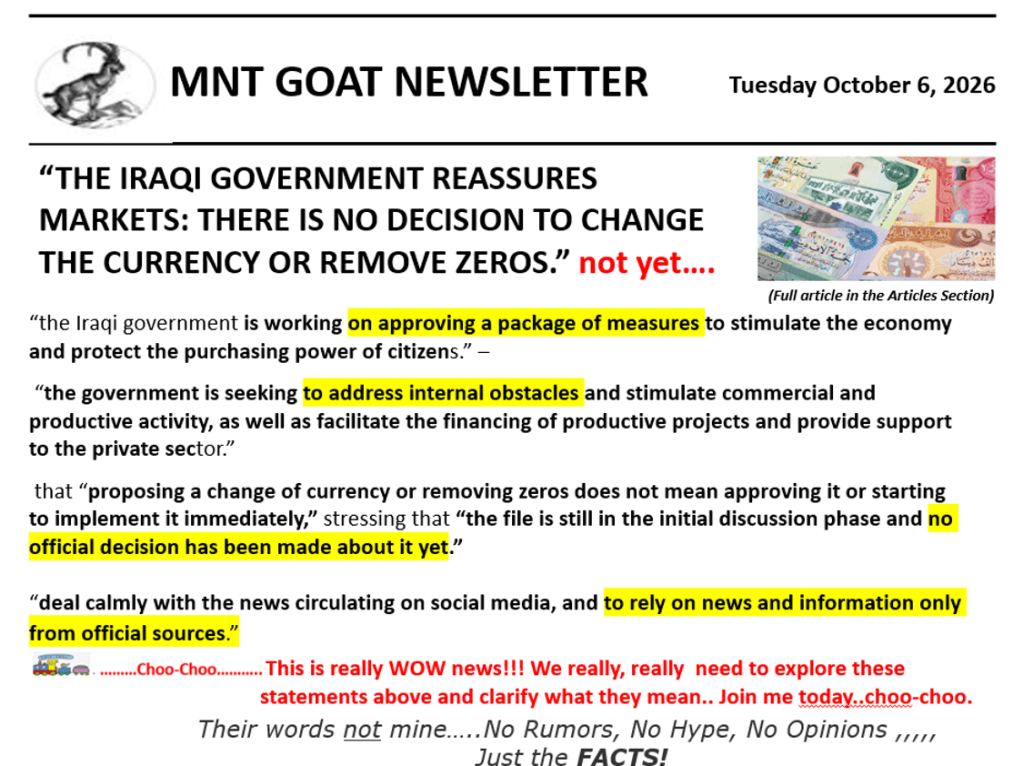
There is one article in particular that I have to first cover today. It is titled “THE IRAQI GOVERNMENT REASSURES MARKETS: THERE IS NO DECISION TO CHANGE THE CURRENCY OR REMOVE ZEROS.”
I need to clarify what this all important article is telling us today. This is chock-full of information for us investors. Just bear in mind that the liquidity issue has come to a new heightened urgency pitch, even more than when I last talked about it.
I quote from the article “A responsible government source confirmed on Wednesday that the Iraqi government is working on approving a package of measures to stimulate the economy and protect the purchasing power of citizens.”
In the past we learned that there is a needed law to conduct the removing of the zeros. In this last paragraph of this article today we see this again. This law is going to be part of a package of measures and will be presented to parliament soon.
I quote again – that “the government is seeking to address internal obstacles and stimulate commercial and productive activity, as well as facilitate the financing of productive projects and provide support to the private sector.”
Okay, so we read that there are obstacles to this package of measures. We read many articles in the recent past about alternatives to conducting the removing of the zeros. I presented this notion to you in my September 3, 2026 Newsletter. Was it more than just a notion? We know that the only solution is to remove the zeros and they know it. So why the hesitation to do it? They hesitate because they know it has to be followed very closely with the reinstatement to FOREX. Are all the other pieces also in place to move to FOREX? Think about this move to FOREX as the last ‘explosive’ piece. As an analogy: when you rig explosives you have to be careful. When you finally pull the trigger, everything has to be just right and in place to get the desired outcome.
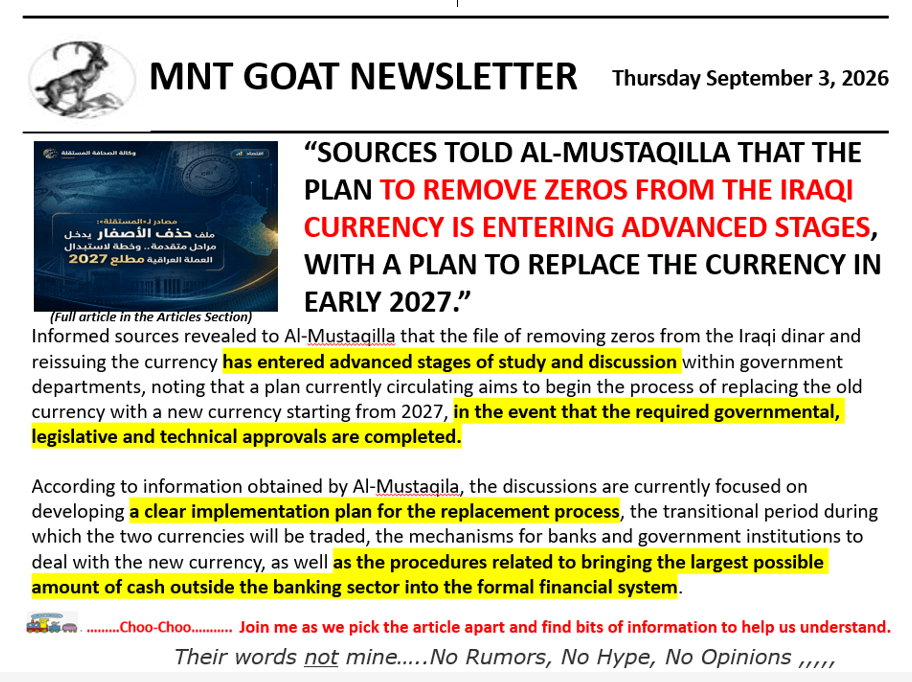
Do you remember this Newsletter going back to early September? What did they tell us then? They said ‘advanced stages’ not ‘initial discussion phase.’ for removing the zeros. Then at that time my CBI contact told me they already had the draft law to conduct the project all written and ready for parliament. So they must already know what they are going to do and how they are going to do it. I firmly believe we may see the beginning of the project to remove the zeros begin in early January 2027, the beginning of a new fiscal year.
I quote again – “Regarding what is being circulated about changing the national currency, the source explained that “proposing a change of currency or removing zeros does not mean approving it or starting to implement it immediately,” stressing that “the file is still in the initial discussion phase and no official decision has been made about it yet.”
So, in this last statement we now have our answer. Did you read it? Seems to me they most probably we will wait until early 2027 to begin removing the zeros. But they did not tell us this even today. We will wait for more news to come. What is in this draft bill they are proposing?
He added that “strengthening confidence in the markets requires providing clear information and practical steps, along with close cooperation between the government, financial institutions and the private sector to alleviate pressures and improve economic performance.”
The government source, through the statement, called on all citizens, merchants and business owners to “deal calmly with the news circulating on social media, and to rely on news and information only from official sources.”
What I believe this last nugget of information is telling us is to be patient. BE CALM. It is coming but there is still some work to be done prior

Stay away from these crooked intel gurus on the internet. They are confusing you with over speculative statements. Listen to only official sources from Iraq. Oh boy, does this resonate with me. Is this not what I have been telling all my readers to do now for over a decade. Yes, it has been over a decade already since I formally began my Newsletter. Remember I began it when TNT Tony kicked me off his site in 2013 for challenging his nonesense. Yes, it is thirteen years already of bringing you HONEST news.
____________________________________
There is another article in today’s news that goes hand-in-hand with the news we just read. It is titled “CURRENCY SPOKESPERSON DENIES DINAR DEVALUATION RUMORS AMID MARKET PANIC”.
I quote from the article:
- Market Spokesperson Jabar Goran clarified that changing the exchange rate is an exclusive constitutional power of the Central Bank of Iraq, not the Ministry of Finance.
- Contacts within the Parliamentary Finance Committee confirmed that the proposal is entirely speculative and has not been drafted into any formal bill.
- Goran labeled a devaluation as “suicidal,” warning it would devastate living standards.
Unverified reports originating from an Iraqi MP claiming a proposed devaluation from 132,000 to 150,000 IQD per $100 triggered a massive parallel market panic
So, we can see from this news that false information cause harm to any economy. This also applies to us investors who over speculate on the timing of this investment. Please read again what this is telling us. The three points At a Glance.
It seems that whenever the dollar takes a rise there are politicians and economist who find the solution always in devaluing the dinar and revaluing the dollar. Do they not know that these hiccups are temporary. They happen solely because the dinar is still pegged exclusively to the dollar. So why wouldn’t hiccups effect it so much. It only stand to reason. My advise to Iraq – Then get off the sole peg to the dollar and execute Dr. Shabibi’s plan! 😊
So, in this most interesting article, we also find out the culprit as to why the dollar rose so much in the first place.
I quote from the article – “He further said that the ASYCUDA system fails to adequately facilitate trade by significantly delaying dollar allocations for merchants importing essential goods, forcing them to purchase dollars directly from the parallel market and thereby driving up demand.”
Yes, there is always a cause and effect relationship. But what if they merchants didn’t have to rely on the dollar so much to buy goods? What if they could use the dinar currency and oil was sold using only Iraqi dinars instead of US dollars. OH boy!!!!!
Once again will the CBI most likely devalue the dinar and bring the official rate to around 1500? I doubt it. As usual we go around and around on this issue every time there is a hiccup in the economy.
I quote from the article –
“The Central Bank of Iraq (CBI) has not issued any official statement regarding the matter so far. “
“However, the apex bank has previously and repeatedly reaffirmed its steadfast commitment to maintaining the official exchange rate at 1,320 IQD per dollar without any alterations.”
But this article says it all. It is titled “AN ECONOMIST ACCUSES “INFLUENTIAL PARTIES” OF FABRICATING THE DOLLAR CRISIS AND CALLS ON THE CENTRAL BANK TO INTERVENE URGENTLY.”
I quote “On Saturday, economist Abdul Rahman Al-Mashhadani accused influential parties of fabricating the current rise in dollar exchange rates in local markets, explaining that the goal of this rise is to achieve exorbitant profits for specific banks that are not subject to sanctions.”
Do you see now the harm that is being caused by staying on the sole peg to the US dollar. How much long can Iraq go on with this foolishness? Yes, it is exacerbating the corruption even more the longer they stay on it.
Enough said on this topic of devaluation…..
________________________________
Update on removing the factions:
I know, I know we are all getting bored with hearing so much about the disarmament of these factions inside Iraq. There are many articles in today’s news on this subject matter. Please feel free to go read them in the Articles Section. I will bring only a few to the surface for you today. The first is titled “AMERICAN MESSAGE TO THE BARZANI GOVERNMENT… WHAT DOES IT CONTAIN?”
So, we get this article about the Factions still remaining in Iraq and not disarming any time soon,” if ever, so they claim”. This is one last desperate attempt by Iran to control Iraq now that the Islamic Revolution Jehad regime is falling apart. What will happen to Hezbollah in Iraq when Iran does eventually fall. This will most likely not happen until after the US midterm elections. I think we are all adults and can understand why I am saying this? What does this article say to us?
“A responsible source in Sulaymaniyah province revealed on Tuesday the contents of an American message to the Kurdistan Regional Government, which he said included Washington’s options regarding the region’s status during the next phase.”
The source told Al-Maalomah News Agency that “Masoud Barzani’s government received a message carried by US envoy Tom Barak, which included two options with no third alternative:
1.the first is to integrate the region’s forces with the regular forces under the supervision of the federal government,
2.and the second is to stop the financial aid provided by Washington to the regional government, in addition to stopping the air support provided to the Peshmerga forces and protecting the region’s airspace from external attacks.”
The source indicated that “the gist of the message confirms that the Barzani government has no option but to respond to the demands of the Trump administration regarding the integration of Kurdish forces of all kinds into the regular forces, without any restrictions or conditions.”
He indicated that “the US administration threatened dire consequences that the Barzani government might bear if the message’s contents were not implemented on the ground.”
The second article is titled “THE (Iranian Factions) BRIGADES WILL BEGIN MONITORING IRAQI AIRSPACE TONIGHT AND THREATEN TO OVERTHROW THE GOVERNMENT AND CLOSE BORDER CROSSINGS.”
I first have to say ‘really’. These are very bold statements. Like statements trying to lur someone into a trap of some kind. Maybe like to trap Trump just before the midterms to take illegal actions of force against these factions. Remember the US was invited back into Iraq in 2014 to fight ISIS and this expired at the end of September 2026. This is why they had to pull out. Will Iraq make a new agreement to have them come back in to fight these factions? Let’s see what happens.
I quote from this article – “The security official of Kataib Hezbollah, Abu Mujahid al-Assaf, considered September 30 an occasion to celebrate “the expulsion of the American and NATO occupation at the hands of the resistance fighters,” and the beginning of achieving full sovereignty in the country.”
You have to remember that this is a contradiction for Hezbollah to say this since their presence proofs that Iraq still DOES NOT have full sovereignty as long as they still exist inside Iraq. yes, they are now the occupiers not the U.S. This withdrawal of NATO and the US forces had nothing to do with their efforts, get it?
“He warned Prime Minister Ali al-Zaidi against bringing down his government by all means, and threatened to close the border crossings with neighboring countries if the air embargo on Iran continues.”
So, we see Hezbollah is bringing the conflict with Iran into Iraq with these kind of statements. This is exactly why they can not continue to exist inside Iraq. They are threatening Iraq from actions the US is making against Iran. They want Iraq to pressure the US to stop the air embargo. Why do they want this? Go figure they want more ammo, weapons and food smuggled in. Iran is being choked.
He indicated that “the Islamic resistance will begin monitoring Iraqi airspace to ensure that it is not violated by hostile aircraft, and will first warn and then work to shoot them down, according to him.”
“Although former US President Barack Obama continued to boast about withdrawing his forces from Iraq in 2011, he was forced, under intense pressure, especially from the Iraqi government, to begin redeploying troops to Iraq.”
The third article is yet more alarming and it is titled “A FACTION DESCRIBES THE SURRENDER OF WEAPONS AS “DELUSIONS” AND THREATENS TO TARGET COUNTRIES IN THE REGION.”
“The “Companions of the Cave” faction, in a statement issued on the occasion of the withdrawal of the international coalition forces from Iraq, asserted that the issue of handing over weapons is merely “illusions,” while also issuing a threat to the countries participating in striking Iran.”
The faction said in a statement: “The issue of surrendering weapons is a delusion dreamt of by the weak, the humiliated, and the dollar slaves. Starting tonight, any foreign presence, whether on land or in the air, will witness a military response from us. This is a legitimate right guaranteed by international conventions to confront the occupation.”
Enough said on this topic…..
____________________________________
Is there any good news? As this drama with the factions continues, the banking reforms as reorganizing the banks in Iraq continues. If you recall the IMF and the World Bank, along side the consulting firms that came into Iraq, simply told the CBI there are too many banks and many are not following the banking laws. It is too ripe for corruption and too complicated to enforce the law. Based on these kinds of statements we learn today that the consolidation of many banks is taking place. Finally… some good news. We have been waiting for this news.
The article is titled “KURDISTAN MERGES 94 GOVERNMENT BANKS INTO NATIONAL BANK”
You can find the entire article here: link This is just snippet. Yes, it is finally a reality. Did this have to happen prior to the reinstatement?
At a Glance
- The Kurdistan Region is consolidating 94 government banks as part of a wider banking sector restructuring.
- Only four banks will remain in central Slemani during the current phase of the merger.
- The National Bank is expected to eventually bring the remaining government banking operations under one institution.
- Authorities aim to complete the merger and accounting procedures across Slemani by the end of 2026.
“The Kurdistan Region is undertaking a major restructuring of its government banking system, with dozens of state banks being consolidated ahead of the planned expansion of the National Bank.”
__________________________________
In this next article we find that there is still much work to be done with the economy. It is titled “A PARALLEL ECONOMY OPERATING OUTSIDE THE SYSTEM… AL-ZAYDI BEGINS A LONG JOURNEY TO REGULATE THE PRIVATE SECTOR AND THE LABOR MARKET.”
The Al-Zaidi government is moving to reorganize one of the largest economic blocs that has operated for decades outside the formal economy. This involves developing a national strategy for transitioning to the formal economy, aiming to broaden the private sector and bring hundreds of thousands of businesses, projects, and workers into the formal registration, social security, financing, and market system.
The figures reveal the scale of the challenge facing this transformation. The latest national labor force survey showed that 66.6% of all workers in Iraq are employed in the informal sector, while approximately 54.8% of the total workforce is employed within the informal sector.
These are workers not paying taxes or social security. They also are not using the banks as they hide their income. Their money does not flow through the economy. This must be broken (changed) to get out of the rentier economy.
________________________________________
The other topic of concern is the 2027 budget.
Like I told all my readers there would be no 2026 budget. It would be rolled into the 2027 and it has. How foolish to track the 2026 even when we were half way through 2026 already and a new government was barely still in place. Oh…. but they thought the RV rate was going to be in it, hype, hype and more hype! So, once again today we see the rate is not in the 2027 as it uses the price per barrel of oil not the rate of the dinar. As usual Mnt Goat was right on target again…. 😊
Remember that the Iraqi fiscal year begins January 1st not October 1st, as many of the intel gurus tell you. The budget for the next year must be ready by the end of October and then passed in parliament by January 1st ready to use. They are given 2 months to discuss and get it passed. This is has NEVER happened before as they always still argue over the budget way into the following year. They go with the 1/12 rule until it is passed. This greatly effects/impedes any real progress in Iraq as budgeted projects can’t be completed in such a short period remaining in the year when it does get passed easly enough in the year. There is so much left-over funds. Where does all this money go? It gets rolled into next year’s funding.
In the article today we hear again that the “program-based budget” in the annual budgeting effort may change all these budgeting delays and may finally get a decent budget completed and passed by the beginning of the fiscal year.
It is titled “MP: THE 2027 BUDGET WILL BE SENT THIS MONTH AND APPROVED BEFORE THE END OF THE YEAR”. Were they trying to tie a new budget to a new dinar rate that is reinstated. Was this going to be a convergence of events also tying it into the WTO full accension? Is this now spoiled with the lingering issues of the Iranian backed factions? Can they start anyhow the removal of the zeros project in early January anyhow?
Al-Moussawi told Al-Maalouma News Agency that “the Council of Ministers will send the proposed 2027 budget law to the House of Representatives during this month,” explaining that “the Parliamentary Finance Committee will immediately begin studying the budget and reviewing all its items upon its arrival so that it can be submitted for discussion and voting at the beginning of the tenth month.”
He added that “next year’s budget will be significantly different from its predecessors, as it will focus primarily on development programs and activating the productive sectors in the country, as well as reducing many unnecessary government spending items,” predicting that “the House of Representatives will pass the budget and vote on it definitively before the start of the new year.”
It is worth noting that the parliamentary finance committee hosted Finance Minister Faleh al-Sari last week to discuss key amendments to the draft budget law, including a detailed discussion of changing the current operating mechanism and transitioning to a “program-based budget.”
_______________________________________
SUMMARY
So, we take the bad news with the goods news today. We must get through it to get to it. Yes, someone moved our cheese again. What can happen between now and early January? I doubt if they can begin removing the zeros and most probably won’t until early 2027. Then will we still have to wait till June for the dismantling of the Iranian factions? I doubt that Iran will last much longer past mid-terms in the USA. What will Hezbollah do then to support themselves?
All the other news is very good. It shows progress. It may be not what we wanted to hear but banking reforms are essential to cleaning up the structure.
We know the fundamentals of what has to be accomplished to prevent much of the fraud and corruption still with the dollars. How can you ship plane loads of dollars into a country to meet their budget and then expect no corruption with all this paper currency around. So, this all has to change in the future too.
Again, I will say what if Iraq could sell its oil for dinars? Would this not force the international market to demand dinars? Would the US ever allow this or do they maintain the dollar dependency as leverage with Iraq? When can they finally end this necessity to have this leverage over Iraq? Is Al-Zaidi going to be their savior?
These are all questions closely related to see our RV. I am not saying that all these events must occur because remember Dr Shabibi was going to reinstate the dinar way back in 2013 and none of these banking reforms were in place nor any of these other measures done. So, anything can happen for these issues as long as SECRITY and STABILITY are achieved. We have been told over and over again these are the two main ingredients necessary for the reinstatement.
Now let me pose some questions in this regard:
- Do you believe Iraq is more secure with terrorist factions occupying Iraq i.e. Hezbollah.
- Do you believe the CBI will ever combat the parallel market to the point of making the two rates equal (parallel vs official CBI rate) ? Remember the parallel rate can be 2% below or above the official rate as acceptable by the IMF. So, we know it is recognized already they can most probably not be equal.
- Do you believe the conflict with Iran is close to completed?
Remember we are dealing with Iraq and so things could change suddenly. There is also much more progress than what we read in the news. We don’t need a ‘perfect’ Iraq to have a reinstatement. Only to follow ‘the plan’ and get enough security and stability to attract investors to grow the economy. Remember that in 2013 ISIS had not yet attacked Iraq. That did not happen until 2014.
I firmly believe statements I hear from the IMF and the CBI that Iraq is to be the ‘financial center’ for the middle east. I don’t see how they can do this with a 1320 rate. Do you see now why president Trump is paying so much attention to the country?
____________________________________________
PRAYER WORKS: As I have declared so many times before. It is our prayers that will help this investment come to reality sooner than later. They are working and we must continue. We must continue to pray and pray harder than before even. Are we willing to even make this little of a sacrifice for God to tell him what we desire?
_______________________________________________
What do you think will happen next? (Leave a comment)
______________________________

________________________________________
Their words not mine…..No Rumors, No Hype, No Opinions ,,,,,
Just the FACTS!
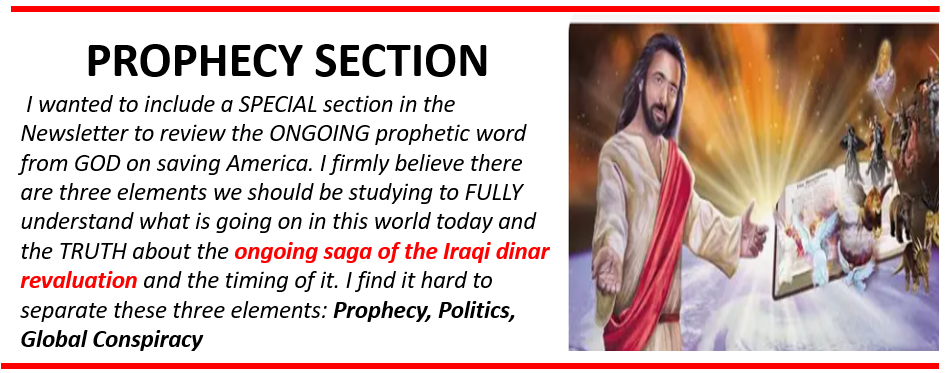

These prophecies are an important tool we have to lead us on our path. They are more important now than ever. They give us the strength, perseverance and hope that a better time is coming and that God’s Hand is at work behind the scenes. If you just take a second even to look around you at these past three election cycles, how can you deny that God is at work? Are you sleeping or what?
It is amazing and there is no other way that these events could have happened the way they turned out. But there is more to come, much, much more, I assure you! Now that God has his biblical David re-elected, we need to pay attention to what He does next.
NOTE: These prophecies tell us also of things happening in the background that either the main stream news media does not know about or the crooked news media refuses to talk about. They do this to keep us in the dark to continue the Trump hating senario and for us to keep thinking that nothing is changing, thus Trump is not successful. But it is just the opposite happening. The proof is all around us if we look for it.
Prophetic Words from the prophets: Julie Green
“Martial Law Is Not That Far Off “
Go to the 13:49 mark on the video. Given on Sept 22, 2026.
How many times does God have to bring this news to us before we listen?
I am bringing this to you so you don’t freak out when it occurs and understand why this has to happen and what it is truly accomplishing. My guess is the democrats will
try something to rig the elections come November. We are very close.
They are VERY. VERY desperate people!

“The Wolf Pack Will Make A Move They Will Soon Regret “
Go to the 10:08 mark on the video. Given on Sept 25, 2026.
Again God talks about martial law and rounding up those for treason. This time is VERY near. Will it come just after the midterm elections?
If you recall God told us through Julie Green at least twice already that he is taking the oil along with the gold and silver out of the hands of the enemy. The oil will SHIFT from the enemy’s hands. The U.S. and Israel will be shifted the oil. Remember God said everything will shift. This is the time of shifting. What happens when you shake things up? They SHIFT! God says ‘what can be shaken will be shaken’. This includes all the developed countries and also Iraq.

________________________________________________
Fr. DON BOSCO EXPOSED THE DARK SECRET BEHIND ISLAM
I keep this one out here to view. Everyone should take the time to watch it. It will awaken you about the Muslim so-called religion (or should we call it for it is — a ‘cult‘.)
— And the truth the world forgot about the so-called Muslim religion.
Fr.Don Bosco, also known as John Bosco, was an Italian Catholic priest and educator, born on August 16, 1815. He founded the Salesian Society in 1859 to help disadvantaged youth, particularly boys, through education and community service. His teachings emphasized lovekindness, and the importance of education for young people, making him a beloved figure in Catholicism and a patron saint of youth. Don Bosco was canonized in 1934.
AMERICA’S 7 NEW ENERGY BREAKTHROUGHS ARE SHOCKING THE ENTIRE WORLD!
Why is the news media not talking more about these new energy sources? Is it because they hate president Trump so much that anything of progress or innovation is kept silent from the citizens? Simply put, they don’t want Trump’s administration to succeed.
A BATTLE IRAN DOES NOT WANT THE WORLD TO SEE

EUROPE IS ON THE VERGE OF COLLAPSE

7 European Countries on the Edge of Collapse: The Alarming Truth Europe Doesn’t Want You to Know
NEW TACTICS OF THE LEFT, EXTREMIST, DEMOCRAT LIBERALS
This is the only way they can get votes – just lie to the American people. What they do once elected is appalling. But you get what you vote for….
There is also news Leavitt may be joining FOX News. This could be the best thing that could happen to FOX.

THE GLOBAL DEBT CRISIS HAS BEGUN (WHY GOLD IS FALLING FIRST)
I was in the dentist not long ago and the nurse and doctor joked about how many scams there were about how to make money. They mentioned the Iraqi dinar and laughed. Then I mentioned silver and how silver has the potential to rise suddenly. They made a joke about it and pretended it was just another money-making scheme off the internet. Remember silver climbed from $25 an ounce to over $100 in a short time and then settled back to over $70. It recently climbed again over $100. Soon $100 will be the new norm. There is just too much going on financially to reset that silver at $300 an ounce cannot be a reality soon. This is how these metals work.
Am I telling you to buy silver? No, I do not give financial advice only tell you what I know from what I read. Of course, if you buy silver now you would have to wait for it to climb again and again and go through it process of ups and downs again until it settled to a new norm. You already missed the first phase. Will you miss the second?

AMERICA’S NEW INVENTION COULD END OIL FOREVER
THE LARGEST SINGLE OIL RESERVE EVER DISCOVERED IN THE UNITED STATES


THE IRAQI GOVERNMENT REASSURES MARKETS: THERE IS NO DECISION TO CHANGE THE CURRENCY OR REMOVE ZEROS.
A responsible government source confirmed on Wednesday that the Iraqi government is closely monitoring the slowdown in buying and selling activity in local markets and is working on approving a package of measures to stimulate the economy and protect the purchasing power of citizens.
The source said in a statement published by the official agency and followed by “Iraq Observer”, that “the current economic challenges are not limited to Iraq alone, but most countries in the region are facing them as a result of the ongoing regional tensions and the closure of the Strait of Hormuz”, noting that “the government is seeking to address internal obstacles and stimulate commercial and productive activity, as well as facilitate the financing of productive projects and provide support to the private sector.”
Regarding what is being circulated about changing the national currency, the source explained that “proposing a change of currency or removing zeros does not mean approving it or starting to implement it immediately,” stressing that “the file is still in the initial discussion phase and no official decision has been made about it yet.”
He added that “strengthening confidence in the markets requires providing clear information and practical steps, along with close cooperation between the government, financial institutions and the private sector to alleviate pressures and improve economic performance.”
The government source, through the statement, called on all citizens, merchants and business owners to “deal calmly with the news circulating on social media, and to rely on news and information only from official sources.”
****************************************************************************************
CURRENCY SPOKESPERSON DENIES DINAR DEVALUATION RUMORS AMID MARKET PANIC
- Market Spokesperson Jabar Goran clarified that changing the exchange rate is an exclusive constitutional power of the Central Bank of Iraq, not the Ministry of Finance.
- Contacts within the Parliamentary Finance Committee confirmed that the proposal is entirely speculative and has not been drafted into any formal bill.
- Goran labeled a devaluation as “suicidal,” warning it would devastate living standards.
- Unverified reports originating from an Iraqi MP claiming a proposed devaluation from 132,000 to 150,000 IQD per $100 triggered a massive parallel market panic.
The Slemani Currency Exchange Market spokesperson warned that recent unverified rumors of an official dinar devaluation to 150,000 IQD per $100 are triggering severe parallel market panic and volatility, labeling any such policy move as a “suicidal decision” for the economy.
Key Statements and Focus Area
- Currency Market spokesperson Jabar Goran stated that the instability in local exchange markets “was triggered by statements from an Iraqi Member of Parliament claiming that the Minister of Finance discussed adjusting the exchange rate—devaluing it from 132,000 dinars to 150,000 dinars [per $100].”
- “This inherently created a highly negative reflection on the market and caused a massive panic. However, this proposal has neither become a draft bill nor has it been presented to the members of the Parliamentary Finance Committee,” Goran affirmed.
- A currency trader told Channel8 that “any rumor circulated in the market—whether accurate or inaccurate, and whether it drives up demand or supply—directly impacts individuals and traders alike.”
Briefing reporters in Slemani on Monday, including Channel8, spokesperson Goran stated that according to the constitution and the regulations of the Central Bank of Iraq, “these powers reside exclusively with the Central Bank.”
He noted that decisions of this nature require comprehensive analysis by Central Bank experts, adding, “a decision like this is never made haphazardly.”
“This would be a suicidal decision,” he stressed, adding that it would create a severe negative impact on the market and drastically lower the citizens’ standard of living.
“In my personal opinion, this decision will not be implemented,” he reaffirmed.
The spokesperson highlighted that “at a time when customs tariffs have already been increased on the public due to the ASYCUDA system, coming along and devaluing the currency on top of that would ultimately have a devastating impact on people’s lives.”
Goran confirmed that according to sources within the Parliamentary Finance Committee and the Central Bank, the exchange rate adjustment remains entirely speculative and has not been drafted into a formal legislative proposal.
Answering questions regarding the motives behind the circulated reports, he said that “the intention of the parliamentarians who circulated this news is either to gauge the public’s reaction first or, in one way or another, to manipulate the market.”
He called on media outlets not to broadcast this news until the source has been officially verified.
Meanwhile, a currency trader noted that the market witnessed intense volatility as the dollar rate surged past 160,000 IQD before retracing to 159,000 IQD, warning that the instability will persist until the Central Bank officially refutes the devaluation rumors.
He further said that the ASYCUDA system fails to adequately facilitate trade by significantly delaying dollar allocations for merchants importing essential goods, forcing them to purchase dollars directly from the parallel market and thereby driving up demand.
FYI
The instability in the parallel market across the Kurdistan Region comes as Iraqi Parliamentary Finance Committee member Dilan Ghafoor revealed that the draft 2027 budget proposes setting the exchange rate at 150,000 IQD per $100.
Lawmaker Ghafoor explained that this fiscal measure, developed by the Ministry of Finance, aims to completely eliminate the gap between official and parallel trading figures by aligning both rates at the 150,000 dinar threshold.
She added that while a principal agreement has been included in the initial budget draft to inject an additional 20 trillion dinars into state revenues, the adjustment is not yet final as it still requires formal approval and votes from both the Council of Ministers and Parliament.
The Central Bank of Iraq (CBI) has not issued any official statement regarding the matter so far.
However, the apex bank has previously and repeatedly reaffirmed its steadfast commitment to maintaining the official exchange rate at 1,320 IQD per dollar without any alterations.
*****************************************************************************************
AMERICAN MESSAGE TO THE BARZANI GOVERNMENT… WHAT DOES IT CONTAIN?
(Mnt Goat: So, first we get this article following closely by the next article from the Factions still remaining in Iraq and not disarming any time soon,” if ever, they claim”. This is one last desperate attempt by Iran to control Iraq now that the Islamic Revolution Jehad regime is falling apart.)
A responsible source in Sulaymaniyah province revealed on Tuesday the contents of an American message to the Kurdistan Regional Government, which he said included Washington’s options regarding the region’s status during the next phase.
The source told Al-Maalomah News Agency that “Masoud Barzani’s government received a message carried by US envoy Tom Barak, which included two options with no third alternative: the first is to integrate the region’s forces with the regular forces under the supervision of the federal government, and the second is to stop the financial aid provided by Washington to the regional government, in addition to stopping the air support provided to the Peshmerga forces and protecting the region’s airspace from external attacks.”
The source indicated that “the gist of the message confirms that the Barzani government has no option but to respond to the demands of the Trump administration regarding the integration of Kurdish forces of all kinds into the regular forces, without any restrictions or conditions.”
He indicated that “the US administration threatened dire consequences that the Barzani government might bear if the message’s contents were not implemented on the ground.”
****************************************************************************************
THE BRIGADES WILL BEGIN MONITORING IRAQI AIRSPACE TONIGHT AND THREATEN TO OVERTHROW THE GOVERNMENT AND CLOSE BORDER CROSSINGS.
The security official of Kataib Hezbollah, Abu Mujahid al-Assaf, considered September 30 an occasion to celebrate “the expulsion of the American and NATO occupation at the hands of the resistance fighters,” and the beginning of achieving full sovereignty in the country.
He warned Prime Minister Ali al-Zaidi against bringing down his government by all means, and threatened to close the border crossings with neighboring countries if the air embargo on Iran continues.
He indicated that the Islamic resistance will begin monitoring Iraqi airspace to ensure that it is not violated by hostile aircraft, and will first warn and then work to shoot them down, according to him.
Obama brought the Americans back to Iraq in September 2014, and Trump withdrew them in September 2016. I do not believe Trump withdrew them. As we saw that he visited the troops in Kurdistan that Christmas time. Go figure more lies to bash Trump.
Although former US President Barack Obama continued to boast about withdrawing his forces from Iraq in 2011, he was forced, under intense pressure, especially from the Iraqi government, to begin redeploying troops to Iraq.
He announced this in a famous speech in the early hours of September 10, 2014, when ISIS artillery reached the outskirts of Erbil and continued its advance across Iraq. At that time, a major US contribution began in building an international coalition that provided fighter jet and artillery support, training, and advice throughout the war, which ended in the summer of 2017.
During this period, the number of US troops in Iraq reached 5,000, distributed across several bases throughout the country. With their withdrawal on Wednesday, their second deployment to Iraq will have lasted 4,491 days, or 12 years and 3.5 months.
****************************************************************************************
THE PEOPLE OF THE CAVE WILL ALSO BE WATCHING THE SKIES OF IRAQ: WE WILL STRIKE ANY AMERICAN AIRCRAFT STARTING TOMORROW.
(Mnt Goat: it says 10 points but only gives eight)
After Kataib Hezbollah announced that it had begun monitoring the skies over Iraq in search of American aircraft on Monday (September 28, 2026), the Ashab al-Kahf faction announced on Tuesday (September 29, 2026) that it would monitor any American aircraft or any similar ground movement and would respond to it.
In a statement, which was monitored by Network 964 , the faction outlined ten points explaining the withdrawal of the international coalition forces:
First: The issue of surrendering weapons is a delusion dreamt of by the weak, the humiliated, and the slaves of the dollar.
Second: Starting tomorrow night, any foreign presence, whether on land or in the air, will be met with a military response from us. This is a legitimate right guaranteed by international conventions to confront occupation.
Third: What the terrorist “Tom Barrack” dreams of, which is to remove Iraq from the arena of the axis of resistance, is a difficult goal and will not be achieved. We will continue to participate according to the policy of the axis, and according to what is required by the ongoing battle between right and wrong, as described by the religious authority.
Fourth: Any country that participates in any aggression against the Islamic Republic must evacuate all its military and economic interests, and some of them should expect a response at any time, in revenge for the martyrs of the Popular Mobilization Forces.
Fifth: In the near future, we will unveil our new weapon that will please our friends and infuriate our enemies.
Sixth: We affirm that we are not subject to any political or partisan entity, and that our close ideological connection is to the religious authority; and whoever wants us to hand over our weapons, let him bring us a written text from it that requires that.
Seventh: We clarify that any hand that reaches out to our fighters will be cut off, and we will use weapons to defend our weapons against anyone, and we will not accept any humiliation, conspiracy, or infringement on our weapons, our existence, or our legitimacy.
Eighth: The brothers, the leaders of the Popular Mobilization Forces, must confront the conspiracies being hatched in the military decision-making office to weaken the Popular Mobilization Forces and pressure them to leave the vulnerable areas. We do not rule out that there may be pressures from “Tom Barrack” and Saudi influence in this office, and the wise understand what we are saying.
It is a jihad… victory or martyrdom.
Peace, mercy and blessings of God be upon you.
************************************************************************************
THE AMERICAN WITHDRAWAL FROM IRAQ: BETWEEN ILLUSION AND REALITY
One day later, on September 30, 2026, the withdrawal of the United States and international coalition forces from Iraq will reach its announced and final date. Thus, a military phase that has extended, in various forms, since 2003 will end, and the Iraqi state will enter a new phase in which it is supposed to bear greater responsibility for its security, its airspace, the pursuit of ISIS, and the protection of its institutions and borders.
But the problem begins precisely here, because the end of the foreign military presence does not necessarily mean the completion of sovereignty, and the departure of the forces does not automatically resolve the question of who possesses power, who decides to use it, and who has the ability to protect the state when it is threatened.
The official Iraqi discourse has treated September 30 as a moment of restoring sovereignty, a description that is politically understandable, but not sufficient from a strategic standpoint. Sovereignty is not merely the absence of foreign forces from the land, but rather the state’s ability to monopolize security and military decisions, protect its airspace, pursue armed groups outside its institutional structure, and prevent its territory from being used as a platform for others’ conflicts. Therefore, the day after the withdrawal will, in reality, be the most difficult test for the Iraqi state, not the end of the test.
**************************************************************************************
A MEMBER OF PARLIAMENT CALLS FOR THE REMOVAL OF CORRUPT FIGURES AND THE OPENING OF MAJOR CASES WITHOUT FAVORITISM.
Member of Parliament Abdul Hamza Al-Khafaji called on Wednesday for oversight and judicial bodies to open and activate major pending financial and administrative corruption cases, stressing the need to pursue the big fish of corruption and recover the looted funds away from any pressures or political settlements.
Al-Khafaji told Al-Maalouma News Agency that “the current stage requires taking courageous and unconventional steps by the Integrity Commission and the Public Prosecution by immediately opening the huge files that witnessed the waste of billions in fictitious contracts and projects that affected vital and strategic sectors,” indicating that “financial corruption is no less dangerous than terrorism in undermining the pillars of the state and draining the people’s wealth.”
He added that “anti-corruption campaigns should not be limited to junior employees, but should reach the big bosses and influential parties who provided political cover for the waste of public money,” noting that “silence or procrastination in resolving these cases disrupts the development process and weakens public confidence in regulatory and executive institutions.”
Al-Khafaji stressed “the necessity of supporting the judiciary and investigative bodies to deter anyone who dares to infringe upon citizens’ rights and the country’s resources,” affirming that “the House of Representatives will firmly exercise its oversight role to ensure that those involved are exposed, brought to justice, and every dinar stolen from the state treasury is recovered.”
***********************************************************************************
AL-ZAYDI ANNOUNCES THE END OF THE INTERNATIONAL COALITION’S MISSION AND AFFIRMS: NO WEAPONS OUTSIDE THE LAW.
On Wednesday, Prime Minister and Commander-in-Chief of the Armed Forces Ali Faleh al-Zaidi presided over the official ceremony marking Sovereignty Day and the end of the mission of the international coalition forces fighting ISIS in Iraq, in the presence of the coalition forces commander and leaders of various military branches and security formations.
In a speech delivered on the occasion, the Commander-in-Chief of the Armed Forces announced the official end of the mission of the international coalition to fight ISIS, proving that cooperation between friendly forces and friendly peoples has resulted in a victory over one of the darkest chapters of extremism and brutality in history.
He added: “ The uprising of our people alongside our armed forces was the starting point for a phase in which our forces reorganized their command systems, were able to mobilize resources, unify efforts, and seize the initiative. Friendly countries also extended a helping hand to Iraq in that decisive confrontation, and our armed forces successfully reorganized and rearmed themselves. ”
He continued: “Throughout the years of the war on terror, the Joint Operations Command has been the heart of coordination, and the mind that gathers information and carries out planning and leadership within a major national battle.”
He added: We extend our thanks and appreciation to all the friendly countries that participated in the international coalition, and to its leaders, officers, trainers and advisors who worked alongside our security forces.
He explained that the end of the international coalition’s mission does not mean the end of our battle with terrorism, but rather that Iraq is moving to a stage in which it assumes full responsibility for its security and stability, and the transfer of joint operations tasks to the office of the Commander- in-Chief of the Armed Forces embodies an institutional formula for managing this effort under the authority of the state and its supreme leadership.
He continued: A new phase has begun, characterized by Iraq’s sovereignty, the strength of its institutions, the readiness of its forces, the unity of its decision, and balanced partnerships with its friends. Security cooperation will remain an open path with friends from the international coalition and will be more effective and focused.
He explained: Cooperation will involve employing technology and digital techniques to serve the goals that support security and stability. The mission has ended in victory, and the responsibility for protecting this victory now rests on all of us.
He concluded his statement with, ”No weapons outside the umbrella of the law, and no power outside the institutions of the state, in accordance with what the constitution stipulates, what our wise leadership has called for , and what our people want.”
*******************************************************************************************
A FACTION DESCRIBES THE SURRENDER OF WEAPONS AS “DELUSIONS” AND THREATENS TO TARGET COUNTRIES IN THE REGION.
The “Companions of the Cave” faction, in a statement issued on the occasion of the withdrawal of the international coalition forces from Iraq, asserted that the issue of handing over weapons is merely “illusions,” while also issuing a threat to the countries participating in striking Iran.
The faction said in a statement: “The issue of surrendering weapons is a delusion dreamt of by the weak, the humiliated, and the dollar slaves. Starting tonight, any foreign presence, whether on land or in the air, will witness a military response from us. This is a legitimate right guaranteed by international conventions to confront the occupation.”
He added that what Tom Barak dreams of, which is removing Iraq from the arena of the axis of resistance, is a difficult goal and will not be achieved. We will continue to participate according to the policy of the axis, and any country that participates in any aggression against the Islamic Republic must evacuate all its military and economic interests, and some of them should expect a response at any time, in revenge for the martyrs of the Popular Mobilization Forces.
He continued, ” In the near future, we will unveil our new weapon that will please our friends and anger our enemies. We affirm that we are not subject to any political or partisan authority, and that our close ideological connection is with the religious authority. Whoever wants us to hand over our weapon, let him bring us a written text from it that requires this.”
He added: The leaders of the Popular Mobilization Forces must confront the conspiracies being hatched in the military decision-making office to weaken the PMF and pressure them to leave the vulnerable areas. We do not rule out that there may be pressure from Tom Barrack and Saudi influence in this office.
The US Department of Defense, the Pentagon, announced this morning that the United States and its partners in the international coalition have officially concluded Operation Inherent Resolve in Iraq.
Prime Minister and Commander-in-Chief of the Armed Forces Ali Faleh al-Zaidi also sponsored the official ceremony on the occasion of Sovereignty Day and the end of the mission of the international coalition forces to fight ISIS in Iraq, and stressed that “there is no weapon outside the umbrella of the law, and no force outside the institutions of the state, in accordance with what the constitution stipulates and in accordance with what our wise religious authority called for and what our people want.”
********************************************************************************************
TWO WITHDRAWALS SEPARATED BY A RETURN: IRAQ FACES A TEST OF SECURITY AND WEAPONS.
In December 2011, the last American convoy crossed the Iraqi border into Kuwait, ending a military deployment that began with the invasion of Iraq. Nearly fifteen years later, Washington announced on Wednesday the end of another mission in the country, this time from Erbil Air Base, from which coalition forces and equipment departed.
Between the two departures, US forces returned to Iraq to fight ISIS, and their size and role changed, while the state’s ability to manage its security remained the most pressing question after the departure.
When President Barack Obama announced the withdrawal of his forces on October 21, 2011, there were about 39,000 American soldiers still in Iraq. In September 2024, when the plan to end the coalition mission, which was to be completed under President Donald Trump, was announced, the size of the declared American force was about 2,500 soldiers.
The two figures do not refer to the number of people who left on the last day of each withdrawal, as the 39,000 were what remained in 2011 from a much larger deployment leading to a complete withdrawal.
The difference in numbers reveals the difference in missions. Obama’s withdrawal came at the end of a war launched by the United States in 2003 to overthrow Saddam Hussein’s regime, while today Washington is ending its military role within a coalition that was formed after the fall of Mosul to ISIS in 2014.
In both cases, the withdrawal of the forces was preceded by the announcement of the end of their combat role, in 2010 in the first case, and at the end of 2021 in the second, when the coalition’s mission officially shifted to advising and assisting.
The deadline that Obama fulfilled was set before he took office. The security agreement concluded by President George Bush and Prime Minister Nouri al-Maliki in 2008 stipulated the withdrawal of American forces by the end of 2011, and negotiations later faltered on keeping an additional force, especially regarding the legal protection of American military personnel.
In his speech announcing the withdrawal, Obama promised a normal relationship between two sovereign states and said that his country would continue to explore training and equipping Iraqi forces. However, the fall of Mosul less than three years later prompted Baghdad to request international military assistance, and American forces returned under the leadership of a new coalition.
The initial withdrawal alone is not enough to explain the rise of ISIS, as it was intertwined with Iraqi political and security crises and the war in Syria. Nevertheless, the return of troops in 2014 made the question of the capabilities of the Iraqi army and the continuation of intelligence support an inseparable part of any discussion of a subsequent American withdrawal.
The second withdrawal plan also began under a president who preceded the one completing it. In September 2024, the Joe Biden administration and the government of Mohammed Shia al-Sudani agreed to end the coalition’s military mission in Iraq by September 2025, while continuing to support operations against ISIS in Syria launched from Iraq until at least September 2026, depending on field conditions and consultations.
After the evacuation of coalition sites in federal areas, including Ain al-Asad base, according to the announcement by the Iraqi Supreme Military Committee last January, the sites in the Kurdistan Region remained the last stop.
A U.S. military official said most of the remaining troops would be redeployed to Jordan and other countries in the region, and that the equipment being moved included air defense systems.
The Pentagon announced today the end of Operation Inherent Resolve in Iraq, saying that the withdrawal of troops and equipment from the Erbil base represents the end of the coalition’s military mission in the country, but stressed that targeted training and intelligence support for Iraqi partners will continue, while Iraqi forces take the lead in operations aimed at securing the country and pursuing ISIS cells.
In Baghdad, Prime Minister Ali al-Zaidi celebrated the end of the mission in the presence of the coalition forces commander and Iraqi military leaders. He said that the end of the military coalition’s presence did not mean the end of the confrontation with terrorism, and pledged to continue security cooperation with the countries that participated in it.
Al-Zaidi had described September 30, during his meeting with the commander of the US Central Command, Admiral Brad Cooper, in August, as the deadline for departure. US Secretary of Defense Pete Hegseth also confirmed, during his talks with the Prime Minister in Washington, his country’s commitment to implementing the 2024 understandings.
However, the end of the military mission inside Iraq does not end the international coalition as a framework for confronting ISIS. In an exclusive statement to Shafaq News at the end of August, a senior White House official spoke of reducing military operations and transitioning to a permanent bilateral security partnership.
The form of this partnership, particularly what Washington will provide in terms of training, information, maintenance and armament, remains subject to arrangements agreed upon by the two countries after the departure. The departure of the coalition forces remains separate from the presence of Turkish forces, as Baghdad and Ankara announced an agreement to gradually hand over the Bashiqa-Zilkan camp to the Iraqi government according to an agreed mechanism and timetable.
With the coalition’s departure, Baghdad’s attention is turning to the issue of weapons, which some factions have linked to the American withdrawal. MP Abu Turab al-Tamimi told Shafaq News Agency that the government can resolve the issue if the withdrawal is completed, and suggested that there are understandings with Washington that help it to do so, without providing details to prove this assessment.
On the other hand, a source within the coordination framework warned that setting a deadline could complicate negotiations with the faction leaders. The government’s deadline for restricting weapons does not end today. The plan presented by Al-Zaydi begins with the factions refraining from launching attacks for 90 days, followed by the process of handing over weapons, to be completed by June 30, 2027.
This leaves approximately nine months between the end of the coalition’s mission and the announced date for completing this file. Discussions about weapons are taking place in more than one direction. Al-Tamimi distinguished between two draft laws concerning the structure of the Popular Mobilization Forces and the service and retirement of its members, and the “sovereignty” proposal related to regulating the weapons of the factions and the mechanism for managing them in coordination with the Popular Mobilization Authority.
In response to Shafaq News, the US State Department said it supports al-Zaidi’s efforts to extend state authority and prevent attacks inside or from Iraq. Miles Caggins, the former military spokesman for the international coalition, believes that the agreement between Baghdad and Washington and the decline in ISIS’s ability to control territory paved the way for the withdrawal, along with the political pressure exerted by pro-Iranian parties to end the American presence.
According to his assessment, training, advice, and cooperation in the maintenance of F-16 fighter jets and C-130J aircraft can continue without a permanent deployment of US forces at Iraqi bases. Kagenz says Washington is not asking Iraq to close its borders with Iran, but wants to limit what he describes as Tehran’s influence within Iraqi institutions and the activities of armed groups supported by it.
He believes that bringing these groups under state control is more difficult than disarming them of their missiles and drones because they have political, economic, and social networks. He warned of potential American retaliation if attacks on American and international interests, or on the Kurdistan Region and neighboring countries, continue.
In the Kurdistan Region, the immediate concern is what will replace the coalition’s capabilities, and days before the withdrawal date, the head of the Kurdistan Democratic Party, Masoud Barzani, warned against a repeat of what followed the withdrawal of US forces in 2011.
In a television interview, he recalled the discussions from that year regarding the ability of Iraqi forces to protect the country, expressing his fear of a return to the scenario of ISIS’s rise, although he acknowledged the difference in current circumstances.
In contrast, the Prime Minister of the Kurdistan Region, Masrour Barzani, stated in remarks republished by his office on September 27 that the withdrawal comes at a sensitive time and that leaving the region without defensive systems is a cause for concern. Today, he thanked the coalition countries, affirming the readiness of Iraqi forces and the Peshmerga to face the challenges after the mission’s conclusion.
Kurdish leader Sirwan Barzani also warned, in an interview with Reuters, of the impact of losing intelligence, logistical support and drones.
In contrast, the spokesman for the Commander-in-Chief of the Armed Forces, Major General Sabah al-Nu’man, said that Baghdad is close to obtaining air defense systems from South Korea, Turkey and the United States, as part of plans that include protecting the region’s airspace. In his speech today, Al-Zaidi linked the end of the coalition’s mission to Iraq assuming full responsibility for its security.
He said: “There is no weapon outside the umbrella of the law, and no power outside the institutions of the state.” His government will have until next June to implement the timetable it set for inventorying weapons, after the last coalition soldiers left their Iraqi bases.
*****************************************************************************************
FOREIGN MINISTER: THE PLAN TO RESTRICT WEAPONS WILL BE PRESENTED IN THE COMING DAYS.
Foreign Minister Fuad Hussein said that the government’s plan to restrict weapons will include specific timelines for implementation, noting that the deadline for its completion will be in June of next year.
The Ministry of Foreign Affairs’ media office stated in a statement that “the Atlantic Council in the American capital, Washington, hosted on Wednesday, the Minister of Foreign Affairs, Fuad Hussein, in a dialogue session entitled ‘Iraq after September 30,’ moderated by Victoria Taylor, Director of the Iraq Initiative and the Syria Project at the Council.”
He added that “the dialogue addressed the latest political and security developments in Iraq and the region, the prospects for Iraqi-American relations, the future of security cooperation, and efforts to combat the ISIS terrorist organization.”
He continued: “He also discussed Iraq’s position on regional conflicts, the impact of sanctions imposed on Iran on Iraq and its economic relations, as well as the Iraqi government’s efforts to restrict weapons to the state and to deal with the issue of armed factions.”
In this context, the minister explained, according to the statement, that “the Iraqi government has prepared a draft plan to restrict weapons to the state, which is scheduled to be presented in the coming days, and will include specific timeframes for its implementation,” noting that “the Prime Minister announced that the final date for completing the plan will be in June of next year.”
He added that “the dialogue also touched on border security and developments in Syria and their repercussions on Iraqi national security, in addition to discussing opportunities to strengthen economic relations between Iraq and the United States, and encouraging American companies to invest in Iraq, which would contribute to expanding the prospects for economic and trade cooperation between the two countries.
**************************************************************************************
AL-HASNAWI: WE ARE READY TO PASS THE POPULAR MOBILIZATION FORCES LAW WITHOUT ANY COMPROMISES OR BARGAINING.
MP Mohammed al-Hassnawi, from the Rights Movement, confirmed the intention and determination to pass the Popular Mobilization Forces (PMF) law in Parliament, away from any political bargaining or compromises, after the government announced the completion of the law and placed the onus on Parliament.
Al-Hassnawi told Al-Maalouma, “The PMF law will be passed in Parliament, and it will absolutely not be allowed to become a bargaining chip or subject to political maneuvering, given that this group defended Iraq and protected its land and honor.”
He added, “Voting and passing the PMF law is not a favor or a gift from the Parliament to this large segment of society that has sacrificed for the nation. No one will be allowed to claim that passing this law is a charitable act towards the PMF.”
He explained that “the law will be passed in Parliament as soon as it arrives from the government, despite some dissenting voices that do not wish Iraq well and seek to keep its sovereignty incomplete,” noting that “there is a strong push to pass the PMF law and keep it out of the realm of political maneuvering.”
The Cabinet voted during its last session to approve the Popular Mobilization Forces Law in order to send it to the Council of Representatives for review, discussion, and legislation, after the government failed to pass the law during the previous parliamentary session. Iraqtravel guides
**************************************************************************************
COORDINATION FRAMEWORK: ENDING THE OCCUPATION IS A NATIONAL ACHIEVEMENT, BUT SOVEREIGNTY IS INCOMPLETE WITHOUT LIBERATING THE ECONOMY.
Ali al-Zubaidi, a member of the Coordination Framework, affirmed on Wednesday that the evacuation of American forces and the end of their military presence represents a national achievement and a long-overdue entitlement, given the record of catastrophic crimes and violations committed by the occupation army since 2003. He stressed that the restoration of national sovereignty will remain incomplete unless the withdrawal is accompanied by ending the financial dependence on American hegemony and regaining full control over Iraqi airspace.
Al-Zubaidi told Al-Maalouma News Agency that “the American presence was and still is the root cause and basis for the crises and setbacks that have plagued Iraq throughout the past two decades,” explaining that “Washington possesses a military destruction machine capable of overthrowing regimes by brute force, but it has proven a resounding failure and complete inability to manage the state, which has plunged the country into systematic chaos and enabled the occupation to exploit Iraqi airspace, along with the airspace of neighboring countries, to carry out repeated attacks against Iran in flagrant violation of international laws.”
He added that “the American military withdrawal is an urgent and deserved step, but it requires the government to complete the pillars of sovereignty by liberating the economic and financial decision from the restrictions and hegemony of the American Federal Reserve,” noting that “talk of the return of sectarian conflict or the outbreak of a civil war after the departure of the occupier is nothing but misleading promotion and a losing bet that is refuted by the reality of the cohesion and coexistence of the established mujahideen and intermarriage among all segments of the Iraqi people, and that any tensions that may arise are limited to narrow political squabbles and conflicts only.”
Earlier, Mu’in al-Kadhim, a member of the Coordination Framework and former MP, affirmed that the Islamic Resistance in Iraq played the largest and most fundamental role in forcing the American occupation forces to leave Iraqi territory, emphasizing the rejection of any attempts to maintain foreign forces under any name or new pretext.
***********************************************************************************
FINANCIAL OVERSIGHT ON “EVERY DINAR” IN IRAQ… THE ALLOCATIONS AUTHORITY REVEALS MECHANISMS FOR MONITORING FUNDS.
The Federal Revenue Allocation Monitoring Authority confirmed today, Saturday, that the flow of funds in the Iraqi treasury is subject to continuous monitoring and supervision, starting from their allocation to the stages of disbursement and utilization.
The head of the authority, Susan Abdullah, stated in a statement followed by the news agency that the authority plays a role of “early warning against corruption” by monitoring allocations and overseeing the funding provided by the Ministry of Finance to ministries and provinces, in addition to tracking the expenditures of funds and verifying sources of federal revenues.
Abdullah clarified that the authority has identified several corruption files and referred them to the competent bodies, including the Integrity Commission, the judiciary, and the Board of Supreme Audit. She emphasized that the authority’s work does not conflict with the tasks of the Board of Supreme Audit, but rather comes within the framework of integration among oversight institutions, confirming that the authority monitors funds before they are disbursed and also oversees their usage after disbursement.
*********************************************************************************************
MP: THE 2027 BUDGET WILL BE SENT THIS MONTH AND APPROVED BEFORE THE END OF THE YEAR
Member of Parliament Mohammed Al-Moussawi revealed on Saturday the expected date for sending the proposed federal general budget law for 2027 to Parliament, stressing that there is a governmental and parliamentary trend to reduce expenditures and activate the productive sectors.
Al-Moussawi told Al-Maalouma News Agency that “the Council of Ministers will send the proposed 2027 budget law to the House of Representatives during this month,” explaining that “the Parliamentary Finance Committee will immediately begin studying the budget and reviewing all its items upon its arrival so that it can be submitted for discussion and voting at the beginning of the tenth month.”
He added that “next year’s budget will be significantly different from its predecessors, as it will focus primarily on development programs and activating the productive sectors in the country, as well as reducing many unnecessary government spending items,” predicting that “the House of Representatives will pass the budget and vote on it definitively before the start of the new year.”
It is worth noting that the parliamentary finance committee hosted Finance Minister Faleh al-Sari last week to discuss key amendments to the draft budget law, including a detailed discussion of changing the current operating mechanism and transitioning to a “program-based budget.”
************************************************************************************
IRAQ IS THE THIRD LARGEST ARAB COUNTRY IN TERMS OF GOLD HOLDINGS DURING THE MONTH.
Data from the World Gold Council for September 2026 showed that the total gold reserves of the Arab countries listed in the table of the top 100 holders amounted to 1,649.1 tons. Businessnews alerts
Saudi Arabia topped the list of Arab countries with reserves of 323.1 tons, followed by Lebanon with 286.8 tons, then Iraq with 175.6 tons, Algeria with 173.6 tons, and Libya with 146.7 tons.
The list also included Egypt with 129.7 tons, Qatar with 116.2 tons, Kuwait with 79 tons, Jordan with 77.8 tons, the UAE with 74.5 tons, Syria with 25.8 tons, Morocco with 22.1 tons, Tunisia with 6.8 tons, Oman with 6.7 tons, and Bahrain with 4.7 tons.
The total gold reserves of all countries and entities listed in the table of the top 100 holders amounted to approximately 36,478 tons, with the holdings of Arab countries, amounting to 1,649.1 tons, constituting approximately 4.52% of the total gold listed in the table.
The World Gold Council’s table includes the top 100 gold holders, and in addition to countries, it includes some official institutions. The Council’s data shows that the data sources include central banks, the International Monetary Fund, and other official sources.
*************************************************************************************
AL-ZARKOUSHI: FOUR NAMES ARE ON THE TABLE FOR DECIDING THE MINISTRIES OF INTERIOR AND DEFENSE… AND THE DECISION AWAITS CONSENSUS AND VOTING.
Member of the Coordination Framework, Abdul Samad al-Zarkoushi, confirmed on Friday that four names have been put forward as candidates for the Ministries of Interior and Defense, noting that the final selection of candidates will be made through political consensus and a vote in Parliament.
Al-Zarkoushi explained to Al-Maalouma that “the Ministries of Interior and Defense are important sovereign security ministries, and they shape the management of the security file in the country in general.”
He added that “four names have been put forward so far for the two ministries, including three high-ranking officers, and it is not possible at this time to definitively say who will head each ministry, as the matter is subject to political agreement and the presentation of names to Parliament.”
He indicated that “all signs point to the remaining ministerial portfolios in Ali al-Zaidi’s government being finalized in the coming days, given the intensified meetings scheduled for next week.”
He pointed out that “the intensified meetings may pave the way for scheduling a parliamentary session to proceed with presenting and finalizing the names of candidates for the nine remaining ministerial portfolios, particularly the Ministries of Interior and Defense.”
******************************************************************************************
AL-KHAFAJI TOLD: THE CABINET WILL BE FINALIZED AND VOTED ON NEXT THURSDAY.
Member of Parliament Miqdad al-Khafaji predicted that the cabinet formation process would be finalized and voted on in Parliament next Thursday.
Al-Khafaji told Al-Mada in an exclusive interview that “the end of this week will be the expected date for finalizing the cabinet and voting on it.” Regarding the most prominent candidates, he explained that several names were put forward during the negotiations, but none of them has been definitively decided yet, noting that an agreement has been reached on most of the names put forward.
(Mnt Goat: I have lost track of how many times they have told us this already…lol..lol..lol.. ☹)
******************************************************************************************
IRAQ PROPOSES MAJOR DINAR DEVALUATION IN 2027 BUDGET
- The draft 2027 budget proposes setting the official exchange rate at 150,000 IQD per $100 to eliminate the gap with the parallel market.
- MP Dilan Ghafoor said fixing the dollar rate at this level is projected to inject an additional 20 trillion dinars into national revenues, bringing the total estimated budget to 218 trillion dinars.
- The draft bill benchmarks the budget on an estimated crude oil price of $58 per barrel.
- While public employee salaries are secured in the draft, other KRG demands remain unresolved.
Iraqi Parliamentary Finance Committee member Dilan Ghafoor, quoting Minister of Finance Faleh al-Sari, stated that the value of $100 has been set at 150,000 dinars in the draft 2027 budget, adding that there are numerous unresolved issues regarding the rights of the Kurdistan Region in the draft bill.
Key Statements and Focus Area
- MP Dilan Ghafoor told Channel8 that according to the decision, the gap between the official exchange rate and the parallel market rate will be eliminated.
- Ghafoor noted that the committee’s meeting with the Finance Minister was dedicated entirely to gathering comprehensive details on the draft budget bill, emphasizing that the dollar exchange rate was discussed as one of the most critical aspects of the budget.
Speaking to Channel8, Lawmaker Ghafoor said that if the decision is implemented, both the parallel market rate and the official government rate will align at 150,000 dinars.
She stressed that fixing the dollar rate at 150,000 dinars will inject an additional 20 trillion dinars into the budget revenue.
Ghafoor also clarified that the approval and vote of the Council of Ministers and Parliament are required; although the Ministry of Finance has thoroughly studied the matter, “it does not mean this is a final decision. Principal agreement, however, is included in the draft.”
The lawmaker confirmed that the total estimated draft budget will reach 218 trillion dinars. The Next year’s draft budget is estimated at 200 to 240 trillion dinars, with the Kurdistan Region requesting roughly 29 trillion dinars.
This proposed allocation is intended to cover KRG public employee salaries, job promotions, new hires, and the permanent integration of contract teachers and civil servants.
Ghafoor highlighted that, thus far, only the salaries of the Kurdistan Region’s public employees have been secured in the draft budget, adding that all other demands from the Kurdistan Region remain under discussion, with no guarantees provided yet.
She underlined that it is critical for the Kurdistan delegation to remain continuously engaged in Baghdad at this stage to resolve outstanding budget issues with the Iraqi government and effectively lobby for its interests.
While the Central Bank of Iraq (CBI) has historically resisted shifting its formal baseline from the 1,300 to 1,320 range to protect domestic purchasing power, intense pressure from the Ministry of Finance may force the bank to administer this shift.
If the draft budget passes, the administrative realignment will allow the ministry to convert oil dollars into a higher volume of local currency, though financial experts warn it could cause an immediate spike in consumer inflation and drive parallel market rates past 160,000 dinars per $100.
Concurrently, the draft 2027 general budget law is under evaluation by the Iraqi Cabinet and is slated for official submission to parliament by mid-month.
The Kurdistan Regional Government is demanding a full 14.14% share of the 2027 federal budget, calculated using recent census data to expand funding beyond public salaries into regional investment and infrastructure projects.
(Mnt Goat: I can tell everyone that this shift to 150,000 dinar per 100 dollars is NOT going to change the parallel market. The parallel market will only shift along with it and this move may bring the parallel market even higher at upwards of 160,000 to 175,000 to dangerous levels. There is only one (1) way for certain to deal with the parallel market and that is to eliminate not let it exist any longer. This can only be done by repegging to a basket of currencies and getting off the sole peg top the dollar. But they can’t make this repeg until they go back to FOREX. Do you see the process? Why don’t they just do it? Well….. first they have to remove the zeros. Also by repegging the rate of the dinar is set to rise significantly.)
*******************************************************************************************
AN ECONOMIST ACCUSES “INFLUENTIAL PARTIES” OF FABRICATING THE DOLLAR CRISIS AND CALLS ON THE CENTRAL BANK TO INTERVENE URGENTLY.
On Saturday, economist Abdul Rahman Al-Mashhadani accused influential parties of fabricating the current rise in dollar exchange rates in local markets, explaining that the goal of this rise is to achieve exorbitant profits for specific banks that are not subject to sanctions.
Al-Mashhadani told Al-Maalouma that “the local market is witnessing clear confusion due to the unjustified rise in exchange rates,” calling on the Central Bank of Iraq to “conduct a real and urgent review of the monetary policy mechanisms currently in place.”
He added that “it has become necessary for the Central Bank to intervene immediately and inject sufficient quantities of foreign currency (dollars) to save the market and curb speculators,” while warning of “the continued rise in exchange rates and the worsening of the crisis if the situation remains as it is without radical solutions.”
Economist Dirgham Muhammad Ali had previously confirmed to Al-Maalomah that the main reason behind the rise in the dollar exchange rate was related to the withdrawal of Al-Taif Bank, which is a major official gateway for dollars entering the country through the Western Union network.
(Mnt Goat: Yes, we witness that there is always a reason behind any rise. Then they do a knee-jerk recation and always want to raise the official rate to some crazy rate. Simply put the CBI is NOT going to go a long with it. They haven’t in the past and will not now.)
************************************************************************************
A PARALLEL ECONOMY OPERATING OUTSIDE THE SYSTEM… AL-ZAYDI BEGINS A LONG JOURNEY TO REGULATE THE PRIVATE SECTOR AND THE LABOR MARKET.
The Al-Zaidi government is moving to reorganize one of the largest economic blocs that has operated for decades outside the formal economy. This involves developing a national strategy for transitioning to the formal economy, aiming to broaden the private sector and bring hundreds of thousands of businesses, projects, and workers into the formal registration, social security, financing, and market system.
The figures reveal the scale of the challenge facing this transformation. The latest national labor force survey showed that 66.6% of all workers in Iraq are employed in the informal sector, while approximately 54.8% of the total workforce is employed within the informal sector. Another study, conducted jointly by the Ministry of Planning and the United Nations Development Programme, indicated that around 80% of the Iraqi private sector operates informally.
The most recent step in this process began with the formation of the National Steering Committee for the Transition to the Formal Economy. At its first meeting last August, the committee approved a roadmap for developing the national strategy. Subsequently, in early September, the first national workshop was held in Baghdad, with the participation of 39 representatives from government institutions, employers, workers, and experts from the International Labour Organization.
The committee includes the Ministries of Planning, Labor, Trade, Finance, Industry, Agriculture, and Reconstruction, along with the Central Bank, the Statistics Authority, the Private Sector Development Council, and federations of chambers of commerce, industries, and trade unions. Its aim is to address the informal economy as a complex economic, financial, and social issue, rather than simply a process of registering companies and workers.
In practice, informal employment means that a large segment of the Iraqi population works without adequate social security or formal employment arrangements. The International Labour Organization estimated in 2024 that there were more than five million workers without social security coverage, in addition to hundreds of thousands of private sector companies operating informally.
*********************************************************************************************
KURDISTAN MERGES 94 GOVERNMENT BANKS INTO NATIONAL BANK
You can find the entire article here: link This is just snippet.
At a Glance
- The Kurdistan Region is consolidating 94 government banks as part of a wider banking sector restructuring.
- Only four banks will remain in central Slemani during the current phase of the merger.
- The National Bank is expected to eventually bring the remaining government banking operations under one institution.
- Authorities aim to complete the merger and accounting procedures across Slemani by the end of 2026.
The Kurdistan Region is undertaking a major restructuring of its government banking system, with dozens of state banks being consolidated ahead of the planned expansion of the National Bank.
Key Statements and Focus Area
- Slemani Consolidation: “We are continuing the process of integrating and merging the banks. Only the banks of Bakhan, Azmar, Slemani, and Tanjaro will remain in central Slemani.” — Hersh Tahir, Director of Slemani Bank 1, to Channel8.
- Completion Timeline: “The committee expects the entire bank and accounting-unit merger process across Slemani Governorate to be finalized by the end of this year.” — Zmnako Mahmood, Member of the Inspection Board for Private and Public Banks, to Channel8.
- Focus Area: The restructuring is designed to consolidate government banking operations under the National Bank while reorganizing accounts, debts, and surplus staff.
********************************************************************************************
Their words not mine…..No Rumors, No Hype, No Opinions ,,,,,
Just the FACTS!
Disclaimer: All information in this newsletter is not intended for investment decisions / purposes. Mnt Goat is not a financial analyst, planner, banker, attorney or associated in any role with giving out professional investment advice.
Auf Wiedersehen
Much love to ya all,
Mnt Goat
*********************************************************************************************
 p
p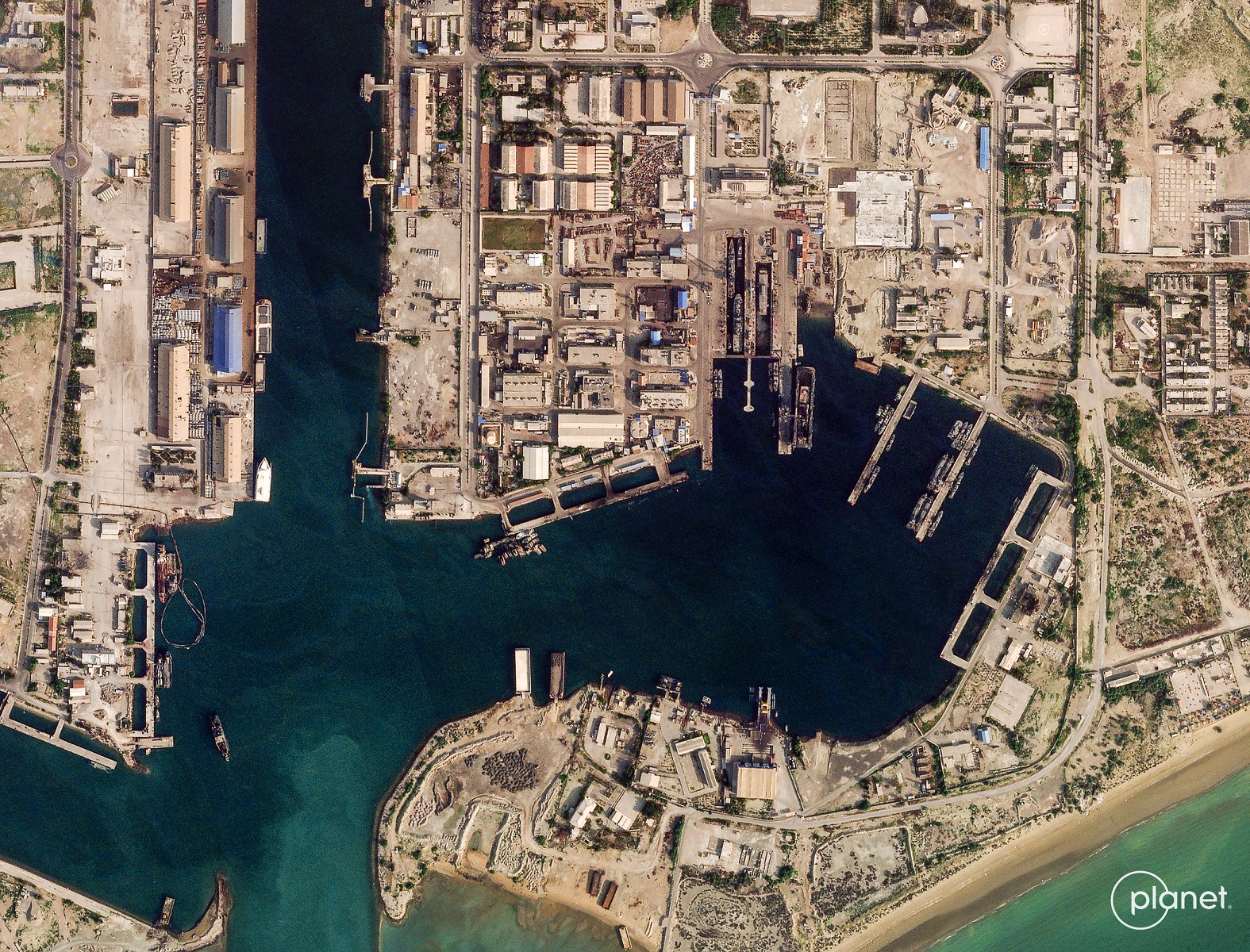 This handout satellite image taken by 2026 Planet Labs PBC shows damage at the military harbour in Iran’s southern port of Bandar Abbas along the Strait of Hormuz on March 4, 2026. (Photo by 2026 Planet Labs PBC / AFP)
 Iraqi Prime Minister-designate Ali al-Zaidi. Photo: PM Media Office

Leave a Reply