

Disclaimer: All information in this newsletter is not intended for investment decisions / purposes. Mnt Goat is not a financial analyst, planner, banker, attorney or associated in any role with giving out professional investment advice.
ABOUT THE NEWSLETTER:

September 292, 2026 Mnt Goat News Brief
Guten Tag everyone:
More news today about disarming the Iranian-backed Factions operating inside Iraq. Some good news, some bad news. Let’s get started!
GIVE A GIFT TO MNT GOAT
I decided to allow everyone to give a Free-will GIFT to Mnt Goat on PayPal if you so desire. Here is the link below. Please show your appreciation for all the hard work I do.

I recommend $15-$20 dollars a month or whatever you can afford. Do you realize I write up to eight (8) Newsletters every month. This is like a second job to me. The only way I know that people are reading and appreciating all the FACTUAL news I bring is through their appreciation. If I do not receive equal appreciation for all the hard work I do, I will simply end the Newsletter and save myself endless hours at the computer. You do want to get paid for your job, don’t you? What makes my job any different? Tell me….. I am tired of this RV saga just as you are.
Let’s all try to chip in!

___________________________________________
Charity is love in action – In the New Testament of the Bible, “charity” often means agape love. Jesus and the apostles show that true charity is demonstrated through deeds, not just words.
STATUS OF THE RV
As we move into October it is a new month to consider preserving the Latest Mnt Goat Newsletter. Have you already helped out? The Newsletter will only be published if my viewers support it. If you have not yet shown your appreciation, please try to help out for this month.
Remember that I don’t need to publish anything for anyone. I do this because I care about the public and because I don’t agree with the bizarre, stupid stuff that is going on to wrongly promote this Iraqi dinar investment as a three-ring circus. Yes, there are many idiots making a lot of money off their nonsense, yet, I bring FACTUAL and HONEST news.
____________________________________________
There is lots of news for this period of reporting. All the articles can be found in the Articles Section of today’s Newsletter. I am just going to point out the more important points to you to help you understand the minds of those involved. Hang on to your seat as this is going to be a very long one today. Get your cup of coffee or tea, sit back, relax and slowly read every bit of it to get exactly what is being said today. It is not complicated just a lot to absorb. But you will never understand if you don’t take some time to inform yourself.

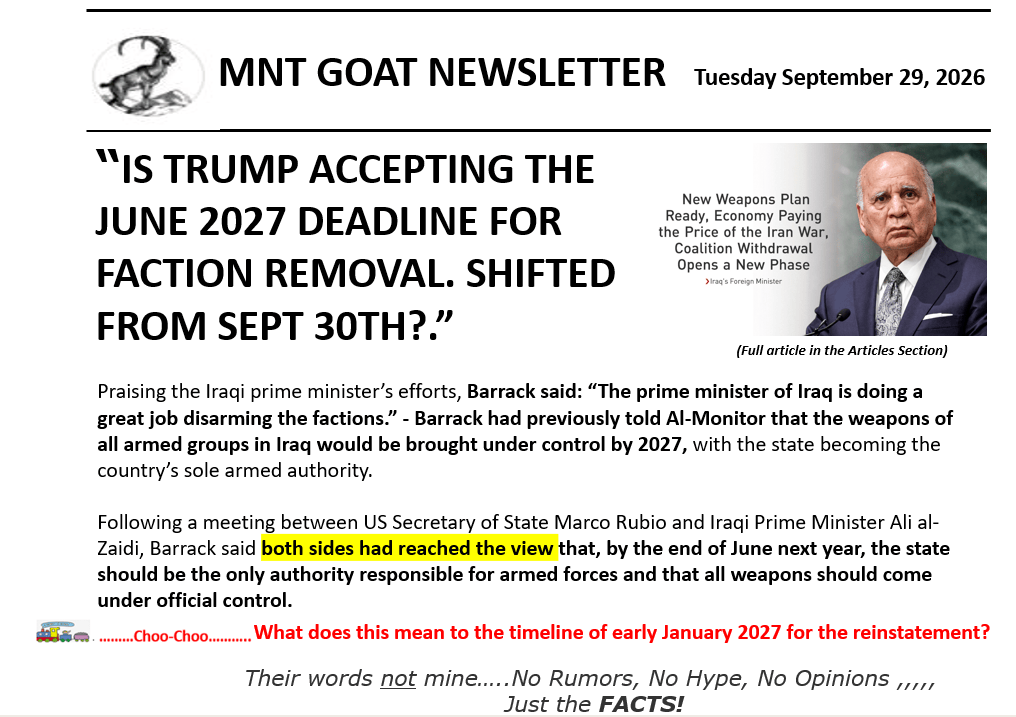
IS TRUMP ACCEPTING THE JUNE 2027 DEADLINE FOR FACTION REMOVAL shifted from Sept 30th?
Answering this question is vital to the timing of payoff of our investment as, if Trump does accept the new deadline all set timelines may be shifting for us. This may affect the timing of the removal of the zeros and later the reinstatement. Remember I was told specifically the US will NEVER signoff on the reinstatement unless these militias and factions are gone from Iraq. In today’s news we find that the US and Iraq have two VERY different views as to the measures to be taken with these factions. This is in itself a dilemma.

I first need to cover the issue of the meeting between president Trump and prime minister of Iraq, Al-Zaidi after the UN council meeting to begin answering this question. Did Trump accept moving the date of September 2026 to June 2027 for disarmament of the Hezbollah factions? Is disarmament really all he wants?
Does the US use the term ‘disarmament’ loosely, but really means something else altogether?
In one article titled “TOM BARRACK: DISARMING ARMED GROUPS IS CRUCIAL FOR IRAQ AND ITS PEOPLE” we get some information on this subject matter.
Praising the Iraqi prime minister’s efforts, Barrack said: “The prime minister of Iraq is doing a great job disarming the factions.”
Barrack had previously told Al-Monitor that the weapons of all armed groups in Iraq would be brought under control by 2027, with the state becoming the country’s sole armed authority.
Following a meeting between US Secretary of State Marco Rubio and Iraqi Prime Minister Ali al-Zaidi, Barrack said both sides had reached the view that, by the end of June next year, the state should be the only authority responsible for armed forces and that all weapons should come under official control.
____________________________________
Then in another article titled “TRUMP MET WITH AL-ZAIDI ALONE… GOVERNMENT SPOKESMAN REVEALS DETAILS OF THE NEW YORK MEETING” we get a bit more information about what they talked about.
Government spokesman Haider al-Aboudi said on Monday (September 28, 2026) that Prime Minister Ali Faleh al-Zaidi’s meeting with US President Donald Trump in New York addressed indicators of stability in Iraq, attracting investments, and the presence of American companies in the oil and energy sectors, noting that al-Zaidi presented during the meeting what he described as the government’s steps to strengthen the authority of the state and the law.
Al-Aboudi explained, in a conversation with journalist Hossam Al-Hajj, via Dijlah TV, which was followed by 964 Network , that Al-Zidi is working on translating the government program into an executive program through “bridging the relationship with the world” and restoring confidence in Iraq, noting that the government aims to reach a production of 10 million barrels of oil per day by 2030, considering that these figures can attract international economic partners.
____________________________________
There is yet another article on this subject matter that really hits home what has to happen with the Hezbollah factions inside Iraq. It is the policy of the U.S. spelled out clearly. It goes way beyond just ‘disarmament’. It is instead complete “but rather dismantling. It is as if they are saying to the Iraqis: ‘We don’t know what you Iraqis are doing!’ But they do not want these militias to exist.” I want to remind everyone we have heard many articles about just ‘disarmament’ but is this all the U.S. really wants. Let’s read this article as proof and find out exactly what president Trump needs. It all now makes sense. The article is titled “IS THE DIVISION OF IRAQ ON TRUMP’S MIND? RUBIO SPOKE OF IT AND BROKE THE PROMISES MADE BY AL-ZAIDI AND THE FRAMEWORK.”
Since the crushing of the ISIS-led insurgency in Iraq, any mention of the country’s unity or concerns about its future has disappeared from the lips of officials. However, US Secretary of State Marco Rubio revived the term “Balkanization” at his press conference on Wednesday, following two consecutive meetings with Ali al-Zaidi, one of which was attended by Trump, and the absence of any other Iraqi representative.
He answered journalists by saying “the continued presence of militias would mean the Balkanization of Iraq, referring to one of the most horrific cases of bloody partition witnessed in the 20th century, centered on the former Yugoslavia. My colleague Adnan al-Tai chose this topic for his episode today with one of the most prominent Iraqi experts on American affairs, Ramadan al-Badran, who summarized the matter in two words: Trump authorized Rubio to handle this file, and he is a man who will not recognize al-Zaidi’s schedules or the coordination framework. He suggested that the matter was very clear during the New York meeting. Although the White House will try to maintain its support for al-Zaidi as much as possible.”
They conveyed a brief message in their statement, saying:
‘Dismantling the terrorist militias.’ This does not mean disarmament, containment, organization, or integration, but rather dismantling. It is as if they are saying to the Iraqis: ‘We don’t know what you Iraqis are doing!’ But they do not want these militias to exist. This is the brief message with which the Americans commented on what Al-Zaidi said. I believe that Washington’s position is now more stringent regarding the militias, especially after what happened with Saudi Arabia recently.”
This prior paragraph is VERY IMPORTANT to understand. So, by June 2027 the U.S. does not want just disarmament, containment, organization, or integration, but rather dismantling. They do not want these militias to exist any longer in Iraq…. period!
He added: “I don’t have details about the reasons why the government team didn’t accompany al-Zaidi during the meeting with Trump, but I think that the one handling the militias file is Marco Rubio, the US Secretary of State, who has a deep understanding of ideas, doctrines, and many other things. At the same time, Trump is still keen on al-Zaidi and committed to him, and still wants to give him a chance. “
So, this last paragraph above tells us Trump is going to give this June 2027 policy a chance. Trump is giving Al-Zaidi time to work on this issue. However, I can bet come June there will be no compromise.
This next paragraph also explains what has happened to Iraq since its so-called liberations in 2003. Was it really liberated or just turned over to Iran as a proxy state? Then in 2014 to fight ISIS the excuse came for Iran to formally send fighters into Iraq and secure its influence in politics.
Thomas Barrack says “But the truth that must be understood is that there are two states in Iraq: the state of the political system and the Iraqi state.”
What does he mean by two states: He then goes on to say “All that remains of the Iraqi state is the position of Prime Minister, which al-Zaidi represents. As for what remains, al-Zaidi carried the message of the political wing of the political system in his previous trip, and now he carries the message of the military wing of the political system.”
Sounds a lot like what is going on in the U.S. with the conservatives vs the extreme liberals, in their social communists attempt to take over the political system in the U.S.
Here is the worst part about this situation in Iraq. Come June Rubio believes nothing much will change and the factions will still exist.
He explained: “The factions are here to stay, whether anyone likes it or not, because they are ideological factions affiliated with an ideological state, namely Iran. They view Iraq as a host country, so they will remain and continue by all means and methods.”
“Anyone who thinks that these factions will give up their weapons is mistaken, because this contradicts the ideological dimension of these factions. What guarantees the political system will remain if the factions are gone?”
He says “What guarantees the continuation of the coordinating framework if the factions are gone?”
“There is a state with a political system in Iraq, an ideological political system, and there is the Iraqi state, which is a state of constitution and citizenship. Iraq now has an ideological state that has been competing with the Iraqi state since 2003,”
“Thus, the factions must realistically understand that their chances of survival lie either in clashing with the state or in disbanding. I doubt there is a rosy future in this matter, as the political system does not allow for relinquishing control of the factions.”
So, we must take Rubio on his word. He is much more familiar than we are in the matters of Iraq. Seems eventually, either now or later, there is going to be a bloody clash between the state and these factions. Also, can the Coordination Framework continue to exists even, after listening to what Rubio has to say in this article.
So, in the next elections cycle things have to also change drastically on how they run their elections. I know I keep telling you over and over again about the upcoming election cycle. Are you listening to me? I surely pray that we are out of this investment before this time period.
If we are still here in this investment or not these changes will be positive and remember that even though positive for the overall benefit of Iraq change is still hard to make when who or what is being changed does not want to be changed. They always resist!
____________________________________
Take a peek at the article titled “IRAQ’S FM: NEW WEAPONS CONTROL PLAN COMING, ECONOMY IS THE IRAN WAR’S FIRST VICTIM”.
“Iraqi Foreign Minister Fuad Hussein announced on Friday, September 25, 2026, that the government is preparing a new plan to address the issue of unlicensed weapons and bring arms under state control, warned that Iraq’s economy is the first casualty of the Iran war currently engulfing the region, and confirmed that Iraq is in discussions with the United States about the sanctions imposed on aviation services for Iranian aircraft landing at Iraqi airports.”
Again, is seems even Hussien is missing the boat when it comes to what to do with these factions. It is not just a matter of bringing the arms under control such as disarming them, but as we read in a previous article the real and of what the complete policy of the U.S. is and I quote – “but rather dismantling. But they do not want these militias to exist.”
____________________________________
Ahhhh….ya, ya, ya – a very important article to understand what is being said here. I encourage everyone to go read the entire article. It is titled: “THE WEAPONS DEADLINE IS TO BUY TIME… AND THE FACTIONS DID NOT AGREE”.
This buying for more time – has this not been the strategy of Iran all along in the Iranian conflict and its ongoing negotiations with the US? Why stop there? They are doing the same in Iraq by extending the deadline to June from September for the faction’s disarmament.
Why would they do this?
There are two reasons for stalling by Iranian-backed politicians inside Iraq:
First, I believe they are hoping that negotiations between Iran and the US can stall for time for them the rebuild. Inside Iraq the factions are hoping by June, that’s 9 months from now, that there will be a turn of events, any turns of events in their favor in the Iranian conflict they can capitalize on, thus stay in Iraq.
Second, the US elections- for the midterms in the U.S. they are hoping the liberals will win both houses and end the U.S. funding for the conflict with Iran. Thus, also the factions might be allowed to stay in Iraq. Then they are working towards the liberals in the US winning the Whitehouse in the 2028 elections ending the siege on Iran altogether. This of course is faulty, irrational thinking with this logic in that time is NOT on their side and the situation inside Iran is worsening every day and the people have had enough already.
“The Iraqi newspaper Al-Mada, in a report followed by Al-Mustaqilla, revealed new details regarding the deadline proposed for limiting the weapons of armed factions, amid a clear difference between the Iraqi vision and the American position regarding the nature of the steps that should be taken and the fate of the weapons during the next stage.”
So, here it is again a difference of vision between the US and Iraq on how to handle these factions. It is not just about disarmament but full exiting of them from Iraq.
According to the report, sources and analysts believe “that the new date proposed for addressing the weapons issue may be more of an attempt to buy more time than a final and binding timetable for handing over the factions’ arsenal, especially in light of the fact that a final agreement has not yet been reached with them.”
The newspaper pointed out that there is a fundamental difference in the terminology used between Baghdad and Washington. While Iraqi parties speak of “restricting weapons,” “regulating them,” and integrating factions into state institutions and the Popular Mobilization Forces, American parties use expressions such as “dismantling militias” and integrating weapons with the army, which reflects a continuing gap in perceptions between the two sides.
____________________________________
Yet another article we get more news from Hussein from the news channels. It is titled “FUAD HUSSEIN ARRIVES IN WASHINGTON: WE WANT A POLITICAL AND SECURITY PARTNERSHIP AND WE WILL DISCUSS THIS IN THE MOST IMPORTANT THINK TANKS.”
“Foreign Minister Fuad Hussein announced on Sunday (September 27, 2026) his arrival in Washington, D.C., to hold meetings with the U.S. administration, with the aim of moving the two countries’ relations towards a broader partnership based on developing political, security and economic cooperation, noting that the discussions that will bring the two countries together will be in the most important think tanks in the U.S. capital.”
____________________________________
Here is an article that might make the hair curl on the back of your neck. I will tell you why. It is titled “AMERICAN COMPANIES ARE WAITING… INTENSIVE IRAQI NEGOTIATIONS TO RESOLVE THE ISSUE OF FACTIONS’ WEAPONS.
“An informed source revealed on Saturday that private meetings are continuing between the Quartet Committee and the leaders of the armed resistance factions, with the aim of reaching final agreements on the management, storage and organization of weapons, stressing that resolving this issue paves the way for more than 40 American companies to enter Iraq to start their projects.”
Every week we get more confirmations of the plan by president Trump to get more and more American companies investing in Iraq. Did I not tell all my readers a year ago or more that Trump has a plan for Iraq and that it was not just restricting weapons but what comes afterwards. Now in this article we get more proof of what I told you. However that factions and militias are in the way. They create a liability for these companies. Iraq will have to deal with these factions if they truly want Trump to help bring economic development to their country. They will have to deal with them on the terms of the U.S. not their own terms. We already read what the true terms were for the U.S. in Rubio’s comments in a prior article.
This next paragraph shows an urgency to get these factions under control. We read words like ‘to intensify’. Why an urgency now? It is because this June timeline interferes with an already established timeline of September 30th 2026. Timeline for what? I already tried to explain about a ‘convergence’ of events and this timeline was important for them to occur. Now does it all have to be adjusted and moved out until June 2027?
The source told Shafaq News Agency that “Iraqi Prime Minister Ali al-Zubaidi asked the political leaders within the coordination framework, specifically the four-party committee concerned with negotiating with the factions, to intensify dialogues and meetings to reach understandings that end the controversy over the management and organization of weapons, in a manner consistent with the interest of Iraq and the region.”
He added that “Washington demanded from al-Zaidi guarantees that American companies, which number more than 40 investment companies in various fields, would not be targeted by resistance factions.”
So, do you think Iran will keep its promises and not attack these companies? What a joke as we all know they will not keep any promises. It seems to me that lots is riding on addressing these factions inside Iraq. Am I wrong?
____________________________________
THE TRUE NATURE OF THE IRANIAN-BACKED FACTIONS INSIDE IRAQ:
These next couple articles show us the true nature of the Iranian-backed factions inside Iraq and why they don’t want to give up and move on out of Iraq. They have become very ingrained in politics. The proverbial ‘eye opener’ for the Washington on this subject of factions is when they used inside Iraq to launch attacks on the Sadie’s. Anyone who criticizes Iraq for having US forces inside Iraq is out of their mind. Trust me on this one – a new s U.S.–Iraq Strategic Framework Agreement, will soon be completed between Iraq and the US and these troops will return prior to June 2027.
Remember that lots of Iranian backed goods are shipped from Iran to Iraq via air travel. Iran is already economically hurting real bad and so go figure why the factions would put out such statements. They are a politically sewn into the fabric of the economy to enforce Iranian policies on Iraq. The titled to this one is “HEZBOLLAH CALLS ON THE IRAQI PEOPLE TO BREAK THE SIEGE ON IRAN”
Can it get any clearer now why Iranian factions inside Iraq are stalling for time and resisting disarmament.
I quote from the article – “Hezbollah in Iraq, according to a statement it published today, Thursday, September 24, described what it called “entities and companies that participated in the air blockade on Iran” as “without dignity,” and called for the purchase of Iranian goods”.
The party said, according to what Baghdad Today received, that the companies and entities “that agreed to submit to the unjust American decisions in exchange for crumbs of interests have chosen for themselves the role of the submissive backer of the American-Zionist decisions,” stressing, “they are entities without dignity,” in reference to the decision to impose an air embargo on Iranian airlines.”
Oh boy…. The true nature of these factions really comes out in these kinds of statements. They hate America and so do you actually think they can exist inside Iraq while American companies invest into Iraq?
In its statement, the party issued what it called a “call to the Iraqi people” to break the siege imposed on Iran, declaring, “We call upon the sons of the Iraqi people to break this siege by every possible means in support of the brotherly Iranian people, especially by supporting its products and encouraging their exchange.”
It seems to me these factions are now trying to stir up the Iraqi people to go against the US sanctions. Remember that these sanctions are also hurting the Iraqi people too as Iran is a major trading partner with Iraq. Much of their goods and food products come from Iran.
____________________________________
😊 I can see that many of my readers are concerned about the withdrawal of the US from Iraq. Let me tell you something. The US only had about 2,500 soldiers in Iraq, most were sent to Kuwait, many units are rotating home. Kuwait is a neighboring country very close by. Fool us once in 2011 when the US pulled out under Obama we are not going to be fooled again. I would not be worried about this move by the U.S. In the article titled “THE U.S. HAS MORE LEVERAGE IN IRAQ THAN IT THINKS”
By James Durso – Sep 22, 2026
I quote from the article – “The U.S. withdrawal should mark a shift from control to influence, with Washington relying more on investment, financial leverage, intelligence and defense cooperation rather than a permanent military presence.”
“Militia reform should be gradual and Iraqi-led.
Washington still holds considerable leverage after withdrawal, particularly through the dollar system, sanctions and Western investment, but using those tools coercively could ultimately weaken U.S. influence.”
“If U.S. forces leave Iraq by 30 September 2026, Washington should view the departure not as the end of its relationship with Baghdad but as an opportunity to redefine it. The U.S. will retain influence in Iraq, but it will have to exercise that influence differently. America’s challenge will be transitioning from control to influence.”
____________________________________
😊Then there is this news that explains that just because the U.S. pulls out of Iraq, its influcne does not end. It is titled “AMERICAN WEBSITE: US INVESTMENT, FINANCIAL INFLUENCE, AND INTELLIGENCE COOPERATION WILL REMAIN IN IRAQ AFTER THE WITHDRAWAL.”
A report by the American news website Oil Price indicated that the withdrawal of American forces from Iraq at the end of this month does not mean the end of American influence and interests in the country, but rather a transition to building long-term communication across the fields of economy, investment, security, intelligence and financial cooperation, as Iraq still needs American and Western technological expertise in the field of energy, infrastructure and reform of the banking sector, especially cooperation in the field of combating terrorism and priority in confronting any possible return of ISIS.
____________________________________
SUMMARY:
IS THE DINAR SHIFTING FAVORABLY TOWARDS THE DOLLAR?
I have a few articles on the topic of this shift and what the CBI is doing to make it happen. Before I get into these articles I want to remind everyone that Iraq is way overdue to get off the sole peg to the dollar. I firmly believe the only major leverage the US now has to fight Iran inside Iraq, is the dollar.
If you keep Iraq dependent on the dollar for trade, then they must follow your policies for their very survival and existence. Is it fair to do this since the UN Chapter VII sanctions are all lifted? I will answer this with another question. Is it fair for Iran to come into Iraq and govern it as a proxy state, stealing trillions from the people. This revenue is their money not Iran’s. But this is the nature of Iran in the middle east as they have done this to Libya, Lebanon, Syria and now Iraq. This is how they fund their military buildup and nuclear ambitions. This funding is now also helping them push Muslim ideology throughout Europe and the US. That is a large part of what this mass migration and open borders was all about. But the tide is shifting, just watch it! 😊
These policies with the dollar are not new policies. Actually, they were policies all along from the Chapter VII sanctions, only no other US administration enforced the new Iraqi constitution upon them before. If they had maybe we would not be where we are today. They let Iran infiltrate and stay inside Iraq. As Rubio says, they have become the politics of Iraq disregarding what the state says even. They continue to do this because the state is afraid to have a head-on bloody confrontation with the Iranian factions which also means a confrontation with the Iranian-backed politicians such as with the Coordination Framework. Remember Trump did not cause these problems but wants to end them and clean this up.
The first article is titled: “MP AMER ABDUL-JABBAR CALLS FOR AMENDING ECONOMIC POLICIES TO STOP THE “BLEEDING OF WEALTH” IN THE DOLLAR MARKET.”
MP Amer Abdul Jabbar revealed on Saturday (September 26, 2026) statistics.
Said in a statement received by “Baghdad Today” that “the losses of the Iraqi people as a result of the price gap during the period of the previous government amounted to more than 27 billion and 312 million dollars,” indicating that “the average daily losses during that period amounted to about 21 million dollars every 24 hours.”
Abdul Jabbar called on the Prime Minister to “urgently review economic, monetary, financial and trade policies to stop the bleeding of national wealth and transform it into sources that enhance the economic capabilities of the state and the people instead of depleting it.”
I will inform MP Amer Abdul Jabbar that his situation will not change and will only get worsen as any oil crisis arises, such as it has since the Iranian conflict. The real cause the sole peg to the US dollar. I will emphasis this again and again in my blog. As long as Iraq is still on the sole peg to the dollar, any hiccup in the oil industry will cause an economic crisis. What can they do about it?
Of course, they must get off the sole peg and repeg to an IMF basket of currencies. This basket as already been exposed and the willingness to do it. The plan was for early 2027 and now we see this shifting. But the US still in the meantime needs the leverage of the sole peg and US dollar to get Iraq to OBEY to force them to fight these Hezbollah factions inside Iraq one way or the other. I mean peacefully through dialogue or by gun point.
__________________________________________
Here is another recent article on this subject matter. It is titled “WHY IS THE DOLLAR RISING? PARLIAMENTARIANS DEMAND THE REASONS BE REVEALED BEFORE PARLIAMENT.”
“Member of Parliament Ghufran Al-Shammari called on the government and the Central Bank yesterday to take urgent measures to limit the fluctuations in the dollar exchange rate and reduce the gap between the official rate and the parallel market rate, warning of the impact of the rise on purchasing power and the prices of goods and services.”
First, I want to say this gap reduction will NEVER happen as long as the Dinar is still on the sole peg to the US dollar. Aren’t you sick and tired already of reading these kinds of articles? When will Iraq actually do what they must do to end these fluctuations? We were told a year ago that the CBI is not worried about the parallel market as they know it will go away once the dinar is off the sole peg to the dollar. Even the CBI knows there is no absolute way to prevent or reduce this gap.
Next, I want to add that we are seeing the URGENCY once again of doing something. The current currency peg is ‘bleeding the wealth’ of Iraq. READ MY LIPS – artificial suppression. Let me explain why this has not yet gone away. Yes, the CBI knows about all the corruption associated with it and the parallel market. But dealing with the militias and factions inside Iraq is holding up any real change. If we say that going to FOREX can end the parallel market and much of the corruption, then why hold it up. It’s called ‘leverage’. Staying on the sole peg to the US dollar gives the US enormous leverage. Get it?
But leverage for what?
Leverage against the politicians to force them to rid Iraq of the militias and factions inside Iraq. This is literally where we stand today for the RV besides getting the Oil and Gas Law passed. These are the two main issues remaining. Yes, I hate to connect the RV to any single event or events, but this removing of the zeros was planned for the fall of 2026 and then the reinstatement in January 2027. I have solid confirmations on this timetable. Seems these events are now maybe going to be pushed out. I am still waiting for my CBI contact me to confirm this situation. It is not definite until she says it is. But this is what she is hearing in her office now, as I write this Newsletter today. It could change as meetings with Washington are ongoing. This change of dates from Sept to June created a shakeup.
__________________________________________
This article again is just more rhetoric for the citizens to help them believe there is something the CBI can do to make a difference…bla, bla, bla. How much of this nonsense can we take, as investors? For a decade now we read these article, just like this one. But nothing much ever really changes. We read in the past many approaches to get the parallel market under control. By the way the black market or parallel market is illegal. So, who has gone to jail over it? Maybe that’s a problem too, no enforcement of the law. These money exchangers walk the streets daily and nobody does anything to stop the flow of these dollars. Where do they come from?
But we all know the reality and what can actually make a difference, a huge difference, don’t we? But the CBI cannot yet do the reinstatement without the approval of the US Treasury and they know it. The article is titled “CENTRAL BANK MOVES TO LOWER DOLLAR EXCHANGE RATE AGAINST IRAQI DINAR”
“The Central Bank of Iraq has taken a new set of measures aimed at reducing the gap between the official and parallel exchange rates, and restoring stability to the dollar exchange rates in local markets.” bla, bla, bla…….. ☹
Hey CBI….would you kindly like to tell us what these so-called measures are? lol…lol…lol…
__________________________________________
The answer to the question of whether this shift is occurring is NO. A big fat NO! These articles I even hesitated to bring you today as I believe whole-heartedly that any measures the CBI can take short of the reinstatement, will not solve this issue of a parallel market. How many of these FAKE articles must we read? The system they had set up in 1991 under sanctions created this issue of the parallel market and only only way to resolve it is to end the reason why it exists and thrives in the first place.
__________________________________________
UPDATE: Oil and Gas Law
There is a recent article titled “THE ABSENCE OF A FEDERAL LAW ON OIL AND GAS SINCE 2007”.
This law, for those who do not know it, represents the basic pillar of the structure of the economy, which is subject to the dominance of oil revenues by (90 percent). Its enactment will enhance the confidence of international investors and support the exchange rate of the Iraqi dinar through the flow of hard currency and establish fair mechanisms for the distribution of revenues. This is their words not mine!
Now can everyone see why the US demands to have this constitutional requirement completed prior to any reinstatement? It truly is just common sense.
National Wealth Unit
“The absence of a federal law on oil and gas since 2007 until today has led to alternating periods of stagnation and escalating conflicts between the federal government and the producing provinces.”
We have witnessed this many times in boycotting parliament to vote on laws. So why not stop taking about it and do something about it?
“Throughout that period, there were no serious intentions to resolve this vital issue related to the state’s economy, which allowed for a competitive war of corruption, smuggling, and the exorbitant enrichment of many figures and names who established financial empires that could finance the budgets of small countries in our regional vicinity.”
The Oil and Gas Law embodies the people’s ownership of their national wealth, as confirmed by Article (111) of the Iraqi Constitution. This article stipulates that oil and gas are the property of the Iraqi people. It also regulates how this national wealth is to be held by the state and under the control of the federal government, taking into account the fair and just distribution of its revenues in proportion to the population distribution throughout the country, as indicated by Article (112) of the Iraqi Constitution.
Enough said…….
____________________________________
Q and A
Question from ashleypikes:
So MG, if ISX Iraqi companies are trading on forex, do we assume the trading conversion rate is 1310! I would think so, can you elaborate for us, thank you….
Answer from Mnt Goat:
Guten Tag Ashley. Until the CBI changes the official rate it will stay at 1310. This news told of the event and did not specify a timeframe. Are they lining it up to target early 2027 along with the reinstatement and a new rate? Even if they remain at the 1310 it shows us they are going to make one more step (an important step) to the international level of doing business. This is wonderful news! 😊
What do you think will happen next? (Leave a comment)
______________________________

________________________________________
Their words not mine…..No Rumors, No Hype, No Opinions ,,,,,
Just the FACTS!

These prophecies are an important tool we have to lead us on our path. They are more important now than ever. They give us the strength, perseverance and hope that a better time is coming and that God’s Hand is at work behind the scenes. If you just take a second even to look around you at these past three election cycles, how can you deny that God is at work? Are you sleeping or what?
It is amazing and there is no other way that these events could have happened the way they turned out. But there is more to come, much, much more, I assure you! Now that God has his biblical David re-elected, we need to pay attention to what He does next.
NOTE: These prophecies tell us also of things happening in the background that either the main stream news media does not know about or the crooked news media refuses to talk about. They do this to keep us in the dark to continue the Trump hating senario and for us to keep thinking that nothing is changing, thus Trump is not successful. But it is just the opposite happening. The proof is all around us if we look for it.
Prophetic Words from the prophets: Julie Green
“Violent Shakings Are Coming To Corporate America“
Go to the 11:47 mark on the video. Given on Sept 17th 2026.

“Interest Rates Will Collapse“
Go to the 14:53 mark on the video. Given on Sept 18th 2026.“

________________________________________________
Fr. DON BOSCO EXPOSED THE DARK SECRET BEHIND ISLAM
I keep this one out here to view. Everyone should take the time to watch it. It will awaken you about the Muslim so-called religion (or should we call it for it is — a ‘cult‘.)
— And the truth the world forgot about the so-called Muslim religion.
Fr.Don Bosco, also known as John Bosco, was an Italian Catholic priest and educator, born on August 16, 1815. He founded the Salesian Society in 1859 to help disadvantaged youth, particularly boys, through education and community service. His teachings emphasized lovekindness, and the importance of education for young people, making him a beloved figure in Catholicism and a patron saint of youth. Don Bosco was canonized in 1934.
PM ALI AL-ZAIDI AT UN GENERAL ASSEMBLY: IRAQ’S ECONOMIC TRANSFORMATION, SECURITY & INVESTMENT
US-LED COALITION PREPARING TO END ITS MISSION IN IRAQ DESPITE KURDISH FEARS OF ISIS RESURGENCE
I also have a very good article in the Articles Section today on this topic.
HOW 2 RIVAL ARMIES ARE DESTROYING TEHRAN FROM INSIDE
The IRCG can be compared to the SS in Hitlers army to the regular army for Germany. It was Hitler’s insurance policy to protect his socialist government should the old Weimar Republic forces oppose him. Listen to this video news and see if history is not repeating itself. Did the Supreme Leader Ayatollah Ali Khamenei study and copy Hitler and how he managed to get into power and insured to keep it?
NATIONWIDE UPRISING IN IRAN! ISLAMIC REGIME & IRGC PANIC AS IRANIANS PLAN COMPLETE SHUTDOWN
IRAN JUST GAVE TRUMP EVERYTHING…

AMERICA’S NEW INVENTION COULD END OIL FOREVER
THE LARGEST SINGLE OIL RESERVE EVER DISCOVERED IN THE UNITED STATES

WHY THEY ARE SPRAYING THE SKY? ARE THEY SPRAYING THE SKIES?
Many still don’t believe this Geoengineering of the weather is going on around the globe. This began during WWII by the British in the hope it might gain an advantage on the battle field. From then it was realized it could be a huge money maker, an industry even. Oh boy….here we go again….!
Any idiot with only half a brain can see the flume patterns in the sky from the spaying. There are not that many flights passing over in these zones daily to create exhaust fumes from the engines. So disregard this ridiculous notion they try to push out to us. If this spraying is not so harmful then why are they trying to cover it up and even decided in some largely inhabited areas to spray only at nighttime? Why do they deny the spraying and even go out their way to create conspiracy theory videos on the internet to confuse us?
One day I counted 32 flumes as the planes (or drones) passed first one way and then can back the other way over our village. We are so far from any airport and not even on any flight paths. So what goes?
Then the flumes then combined and the air got sticky and stinky. The next day we had a lot of rain. Today we take a more in-depth look into this subject matter. Are these chemicals causing an environmental disaster so slow it is not recognized even by most until it is too late. Do you see that vegetation on the top crowns of most trees is barren? Then if you watch the tree over a couple years it eventually dies. What about the water? This slop they are spraying also ends up in our water supply. We drink it too.
Yes, vegetation and trees are dying at an alarming rate. Did these idiots bring back acid rain in their efforts to control the weather and only God knows what else they are doing to us? Is it time to speak up and pull the plug on all of this? The High-frequency Active Auroral Research Program (HAARP) project radiation into the skies also combines with these spraying operations and so what does it do to our health? Is it no wonder why cancer and other body disorders are pandemic. We never had such high rates when I was growing up.



TOM BARRACK: DISARMING ARMED GROUPS IS CRUCIAL FOR IRAQ AND ITS PEOPLE
The US special envoy for Syria and Iraq says disarming armed factions is a crucial issue for Iraqis and voices Washington’s support for Prime Minister Ali al-Zaidi’s efforts to bring weapons under state control.
US Special Envoy for Syria and Iraq Tom Barrack has described the disarmament of armed factions in Iraq as a crucial issue for the country and its people, while praising Prime Minister Ali al-Zaidi’s efforts to bring weapons under official state control.
Barrack made the remarks on Tuesday, in comments to Al Arabiya, where he addressed the ongoing process of bringing uncontrolled weapons in Iraq under state authority.
Barrack expressed hope that the process of disarming armed factions in Iraq would succeed, stressing the importance of the issue for Iraq and Iraqis.
He also voiced Washington’s support for the steps being taken by Prime Minister Ali al-Zaidi, praising his efforts to address the issue of weapons held by armed groups.
In his remarks, Barrack said: “We hope that the disarmament of the factions in Iraq will succeed.”He also described the disarmament of armed factions as “an important issue for Iraq and Iraqis.”
Praising the Iraqi prime minister’s efforts, Barrack said: “The prime minister of Iraq is doing a great job disarming the factions.”
Barrack had previously told Al-Monitor that the weapons of all armed groups in Iraq would be brought under control by 2027, with the state becoming the country’s sole armed authority. He indicated that Washington and Baghdad were approaching one of Iraq’s most sensitive issues, placing the question of multiple armed forces under a decisive timeline.
Following a meeting between US Secretary of State Marco Rubio and Iraqi Prime Minister Ali al-Zaidi, Barrack said both sides had reached the view that, by the end of June next year, the state should be the only authority responsible for armed forces and that all weapons should come under official control.
The joint step between Washington and Baghdad opens what Barrack described as a decisive phase toward ending the influence of unofficial armed forces across the country, with security and military decisions no longer being made outside legitimate institutions and the authority over weapons consolidated under the law.
********************************************************************************
TRUMP MET WITH AL-ZAIDI ALONE… GOVERNMENT SPOKESMAN REVEALS DETAILS OF THE NEW YORK MEETING
Government spokesman Haider al-Aboudi said on Monday (September 28, 2026) that Prime Minister Ali Faleh al-Zaidi’s meeting with US President Donald Trump in New York addressed indicators of stability in Iraq, attracting investments, and the presence of American companies in the oil and energy sectors, noting that al-Zaidi presented during the meeting what he described as the government’s steps to strengthen the authority of the state and the law.
Al-Aboudi explained, in a conversation with journalist Hossam Al-Hajj, via Dijlah TV, which was followed by 964 Network , that Al-Zidi is working on translating the government program into an executive program through “bridging the relationship with the world” and restoring confidence in Iraq, noting that the government aims to reach a production of 10 million barrels of oil per day by 2030, considering that these figures can attract international economic partners.
He added that during the meeting, Al-Zaydi reviewed “the indicators of strength and the files in which the government has achieved progress,” including combating corruption, restricting weapons to the state, strengthening the rule of law, as well as economic and investment files.
Regarding the possibility of discussing the details of the September 30th date during the meeting, Al-Aboudi said that the file is “Iraqi in all its dimensions,” and that what Al-Zaidi presented focused on restoring the state’s health and its ability to manage internal stability in accordance with the constitution and the law.
He noted that the meeting also addressed the investment environment and the presence of American companies in Iraq, particularly in the oil and petroleum industry sector, as these are among the issues in which the government seeks to expand cooperation. Al-Aboudi explained that Iraq has made a decision to implement the Banias pipeline project, and there is a consortium of important international companies that will implement the project. The contracts between the Ministry of Oil and these companies are being finalized. He clarified that once the technical aspects and details are completed, things will be implemented on the ground, and the two countries will participate in implementing this project.
(Mnt Goat: Drill baby drill, baby drill!!! 😊)
********************************************************************************
PRIME MINISTER: THE GOVERNMENT IS PROCEEDING WITH RESTRUCTURING THE FUNDAMENTAL ASPECTS OF FISCAL POLICY IN IRAQ.
Prime Minister Ali Faleh al-Zaidi affirmed on Wednesday that the government is proceeding with restructuring the fundamental pillars of fiscal policy in Iraq.
The Prime Minister’s Media Office stated in a press release received by the Iraqi News Agency (INA) that “Prime Minister Ali Faleh al-Zaidi met in New York, after midnight on Tuesday, Baghdad time, with Jihad Azour, Director of the Middle East and Central Asia Department at the International Monetary Fund (IMF), and his accompanying delegation.” The statement added that “the meeting addressed developments in the global economic landscape, the repercussions of the crisis in the region and its impact on markets, prices, supply chains, and inflation rates, as well as its effects on energy consumption and oil prices.”
According to the statement, the Prime Minister emphasized that “the government is proceeding with restructuring the fundamental pillars of fiscal policy in Iraq through expanding the automation system and gradually transitioning towards a program and performance-based budget, within the framework of the 2027 budget project.”
For his part, Azour affirmed the IMF’s readiness to continue cooperating with Iraq and strengthening the path of economic and financial reforms, in a way that contributes to consolidating financial and economic stability in Iraq.
******************************************************************************************
AL-KINANI: WASHINGTON HAS SET 10 POINTS FOR THE CONTINUED TRANSFER OF IRAQI FUNDS
Economic and strategic expert Nasser al-Kinani revealed on Monday that the United States has set ten conditions for the continued transfer of Iraqi funds, including the surrender of weapons. He emphasized that these funds belong to Iraq and are not a US grant.
He added, “Any funds Iraq needs must be requested by the Central Bank of Iraq from the US Federal Reserve for transfer.
He explained that “the solutions are simple; a request can be submitted to the United Nations to confirm that Iraq is not indebted and that controlling Iraqi funds constitutes an infringement on Iraqi sovereignty.” He also noted that “the Iraqi negotiator was weak from the beginning and was unable to defend the rights of the Iraqi people.”
Al-Kinani pointed out that “an agreement was reached in 2010 to end the transfer of Iraqi funds to the Federal Reserve, and it included three obstacles imposed by the United States, which previous and current Iraqi governments have been unable to overcome.”
He added that “the argument that funds were going to entities claiming financial dues from Iraq has ended, especially after the payment of the last amount claimed by Kuwait, which was $1.65 billion.” He considered that the absence of other entities claiming financial dues from Iraq eliminates the justifications for continuing to control Iraqi funds.
*****************************************************************************************
A POLITICIAN STATED THAT FORCES LINKED TO WASHINGTON ARE PROMOTING LINKING THE DOLLAR TO THE WITHDRAWAL PROCESS AND THE FACTIONS.
Political analyst Ali Al-Tawil believes that some political forces that consider themselves representatives of the American side in Iraq are seeking to promote the imposition of economic sanctions and reduce the sending of dollar shipments to Iraq after September 30.
Al-Tawil told Al-Maalouma, “American hands in Iraq have the most prominent role in the issue of the rise in the dollar exchange rate in local markets, as Washington seeks to send a message that the American withdrawal from Iraq will negatively affect the Iraqi economy.”
He added that “America is threatening to reduce dollar shipments to the country if it does not move towards fulfilling its desires,” noting that “there are parties inside and within the political class who benefit from the American threats against the resistance.”
He pointed out that “some political parties stand with the American plans against the resistance, as they support Washington’s actions and intentions, in addition to standing with ISIS terrorists and some regional countries.”
He explained that “some political forces are closely linked to the American administration and work to serve Washington’s interests. These forces are promoting economic sanctions, reducing dollar shipments to Iraq, and linking and linking this to the American withdrawal and the issue of factions after September 30th.
**************************************************************************************
IRAQ HAS A SAY
Iraq’s participation in the (81) session of the United Nations General Assembly coincides with a number of crucial transitional milestones that Iraq wants to emphasize and announce, and there is no better occasion and international platform than this to convey them to the world.
1.The most prominent of these steps is the reaffirmation of Iraq’s independent decision-making, which was best exemplified by its stance on the regional conflict.
2.The second is the focus on ambitious plans to reform the economy and address the weaknesses it has suffered as a result of ineffective economic policies, both past and present.
3.Finally, and perhaps most importantly, there is the completion of sovereign agreements with the United States and the presentation of the Iraqi state’s plans regarding arms control and the transition of relations between the two countries from security matters to a phase of sustainable partnership.
The presence of Prime Minister Ali al-Zaidi and the anticipation surrounding his speech there will have a significant impact on reaching conclusions on these issues that align with the Iraqi government’s objectives. Yesterday’s statement by the US Special Presidential Envoy to Iraq, Tom Barrack, was particularly noteworthy. He announced a “decisive agreement to restrict weapons to the Iraqi state and to resolve the issue definitively by the end of June (2027),” a development considered a victory for Iraq’s position as it comes in response to a proposal put forward by al-Zaidi’s government.
The speech that the Iraqi Prime Minister will deliver will certainly include a detailed presentation of all positions on regional and international developments, but the most important thing in it will be a statement of Iraq’s position on the challenges it faces, both politically and economically.
*****************************************************************************************
IS THE DIVISION OF IRAQ ON TRUMP’S MIND? RUBIO SPOKE OF IT AND BROKE THE PROMISES MADE BY AL-ZAIDI AND THE FRAMEWORK.
Since the crushing of the ISIS-led insurgency in Iraq, any mention of the country’s unity or concerns about its future has disappeared from the lips of officials. However, US Secretary of State Marco Rubio revived the term “Balkanization” at his press conference on Wednesday, following two consecutive meetings with Ali al-Zaidi, one of which was attended by Trump, and the absence of any other Iraqi representative. Before anything could leak out amidst one of the rare moments of tension between the two sides over the disarmament timetable, which is almost being torn apart by conflicting schedules and rendered meaningless, the US Secretary of State made a statement that left observers wondering.
He answered journalists by saying that the continued presence of militias would mean the Balkanization of Iraq, referring to one of the most horrific cases of bloody partition witnessed in the 20th century, centered on the former Yugoslavia. My colleague Adnan al-Tai chose this topic for his episode today with one of the most prominent Iraqi experts on American affairs, Ramadan al-Badran, who summarized the matter in two words: Trump authorized Rubio to handle this file, and he is a man who will not recognize al-Zaidi’s schedules or the coordination framework. He suggested that the matter was very clear during the New York meeting. Although the White House will try to maintain its support for al-Zaidi as much as possible.
Ramadan Al-Badran, an international affairs researcher, stated in an interview with journalist Adnan Al-Tai on UTV, which was monitored by 964 Network , that “the Americans were clear through the State Department’s statement after the meeting with the Iraqi delegation. I believe that the Americans are not taking into account the new timing agreed upon by the government with the factions, and they did not pay attention to it or consider it. They conveyed a brief message in their statement, saying:
‘Dismantling the terrorist militias.’ This does not mean disarmament, containment, organization, or integration, but rather dismantling. It is as if they are saying to the Iraqis: ‘We don’t know what you Iraqis are doing!’ But they do not want these militias to exist. This is the brief message with which the Americans commented on what Al-Zaidi said. I believe that Washington’s position is now more stringent regarding the militias, especially after what happened with Saudi Arabia recently.”
********************************************************************
(Mnt Goat: This last paragraph is VERY IMPORTANT to understand. So by June 2027 the U.S. does not want just disarmament, containment, organization, or integration, but rather dismantling. It is as if they are saying to the Iraqis: ‘We don’t know what you Iraqis are doing!’ But they do not want these militias to exist.)
********************************************************************
He added: “I don’t have details about the reasons why the government team didn’t accompany al-Zaidi during the meeting with Trump, but I think that the one handling the militias file is Marco Rubio, the US Secretary of State, who has a deep understanding of ideas, doctrines, and many other things. At the same time, Trump is still keen on al-Zaidi and committed to him, and still wants to give him a chance.
On the other hand, Thomas Barrack is succeeding in obtaining exemptions and permissions for al-Zaidi to do what he can. But the truth that must be understood is that there are two states in Iraq: the state of the political system and the Iraqi state. All that remains of the Iraqi state is the position of Prime Minister, which al-Zaidi represents. As for what remains, al-Zaidi carried the message of the political wing of the political system in his previous trip, and now he carries the message of the military wing of the political system.”
(Mnt Goat: Sounds a lot like what is going on in the U.S. with the conservatives vs the extreme liberals (social communists attempt to take over the political system in the U.S.) )
He explained: “The factions are here to stay, whether anyone likes it or not, because they are ideological factions affiliated with an ideological state, namely Iran. They view Iraq as a host country, so they will remain and continue by all means and methods.
Anyone who thinks that these factions will give up their weapons is mistaken, because this contradicts the ideological dimension of these factions. What guarantees the political system will remain if the factions are gone?
What guarantees the continuation of the coordinating framework if the factions are gone?
There is a state with a political system in Iraq, an ideological political system, and there is the Iraqi state, which is a state of constitution and citizenship. Iraq now has an ideological state that has been competing with the Iraqi state since 2003, and this does not apply only to the Shiites, but also to the Sunnis, especially ISIS and al-Qaeda, as they wanted to establish a state at the expense of the Iraqi state, but they have all ended.”
He emphasized: “The US State Department statement consisted of three points, each complementing the others. It not only addressed the importance of dismantling the militias but also preventing any attacks launched from Iraqi territory, in addition to Iraq exercising its full sovereignty. Therefore, the presence of these factions is considered an infringement on Iraqi sovereignty.
Thus, the factions must realistically understand that their chances of survival lie either in clashing with the state or in disbanding. I doubt there is a rosy future in this matter, as the political system does not allow for relinquishing control of the factions. Even one of the leaders of al-Nujaba said that the framework is negotiating with the factions and subtly hinting to them not to give up their weapons. How can the political system protect itself, which came to power after isolating Sunni and Shiite political forces? Through achievements? Of course not. Rather, it does so by transforming the system into a police state. The political system employs the factions to protect itself.”
*******************************************************************************************
CENTRAL BANK MOVES TO LOWER DOLLAR EXCHANGE RATE AGAINST IRAQI DINAR
The Central Bank of Iraq has taken a new set of measures aimed at reducing the gap between the official and parallel exchange rates, and restoring stability to the dollar exchange rates in local markets.
An informed source at the Central Bank of Iraq stated that these measures were taken due to the rise in the exchange rate of the dollar against the Iraqi dinar in local markets on Saturday, exceeding the level of 160,000 dinars per 100 dollars.
The bank continues to take measures and policies to develop the banking environment, raise the efficiency of the financial system, and provide the necessary elements to support sustainable economic growth, thereby achieving long-term financial stability and maintaining the stability of the exchange rate and the integrity of financial channels.
Earlier yesterday, the Central Bank of Iraq confirmed that it continues to finance foreign trade according to approved purposes and channels, while noting that foreign reserves meet all demands for foreign currency.
The bank said in a statement that “in light of what some media outlets are reporting about rising prices and a slowdown in market activity, the Central Bank of Iraq announces that it has sufficient foreign reserves to meet the demands for foreign currency for financing foreign trade, settling bank cards, and travelers’ requests for cash dollars at the official approved exchange rate.”
He added that “the rise in the exchange rate in the local markets is due to market speculation, expectations, and the misuse of geopolitical conditions in the region to disrupt the economic and financial situation by some beneficiaries of this situation,” stressing “his continued financing of foreign trade according to the approved purposes and channels, in a way that ensures the smooth flow of imports and the provision of the needs of the local market.”
According to the statement, the Central Bank of Iraq called on citizens to “rely exclusively on official information and data issued by it, and not to be swayed by news or information circulating through unreliable sources,” indicating that in case of any violations or inquiries, citizens can submit complaints and reports through the official complaints website of the Central Bank of Iraq.
Burathanews.com
*********************************************************************************
THE ABSENCE OF A FEDERAL LAW ON OIL AND GAS SINCE 2007
National Wealth Unit
The absence of a federal law on oil and gas since 2007 until today has led to alternating periods of stagnation and escalating conflicts between the federal government and the producing provinces. Throughout that period, there were no serious intentions to resolve this vital issue related to the state’s economy, which allowed for a competitive war of corruption, smuggling, and the exorbitant enrichment of many figures and names who established financial empires that could finance the budgets of small countries in our regional vicinity.
This law, for those who do not know it, represents the basic pillar of the structure of the economy, which is subject to the dominance of oil revenues by (90 percent). Its enactment will enhance the confidence of international investors and support the exchange rate of the Iraqi dinar through the flow of hard currency and establish fair mechanisms for the distribution of revenues. In addition to providing an investment environment for the development of fields and the investment of associated gas, the existence of a stable legislative framework encourages global energy companies to double production to confront the shocks of declining revenues and absorb financial disputes.
The Oil and Gas Law embodies the people’s ownership of their national wealth, as confirmed by Article (111) of the Iraqi Constitution, which is the supreme and highest law in the country. This article stipulates that oil and gas are the property of the Iraqi people in all regions and governorates. It also regulates how this national wealth is to be held by the state and under the control of the federal government, taking into account the fair and just distribution of its revenues in proportion to the population distribution throughout the country, as indicated by Article (112) of the Iraqi Constitution.
On another front, the enactment of this law establishes a mechanism for distributing a portion of the profits generated from crude oil sales to several funds, including a Citizen’s Fund, a Reconstruction Fund, a Generations Fund, and other long-term financial reserves. Since the fall of the regime until today, some oil- and gas-producing provinces may have suffered injustice. The management of the country’s wealth must be exclusively in the hands of the federal government, and its revenues must be distributed fairly and equitably according to population size. This can only be guaranteed by the Oil and Gas Law, as it is not merely a passing piece of legislation, but rather the cornerstone for restructuring the Iraqi economy.
The continued obstruction of such a law for years, due to political disputes and the prioritization of narrow interests, has cost the public treasury enormous losses and kept the country in a state of financial instability. Therefore, it has become imperative for the House of Representatives to end the state of conflicting constitutional interpretations and reliance on temporary understandings, and to establish fair mechanisms for distributing revenues between the federal government and the producing regions and governorates, and to put an end to the duality of oil policies and protect the unity of national wealth.”
As for the contentious clauses, the best solution lies in adopting a consensual formulation that guarantees the producing governorates a wider scope in managing their affairs, while the sovereign decision to contract and market remains unified in the hands of the federal government. Continuing to obstruct this law is not a strategic option, but rather a sacrifice of Iraq’s future for immediate political gains. It is time for the political forces to overcome their differences and put the national interest above all considerations, in order to find a real entry point for economic reform and financial stability.
*****************************************************************************
THE WEAPONS DEADLINE IS TO BUY TIME… AND THE FACTIONS DID NOT AGREE
The Iraqi newspaper Al-Mada, in a report followed by Al-Mustaqilla, revealed new details regarding the deadline proposed for limiting the weapons of armed factions, amid a clear difference between the Iraqi vision and the American position regarding the nature of the steps that should be taken and the fate of the weapons during the next stage.
According to the report, sources and analysts believe that the new date proposed for addressing the weapons issue may be more of an attempt to buy more time than a final and binding timetable for handing over the factions’ arsenal, especially in light of the fact that a final agreement has not yet been reached with them.
The newspaper pointed out that there is a fundamental difference in the terminology used between Baghdad and Washington. While Iraqi parties speak of “restricting weapons,” “regulating them,” and integrating factions into state institutions and the Popular Mobilization Forces, American parties use expressions such as “dismantling militias” and integrating weapons with the army, which reflects a continuing gap in perceptions between the two sides.
Al-Mada quoted informed sources as saying that the talks with the factions, which were said to have lasted for about 40 days, were not continuous negotiations, but rather witnessed pauses and changes in the negotiators, and did not ultimately reach a final agreement on the handover of weapons or mechanisms for dealing with them.
According to the same sources, talk of a new deadline came after a question was raised within the coordination framework regarding the period needed for the weapons inventory file, with one of the proposed answers being that about eight months might be sufficient, before the new date appeared just before Prime Minister Ali Faleh al-Zaidi headed to New York.
The newspaper’s sources linked the timing of the new schedule to American pressure regarding the arms file and to an attempt to avoid a political or security confrontation when the previous deadline expires on September 30, 2026. The sources described this path as potentially providing the government with additional time to address the issue.
The factions have not announced their approval.
On the other hand, there are still no indications that all armed factions have agreed to give up their weapons.
In a post published on September 22, Abdul Qadir al-Karbalai, the military aide to the al-Nujaba Movement, confirmed the movement’s continued stance on the survival of what it calls the “resistance” and the Popular Mobilization Forces, using harsh rhetoric towards US President Donald Trump and US envoy Tom Barrack.
According to Al-Mada’s report, this position reinforces questions about the ability of any government timetable to turn into a viable agreement unless the government obtains clear approvals from the relevant factions.
Baghdad and Washington: A dispute that goes beyond the deadline
The newspaper quoted Ihsan al-Shammari, a professor of strategic and international politics at Baghdad University, as saying that the success of al-Zaidi’s government in obtaining the Trump administration’s approval to extend the deadline for restricting weapons is not a foregone conclusion.
According to Al-Shammari’s analysis, the disagreement is not limited to the duration of implementation, but extends to the definition of the process itself. While Washington, in his estimation, adheres to the concept of “disarmament,” the Iraqi vision is moving towards “regulating weapons” and confining them to state institutions.
The information reported by Al-Mada indicates that there is more than one formula being put forward within the Iraqi political forces, including “restricting weapons to the state” and “regulating weapons with the state,” which are expressions that carry an important political and security difference regarding the future of the factions and their arsenal.
According to the sources, it has not yet been decided whether the weapons will be placed in warehouses belonging to the Popular Mobilization Forces or transferred to other security institutions, given the objections and lack of confidence among some factions regarding the proposed storage options.
A new schedule is on the table in New York.
Researcher and politician Zulfiqar Hussein, as quoted by the newspaper, believes that Al-Zaidi’s visit to New York and the meetings he is holding on the sidelines of the United Nations meetings provide an opportunity to present the government’s vision regarding the management of the weapons file.
According to Hussein, the government may try to convince the American side that restructuring the security file needs additional time, and may link the implementation of the weapons control plan to economic and investment files and broader agreements with the United States and other countries.
However, he estimated that any potential US extension, if it were to occur, would likely be time-limited, given Washington’s desire to obtain a clear program that moves from political pledges to concrete steps on the ground.
In conclusion, the data reported by Al-Mada reveals that the essence of the crisis is no longer related only to setting a new date, but to the more complex question: Is the intention to dismantle the factions’ weapons and hand them over to the state, or to organize them and reintegrate them into the security institutions?
Between these two options, the implementation of any new deadline remains contingent on the position of the factions themselves, on understandings between Baghdad and Washington, and on the ability of the Iraqi government to translate pledges and timetables into actual actions on the ground.
*****************************************************************************************
AL-SALEHI WARNS OF BARAK’S PLAN TO END THE ROLE OF THE RESISTANCE AND DISARM IT.
On Thursday, Abdul Sattar al-Salihi, a leader in the Anbar Alliance, warned against the plan of US envoy Tom Barrack, which aims to disarm the resistance and end its deterrent role in the region.
Al-Salihi told Al-Maalouma News Agency, “The plan of the American envoy, Tom Barak, to Iraq has been exposed to everyone and its features have become clear after Prime Minister Ali Falih al-Zaidi demanded the preparation of a plan to hand over the weapons of the resistance and end its deterrent role in the region. However, this demand was met with rejection, and the resistance confirmed that its weapons will not be handed over until the last foreign soldier leaves Iraqi territory, and the country’s sovereignty is prevented from being violated, and foreign interference in internal affairs is rejected. These are conditions prepared by specialists that are consistent with the demands of the people, who reject the foreign occupation in all its forms.”
He added that “Tom Barak’s plan paves the way for ending the role of the resistance and allowing the Peshmerga and Asayish forces to retain their weapons as a military force outside the authority of the federal government, in a clearly defined scheme to strengthen one side over the other in an equation that appears to be the end of a conspiracy directed against the resistance by the axis of evil.
************************************************************************************
HEZBOLLAH CALLS ON THE IRAQI PEOPLE TO BREAK THE SIEGE ON IRAN
(Mnt Goat: Can it get any clearer now why Iranian factions inside Iraq are stalling for time and resisting disarmament.)
Hezbollah in Iraq, according to a statement it published today, Thursday, September 24, described what it called “entities and companies that participated in the air blockade on Iran” as “without dignity,” and called for the purchase of Iranian goods.
The party said, according to what Baghdad Today received, that the companies and entities “that agreed to submit to the unjust American decisions in exchange for crumbs of interests have chosen for themselves the role of the submissive backer of the American-Zionist decisions,” stressing, “they are entities without dignity,” in reference to the decision to impose an air embargo on Iranian airlines.
In its statement, the party issued what it called a “call to the Iraqi people” to break the siege imposed on Iran, declaring, “We call upon the sons of the Iraqi people to break this siege by every possible means in support of the brotherly Iranian people, especially by supporting its products and encouraging their exchange.”
It is noted that air handling companies operating at Iraqi airports have begun implementing the US sanctions on Iranian airlines for fear of being subjected to direct economic sanctions.
************************************************************************************
IRAQ’S FM: NEW WEAPONS CONTROL PLAN COMING, ECONOMY IS THE IRAN WAR’S FIRST VICTIM
Fuad Hussein tells reporters Friday that Iraq is entering a new phase after the coalition withdrawal, is discussing Bessent’s Iranian airline sanctions with Washington, and that negotiations on weapons handover with armed factions are ongoing
Iraqi Foreign Minister Fuad Hussein announced on Friday, September 25, 2026, that the government is preparing a new plan to address the issue of unlicensed weapons and bring arms under state control, warned that Iraq’s economy is the first casualty of the Iran war currently engulfing the region, and confirmed that Iraq is in discussions with the United States about the sanctions imposed on aviation services for Iranian aircraft landing at Iraqi airports.
“After the completion of the international coalition’s withdrawal process from Iraq, a new phase begins,” Hussein told reporters on Friday, framing the September 30 coalition departure as a turning point rather than a security vacuum.
On the weapons control file, Hussein said: “The issue is an internal Iraqi matter, and in this regard we are presenting a new plan for this file. Negotiations and discussions regarding the handover of weapons with the relevant parties are ongoing.” The statement confirms that the phased disarmament plan announced by Prime Minister al-Zaidi at the UN General Assembly this week, setting June 30, 2027, as the new deadline with a 90-day mutual ceasefire as its first phase, remains an active negotiation rather than a concluded agreement, with Baghdad still in dialogue with the armed factions about the terms of compliance.
Iraq’s Economy: The War’s First Victim
Hussein’s most striking statement came in his warning about the economic consequences of the regional conflict for Iraq. “Iraq’s economy is the first victim of the war currently taking place in the region related to Iran,” he said, in the most direct Iraqi official acknowledgment yet of the concrete economic damage that the US-Iran war has inflicted on Baghdad. The war has disrupted Iraq’s oil export revenues, generated instability in energy markets, created volatility in the Iraqi dinar, and placed Baghdad in the politically difficult position of being caught between its American partners and its Iranian neighbors simultaneously.
Iranian Airline Sanctions
On the aviation sanctions announced by Treasury Secretary Scott Bessent on September 22, 2026, grounding all Iranian airlines worldwide from September 23, Hussein confirmed that Iraq is discussing the matter with the United States. He clarified that Iran has been formally notified by Iraq of the decision to ban Iranian aircraft from Iraqi airports, a diplomatic step that places Baghdad in compliance with the American sanctions framework while managing the notification through official channels rather than unilateral action.
The Iranian airline shutdown, which Bessent announced by threatening dollar system exclusion for any entity worldwide that fuels, services, or sells tickets to Iranian aircraft, directly affects Iraqi airports that had been servicing Iranian carriers throughout the conflict. Hussein’s confirmation that Iraq is coordinating with Washington on implementation and has formally notified the Iranian side reflects Baghdad’s attempt to manage the compliance requirement without further inflaming its relationship with Tehran at a moment when the diplomatic environment is showing its first positive movements in months.
The foreign minister’s statements on Friday come as Iraq navigates its most diplomatically complex week since al-Zaidi took office, with the coalition withdrawal five days away, the militia disarmament file still unresolved, the Saudi pipeline drone attack from Iraqi territory generating regional pressure, and the indirect US-Iran talks through Qatar and at the UNGA margins producing the first concrete Iranian proposal for a Hormuz deal in months.
***************************************************************************************
AMERICAN WEBSITE: US INVESTMENT, FINANCIAL INFLUENCE, AND INTELLIGENCE COOPERATION WILL REMAIN IN IRAQ AFTER THE WITHDRAWAL.
A report by the American news website Oil Price indicated that the withdrawal of American forces from Iraq at the end of this month does not mean the end of American influence and interests in the country, but rather a transition to building long-term communication across the fields of economy, investment, security, intelligence and financial cooperation, as Iraq still needs American and Western technological expertise in the field of energy, infrastructure and reform of the banking sector, especially cooperation in the field of combating terrorism and priority in confronting any possible return of ISIS.
The report argues that this withdrawal should not be seen as the end of Washington’s relationship with Baghdad, but rather as an opportunity to redefine it. The United States will retain influence in Iraq, but it will have to exercise that influence in different ways. The challenge lies in shifting from direct control to indirect influence. Washington will still possess significant instruments of power, including the dollar-based global financial system, sanctions, arms sales, intelligence cooperation, diplomatic leverage, investment, technology, and access to Western markets.
The post-withdrawal relationship should become less focused on security and more comprehensive and strategic. The United States can continue to provide defense assistance and counterterrorism cooperation, particularly in the face of a potential resurgence of ISIS, which will remain a key priority.
However, the economic aspect may become even more important. Iraq needs American and Western technology and investment in energy, electricity, infrastructure, banking, transportation, and other sectors. Thus, the United States can maintain its influence through trade and investment relations, rather than relying on a military presence.
The report notes that this approach is consistent with the 2008 US-Iraq Strategic Framework Agreement, which stipulated that cooperation between the two countries should extend beyond the defense field to include diplomacy, the economy, energy, education, and other areas.
The report notes that US financial leverage will remain even after the withdrawal of US troops. Iraq’s oil revenues are integrated into the dollar-based international financial system, and Iraqi banks rely on access to dollar transactions and international correspondent banking networks.
Washington demonstrated this leverage in 2026 when it restricted cash dollar shipments to Iraq amid concerns about Iranian-backed militias and illicit financial activities. These restrictions were later eased after Baghdad took steps that included strengthening financial controls, reforming the banking sector, and disarming armed groups. The question remains: Will Washington halt dollar shipments again if the militias defy the September 30 deadline?
This gives Washington a powerful tool for exerting influence after the military withdrawal. It can restrict access to the international financial system, impose sanctions on banks and individuals, and pressure Iraqi institutions to prevent money laundering and sanctions evasion. Iraqi banks seeking access to the international financial system must adhere to international standards of transparency, anti-money laundering, and sanctions compliance.
The more Baghdad manages to rein in armed factions, improve oversight of the banking system, and prevent money laundering and sanctions circumvention, the more American investment it can attract, the more defense cooperation it can expand, and the more integrated it can be into the international financial system. Conversely, those who continue to carry out armed attacks, engage in money laundering, or violate sanctions could face targeted financial measures and sanctions.
The report notes that Washington supports the principle of all armed groups being subordinate to the civilian government and the military chain of command, but it should be cautious in demanding that Baghdad disarm all factions immediately. There seems to be a consensus among Iraqis that armed factions will not begin handing over their weapons to Baghdad until after September 30.
Many of these factions are not merely armed groups; they have political parties, parliamentary representation, businesses, and social networks, and some are even officially part of the Iraqi security apparatus. Attempting to eliminate them all at once could trigger a civil war, leading to political disintegration and economic collapse.
Accordingly, September 30 should be viewed as a significant political milestone, not a deadline for the disarmament of all factions, even though it is noteworthy to hear Americans complaining about private entities possessing weapons. Washington should insist that progress toward state control be genuine and irreversible, leaving the determination of the appropriate pace and mechanisms to Baghdad.
The report indicates that Iraq in 2026 is not the Iraq of 2011, at the time of the American withdrawal. Today’s Iraqi political elite increasingly views the strategic partnership with the United States as a necessity, at a time when political competition is gradually shifting from identity-based divisions to competition over issues and programs. This makes sectarian polarization less appealing and strengthens the United States’ position as a partner that provides investment, technology, and prosperity.
***********************************************************************************
THE U.S. HAS MORE LEVERAGE IN IRAQ THAN IT THINKS
By James Durso – Sep 22, 2026
The U.S. withdrawal should mark a shift from control to influence, with Washington relying more on investment, financial leverage, intelligence and defense cooperation rather than a permanent military presence.
Militia reform should be gradual and Iraqi-led.
Washington still holds considerable leverage after withdrawal, particularly through the dollar system, sanctions and Western investment, but using those tools coercively could ultimately weaken U.S. influence.
If U.S. forces leave Iraq by 30 September 2026, Washington should view the departure not as the end of its relationship with Baghdad but as an opportunity to redefine it. The U.S. will retain influence in Iraq, but it will have to exercise that influence differently. America’s challenge will be transitioning from control to influence.
For two decades, the military presence gave Washington an extraordinary degree of leverage over Iraq. Once U.S. troops leave, leverage will diminish, but the U.S. will retain important instruments of power: the U.S. Dollar-based financial system, sanctions, defense sales, intelligence cooperation, diplomatic influence, investment, technology, and access to Western markets. But will Washington use those instruments to influence Iraqi choices or try to use them to attempt to control Baghdad?
The latter approach will probably fail.
The post-withdrawal relationship should become less securitized and more broadly strategic. Washington can continue providing defense assistance and counterterrorism cooperation, particularly against an Islamic State resurgence, which will remain important.
But economics may become more important. Iraq needs American and Western technology and investment in energy, electricity, infrastructure, banking, transportation, and other sectors. America can maintain its influence through commercial relationships rather than military occupation.
Related: Saudi Arabia Restarts East-West Oil Pipeline
This would be consistent with the 2008 U.S.–Iraq Strategic Framework Agreement, which envisioned cooperation extending beyond defense into diplomacy, economics, energy, education, and other fields.
American financial power will remain when American troops leave. Iraq’s oil revenues are integrated into the international dollar system, and Iraqi banks depend on access to dollar transactions and correspondent banking.
Washington demonstrated this leverage in 2026 by restricting physical-dollar shipments to Iraq amid concerns about Iran-backed militias and illicit financial activity. The restrictions were eased after Baghdad took steps involving financial controls, banking reform, and militia disarmament. Will Washington stop dollar shipments if the militias defy the 30 September mandate?
This gives Washington a powerful post-withdrawal instrument. It can restrict access to the international financial system, sanction banks and individuals, and pressure Iraqi institutions to prevent money laundering, sanctions evasion, and militia financing.
But there is a distinction between protecting the integrity of the U.S. Dollar system and using the dollar to dictate Iraqi political decisions. The former is legitimate and sustainable, but the latter could encourage Baghdad to seek alternatives to the dollar.
A smarter policy is conditional access: Iraqi oil revenues remain Iraqi revenues, but Iraqi banks seeking access to international finance must meet international standards for transparency, anti-money-laundering enforcement, and sanctions compliance.
The most complicated issue will be Iraq’s Iran-aligned militias, “the resistance” in the eyes of many Iraqis.
Washington should support the principle that all armed formations must answer to the civilian government and the military chain of command, but it should be cautious about demanding that Baghdad disarm every militia immediately.
One thing Iraqis appear to agree on is that the militias will not start surrendering weapons to Baghdad until after 30 September. Hopefully, the American embassy is keeping the White House apprised of this, so we do not wake up on 1 October to a storm of angry tweets.
Many militias are not simply armed gangs. They have political parties, parliamentary representation, businesses, social networks, and some are officially part of Iraq’s security structure. Trying to eliminate them simultaneously could start a civil war, triggering political fragmentation, economic deterioration, and Iranian intervention.
Consequently, 30 September should be a political milestone rather than a deadline for collecting every militia weapon, though it is odd to hear Americans complaining about private ownership of firearms. Washington should insist that progress toward state control be genuine and irreversible while allowing Baghdad to determine the pace and mechanics.
The objective should be transformation instead of immediate demobilization. Iraqis remember the violent consequences of America’s heedless decision in 2003 to suddenly disband Iraq’s army. Many of the cashiered soldiers joined the resistance against the U.S. -led coalition, and their officers helped organize the Islamic State. Militia personnel who accept Baghdad’s authority can join the military or police, while independent chains of command, unauthorized military operations, and heavy weapons gradually disappear, though the economic enterprises may become assets of allied political parties.
Disarmament needs specific conditions. From Northern Ireland to Bosnia, successful militia transitions required three items: a strong state, political and economic incentives, and voluntary disarmament. Iraq lacks these conditions, making externally imposed disarmament a potential trigger for civil conflict.
Several militias recently proposed putting the heavy weapons into storage, but under their control, and refraining from military activity for two years; Baghdad rejected the offer and negotiations are ongoing. Also proposed was the demobilization of the Kurdish militia, the
Peshmerga, but Washington will probably oppose that as the armed Kurds are a useful “thumb on the scale” in Iraq and regionally, and Iraq’s constitution allows the Kurdish Regional Government to establish and organize its own internal security forces. (However, in Fiscal Year 2027, the Pentagon has proposed slashing funding for Kurdish security forces.)
Washington should also avoid demanding that Iraq choose between the United States and Iran. Iraq’s geography, history, religious ties, and economic relationships make a substantial relationship with Iran inevitable. The U.S. administration’s “Operation Economic Outcast” is aimed at Iran but will probably hit Iraq, which cannot afford more economic disruption as it is still recovering from three wars and decades of economic sanctions. And like Russians in the 1990s, many Iraqis may associate the Americans’ gift of “democracy” with disorder and privation.
An Iraqi politician can be pro-Iran. Iraq can trade with Iran. Iraq can buy Iranian electricity. None of those things threaten American interests and are more about Washington’s grievances with Tehran than Iraqi sovereignty.
The red line should instead be whether Iranian influence operates through Iraqi politics or through an Iranian-backed parallel military structure inside Iraq. A mature Washington will tolerate some Iranian influence while opposing Iranian control over Iraqi armed forces, borders, or illicit financial networks.
American financial leverage can also be used to strengthen rather than undermine Iraqi sovereignty. Instead of telling Baghdad, “Disarm by 30 September or face punishment,” Washington could establish a positive relationship between Iraqi institutional performance and American cooperation.
Greater control over armed groups, stronger banking regulation, and protection against sanctions evasion could produce greater American investment, defense cooperation, and access to financial markets. Conversely, militia attacks, money laundering, and systematic sanctions evasion could trigger targeted sanctions and financial restrictions.
*******************************************************************************************
WHY IS THE DOLLAR RISING? PARLIAMENTARIANS DEMAND THE REASONS BE REVEALED BEFORE PARLIAMENT.
Member of Parliament Ghufran Al-Shammari called on the government and the Central Bank yesterday to take urgent measures to limit the fluctuations in the dollar exchange rate and reduce the gap between the official rate and the parallel market rate, warning of the impact of the rise on purchasing power and the prices of goods and services.
Al-Shammari said, in a press conference attended by a correspondent from (Al-Mada), that the rise of the dollar has direct effects on the cost of living and commercial and economic activity, which calls for coordinated institutional action to protect citizens, especially those with limited and middle incomes.
She referred to the Central Bank’s statement issued on September 19, 2026, which confirmed the adequacy of its foreign reserves and the continued financing of foreign trade through official channels, and attributed the rise in the exchange rate to speculation and exploitation of expectations and geopolitical conditions, demanding that these clarifications be translated into practical and transparent measures that restore stability to the market.
Al-Shammari called for ensuring the smooth flow of foreign trade financing and meeting legitimate demands for foreign currency, while simplifying banking procedures and tightening control over speculation, manipulation, money laundering and currency smuggling operations.
It also called on the Central Bank to issue periodic statements clarifying the size of the demand for the dollar, foreign currency sales, the reasons for the change in the exchange rate, and the measures taken to address it, in order to limit rumors and misleading information that affect the markets.
She stressed the need to activate coordination between the government, the central bank, the ministries of finance, trade, and planning, and regulatory bodies to address the causes of the increase, as well as to protect the incomes of employees, retirees, and vulnerable groups from the effects of inflation.
Al-Shammari called for a detailed report to be submitted to the House of Representatives that includes the reasons for the rise of the dollar, the size of foreign reserves, trade financing mechanisms, and the challenges facing monetary and fiscal policies, with the identification of measurable corrective measures, stressing that the stability of the dinar requires an integrated economic policy that supports local production and enhances confidence in the banking system.
*****************************************************************************************
AMERICAN COMPANIES ARE WAITING… INTENSIVE IRAQI NEGOTIATIONS TO RESOLVE THE ISSUE OF FACTIONS’ WEAPONS.
An informed source revealed on Saturday that private meetings are continuing between the Quartet Committee and the leaders of the armed resistance factions, with the aim of reaching final agreements on the management, storage and organization of weapons, stressing that resolving this issue paves the way for more than 40 American companies to enter Iraq to start their projects.
The source told Shafaq News Agency that “Iraqi Prime Minister Ali al-Zubaidi asked the political leaders within the coordination framework, specifically the four-party committee concerned with negotiating with the factions, to intensify dialogues and meetings to reach understandings that end the controversy over the management and organization of weapons, in a manner consistent with the interest of Iraq and the region.”
He added that “Washington demanded from al-Zaidi guarantees that American companies, which number more than 40 investment companies in various fields, would not be targeted by resistance factions.”
According to the source, an important meeting will be held under the auspices of the Prime Minister after his return from Washington, between the Quartet Committee emanating from the Coordination Framework and the leaders of the factions that are hesitant to hand over weapons, in the presence of the Iranian ambassador or his representative, to discuss limiting and regulating the management of weapons officially, and to ensure that American companies that will arrive in Iraq after the official withdrawal of American forces from the country are not targeted.
He pointed out that “the meeting will also discuss the issue of integrating elements of those factions into the Popular Mobilization Forces within three months,” noting that “the faction leaders reject this, but their position may change after the meeting, and everyone is counting on that.”
For his part, Abdul Rahman al-Jazaeri, a leader in the National Oath Movement, which is part of the State of Law Coalition, confirmed to Shafaq News Agency that “the leaders of the four factions with whom negotiations are being conducted by the Quadripartite Committee have demanded the enactment of a special law to restrict, manage and regulate weapons by the House of Representatives, so that it acquires legal and official status, and preserves the rights of those factions under one name in the Popular Mobilization Forces.”
Al-Jazairi explained that “the issue of restricting weapons has become directly linked to the Iraqi-American relationship, as it is no longer an internal matter.”
He continued, saying that “the Prime Minister will work upon his return to expedite the procedures for completing the cabinet, especially the Ministries of Interior and Defense, given that the withdrawal process, according to the approved protocol, requires that the handover and American withdrawal be carried out through the signing of an official protocol with the ministers concerned with the security file, and therefore it is necessary to choose the Ministers of Interior and Defense.”
In a speech to the United Nations General Assembly on Friday, Iraqi Prime Minister Ali al-Zubaidi stressed that one of his government’s priorities is for the state to be the decision-maker in peace and war, emphasizing that weapons and instruments of power must remain in the hands of the constitutional state institutions, and that the law should be the arbiter and the national interest the compass.
The issue of armed factions is one of the most sensitive issues facing the Iraqi government, with the approach of September 30, which the main political forces have set as the deadline for restricting weapons to official institutions.
The State Administration Coalition, which includes the most prominent Shiite, Sunni and Kurdish political forces, stressed during its meeting on August 5 the need to restrict weapons to the state, and considered the parties that carry out activities that threaten the security of the country outside the framework of official institutions as “outlaws and must be fought.”
The coalition warned that any armed activity outside the framework of the state after September 30 would be dealt with according to the anti-terrorism law. Last month, Baghdad witnessed security tensions coinciding with threats by armed factions to retaliate against Saudi Arabia, following strikes targeting Popular Mobilization Forces sites. The tensions ended with contacts and a dawn meeting between Prime Minister Ali Faleh al-Zubaidi and Badr Organization leader Hadi al-Amiri, which led to a mutual calming of tensions and opened the way for diplomatic action to address the crisis.
Al-Amiri later called on the “Islamic Resistance” factions to postpone any military response against Saudi Arabia and to prioritize “Iraq’s higher interest,” but he returned and stressed during a meeting with a number of Popular Mobilization Forces leaders the importance of maintaining a high level of readiness.
The plan to restrict weapons does not have a unified position among the armed factions, as some forces have expressed a willingness to reorganize their military and security relationship with the state.
Other factions, including Kataib Hezbollah, Harakat al-Nujaba and Kataib Sayyid al-Shuhada, have announced their refusal to give up their military capabilities, and have linked any discussion about their weapons to the end of the presence of foreign forces and ensuring the protection of Iraq from external attacks.
The September 30th date also coincides with the deadlines related to ending the military presence of the international coalition in Iraq, which some factions use as a basis for linking the future of their weapons to the withdrawal of foreign forces.
*********************************************************************************************
THE IRAQI CURRENCY IS A WALL OF MEMORIES FOR SOME AND A “SHAMEFUL” SPACE FOR OTHERS (PHOTOS)
(Mnt Goat: The only reason why I am bringing this article today is to make the case for the coins that can’t be defaced. These coins are part of removing the zeros effort. Are they trying to make this case now with the citizens via this article? Are they psychologically prepping the people for them?)
Zahraa Khaled bought some necessities from a grocery store, and when she finished, she took out a 25,000 dinar banknote to pay for the purchases, but she noticed that there were “indecent” phrases written on the banknote.
The girl refused to hand the paper to the grocer, and she also did not want to go to the exchange office to exchange it. She thought about going to a bank, but she realized that it might take time to wait, in addition to the transportation costs to the bank. Finally, she gave up and chose to destroy the paper and get rid of it.
For some time now, banknotes have become like a personal memory wall for some Iraqis, on which they write important dates in their lives or to express their emotions and sorrows, while others have made them a space for “indecent” phrases or a canvas for expressive drawings. This is with regard to the local currency. As for the dollar, it is “precious” and only a few dare to deface it with writings, but it has not escaped the stamps of exchange offices.
BIRTH OF LIFE
Citizen Haifa Ali told Shafaq News Agency: “I kept a 25,000 dinar banknote for two years because I wrote the birth date of my first child on it.”
She adds: “I didn’t carry this paper with my money out of pride, but I had to spend it one day because of need,” explaining that what prompted her to record her child’s birth date on a banknote was because “money is precious, and that’s why I wanted to keep this banknote, but need overcame my desire.”
It has become commonplace to see cryptic phrases, girls’ names, or mementos written on local currency. There are also phrases or drawings deemed “offensive,” and even phone numbers.
MONETARY VALUE
Many questions revolve around the extent to which banknotes are affected by writing, and whether writing changes their identity, causes them to lose value, or prevents their circulation.
In this regard, Osama Al-Mushrifawi, owner of an exchange outlet and company, explains that the exchange rate varies depending on the banknote that has writing on it. Writing on the US dollar causes confusion for exchange companies, as many of these companies do not deal with dollar bills that have writing on them.
He points out that exchange offices and companies usually use their own seals to stamp the dollar, “and the high value of the dollar prevents it from being defaced with writings and drawings.”
He adds: “Generally, there is very little writing on the dollar compared to the local currency,” adding, “Also, company and exchange stamps are used in dealing with the fifty thousand Iraqi dinar note due to the prevalence of counterfeiting in this denomination.”
UNCIVILIZED PHENOMENON
Citizen Mu’ayyad Abdul Hamid believes that writing on banknotes is an uncivilized phenomenon.
He adds in an interview with Shafaq News Agency that “writing on banknotes harms others because it sometimes makes the currency unusable. As for me, I have banknotes from the 1960s with phrases and phone numbers written on them, and this indicates that this phenomenon is old in Iraqi society.”
For his part, economist Mustafa Hantoush told Shafaq News Agency that the phenomenon of writing on currency causes it to be consumed quickly, and this is not in line with monetary policy.
He adds that “the consumption of currency costs considerable sums, as some banknotes become unfit for circulation,” stressing that some banknotes bearing writings give the impression that this currency is counterfeit and needs to be examined. “The process of defacing currency is unacceptable and does not help in preserving the value of money, and the media must play an active role in stimulating awareness in preserving currency instead of defacing it.”
LEGAL CONSEQUENCES
With the spread of this phenomenon, questions are being raised about the legal position on these practices, and whether they affect the validity of the banknote for circulation, which is explained by legal expert Ali Al-Tamimi in an interview with Shafaq News Agency.
He says that Iraqi law differentiates between counterfeiting currency and defacing or writing on it, explaining that counterfeiting or imitating banknotes is a felony according to the Penal Code No. 111 of 1969, while the Central Bank of Iraq Law No. 56 of 2004 dealt with the penalties related to deliberately minting or possessing counterfeit currency.
Al-Tamimi explains that “writing, drawing, or placing seals on banknotes does not fall under the crime of counterfeiting, but it is considered a case of defacing or damaging the currency,” noting that the Central Bank has set controls to determine which banknotes are valid and which are not valid for circulation, including banknotes that contain writings or seals or have been damaged.
He adds that a banknote that contains writing or a stamp and does not significantly affect its external appearance may be classified as unfit for circulation, and its holder will be compensated according to regulations, provided that it is withdrawn from circulation and referred to the Central Bank for the purpose of destroying it.
Al-Tamimi points out that “responsibility varies according to the nature of the act. Just because a paper with writing on it reaches a person in daily transactions does not mean that he has committed a violation, while responsibility may arise when the currency is deliberately defaced or damaged to a large extent.”
**************************************************************************************
MP AMER ABDUL-JABBAR CALLS FOR AMENDING ECONOMIC POLICIES TO STOP THE “BLEEDING OF WEALTH” IN THE DOLLAR MARKET.
MP Amer Abdul Jabbar revealed on Saturday (September 26, 2026) statistics with figures relating to the size of the losses resulting from the price gap between the official exchange rate of the dollar and its price in the parallel market.
Abdul-Jabbar said in a statement received by “Baghdad Today” that “the losses of the Iraqi people as a result of the price gap during the period of the previous government amounted to more than 27 billion and 312 million dollars,” indicating that “the average daily losses during that period amounted to about 21 million dollars every 24 hours.”
Abdul-Jabbar added that “the losses continued to record more than $2 billion and 155 million during the current government’s term until the end of last July,” noting that “the price difference rose in the current month of September to 290 dinars per dollar, which is the highest since 2003.”
Abdul Jabbar called on the Prime Minister to “urgently review economic, monetary, financial and trade policies to stop the bleeding of national wealth and transform it into sources that enhance the economic capabilities of the state and the people instead of depleting it.”
*******************************************************************************************
FUAD HUSSEIN ARRIVES IN WASHINGTON: WE WANT A POLITICAL AND SECURITY PARTNERSHIP AND WE WILL DISCUSS THIS IN THE MOST IMPORTANT THINK TANKS.
Foreign Minister Fuad Hussein announced on Sunday (September 27, 2026) his arrival in Washington, D.C., to hold meetings with the U.S. administration, with the aim of moving the two countries’ relations towards a broader partnership based on developing political, security and economic cooperation, noting that the discussions that will bring the two countries together will be in the most important think tanks in the U.S. capital.
******************************************************************************************
IRAQ BETWEEN OIL AND THE DOLLAR
The Iraqi oil crisis is no longer fundamentally a production crisis, but rather a crisis of access, cost, and marketing flexibility.
The economic value of a barrel is not realized at the wellhead, but rather upon its arrival at the market and its conversion into actual revenue for the state. Hence, the Strait of Hormuz crisis has redefined the concept of energy security for Iraq, not only in terms of reserve size or production capacity, but also in the state’s ability to guarantee exportability and maintain the highest possible net return per barrel.
During September, Iraq’s exports averaged around 2.6 million barrels per day, according to the Ministry of Oil, indicating a recovery of a significant portion of the flows after the declines imposed by the crisis. However, this was achieved within a high-risk and costly logistical environment.
The fundamental problem is that Iraq has a highly concentrated geographical area in its export system, with the majority of its exports relying on its southern ports and then transiting the Strait of Hormuz. When this maritime passage becomes a geopolitical chokepoint, the risks immediately extend to tanker rates, insurance, and crude oil pricing. The Iraqi oil minister stated that the cost of transporting Iraqi crude had risen from approximately $26 to $37 per barrel, while Saudi Arabia described regional shipping costs as having reached exceptional levels due to the war and disruptions to maritime navigation.
In response, the government, the Ministry of Oil, and the State Oil Marketing Company (SOMO) moved toward a more flexible management of Iraqi crude: expanding the buyer base, using price incentives to maintain market share, and leveraging the expanded ship-to-ship (STS) network in the Gulf of Oman to reduce the time large tankers are exposed to the risks of the Strait of Hormuz.
The northern route was also revitalized, and a pilot program was launched to transport crude from the south to Kirkuk by truck to boost exports to Ceyhan. However, overland transport remains a limited-capacity tactical solution and cannot be economically comparable to large-capacity pipelines.
Most importantly, there are the economics of the barrel. ADNOC purchased large quantities of Iraqi crude during August and September at discounts ranging from approximately $18 to $27 per barrel in some deals. This flexibility helped market volumes that might otherwise have struggled to reach buyers, but it also means that increased export volumes do not necessarily translate into a proportional increase in revenue.
Here, a distinction must be made between three indicators:
1.the global price of oil,
2.the actual selling price of Iraqi crude,
3.and the net return or “netback” after accounting for pricing differences, logistical costs, and risks.
Brent crude may rise, but Iraq may not fully benefit from this increase if discounts widen and transportation and risk premiums rise.
This equation leads directly to the dollar. The selling price in Baghdad’s exchange shops exceeded 160,000 dinars per 100 dollars on September 19, before declining to about 157,750 dinars by the close of trading on September 22.
Technically, the rise of the dollar cannot be automatically linked to the decline in oil exports. There is a difference between the flow of sovereign oil revenues and the supply of dollars in the local market. The central bank affirmed the adequacy of its foreign reserves to meet legitimate demand and attributed the rise in the parallel market to speculation, expectations, and geopolitical conditions. Nevertheless, the structural relationship remains clear: oil is the primary source of foreign currency and public finance, and therefore, the continued erosion of net revenue per barrel gradually reduces the financial margin available to the state.
The strategic lesson of the crisis is that Iraq needs to move from managing exports to building export security: multiple outlets, alternative pipelines, strategic storage, greater national capacity in maritime transport, and marketing flexibility that reduces the cost of risks.
The real measure is no longer how many barrels Iraq exports, but how many net dollars it retains from each barrel, and the extent to which this revenue can support the budget, reserves, and the stability of the dinar. Here, the oil file shifts from managing quantities to managing value and economic security.
***************************************************************************************
FULL US WITHDRAWAL FROM IRAQ: OFFICIAL REVEALS COMPLETION OF OPERATION
An Iraqi government official announced on Sunday the completion of the US troop withdrawal from Iraq, noting that all combat and logistical support forces have left the country.
The official told the German Press Agency (DPA) that the withdrawal process is fully complete, although there has been no official confirmation from the US side yet. Iraq and the United States had agreed on a timeline to end the US military presence in the country. According to the US Department of Defense, approximately 2,500 US troops had been stationed in Iraq in recent years.
Prior to the withdrawal, US forces were deployed across Erbil in the Kurdistan Region, a base near Baghdad Airport, and locations within the capital’s Green Zone.
US forces had returned to Iraq in 2014—at the request of the Iraqi government and as part of the international coalition to combat ISIS—three years after their withdrawal following the 2003 US invasion of the country.
(Mnt Goat: No this last sentence is incorrect. It was rather two years after their withdrawal following the president Obama era pullout in 2012. Why did they forget about this pullout that happened and left the void for ISIS to come in. This is important to remember. Will something like this happen again once the US is out and the militias and factions are gone? Remember ISIS is not part of Iranian influence and work as a terrorist group on their own. They raid countries for their funding.)
********************************************************************************************
Their words not mine…..No Rumors, No Hype, No Opinions ,,,,,
Just the FACTS!
Disclaimer: All information in this newsletter is not intended for investment decisions / purposes. Mnt Goat is not a financial analyst, planner, banker, attorney or associated in any role with giving out professional investment advice.
Auf Wiedersehen
Much love to ya all,
Mnt Goat
*********************************************************************************************


Leave a comment