

Disclaimer: All information in this newsletter is not intended for investment decisions / purposes. Mnt Goat is not a financial analyst, planner, banker, attorney or associated in any role with giving out professional investment advice.
ABOUT THE NEWSLETTER:

September 15, 2026 Mnt Goat News Brief
Guten Tag everyone:
WOW! WOW! WOW! More news today about numerous other options to bring in the 80-90% of the horded cash back into the banks. I want to point out that the pressure to do something to alleviate the liquidity crisis is real. In today’s news we get more of an explanation and understanding as to why solving this liquidity issue is so important to move the banks to the ‘international’ level that we all want. With five (5) confirmations in the past month that they are going to remove the zeros and go ahead with the ‘Project to Remove the Zeros’ as the means to solve this liquidity issue, it appears to be the direction they will most likely take. This is a joint effort by the CBI and the Finance Committee.
The Securities and Exchange just announced they are going to let ISX stocks trade on FOREX. WOW! WOW! WOW!
You are going to just luv all the news today!
GIVE A GIFT TO MNT GOAT
I decided to allow everyone to give a Free-will GIFT to Mnt Goat on PayPal if you so desire. Here is the link below. Please show your appreciation for all the hard work I do.

I recommend $15-$20 dollars a month or whatever you can afford. Do you realize I write up to eight (8) Newsletters every month. This is like a second job to me. The only way I know that people are reading and appreciating all the FACTUAL news I bring is through their appreciation. If I do not receive equal appreciation for all the hard work I do, I will simply end the Newsletter and save myself endless hours at the computer. You do want to get paid for your job, don’t you? What makes my job any different? Tell me….. I am tired of this RV saga just as you are.
Let’s all try to chip in!

___________________________________________
Proverbs 19:17
“Whoever is generous to the poor lends to the Lord, and he will repay him for his deed.”
STATUS OF THE RV
There is lots to go over today. It’s going to be a Lovely Day! This is going to be one of those longer Newsletters today. Get your favorite cup of coffee or tea, sit back and relax. Read carefully.

Try to absorb and understand what I am saying to you. I have some real gems for you today. You just have to see them and understand to appreciate that things in Iraq are not as normal as over the last 23 years and are changing VERY fast.
This is all tied to the meeting with Al-Zaidi and Trump. They are working towards the timing of the reinstatement we are waiting for. Folks, if you don’t take some time to educate yourself you will never know the TRUTH. Instead, you will fall prey to these idiotic intel gurus out there on the internet – then the roller coaster ride begins…… All of these recent events mean something, but just no RV yet. It is coming….

My CBI contact told me over the weekend that by the end of this month of September they intend to make a decision on what to about this liquidity issue. What option will they choose? I firmly believe the will remove the zeros and issue newer lower denominations and leave the CBI official rate alone. No RV inside Iraq to do it, just as they told us.
There are many options on the table and in today’s news I present yet a couple more options. I want to warn everyone that so far these are options only and information on how each option might work. In know, I know when you read the articles it may not seem that way, but trust me they are just throwing out ideas. Not all of them will stick.
In my last Newsletter I defined the difference between what the CBI can do alone (issuing brand new currency) and what needs legislation (removing the zeros project). This was a bit tricky to understand but I think I reviewed it for you in enough detail. You can go to the Mnt Goat Archives and reference the September 8, 2026 Newsletter to refresh your memory.
- I quote from the article- “Changing the currency is one of the exclusive powers of the central bank.” Thus, it does not need legislation to do it.
- I quote from the article – “While removing zeros requires legislation from the House of Representatives at the request of the government.”
____________________________________
So, again the news media from Iraq emphasizes the problem in the article titled “NO LOANS OR ADVANCES… GOVERNMENT BANKS HAVE NO LIQUIDITY.”
Daily News subscription
An informed source revealed on Thursday that most government banks have stopped granting loans and advances of all kinds, attributing this to the lack of financial allocations and the lack of sufficient liquidity in those banks.
Is this urgent? Again, they tell us the importance of changing the currency is highlighted by the fact that “there are more than 100 trillion dinars outside the banks”. Being that the M2 money supply is about 120 trillion dinars I’d say this is a crisis. Iraq will never get to a level of international banking with these kind of statistics.
You are going to read below six (6) more proposals as to how to solve the banking liquidity crisis in Iraq. They are just proposals. They came out in the news from Iraq this week. Please do not go off half-cocked thinking any one of these is exactly what they are going to do. In other words, they are just ‘opinions’ and we would much rather they just tell us what they will do and stop being hypothetical or beating around the bush. But we have speculators and they are trying to confuse them a bit…..
These six new proposals also shows they are tossing around different ideas other than to remove the zeros and does not discount the removing of the zeros option. Get it? They will soon announce what they will actually do. They told us in previous articles they still needed to debate and think over the final solution, so they are doing exactly what they said they would do. I am just bringing these to you so you understand what they are doing and why its taking so long to tell us what they WILL DO. Get it?
Remember this article from my September 8th Newsletter tit
“REMOVING ZEROS FROM THE DINAR: PARLIAMENTARY FINANCE COMMITTEE SETS CONDITIONS FOR PROCEEDING WITH THIS MATTER.“
“Member of the Parliamentary Finance Committee, Amer Rahim, confirmed on Saturday that voting on a bill to remove zeros from the local currency requires extensive discussions and the enactment of a package of laws within the Parliament. He indicated that raising this issue at the present time is premature.”
“Rahim told Al-Maalouma, “The step of removing zeros from the currency cannot be decided hastily; rather, it requires a series of lengthy and in-depth discussions within Parliament.” He explained that “the process is closely linked to the economic reality and requires amending and enacting several supporting financial laws and regulations to ensure market stability.”
What follows are these discussions:
1)So out came some new solutions/options in this recent article as to what can they do to fix this liquidity issue. The first article is titled “THE DINAR MUST BE CHANGED! WE WON’T REMOVE ZEROS, BUT THE CURRENT CURRENCY WILL NOT LAST.”
We read of yet another proposal to do something to correct the liquidity issue. Remember this is just an opinion not yet confirmed this is what they are going to do. Yet, we have five (5) other confirmations that they are going to remove the zeros. So which one do you believe they are going to do?
I quote from the article:
“Following banking warnings that money hoarded in homes and outside banks is disrupting the liquidity cycle and weakening the banking system, an idea is emerging within the Central Bank and among members of the parliamentary finance committee to change the currency and launch a new series, instead of removing zeros,”
“A member of the parliamentary finance committee told 964 Network that “the ongoing discussions regarding the future of the Iraqi currency are currently focused on adding new denominations and making broader changes to the currency in circulation.”
“The option of removing zeros has been ruled out at this stage.” Really?
The author them goes on to say this is just a ‘trend’ as it is not yet confirmed, so the option of removing the zeros is NOT really totally ruled out yet.
“There is a trend that believes issuing a new series of currency can achieve greater goals, including updating security features, eliminating counterfeit currency, withdrawing worn-out banknotes, addressing some of the stolen currency or funds moving outside the financial system, in addition to reorganizing the circulating money supply.”
2-5) Yet a second option also came out in the article titled “AN ECONOMIST EXPLAINS THE EXTENT TO WHICH CASH LIQUIDITY CAN BE WITHDRAWN FROM CITIZENS.”
Let’s break down this article a bit into pieces. There are actually four (4) more options that Qusay explains to us.
- “Economic expert Dr. Safwan Qusay explained the possibility of withdrawing the cash liquidity held by citizens and transitioning entirely to electronic systems.”
Hey, Qusay the CBI and the Finance Committee already told us that this total electronic systems (no cash) is impossible at the current time since electricity is not everywhere yet in Iraq and it is still too sporadic. Maybe someday but not today.
- Qusay told Al-Maalouma, “Some studies indicate that Iraq has the capacity to fund credit cards, with the aim of withdrawing the estimated 70 trillion dinars held by Iraqis, so that banks can access it to finance public expenditures.”
- He added, “By selling real estate shares or shares in companies with suitable returns through the Iraq Stock Exchange, banks can withdraw this liquidity through such projects.”
- He pointed out that “there is a need to incentivize Iraqis to buy bonds and shares through the returns and interest generated by the nature of the project being sold. This is one solution for withdrawing cash liquidity, which can be implemented in the coming period.”
My question is this – why is Iraq always trying to avoid removing the zeros? What are they afraid of? Remember we have seen now dozens of articles as to why they should remove the zeros and do it now and how they might do it.
At some point regardless if they do it now or later they will have to convert back to the lower denominations to deal with the rest of the world. They told us even the US Treasury wants them to complete this project ot delete the zeros. So why are they throwing around all these other options? My conclusion is this effort is actually all of these options combined driven my removing the zeros. This approach is what will really work. This is just me saying this and so what do I know….lol..lol..lol.. 😊
6) And one newer recent proposal. The 6th new one this week. It is titled “THE BAGHDAD DINAR IS DISAPPEARING… CLOSE THE BORDERS!” THE FINAL SOLUTION IS TO ABOLISH IRAQ’S PAPER CURRENCY!”
I firmly believe they are using Iraq as a testing ground (beta test) for a paperless currency. In this article you get a VERY REAL sense that they are now just throwing out proposals for solutions to the liquidity crisis. This is just one more.
“Perhaps no country in the world has abolished paper currency, but amidst the anxiety surrounding discussions in the local market and among banks—both those sanctioned and those not—within an economy mired in a ceaseless war, an Iraqi expert and academic believes that the chaos plaguing the financial market necessitates the “complete abolition of paper currency” and its conversion into a bank card for every citizen. “
Can’t do this to all electronic card since there is no electricity in many of the districts still or unreliable grid. This must wait till later. Can Iraq wait till later with the currency liquidity crisis?
“This is preferable to other proposals for addressing the escalating liquidity crisis. “Neither removing zeros nor replacing denominations with larger ones (such as a 100,000 dinar note) will work,” he argues. He suggests that abolishing paper currency would bring all “buried, stolen, and smuggled funds back” in a documented and verifiable manner.”
______________________________________
UPDATE: Oil and Gas Law
Let’s now address another issue that we all should realize by now Iraq needs in order to reinstate the dinar. There are a couple of good articles that recently came out from Iraq explaining much to us.
Remember I said reinstate not remove the zeros, so pay close attention. Yes, Iraq can still remove the zero without this law. But they probably won’t, so why? Could it be the delay in getting the Oil and Gas Law is also holding up the removing of the zeros because we know the reinstatement would have to follow the issuing of the newer lower denominations in short order. The Oil and Gas Law is one of the five main issues we were told last September 2025 by my CBI contact, just over a year already could/has held up the reinstatement.
😊The first article is titled: “AFTER TWO DECADES OF STAGNATION, THE OIL AND GAS LAW HAS A CHANCE TO BE RESOLVED.”
We all know that the existence of serious political intentions to end the disputes that have hindered its legislation and other legislation since 2007 have now come to a point that this can no longer go on.
“Parliamentary assurances to proceed with the enactment of the oil and gas law during the current session have clearly expanded, coinciding with the inclusion of the file among the priorities of the legislative and executive authorities”,
“These assurances come after the “Coalition for State Administration,” during its last meeting, stressed the need to discuss a draft version of the Oil and Gas Law in preparation for sending it to the House of Representatives, in a step that brings the law back to the forefront of legislative work after years of disruption,”
Then this recent article pops out about the reasons why the law has not been yet passed. It is titled “WHY HASN’T AN OIL AND GAS LAW BEEN ENACTED? A FORMER MINISTER REVEALS THE REASONS.”
Former MP and Minister Zuhair al-Jalabi revealed on Thursday the reasons why political parties have not moved forward with enacting the oil and gas law, despite nearly two decades having passed since attempts to pass this crucial legislation.
- “The issue of annexing land from Nineveh Governorate to the Kurdistan Region is practically over, especially since the administrative boundaries of the governorates are defined within the Ministry of Planning and cannot be changed except by a decision from the Council of Representatives through a vote on a new administrative map of the governorates.”
- “Regarding the oil and gas law, despite talk of obstacles related to shared lands and the ownership of oil fields, whether by Baghdad or the region, the problem is much larger because many countries are working to prevent the passage of such a law.” Some countries are striving to ensure the continuation of this scenario to guarantee their own interests.”
😊In this next most recent article titled: “AL-YAKTI TOLD ULTRA IRAQ: BAGHDAD AND THE REGION REACHED AN UNDERSTANDING ON THE BUDGET, OIL, AND ASYCUDA.” We get a sense that all are now agreeing on the issues and they can go forward with the law to parliament now.
I quote from the article – “The Patriotic Union of Kurdistan (PUK) confirmed on Saturday, September 12, 2026, that there are understandings between the federal government and the Kurdistan Regional Government regarding the budget, the oil file, and ASYCUDA.”
SOMO is in charge of the oil file in the Kurdistan Region.
Ahmad al-Harki, a member of the Patriotic Union of Kurdistan, told Ultra Iraq that “there are currently positive understandings between Baghdad and Erbil regarding the budget and ways to address oil issues and non-oil revenues.”
He noted that the oil marketing company “SOMO” will handle the oil file in the region,
____________________________________
Another round of banking reforms
(when will it end?):
😊This next article really amazes me because it was said that banking reforms were all about completed, yet Al-Zaidi seems to want to completely reform the systems even more. In the article titled “THE ZAIDI GOVERNMENT IS DISMANTLING THE BANKING SECTOR’S STRUCTURE… HANTOUSH TELLS IRAQ OBSERVER: QUALITATIVE REFORMS WILL RESTORE CONFIDENCE AND OPEN THE DOORS TO FINANCIAL STABILITY.”
“In a move reflecting the success of Prime Minister Ali Faleh al-Zaidi’s government in handling complex economic issues, Iraq is continuing its reform path aimed at addressing the obstacles that have long hampered the performance of the banking sector. Financial and banking expert Dr. Mustafa Hantoush affirms that the measures taken by the Central Bank of Iraq represent important supervisory tools for addressing the shortcomings within the banking sector.”
He added that “the government’s move to a more serious phase in addressing banking imbalances, through supporting regulatory and supervisory measures and enhancing confidence in the financial sector,”
He continued, “Developing the banking sector is also a key pillar of the Al-Zaidi government’s economic vision,” So how will they get the liquidity back into the banks? We all know Al-Zaidi is all for removing the zeros as a serious move, he told us.
“the reform steps led by the Al-Zaidi government, in coordination with the Central Bank, are outlining a new phase characterized by discipline, confidence, and stability.”
Okay, so we know that Al-Zaidi intends to reform the banking system but why? What needs reforming? In the following article is gets clearer as to why the banks still need reforming. It is all good for us investors as the reforms all stem around ‘international’ reforms as to be able to work in the international banking system alongside other “disciplined, confident, and stabile banks.” I have to wonder if this is also the reason for any delay in the reinstatement?
So, here is an article titled “81 BANKS AND FINANCIAL INSTITUTIONS IN IRAQ… WHY ARE MOST OF THEM ABSENT FROM GLOBAL BANKING LISTS?” This article is what I call an ‘eye opener’ as it is chockfull of information as to what level of reforms must be completed and where Iraq is going in their banking system to get to the international level.
I have to ask, sorry…. but why was this not already done? Didn’t we see article after article about all the banking reforms? Sudden changes in news like this baffle me….. What was al-Alaq doing all these years?
The economy could not even go to inside Iraq correspondent banks to receive funding for imports. Why? I will sum it in two words – No Liquidity. And we all know about this problem don’t we?

I will quote from parts of the article – “Iraq has a numerically large banking network, comprising dozens of government, commercial, Islamic, and foreign bank branches, but the paradox emerges when moving from the number of banks to their real weight on the international banking map; This large number is not reflected in a similar presence in the most prominent global bank rankings.”
“According to the approved lists of operating banks, the Iraqi banking system includes 8 government banks, 24 local commercial banks, and 31 local Islamic banks, in addition to 16 branches of foreign banks and two representative offices, bringing the total number to about 81 banking institutions and representative offices.”
“However, research into the most international rankings, most notably the Top 1000 World Banks list issued by The Banker magazine, which is mainly prominent based on the size of Tier 1 Capital, reveals that the Iraqi presence in the global list has remained very limited compared to the number of banks operating in the country”.
Yes, low in international rankings because the banks have no capital. Oh, not liquid! And they have no capital because its all tied up outside the banking system. Remember we have almost half of the money outside of Iraq as investors. Yes, our stashes of cash as investors along side the stashes of cash in Iraq stashed in various ways as they described in a previous article in today’s news. How are they going to come and get this cash from us? What are they waiting for?
“This highlights one of the most significant problems in understanding the reality of Iraqi banks: the existence of dozens of banks does not mean that each one has a global ranking. Major international rankings are based on capital, assets, profitability, financial strength, market reach, and balance sheet quality, while the majority of small and medium-sized banks do not even appear on these lists.”
“The difference becomes even more apparent when comparing Iraq to the Gulf banking systems. Countries like Saudi Arabia, the UAE, Qatar, and Kuwait, while having fewer banks in some cases, have a stronger presence in global rankings because several of their banks possess significantly larger capital, assets, profitability rates, and international reach.”
“This ranking does not mean that Iraq is ranked tenth globally; Rather, the S&P scale ranges from Group 1 to Group 10, with Group 1 representing the lowest-risk systems and Group 10 representing the highest-risk systems. Thus, Iraq falls within the highest levels of banking risk according to this international scale.”
“A regional comparison reveals the widening gap. In the same S&P assessment, Saudi Arabia was in Group 3, the UAE and Qatar in Group 4, Kuwait in Group 3, Jordan in Group 6, while Iraq remained in Group 10.”
“Here the real question becomes: How many banks does Iraq have? But: How many of them are capable of competing globally?”
“The existence of dozens of banks does not automatically translate into a strong sector unless there are banks with large capitalizations, stable deposit bases, sustainable sustainability, strong governance, effective compliance systems, international correspondent relationships, and credit ratings comparable with regional and international institutions.”
“Therefore, describing all 81 banks as having a “global ranking” is inaccurate. The vast do not even appear in any of the most prominent majority rankings of the world’s largest banks.”
“The ongoing reform of the banking sector may, in the next phase, lead to a restructuring of the market, capital raising, compliance and governance requirements, and perhaps reducing the number of weak banks or merging some of them, in exchange for building larger institutions that are more capable of connecting with the international financial system.”
In conclusion, the situation can be summarized in one sentence:
“Iraq has dozens of banks, but it does not yet have dozens of banks with global influence.”
“This puts the sector to a real test: Will the upcoming reforms succeed in transforming the “abundance of banks” into “banking strength,” or will the map of Iraqi banks witness downsizing, mergers, and extensive restructuring in the coming years?”
I hope everyone can now understand that the reforms we all thought were already done are not completed, at least as much as the international stage is concerned. Let’s see what Al-Zaidi’s working with the CBI can do in a short period of time. Can everyone now see why it is so urgent to get these stashes of cash back into the banks and do it now. This part MUST be part of the Al-Zaidi banking reforms. Today we read the importance of adequate capital.
_______________________________________________
UPDATE: On disarming the militias

Speaking about being a SECURE and SOVERIEGN Iraq, what about the Iranian militias and factions?
Washington said no bargaining on this subject matter…period! The factions are using the disarming issue saying the US must also leave as well as Iran to give back full sovereignty to Iraq. That ‘full’ sovereignty is needed for the factions to lay down their arms and go home. I recommend everyone go read the entire article in the Articles Section.
In this recent article it seems the factions want to bargain. The title is “IRAQI FACTIONS HAVE MADE THEIR DECISION: SOVEREIGNTY IN EXCHANGE FOR WEAPONS.”
On Tuesday, armed factions in Iraq affirmed that the issue of restricting weapons cannot be separated from achieving full sovereignty for Iraq, while considering that the September 30th deadline represents a test of the seriousness of the United States and the international coalition in implementing their commitments to the Iraqi government.
“Al-Fartousi explained that “the principle put forward by the factions, which cannot be divided or negotiated, is that this weapon is in exchange for sovereignty,” stressing that they will not give up the weapon unless there is full sovereignty in the country.”
“Regarding the date of September 30, and whether it represents a date for resolving the issue of restricting weapons, Al-Fartousi explained that there is “confusion about dates,” and that this is the date of the withdrawal of coalition forces from Iraq.
According to him, this date represents “the first test of the seriousness of the Trump administration and the coalition in implementing their commitments to the Iraqi government,” noting that “after September 30, the discussion will begin about the issue of weapons, their presence and use.”
This is certainly NOT what Washington said. They did not say to begin on Sept 30th to discuss it but for them to be disarmed or gone by Sept 30th. A nice twist to delay the process by Al-Fartousi.
“Sources revealed two days ago that a preliminary agreement had been reached to hold a meeting that would include official government military and security parties, along with leaders from the coordination framework, representatives of the Popular Mobilization Forces, and representatives of armed factions, to discuss the mechanism for restricting weapons to the state, before the deadline of September 30, before it was postponed due to the absence of the Al-Nujaba Movement.”
Tick Tock, Tick Tock Washington said DONE by Sept 30th no tin a couple years! You know Iraq, they always push thing off until forced to act. With only 2 weeks remaining will they do it on time?
“According to the sources, the meeting “does not mean reaching a final agreement on the mechanism for restricting weapons,” but rather comes within the framework of efforts to calm tensions and prevent any possible escalation, and to try to reach solutions and understandings regarding the process of restricting weapons.”
“A source told Shafaq News Agency last Sunday that the armed factions will not hand over their weapons on September 30, while also mentioning the second option being discussed in the negotiations, which is to regulate or freeze the weapons.”
“The State Administration Coalition, which includes the most prominent Shiite, Sunni and Kurdish political forces in Iraq, had warned that any armed activity outside the framework of the state after September 30 would be dealt with according to the anti-terrorism law.”
This kind of rhetoric is exactly why Trump will not totally depart Iraq until this issue of the factions is dealt with.
😊 Yet in another article we get more information on disarming the factions. The article is titled: “THE WHITE HOUSE CALLS ON BAGHDAD TO BE TRANSPARENT WITH WASHINGTON AND REGIONAL PARTNERS REGARDING THE HANDOVER OF WEAPONS BY THE FACTIONS.”
“A U.S. administration official on Monday affirmed the United States’ full support for disarming factions in Iraq and transferring their weapons to the federal government, stressing that transparency with Washington and regional partners regarding the mechanism for implementing the process is a crucial factor for its success.”
“In contrast, influential armed factions refuse to consider September 30 as a binding date for them, and link discussions about the future of their weapons to the complete and permanent withdrawal of foreign forces.”
“Despite this discrepancy, the spokesman for the Commander-in-Chief of the Armed Forces, Sabah al-Nu’man, confirmed to Shafaq News Agency that the end of the coalition’s mission will lead to an acceleration in resolving the issue, because the justifications for keeping weapons will disappear after September 30,”
😊 This next article certainly says that the U.S. wants disarmament by Sept 30th not to just start discussions about it. There is no confusion on the part of the Trump administration. Trump sent the message very clear to them months ago. They have had months already to deal with it. I think this is a final warning from the U.S. The article is titled “U.S. WARNS IRAQ: DISARM MILITIAS BY SEPT. 30 OR DOLLAR TRANSFERS STOP”
“Two Iraqi government sources tell Kurdistan24 that Washington could halt dollar transfers unless Iran-aligned armed factions disarm by Sept. 30.”
“The Trump administration has warned Iraq that monthly dollar transfers could be suspended unless Iran-aligned armed factions surrender their weapons by Sept. 30, two sources familiar with the Iraqi government told Kurdistan24, tying one of Washington’s most powerful financial levers over Baghdad to an increasingly contentious disarmament deadline.”
“The sources said the warning was delivered directly to Prime Minister Ali al-Zaidi during his visit to Washington, where U.S. officials made clear that failure to curb armed groups threatening American and regional interests would carry consequences for bilateral relations and Iraq’s access to dollar liquidity.”
Why Dollar Transfers Matter
The significance of the U.S. warning stems from the structure of Iraq’s oil-dependent financial system. Remember that oil is still sold only for US Dollar (petro-dollar) and the funds get stored in US banks in NYC. The budget for the year is scrutinized by the US Treasury and funds are transferred in dollars to meet the annual budget. Without these dollar there is no budget, get it? There is no Iraq, get it?
“Economic observers note that Iraq’s oil revenues are held through the Central Bank of Iraq’s account at the Federal Reserve Bank of New York, with dollar liquidity subsequently made available to Iraq’s financial system. The arrangement gives Washington considerable influence over the movement of U.S. currency into Iraq.”
So, why would the US return all these billions of dollars (about $110 billion) back to Iraq when they can use it as leverage to shape up and behave. It is a shame that the US still has to do this 20 years later after the 2003 war is over. This shows us the level of corruption after the invasion when everything was a free-for-all in Iraq.
Sept. 30 Becomes a Wider Pressure Point
The date has acquired broader strategic significance.
“According to Kurdistan24’s follow-up, Sept. 30 also coincides with the scheduled conclusion of the international anti-ISIS coalition’s military mission in Iraq, while Baghdad has been pressing armed factions to bring weapons under state authority.
Washington’s reported ultimatum therefore connects three issues that have often been treated separately:
- the future of the U.S.-led military presence,
- the status of Iran-aligned armed groups
- Iraq’s access to dollar liquidity.
For al-Zaidi’s government, that creates a compressed timetable. As investors watching this saga play out we must also consider that the Iranian regime is falling apart. The citizens rebels are now going after the elite long standing leaders manipulating the country and negotiations. This regime is expected to fall any day now. What will happen to the Iranian factions inside Iraq. There is not mother regime to report to anymore.
Then out pops this article on Monday. It is titled “MALIKI GIVES FACTIONS UNTIL 2028 AND ACCEPTS A CONTROVERSIAL FORMULA REGARDING WEAPONS.”
I won’t even go into the article in any depth because I know Maliki’s proposal is so ridiculous for him to even try this stunt.
It is just a stunt again by the peanut-head man. He seems to think he’s running the country. Doesn’t he realize Trump absolutely hates him? He is putting gasolene on the fire. He is lucky if he skates through the corruption cleanup effort with his peanut-head still intact but I don’t think this will be the case. Al-Zaidi’s last trip to Europe says it all as he came back with news recently that he wants INTERPOL to come to Iraq and arrest many of these figures that are hard to touch i.e. Maliki. I believe president Trump will let it happen. It saves the U.S. lots of time and effort. I also want to say why would the U.S. send such a strong message to Iraq threatening to stop the dollar if the factions were not disarmed by Sept 30th 2026? Did you read that article?
____________________________________
Is Iraq ready to control their own oil revenues?
See article titled “EXPERTS WARN OF THE RISKS OF LIFTING THE FEDERAL RESERVE’S PROTECTION ON IRAQI FUNDS.”
“Economic experts have warned of the risks of canceling the Iraqi account at the US Federal Reserve and lifting protection on oil export revenues at the present time, stressing that the sudden move away from American protection may cost Iraq economic and financial losses, which will be reflected in the dinar, the exchange market and the financing of imports.”
“Economic expert Mustafa Faraj confirmed that Iraq, theoretically, can manage its oil revenues and reserves without American protection, but practically in the current situation, a sudden transition would be highly risky, explaining that the issue is not simply about transferring funds from one American bank to another, but is linked to the dollar system, correspondent banks, foreign trade settlement, and the central bank’s ability to manage the exchange market.”
Not now, then when? What will be different in the future? What this last paragraph is saying they don’t want to take Iraq out of the sanction-like mode it is in and free to manage its own funds. The past shows they can’t manage their own funds. I don’t see why the US would free up the funds.
Here is the juicy part of this entire article:
INTERNATIONAL BANKING NETWORK
“He explained that one of the alternatives is to build a multilateral international banking network, by expanding Iraq’s relations with European, Asian and Gulf banks, so that the Iraqi banking system is not dependent on a single channel (the dollar). He pointed to the possibility of increasing the use of the euro and local currencies in trade, through clearing agreements with countries such as China, Turkey, India and the Gulf States, explaining that this requires deep markets, a convertible currency and reliable settlement mechanisms.”
“He stated that Iraq can reduce its dependence on American protection in the future, but cannot replace it with a political decision alone at present. He stressed that what is required is to build an alternative financial system first, and then to transition gradually, warning that the greatest danger will not be to the oil money itself, but rather to the dinar, the exchange market, import financing, and the confidence of the banking sector.”
Oh… is this why Al-Zaidi announced he wanted to reform the banking system differently than how it is now structured today? The number #1 priority is the liquidity issue…..
OFFICIAL AND PARALLEL PRICES
“He added that the most sensitive economic risk is the pressure on the dinar and the decline in its monetary value, and the disruption to the smooth flow of oil and dollar revenues to Iraq, explaining that the economy depends to a large extent on oil revenues to finance public spending.“
____________________________________
Meanwhile in the background parliament is working on the draft law to deal with security forces. Does it include these Iranian factions? It is titled “FROM 40 TO 42 YEARS OLD… PARLIAMENT COMPLETES AMENDMENT TO THE INTERNAL SECURITY FORCES SERVICE AND RETIREMENT LAW”
“On Tuesday, the Parliamentary Committee on Security and Defense completed the draft of the second amendment to the Internal Security Forces Service and Retirement Law.”
Dailynews subscription-“Committee member MP Othman Al-Shaibani said in a statement to Shafaq News Agency that the age for optional retirement will be from 40 to 42 years, provided that the actual service is not less than 15 years.”
Please go read the article itself for more details if interested in this subject. I personally believe by making the retirement age so low, they are opening a can of worms again on the draw on the monthly salary file that is due each month. Why only 15 years and not 20 like the western military?
_________________________________________
Next Iraqi Election Cycle:
(“moving from a parliamentary system to a semi-presidential system.”)
😊 Then in the following article once again we get a sense of the warped brain of the peanut-head Nouri al-Maliki. I can hardly believe he would say such foolishness, but then again, his words only reinforce what we all already know about just how corrupt he and his gang are. The article is titled “AL-MALIKI: MAINTAINING THE POLITICAL PROCESS IN ITS CURRENT STATE IS BETTER THAN TRYING TO REFORM IT.”
“Independent/Baghdad/- Media outlets, social media pages, and WhatsApp groups have circulated a statement attributed to Nouri al-Maliki, head of the State of Law Coalition, which was understood to mean that he is warning against making fundamental reforms to the political process in its current form, in a position that contrasts with previous calls made by al-Maliki himself to amend the constitution and change the form of the political system.”
Of course he would not want change. This lessens his chances of EVER even being nominated again for prime minister, something he wants so much. Oh… did I tell you the average citizen in Iraq hates Maliki? He would never get enough popular votes.
Well-informed political sources told Al-Mustaqilla that the head of the Supreme Judicial “Council, Judge Faiq Zaidan, is working on developing a new vision to reconsider the form of the political system, which includes moving from a parliamentary system to a semi-presidential system.”
All I can say is ‘I told you so’. Did I not show you proof that the next election is not going to be run like the past. The ‘majority’ will be redefined on how it determined and determined based on voting by the citizens and not by horse -trading later to decide the majority block. Yes, the ‘majority block’ will have to earn the majority by helping the citizens and the country grow. In other words they will no longer be able to ‘rig’ the elections for their own power and control. The last election certainly brought this home and we witnessed it happen first hand. Oh…. I also want to point out the U.S. president Trump made comments on getting a more democratic process in place for elections. I reported on this article too, remember? It all ties together nicely! 😊
😊So, when will they finally go after this peanut head jerk Nori al-Maliki and others like him? In the article titled “FROM PARIS, IRAQ REQUESTS INTERPOL’S SUPPORT TO PURSUE CORRUPT OFFICIALS AND RECOVER STOLEN FUNDS.”
We know it is hard to prosecute Maliki in Iraq as he is protected. It ought not to be that way but it is. They must find a way to get justice for his crimes. The prophets tell us that justice is coming for people like him for past crimes. God says they will NOT escape justice!
“On Monday, the head of the Integrity Commission, Mohammed Ali Al-Lami, called on Interpol to strengthen international cooperation and coordination in pursuing those wanted and accused in corruption cases, and to expedite the procedures for tracking them and exchanging relevant information.”
“Al-Lami called for strengthening Interpol’s support for Iraq’s efforts in combating corruption, pursuing wanted individuals, and recovering the proceeds of their crimes, stressing that “confronting transnational corruption requires an effective international partnership that prevents providing any safe haven for corrupt individuals and reinforces the principle that fleeing the country does not mean escaping justice.”
____________________________________
FUTURE THINKING:
😊The first article is titled “WASHINGTON SPEAKS OF A NEW PHASE IN ITS ECONOMIC RELATIONS WITH IRAQ”
“The US Chargé d’Affaires in Iraq, Steven Fagin, confirmed on Saturday that relations between Baghdad and Washington are on the verge of a major transformation, given the two countries’ interest in expanding trade opportunities and deepening economic cooperation.”
He added “that US President Donald Trump is looking forward to a “fruitful partnership with the Iraqi people, based on real and tangible results,”
“Fagin described the next phase as a transformation in the nature of the Iraqi-American relationship, stressing Washington’s desire to continue the partnership with Baghdad and turn opportunities for cooperation into practical results.”
😊Next article is titled “US CHARGÉ D’AFFAIRES: AL-ZAIDI’S VISIT TO WASHINGTON OPENED NEW HORIZONS FOR THE IRAQI-AMERICAN PARTNERSHIP”
“The US Chargé d’Affaires in Iraq, Steven Fagin, affirmed on Saturday that Prime Minister Ali Faleh al-Zaidi’s visit to Washington opened new horizons for the Iraqi-American partnership. Noting “a shared commitment to strengthening the economic partnership and expanding opportunities for cooperation between the two countries.”
___________________________________________
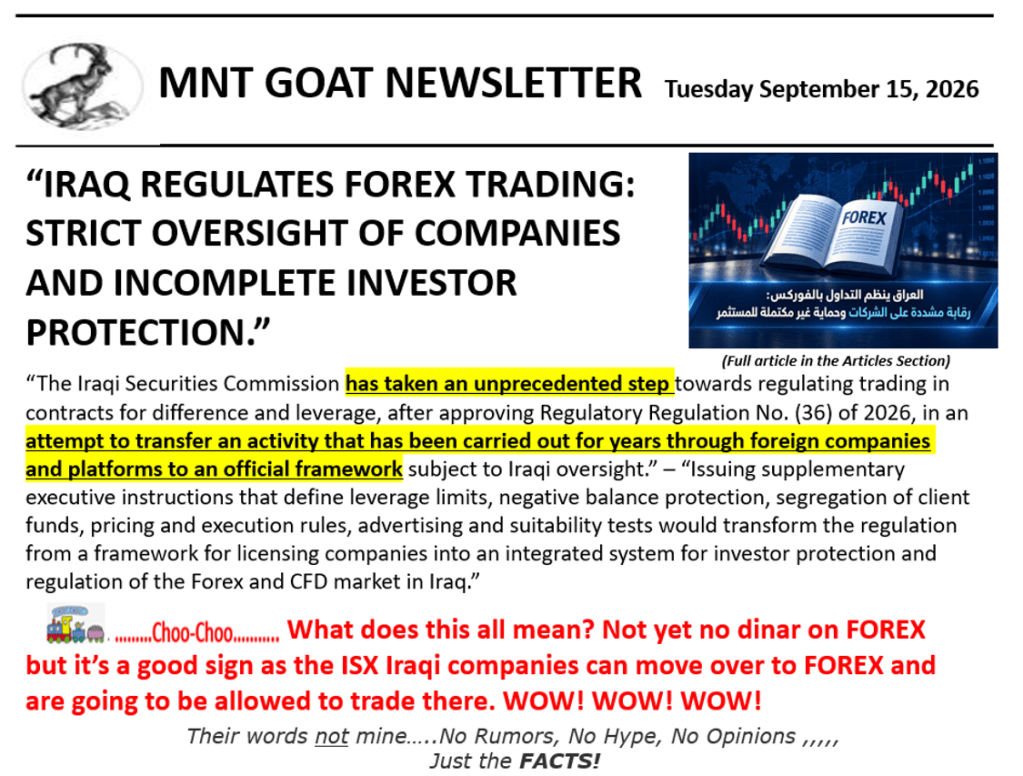
😊😊😊Take a long read in this article. It is titled “IRAQ REGULATES FOREX TRADING: STRICT OVERSIGHT OF COMPANIES AND INCOMPLETE INVESTOR PROTECTION.” If this one does not convince you we are VERY close to a reinstatement, I don’t know what will. Remember all the ‘remove the zeros’ articles were not all for nothing. They are telling us the next step.
Do all you investors really realize just how fantastic this news is? No, the IQD is not yet on FOREX however, they are going to allow Iraqi companies to list their stocks from ISX on FOREX. This is literally one step away from the IQD currency being listed too on the currency exchange. 😊 😊 😊 WOW! WOW! WOW!
“The Iraqi Securities Commission has taken an unprecedented step towards regulating trading in contracts for difference and leverage, after approving Regulatory Regulation No. (36) of 2026, in an attempt to transfer an activity that has been carried out for years through foreign companies and platforms to an official framework subject to Iraqi oversight.”
“Reading the regulations reveals a clear tightening in the selection of companies allowed to enter the Iraqi market, while a number of investor protection elements during trading still need more detailed rules, especially since leveraged forex and CFD contracts are among the most risky investment tools for individuals.”
___________________________________________
SUMMARY:
I just wanted to let everyone know once again that I read the plan to get to FOREX in 2011 in a document published by the director of the CBI at that time, Dr Shabibi. It was an effort by the IMF and the World Bank alongside the CBI. This is why I am confident they will remove the zeros and not these other options they are now proposing. They want to kill the proverbial multiple birds with one stone. Afterall why not? I was also amazed to read that many ISX stocks are going live on FOREX for trading. Is the IQD next inline. Up to the point only links to the ISX from FOREX for certain stocks have been shown for trading. What they doing now is direct listing on FOREX. So, this is an unprecedented move. WOW!
I firmly believe we will see some movement of the dinar somehow between now and early 2027. My CBI contact told me they plan to decide on the option to implement to liquify the banks. Remember that October salaries are just around the corner too.
With the fall of the Iranian Islamic Revolutionary gang of thugs in Iran what will happen to the resistance of the Factions in Iraq? I know, I know, they are resisting saying that they want the US troops out first and then they will leave. Why wait then until 2028 as Maliki proposes if the US is out by Sept 30th 2026? Again Maliki is playing politics as he knows that a new administration will be in power in the US come 2028 and he is chancing that they won’t force the factions out. These factions are his power and control mechanism. Remember he is the one that let these Kud forces into Iraq to fight ISIS in the first place. Once the militia were in, the Hezbollah factions snuck in and infiltrated alongside the militia over the years since. Maliki still has hopes of someday being prime minister once again. Didn’t he do enough damage already to Iraq. Can they withstand yet another four years of Maliki? His latest news is ridiculous and shows signs of desparation. I really pray that they will take him out once and for all.
It’s going to be a Lovely Day!
______________________________________________
What do you think will happen next? (Leave a comment)
______________________________

________________________________________
Their words not mine…..No Rumors, No Hype, No Opinions ,,,,,
Just the FACTS!

These prophecies are an important tool we have to lead us on our path. They are more important now than ever. They give us the strength, perseverance and hope that a better time is coming and that God’s Hand is at work behind the scenes. If you just take a second even to look around you at these past three election cycles, how can you deny that God is at work? Are you sleeping or what?
It is amazing and there is no other way that these events could have happened the way they turned out. But there is more to come, much, much more, I assure you! Now that God has his biblical David re-elected, we need to pay attention to what He does next.
NOTE: These prophecies just keep getting better and better, giving us HOPE of a brighter future. They seem to converge now closer and closer to seeing them come to fulfillment. WOW!
Prophetic Words from the prophets: Julie Green
“The Judgement Day Is Here For The Enemies of Almighty God“
Go to the 14:08 mark on the video. Given on Sept 5th 2026. “

“Everything Is Changing And Nothing Will Stay The Same“
Go to the 15:06 mark on the video. Given on Sept 5th 2026.

Fr. DON BOSCO EXPOSED THE DARK SECRET BEHIND ISLAM
I keep this one out here to view. Everyone should take the time to watch it. It will awaken you about the Muslim so-called religion (or should we call it for it is — a ‘cult‘.)
— And the truth the world forgot about the so-called Muslim religion.
Fr.Don Bosco, also known as John Bosco, was an Italian Catholic priest and educator, born on August 16, 1815. He founded the Salesian Society in 1859 to help disadvantaged youth, particularly boys, through education and community service. His teachings emphasized lovekindness, and the importance of education for young people, making him a beloved figure in Catholicism and a patron saint of youth. Don Bosco was canonized in 1934.
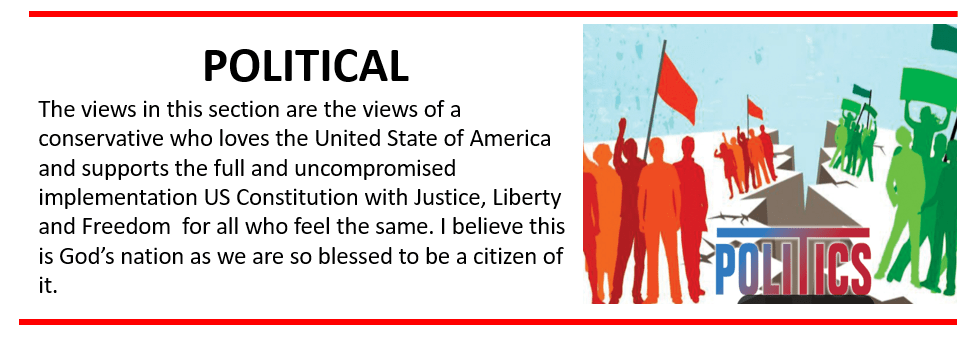
TRUMP PROMISES FREE $5000 CASH TO EVERY AMERICAN CITIZEN
Trump Promises Free $5000 Cash To Every American Citizen On One Condition!
Republicans Set Midterm Agenda must win both houses in November. Is this just a hoax to get more votes? We are not talking about a $600 check but $5,000 and this much has NEVER been given directly to the American people before by any predecessor before Trump.
Here is the initial PROMISE speech at the RNC:
Then again he promises it will happen upon being interviewed after his visit to Ireland while still on the tarmac:
NATIONWIDE UPRISING IN IRAN! ISLAMIC REGIME & IRGC PANIC AS IRANIANS PLAN COMPLETE SHUTDOWN
THIS IS WHAT HAPPENS WHEN YOU TAKE JOURNALISM SERIOUSLY
Maria Bartiromo OUSTED by Fox News After 12 Years, Erased From Network After Shocking Split. She was getting too close to too many conspiracies and they didn’t like it. In other words she ruffled too many feathers…. Then they oust you for telling the TRUTH!

MARIA BARTIROMO FINALLY SPEAKS OUT AFTER FOX NEWS FIRING

THE LARGEST SINGLE OIL RESERVE EVER DISCOVERED IN THE UNITED STATES

U.S. AND VENEZUELA SIGN NEW OIL DEAL
IRAN OIL PROVINCE: CAN INSIDE REBELS TAKE THE ISLAMIC REGIME DOWN?
America declared Economic War on Iran with Operation Economic Outcast, sanctioning 60 targets in one day. But the real war is inside Iran. In this episode of Decoded, Nikita Kapoor breaks down Khuzestan, the province that produces 80% of Iran’s oil, houses Bushehr nuclear reactor and Abadan refinery, but lives with 50% unemployment and is the world’s most polluted city on earth.
Ahwazi Arabs, armed groups like Arab Struggle Movement for the Liberation of Ahwaz, Ahwaz Falcons and Ahwaz Freedom Brigades have declared open rebellion against the IRGC. Can they blow pipelines, block ports and shut refineries to collapse the regime?
WHAT NOW FOR IRAN?
The U.S. imposes strict broad secondary economic sanctions against Iran on August 24th. What will Iran do now? Total Meltdown! Iran President Loses ALL Powers As Hardliners Take Over? Civil War Now?
Iran hard liners threaten to choke anyone who partners with the U.S. in this new embargo. Iran’s president says to end the war now that contradicts the hardliners. Who is really in charge?
PPF: (Peoples Fighter Front) A NEW INSIDE REBEL ARMY UNLEASHES CHAOS ON THE ISLAMIC HARDLINERS
I really luv Nikita Kapoor’s updates of what is really happening in Iran. We are not going to get this TRUTH from any western news channels.
ARMY OF JUSTICE: Has a regime change begun from the inside? All the U.S. has to do is wait out the effects of Operation Economic Outcast secondary sanctions and let the PPF overtake the IRGC forces and round up hardlines and bring the regime to its knees. We simply don’t know how this will al play out, but this regime will fall, just not as easy as the Trump Administration thought.
Iran is planning to evacuate its capital, Tehran, due to a severe water drought, moving its government straight into a war zone. As the regime considers relocating to Makran, a powerful new rebel force, the People’s Fighters Front, is striking from within. In this episode of Decoded, Nikita Kapoor reveals why Iran’s biggest threat isn’t foreign air forces, but an internal army rising inside its own borders.
Timing is everything!

NO LOANS OR ADVANCES… GOVERNMENT BANKS HAVE NO LIQUIDITY.
Dailynews subscription
An informed source revealed on Thursday that most government banks have stopped granting loans and advances of all kinds, attributing this to the lack of financial allocations and the lack of sufficient liquidity in those banks.
The source told Shafaq News Agency that the decrease in the volume of deposits and the decline in liquidity levels have directly affected the ability of government banks to provide loans and advances, as well as investment loans allocated to finance projects and residential complexes in Baghdad and the provinces.
He added that the decline in banking liquidity has reduced the ability of banks to continue financing various credit and investment activities, which may affect the flow of financing and support for housing and development projects .
******************************************************************************************
THE DINAR MUST BE CHANGED! WE WON’T REMOVE ZEROS, BUT THE CURRENT CURRENCY WILL NOT LAST.
(Mnt Goat: We read of yet another proposal to do something to correct the liquidity issue. Remember this is just an opinion not yet confirmed this is what they are going to do. Yet, we have five (5) other confirmations that they are going to remove the zeros. So which one do you believe they are going to do?)
Following banking warnings that money hoarded in homes and outside banks is disrupting the liquidity cycle and weakening the banking system, an idea is emerging within the Central Bank and among members of the parliamentary finance committee to change the currency and launch a new series, instead of removing zeros, in a process aimed at withdrawing counterfeit, worn-out, and stolen currency, and returning part of the funds to the banking system, through a mechanism being discussed to link the exchange of large sums to opening accounts and proving the sources of funds.
A member of the parliamentary finance committee told 964 Network that “the ongoing discussions regarding the future of the Iraqi currency are currently focused on adding new denominations and making broader changes to the currency in circulation.
The option of removing zeros has been ruled out at this stage.
(Mnt Goat: the author them goes on to say this is just a ‘trend’ as it is not yet confirmed)
There is a trend that believes issuing a new series of currency can achieve greater goals, including updating security features, eliminating counterfeit currency, withdrawing worn-out banknotes, addressing some of the stolen currency or funds moving outside the financial system, in addition to reorganizing the circulating money supply.”
The MP, who asked to remain anonymous, added that “one of the most important ideas under discussion relates to the method of replacing the old currency. There are proposals to facilitate the replacement of ordinary amounts, while subjecting large amounts to different banking procedures, which may include opening a bank account, depositing the amount into it, and applying customer knowledge and verification requirements for the source of funds, instead of handing over the same amount in cash from the new issue.
These details, including determining the size of the amount subject to these procedures, are still under discussion and have not been finalized, as they currently revolve around 100-150 million.”
He added that “the success of any project of this kind requires a sufficient transition period, ensuring that markets are not disrupted, and putting in place easy mechanisms for citizens and owners of natural savings, as well as the readiness of banks to receive deposits and deal with the expected large demand, because the goal in the end is not just to replace one piece of paper with another, but to take advantage of the currency change to rearrange a part of the monetary cycle and enhance confidence in the banking system and the ability to monitor the movement of funds.”
100 trillion outside the banks
The importance of changing the currency is highlighted by the fact that there are more than 100 trillion dinars outside the banks, distributed between daily transactions and the funds hoarded by citizens and companies, which indicates – according to experts – the weakness of cash entering the banking system, and makes the exchange process an opportunity to return part of these funds to the accounts, especially if changing large amounts is linked to proving their sources.
Recently, Ali Abdul-Ridha Alwan, director of the Trade Bank of Iraq (TBI), warned that keeping more than 85% of the money supply outside the banking system disrupts the liquidity cycle. He explained that citizens keeping money at home deprives banks of the liquidity they need to perform their role in economic activity and creates a disruption in the chain that begins with the injection of money through financial institutions and ends with spending and paying salaries.
What are the gains from the process?
A member of the Finance Committee says that “the initial estimates circulating regarding the results of the currency change indicate the possibility of recovering the equivalent of 20-25 trillion dinars of the cash mass that is not currently moving normally within the financial system, whether due to worn-out or counterfeit currency or hoarded funds, which would allow for the reorganization of an important part of the monetary cycle.”
He added that “estimates also assume that the replacement process will push large numbers of citizens to deal with banks and open accounts, and there are perceptions that about 25% of money owners who enter the banking system for the purpose of changing the currency may leave all or part of their money in their accounts instead of withdrawing it again in cash, which means increasing deposits, enhancing liquidity within banks, and returning part of the hoarded money to the banking cycle.”
*****************************************************************************************
THE BAGHDAD DINAR IS DISAPPEARING… CLOSE THE BORDERS!” THE FINAL SOLUTION IS TO ABOLISH IRAQ’S PAPER CURRENCY!
(Mnt Goat: I firmly believe they are using Iraq as a testing ground (beta test) for a paperless currency.)
(Mnt Goat: in this article you get a VEREY sense that they are now just throwing out proposals for solutions to the liquidity crisis. This is just one more.)
Perhaps no country in the world has abolished paper currency, but amidst the anxiety surrounding discussions in the local market and among banks—both those sanctioned and those not—within an economy mired in a ceaseless war, an Iraqi expert and academic believes that the chaos plaguing the financial market necessitates the “complete abolition of paper currency” and its conversion into a bank card for every citizen.
(Mnt Goat: Can’t do this yet, no electricity in many districts still or unreliable grid. This must wait till later. Can Iraq wait till later with the currency liquidity crisis?)
This is preferable to other proposals for addressing the escalating liquidity crisis. “Neither removing zeros nor replacing denominations with larger ones (such as a 100,000 dinar note) will work,” he argues. He suggests that abolishing paper currency would bring all “buried, stolen, and smuggled funds back” in a documented and verifiable manner.
However, this expert also calls for a measure to be implemented:
“closing the borders” so that Baghdad can effectively nullify the value of “stolen, buried, and smuggled dinars” within the country or in neighboring states like Turkey and Iran. He does not, however, specify a timeframe for closing the borders! While this proposal appears desperate, it reflects the intensity of the debate among Iraqi financial experts regarding how to address the “disappearance of the dinar and liquidity” from the market and the resulting scarcity that hinders salary payments and stifles daily economic activity. According to expert Safwan Qusay, in a conversation with journalist Mona Sami, which was followed by 964 Network .
Economic expert Safwan Qusay stated, “Our problem is that the Central Bank issued currency worth 106 trillion dinars, 40 trillion of which are within the banking system, while more than 60 trillion dinars remain in the form of cash in the pockets of Iraqis. This amount does not enter the banking system, so we need to call these funds to find out where they are. Here, opinions vary.”
- Some advocate removing zeros as long as a new currency is to be printed.
- Some argue that there is no need to remove zeros and print more currency, but rather to move towards using only electronic payment cards. They suggest giving Iraqis a grace period, say until the end of the year, during which they would deposit all their savings into the card. This would lead to a halt in cash purchases, causing paper currency to lose its legitimacy. People would then be forced to deposit cash into the card, which would have a special code that, if entered into the banks, would be monitored. Any money that is missing would be discarded.
He added: “This should include each category separately; all categories should not be included at once. Such a measure requires closing the borders, because there is a portion of the dinar that some suspect is outside Iraqi borders, since the Iranian currency has been subjected to many shocks, so it is not unlikely that they have saved Iraqi money. The same applies to the Turks.
Therefore, the process begins with closing the borders, recovering the money, and then injecting it back into circulation in a legitimate way through the electronic card. At that point, the legitimacy of money not belonging to the government, especially buried money, will be lost, and this measure will restore the prestige of the Iraqi dinar.”
******************************************************************************************
AN ECONOMIST EXPLAINS THE EXTENT TO WHICH CASH LIQUIDITY CAN BE WITHDRAWN FROM CITIZENS.
Economic expert Dr. Safwan Qusay explained the possibility of withdrawing the cash liquidity held by citizens and transitioning entirely to electronic systems.
Qusay told Al-Maalouma, “Some studies indicate that Iraq has the capacity to fund credit cards, with the aim of withdrawing the estimated 70 trillion dinars held by Iraqis, so that banks can access it to finance public expenditures.”
He added, “By selling real estate shares or shares in companies with suitable returns through the Iraq Stock Exchange, banks can withdraw this liquidity through such projects.”
He pointed out that “there is a need to incentivize Iraqis to buy bonds and shares through the returns and interest generated by the nature of the project being sold. This is one solution for withdrawing cash liquidity, which can be implemented in the coming period.”
******************************************************************************************
THE CENTRAL BANK OF IRAQ IS TAKING STEPS TO REDUCE THE DOLLAR GAP; A UNIFIED EXCHANGE RATE FOR CURRENCY EXCHANGE OFFICES IS APPROACHING 1320.
Informed sources revealed to the Independent Press Agency new moves within the Central Bank of Iraq aimed at reducing the large gap between the official exchange rate of the dollar and the prices circulating in the local market, through a package of measures being worked on to regulate the sale of foreign currency and tighten control over exchange companies, in conjunction with the continued rise of the dollar in Baghdad and other governorates.
The sources said the anticipated measures focus on reorganizing the mechanism for the dollar’s access to the market and meeting the actual and legitimate demand for foreign currency, thereby reducing the dependence of traders and citizens on the informal market and limiting speculation that has pushed the exchange rate away from the levels set by the central bank.
According to information obtained by the Independent Press Agency, one of the options being considered in the coming period is setting a more disciplined and unified price for selling dollars through exchange companies and authorized outlets, so that the prices are much closer to the official price, instead of the wide gap currently recorded between the dollar available through official channels and its price in the market.
The sources indicated that the move, according to the available information, is not related to changing the official price of the dinar, but rather to trying to bring the price at which the dollar reaches the end beneficiary closer to the approved official levels, foremost among them the level of 1320 dinars per dollar, through procedures related to distribution, control, pricing and the mechanism of the work of exchange companies.
This information comes at a time when the Central Bank officially confirms that there is no intention to change the official exchange rate, as it was categorically denied on June 17, 2026, the news that spoke of amending the price of the dinar, warning against circulating documents or information not issued by it.
The official pricing system announced by the Central Bank in February 2023 is based on a rate of 1,300 dinars for purchasing dollars from the Ministry of Finance, 1,310 dinars for selling dollars to banks, and 1,320 dinars as the maximum selling price from banks and non-bank financial institutions to the end user. Official bank data also shows the rate remaining at 1,310 dinars per dollar.
Tightening restrictions on exchange companies
Sources from “Independent Press” confirm that the current phase is already witnessing increased oversight of exchange companies, and that this trend is likely to expand in the coming days, especially with regard to the sources of buying and selling dollars, the approved prices, the movement of funds, and compliance with the Central Bank’s regulations.
These moves are consistent with measures taken by the bank during the past months to strengthen oversight of the money exchange sector. In June 2026, the bank asked A and B category money exchange companies and brokerage firms to provide it with data relating to bank accounts for regulatory and supervisory purposes. It also continued during 2026 to withdraw licenses from violating companies and tighten compliance requirements.
Last April, the Central Bank confirmed its ability to meet all requests from banks and exchange companies for dollars allocated to travelers, pilgrims, and foreign transfers, indicating that a key part of its strategy is based on increasing access to dollars through official channels instead of allowing demand to flow to the informal market.
25,000 dinars gap for every 100 dollars (that’s about $19 USD or 1/5)
The anticipated moves are gaining even greater importance as the large gap between the official price and the local market continues.
The selling price of the dollar in Baghdad exchange shops on Monday, September 14, 2026, was recorded at about 157,000 dinars per 100 dollars, while the buying price was about 156,000 dinars, while the Al-Kifah and Al-Harithiya exchanges recorded about 156,500 dinars per 100 dollars.
Assuming a rate of 1320 dinars per dollar for the end beneficiary through official channels, the value of 100 dollars is approximately 132,000 dinars, which means there is a gap of approximately 25,000 dinars per 100 dollars compared to the selling price traded in some exchange shops in Baghdad.
According to sources, this gap is what the central bank seeks to gradually reduce, not by changing the official price, but by expanding official channels and facilitating the fulfillment of the real demand for dollars, while increasing oversight of entities that buy currency at the official price and then these prices are not actually reflected in the end beneficiary.
The Central Bank had previously paved the way for this path.
The anticipated move brings back to the forefront a previous position of the Central Bank, in which it stressed that the dollar circulating in Iraq comes mainly from the Central Bank through banks, exchange companies and brokerage, and that dealing at prices far from the set price is related to speculation more than it is a normal independent exchange market.
The bank also confirmed on June 22, 2026, the continuation of its reform program to maintain monetary and financial stability, stressing its continued commitment to meeting legitimate demand for dollars and taking the necessary policies to maintain exchange rate stability and the integrity of financial channels.
According to sources from the Independent Press Agency, the coming days will be important regarding the dollar issue, and may witness the implementation of additional measures at the level of exchange companies and pricing and distribution mechanisms, in an attempt to create a more disciplined price in the market and reduce the space in which speculation moves.
The sources confirmed that the ultimate goal of the proposed measures is to bring the dollar available to citizens and merchants through legal channels closer to the official rate, and to increase the ability of official channels to meet demand, which, if the measures are implemented efficiently and the required quantities are provided, may lead to increased pressure on the informal market and push exchange rates to gradually decline.
However, the sources stressed that the success of these measures will remain linked to the central bank’s ability to ensure that the dollar reaches the rightful beneficiary at the set price, and to prevent its resale outside official channels, in addition to securing the needs of trade and foreign transfers on a regular basis.
Thus, the Iraqi exchange market enters a new phase of anticipation, amid a still significant gap between the official and parallel market rates. All eyes are on the Central Bank to see what measures it may announce in the coming days, and to what extent they can bring the dollar back to levels closer to the official rate.
*****************************************************************************************
AFTER TWO DECADES OF STAGNATION, THE OIL AND GAS LAW HAS A CHANCE TO BE RESOLVED.
Parliamentary assurances to proceed with the enactment of the oil and gas law during the current session have clearly expanded, coinciding with the inclusion of the file among the priorities of the legislative and executive authorities, and the existence of serious political intentions to end the disputes that have hindered its legislation since 2007, thus opening the door to regulating the management of oil wealth, defining powers and obligations, and controlling production, sale, and export operations.
These assurances come after the “Coalition for State Administration,” during its last meeting, stressed the need to discuss a draft version of the Oil and Gas Law in preparation for sending it to the House of Representatives, in a step that brings the law back to the forefront of legislative work after years of disruption, amid hopes that its approval will contribute to addressing the existing problems between the federal government, the Kurdistan Region and the producing governorates, and end the multiplicity of interpretations in managing the oil sector.
Parliamentary efforts
Zainab Al-Tamimi, a member of the Parliamentary Oil, Gas and Natural Resources Committee, told Al-Sabah: “The Speaker of Parliament, the head of the committee and its members give great importance to the oil and gas law,” indicating that “the previous session witnessed serious work to finalize the law, but it did not reach the expected result.”
She added that “the representatives of the current session, especially the representatives of Basra Governorate, emphasize the need to finalize the law during this session,” noting that there are “real and serious intentions to proceed with its legislation, as the law topped the list of the main topics discussed by the Oil and Gas Committee during its meetings.”
Al-Tamimi expressed her hope that “the law will see the light during the current session,” stressing that it “will address a number of obstacles and problems facing the oil sector, and provide a clear legal framework to regulate its work in general.”
Two decades of disruption
For his part, committee member MP Banas Al-Douski told Al-Sabah: “The oil and gas law should have been discussed and legislated since 2007, due to its importance in defining the rights, duties, obligations and general powers in the oil sector.”
He explained that “the Iraqi oil sector is facing a state of stagnation due to the absence of a federal law regulating its work, at a time when the old frameworks are no longer able to keep pace with the developments witnessed by the sector,” noting that “the continued absence of the law has contributed to the exacerbation of a number of failures.”
“And the existing problems.” Al-Douski stressed that “the current stage requires a genuine political will to enact the law, now that Iraq needs a federal framework that regulates the management of oil wealth and oil sales and export operations, and clearly defines the responsibilities and powers of the concerned parties.”
Adel Al-Mahalawi, a member of the “Progress” bloc, had previously confirmed to Al-Sabah that there was a political agreement among the majority of blocs to proceed with the oil and gas law and put it on the table of the House of Representatives, as it is one of the most prominent economic legislations related to managing national wealth and regulating the relationship between the federal government and the producing governorates.
Al-Mahalawi pointed to “Prime Minister Ali Al-Zaidi’s readiness to cooperate with the House of Representatives in finalizing important legislation,” explaining that “the Oil and Gas Law is at the forefront of the package of economic and service laws that are expected to be worked on in coordination between the two authorities, given its importance in expanding the role of the governorates, regulating powers, and ending the disputes that have delayed its approval throughout the past years.”
Expert opinions
Economic expert Dr. Nabil Al-Abadi told Al-Sabah newspaper: “The oil and gas law is not just a passing piece of legislation, but rather the cornerstone for restructuring the Iraqi economy, which depends on oil revenues for up to 90% of its income.” He explained that “the obstruction of this law for years, since 2005, due to political disputes and the prioritization of narrow interests, has cost the public treasury enormous losses and kept the country in a state of…”
“From financial instability.” He explained that “the enactment of this law will establish a clear and transparent legal framework to regulate the management of national wealth, which will enhance the confidence of international investors and open the door to major investment inflows that will increase production and boost the flow of hard currency to the Central Bank, directly supporting the dinar’s exchange rate.” He emphasized that “this law will end the state of conflicting constitutional interpretations and reliance on temporary understandings, and will establish fair mechanisms for distributing revenues between the federal government and the producing regions and governorates, thus preventing the duplication of oil policies and protecting the unity of national wealth.”
Regarding the contentious clauses, Al-Abadi believes that “the optimal solution lies in adopting a consensus-based formulation that guarantees the producing governorates greater autonomy in managing their affairs, while the sovereign decision regarding contracting and marketing remains unified with the federal government.”
Al-Abadi added, “Continuing to obstruct this law is not a strategic choice, but rather a sacrifice of Iraq’s future for immediate political gains. It is time for political forces to overcome their differences and put the national interest above all else, as passing this law is the true gateway to economic reform and financial stability.”
Essential step
Hadi Hindas, a member of the Baghdad Economic Forum, told Al-Sabah newspaper, “Enacting the oil and gas law is a fundamental step towards regulating the Iraqi oil sector and enhancing Iraq’s ability to manage one of its most important resources according to a clear and sustainable vision.”
Hindas explained that “Iraq possesses significant oil reserves, but the current stage requires a comprehensive legal framework that clearly defines the powers and responsibilities of the entities involved in managing the oil sector and regulates the relationship between the federal government and the governments of the producing regions and governorates, thus ensuring the protection of national wealth and achieving fairness in the distribution of financial revenues.” He added that “the oil and gas law not only addresses existing administrative and legal issues but also plays a crucial role in strengthening the investment environment, as it provides investors and international companies with a clearer and more stable vision regarding the mechanisms for operating and investing in the oil and gas sector.”
He pointed out that “the legislation contributes to laying the strategic foundations for managing oil fields, investing in associated gas, and developing infrastructure, as well as regulating production and export plans in line with Iraq’s need to increase its resources and diversify its energy sources.”
Hindas noted that “the importance of the law lies in its ability to unify the national vision for managing the oil sector, moving away from multiple interpretations, and enhancing transparency and efficiency in revenue management. Enacting the oil and gas law has become a national and economic necessity, given its direct role in regulating this vital sector, ensuring the sustainability of its resources for future generations, and supporting the economy.” The Iraqi in general.
Doubling production
For his part, Dr. Sadiq Al-Rikabi, Director of Economic Research at the Global Center for Development Studies in the United Kingdom, stressed the importance of passing the federal oil and gas law for Iraq and the national economy, especially in light of the current circumstances, indicating that Iraq needs to double its oil production to higher levels to absorb the shock of declining revenues and compensate for it in the future.
Al-Rikabi explained that increasing production requires, first and foremost, a stable and clear legislative environment, which can be provided by the Oil and Gas Law through the creation of a legal and institutional framework that regulates the management of the sector and contributes to ending the disputes between Baghdad and Erbil, thus enabling an increase in oil wealth and the exploitation and management of oil and gas fields, as well as defining the responsibilities of each party and putting an end to the disputes related to some constitutional articles and financial disputes that have contributed to disrupting the movement of production and the work of companies.
Al-Rikabi pointed out that the repercussions of the disputes witnessed in the past period were reflected in the investment environment, and led some companies to avoid going to the Kurdistan Region or increasing their investments in it, stressing that the absence of legislation increases investment risks, especially for foreign companies that are looking for a stable environment with clear laws, in which contracts are strongly protected by law and decisions are more stable.
He added that the enactment of the oil and gas law would encourage global energy companies to increase their investments, whether in developing existing fields or exploring new fields, which would contribute to raising Iraq’s production capacity, which would reflect on financial stability, support the federal budget and increase its revenues, as well as enhance the national economy’s ability to cope with energy price fluctuations and political tensions.
Al-Rikabi pointed out that the existence of a clear legal framework for oil and gas can also reflect on internal political stability, by regulating the relationship between the federal government and the Kurdistan Region, and contributing to addressing many of the problems related to the region’s oil revenues, which have been a frequent cause of disputes related to the budget, its formulation, the obligations incurred by the region, and the demands of the federal government.
He concluded by saying that passing the law would represent an important step towards developing the oil and gas sector, attracting more investments to it, and increasing its production capacities, which would contribute to achieving greater political and economic stability in the country.
Legal perspective
In a related context, lawyer Talib al-Ziyadi told Al-Sabah newspaper, “The oil and gas law embodies the people’s ownership of their national resources, as affirmed by Article 111 of the Iraqi Constitution, the supreme law of the land, which stipulates that oil and gas belong to the Iraqi people in all regions and governorates.” He added, “The enactment of this law establishes a mechanism for distributing a portion of the profits generated from crude oil sales to several funds, including the Citizen’s Fund and the Reconstruction Fund, among others. It also regulates how this national wealth is held by the state and under the control of the federal government, ensuring that its revenues are distributed fairly and equitably, in proportion to the population distribution throughout the country, as indicated in Article 112 of the Iraqi Constitution.” Al-Ziyadi explained that “since the fall of the previous regime in 2003 until now, there has been injustice and unfairness inflicted on some of the oil and gas producing governorates,” noting that “the Kurdistan Region monopolizes the largest share of oil exports, in addition to receiving a share of the budget like the rest of the governorates, while Basra and other oil-producing governorates produce a large percentage of the oil and gas in Iraq,” as he put it.
He stressed that “the enactment of the law will place the management of this wealth exclusively in the hands of the federal government, and will ensure that its revenues are distributed fairly and equitably according to the population census.”
*********************************************************************************************
WITH AN INCREASE OF ONE TON, IRAQ STRENGTHENS ITS GOLD RESERVES AND CONTINUES ITS GLOBAL PROGRESS.
Data from the World Gold Council for August 2026 showed that Iraq maintained its position among the world’s largest gold holders, with an increase in its holdings compared to its last data.
According to data seen by Shafaq News Agency, Iraq’s gold reserves amounted to 175.6 tons, ranking it 28th globally, with gold constituting about 24.8% of its total reserves. The latest data for Iraq dates back to May 2026. Compared to previous data, Iraq’s holdings increased from 174.6 tons to 175.6 tons, an increase of one ton.
Iraq comes in third place in the Arab world in terms of gold holdings, after Saudi Arabia, which has 323.1 tons, and Algeria, with 173.6 tons. Globally, the United States topped the list with reserves of 8,133.5 tons, followed by Germany with 3,349.5 tons, then the International Monetary Fund with 2,814 tons, Italy with 2,451.8 tons, and France with 2,437 tons.
*****************************************************************************************
THE ZAIDI GOVERNMENT IS DISMANTLING THE BANKING SECTOR’S STRUCTURE… HANTOUSH TELLS IRAQ OBSERVER: QUALITATIVE REFORMS WILL RESTORE CONFIDENCE AND OPEN THE DOORS TO FINANCIAL STABILITY.
In a move reflecting the success of Prime Minister Ali Faleh al-Zaidi’s government in handling complex economic issues, Iraq is continuing its reform path aimed at addressing the obstacles that have long hampered the performance of the banking sector. This is being achieved through strengthening oversight, raising compliance levels, protecting depositors’ funds, and establishing more disciplined rules in the financial market.
Financial and banking expert Dr. Mustafa Hantoush affirms that the measures taken by the Central Bank of Iraq represent important supervisory tools for addressing the shortcomings within the banking sector. He points out that placing some banks under receivership does not mean their bankruptcy, but rather provides a framework for direct supervision of their situations, assessment of liquidity, assets, and investments, and taking appropriate corrective measures.
Hantoush told Iraq Observer that “the success of banking reform depends on the ability of regulatory bodies to diagnose problems and address them before they escalate into crises.” He explained that the possibility of reforming a bank’s situation allows it to resume operations, while legal procedures open up other options when reform proves impossible.
He added that “the government’s move to a more serious phase in addressing banking imbalances, through supporting regulatory and supervisory measures and enhancing confidence in the financial sector, will contribute to curbing speculation, regulating the flow of funds, and providing a more stable environment for the private sector and investment.”
He continued, “Developing the banking sector is also a key pillar of the Al-Zaidi government’s economic vision, given that stronger and more disciplined financial institutions contribute to stimulating the economic cycle, facilitating financing and transfers, and protecting the interests of citizens and depositors.”
While banking obstacles have posed a cumulative challenge to the Iraqi economy, the reform steps led by the Al-Zaidi government, in coordination with the Central Bank, are outlining a new phase characterized by discipline, confidence, and stability. These steps underscore that addressing the root causes of these problems early and decisively can pave the way for building a stronger banking sector capable of supporting the Iraqi economy.
***************************************************************************************
IRAQI FACTIONS HAVE MADE THEIR DECISION: SOVEREIGNTY IN EXCHANGE FOR WEAPONS.
On Tuesday, armed factions in Iraq affirmed that the issue of restricting weapons cannot be separated from achieving full sovereignty for Iraq, while considering that the September 30th deadline represents a test of the seriousness of the United States and the international coalition in implementing their commitments to the Iraqi government.
The spokesman for the Sayyid al-Shuhada Brigades, Kazem al-Fartousi, told Shafaq News Agency that the issue of restricting weapons was discussed through a committee formed from the coordination framework and another from the resistance factions, indicating that the discussions witnessed the determination of priorities regarding this issue.
Al-Fartousi explained that “the principle put forward by the factions, which cannot be divided or negotiated, is that this weapon is in exchange for sovereignty,” stressing that they will not give up the weapon unless there is full sovereignty in the country.
He added that this requires protecting the Iraqi people, land, and skies, as well as national gains, in addition to protecting political decision-making and economic independence, noting that the ten demands put forward by the factions are “national and concern all of Iraq from north to south.”
He explained that these demands are not related to the interests of the resistance factions, but rather represent, in his words: “a definition of sovereignty, an expression of it, and how to achieve full sovereignty for this nation.”
Regarding the government’s ability to respond to these demands, Al-Fartousi pointed out that “part of these demands are included in the government program,” stressing that the issue is not only about whether the government responds or not, but is related to “where Iraq’s interest lies.”
He pointed out that the Iraqi government represents the executive administration of the Iraqi people and the country’s interest, while the coordinating framework, as the owner of the principle and political action, bears the responsibility of considering, establishing and engineering the work of the government.
Regarding the date of September 30, and whether it represents a date for resolving the issue of restricting weapons, Al-Fartousi explained that there is “confusion about dates,” and that this is the date of the withdrawal of coalition forces from Iraq.
According to him, this date represents “the first test of the seriousness of the Trump administration and the coalition in implementing their commitments to the Iraqi government,” noting that “after September 30, the discussion will begin about the issue of weapons, their presence and use.”
Al-Fartousi concluded his remarks by saying that some of the issues raised “need time,” while other issues “only need a political decision and do not need much time.”
Sources revealed two days ago that a preliminary agreement had been reached to hold a meeting that would include official government military and security parties, along with leaders from the coordination framework, representatives of the Popular Mobilization Forces, and representatives of armed factions, to discuss the mechanism for restricting weapons to the state, before the deadline of September 30, before it was postponed due to the absence of the Al-Nujaba Movement.
According to the sources, the meeting “does not mean reaching a final agreement on the mechanism for restricting weapons,” but rather comes within the framework of efforts to calm tensions and prevent any possible escalation, and to try to reach solutions and understandings regarding the process of restricting weapons.
A source told Shafaq News Agency last Sunday that the armed factions will not hand over their weapons on September 30, while also mentioning the second option being discussed in the negotiations, which is to regulate or freeze the weapons.
Two weeks ago, the coordination framework formed a tripartite committee comprising Mohammed Shia al-Sudani, Nouri al-Maliki, and Hadi al-Amiri, in order to contain the repercussions of restricting weapons to the state, especially after the media escalation and scaremongering witnessed in the Iraqi arena regarding this issue.
Over the past few days, the tripartite committee has held many dialogues and discussions with the factions concerned with the issue of restricting weapons.
It is worth noting that the state’s monopoly on weapons does not have the consensus of the Iraqi factions, as the Al-Nujaba Movement, Kataib Hezbollah, Kataib Sayyid al-Shuhada and other factions announced their refusal to give up their military capabilities on September 30, the date set by the Iraqi government, which coincides with the end of the international coalition’s military presence in Iraq, as these factions link the future of their weapons to the withdrawal of foreign forces.
The State Administration Coalition, which includes the most prominent Shiite, Sunni and Kurdish political forces in Iraq, had warned that any armed activity outside the framework of the state after September 30 would be dealt with according to the anti-terrorism law.
**********************************************************************************
THE WHITE HOUSE CALLS ON BAGHDAD TO BE TRANSPARENT WITH WASHINGTON AND REGIONAL PARTNERS REGARDING THE HANDOVER OF WEAPONS BY THE FACTIONS.
A U.S. administration official on Monday affirmed the United States’ full support for disarming factions in Iraq and transferring their weapons to the federal government, stressing that transparency with Washington and regional partners regarding the mechanism for implementing the process is a crucial factor for its success.
In response to a question from Shafaq News Agency regarding the US administration’s position on the issue of restricting weapons to the state, the official said, “The United States has been clear with Iraq about the critical importance of preserving its sovereignty and preventing Iranian-backed militias from launching attacks from within its borders.”
He added that “the United States fully supports disarmament and the transfer of weapons to the central government,” stressing that “transparency with the United States and regional partners on how this process is implemented is crucial to its success.”
The US position comes days after Saudi Arabia announced that drones launched from Iraqi territory attacked facilities belonging to the East-West oil pipeline in the Riyadh and Medina regions, causing injuries and material damage and leading to the temporary shutdown of the pipeline.
Riyadh announced that it would refrain from responding at the present time in response to a request from Iraqi Prime Minister Ali Faleh al-Zaidi, while reserving the right to take the necessary measures to protect its sovereignty, security and vital facilities.
Following the attack, the Iraqi government announced that investigations proved that the drones were launched from inside the country, while Al-Zaydi relieved the commanders of operations and police in Maysan of their positions, transferred the directors of the security services in the governorate to the command and referred them to investigation, in addition to forming an urgent investigative council.
The Iraqi government has also agreed to conduct a joint investigation with Iran regarding drone launch platforms found near the border strip, while the identity of the party that carried out the attack has not yet been announced.
The “Islamic Resistance in Iraq” denied responsibility for it, announcing its readiness to cooperate with the government investigation.
The attack brought the issue of restricting weapons to the state back to the forefront of the Iraqi scene, before the September 30 deadline, which al-Zaydi pledged to make the ceiling for disarming armed groups, coinciding with the end of the mission of the international coalition forces in Iraq.
After the date was initially presented as a deadline for handing over weapons located outside state institutions, government officials later clarified that it pertains to the end of the international coalition’s mission in Iraq, and does not represent a date for completing the disarmament of factions.
In contrast, influential armed factions refuse to consider September 30 as a binding date for them, and link discussions about the future of their weapons to the complete and permanent withdrawal of foreign forces.
Despite this discrepancy, the spokesman for the Commander-in-Chief of the Armed Forces, Sabah al-Nu’man, confirmed to Shafaq News Agency that the end of the coalition’s mission will lead to an acceleration in resolving the issue, because the justifications for keeping weapons will disappear after September 30, expecting the process of organizing them under the umbrella of the state to be completed in record time.
The State Administration Coalition had taken a more hardline stance, warning that any armed activity threatening Iraq’s security outside of official institutions after September 30 would be dealt with according to the anti-terrorism law.
************************************************************************************
U.S. WARNS IRAQ: DISARM MILITIAS BY SEPT. 30 OR DOLLAR TRANSFERS STOP
Two Iraqi government sources tell Kurdistan24 that Washington could halt dollar transfers unless Iran-aligned armed factions disarm by Sept. 30.
The Trump administration has warned Iraq that monthly dollar transfers could be suspended unless Iran-aligned armed factions surrender their weapons by Sept. 30, two sources familiar with the Iraqi government told Kurdistan24, tying one of Washington’s most powerful financial levers over Baghdad to an increasingly contentious disarmament deadline.
The sources said the warning was delivered directly to Prime Minister Ali al-Zaidi during his visit to Washington, where U.S. officials made clear that failure to curb armed groups threatening American and regional interests would carry consequences for bilateral relations and Iraq’s access to dollar liquidity.
Kurdistan24 has not independently obtained a U.S. government document setting out the warning, and no public statement from Washington confirming the ultimatum was included in the reporting. The account rests on two Iraqi government sources familiar with the discussions.
One source said Washington had already demonstrated its ability to exert pressure through the timing of dollar transfers early in al-Zaidi’s tenure.
“From the beginning of Ali al-Zaidi’s time in office, America delayed the timing of dollar transfers, and this had a direct impact on the value of the dinar,” the source told Kurdistan24.
The source said transfers later returned to normal following al-Zaidi’s Washington visit after the two sides reached an understanding.
According to the same source, U.S. officials told the Iraqi prime minister that Baghdad’s inability to prevent armed groups from targeting American interests or neighboring countries would damage relations and that the problem had to be addressed at its source.
The warning substantially raises the stakes surrounding the Sept. 30 deadline.
Until now, the dispute over weapons outside direct state control has largely been framed as a security and sovereignty issue. The reported U.S. position adds a potentially immediate economic consequence to Baghdad’s handling of Iran-aligned factions.
Pressure on Baghdad After Washington Visit
According to Kurdistan24’s sources, al-Zaidi returned from Washington convinced that a disruption to dollar flows represented a genuine risk. He subsequently pushed through the Coordination Framework for armed factions to accelerate the surrender of weapons, the sources said.
That effort initially moved with greater urgency, but several armed groups responded with threats against the prime minister, prompting the issue to be handed to the Coordination Framework for further negotiations, according to the reporting.
Several factions, including Kataib Hezbollah, Harakat al-Nujaba, Kataib Sayyid al-Shuhada, Saraya Awliya al-Dam, Ashab al-Kahf and the Karbala Battalions, have resisted the weapons handover process.
Some have sought to portray the process as a reorganization rather than disarmament and have attached conditions that include a complete withdrawal of U.S. forces from Iraq. Those positions illustrate the political difficulty facing Baghdad: Washington is demanding measurable action by a fixed deadline, while some of the factions expected to disarm reject the premise or conditions of the process.
Why Dollar Transfers Matter
The significance of the U.S. warning stems from the structure of Iraq’s oil-dependent financial system.
Economic observers note that Iraq’s oil revenues are held through the Central Bank of Iraq’s account at the Federal Reserve Bank of New York, with dollar liquidity subsequently made available to Iraq’s financial system.
The arrangement gives Washington considerable influence over the movement of U.S. currency into Iraq.
Disruptions to that flow can put pressure on the dinar’s market exchange rate and complicate the Central Bank’s ability to supply foreign currency to an economy heavily dependent on imports.
The report cited an earlier delay in a $500 million dollar shipment in April 2026 as an example of the market’s sensitivity to interruptions. The backgrounder also placed Iraq’s foreign-currency reserves at $79.2 billion in August, down from $97.8 billion in April.
Those figures help explain why the reported U.S. warning carries consequences beyond the immediate security dispute.
A prolonged restriction on dollar liquidity could affect exchange-rate stability, import financing and the government’s broader fiscal position. The exact economic effect would depend on the scope and duration of any U.S. measure, and the supplied reporting does not establish that Washington has yet implemented a cutoff.
Sept. 30 Becomes a Wider Pressure Point
The date has acquired broader strategic significance.
According to Kurdistan24’s follow-up, Sept. 30 also coincides with the scheduled conclusion of the international anti-ISIS coalition’s military mission in Iraq, while Baghdad has been pressing armed factions to bring weapons under state authority.
Washington’s reported ultimatum therefore connects three issues that have often been treated separately: the future of the U.S.-led military presence, the status of Iran-aligned armed groups and Iraq’s access to dollar liquidity.
For al-Zaidi’s government, that creates a compressed timetable.
The prime minister must navigate factions that retain significant armed and political influence while also avoiding a confrontation with Washington that could spill rapidly from security relations into the economy.
The sources who spoke to Kurdistan24 portrayed the dollar warning as an attempt to force that choice. If their account is borne out, the Sept. 30 deadline is no longer simply a test of whether Baghdad can persuade armed factions to relinquish their weapons.
It is also a test of how far Washington is prepared to use financial leverage to compel Iraq’s government to enforce state control over armed actors, and how much economic risk Baghdad is willing to carry if the disarmament process falls short.
**********************************************************************************
FROM 40 TO 42 YEARS OLD… PARLIAMENT COMPLETES AMENDMENT TO THE INTERNAL SECURITY FORCES SERVICE AND RETIREMENT LAW
On Tuesday, the Parliamentary Committee on Security and Defense completed the draft of the second amendment to the Internal Security Forces Service and Retirement Law.
Dailynews subscription
Committee member MP Othman Al-Shaibani said in a statement to Shafaq News Agency that the age for optional retirement will be from 40 to 42 years, provided that the actual service is not less than 15 years.
Al-Shaibani added that the Retirement Authority objected to the Ministry of Interior employees going into voluntary retirement due to the lack of financial allocations, explaining that the committee intervened to resolve the issue, and that the first reading of the draft law will be during the current legislative session.
He indicated that the Parliamentary Security and Defense Committee will host all the first-line leaders of the various security agencies, including the Interior Minister of the Kurdistan Region, to assess the readiness of the Iraqi armed forces and security agencies, especially after September 30 and the withdrawal of US forces from Iraq.
Al-Shaibani pointed out that the committee is directly monitoring the application and admission process at the Higher Institute, the Police College, and the Commissioners Institute affiliated with the Ministry of Interior, to ensure that admission procedures proceed according to clear and transparent standards, and away from exceptions and favoritism.
**********************************************************************************
WHY HASN’T AN OIL AND GAS LAW BEEN ENACTED? A FORMER MINISTER REVEALS THE REASONS.
Former MP and Minister Zuhair al-Jalabi revealed on Thursday the reasons why political parties have not moved forward with enacting the oil and gas law, despite nearly two decades having passed since attempts to pass this crucial legislation.
Al-Jalabi told Al-Maalouma, “The issue of annexing land from Nineveh Governorate to the Kurdistan Region is practically over, especially since the administrative boundaries of the governorates are defined within the Ministry of Planning and cannot be changed except by a decision from the Council of Representatives through a vote on a new administrative map of the governorates.”
He added, “Regarding the oil and gas law, despite talk of obstacles related to shared lands and the ownership of oil fields, whether by Baghdad or the region, the problem is much larger because many countries are working to prevent the passage of such a law.”
He explained that “the countries seeking to prevent the law’s passage benefit from oil smuggling, the rampant corruption in the relevant ministry, and the chaos associated with this issue. Some countries are striving to ensure the continuation of this scenario to guarantee their own interests.”
********************************************************************************************
US TREASURY SANCTIONS IRAQI BUSINESSMEN OVER IRAN SUPPORT
The Treasury said the measures were part of “Operation Economic Outcast,” a campaign launched to cut off the remaining economic networks and financial channels supporting the Iranian regime. The U.S. Department of the Treasury’s Office of Foreign Assets Control (OFAC) on Thursday sanctioned Iraqi businessmen accused of supporting Iran-backed groups and helping Tehran evade sanctions.
The Treasury said the measures were part of “Operation Economic Outcast,” a campaign launched to cut off the remaining economic networks and financial channels supporting the Iranian regime.
The department said the operation, announced by U.S. Treasury Secretary Scott Bessent on Aug. 24, targets networks involved in oil smuggling, sanctions evasion and financing terrorism. It warned that entities facilitating money laundering or sanctions evasion on behalf of Iran risk being cut off from the U.S. financial system.
IRAQI MILITIA COMMANDERS TARGETED
OFAC designated four members and commanders of Kata’ib Hizballah (KH): Ali Hasan Farhan Al-Lami, Hussein Ahmed Hussein Al-Dhuhaibawi, Mohamed Ameen Fadhil Ali Al-Shaikhli, and Karrar Mohammed Qasim Al-Hraishawi.
The Treasury said the four were sanctioned under Executive Order 13224 for acting directly or indirectly on behalf of Kata’ib Hizballah.
According to the Treasury, KH receives training, weapons, funding, intelligence and logistical support from Iran’s Islamic Revolutionary Guard Corps-Qods Force (IRGC-QF).
The Treasury further accused KH and other Iran-aligned Iraqi militias of carrying out hundreds of attacks against U.S. and Coalition forces since February, including attacks involving explosive drones and rockets.
COMPANIES SANCTIONED
The Treasury also sanctioned Iraqi businessman Abdullah Nadhim Luaibi Al Ameri, his company Al-Brouj for General Contracting Company Ltd, and Khaldoon Naser Maryoosh Al-Abada, a representative of Ain Al-Iraq for Protecting Technology and Audio, Visual, and Communications Solutions Company Ltd.
Iraqi businessmen accused of helping Iran evade sanctions
The U.S. Treasury also designated Majid Ali Akbar Namdar Al-Mandalawi and Abdulhasan Ali A. Namdar Al-Mandalawi, along with Dubai-based Shams & Bahr Trading Company L.L.C.
According to the Treasury, Majid Al-Mandalawi used Iraqi private banks to transfer funds through the company’s hawala network, while the Dubai-based exchange was used to transfer millions of dollars from Iraq to Iran via the United Arab Emirates.
The latest sanctions come as Washington continues to intensify economic pressure on Iran under Operation Economic Outcast, targeting financial networks and individuals accused of supporting Iranian-backed armed groups and helping Tehran circumvent U.S. sanctions.
****************************************************************************************
AL-MALIKI: MAINTAINING THE POLITICAL PROCESS IN ITS CURRENT STATE IS BETTER THAN TRYING TO REFORM IT.
Independent/Baghdad/- Media outlets, social media pages, and WhatsApp groups have circulated a statement attributed to Nouri al-Maliki, head of the State of Law Coalition, which was understood to mean that he is warning against making fundamental reforms to the political process in its current form, in a position that contrasts with previous calls made by al-Maliki himself to amend the constitution and change the form of the political system.
Well-informed political sources told Al-Mustaqilla that the head of the Supreme Judicial Council, Judge Faiq Zaidan, is working on developing a new vision to reconsider the form of the political system, which includes moving from a parliamentary system to a semi-presidential system. The sources added that political and intellectual efforts are underway, in parallel, behind the scenes to prepare a national project to reform the Iraqi state and address the imbalances that have accumulated in the structure of the political and constitutional system over the past years.
The statement in question originated from an article by journalist Walid Ibrahim published in Al-Zawraa newspaper following a meeting between Maliki and a group of media professionals and political analysts, which lasted about two hours without cameras.
Ibrahim said that Maliki, in response to a question about calls to reform the political process or find other paths for it, believed that keeping it in its current state was better than its absence, warning that “any attempt at reform could lead to the collapse of the roof on everyone.”
The current position highlights a contrast with a vision previously put forward by Maliki in June 2020, when he explicitly called for a national dialogue to reform the political system and amend the constitution, saying that the parliamentary system that emerged after 2003 suffers from “legal loopholes” and imbalances that, according to him, have led to power-sharing, corruption, failure and paralysis.
At the time, Maliki presented the presidential and semi-presidential systems as alternatives to the parliamentary system, arguing that the first step toward “real change” began with amending the constitution and building a more effective political system. He returned in October of the same year to reiterate that some articles of the constitution needed revision.
Judge Faiq Zaidan had criticized the interpretation of the concept of the “largest bloc” last March, considering that its practical results contributed to repeated political crises and delays in the formation of governments, and calling for a constitutional amendment to resolve the problem.
Al-Maliki’s recent remarks do not clarify what has changed in his assessment between his call six years ago to rebuild the system and his warning today about the dangers of reforming it, but they reflect the widening disagreement over whether maintaining stability requires keeping the existing formula or embarking on broader constitutional and political reform.
******************************************************************************************
MALIKI GIVES FACTIONS UNTIL 2028 AND ACCEPTS A CONTROVERSIAL FORMULA REGARDING WEAPONS.
(Mnt Goat: I see a conflict of interest here, a trend, going on here with Maliki versus Al-Zaidi. Who is the prime minister anyhow Maliki or Al-Zaidi? Do you see it too. Trump already dislikes this guy and I can only imagine what he says about him in private. I think by this news Maliki just signed his own death warrant. His days are numbered. These two articles are signs of a desperate man in desperate times. He knows he is finished. He does not even hold any position in the government at this time. He has no immunity and he knows it.)
Press reports have revealed new details regarding the political negotiations related to the issue of restricting weapons to the state, indicating that the leader of the State of Law Coalition, Nouri al-Maliki, agreed to extend the deadline for armed factions until the beginning of 2028.
According to the report, several meetings took place between Maliki, former Prime Minister Mohammed Shia al-Sudani, and Badr Organization official Hadi al-Amiri, with the aim of reaching a settlement based on the principle of not using weapons, while keeping them for the time being.
The report indicated that the negotiations included a formula that would allow for the cancellation of the agreement not to use weapons in “specific circumstances,” without clearly defining the nature of these circumstances, which raised questions about the feasibility of implementing the agreement and ensuring the parties’ commitment to it.
He added that the timeline extending to the beginning of 2028, according to the report, is consistent with Iranian trends that called on the factions to gain more time in dealing with American pressure regarding the weapons file.
The report concluded that the balance of power within the political process has changed recently, with increasing pressure on the government regarding the issue of arms control, amid fears that negotiations will turn into compromises that postpone resolving the issue instead of ending it.
*******************************************************************************************
IRAQ REGULATES FOREX TRADING: STRICT OVERSIGHT OF COMPANIES AND INCOMPLETE INVESTOR PROTECTION.
The Iraqi Securities Commission has taken an unprecedented step towards regulating trading in contracts for difference and leverage, after approving Regulatory Regulation No. (36) of 2026, in an attempt to transfer an activity that has been carried out for years through foreign companies and platforms to an official framework subject to Iraqi oversight.
Reading the regulations reveals a clear tightening in the selection of companies allowed to enter the Iraqi market, while a number of investor protection elements during trading still need more detailed rules, especially since leveraged forex and CFD contracts are among the most risky investment tools for individuals.
The authority imposed high conditions for obtaining the license, most notably that the company be one of the prestigious global brokerage companies, and that it possess at least five valid international regulatory licenses of the first Tier 1 Onshore category, with Offshore licenses not being accepted, as well as a record of no less than ten years in brokerage, derivatives and electronic trading.
It also stipulated the establishment of a branch or licensed company within Iraq, and the provision of guarantees from the parent company of no less than five billion dinars, while it set ten billion dinars as the minimum capital if the company is established in Iraq, in addition to requirements for financial solvency, governance, risk management, anti-money laundering, cybersecurity, business continuity and training of Iraqi personnel.
These conditions are a clear strength, as they reduce the likelihood of unknown companies or companies registered in weak regulatory jurisdictions entering the market, and give the authority tools to suspend or revoke licenses and impose penalties when requirements are violated.
However, a closer look at the regulations reveals that the strictness in choosing a broker has not yet been matched by a similar level of detail in protecting the client after trading has begun.
The regulation explains the risks of leverage, stating that leverage in forex trading can reach more than one hundred times, but it does not specify a mandatory ceiling for the leverage that the company may grant to an individual investor, nor does it specify uniform numerical ratios for the initial margin or the mandatory closing level of positions.
This differs from mature markets such as Britain, where the Financial Conduct Authority (FCA) limits leverage offered to retail clients to between 30 to 1 and two to 1 depending on the asset, and mandates the closing of positions when funds fall to 50 percent of the required margin.
The published text of the Iraqi regulation does not include an explicit provision obligating companies to protect negative balances, ensuring that the customer’s loss does not exceed the funds in their account. This is a mandatory protection for retail customers under international regulatory bodies such as the FCA and ASIC.
The text also does not provide a detailed system for separating clients’ funds from the brokerage firm’s funds, nor does it clearly define the rules for preserving those funds and their legal fate in the event of the firm’s failure or bankruptcy.
Questions also arise regarding investor suitability testing before allowing access to high-risk products, advertising and marketing incentives, pricing sources, slippage, order execution mechanisms, and conflict of interest disclosure when a brokerage firm acts as a counterparty to its clients’ trades. The FCA, for example, imposes restrictions on marketing incentives and a standardized warning indicating the percentage of client accounts that lose money trading CFDs.
The requirement to obtain five Category 1 licenses may raise another question regarding the balance between protecting the market and encouraging competition, as it could exclude strong international companies licensed by high-level regulatory bodies simply because they do not hold five separate licenses. The regulation, in its current form, appears to be an important basis for regulating a sector that has remained outside local oversight, but it seems more complete in regulating the entry of companies into the market than in regulating what happens to the Iraqi investor’s money within the trading account.
Issuing supplementary executive instructions that define leverage limits, negative balance protection, segregation of client funds, pricing and execution rules, advertising and suitability tests would transform the regulation from a framework for licensing companies into an integrated system for investor protection and regulation of the Forex and CFD market in Iraq.
*********************************************************************************************
AL-YAKTI TOLD ULTRA IRAQ: BAGHDAD AND THE REGION REACHED AN UNDERSTANDING ON THE BUDGET, OIL, AND ASYCUDA.
The Patriotic Union of Kurdistan (PUK) confirmed on Saturday, September 12, 2026, that there are understandings between the federal government and the Kurdistan Regional Government regarding the budget, the oil file, and ASYCUDA.
SOMO is in charge of the oil file in the Kurdistan Region.
Ahmad al-Harki, a member of the Patriotic Union of Kurdistan, told Ultra Iraq that “there are currently positive understandings between Baghdad and Erbil regarding the budget and ways to address oil issues and non-oil revenues.”
He explained that “the relationship between the federal government and the regional government is based on the constitution and mutual rights and duties, with a sincere intention on both sides to eliminate crises and resolve outstanding problems.”
He noted that the oil marketing company “SOMO” will handle the oil file in the region, and it was agreed to implement the ASYCUDA system for customs in the region to unify procedures with the rest of Iraq. He said that “the Iraqi economy has been negatively affected by the repercussions of regional tensions, and has been unable to make optimal use of rising oil prices due to its total dependence on a rentier economy.”
He explained that “the political forces are committed to the need for cohesion on the home front, with a political will to move forward with the enactment of vital laws such as the Oil and Gas Law and the Federal Council Law.” He added: “Attention must be paid to the issue of employee salaries and ending the crisis of promotions and allowances that have been suspended since 2016 in order to ensure fairness and equality among all employees in Iraq.”
He called for “adopting a responsible national discourse that focuses on commonalities and higher national interests instead of exchanging accusations,” expressing his “optimism about the possibility of reaching a comprehensive national pact formula.”
A few days ago, a high-level delegation from the Kurdistan Regional Government, including the Ministers of Finance and Economy, Natural Resources, the Head of the Cabinet Office, the Secretary of the Cabinet, the Head of the Coordination and Follow-up Department, and the Undersecretary of the Ministry of Planning, arrived in Baghdad to conduct a series of intensive meetings with relevant ministries and authorities in the federal government, with the aim of participating in the “preparation of a draft federal general budget law for the year 2027,” by meeting with officials of the federal Ministry of Finance, and holding extensive discussions with the Ministries of Planning and Oil, to review “issues of dispute and reach common understandings.”
The delegation came to Baghdad with the agenda for the talks including “the Kurdistan Regional Government’s vision and demands regarding salary allocations and financial entitlements for all employees and salary recipients, as well as job classifications and financial grades, allocations for investment projects and provincial development, the operational budget, in addition to resolving the pending oil file,” according to a statement issued by the Kurdistan Regional Government, which confirmed that it “seeks to end the financial disputes and formulate a comprehensive agreement and common understanding with the federal government that guarantees the inclusion and confirmation of the region’s full rights and shares within the 2027 general budget law before it is referred to Parliament.”
Patriotic Union of Kurdistan member Mahmoud Khoshnaw said that “the ongoing negotiations between Baghdad and Erbil aim to develop a strategy for the 2027 budget, and the current solutions will remain temporary and patchwork until a fair oil and gas law is enacted.”
In an interview with Ultra Iraq, Khoshnaw noted that “there is a mutual and serious desire this time between Baghdad and Erbil to reach understandings that contribute to overcoming previous financial crises, even though the energy file has witnessed a relative breakthrough thanks to the resumption of oil exports and the preliminary agreements that govern the marketing of oil through SOMO.”
He continued: “Clear standards for actual spending must be adopted instead of previous estimates to ensure a fair share for the region with full equality in financial rights and allocations for Peshmerga fighters with their counterparts in the Federal Ministry of Defense.”
He explained that “sovereign and governing expenses must be deducted from the state budget as a whole, while ensuring social justice in the distribution of appointments and job grades, as the region seeks to establish 60,000 employees on a contractual basis on a permanent basis in accordance with legal and constitutional contexts.”
He explained that “the Iraqi constitution has set clear frameworks for the distribution of revenues and fair representation, and adhering to them is the only way to end the engines of conflict and establish stability. Therefore, Baghdad must choose, either to adopt accurate population ratios or to estimate actual spending so that the region can then manage its funds and cover the entitlements of retirees and other sectors.”
On Saturday, a statement was issued by the Kurdistan Region’s negotiating delegation with the federal government, which was reviewed by Ultra Iraq. The statement read, “As part of the Kurdistan Regional Government’s participation in the ongoing preparations for drafting the Iraqi federal budget law for the fiscal year 2027, the Kurdistan Regional Government’s negotiating delegation held a meeting today, Saturday, September 12, with the Kurdistan Democratic Party bloc in the Iraqi Parliament.”
During the meeting, the negotiating delegation reviewed “the results of its recent meetings and discussions in Baghdad with the federal ministries of finance, planning, and oil. Extensive discussions were also held regarding the regional government’s main visions and proposals concerning the 2027 budget.” The statement added that “those present emphasized the importance of securing the constitutional and financial rights and entitlements of the Kurdistan Region, particularly ensuring the continuous and timely payment of salaries and various financial entitlements in the region, and keeping the issue of salaries separate from financial and political disputes.”
The participants also stressed the importance of coordination at all stages of preparing and approving the draft budget law, as well as highlighting the importance of continuing dialogue and coordination with all Kurdish blocs and representatives of the Kurdistan Region in the Iraqi Parliament without exception, in order to formulate and develop a unified position, with the aim of protecting the rights and entitlements of the people of the Kurdistan Region in the federal budget for 2027.
****************************************************************************************
AL-JUBOURI TO AL-ZIDI: ATTRACT COMPANIES AND FULFILL YOUR PROMISES TO THE IRAQI PEOPLE.
Member of Parliament’s Investment Committee, Iyad al-Jubouri, affirmed his support for the government’s direction towards attracting foreign companies to Iraq in various sectors, expressing his hope that Prime Minister Ali Faleh al-Zaidi’s upcoming visit to Europe will result in tangible projects.
Al-Jubouri told Al-Mada that investment has been a priority since the beginning of the government program, considering it a crucial path for the Iraqi economy. He added that attracting companies should not be limited to one sector, emphasizing his support for the Prime Minister’s efforts in this regard.
Regarding the anticipated European visit, Al-Jubouri expressed his hope that Al-Zidi would succeed in presenting projects that would convince the public of the visit’s usefulness, calling for a focus on implementing the pledges included in his government program. Al-Jabouri did not specify particular sectors or projects that he expects to agree upon during the visit.
******************************************************************************************
81 BANKS AND FINANCIAL INSTITUTIONS IN IRAQ… WHY ARE MOST OF THEM ABSENT FROM GLOBAL BANKING LISTS?
Iraq has a numerically large banking network, comprising dozens of government, commercial, Islamic, and foreign bank branches, but the paradox emerges when moving from the number of banks to their real weight on the international banking map; This large number is not reflected in a similar presence in the most prominent global bank rankings.
According to the approved lists of operating banks, the Iraqi banking system includes 8 government banks, 24 local commercial banks, and 31 local Islamic banks, in addition to 16 branches of foreign banks and two representative offices, bringing the total number to about 81 banking institutions and representative offices.
However, research into the most international rankings, most notably the Top 1000 World Banks list issued by The Banker magazine, which is mainly prominent based on the size of Tier 1 Capital, reveals that the Iraqi presence in the global list has remained very limited compared to the number of banks operating in the country.
One of the most prominent documented Iraqi cases is the Trade Bank of Iraq (TBI), which in previous years managed to enter the list of the world’s top 1,000 banks. According to officially published data from the bank, its ranking reached 319th globally in 2020 according to the Tier 1 Capital metric, after advancing 26 places compared to the previous year.
However, this ranking is historical and should not be treated as a current ranking for 2026. Even in the latest edition of The Banker’s list, there is no documented current ranking in open public data that can be attributed to all Iraqi banks or even most of them individually.
This highlights one of the most significant problems in understanding the reality of Iraqi banks: the existence of dozens of banks does not mean that each one has a global ranking. Major international rankings are based on capital, assets, profitability, financial strength, market reach, and balance sheet quality, while the majority of small and medium-sized banks do not even appear on these lists.
The difference becomes even more apparent when comparing Iraq to the Gulf banking systems. Countries like Saudi Arabia, the UAE, Qatar, and Kuwait, while having fewer banks in some cases, have a stronger presence in global rankings because several of their banks possess significantly larger capital, assets, profitability rates, and international reach.
In Iraq, the IMF notes that the banking system remains heavily concentrated around two major state-owned banks, while private banks remain relatively small and face challenges related to limited capital, a limited customer base, and competition with state-owned banks. The IMF also pointed out that the dominance of large state-owned banks has hindered the emergence of stronger private banks.
The IMF also pointed to the need to complete the restructuring of state-owned banks, modernize the banking system, and expand international correspondent banking relationships, as essential steps for integrating the Iraqi banking sector more broadly into the global financial system.
Most telling is the risk assessment conducted by S&P Global Ratings on banking systems worldwide. In its July 2026 update, the agency placed the Iraqi banking system within the BICRA Group 10. ( S&P Global.
This ranking does not mean that Iraq is ranked tenth globally; Rather, the S&P scale ranges from Group 1 to Group 10, with Group 1 representing the lowest-risk systems and Group 10 representing the highest-risk systems. Thus, Iraq falls within the highest levels of banking risk according to this international scale.
A regional comparison reveals the widening gap. In the same S&P assessment, Saudi Arabia was in Group 3, the UAE and Qatar in Group 4, Kuwait in Group 3, Jordan in Group 6, while Iraq remained in Group 10.
This does not mean that all Iraqi banks are in trouble or in similar situations, because the BICRA rating relates to banking risks at the national and financial system levels, not to an individual rating for each bank. Rather, it reflects the environment in which these institutions operate and the strength of the surrounding regulatory, economic, and financial system.
S&P also notes that the Iraqi economy is highly sensitive to oil market fluctuations, and that its high dependence on oil and political and economic volatility affects the operating environment for banks. The agency has described the Iraqi banking environment in its reports as relatively weak compared to other banking systems.
Here the real question becomes: How many banks does Iraq have? But: How many of them are capable of competing globally?
The existence of dozens of banks does not automatically translate into a strong sector unless there are banks with large capitalizations, stable deposit bases, sustainable sustainability, strong governance, effective compliance systems, international correspondent relationships, and credit ratings comparable with regional and international institutions.
The presence of 16 branches of foreign banks in Iraq does not mean that they are included in the global classification of Iraqi banks, because the classification that a banking group such as Standard Chartered or others may have is due to the parent bank and its global group, and not to its branch operating inside Iraq as an independent Iraqi bank.
Therefore, describing all 81 banks as having a “global ranking” is inaccurate. The vast do not even appear in any of the most prominent majority rankings of the world’s largest banks, while a limited number appear only in individual international data or assessments.
Between the large number and the weak international presence, it seems that the next challenge facing the Central Bank of Iraq will not only be maintaining dozens of banking licenses, but also building a less fragmented, stronger and more competitive sector.
The ongoing reform of the banking sector may, in the next phase, lead to a restructuring of the market, capital raising, compliance and governance requirements, and perhaps reducing the number of weak banks or merging some of them, in exchange for building larger institutions that are more capable of connecting with the international financial system.
In conclusion, the situation can be summarized in one sentence:
Iraq has dozens of banks, but it does not yet have dozens of banks with global influence. The number has reached about 81 banking institutions and representative offices, but the presence in major global rankings remains limited, at a time when the Iraqi banking system is still classified among the highest risk groups by S&P.
This puts the sector to a real test: Will the upcoming reforms succeed in transforming the “abundance of banks” into “banking strength,” or will the map of Iraqi banks witness downsizing, mergers, and extensive restructuring in the coming years?
******************************************************************************************
AL-ZAIDI’S VISIT TO EUROPE: A STEP TOWARDS GLOBAL ECONOMIC OPENNESS
Economic experts and specialists confirmed that Prime Minister Ali Faleh al-Zaidi’s European tour, which will begin in France and Germany, aims to strengthen economic partnerships and attract investments between Iraq and the European Union countries, noting that it will witness the signing of agreements and memoranda of understanding in economic fields.
Member of Parliament, Nasser Turki, said: “Prime Minister Ali al-Zubaidi’s visit to France, Germany and European countries will be important, because it aims to make Iraq a leading country in international relations that are open to the world, based on mutual respect and non-interference in internal affairs, and based on common interests that serve all parties.”
Turki explained that “among the most important files that the Prime Minister pays great attention to are the files of energy, electricity, oil, technology and the petrochemical industry, as well as attracting foreign capital to support the industrial, agricultural, transportation and communications sectors,” stressing that “the Prime Minister is very determined that this visit be practical and not just paper agreements, but a practical reality that brings good and tangible results to Iraq and its people.”
IMPORTANT AGREEMENTS
For his part, economic researcher Jalil Al-Lami stressed that “the Prime Minister’s European tour to France and Germany carries great economic importance, because it aims to move the relationship with the two largest and most influential economies in the European Union from the level of trade exchange to the level of investment, industrial partnerships and technology transfer, especially in the energy, electricity, industry, transportation, infrastructure and technology sectors.”
ECONOMIC PARTNERSHIP
Al-Lami explained in an interview with Al-Sabah that “the European Union represents an important economic partner for Iraq, as the volume of trade in goods between Iraq and the EU countries reached about 18.2 billion euros during 2025, of which 12.7 billion euros were Iraqi exports to Europe compared to 5.5 billion euros in European exports to Iraq, while machinery and transport equipment alone accounted for about 2.3 billion euros, or 41 percent, of European exports to the Iraqi market.”
He added that “the volume of trade between Iraq and Germany reached about 2.85 billion euros during 2025, of which 1.416 billion euros were German exports to Iraq and 1.431 billion euros were German imports from Iraq,” noting that “the balance of German direct investments in Iraq did not exceed 25 million euros according to the latest data for 2024, which is a very modest figure compared to the size of the two economies and the opportunities available in Iraq, and therefore the visit could aim to raise the level of German investment and not just trade.”
GERMAN COMPANIES
He pointed out that “there is an important Iraqi proposal that was put forward before the visit, which is to establish a joint Iraqi-German fund to finance projects for developing Iraqi industry in cooperation with the German side, which may open the way for German companies to enter into the rehabilitation of factories, energy, electricity and technology, and the transfer of production lines and expertise “Inside Iraq.”
Regarding France, Al-Lami explained that “France has a larger investment base in Iraq, most notably Total Energies’ integrated energy project, with investments amounting to approximately $27 billion, in addition to new cooperation between the Iraq Development Fund and the French state investment bank to support investment opportunities.”
“And the business between the two countries.”
FRENCH TRADE DEFICIT
He expected that “the tour will witness memoranda of understanding and economic agreements in the fields of investment, energy, industry, technology and trade.”
He stressed that “the government has confirmed that the goal is to turn understandings into executive paths and practical partnerships, and information related to the Paris visit indicates that it is likely to witness the signing of several memoranda of understanding,” stressing that “what is most important for Iraq is not the number of memoranda that will be signed, but rather the volume of investments that will actually turn into contracts, projects, job opportunities and technology transfer within Iraq.”
DEVELOPMENT RELATIONS
For his part, economist Abdul Hassan al-Shammari told Al-Sabah newspaper that Prime Minister Ali Faleh al-Zaidi’s European tour to France and Germany may be followed by another foreign visit. He predicted that the Prime Minister’s visit to France and Germany would result in important economic and development agreements, most of which would be in Iraq’s favor. He explained that these visits would contribute to building strong, robust, and cohesive economic and political relations with other developed countries, based on mutual benefit and partnership.
Ongoing economic activity.
CONCLUDING AGREEMENTS
He stated that “the European tour indicates that Iraq has begun to develop under the leadership of Prime Minister Ali Faleh al-Zaidi,” and predicted that “the visit will witness the signing of joint economic agreements and memoranda of understanding.” Between Iraq and those countries.
**************************************************************************************
US CHARGÉ D’AFFAIRES: AL-ZAIDI’S VISIT TO WASHINGTON OPENED NEW HORIZONS FOR THE IRAQI-AMERICAN PARTNERSHIP
The US Chargé d’Affaires in Iraq, Steven Fagin, affirmed on Saturday that Prime Minister Ali Faleh al-Zaidi’s visit to Washington opened new horizons for the Iraqi-American partnership.
Fagin stated in a statement received by the Iraqi News Agency (INA) that “relations between Baghdad and Washington are on the cusp of significant development,” noting “a shared commitment to strengthening the economic partnership and expanding opportunities for cooperation between the two countries.”
He emphasized that “Prime Minister Ali al-Zaidi’s visit to Washington last summer came with a mandate from the Iraqi people to build a sovereign, secure, and prosperous Iraq,” adding that “Iraq today is not viewed as the Iraq of yesterday, but rather as a country brimming with great opportunities.”
He further stated that “US President Donald Trump has aspirations regarding bilateral relations, which are embodied in establishing a fruitful partnership with the Iraqi people based on real and tangible results.”
He explained that “the agreements signed during al-Zaidi’s visit covered the energy, healthcare, technology, and financial sectors, with a total value of $60 billion.”
Fagin emphasized that his goal during his tenure as Chargé d’Affaires at the U.S. Embassy in Iraq was to deepen economic opportunities and achieve accomplishments that benefit both countries.
He noted that the United States and Iraq stand on the cusp of a transformative phase in their relationship, highlighting a shared interest in expanding trade opportunities.
He concluded by saying that the two countries can continue this fruitful partnership, achieving tangible results and real progress to ensure the prosperity of both the United States and Iraq.
***************************************************************************************
WASHINGTON SPEAKS OF A NEW PHASE IN ITS ECONOMIC RELATIONS WITH IRAQ
The US Chargé d’Affaires in Iraq, Steven Fagin, confirmed on Saturday that relations between Baghdad and Washington are on the verge of a major transformation, given the two countries’ interest in expanding trade opportunities and deepening economic cooperation.
Fagin said, in statements reported by the US Embassy and followed by (Al-Mada), that Prime Minister Ali Al-Zaidi’s visit to Washington last summer witnessed the signing of agreements in the energy, healthcare, technology and financial sectors, which amounted to $60 billion, according to him.
He added that US President Donald Trump is looking forward to a “fruitful partnership with the Iraqi people, based on real and tangible results,” noting that his goal during his time in Baghdad is to expand economic opportunities and achieve accomplishments that benefit both countries.
Fagin described the next phase as a transformation in the nature of the Iraqi-American relationship, stressing Washington’s desire to continue the partnership with Baghdad and turn opportunities for cooperation into practical results.
*****************************************************************************************
EXPERTS WARN OF THE RISKS OF LIFTING THE FEDERAL RESERVE’S PROTECTION ON IRAQI FUNDS.
Economic experts have warned of the risks of canceling the Iraqi account at the US Federal Reserve and lifting protection on oil export revenues at the present time, stressing that the sudden move away from American protection may cost Iraq economic and financial losses, which will be reflected in the dinar, the exchange market and the financing of imports.
Economic expert Mustafa Faraj confirmed that Iraq, theoretically, can manage its oil revenues and reserves without American protection, but practically in the current situation, a sudden transition would be highly risky, explaining that the issue is not simply about transferring funds from one American bank to another, but is linked to the dollar system, correspondent banks, foreign trade settlement, and the central bank’s ability to manage the exchange market.
(Mnt Goat: Not now, then when. What will be different in the future? What this last paragraph is saying they don’t want to take Iraq out of the sanction-like mode it is in and free to manage its own funds. They have it too good with sources to steal funds from it if they remain in the sanction-like mode.)
GLOBAL FINANCIAL SYSTEM
He added that Iraq does not rely solely on the United States to protect its funds, but depends to a large extent on the global financial system, a significant portion of which passes through the dollar.
American financial institutions Faraj pointed out that instead of focusing heavily on the dollar, the share of the euro, gold, and convertible Asian currencies could be increased, while managing liquidity risks. He stressed that moving the entire reserve away from the dollar is not a solution because most of Iraq’s oil and import trade is linked to the dollar.
INTERNATIONAL BANKING NETWORK
He explained that one of the alternatives is to build a multilateral international banking network, by expanding Iraq’s relations with European, Asian and Gulf banks, so that the Iraqi banking system is not dependent on a single channel (the dollar). He pointed to the possibility of increasing the use of the euro and local currencies in trade, through clearing agreements with countries such as China, Turkey, India and the Gulf States, explaining that this requires deep markets, a convertible currency and reliable settlement mechanisms.
STRONG IRAQI BANKS
Faraj stressed that strengthening the Iraqi banking sector represents the real alternative, not just replacing the dollar with the yuan or the euro, noting that Iraq needs strong Iraqi banks, internationally audited, committed to anti-money laundering and counter-terrorism financing standards, and connected to a wide network of correspondent banks.
He stated that Iraq can reduce its dependence on American protection in the future, but cannot replace it with a political decision alone at present. He stressed that what is required is to build an alternative financial system first, and then to transition gradually, warning that the greatest danger will not be to the oil money itself, but rather to the dinar, the exchange market, import financing, and the confidence of the banking sector.
PREVIOUS FINANCIAL CLAIMS
Economic expert Ahmed Eid said that lifting US protection on Iraqi funds “without creating an alternative legal and financial umbrella may open the door to risks related to legal claims and attempts to seize some Iraqi assets abroad, especially if there are previous rulings or financial claims,” indicating that this “may increase the degree of uncertainty surrounding the management of state funds and its external revenues.”
OFFICIAL AND PARALLEL PRICES
He added that the most sensitive economic risk is the pressure on the dinar and the decline in its monetary value, and the disruption to the smooth flow of oil and dollar revenues to Iraq, explaining that the economy depends to a large extent on oil revenues to finance public spending.
He added that any disruption in external flows could put pressure on the exchange market, widen the gap between the official and parallel rates, and be reflected in the prices of imported goods, inflation, and purchasing power.
*************************************************************************************
FROM PARIS, IRAQ REQUESTS INTERPOL’S SUPPORT TO PURSUE CORRUPT OFFICIALS AND RECOVER STOLEN FUNDS.
On Monday, the head of the Integrity Commission, Mohammed Ali Al-Lami, called on Interpol to strengthen international cooperation and coordination in pursuing those wanted and accused in corruption cases, and to expedite the procedures for tracking them and exchanging relevant information.
This came, according to a statement issued by the commission and received by Shafaq News Agency, during Al-Lami’s meeting with the president of the International Criminal Police Organization (Interpol), Lucas Philippe, on the sidelines of his participation in the government delegation visiting the French capital, Paris.
Al-Lami stressed that “the transnational nature of corruption crimes, and the associated smuggling of funds and movement of wanted persons between countries, makes international cooperation a fundamental pillar in the system of combating it, stressing the need to prevent perpetrators of these crimes from exploiting borders or differences between systems and legislations to escape legal prosecution and benefit from the proceeds of their crimes.”
He pointed out that “the escalation of anti-corruption campaigns in Iraq, and the tightening of prosecution, investigation and inquiry procedures, has prompted some of those involved to try to leave the country and take refuge outside its borders, which requires a rapid international response and effective coordination with Interpol and counterpart agencies to track down the wanted individuals, determine their whereabouts and take the necessary legal measures against them.”
The head of the commission explained that “some wanted individuals resort to various means and methods to obstruct the procedures for pursuing them, including taking refuge in foreign nationalities, or exploiting the differences between legal systems, as well as attempting to politicize criminal cases related to corruption,” stressing the importance of “exchanging information, evidence, and documents that contribute to clarifying the criminal nature of these cases and enhancing the chances of enforcing legal procedures regarding them.”
Al-Lami called for strengthening Interpol’s support for Iraq’s efforts in combating corruption, pursuing wanted individuals, and recovering the proceeds of their crimes, stressing that “confronting transnational corruption requires an effective international partnership that prevents providing any safe haven for corrupt individuals and reinforces the principle that fleeing the country does not mean escaping justice.”
The statement noted that the discussions touched on mechanisms to expedite the pursuit and tracking of those wanted in corruption cases, and to facilitate the exchange of information about them, as well as activating points of direct contact and coordination between the two sides, in order to shorten procedures and enhance the speed of response to requests related to international prosecution.
He explained that the two sides discussed enhancing cooperation in the field of building the capacities of Iraqi personnel concerned with pursuing wanted persons and recovering funds, through specialized training programs, exchanging experiences and expertise, and benefiting from the capabilities and mechanisms provided by the international organization in the field of police cooperation and information exchange.
He pointed out that the meeting emphasized the importance of continuing coordination, developing communication channels, and exchanging information and experiences between the two sides, in order to raise the level of response in the files of those wanted in corruption cases, and to contribute to supporting Iraq’s efforts to pursue them and recover the funds and assets obtained from their crimes.
It is noted that Iraqi Prime Minister Ali Faleh al-Zaidi arrived earlier on Sunday evening in the French capital, Paris, on an official visit accompanied by a high-level government delegation, according to his media office.
*******************************************************************************************
Their words not mine…..No Rumors, No Hype, No Opinions ,,,,,
Just the FACTS!
Disclaimer: All information in this newsletter is not intended for investment decisions / purposes. Mnt Goat is not a financial analyst, planner, banker, attorney or associated in any role with giving out professional investment advice.
Auf Wiedersehen
Much love to ya all,
Mnt Goat
*********************************************************************************************
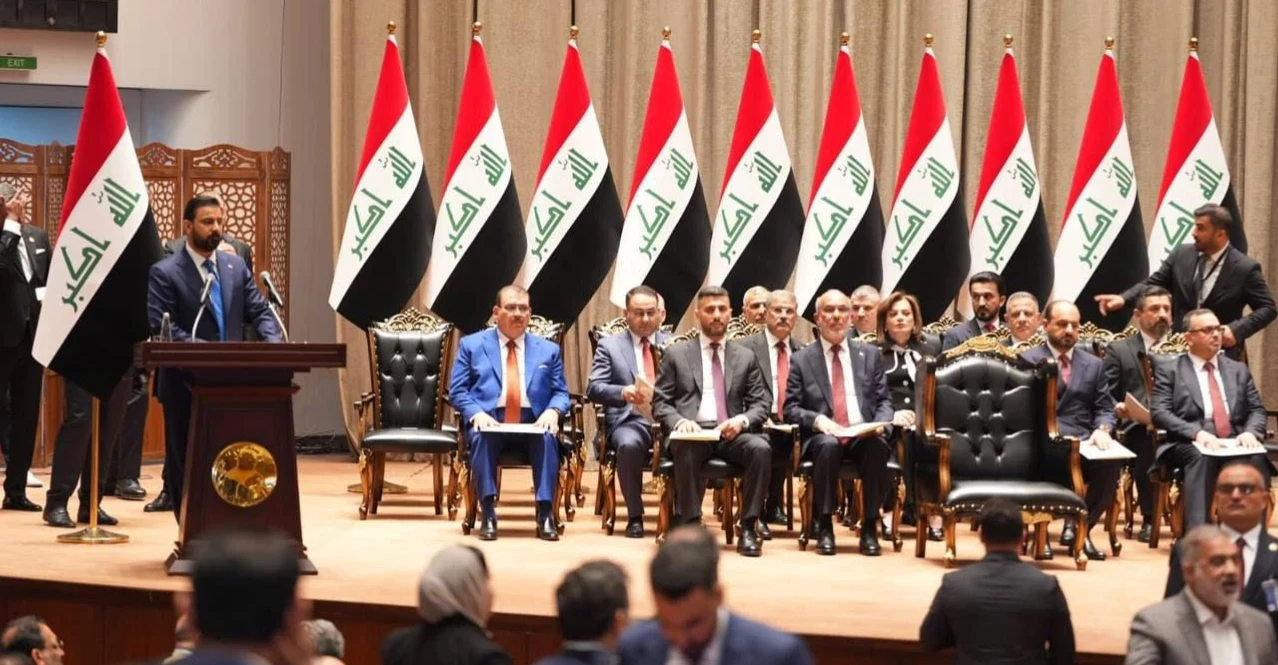
 LATEST MNT GOAT NEWSLETTER
Leave a comment