

Disclaimer: All information in this newsletter is not intended for investment decisions / purposes. Mnt Goat is not a financial analyst, planner, banker, attorney or associated in any role with giving out professional investment advice.
ABOUT THE NEWSLETTER:

September 22, 2026 Mnt Goat News Brief
Guten Tag everyone:
More news today about disarming the Iranian-backed Factions operating inside Iraq. In fact, this is again just about all the news there is and is a major concern now inside Iraq. This new plan comes with a new extended timetable and comes with a complication of other issues associated with it. One of which may be our timetable for removing the zeros and the later reinstatement. How will President Trump react to this new plan (extended plan way beyond Sept 30th) to disarm the terrorist factions inside Iraq? What will happen to the overall security of Iraq once the US completes it’s part of the agreement to pull out by Sept 30th yet leaving the Factions inside Iraq for nine more months? Will this new plan backfire on Iran as the US might decide to just delay its pullout too? So many questions and we hope to answer many of them in today’s ‘Latest Mnt Goat Newsletter’.
GIVE A GIFT TO MNT GOAT
I decided to allow everyone to give a Free-will GIFT to Mnt Goat on PayPal if you so desire. Here is the link below. Please show your appreciation for all the hard work I do.

I recommend $15-$20 dollars a month or whatever you can afford. Do you realize I write up to eight (8) Newsletters every month. This is like a second job to me. The only way I know that people are reading and appreciating all the FACTUAL news I bring is through their appreciation. If I do not receive equal appreciation for all the hard work I do, I will simply end the Newsletter and save myself endless hours at the computer. You do want to get paid for your job, don’t you? What makes my job any different? Tell me….. I am tired of this RV saga just as you are.
Let’s all try to chip in!

___________________________________________
1 John 3:17
Warns that if someone has resources but ignores another’s need, God’s love cannot dwell in them.
STATUS OF THE RV
The news this week is a lot like last week just more detailed since we have more details shared by Iraq. It is mostly about the resistance of the Iranian factions inside Iraq that are resisting the disarmament process and want to delay it. What will Trump do? So, here we are again dealing with this ongoing saga of disarmament.
I know this saga may seem boring and the tendency may be to ignore the news today. If you did you would be doing yourself an injustice since it is chock-full of details on how this may all play out. You do want your RV by January 2027, don’t you?
Why do we have so many ‘ongoing sagas’ when it comes to Iraq?
UPDATE: On disarming the militias/factions:

Speaking about being a SECURE and SOVERIEGN Iraq, what about the Iranian militias and factions?
Today’s news is all about extending the Sept 30th deadline to disarm the Iranian-backed militia and factions inside Iraq.
There are only eight (8) more days until the deadline of the end of the month is here. Will the Iranian backed Factions in Iraq be disarmed, as agreed to by Al-Zaidi last July in his visit to Washington with president Trump? According to the recent news Al-Zaidi was expected to revisit Washington this week, on his trip also to the UN.
I just want everyone to remember that this issue of the Popular Mobilization Forces (PMF) which is the Iranian-backed militia and factions is still on the radar of the US and must be settled prior to any reinstatement. In order to reinstate we need to see the removal of the zeros. The removing of the zeros takes time and so time is running out if we are going to see any movement in early January 2027 of the IQD.
_______________________________________
Al-Zaidi is to speak at the United Nations in NYC this week. What will he say? Let’s take a peek at the article titled “AL-ZAIDI RETURNS TO AMERICA NEXT WEEK… A SPEECH IN NEW YORK AND A MEETING WITH TRUMP”.
“Government spokesman Haider al-Aboudi said on Thursday (September 17, 2026) that Prime Minister Ali al-Zaidi will go to the United States next week, explaining that al-Zaidi will deliver a speech before the United Nations General Assembly in New York, and will meet with US President Donald Trump and a number of heads of state.”
I could be wrong, but I don’t believe so, when I say that President Trump wants all the Iranian influence out of Iraq, not some law to restrict them or even pay them retirement pensions and salaries. How stupid is that?
We have read many very recent articles about the sanctions being imposed and these were strict demands from Washington without any compromises.
________________________________
The titled to this recent article is “ANALYSIS: TRUMP WILL NOT MEET WITH A PRIME MINISTER WHO BROKE HIS PROMISE… AND BAGHDAD IS OFF THE NEW YORK AGENDA”
The title is tricky to read since it does not mean the meeting with president Trump has been cancelled, as of yet, although it could not go well. See the next article below. What it is saying is that even thought they do have a meeting will it be productive to resolve the issue of the factions? Can Al-Zaidi be allowed to delay this action any longer? Everyone should go read the entire article to really understand fully.
“The surprise that Prime Minister Ali al-Zaidi may bring to New York, in a possible meeting this week with Donald Trump, could be more than just a fleeting encounter.
“The apparent setback in the dismantling of armed factions in recent weeks may not mean the plan is over. It could simply be a political maneuver before the government’s September 30th deadline.”
“In Baghdad, sources close to the matter speak of the possibility of a more confrontational plan resurfacing. This plan might include arrests of those who refuse to surrender their weapons, while the government denies that there is a final deadline for negotiations.”
“The surprise may emerge in New York. The Iraqi government has stated that Prime Minister Ali al-Zaidi will meet with US President Donald Trump on the sidelines of the UN General Assembly meetings this week.”
________________________________
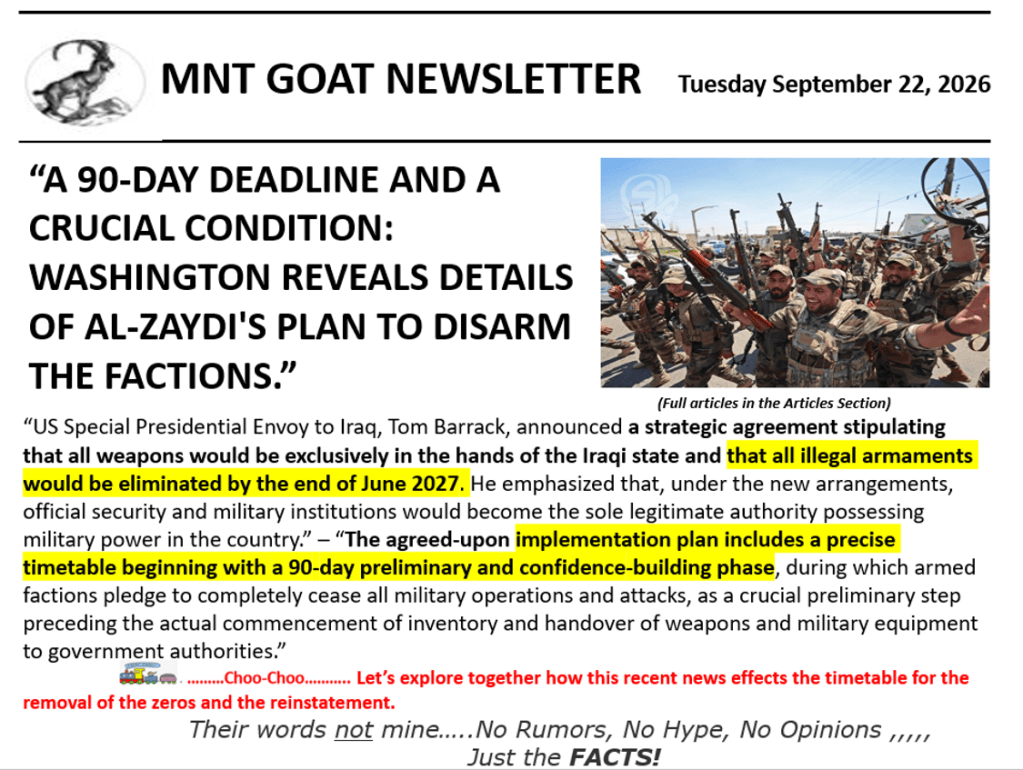
See most recent article titled “AL-ZAYDI: THE WEAPONS CONTROL PROCESS BEGINS WITH A 90-DAY DEADLINE AND ENDS IN JUNE 2027.”
“Iraqi Prime Minister Ali al-Zaidi pledged on Monday to disarm armed factions in Iraq by June 2027, stressing that the factions have 90 days after which they will be outlawed.”
“Al-Zaydi told the New York Times that the disarmament plan would be implemented in stages, explaining that this step would be a key focus in Iraq’s management of its relations with its two main allies, the United States and Iran, in light of the ongoing war between them.”
“He added that “the disarmament plan is not optional, but a necessity.”
“An Iraqi official revealed on Monday (September 21, 2026) a government plan to disarm the factions that extends until the middle of next year. Al Jazeera quoted the official’s statements, which were followed by Network 964 , that “the Iraqi government has a plan to disarm the factions that extends until the middle of next year.”
He added: “It is likely that Iraqi Prime Minister Ali al-Zaidi will inform US President Donald Trump of this plan during their meeting in New York.”
________________________________
Take a peek at the recent article titled “AFTER “COMPREHENSIVE AMENDMENTS,” PARLIAMENT AWAITS THE GOVERNMENT’S SUBMISSION OF THE POPULAR MOBILIZATION FORCES (PMF) LAW.”
“Iskandar Watout, a member of the parliamentary Security and Defense Committee, confirmed on Thursday that the amended Popular Mobilization Forces Law will reach parliament soon for the purpose of passing it, after amendments are made to it.”
Shafaq News Agency that “the committee is waiting for the law to arrive, in order to include it on the parliament’s agenda.”
I have not seen the contents of this proposed draft law for the PMF but if it the same law from years ago it is disastrous and legalizes the PMF paying them salaries and retirement. This law was just the opposite of what Washington wants. If you recall there were objections to the draft law about the PMF by Washington at that time. Trump wants disarming not embellishments or support.
He does not want them ‘protecting’ Iraq any longer since they are terrorist organizations and vow to destroy the U.S. and its way of life. They have openly made their convictions clear. These factions inside Iraq have already demonstrated many times their willingness to launch rockets at Iraqi bases which contain US forces. In the midst of what is happening in Iran their presence should not be welcome in Iraq. Will it be up to the Iraqi people to throw them out? The real problem stems from the question of whether the Iraqi forces are even strong enough in both willpower and physical strength to do it themselves.
How can president Trump then get large scale investors into Iraq to grow the economy and maybe someday even get off the petro-dollar. There are vast resources to yet exploit in Iraq and it only needs investment money to do it. It just does not make any common sense to allow Iranian influences in Iraq. Also, I need to remind everyone that the US forces inside Iraq would not be pulling out if not for some brilliant trap Trump is most likely setting for Iraq and the factions. Did he really believe Al-Zaidi could make good on his promise to disarm them all?
Yes, I too don’t get why the US would agree to pull out all US forces by Sept 30th, yet leave the Iranian-backed factions intact. I only have to surmise that there is a trap set of some kind in place ready to spring upon them given Sept 30th timeframe. I am not giving an ‘opinion’ just warning everyone of what may happen if these factions are not disarmed soon.
Here is a follow up news in article titled “BEFORE SENDING IT TO PARLIAMENT, AL-ZAYDI DRAFTED THE “POPULAR MOBILIZATION FORCES LAW” IMMEDIATELY UPON HIS RETURN FROM NEW YORK.” This article is telling us that Al-Zaidi had to let the U.S. first review the draft law while in Washington before he could pass it on to parliament. As we all should know the U.S. disapproved the last version of the law because it was not disarming the militias and factions but supporting them financially and giving them legality.
“An informed source reported on Tuesday that Prime Minister Ali al-Zubaidi will submit the draft Popular Mobilization Forces Law, whose clauses have been amended according to the observations of parliamentary and political forces, to the House of Representatives as soon as he returns from the United States.“
“The source told Shafaq News Agency that the paragraph regarding amending the “legal age of the head of the Popular Mobilization Forces” needs to be amended or reformulated, as it indicates that the extension, renewal, and referral to retirement of the head of the Popular Mobilization Forces will be in the hands of the Commander-in-Chief of the Armed Forces.“
______________________________________
Why won’t Iran just pull the armed groups out of Iraq?
“IRAQ IS IRAN’S LAST ROUTE FOR SMUGGLED DOLLARS, IRAQI MP SAYS”
Iraq has become Iran’s only remaining route for obtaining smuggled US dollars following intensified American economic pressure on Tehran, an Iraqi lawmaker told Iran International.
The United States is cutting off Iran’s access to the global financial system, State Department spokesperson Tommy Pigott said earlier this month, through its Operation Economic Outcast which has already led to sanctions against banks in Turkey, the UAE and Russia.
The Iraqi lawmaker warned that Iraq could face sweeping US sanctions, potentially extending to its oil sector, if Baghdad failed to bring armed groups outside state control under government authority.
The warnings come ahead of the planned September 30 withdrawal of international coalition forces from Iraq, with efforts to disarm Iran-aligned forces yet to produce an agreement.
______________________________________
So, who will then protect Iraq after the US pulls out?
We get a glimpse of ideas as to how protection and security will be handled by Iraq in the following article titled “KURDISTAN PRESIDENCY: BAGHDAD IS RESPONSIBLE FOR PROTECTING OIL FACILITIES AFTER SEPTEMBER 30”
“On Monday, the spokesperson for the Kurdistan Region Presidency, Dilshad Shahab, confirmed that the federal government will bear a great responsibility for defending Iraq, including the Kurdistan Region, after September 30, particularly in the airspace, noting that protecting the region’s oil facilities is part of this responsibility.
Remember that in December 2012 after Obama pulled all US troops out of Iraq that the Federal Government failed to defend Iraq later in 2014 when ISIS invaded, thus the Iranian Kud forces came into to help. Are we about to repeat this same senario again under Trump? Will we ever learn our lessons with these Arabs?
Shahab said in a press conference, attended by a correspondent from Shafaq News Agency, that the protection of oil facilities by air in the Kurdistan Region comes in accordance with the agreement between the regional government and the federal government, noting that a major part of Iraq’s revenues comes from the region.
He explained that the threats to oil facilities in the region have had a significant and negative impact on the Iraqi economy, stressing that the issue is not only related to the Kurdistan Region, but to the Iraqi economy as a whole.
______________________________________
What will happen on Sept 30th should the Iranian factions still occupy Iraq? Will the US carry out its claims of cutting off ‘all’ dollars to Iraq? Let’s take a peek at the recent article titled “THE DOLLAR FUELS POST-SEPTEMBER 30TH FEARS… SPECULATION AND POTENTIAL SANCTIONS PUT PRESSURE ON THE IRAQI DINAR.”
“The Iraqi exchange market has entered a new phase of tension as the end of September approaches, after the selling price of the dollar in some Baghdad markets exceeded the 160,000 dinar mark for every 100 dollars on Saturday, September 19, 2026, in a movement that reflects the widening gap between the official price and the parallel market, and the rising demand for the US currency amid a state of economic and political uncertainty.”
“The rise comes in conjunction with the monitoring by the “Eco Iraq” Observatory of an acceleration in the prices of the dollar, attributing this to a set of overlapping factors that cannot be reduced to one reason, foremost among them speculation and the high demand for the dollar, in addition to fears related to what may happen after September 30 and the increasing talk about the possibility of imposing American sanctions or taking new financial measures.”
________________________________
Here is yet another article on this same subject matter. It is titled “WHO IS DRAINING DOLLARS FROM THE MARKET? UNVEILING THE GAP PRESSURING THE DINAR”
“The rise in the dollar exchange rate against the Iraqi dinar has once again taken center stage in economic and public discourse. This follows a widening gap between the official rate set by the Central Bank of Iraq and the rates circulating outside official channels, raising questions about the factors driving the market upward despite the continued inflow of foreign currency and the Central Bank’s capacity to meet legitimate demand.”
“An analysis of market dynamics suggests that this rise is not attributable to a single cause but rather to a complex interplay of variables. These range from commercial demand for dollars and import financing to hoarding, speculation, banking compliance requirements, customs procedures, and political and regional tensions.”
“The Central Bank of Iraq sets the official dollar rate at 1,310 dinars, whereas the rate outside official channels fluctuates based on different dynamics—specifically, the demand for physical cash dollars, merchants’ access to banking transfers, and the behavior of savers and speculators.”
Just wait until the US dollar sanctions kick in (if they do), post Sept30th should Iraq not meet Washington’s deadline. When the U.S. misses the first shipment of dollars to Iraq things will change quickly in their attitudes towards these Iranian factions. Then again, president Trump may allow a justified delay.
_____________________________________
UPDATE: Oil and Gas Law
“A MEMBER OF PARLIAMENT DEMANDS THE GOVERNMENT SEND THE LAWS ON THE POPULAR MOBILIZATION FORCES, OIL AND GAS, AND THE SALARY SCALE TO PARLIAMENT: “DELAY IS UNACCEPTABLE.”
The head of the National Statement Alliance and member of Parliament, Abdul Amir al-Mayahi, affirmed the existence of several priority laws that cannot be postponed within Parliament, urging the government to expedite their submission for enactment.
Al-Mayahi stated that “the Popular Mobilization Forces Law is a very important law, and the government must submit it,” noting that the Oil and Gas Law is also among the important laws awaiting Parliament.
He added, “There was a request from the government in the previous session to submit the Oil and Gas Law, but it was not submitted,” emphasizing the necessity of moving forward with this matter.”
_______________________________________________
SUMMARY:
Appears today’s news is all about the disarmament of the Iranian-backed factions stationed inside Iraq. It is hard to believe that this is just about the only news coming from Iraq right now.
There are two interesting articles that summarizes nicely what is going on and what we might expect with Al-Zaidi’s visit this week to Washington.
One is titled:
“A 90-DAY DEADLINE AND A CRUCIAL CONDITION: WASHINGTON REVEALS DETAILS OF AL-ZAYDI’S PLAN TO DISARM THE FACTIONS”.
then go and please read this entire other article titled:
“ANALYSIS: TRUMP WILL NOT MEET WITH A PRIME MINISTER WHO BROKE HIS PROMISE… AND BAGHDAD IS OFF THE NEW YORK AGENDA”.
Connect the dots as to how Washington will take this recent news and what might happen next……..
What will come out of Al-Zaidi’s visit with president Trump? Will Trump ignore this new plan and place sanctions on Iraq since they had already since July to disarm and did not disarm the factions? However, most, if not all, of the militias did disarm already and that shows most of the progress made so far. They are now also waiting for the draft bill to go before parliament for governing the PMF after disarmament. What is in this law?
Here is a bit of a ‘taste’ of what is in this draft law for handling the PMF after disarmament:
According to the informed source, “The Prime Minister’s approach is not based on dissolving the Popular Mobilization Forces or altering their legal status, but rather on ending dual military affiliation, so that a fighter is no longer part of an official institution while simultaneously being linked to a separate military structure, command, and decision-making process.”
Personally, I don’t believe Al-Zaidi has enough of highly trained security forces to confront and overcome these Iranian radical terrorists factions inside Iraq if he wanted to dissolve them. He already confronted them and they refused. Prior prime ministers have allowed these factions to get too deep seeded and comfortable in Iraq. This shows a week spot in Al-Zaidi’s leadership. He could have gone to the U.S. for help, if needed.
The source explained that “the proposed approach involves dealing with members of factions who wish to continue their security work individually and integrating those who meet the criteria into official institutions, while simultaneously dismantling independent armed groups and command structures operating outside the state’s military hierarchy.”
Heavy weapons will be prioritized, according to a source familiar with the matter who spoke to Iraq Observer. The source explained that “priority in the handover process will be given to weapons that represent a military capability that should not exist outside state control, primarily missiles, drones, launch systems, and heavy weapons. The remaining types will be subject to inventory and handover mechanisms determined by the relevant security authorities.”
The source added that “the government does not want a showy handover of limited quantities of weapons, but rather a verifiable mechanism that ensures knowledge of what the formations included in the plan possess, what has actually been handed over, where it will be stored, and the official entity that will be responsible for its control.”
__________________________________
As investors, in the Iraqi dinar, let’s all stay focused and positive that a sound resolution will occur on this subject matter before the Sept 30th. I think that we can agree that both sides do not want more bloodshed in Iraq.
However, will this extension of the disarmament process delay the removing of the zeros followed by the reinstatement of the dinar? Iraq wants a 90 day extension (Oct-Dec) to begin the process of disarmament, then complete it by June 2027. Is this just a delay tactic for Iran for some notorious reason or do they really need this much time to complete the process? We know they are always playing games with their strategic delays, yes, delay, delay!
This should be our major concern at this point this is why I believe it is now in the news so much from Iraq. Yes, it is URGENT. So, here we have the CBI and the Finance Committee working on one time table and then this happens. Do they adjust their timetable? Do they need to, since the first 90 days brings us to January 2027. But they are telling us in an article the job of disarmament wouldn’t be completed until mid-year 2027. Are they hoping for democrat majority wins in both houses for the midterm elections in the US to stop president Trumps efforts to disarm them? Is this what they are up to? Seems a week side of Al-Zaidi to go along with the Maliki plan, but politics are involved.
Can the CBI and Finance Committee adjust their process since January is the beginning of the fiscal year (the best time to RV according to the CBI) and the effort was to get the budget completed based on having a reinstatement going forward along with it. Could this delay in the disarmament put a proverbial ‘monkey wrench’ in the mix?
All we can do not as investors is watch and see what happens. We need to watch for president Trump’s reaction to the new plan for disarmament. We need to watch what happens in the U.S. mid-term elections. As many say let’s sit back and watch the show.
Oh…. but our prayers do work we witnessed it over these last couple months. This monkey wrench is yet just another dig by the dark side to stop or slow down the outcome of our prayers. Remember God has spoken to many prophets about this coming period of great prosperity and wealth. Included in these prophetic words was specific mention of the Iraqi dinar and so God wants this event (RV) to happen as part of all this transfer of wealth.
______________________________________________
There are many politicians who see the full benefit of getting the Oil and Gas law passed. They are putting pressure on the rest. However, there are also many crooked politicians who still don’t want to end the gorging on the dollars or stealing of the oil since passing the law will make a lot of the corruption in dealing with the oil illegal and will pass on the spoils from the oil revenues to benefit more the citizens of Iraq than those crooked politicians.
I hope everyone of my readers today appreciates the time I took to research, translate the articles and compose this Newsletter today. I am not going to paint a rosy picture for you as you need to know the TRUTH. Gosh, doesn’t anyone have enough common sense to see what is actuall taking place in Iraq? Are we all stupid or what?
It is a lot of work and time consuming to report to my readers. But I do it all for my readers so you can understand the TRUTH of what is going on in this RV saga. Also I want to mention that many of these internet intel gurus out there have been at it again telling you the RV is going to happen on the 30th of September or shortly afterwards. I will summarize their intel in two words – ‘total bullshit’. They claim this because they read some news about Iraqi ‘full sovereignty’ on September 30th when the disarmament of the militias and factions were to be completed. There will be no ‘full sovereignty’ Get it?
I mean to bust their bubble in telling them that the ‘full sovereignty’ of Iraq is a joke. They are not going to get it until they learn to behave like a responsible international entity. Their banks are a disgrace and still need major reforms to meet international guidelines. So far, with all the corruption and then the Iranian influence interfering in their affairs, is not what I call ‘responsible’ by any definition of the word. They can’t be a proxy state for Iran and then call themselves a sovereign nation. It is a contradiction. Get it? Why do they blame the U.S. then for all their problems when we can clearly see they come from Iran.
Yes, Iraq wants the release from the petro-dollar funds, part of the sanctions placed in 1991. Is this so they can have access to these funds and steal them too? But this is the only leverage the US Treasury has on Iraq now to make them behave. The proposed new sanctions to get the factions disarmed is just an example of this leverage. Simply put the U.S. did not fight two Iraqi wars to let Iraqi’s wealth get squandered and go to the corrupt bastards taking advantage of the democratic-like government the US helped set up for them to free the citizens, not giving the wealth to some bastards in control.
What do you think will happen next? (Leave a comment)
______________________________

________________________________________
Their words not mine…..No Rumors, No Hype, No Opinions ,,,,,
Just the FACTS!

These prophecies are an important tool we have to lead us on our path. They are more important now than ever. They give us the strength, perseverance and hope that a better time is coming and that God’s Hand is at work behind the scenes. If you just take a second even to look around you at these past three election cycles, how can you deny that God is at work? Are you sleeping or what?
It is amazing and there is no other way that these events could have happened the way they turned out. But there is more to come, much, much more, I assure you! Now that God has his biblical David re-elected, we need to pay attention to what He does next.
NOTE: These prophecies tell us also of things happening in the background that either the main stream news media does not know about or the crooked news media refuses to talk about. They do this to keep us in the dark to continue the Trump hating senario and for us to keep thinking that nothing is changing, thus Trump is not successful. But it is just the opposite happening.
Prophetic Words from the prophets: Julie Green
“Something Is Coming That Will Bring Down Every Stolen Election“
Go to the 10:49 mark on the video. Given on Sept 15th.

“A Total Govt Reset Is Taking Place“
Go to the 11:35 mark on the video. Given on Sept 13th.

“Treason Is Being Dealt With Now“
Go to the 10:13 mark on the video.

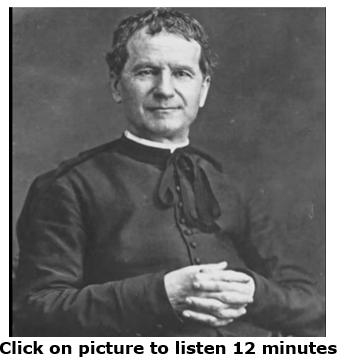
Fr. DON BOSCO EXPOSED THE DARK SECRET BEHIND ISLAM
I keep this one out here to view. Everyone should take the time to watch it. It will awaken you about the Muslim so-called religion (or should we call it for it is — a ‘cult‘.)
— And the truth the world forgot about the so-called Muslim religion.
Fr.Don Bosco, also known as John Bosco, was an Italian Catholic priest and educator, born on August 16, 1815. He founded the Salesian Society in 1859 to help disadvantaged youth, particularly boys, through education and community service. His teachings emphasized lovekindness, and the importance of education for young people, making him a beloved figure in Catholicism and a patron saint of youth. Don Bosco was canonized in 1934.
TRUMP BANS 3 MAJOR NEWS OUTLETS FROM WHITE HOUSE
Why did Trump do this? Is this a violation of freedom of the press? Is he hiding something from us?
This action is an action taken by the president since these three news channels have been disruptive in these news briefings. They keep asking the same questions over and over again with a different spin until they hope to get the answer they want, which is to bash the Trump administration somehow. They use this tactic since they know the cameras are rolling. Also we must remember that they are invited into the Whitehouse. This room is inside the Whitehouse and they are the guest of the president since this is a house given to him to live while president by the people of the U.S. There is no precedence that gives the news media a free rein over the Whitehouse.
How would you like it if someone came into your house invited, then pissed all over it disrespectfully? This goes way beyond freedom of the press since with this freedom also comes responsibility for what you say and print. You must be able to back it up with proof not rumors and hype.

WILL THE U.S. INVADE IRAN WITH BOOTS ON THE GROUND?
420,000 Iranian soldiers on high alert as Trump decides next move! Iran prepares for ground invasion. Iran would luv a blood bath especially during election year. I don’t believe Trump is going to fall for this. He has other plans for Iran and his plan is to neutralize the current regime and let the people decide what comes next. I don’t believe a ground invasion was ever in his plans.

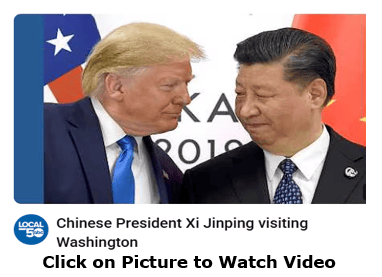
CHINESE PRESIDENT XI JINPING VISITING WASHINGTON
When we hear of sudden announcements as this one, we must ask ourselves why.
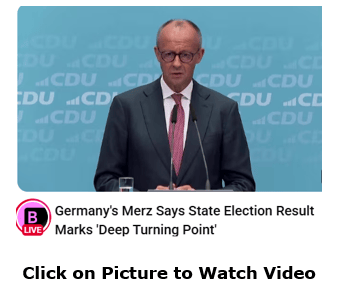
A PROFOUND CHANGE IN THE POLITICAL PARTY SYSTEM IN GERMANY AS WELL AS OTHER PARTS OF THE WORLD
Chancellor Friedrich Merz speaks at a news conference about the election in the Baltic coast state of Mecklenburg-Western Pomerania, which resulted in his Christian Democratic Union party crashing out of a regional parliament for the first time in the country’s post-World War II history.
I’d have to say that this is prophecies being fulfilled if you ask me…… Remember what God told us years ago, He would transform the planet starting in the US and then it would branch out to other countries. This movement is a break away from the globalist world domination attitude of one government with overriding control and servitude back to Nationalism, Judeo-Christian freedom, liberty and abundance for all. It has started!
Anyhow….their words not mine. I am just the reporter….. 🙂
CARNEY’S EU PLAN BLOWING UP IN HIS FACE!
This is a perfect example of a patsy not a leader. How do we pick our leaders to lead our nations. Is it on personality or background record of ability?
TOTAL REVOLT! IRAN REGIME IN PANIC!
Iran’s Kurds Plan Complete Shutdown
NATIONWIDE UPRISING IN IRAN! ISLAMIC REGIME & IRGC PANIC AS IRANIANS PLAN COMPLETE SHUTDOWN
THE LARGEST SINGLE OIL RESERVE EVER DISCOVERED IN THE UNITED STATES


AFTER “COMPREHENSIVE AMENDMENTS,” PARLIAMENT AWAITS THE GOVERNMENT’S SUBMISSION OF THE POPULAR MOBILIZATION FORCES (PMF) LAW.
(Mnt Goat: we have yet to see what this law now contains. Is this acceptable to Washington or are we going to have another saga over this law too. if you remember Washington did not like the first version and prohibited it since it was too radical and supporting the Iranian influence and proxy.)
Iskandar Watout, a member of the parliamentary Security and Defense Committee, confirmed on Thursday that the amended Popular Mobilization Forces Law will reach parliament soon for the purpose of passing it, after amendments are made to it.
Shafaq News Agency that “the committee is waiting for the law to arrive, in order to include it on the parliament’s agenda.”
He added: “During the committee’s meeting with Prime Minister Ali al-Zaidi last month, I asked him to send the Popular Mobilization Forces Law to the House of Representatives for review and referral for reading and voting, and al-Zaidi promised that it would arrive soon.”
Regarding the amendments, he pointed out that the amendments made by the committee included the entire law, and therefore a draft law was produced similar to that of the Ministry of Defense because it deals with an integrated security institution.
Regarding the position of head of the Popular Mobilization Forces, and its equivalence to that of an undersecretary or minister, he indicated that “we did not address this matter in the law.”
In addition, an informed source revealed that there is a political consensus to change the title of the head of the Popular Mobilization Forces to something equivalent to a ministerial position without a ministry, while the official name of the Popular Mobilization Forces remains unchanged.
The source confirmed to Shafaq News Agency that changing the title of the head of the commission requires political consensus.
Informed sources revealed that the draft laws on the structure of the Popular Mobilization Forces and on service and retirement will soon be referred to the Iraqi Parliament, after the removal of a number of controversial clauses that were subject to an American veto.
According to the source, there is an American veto on some clauses of the Popular Mobilization Forces laws, and therefore the two drafts will be referred in their final form to the House of Representatives, in preparation for starting the procedures for legislating them according to the approved official contexts.
The US Treasury Department had placed “Al-Muhandis Company” on the sanctions list in October 2025, on the grounds that it was linked to financing armed factions and facilitating economic activities related to the Iranian Revolutionary Guard, which was met at the time with rejection and regret from the Iraqi government.
With regard to the military educational institutions affiliated with the Popular Mobilization Forces, legal or administrative objections related to the terms and conditions of nomination and acceptance, including institutions concerned with qualifying Popular Mobilization officers or admission channels to the Joint Staff College, are subject to official administrative and legal references within the organization.
Iraqi Prime Minister Ali al-Zubaidi recently stressed the need for a revolution in laws, including the Popular Mobilization Forces Law, emphasizing the importance of developing the legislative system in line with the requirements of the next stage.
*******************************************************************************************
BEFORE SENDING IT TO PARLIAMENT, AL-ZAYDI DRAFTED THE “POPULAR MOBILIZATION FORCES LAW” IMMEDIATELY UPON HIS RETURN FROM NEW YORK.
An informed source reported on Tuesday that Prime Minister Ali al-Zubaidi will submit the draft Popular Mobilization Forces Law, whose clauses have been amended according to the observations of parliamentary and political forces, to the House of Representatives as soon as he returns from the United States.
The source told Shafaq News Agency that the paragraph regarding amending the “legal age of the head of the Popular Mobilization Forces” needs to be amended or reformulated, as it indicates that the extension, renewal, and referral to retirement of the head of the Popular Mobilization Forces will be in the hands of the Commander-in-Chief of the Armed Forces.
According to the information provided by the source, the aforementioned paragraph will be amended to grant the Prime Minister the authority to extend the term of the head of the authority for a limited period, not exceeding two years, and without renewal.
Last week, Iskandar Watout, a member of the parliamentary Security and Defense Committee, confirmed that the amended Popular Mobilization Forces Law would soon reach parliament for passage, after amendments were made to it.
There is near-political consensus to change the title of the head of the Popular Mobilization Forces to something equivalent to a ministerial position without a ministry, while the official name of the Popular Mobilization Forces remains unchanged.
Informed sources revealed that the draft laws on the structure of the Popular Mobilization Forces and on service and retirement will soon be referred to the Iraqi Parliament, after the removal of a number of controversial clauses that were subject to an American veto.
However, there is an American veto on some clauses of the Popular Mobilization Forces laws, and therefore the two drafts will be referred in their final form to the House of Representatives, in preparation for starting the procedures for legislating them according to the approved official contexts.
The US Treasury Department had placed “Al-Muhandis Company” on the sanctions list in October 2025, on the grounds that it was linked to financing armed factions and facilitating economic activities related to the Iranian Revolutionary Guard, which was met at the time with rejection and regret from the Iraqi government.
With regard to the military educational institutions affiliated with the Popular Mobilization Forces, legal or administrative objections related to the terms and conditions of nomination and acceptance, including institutions concerned with qualifying Popular Mobilization officers or admission channels to the Joint Staff College, are subject to official administrative and legal references within the organization.
********************************************************************************************
AL-ZAIDI RETURNS TO AMERICA NEXT WEEK… A SPEECH IN NEW YORK AND A MEETING WITH TRUMP
(Mnt Goat: will Trump cancel the meeting with Al-Zaidi due to the Factions that are not yet disarmed. Says Al-Zaidi reneged on a promise.)
Government spokesman Haider al-Aboudi said on Thursday (September 17, 2026) that Prime Minister Ali al-Zaidi will go to the United States next week, explaining that al-Zaidi will deliver a speech before the United Nations General Assembly in New York, and will meet with US President Donald Trump and a number of heads of state.
Government spokesman Haider al-Aboudi stated in an interview with journalist Sadiq al-Shammari, which was followed by 964 Network : “Prime Minister Ali al-Zaidi is preparing to head to America in the middle of the week to participate in the United Nations General Assembly as a representative of the Republic of Iraq. He will deliver the speech of the Iraqi people before the world, which carries the message of a state that has dealt with complex issues and opened up with confidence to the world, and conveyed a message that the Iraqi state will not be part of the axes of conflict and will not align itself unilaterally with anyone.”
Al-Aboudi added that “the government has maintained the balance stipulated in its program, which does not allow aggression against neighboring countries, and the Prime Minister will review the measures taken by the government in this matter, as well as matters related to the economic relations that link Iraq with the world.”
Al-Aboudi continued, “The visit schedule that has been prepared includes many meetings with the heads of Arab and foreign states, and there will also be a meeting with His Excellency President Donald Trump to review the features and prospects of the relationship between Baghdad and Washington, which began in mid-July when it was translated into 48 memoranda of understanding and agreements between the two countries in the fields of energy and investment.”
Al-Aboudi concluded, “The Prime Minister will also meet with the American Chamber of Commerce to review the files and sustain the economic relationship between the two sides.”
*******************************************************************************************
WHO IS DRAINING DOLLARS FROM THE MARKET? UNVEILING THE GAP PRESSURING THE DINAR
The rise in the dollar exchange rate against the Iraqi dinar has once again taken center stage in economic and public discourse. This follows a widening gap between the official rate set by the Central Bank of Iraq and the rates circulating outside official channels, raising questions about the factors driving the market upward despite the continued inflow of foreign currency and the Central Bank’s capacity to meet legitimate demand.
An analysis of market dynamics suggests that this rise is not attributable to a single cause but rather to a complex interplay of variables. These range from commercial demand for dollars and import financing to hoarding, speculation, banking compliance requirements, customs procedures, and political and regional tensions.
The Central Bank of Iraq sets the official dollar rate at 1,310 dinars, whereas the rate outside official channels fluctuates based on different dynamics—specifically, the demand for physical cash dollars, merchants’ access to banking transfers, and the behavior of savers and speculators.
A widening gap between the two rates does not necessarily indicate a shortage in Iraq’s foreign currency reserves; according to experts, the issue stems from a portion of demand that remains outside the banking system or fails to meet the requirements for external transfers.
Shifts in the Dollar Market
Part of the gap between the official exchange rate and the market trading rate stems from shifts in foreign trade financing mechanisms in recent years. These changes involve stricter requirements for auditing transfers, verifying ultimate beneficiaries, and adhering to anti-money laundering and counter-terrorism financing standards.
As stricter requirements were applied to outward transfers, certain trade transactions failing to meet documentation and compliance criteria struggled to access US dollars through the banking system. This drove a portion of the demand toward alternative channels at higher rates.
Simultaneously, restrictions were imposed on the US dollar operations of several Iraqi banks, coinciding with the Central Bank’s implementation of a banking sector reform program aimed at enhancing compliance and governance standards and expanding relationships with international banks.
The restrictions placed on certain banks do not mean a cessation of all banking activities; rather, they limit the banks’ ability to conduct dollar-based transactions, depending on the specific nature of the restrictions and regulatory requirements imposed upon them. Concurrently, the trade and customs sector has undergone significant changes, marked by the expanded implementation of the ASYCUDA system and stricter scrutiny of import invoices and commercial documents—measures aimed at regulating the flow of goods and revenue while curbing invoice manipulation.
While these measures seek to channel the bulk of foreign trade through the banking system and enhance transparency, the fact that a portion of commercial demand remains outside these channels renders the market highly sensitive to any surge in demand or shift in expectations.
**Traders Withdrawing Dollars from the Market**
Financial expert Dr. Majid Khalid Al-Darraji identifies commercial demand as a primary factor exerting pressure on the exchange rate, particularly when traders and importers resort to purchasing cash dollars to finance transactions that cannot easily be processed through banking channels.
Speaking to *Al-Ahed News*, Al-Darraji explains that a trader needing to settle payment for a shipment on short notice—and unable to secure an external transfer at the official rate due to missing documentation or procedural delays—may turn to licensed exchange bureaus to acquire the currency.
When large numbers of traders seek dollars simultaneously, the demand for cash dollars rises while market supply dwindles, driving up the price even in the absence of changes to official reserve levels.
Al-Darraji notes that a portion of the dollars purchased by importers effectively exits the local circulation cycle to settle trade transactions outside Iraq; this differs from dollars used for speculation, which may return to the market once prices shift.
The impact of this factor intensifies during peak import seasons and religious or social occasions, driven by increased demand for foodstuffs, appliances, vehicles, construction materials, and various other goods.
And whenever [there is a failure]… As banking channels struggled to accommodate legitimate commercial demand with the required speed and efficiency, a portion of this demand found its way to the cash market, placing fresh pressure on the exchange rate.
**Citizen Hoarding: A Different Kind of Pressure**
Demand for the dollar does not stem solely from merchants; another factor is the tendency of some citizens and savers to purchase the US currency and keep it at home or in safes as a means of saving and hedging.
Dr. Faisal Al-Bayati, a professor at the College of Administration and Economics at Wasit University, tells *Al-Ahad News* that this behavior typically intensifies amid rising fears of dinar depreciation, or the spread of rumors regarding exchange rate changes or new restrictions on accessing foreign currency.
While individual purchases may seem limited, the cumulative effect of buying by large numbers of citizens and business owners can withdraw significant amounts of dollars from circulation.
The impact of this type of demand differs from daily speculation; hoarded dollars may remain out of the market for extended periods, thereby reducing available supply and making prices more sensitive to any new wave of demand.
Al-Bayati describes the phenomenon as a self-reinforcing cycle: a price increase stokes fears among some savers of further hikes, prompting them to buy dollars; this reduces available supply and intensifies pressure on the price.
Consequently, demand for the US currency is no longer tied solely to imports; instead, the dollar—alongside gold and other instruments—becomes a savings haven for those with financial surpluses during times of uncertainty.
Shifting the Demand Landscape
Separately, economist Nabil Al-Marsoumi links fluctuations in the exchange rate to the implementation of the ASYCUDA customs system and changes in customs tariffs and procedures.
Al-Marsoumi tells *Al-Ahad News* that stricter scrutiny of import invoices has helped curb inflated invoicing and the phenomenon known as “returned dollars”—a practice involving the acquisition of dollars at the official rate for imports with exaggerated values, followed by the resale of the surplus in the market.
According to Al-Marsoumi, the contraction of this artificial source of supply has contributed to a relative scarcity of dollars circulating outside official channels, coinciding with a shift of some trade activity toward alternative routes.
Al-Marsoumi also attributes part of the demand to the financing of imports passing through Kurdistan Region border crossings, noting the disparities in procedures and costs between different entry points.
This issue highlights the importance of unifying customs procedures; applying stricter regulations at one crossing while procedures differ at another can drive commercial activity toward the less costly route, thereby impacting trade financing methods and the demand for dollars.
Economist Safwan Ghazi concurs with aspects of this analysis, linking previous surges in the dollar’s value to the implementation of advance customs duties and the resulting shift—in his view—of a portion of demand outside the banking system.
Ghazi believes such pressure could prove temporary if imbalances are rectified and official channels succeed in absorbing genuine commercial demand.
Why does the rise in the dollar’s value quickly affect the average citizen? The impact of a rising exchange rate is not confined to currency markets or exchange bureaus; it gradually filters through to the prices of goods and services—particularly in an economy heavily reliant on imports.
Importers who acquire dollars at a higher rate pass the exchange rate differential on to the cost of the goods; this price increase then travels through the supply chain—spanning transport, distribution, and wholesale and retail sectors—until it reaches the consumer.
These repercussions are most evident in imported goods, including appliances, consumer products, certain foodstuffs, pharmaceuticals, and various other supplies.
Furthermore, the mere expectation that the dollar will continue to rise can prompt merchants to reprice their goods in anticipation of higher future import costs, meaning the exchange rate’s impact extends beyond the dollar’s actual movement to influence market expectations themselves.
How can this rise be contained?
Hashem Al-Zoubi, a finance and banking expert, argues that addressing the issue cannot rely on a single, isolated measure; rather, it requires a cohesive package of actions, starting with facilitating the financing of genuine trade through the banking sector. Al-Zoubi tells *Al-Ahed News* that enabling merchants who provide valid documents and invoices to secure foreign transfers quickly and at a transparent cost would shift a significant portion of demand from the cash market to the banking system, thereby easing pressure on the dollar circulating outside official channels.
He emphasizes that streamlining procedures does not mean abandoning anti-money laundering and financial compliance requirements; rather, it necessitates building a system that balances speed with oversight.
He also underscores the importance of standardizing procedures and customs tariffs, implementing the ASYCUDA system at all border crossings—including those in the Kurdistan Region—and electronically linking customs systems with the Central Bank, tax authorities, and commercial banks.
Al-Zoubi believes that disparities in import costs and procedures across different border crossings create distortions in commercial activity, which can, in turn, impact the demand for foreign currency.
**Restoring Confidence in the Dinar**
According to Al-Zoubi, addressing dollar hoarding is linked to the issue of confidence; it is difficult to persuade citizens to keep their savings in dinars without a reliable banking sector and savings instruments capable of attracting funds.
He calls for strengthening deposit protection, improving banking services, and offering dinar-denominated savings instruments—such as deposits, certificates of deposit, and government bonds aimed at individuals—alongside transparently publishing economic data and swiftly addressing rumors regarding the exchange rate.
He also stresses the importance of publishing periodic data on foreign transfers and import financing, enabling the market to distinguish between genuine commercial demand and demand driven by speculation or hoarding.
In the longer term, Al-Zoubi highlights the restructuring of the banking sector and the enhancement of its capacity… …establishing international correspondent banking relationships is considered a fundamental solution; an economy the size of Iraq’s cannot sustainably rely on the circulation of physical US dollars to finance a significant portion of its foreign trade.
Conversely, there are warnings that tightening market oversight or shutting down trading channels—without providing effective banking alternatives—could backfire by reducing available supply and driving up prices.
**It Is Not Just a Dollar Crisis**
Expert opinions gathered by *Al-Ahad News* reveal that exchange rate fluctuations in Iraq cannot be explained by a single indicator; focusing solely on speculators or traders fails to provide a complete picture of the situation.
Commercial demand draws dollars to finance imports, while hoarding removes another portion from circulation. Meanwhile, compliance requirements limit the ability of certain transactions to access dollars at the official rate, and customs disparities influence trade routes; furthermore, expectations, rumors, and political and regional tensions exert additional pressure on the market.
Although the motivations of traders and savers differ, the outcome is the same from the perspective of the currency market: a decline in the volume of dollars available for circulation relative to demand.
Moreover, the widening gap between the official rate and the rate in unofficial channels does not, in itself, indicate a shortage of Iraq’s foreign currency reserves. Rather, it reveals a disparity between the demand for dollars and the financial and banking system’s capacity to accommodate that demand within approved channels and regulations.
**What Does the Market Need?**
According to experts, solutions should focus on addressing the sources of demand rather than merely reacting to price hikes. This involves expanding trade finance…
*****************************************************************************************
A MEMBER OF PARLIAMENT DEMANDS THE GOVERNMENT SEND THE LAWS ON THE POPULAR MOBILIZATION FORCES, OIL AND GAS, AND THE SALARY SCALE TO PARLIAMENT: “DELAY IS UNACCEPTABLE.”
The head of the National Statement Alliance and member of Parliament, Abdul Amir al-Mayahi, affirmed the existence of several priority laws that cannot be postponed within Parliament, urging the government to expedite their submission for enactment.
Al-Mayahi stated that “the Popular Mobilization Forces Law is a very important law, and the government must submit it,” noting that the Oil and Gas Law is also among the important laws awaiting Parliament.
He added, “There was a request from the government in the previous session to submit the Oil and Gas Law, but it was not submitted,” emphasizing the necessity of moving forward with this matter.
Regarding the salary scale, al-Mayahi explained, “We are also waiting for the government to address the salary scale to ensure fairness for state employees and achieve equality,” indicating that this issue is of great importance given the continuous demands from employees and the Iraqi people for the adoption of a unified salary scale. He added, “There are numerous demands and voices from employees and the Iraqi people constantly calling for a salary scale,” urging the government to finalize the related procedures and submit it to Parliament. He noted that “the previous government started but did not complete it,” calling on the current government to “finalize the remaining aspects of the salary scale and send it to Parliament.”
Al-Mayahi reiterated the importance of the oil and gas law, while also pointing to other laws, including the recovery law, as well as the settlement and recovery law and the establishment of a settlement fund, which he said the government is serious and eager to submit to Parliament.
*********************************************************************************************
NEW IRAQI PRIME MINISTER ALIGNS WITH WASHINGTON
Washington Report on Middle East Affairs, October 2026, pp. 73-74
Waging Peace
SINCE PARLIAMENTARY elections late last year, Iraqi politicians have engaged in fraught negotiations to form a new government. In April, those negotiations culminated in the country’s Coordination Framework alliance selecting businessman Ali al-Zaidi as prime minister. On July 9, 2026, experts shared insights into the situation during a virtual panel co-hosted by the Arab Center Washington DC and Georgetown University’s Center for Contemporary Arab Studies.
Renad Mansour, deputy director of Chatham House’s Middle East and North Africa Program, predicted that President Donald Trump’s personal compatibility with al-Zaidi would inform future relations between Washington and Baghdad. “There is a kind of hope that there could develop a bromance between al-Zaidi and Trump, like what happened with [Syrian President] Ahmed al-Sharaa and Trump,” he said.
However, Iraqi politicians “are terrified of the U.S.,” he said. Already, Trump rejected former Iraqi Prime Minister Nouri al-Maliki’s bid to retake the premiership, prompting al-Maliki to leave the race. Washington influenced Baghdad’s new government formation by threatening to make its full release of the country’s vital oil revenue (which has been held in New York since the 2003 U.S. invasion) contingent on a candidate favorable to Washington being named prime minister.
According to Mansour, al-Zaidi is intent on winning Washington’s favor. To this end, the new prime minister has launched an anti-corruption campaign. However, Mansour suggested that the campaign is both self-serving and an attempt to appease Washington. “Corruption is the political system” in Iraq, he argued. The government awards contracts to businesses, and a “whole new sort of patronage networks of corruption develop” between the government and businesses. Most business contracts are government contracts, so there is no true private sector, according to Mansour. “To play politics means you have to play corruption.” Anti-corruption campaigns “clear out your predecessor,” he added.
Popular unrest remains common in Iraq, Mansour said. “Al-Zaidi has [faced] a protest almost every day,” he noted. “There have been many, many protests. They’re often local, they’re often sectoral,” with exceptions such as the doctors’ syndicate that attempted to demonstrate on a national scale.
Even so, it is “unlikely” that protests will succeed, according to Rutgers University associate professor Zahra Ali. She explained that Baghdad effectively structurally suppresses popular movements, in part because the electoral system only permits large parties to gain representation in parliament. That prevents popular movements, which do not form large parties, from gaining representation.
In addition to anti-corruption, one of al-Zaidi’s other major goals is the daunting task of “integrating and demobilizing Iraq’s militias and armed groups,” according to Mansour. Al-Zaidi set a Sept. 30 deadline for integration and demobilization—but the Coordination Framework has already delayed this deadline.
While Shi’i leaders Muqtada al-Sadr and Qais al-Khazali have expressed approval for this process, Shi’i groups linked to Iran—Kataib Hezbollah and Harakat al-Nujaba—have rejected the notion.
According to Lahib Higel, senior analyst for Iraq at the International Crisis Group, the “resistance groups…have clearly made their case that they won’t lay down arms until the Americans have left.”
“The Americans have essentially said, ‘Get rid of these groups,’ but not provided a roadmap,” Higel explained. “Nor have the Iraqis from what I can tell.”
According to Mansour, the issue is: “Is al-Zaidi ultimately willing to go to war with these groups?” Higel does not believe there will be an “inter-Shi’i war” over disarmament. “I think that we’re quite far away from that type of scenario,” she shared.
*******************************************************************************************
THE DOLLAR FUELS POST-SEPTEMBER 30TH FEARS… SPECULATION AND POTENTIAL SANCTIONS PUT PRESSURE ON THE IRAQI DINAR.
The Iraqi exchange market has entered a new phase of tension as the end of September approaches, after the selling price of the dollar in some Baghdad markets exceeded the 160,000 dinar mark for every 100 dollars on Saturday, September 19, 2026, in a movement that reflects the widening gap between the official price and the parallel market, and the rising demand for the US currency amid a state of economic and political uncertainty.
The rise comes in conjunction with the monitoring by the “Eco Iraq” Observatory of an acceleration in the prices of the dollar, attributing this to a set of overlapping factors that cannot be reduced to one reason, foremost among them speculation and the high demand for the dollar, in addition to fears related to what may happen after September 30 and the increasing talk about the possibility of imposing American sanctions or taking new financial measures.
The price movements of recent days indicate that psychological factors have become a clear influence on the market. On September 14, the Al-Kifah and Al-Harithiya exchanges recorded a rate of approximately 156,500 dinars per 100 dollars, before prices gradually increased, reaching levels approaching or exceeding 160,000 dinars in Baghdad exchange bureaus this past Saturday.
This rapid move does not necessarily mean a change in the official exchange rate of the dinar, as the central bank’s official policy remains separate from the parallel market exchange rate. The central bank also denied, last June, rumors circulating about a change in the dinar’s exchange rate and warned against relying on documents or news not issued through its official channels.
The market is buying dollars in anticipation of the unknown.
The main problem at the current stage is that the market does not necessarily wait for the decision to occur in order to react to it, but rather begins to price in its probabilities in advance.
With increasing talk in recent days about the issue of restricting weapons to the state, the future of the relationship between Baghdad and Washington after the end of September, and the possibility of expanding sanctions related to financial networks dealing with Iran, some traders, speculators, and liquidity holders have begun to hedge by increasing demand for the dollar.
This type of demand is not entirely related to an actual commercial need for foreign currency, but also includes what can be described as “fear demand”; that is, buying dollars in anticipation of its future rise.
The more expectations spread that the dollar might rise further, the more people want to buy it, and the expectations themselves become an additional factor pushing the price upwards.
September 30th: A political date that becomes a factor in the currency market
Concerns are particularly focused on September 30, due to its connection with sensitive political and security issues being discussed in Iraq, especially the issue of weapons control and the future of the security relationship with the United States.
The newspaper Al-Akhbar, in a report published on September 18, quoted a recent Iraqi government official regarding American messages and the possibility of using economic tools if no progress is made on the weapons control file. However, the same report indicated that the Prime Minister’s financial advisor denied the existence of any currently declared American plan to halt dollar shipments due to the file not being completed by September 30.
Here, a distinction must be made between a political possibility that is being discussed and an official, declared American decision.
As of September 19, 2026, no official announcement appears in the public data reviewed by the U.S. Treasury Department specifying September 30 as the date for cutting off dollar shipments to Iraq or imposing comprehensive economic sanctions on the Iraqi state.
But Washington is already tightening its measures against networks it considers linked to Iran or assisting sanctioned entities. On September 10, the US Treasury Department announced new measures against networks it said support Kataib Hezbollah and Hezbollah and help Iran circumvent sanctions.
This means that market concerns are not entirely unfounded, but at the same time they do not constitute evidence of a comprehensive or automatic US decision that will be issued on September 30.
Al-Taif Bank brings the trust file back to the forefront
Another factor that puts pressure on customer behavior is trust in the banking sector.
On September 3, the Central Bank of Iraq announced the imposition of guardianship over Al-Taif Islamic Bank for Investment and Finance.
Following growing concern among depositors, the central bank confirmed that imposing receivership does not mean the bank is bankrupt, but rather represents a precautionary supervisory measure to protect the rights of depositors and ensure the stability of banking operations.
On September 8, the Central Bank reiterated that the rights of depositors at Al-Taif Bank are protected, and that it is working with the appointed trustee to regulate withdrawals and fulfillment of financial obligations in a gradual and organized manner.
Despite these assurances, any crisis involving a bank or customer deposits could have a psychological impact on the market, especially in an economy where a large portion of transactions and liquidity are kept outside the banking system.
When confidence declines, some money holders tend to hold onto cash dollars as a hedge, which increases demand for them in the parallel market.
Speculators get involved
The role of speculation is no less important than the political factor.
The rapid rise in prices creates an opportunity for speculators to buy and resell the dollar, anticipating continued appreciation. With increased demand, price movements may begin to deviate from fundamental economic factors and become driven, for a time, by expectations, rumors, and the behavior of traders.
Therefore, the mere spread of unconfirmed news about “cutting off dollars to Iraq” or “sanctions after September 30” may prompt some traders to buy, even before verifying the news.
In this case, the market is faced with a recurring cycle:
Spreading fears drives up dollar purchases, increased demand raises the price, and the rising price reinforces the belief that there is a dangerous development, so new buyers enter the market.
Can the dollar continue to rise?
The course of events in the coming days will largely depend on the news and official decisions that will be issued from Baghdad and Washington, in addition to the ability of the Central Bank of Iraq to manage the demand for foreign currency and contain speculation.
If no broad new US measures emerge, and concerns related to the period after September 30th subside, it is possible that some of the precautionary demand for the dollar will decrease.
However, if new sanctions are imposed on Iraqi financial institutions, companies, or networks, or if restrictions on dollar transactions are expanded, pressure on the parallel market may increase, especially if this is accompanied by widespread speculative activity.
But it is also important to distinguish between sanctions that target specific individuals, companies, or banks and any action that affects Iraq’s access to the dollar as a country; these are entirely different levels of action and should not be treated as one thing.
The central bank faces a confidence test.
The current battle is not only related to the volume of dollars in circulation, but also to confidence. The market needs clear and quick messages that reduce the space for rumors and clarify the truth about what is happening regarding foreign transfers, dollar shipments, and any changes that may occur in the banking system.
Conversely, continued conflicting news and a lack of quick clarifications may give speculators more room to move the market.
Between the potential sanctions, the post-September 30 obligations, and the crisis of confidence that appears from time to time in some banks, it seems that the dollar in Iraq is not only pricing in the current realities, but also in the fear of the next scenario.
Therefore, the question the market is watching now is not just: What is the price of the dollar today?
But what will happen after September 30th?
The answer, so far, has not come in the form of a decisive official decision from Washington or Baghdad, while the market has already preempted everyone and begun pricing in the fears.
September 30th is approaching… and Al-Zaidi is hiding a card that his opponents have not yet seen!
********************************************************************************************
ANALYSIS: TRUMP WILL NOT MEET WITH A PRIME MINISTER WHO BROKE HIS PROMISE… AND BAGHDAD IS OFF THE NEW YORK AGENDA
The surprise that Prime Minister Ali al-Zaidi may bring to New York, in a possible meeting this week with Donald Trump, could be more than just a fleeting encounter.
The apparent setback in the dismantling of armed factions in recent weeks may not mean the plan is over. It could simply be a political maneuver before the government’s September 30th deadline.
In Baghdad, sources close to the matter speak of the possibility of a more confrontational plan resurfacing. This plan might include arrests of those who refuse to surrender their weapons, while the government denies that there is a final deadline for negotiations.
The surprise may emerge in New York.
The Iraqi government has stated that Prime Minister Ali al-Zaidi will meet with US President Donald Trump on the sidelines of the UN General Assembly meetings this week.
According to sources close to the government who spoke to Al-Mada, al-Zaidi may bring with him to New York a renewed commitment to the deadline for restricting weapons to the state. But the question preceding the meeting is whether al-Zaidi has actually backed down from the plan to dismantle the factions, or whether the positions have been misinterpreted.
Qasim al-Araji, al-Zaidi’s advisor, says there is no final deadline for resolving the discussions regarding weapons control.
In his latest statement, al-Araji denied the rumors circulating about a set timeframe for the work of the weapons inventory committee, saying that this was “completely untrue,” and emphasizing that “there is no specific deadline for the state to consolidate weapons under its control.”
However, al-Araji’s statement can be interpreted in two ways, according to what Al-Mada learned from sources close to the matter.
First, that the discussions with the factions might conclude before September 30th, a scenario that seems unlikely given the ongoing disagreement over the very idea of surrendering weapons.
Second, that the government has indeed set September 30th as a final deadline, which could be extended for a short period, but during this time, no action will be permitted without al-Zaydi’s approval, and other measures will be taken immediately upon any violation, as happened in the Maysan case.
Three committees… and three deadlines for weapons:
In al-Araji’s recent statements, the outlines of a government committee negotiating with the factions emerge for the first time, in addition to the Shiite framework committee, which began with three parties and then expanded to four.
In a televised interview, al-Araji, a former national security advisor and a leader in the Badr Organization, which opposes the use of force against the factions, stated that the committee negotiating with the factions operates under the direct supervision of the Prime Minister.
This confirms, according to available information, the existence of at least three negotiating channels.
The first is the Shiite framework committee, which includes Nouri al-Maliki, Mohammed al-Sudani, and Hadi al-Amiri, and was later joined by Humam Hamoudi.
The second is a parliamentary committee led by Adnan Faihan, the Deputy Speaker of Parliament and a leader in Asa’ib Ahl al-Haq.
The third is a governmental committee headed by al-Araji himself.
However, the three committees do not necessarily operate in unison.
Qais al-Khazali, the leader of Asa’ib Ahl al-Haq, was excluded from the first committee, despite being one of the leaders of the framework.
According to sources close to him, he had a different opinion regarding the weapons issue and is attempting to implement it through Faihan. Each party seems to have different parameters for what could be termed “the end of the weapons issue.”
Proposals range from a few weeks to four years. This divergence is where the problem lies: who truly has the power to resolve the issue?
The government says one thing, the framework discusses another, and Parliament has a different vision, while the armed factions still refuse to move from dialogue to surrendering their weapons.
Al-Araji goes even further. He says that when weapons are completely in the hands of the state, anyone who retains weapons outside the state will be treated as a terrorist. The plan hasn’t disappeared; it has simply faded from view.
Aqeel Abbas, an academic and political analyst, told Al-Mada that there is a general feeling of backtracking on the original agenda—the dismantling of the factions—but he says the issue is not yet resolved.
He explains that the original plan relied on the judiciary, through Judge Faiq Zaidan, in cooperation with Al-Zaydi, and the use of the Counter-Terrorism Service to arrest those who refuse to surrender their weapons if arrest warrants are issued against them.
But what has changed, according to his analysis, is not necessarily Al-Zaydi’s position alone, but rather the framework’s stance on the plan.
He says there are indications that the framework had given initial and preliminary approval to it before backtracking, especially after the visit of Iranian Parliament Speaker Mohammad Bagher Ghalibaf to Baghdad.
From that moment, the approach to dealing with weapons began to gradually change. From “disarmament” to “storage,” then to “regulation.”
The factions engaged in dialogue but refused to surrender their weapons.
Even this point remains unresolved. Among the proposals are transferring some weapons to Iran, storing them in faction-owned depots, or placing them in special storage facilities within the Popular Mobilization Forces.
The disagreement isn’t solely about location. Another question arises: will the storage include all weapons, or only heavy weapons and ballistic missiles?
Then came the attacks on Saudi Arabia, which presented al-Zaidi with a new political opportunity.
The government dismissed security officials in Maysan, revealed the drone launch sites, and closed the border with Iran. Al-Araji confirmed the accuracy of the Saudi information, despite conflicting narratives pointing to Israel, Ukraine, and even Somalia.
According to sources who spoke to Al-Mada, these measures “turned” public opinion around, transforming al-Zaidi from a prime minister whom Shia forces were attempting to “block” into a figure leading the investigation into the source of the attacks.
Meanwhile, in anticipation of a potential clash after September 30, Shia forces began exploring the formation of a “leadership council” to organize and oversee the state.
According to sources, this council would effectively diminish the role of the government and its prime minister.
One source described the move as “targeting the constitution, Ali al-Zaidi personally,” and the agreement reached between the US and Iraq.
What if this retreat is temporary?
For Abbas, the real question is not whether the plan has changed, but whether al-Zaidi himself has backed down. If this is the case, Abbas believes the prime minister’s political future will be severely impacted.
He estimates that US support for al-Zaidi will cease, and his position could be reduced from prime minister to merely a “director-general” for those who wish to keep him in power. Alternatively, it could open the door to his dismissal or resignation, triggering a competition for the position.
Maliki wants him, Sudani wants him, and others do too, according to Abbas.
The government’s recent actions were interpreted in political circles as a retreat from the disarmament process.
The slogan that appeared on state television and was later removed, comparing the surrender of weapons to the preservation of life, along with the push to legislate the Popular Mobilization Forces (PMF) law, were two indicators of a softening in the government’s rhetoric.
This coincided with high-level Iranian visits to Baghdad, most notably those of Mohammad Bagher Ghalibaf and Esmail Qaani, commander of the Quds Force.
The framework began to speak of the need to consider the “feelings of the factions,” as Maliki stated, while Amiri reiterated that a clash would not occur. According to sources close to the government, Amiri may have been relying solely on this assumption.
Subsequently , the language shifted from disarmament to storage, and then organization. The factions, for their part, engaged in dialogue without agreeing to surrender. Now, the issue has reached New York, and if Zaidi meets with Trump, he may have an opportunity to reaffirm the date—according to sources close to the government—which has been repeatedly postponed in Iraqi discourse. However, even the meeting itself is not as certain as it is being discussed in Baghdad. Kato Saadallah, an expert on Iraqi-American affairs, told Al-Mada that UN meetings are usually packed, and that the US president will be busy meeting with leaders of several countries. He noted that the White House confirmed Trump’s meeting with the leaders of Saudi Arabia, Qatar, Bahrain, and the UAE to discuss the Iranian issue and the repercussions of war, while, according to him, no lengthy meeting with the Iraqi prime minister was announced. Saadallah expects the meeting, if it takes place, to be brief; perhaps a greeting or a quick chat.
Al-Zaidi might ask Trump for more time or an extension on the disarmament file, citing the ongoing negotiations with the factions. However, he believes that the importance of this file to Washington may diminish after the withdrawal of US forces from Iraq, and that future developments will depend more on what the Trump administration does regarding Iran: will it head towards a new round of war, or a last-minute agreement?
According to Saadallah, al-Zaidi’s visit this time will not be like his previous one, and there may be American displeasure with the lack of progress on the factions file, as well as on the anti-corruption file. Al-Zaidi had promised, publicly, that September 30th would be the last day for the factions.
Saadallah says that Trump initially gives opportunities to those who make promises, but the situation could change if those promises are not fulfilled.
A short meeting… and a long message . Abbas, on the other hand, doubts the narrative that downplays the importance of the meeting. If the meeting does take place, he says, it will greatly strengthen al-Zaidi’s position and may push him to adhere even more firmly to the original agenda. “I believe a meeting with Trump will not happen without American trust or an American understanding that the agreed-upon plan will be implemented,” Abbas says. He adds, “There will be no meeting with a prime minister who broke his promise to the Americans.”
******************************************************************************************
AL-ZAIDI MEETS TRUMP IN NEW YORK AHEAD OF THE END OF THE COALITION’S MISSION.
- All eyes are on the upcoming visit of Prime Minister Ali Faleh al-Zaidi to New York next Tuesday to participate in the United Nations General Assembly meetings.
- During the visit, al-Zaidi is scheduled to meet with US President Donald Trump, at a time when the country is witnessing a withdrawal of coalition forces as the September 30 deadline approaches.
- This visit comes at a different political juncture, as the Iraqi diplomatic move intersects with an internal debate about restricting weapons to the state and the future of the American military presence in Iraq.
Channel 8 has learned that Al-Zaidi will visit the United States this week to attend the United Nations General Assembly meeting, where he will deliver Iraq’s speech.
- The visit’s schedule will include meetings with Trump and the heads of several states.
- The Zaidi movement embodies the strategic relations between Iraq and those countries.
- Al-Zaidi will attend a meeting of the American Chamber of Commerce, as part of efforts to sustain economic and trade relations between the two countries.
- September 30th represents an important sovereign milestone, which will move the relationship with Washington towards long-term economic cooperation, according to Haider Al-Aboudi.
- Meanwhile, Iraqi Ambassador Krikor Der Hagopian presented his credentials to Trump as Iraq’s resident ambassador extraordinary and plenipotentiary to the United States.
- Iraqi Ministry of Foreign Affairs: The presentation of credentials ceremony took place at the White House.
- The ambassador conveyed the greetings of the Iraqi government to the US president, and affirmed their pride in his appointment as ambassador to the United States.
Iraq is approaching a pivotal moment in its relationship with the United States, with the government’s security advisor, Qasim al-Araji, confirming that the international coalition forces led by Washington will leave the country by the end of September, in accordance with the agreement concluded between Baghdad and Washington in 2024.
While the results of the visit remain contingent on the outcome of the political meetings and contacts, the presence of the arms issue and the relationship with the United States in the Iraqi scene makes the New York visit more than a routine diplomatic stop; it comes at a moment when international obligations intersect with internal questions related to the future of Iraq’s security and sovereign decision-making.
******************************************************************************************
KURDISTAN PRESIDENCY: BAGHDAD IS RESPONSIBLE FOR PROTECTING OIL FACILITIES AFTER SEPTEMBER 30
On Monday, the spokesperson for the Kurdistan Region Presidency, Dilshad Shahab, confirmed that the federal government will bear a great responsibility for defending Iraq, including the Kurdistan Region, after September 30, particularly in the airspace, noting that protecting the region’s oil facilities is part of this responsibility.
Shahab said in a press conference, attended by a correspondent from Shafaq News Agency, that the protection of oil facilities by air in the Kurdistan Region comes in accordance with the agreement between the regional government and the federal government, noting that a major part of Iraq’s revenues comes from the region.
He explained that the threats to oil facilities in the region have had a significant and negative impact on the Iraqi economy, stressing that the issue is not only related to the Kurdistan Region, but to the Iraqi economy as a whole.
He added that the President of the Kurdistan Region and the regional government made it clear to the federal government that Kurdistan would support the protection of these oil facilities.
He noted the arrival of federal delegations to the Kurdistan Region and to the oil facilities, indicating that there is an agreement in principle with the federal government regarding the protection of the oil facilities, but he clarified that he does not know the remaining military details.
Regarding military support, Shihab said that the support provided by the coalition forces during the past period came within the agreement with the federal government, and that the date for the end of the coalition forces’ mission will come sooner or later, explaining that there is a strategic agreement between Iraq and the United States, which includes a part related to military matters.
He added that it is possible that in the future the coalition forces will not be present in their current form, but military support is not limited to a military presence on the ground.
He continued: “We heard from senior military leaders that Iraq still needs international support because of the many threats in the region,” noting that unifying the Peshmerga forces was a prerequisite for the coalition forces to continue their support.
Regarding relations between the Kurdistan Democratic Party and the Patriotic Union of Kurdistan, Shihab said that he is not directly involved in this matter, but he believes that, when comparing the current situation to what it was a month ago, there has been an improvement in relations, with an exchange of views and some meetings, as well as a cessation of mutual media attacks.
Regarding the formation of the Kurdistan Regional Government, Shahab indicated that there was a “good atmosphere,” stressing the need to activate the parliament, and considering that the current developments represent “good hope” for the formation of the government.
The September 30th date coincides with the deadlines related to ending the international coalition’s military presence in Iraq.
In September 2024, Iraq and the United States agreed to end the military mission of the US-led international coalition against ISIS in Iraq, as part of a phased plan to move the security relationship between the two countries from the framework of the coalition to a bilateral partnership.
The first phase of the mission ended in September 2025, while forces remained in the Kurdistan Region to support operations against the organization in Syria, with the final phase to be completed by the end of September 2026.
The international coalition was formed in 2014 to assist Iraqi forces in confronting ISIS, which at the time controlled large areas of Iraq and Syria. The mission of the coalition forces later shifted primarily to training, advising, and intelligence support, while Baghdad asserts that its forces are now capable of assuming responsibility for security and pursuing the organization’s cells.
*********************************************************************************************
IRAQ IS IRAN’S LAST ROUTE FOR SMUGGLED DOLLARS, IRAQI MP SAYS
Iraq has become Iran’s only remaining route for obtaining smuggled US dollars following intensified American economic pressure on Tehran, an Iraqi lawmaker told Iran International.
“Dollar smuggling from Iraq to Iran or any other destination is continuing,” said Sherwan Doberndani, a member of the Iraqi parliament’s security and defense committee.
Doberndani said Washington stopped dollar transfers to Baghdad about a month ago, contributing to the dollar’s rise against the Iraqi dinar.
The United States is cutting off Iran’s access to the global financial system, State Department spokesperson Tommy Pigott said earlier this month, through its Operation Economic Outcast which has already led to sanctions against banks in Turkey, the UAE and Russia.
The Iraqi lawmaker warned that Iraq could face sweeping US sanctions, potentially extending to its oil sector, if Baghdad failed to bring armed groups outside state control under government authority.
The warnings come ahead of the planned September 30 withdrawal of international coalition forces from Iraq, with efforts to disarm Iran-aligned forces yet to produce an agreement.
*********************************************************************************************
AL-ZAYDI: THE WEAPONS CONTROL PROCESS BEGINS WITH A 90-DAY DEADLINE AND ENDS IN JUNE 2027.
Iraqi Prime Minister Ali al-Zaidi pledged on Monday to disarm armed factions in Iraq by June 2027, stressing that the factions have 90 days after which they will be outlawed.
Al-Zaydi told the New York Times that the disarmament plan would be implemented in stages, explaining that this step would be a key focus in Iraq’s management of its relations with its two main allies, the United States and Iran, in light of the ongoing war between them.
He added that “the disarmament plan is not optional, but a necessity.”
Al-Zaydi continued, saying: “Others spoke about this matter and then backed down. They succumbed to pressure or other fears. As for me, this issue, along with the issue of corruption, is a matter of honor.”
According to Al-Zaydi, there will first be a 90-day period during which the factions will refrain from launching any attacks, with a guarantee that they will not be attacked by US forces. After that, the factions will begin handing over their weapons, with the disarmament process to be completed by June 30, 2027.
Regarding oil, Al-Zaidi explained: “We lost 60% of our monthly oil revenues because of the war,” clarifying that “Iran did not allow our tankers to pass through Hormuz, as its goal is to raise global oil prices.”
The issue of armed factions is one of the most sensitive issues facing the Iraqi government, with the approach of September 30, which the main political forces have set as the deadline for restricting weapons to official institutions.
The State Administration Coalition, which includes the most prominent Shiite, Sunni and Kurdish political forces, stressed during its meeting on August 5 the need to restrict weapons to the state, and considered the parties that carry out activities that threaten the security of the country outside the framework of official institutions as “outlaws and must be fought.”
The September 30th date also coincides with the deadlines related to ending the military presence of the international coalition in Iraq, which some factions use as a basis for linking the future of their weapons to the withdrawal of foreign forces.
*********************************************************************************************
A 90-DAY DEADLINE AND A CRUCIAL CONDITION: WASHINGTON REVEALS DETAILS OF AL-ZAYDI’S PLAN TO DISARM THE FACTIONS.
US Special Presidential Envoy to Iraq, Tom Barrack, announced a strategic agreement stipulating that all weapons would be exclusively in the hands of the Iraqi state and that all illegal armaments would be eliminated by the end of June 2027. He emphasized that, under the new arrangements, official security and military institutions would become the sole legitimate authority possessing military power in the country.
This American revelation, according to a detailed report published by Al-Monitor, came in the wake of high-level talks held by Iraqi Prime Minister Ali Faleh al-Zaidi with US Secretary of State Marco Rubio in New York, which coincided with the Iraqi government’s announcement of a comprehensive national plan to disarm the factions and dismantle their military structures while integrating their compliant members, within legal frameworks, into the official state institutions.
The agreed-upon implementation plan includes a precise timetable beginning with a 90-day preliminary and confidence-building phase, during which armed factions pledge to completely cease all military operations and attacks, as a crucial preliminary step preceding the actual commencement of inventory and handover of weapons and military equipment to government authorities.
This move is of exceptional importance as it lays the foundations for a new identity in the relationship between Baghdad and Washington. It coincides with Iraqi diplomatic efforts at the United Nations and the approaching deadline of September 30 for the withdrawal of international coalition forces from Iraq, reflecting the federal government’s desire to fully assert its sovereignty and ensure sustainable security and economic stability, paving the way for the post-coalition era.
*******************************************************************************************
Their words not mine…..No Rumors, No Hype, No Opinions ,,,,,
Just the FACTS!
Disclaimer: All information in this newsletter is not intended for investment decisions / purposes. Mnt Goat is not a financial analyst, planner, banker, attorney or associated in any role with giving out professional investment advice.
Auf Wiedersehen
Much love to ya all,
Mnt Goat
*********************************************************************************************


Leave a comment