

Disclaimer: All information in this newsletter is not intended for investment decisions / purposes. Mnt Goat is not a financial analyst, planner, banker, attorney or associated in any role with giving out professional investment advice.
ABOUT THE NEWSLETTER:

November 17, 2026 Mnt Goat News Brief
Guten Tag everyone:
I want to emphasize today that the SHIFT we wanted and needed is happening now in Iraq. When we read the recent articles for today’s news it is apparent it won’t be long before the awakening happens in Iraq. The Iraqi’s must know who their friend is really and who is their foe.
GIVE A GIFT TO MNT GOAT
I decided to allow everyone to give a Free-will GIFT to Mnt Goat on PayPal if you so desire. Here is the link below. Please show your appreciation for all the hard work I do.

I recommend $15-$20 dollars a month or whatever you can afford. Do you realize I write up to eight (8) Newsletters every month. This is like a second job to me. The only way I know that people are reading and appreciating all the FACTUAL news I bring is through their appreciation. If I do not receive equal appreciation for all the hard work I do, I will simply end the Newsletter and save myself endless hours at the computer. You do want to get paid for your job, don’t you? What makes my job any different? Tell me….. I am tired of this RV saga just as you are.

Let’s all try to chip in!

___________________________________________
The Bible repeatedly teaches that giving to the poor is an act of love, commanded by God, and rewarded by Him—for example,
Hebrews 13:16 urges believers not to neglect doing good and sharing with others.
STATUS OF THE RV
Can you believe we are half way through November already? How time is flying by!
In today’s Newsletter I want to emphasize mostly that Iraq is finally beginning to SHIFT its thinking and the paradigms are changing around many issues. This had to happen to orchestrate the real type of change that has to happen inside Iraq to see the reinstatement of the Iraq dinar any time soon. We can’t listen to many of these silly, ignorant RV intel gurus out on the internet telling you of an any day RV. They will plaster their sites will all kinds of fiction about rate changes and revaluations happening. It is all lies and click bait. Get it?
So, these same five issues I posted way back in my September 16, 2026 Newsletter still hold true today. Just read the current news each week from Iraq. What do you read? It’s all about one or more of these five issues.
These issues must be resolved one way or the other. Will they hold back the removing of the zeros, promised to the Iraq citizens come early 2027, if not resolved? Let’s take a peek at this notion today.
It’s mid-November already and we have not yet heard more about this process of removing the zeros. With only about 45 days remaining until 2027 don’t you think its about time they published something about this process and how it will work?
Yes, we have gotten many past articles in the news already on the subject matter but these were just discussions and proposals of what might work and not formal policy going forward. The only formal part was when two (2) of the Finance Committee members came out and told us this would happen in early 2027. Are they lying to us or did they change this timeline too already?
The final plan was not yet given. Even inside Iraq there are almost daily showings of a couple commercials from the Finance Committee and the CBI on the removing the zeros and what it means, but still no formal process given on how it will work in 2027. For instance; will it be a lengthy process? Will it be gradual over time and what is the time line? When do they expect to collect all the large three zeros notes and be done?
We know from former information on the process of reinstating the dinar back to FOREX is to first remove the zeros then move to FOREX but only if inflation is controlled. There is no way around it. They must move shortly afterwards to FOREX. So, controlling inflation now is paramount to remove the zeros since later, if there is high inflation, it will damper the process of moving to FOREX.
What does controlling inflation mean? It means that the CBI must be able to control any factor to causes inflation and that these factors are controlled and inflation is low. The parallel market is one of these factors. Can they actually control the parallel market? In today’s news we can clearly see they cannot. Even though they have made every attempt to do so, still it will not be controlled as long as they are on the sole peg to the US dollar. If they continue using the dollar for trade still under the sanction-like mode there will always then be a need for the dollar and thus the black market will thrive.
So, the latest attempt was to infuse billions of dollar back into Iraq and sent over from the US from their protected oil funds in the US. But what did this solve? It was thought that by devaluing the dinar by raising the official CBI rate of dinars per 1 dollar to 1520 and then coinciding this with the infusion of dollars, this would solve the crisis. But they failed again…..The black market rate only sored to over 1720 dinars per 1 dollar.
So what is the solution then?
Take a peek at the recent article titled “A MEMBER OF PARLIAMENT ACCUSES THE GOVERNMENT AND THE CENTRAL BANK OF RENEGING ON THEIR PROMISES TO CONTROL THE PARALLEL MARKET.”
“Member of Parliament, Miqdad al-Khafaji, criticized the government and the Central Bank of Iraq on Thursday for reneging on previous promises to take measures to protect citizens from the repercussions of the exchange rate adjustment and to achieve a balance between the official rate and the parallel market rate.”
“A REPORT ANALYZES THE DOLLAR CRISIS: 14 REASONS DRIVING THE RISE OF THE PARALLEL MARKET RATE AND WIDENING THE PRICE GAP IN IRAQ.”
“The head of the “Iraq Future” Foundation for Economic Studies and Consultations, economist Manar Al-Obaidi, identified on Thursday a set of main reasons that drive the increased demand for the dollar in the parallel market, and the pressure to widen the gap between the official and unofficial prices in Iraq.”
I am not going to list all 14 of these reasons here since this is long enough already. Please go read this article and get informed. See if this makes sense to what I am telling you about the parallel market (black market).
“EXCHANGE RATE: FLUCTUATIONS IN THE PARALLEL MARKET AND CALLS TO CURB IT”
“Economic concerns are escalating in the country as the exchange rate crisis and its successive fluctuations continue. These changes are casting a heavy shadow on local markets and increasing the severity of the living pressures facing citizens, amid parliamentary demands for the necessity of decisive government intervention to achieve monetary stability and protect the purchasing power of families from the continuous rise in the prices of basic goods and foodstuffs.”
Again I will only add to this news from the article that this is pathetic since Iraq brings in billions every day from oil revenues, yet look at how the average citizens has to live.
There are other reasons why the parallel market took a sudden hike in its rates for dollars. Take a peek at the article titled “SLEMANI CURRENCY MARKET SPOKESPERSON EXPLAINS RECENT IRAQI DINAR EXCHANGE DROP”
At a Glance
- Delayed bank remittances from pre-devaluation contracts forced merchants to buy dollars on the open market, driving rates higher.
- Heavy inflows of high-denomination dinar notes and political tensions surrounding Jurf al-Sakhar added further pressure on exchange markets.
- Public trust in the dinar has weakened alongside media-driven panic, prompting the Central Bank of Iraq to clear backlogged import transfers.
Take a peek at this next article titled “BAGHDAD SHOPS HAND OUT CELERY AND SWEETS AS SMALL DINAR NOTES RUN SHORT”
WOW! ☹ I find this really pathetic and an appalling situation for Iraqi citizens as it has gotten itself into a fine mess over these last 23 years, mainly because they did not revalue and reinstate their currency way back in 2013 when they were supposed to. Instead they let Iran run their country and suppress their currency. Either that or they are just stupid, but I doubt the later.
They have huge oil reserves and sell vast amounts of crude oil. Where does all the money go? It is a free-for-all in Iraq since they were liberated. Everyone’s got their hands in the corruption taking their wealth leaving little for the people and restoring Iraq to its glory. They mostly all protect each other to keep the scam going.
Is this what the 2003 liberation was supposed to be all about? Then to make it worse, the economic mess is manifested by staying in this sanction-like mode and not getting off the sole peg to the US dollar.
But the question or the takeaway from this article really is this – Why won’t the CBI print more money? They won’t print more since remember the value of a currency is based in part on the monetary mass. The higher the amount the lower each note is worth. They want to reinstate at a much higher real nominal rate so they must shrink the monetary mass not expand it. They are also trying to back the dinar with gold and other precious metals, in part. They are reducing the supply not increasing the supply. They know what is coming but never can just get there. This is a tail, tail sign for us to pay attention to.
I quote from the article – “BAGHDAD, November 9, 2026. Shopkeepers across Baghdad say 250 and 500 dinar banknotes have become so scarce that they are handing customers celery or sweets instead of change, or simply waiving the difference. The two notes, the smallest in circulation, are worth about 15 and 30 US cents at the street rate.”
I would liv to give you my opinion, but I won’t, as we want to stick to FACTS on this blog. So, I will talk now about FACTS and what must be done to control the parallel market from an official in the CBI. This comes from my contact in the CBI, her words not mine. She told me that they can take these actions if they really want to fix the situation with the parallel market, so why won’t they?
1.The justice system must either enforce the law as these street money changers are illegal. They must arrest them and get them closed down. But they have the backing of the Iranian militias and so they are politically connected to them through the politicians. This is one way they get dollars and funnel them to Iran.
2.Or they must change the law and license these money changers, if they are to exist and handle money outside the banking system. This way if they do not follow the rules, which is to adhere to the official CBI rate, they will lose their license and be shut down. There must be stiff fines, jail penalties for violations and they must be enforced. Again, we go to legal actions. Is the judiciary going to act or not? They can also require these exchangers to submit an annual report of their transactions for full transparency. Dollars must come from the CBI and dollars exchanged for dinars must match the dollars bought from the CBI through the banking system. There must be full accountability or traceability as to where these dollars come from and where they go.
Why do people go to these money exchangers in the first place and not the banks for their needed dollars to pay for imports? Why pay these exorbitant rates of exchange when you can go to the bank and get them at the official, much lower CBI rate?
To answer this question, we must look at the illegitimacy of these dealings. Oh… this is at the heart of the problem. They don’t go to the banks because the banking laws, through the currency auctions, now trace back to legitimate sellers of imports, thus full transparency is already established if they were to use the banks. This is why they want to circumvent the banks. This is all now electronically tracked through Correspondence Banks, remember? But they still need to tie this in to customs systems since this would complete the loop of money flow and show the goods were actually received and not fake invoices. This will indicate if they are funneling dollars to Iran through fake invoices. These corrupt people can’t have this full accountability, can they? They use the parallel market to bypass any legitimacy of where the dollars are going. But why not just do away with this sanctioned process altogether. Gee-whiz what a novel idea…. Lol..lol..lol.. 😊
3.But there are other solutions too, as my contact brings to my attention. She said to get off the sole peg to the US dollar and repeg to a basket of currencies. This lessens the need to mandate this sanction-like process of using only the US dollar for trade. This lessens the need for these massive amounts of dollars in the first place. Since Iraq’s currency is dinars, it is time to use dinars too in trade as well as other currencies in the currency reserve basket. This is what Dr Shabibi wanted to do in 2013 and so it is feasible now too. In fact she told me much more economically feasible now then 13 years ago.
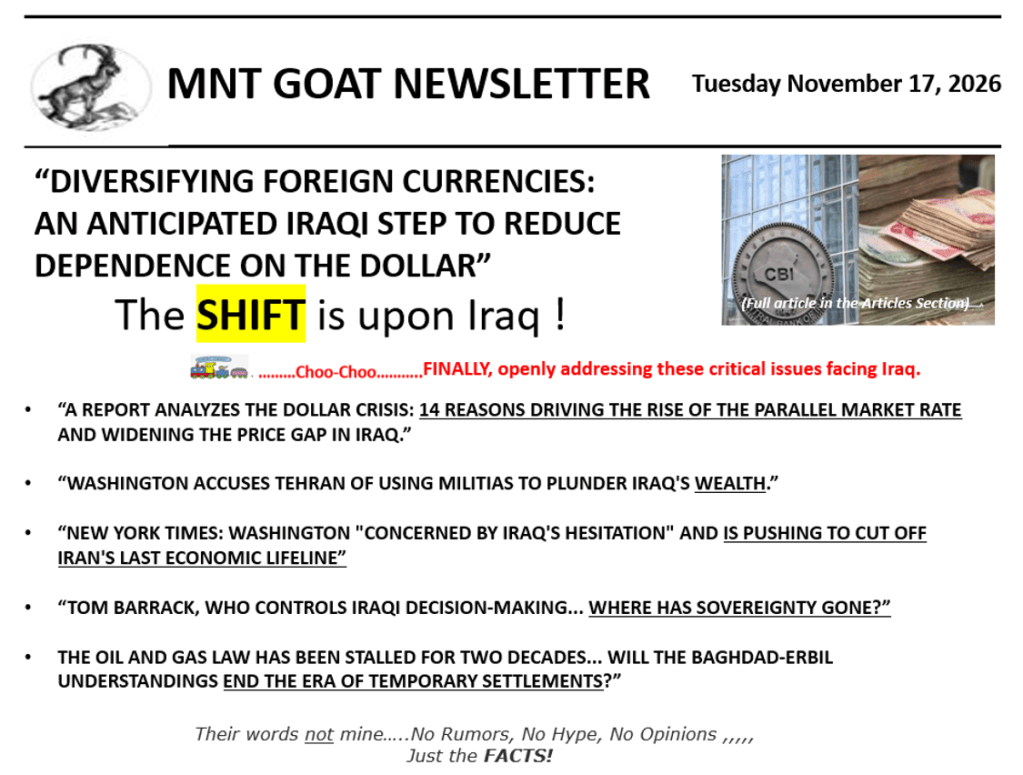
In an article today we see in the recent news that they are finally beginning to ‘publicly’ see the light and the necessity to use other currencies. To me this is a huge WOW! for today’s Newsletter. This say ‘basket’ all over it and we know what that leads to, don’t we? This is the SHIFT I was talking about. The article is titled “DIVERSIFYING FOREIGN CURRENCIES: AN ANTICIPATED IRAQI STEP TO REDUCE DEPENDENCE ON THE DOLLAR”
“Amid the rapid geopolitical and economic shifts the world is witnessing, calls are growing within Iraqi political and economic circles to reconsider the near-total reliance on the US dollar and to seek alternative currencies that ensure greater flexibility for foreign trade. These moves stem from a growing conviction among many observers and decision-makers that the US currency is no longer merely a tool for trade exchange, but has become a political and economic weapon used to exert pressure and engage in what they describe as “financial blackmail” against Iraq, through control of the hard currency market and tightening restrictions on foreign financial transfers.”
4.Iraq must severe the ties between the politicians and these money exchangers. The government must audit every politician and ask where their money is coming from.
So here it is in black and white if you don’t believe me in what I have been saying to you about this proxy Iranian state of Iraq and why it exists. It is NOT to help the Iraqi people. It is a mechanism to steal its oil wealth. It is not concerned about growing the economy and getting out of the rentier economy (sole oil-based economy) for if it was it would be done years ago. In fact they stopped they reinstatement way back in 2013 with false allegations of corruption in the CBI. There is plenty of money to plunder (so the Iranians believe) without advancing Iraq any further. They like it exactly the way it is. In fact, if Iraq did advance it would only mean the demise of their plan to stay as a proxy state. But under president Trump this is what is happening now as the SHIFT has started for their demise. It is titled “WASHINGTON ACCUSES TEHRAN OF USING MILITIAS TO PLUNDER IRAQ’S WEALTH.”
“The US State Department accused Iran of using Iraqi armed factions, primarily Kataib Hezbollah, to plunder the wealth of the Iraqi people, weaken the economy, and undermine the country’s sovereignty, stressing that it will continue to target the financing networks of these groups . A spokesperson for the US State Department told Sky News, as reported by Al-Sa’a Network, that “these factions use the proceeds of corruption to serve their own agendas and Tehran’s regional agenda.”
He added that “the United States designates Kataib Hezbollah as a foreign terrorist organization and imposes sanctions on it,” stressing “the continued pursuit of illicit financing networks and entities that facilitate financial transactions for the factions, within the framework of the maximum economic pressure policy pursued by the administration of President Donald Trump towards Iran.”
Yet more evidence of the SHIFT is happening. It is titled “NEW YORK TIMES: WASHINGTON “CONCERNED BY IRAQ’S HESITATION” AND IS PUSHING TO CUT OFF IRAN’S LAST ECONOMIC LIFELINE”
Remember that Iran is a major trading partner with Iraq. With the Iraqi port of Faw now open and flowing with more ability to import a variety of goods, Iran is becoming less and less important as a trading partner. By this conflict and Iran’s response to delay disarming the factions Iran is only ‘cutting off one’s own nose to spite its own face’. Soon Iraq will not need Iran to survive, in fact this is almost inevitable now. Iran will lose this major trading partner in the future, if not careful. it is the average citizen that will suffer the most not the IRCG clerics. So, there is much more to this conflict with Iran that we hear on the major news channels. Thus, it is of high benefit for the country of Iran to stand up to the IRCG and fight it and throw them out of Iran. The IRCG is only concerned about self-preservation. Their mere existence is at stake. This conflict is not about the beautiful Iranian people and their culture. It is about finally ending a terrorist revolution that wants to engulf the entire world.
“The New York Times, in a report published today (Thursday, November 12, 2026), described the United States’ position on the Iraqi government’s “hesitation” to close the border crossings with Iran as “concerned.”
“The newspaper, as translated by “Baghdad Today,” said that Washington’s efforts to achieve an “economic strangulation” on Iran are now clashing with its hesitant neighbor Iraq, explaining that “the Iraqi government fears that closing the border crossings with Iran will lead to an economic downturn and a rise in the prices of local goods. The newspaper asserted that the US government “is not taking into account the economic consequences that Iraq will suffer if its border crossings with Iran are completely closed, as it is now pressuring its government to achieve its goal of economically strangling Iran.”
Now I want to tell my listeners something. I was not a high-ranking general or military strategists. I was only at the rank of O-5 in the US Army Intelligence Corps. But I witnessed more than I wanted to. I briefed some very high-level people on the situations that happened on the ground. So, I am not ignorant on what has to happen in Iran to truly bring peace. Remember that armies need soldiers to fire weapons. In a country like Iran, they need to find where the soldiers are located and take them out. Then equip the citizens to go after these revolutionary Shiite Clerics, round them up and hold military like tribunals for crimes against humanity. Make an example for the entire world to see. Publicly hang every last one of them, if convicted. We must stop this terrorism that has plagued the world way too long already.
To do this we must get into the mode of fighting a war like WW2 and realize this is a high-stakes game, the same stakes as back in the 1940’s. We must convince other middle eastern countries and the other developed western countries to form a coalition against Iran. It is totally winnable. But we must be united in this effort. It must not be against the Muslims but against a warped ideology of Islamic revolutionaries trying to control the planet, as Hitler also wanted to do.
You see, if you study history you will see these movements for world domination come and go. Even if they last for a bit, like the Roman Empire for a thousand years, eventually they do fail as did Hitler and Napoleon. It is in the human nature to want freedom, liberty and to love his fellow mankind. We are designed not to hate but to love by God’s creation.
So, why must we go through all this suffering the meantime? Do you think that 50 years of terrorism is enough? Why not just end these dark elements while they are not so controlling? Oh but what if they did get a nuclear weapon. What then? This is what I believe the President Trump vision is for the middle east and to get their we must end this Iranian Islamic Revolution and deal with the instigators of it or it will only come back another day and haunt us again.
______________________________________
So again, in this news period we read of yet of more recent news of the money stashes. It is titled “THE PUBLIC IS HOLDING ONTO CASH; 94% OF IRAQI CURRENCY IS OUTSIDE THE BANKING SYSTEM.”
Define public? Aren’t we the public and our dinars are also outside the Iraqi banking system. Right?
Yes, Iraq is very good at talking about their problems over and over again. Why don’t they take the needed actions necessary to fix it? These stashes of dinars are also our dinars outside of Iraq. Banks around the world also have also invested in dinar and are holding them too in their reserves, such as the U.S. and UK reserves. This is all part of this 94%. This is the bulk of this 94%. Really now let’s not be stupid about this claim by Iraq. How in hell can the average group of Iraqi citizens hold 94% of the monetary mass outside the banking system in the first place? You tell me because I don’t know how this can even be possible. This is a huge sum of money.
So, these many articles on this subject matter are not telling us the entire story. You want liquidity? Come and get our dinars…lol..lol..lol.. 😊 But first you will have to cleanup your act, behave like a responsible country again and all the conditions that apply to this concept of Security and Stability? I can say that having Iranian terrorist groups running your country is not what I call secure nor will outside investors. Get it?
“Data from the Central Bank of Iraq showed that about 94% of the total cash in Iraq is outside banks, compared to only 6% within the banking system, an indicator that reflects the amount of cash in circulation among the public compared to the liquidity available within banks.”
“According to economic indicators issued by the Central Bank, which were reviewed by Shafaq News Agency, the value of currency traded outside banks reached 101.868 trillion dinars during September 2026, compared to 100.186 trillion dinars in August, an increase of 1.682 trillion dinars, and a rise of 1.7%.”

________________________________________________
Aren’t you tired of ranking on the U.S. for policies with Iraq? What about Iranian influence. Aren’t they also an occupying force in Iraq? In fact, there are more Iranian Kud forces and militia in Iraq than US forces ever since 2003. The US forces have since left Iraq in 2011 and now again in 2026. What about the Iranian forces?
In this following article again we see the openness to share the truth. The SHIFT is happening. We see once again the irony of the situation between the US and Iran in dealing with Iraq. It is titled “TOM BARRACK, WHO CONTROLS IRAQI DECISION-MAKING… WHERE HAS SOVEREIGNTY GONE?”
Iraq’s sovereignty was gone when they let the Iranian Kud forces remain in Iraq post ISIS war. It has very little to do with the US influence. They have been suffering ever since. Then to make it worse Iraq wanted to make Iranian militias their security force and pay them, without having full control over their weapons and political clout. This was when the Iranian proxy state of Iraq was born.
Iraq let Iran Shiites infiltrate into the government and now they are paying the consequences for these actions. Just look at the Coordination Framework. This reminds me of the IRCG as it controls Iran behind the scenes giving the pretense of a normal government on the surface. They are doing this too in Iraq. Why do they always go after the U.S. for this sovereignty issue when it’s really Iran who is using the militias and factions to funnel billions of Iraqi wealth to Iran. Iran formed a proxy state not the US.
“Popular and political condemnation continues against the political moves led by US envoy Tom Barrack, amid accusations of attempting to interfere in military and security decisions and impose dictates on independent Iraqi decisions, bringing back memories of the era of the “civilian governor” from which Iraq got rid thanks to the sacrifices and blood of its sons.
“In this regard, Haider al-Moussawi, head of the Summit Center, told Al-Maalomah that “Barack’s recent statements, in which he praised Prime Minister Ali al-Zaidi’s stance on the influence of resistance factions, raise important questions about the nature of the American role in shaping the Iraqi government’s policies. Is it simply a matter of issuing orders, with the Prime Minister merely an employee bound to implement them?”
“He pointed out that “resistance factions played a role in confronting the ISIS terrorist organization and defending Iraq and its people during the period of danger that threatened the country,” stressing that “addressing the issues related to weapons and armed groups must be done through national dialogue and Iraqi constitutional institutions, far removed from external dictates or statements targeting specific Iraqi parties.”
But the ISIS war is over. Stop using this as your excuse to remain in Iraq. It is time to go back home to Iran like the US has left Iraq. The Iraqi constitution clearly states about any external interference in their government. But we are not fooled. We all know why these terrorist groups remain in Iraq and what they really want. So most of this article is nothing more than propaganda covered in half-truths to make it sound reasonable but not factual to the current day situation.
______________________________________________
SUMMARY
So, the Oil and Gas Law surfaces once again in this period of news. Oh… this sounds like an open SHIFT in the public eye to me. Do you think its important? Please take a peek at the article titled “THE OIL AND GAS LAW HAS BEEN STALLED FOR TWO DECADES… WILL THE BAGHDAD-ERBIL UNDERSTANDINGS END THE ERA OF TEMPORARY SETTLEMENTS?”
I only posted the short version of this article. You can read the entire article in this link. So, do think this law is important after reading the full article? Was my CBI contact correct in telling us we need to see this law passing in parliament prior to any reinstatement?
“The project remains stalled within the government amid disagreements over field management, contracts, and exports.”
“Despite the passage of nearly two decades since the introduction of the federal oil and gas law, the legislation that is supposed to regulate the management of oil wealth in Iraq remains stuck in the government drawers, amid political and technical disputes between Baghdad and Erbil regarding the management of the fields, contracting powers, production, export and the distribution of revenues.”
“The oil and gas law, which has been stalled since the adoption of the Iraqi constitution in 2005, is one of the most important pieces of legislation related to shaping the country’s oil policy and regulating the mechanisms for extracting resources and distributing revenues between the federal government and the producing regions and governorates”
“the draft federal oil and gas law remains in the government’s files and has not yet been sent to Parliament in its final form, despite its importance in regulating and managing Iraq’s oil wealth.”
“Enacting this law has become a national necessity, particularly to regulate the oil relationship between the federal government and the Kurdistan Region,
He added that “the continued delay in enacting the law leaves the oil-related issues unresolved without clear legislative solutions,” calling on the government to “resolve the disputes and send the draft law to Parliament so that it can discuss it, make the necessary amendments, and vote on its enactment.”
“AL-MAYAHI: THE OIL AND GAS LAW IS A GATEWAY TO FAIRNESS FOR BASRA AND THE PRODUCING GOVERNORATES.”
“Member of Parliament Abdul Amir Al-Mayahi reiterated his demand on Sunday for the government to expedite the submission of long-awaited draft laws to Parliament for enactment, foremost among them the oil and gas law and other social legislation. He emphasized that passing this law is a fundamental pillar for regulating the management of oil wealth and ensuring fairness for oil-producing provinces, particularly Basra.”
“Al-Mayahi told the Information Agency, “The government is obligated today to finalize the pending legislation and send it to Parliament without further delay”
I also need to point out a recent article that struck a note with me. It is about time that the World Bank or the IMF put conditions upon these loans given to Iraq. This is also part of our SHIFT what we see occurring putting pressure on Iraq to implement many of the reforms it keeps talking about but never seems to finish. It is titled “A MYSTERIOUS LOAN AND INTERNATIONAL CONDITIONS: THE WORLD BANK PROPOSES “FINANCING” IRAQ IN EXCHANGE FOR THREE YEARS OF ECONOMIC REFORM.”
“Economic expert Ziad Al-Hashemi announced (Thursday, November 12, 2026) that the Iraqi Ministry of Finance, during its discussions with the World Bank aimed at obtaining “urgent financing loans” for the Iraqi economy, “has made progress in the discussions.”
Al-Hashemi said, according to a post, that the Iraqi government, which is seeking funding from the World Bank, faced “international conditions” including “implementing a three-year economic reform program in cooperation with the World Bank.”
Folks, I want you to know this article is not telling us we will have to wait another 3 years for these reforms to get the reinstatement of the Iraqi dinar (IQD). In fact one of reforms is the currency reform. WOW! My point in presenting this news is that things are changing. The shift is happening and these entities working with Iraq are now pushing Iraq to make these necessary changes. The Trump administration is also doing the same and so pressure from both ends.
😊 😊 😊 So, we still move forward in this RV saga. Today’s news was VERY GOOD news for us investors as change had to happen and the sooner the better. I want to emphasize mostly that Iraq is finally beginning to SHIFT it’s thinking, and the paradigms are changing around many issues. This had to happen to orchestrate the real type of change that has to happen inside Iraq to see the reinstatement of the Iraq dinar any time soon. We can’t listen to many of these silly, ignorant RV intel gurus out on the internet telling you of an any day RV. They will plaster their sites will all kings of fiction about rate changes and revaluations happening. It is all lies and clickbait. Get it?
So, these same five issues I posted way back in my September 16, 2026 Newsletter still hold true today. Just read the current news each week from Iraq. What do you read? It’s all about one or more of these five issues.
I also want to take this time to especially thank all by blog readers for the effort made to help in your consideration of the Newsletter. Remember that the Newsletter is ongoing and so the support must follow. I feel this blog is an instrument to bring FACTUAL REALITY to this investment. For some of these so-called intel gurus, the intel has become a business for many and a three-ring circus show. I take the time to listen to many of these intel gurus in the past and still do for some. I do this to be able to address your concerns and bring clarity to their nonsense. Many are just so outright STUPID and IGNORANT of the situation of this revaluation process. I have to cry when I hear them speak. Yes, some of it is so comical that I also laugh. Like the one who mixes cocktails and indulges as she talks about her ‘God given’ intel.
I strongly encourage everyone to bring a friend to the blog if you know of others invested in the Iraqi dinar. They may also appreciate the non-bias and factual news. Remember this is their words not mine. I am only relaying the information to you from Iraq as we move through this RV journey. There are no such things as ‘secret’ sources or bank contacts that can bring you any information that is not published from Iraq.
I talk to many people about the US elections and they fear for the worst. I ask why do you fear so much? Does not God tell us through his prophets He is not going to let this great country of ours (His) get destroyed by this woke culture and corruption? He says together we will ‘Make America Great Again’.
So, I encourage everyone to view all my recent videos in the pollical section. I really get a distaste for anyone who claims to keep politics out of this RV sage. I say ‘really’? The TRUTH is you can’t and it’s all about politics. It always has been. Politics is going to get us this RV sooner or later, better sooner than maybe never. I have many friends who have followed my blog and they are gone. Yes, they have already died. I ask God why didn’t you allow them to enjoy this blessing. This is what I mean by sooner than later. Enough said….
____________________________________________
PRAYER WORKS: As I have declared so many times before. It is our prayers that will help this investment come to reality sooner than later. They are working and we must continue. We must continue to pray and pray harder than before even. Are we willing to even make this little of a sacrifice for God to tell him what we desire?
_______________________________________________
What do you think will happen next? (Leave a comment)
______________________________

________________________________________
Their words not mine…..No Rumors, No Hype, No Opinions ,,,,,
Just the FACTS!

These prophecies are an important tool we have to lead us on our path. They are more important now than ever. They give us the strength, perseverance and hope that a better time is coming and that God’s Hand is at work behind the scenes. If you just take a second even to look around you at these past three election cycles, how can you deny that God is at work? Are you sleeping or what?
It is amazing and there is no other way that these events could have happened the way they turned out. But there is more to come, much, much more, I assure you! Now that God has his biblical David re-elected, we need to pay attention to what He does next.
NOTE: These prophecies tell us also of things happening in the background that either the main stream news media does not know about or the crooked news media refuses to talk about. They do this to keep us in the dark to continue the Trump hating senario and for us to keep thinking that nothing is changing, thus Trump is not successful. But it is just the opposite happening. The proof is all around us if we look for it.
Prophetic Words from the prophets: Julie Green
“2026 Midterms Are Not Changing My Plans”
Go to the 13:00 mark on the video. From Nov 6th.“

“The United States Is Being United Again”
Go to the 9:02 mark on the video.

“Do Not Fear What Is Coming”
Go to the 9:18 mark on the video. Given on Nov 1st.

A PROPHETIC WORD ABOUT TRUMP’S FUTURE IN AMERICA AFTER MIDTERMS
________________________________________________
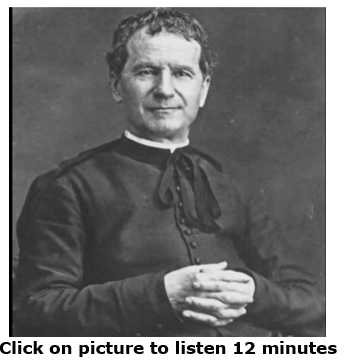
Fr. DON BOSCO EXPOSED THE DARK SECRET BEHIND ISLAM
I keep this one out here to view. Everyone should take the time to watch it. It will awaken you about the Muslim so-called religion (or should we call it for it is — a ‘cult‘.)
— And the truth the world forgot about the so-called Muslim religion.
Fr.Don Bosco, also known as John Bosco, was an Italian Catholic priest and educator, born on August 16, 1815. He founded the Salesian Society in 1859 to help disadvantaged youth, particularly boys, through education and community service. His teachings emphasized loverkindness, and the importance of education for young people, making him a beloved figure in Catholicism and a patron saint of youth. Don Bosco was canonized in 1934.
UNDERSTANDING THE IRANIAN CONFLICT
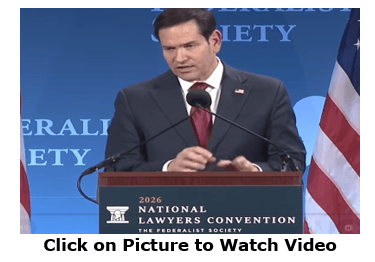
A must watch for all my readers. I hope you do! To try to understand why this conflict with Iran one should listen carefully to this speech by Marco Rubio. All I can say is WOW! WOW! WOW!
THIS WAS TRUMP’S PLAN FROM THE START…

EXPLOSIVE NEW ALLEGATIONS AGAINST OMAR ADD ‘A LITTLE BIT MORE SMOKE INTO THE MIX’ AMID FRAUD PROBE
COUNCIL ON FOREIGN RELATIONS (CFR) ADMITS DEFEAT
This is how we are going to get the reinstatement of the Iraqi dinar. When Iraq truly becomes a sovereign nation away from the Iranian proxy puppetry.
Susan Kokinda analyzes President Trump’s suggestion that Iran could someday join the Abraham Accords, arguing it reflects a foreign policy built on “real physical economics” rather than geopolitical rules. She contrasts this approach with criticism from figures like Mike Pompeo and highlights White House Communications Director Steven Cheung’s sharp rebuttal. Kokinda points to the National Security Strategy’s focus on reindustrialization—“the future belongs to the makers”—and frames energy independence, supply-chain security, and tariffs as “hard power.”
She interprets the Council on Foreign Relations new “Future of American Strategy” project as an admission that the liberal international order and the U.S.-U.K. “special relationship” are ending, citing CFR contributors who dismiss reindustrialization. The episode also notes emerging diplomacy and economic cooperation involving the U.S., Russia, China, and India.
THE MIDTERM AFTERMATH: WHAT HAPPENS TO AMERICA NOW? – Dr. Jan Halper-Hayes

KIM CLEMENT’S SENATE PROPHECY: A SHAKING IN THE SENATE
The prophecies from over a decade ago go hand in hand with what Julie Green and many others are now telling us will happen during these next 2 years.
HYPNOTIC NOVEMBER
As many conservatives woke up on Wednesday 11/4 morning to gloom and doom about the election results of the Republican Party, we must hold fast and count on God now to do the rest. It is in His hands now. All is not lost. We did our part and voted as we did in 2020. There is a reason for everything.


BAGHDAD SHOPS HAND OUT CELERY AND SWEETS AS SMALL DINAR NOTES RUN SHORT
(Mnt Goat: I find this really pathetic situation Iraq has gotten itself into over these last 23 years. They have huge oil reserves and pump and sell vast amounts of oil. Where does all the money go? It is a free-for-all. Everyone’s got their hand of corruption on their wealth and this is manifested by staying in this sanction-like mode and not getting off the sole peg to the US dollar.)
BAGHDAD, November 9, 2026. Shopkeepers across Baghdad say 250 and 500 dinar banknotes have become so scarce that they are handing customers celery or sweets instead of change, or simply waiving the difference.
The two notes, the smallest in circulation, are worth about 15 and 30 US cents at the street rate. Merchants in both Karkh and Rusafa told the local outlet 964media that many of the notes still in use are torn or worn, and customers refuse them.
Yousif Muayad, who owns a pharmacy in Adhamiya, said the shortage had hurt his business for about a year. When a customer owes 4,500 dinars and he has no change, he takes 4,000 and lets the rest go, he said.
Some cheap medicines, including paracetamol made in Samarra, cost 250 or 500 dinars, Muayad said. Customers sometimes buy two strips and pay 1,000 dinars to avoid the problem.
A grocery worker in Adhamiya said it happens every day. A shopper may leave with a bunch of celery in place of change, and children who come along may be given a banana.
In Abu Ghraib, on the city’s western edge, shop owner Omar al-Mafraji said the 1,000 dinar note was still easy to find but smaller notes were disappearing. He called on the Central Bank of Iraq to print more of them.
The Central Bank has not publicly explained the shortage. Merchants blame notes worn out by daily use, too few replacements and the low value of the smallest notes.
The bank said in October that Iraqis could now apply online to replace damaged banknotes. The country remains heavily dependent on cash. About 92 percent of the currency the bank had issued was held outside banks at the end of June, according to its data.
The 250 dinar note has been the smallest denomination since the bank withdrew the 50 dinar note in 2015.
********************************************************************************************
ACADEMICS CALL FOR SUPPORT FOR PRODUCTIVE PROJECTS AND PROTECTION OF THE CURRENCY.
Harmony and coordination between fiscal and monetary policies are fundamental to ensuring financial stability and supporting sustainable growth in the country. Economic experts emphasize that the current structural and institutional challenges necessitate strengthening cooperation mechanisms between executive bodies and the Central Bank of Iraq. This will ensure efficient management of monetary liquidity, mitigate external shocks, and achieve the desired balance between stimulating economic activity and curbing inflationary pressures.
Spending Management
In this context, academic and economic researcher, Dr. Abdul Karim Al-Issawi, considered the harmony between the two policies to be one of the basic rules for directing economic activity in the right way and addressing imbalances resulting from external or internal conditions.
Al-Issawi explained in an interview with Al-Sabah that the government seeks, through fiscal policy, to manage public spending and tax tools with the aim of positively influencing aggregate demand, investment, and the provision of services, while monetary policy is managed by the Central Bank through multiple tools, most notably the interest rate, money supply, and open market operations, to maintain the stability of the general price level and achieve monetary stability.
He added that the importance of coordination is highlighted in creating a stable environment in which government decisions are consistent with the directions of the central bank, whether when formulating an expansionary or contractionary fiscal policy, indicating that the absence of full coordination may lead to a weakening of the effectiveness of economic measures and an increase in the costs of achieving stability. He pointed out that successful harmony is based on a strategic plan based on clear priorities, which are represented in stimulating economic activity, maintaining the stability of the national currency, and directing government spending and cash liquidity towards productive and investment projects to enhance economic growth.
Al-Issawi reviewed a number of challenges facing the Iraqi economy in this regard, foremost among them external shocks such as fluctuations in global oil prices and rising international interest rates, noting that the heavy reliance on oil revenues may sometimes cast a shadow on the implementation of future monetary objectives, which requires addressing the weakness of institutional coordination in managing liquidity and controlling the expansion of current spending to facilitate achieving harmony between public spending and monetary policy.
Central Bank Independence
For his part, academic Dr. Amr Hisham stressed the importance of regulating the institutional relationship between the two policies to avoid any discrepancy in objectives or the dominance of one side over the other, stressing the need to support and strengthen the independence of the Central Bank of Iraq to enable it to continue to perform its legal duties in maintaining acceptable levels of inflation, exchange rate stability, and achieving general monetary stability.
Hisham told Al-Sabah that the rentier economy makes the balance of financial flows structurally tilt in favor of financial channels, as dollar oil revenues are transferred to the Central Bank’s account to be liquidated in dinars for the benefit of government spending. He explained that fiscal policy undertakes necessary social tasks and derivations, such as expanding employment opportunities, alleviating poverty, and providing support to the electricity, farmers, and vulnerable segments, which are basic obligations of the state despite the burdens they place on the general budget.
Addressing the effects of inflation
He pointed out that increased government spending often generates inflationary pressures that necessitate monetary policy intervention to mitigate them, recalling the oil price surges the country experienced in previous years (such as 2006 and 2008), when public spending accelerated. He emphasized that activating frameworks for coordination between fiscal and monetary policies in such circumstances ensures flexible control over inflation rates at minimal cost and protects the country’s key economic gains.
Institutionalizing coordination
It is worth noting that, amidst these economic visions, the government continues to take practical steps to solidify this harmony through regular high-level meetings between the Ministry of Finance and the Central Bank. The current government strategy focuses on strengthening ongoing coordination to address current challenges and ensure the efficient management of public finances, enabling the state to meet its obligations without compromising monetary policy targets.
These joint efforts are centered around activating the reform of the financial system, upgrading the tools for managing public funds, in addition to intensifying the exchange of data and periodic reports and accelerating the comprehensive digital transformation between the Ministry and the Central Bank, which contributes to the smooth disbursement of financial returns and raising the efficiency of the response to any changes or emergency economic shocks.
*******************************************************************************************
AMERICA IS BANKING ON THE JUDICIARY AND INVESTMENT TO STRENGTHEN ITS PARTNERSHIP WITH IRAQ.
The United States of America affirmed its commitment to deepening its strategic partnership with Iraq and expanding bilateral cooperation to include judicial institutions, the rule of law, energy, investment, and economic development, within the framework of an American approach to strengthening relations with Baghdad and moving towards a more comprehensive partnership that goes beyond traditional security dimensions to long-term economic and institutional interests.
This came in statements by the US Presidential Envoy to Iraq, Tom Barrack, on Tuesday, following a meeting he said he held in the British capital, London, with Iraqi officials headed by the President of the Supreme Judicial Council, Judge Faiq Zaidan, to discuss the future of relations between the two countries and opportunities to develop cooperation in a number of vital sectors.
According to what Barak stated in a post on the “X” platform, the meeting witnessed an important exchange of views on the future of American-Iraqi relations, at a stage he described as historic for the people of both countries and the region, stressing that there is an opportunity to build a long-term partnership based on judicial cooperation, strengthening institutions and expanding investments.
The US envoy indicated that the proposed areas of cooperation include the rule of law, energy, economic development, institutional partnerships, security and regional stability, considering that the potential available to develop relations between Washington and Baghdad is great, and can be used to achieve common interests and enhance stability.
These statements reflect the desire of the US administration to redefine the priorities of its relations with Iraq, by giving economic, legal and institutional issues more space in the bilateral dialogue, in parallel with continued coordination on security challenges and regional developments.
Barak stressed the importance of strong and independent judicial institutions, considering that strengthening cooperation between the Iraqi and American legal systems is a fundamental pillar for building trust, consolidating the rule of law, and providing a more stable environment for investment and development.
The judicial cooperation file is of particular importance in light of Iraq’s efforts to develop its investment environment and enhance the confidence of foreign companies in government institutions, as long-term investment decisions are linked to the clarity of legislation, the effectiveness of the judiciary, dispute resolution mechanisms, and the protection of contractual rights.
The head of the Supreme Judicial Council, Faiq Zaidan, received Barak in Baghdad on November 5, and discussed with him the follow-up to the results of the dialogues related to strengthening judicial relations with the American counterparts, according to an official statement issued by the Supreme Judicial Council.
The two sides had previously discussed, during a meeting on October 12, ideas for developing bilateral relations in the legal and judicial fields, indicating that this issue continues to be addressed within the channels of communication between Baghdad and Washington.
On the economic side, energy and investment stand out as the most prominent sectors poised to expand cooperation between the two countries, especially given Iraq’s need to develop its infrastructure, raise the efficiency of electricity production, modernize the oil and gas industries, and enhance the contribution of the private sector to economic activity.
Partnerships with American companies can contribute to providing technology, technical expertise, and financing for strategic projects, but turning political understandings into actual investments remains contingent on having clear agreements, a stable regulatory environment, and appropriate legal guarantees.
These moves come at a time when Baghdad is seeking to expand its international economic relations and reduce dependence on oil revenues by revitalizing the productive and service sectors and attracting foreign capital.
Barak’s meetings with Iraqi officials in Baghdad last week focused on expanding trade and investment relations, as well as discussing regional challenges and the transition to a broader bilateral partnership after the end of the international coalition’s mission in Iraq on September 30, 2026.
The American focus on economic development reflects a trend towards linking Iraq’s stability to its ability to build effective institutions and a more diversified economy, rather than limiting the bilateral relationship to military and security cooperation.
Conversely, the success of this approach remains contingent on the ability of both sides to address the challenges related to project implementation, the investment environment, and administrative procedures, as well as ensuring respect for Iraqi sovereignty and the independence of constitutional institutions within the framework of joint cooperation.
At the regional level, Barak’s statements come amid continuing political and security tensions in the Middle East, and the challenges they pose to Iraq due to its geographical location and its relations with the United States, Iran and neighboring countries.
Washington views Iraq’s stability as an important element of the regional security system, while Baghdad seeks to maintain balanced relations with its international partners and avoid involvement in conflicts that could affect its internal security and economic interests.
In this context, expanding economic and institutional cooperation with the United States can be a supportive factor for stability, provided that it is accompanied by respect for the privacy of Iraqi decision-making and the requirements of the national interest, and that understandings are translated into implementable projects and programs.
According to statements attributed to him, Barak stressed that strengthening relations between the judicial and legal institutions of the two countries can contribute to building trust and opening new horizons for shared prosperity, emphasizing the United States’ desire to continue working with Iraqi partners in the next phase.
These messages indicate that the US administration is seeking to present a more comprehensive vision for the future of its relations with Baghdad, based on the integration of legal, economic and security cooperation, at a time when Iraq is facing challenges related to institutional reform, economic diversification and attracting investments.
However, talk of broad opportunities for cooperation does not necessarily mean the existence of new executive agreements, as the information available about the London meeting did not include an announcement of specific investment contracts, financial commitments, or a timetable for implementing the proposed projects.
Thus, the political importance of the meeting lies in confirming the continuation of high-level communication between the two countries, and identifying the areas that Washington and Baghdad seek to develop during the next stage, while measuring the results remains dependent on what will be issued in terms of agreements and practical measures.
These developments raise questions about the future of the American economic presence in Iraq, and the possibility of judicial and institutional cooperation becoming a broader entry point for improving the business environment and attracting foreign companies, in conjunction with the requirements for strengthening national sovereignty and regional stability.
Between Washington’s aspirations to build a long-term strategic partnership and Baghdad’s need for more effective investment and economic and institutional cooperation, Iraqi-American relations appear to be entering a new phase, the measure of whose success will be the transition from diplomatic statements to projects and agreements that achieve tangible results for both countries.
*****************************************************************************************
LONDON: THE “IRAQ INITIATIVE 2026” CONFERENCE DISCUSSES THE CHALLENGES FACING THE AL-ZAIDI GOVERNMENT.
The Royal Institute of International Affairs (Chatham House) in the British capital, London, will hold its eighth edition of the “Iraq Initiative 2026 Conference” tomorrow, Wednesday, to assess the ability of the new federal government headed by Federal Prime Minister Ali Faleh al-Zaidi to confront internal and regional pressures and consolidate national sovereignty, according to the agenda announced today, Tuesday, November 10, 2026.
The conference will be held in a hybrid format combining in-person attendance at the Institute’s headquarters in London and virtual broadcasting via the internet, with broad participation from decision-makers in Iraq and the international arena, as well as prominent business leaders, experts and representatives of civil society.
According to the conference program, Iraq is going through a critical turning point in light of the widening regional conflict, which has reflected the magnitude of the challenges in Baghdad. Attacks by armed groups close to Tehran inside and outside the country, along with American and Israeli airstrikes on Iraqi sites, have brought back to the fore the issue of national sovereignty and the state’s right to monopolize weapons and use force as one of the most sensitive issues.
The working papers indicate that the intensifying competition between Washington and Tehran to enhance influence in the Iraqi scene puts al-Zaidi’s cabinet to a complex test in maintaining a balance in its relations with both sides and limiting the direct security and political repercussions.
The conference also addresses the repercussions of the disruption to energy and trade markets on Iraq’s rentier economy, which is based on oil exports, and the resulting decrease in financial revenues and growing challenges in securing electricity, amid rising popular demands to address inflation and combat unemployment.
The participants will discuss a number of key themes, foremost among them:
– The extent to which the federal government can implement genuine reforms and maintain economic stability during its first 100 days in office.
– The impact of security, economic, and geopolitical pressures on the independence of Iraqi decision-making.
– The steps required to reduce over-reliance on the unstable energy sector and respond to public demands.
– The mechanisms that will enable Baghdad to balance its international relations amidst regional polarization and tensions.
*******************************************************************************************
MASROUR BARZANI: WE AGREED WITH AL-ZAIDI ON A UNIFIED BUDGET FOR KURDISTAN AND HELD EXCELLENT TALKS.
On Monday, Kurdistan Regional Government Prime Minister Masrour Barzani announced that an agreement had been reached with Iraqi Prime Minister Ali Zaidi regarding the allocation of a unified budget covering all parts of the region, stressing that the talks between the two sides were “excellent”.
Barzani said in a speech from Baghdad, which was followed by Shafaq News Agency, that the talks with the Iraqi government were excellent, expressing his pleasure at the good understanding between the two sides, especially regarding the allocation of a single and unified budget for the Kurdistan Region, which includes all its regions.
Regarding the Kormor field, he explained that both sides agreed on the need to put an end to attacks targeting oil and gas fields, noting the formation of an investigative committee on this matter to reach conclusions.
He expressed hope that the investigations would identify those involved in these attacks, so that anyone found responsible would receive the appropriate legal punishment.
Earlier today, Federal Prime Minister Ali Zaidi discussed outstanding issues between the federal government and the Kurdistan Regional Government with Kurdistan Regional Government Prime Minister Masrour Barzani. These issues included the management of oil fields, revenues, employee salaries, the region’s share of the 2027 federal budget, and the oil and gas law.
The Prime Minister of the Kurdistan Region arrived in the federal capital, Baghdad, on Monday morning to discuss the federal budget law and other issues.
Shafaq.com
****************************************************************************************
TOM BARRACK, WHO CONTROLS IRAQI DECISION-MAKING… WHERE HAS SOVEREIGNTY GONE?
(Mnt Goat: Iraq’s sovereignty was gone when they let the Iranian Kud forces remain in Iraq post ISIS war. Then to make it worse wanted to make them their security force and pay them, without having full control over their weapons and political clout. The let then infiltrate into the government and now they are paying the consequences for these actions. Why do they always go after the U.S. for this sovereignty issue when its really Iran who is using the militias and factions to funnel billions of Iraqi wealth to Iran.)
Popular and political condemnation continues against the political moves led by US envoy Tom Barrack, amid accusations of attempting to interfere in military and security decisions and impose dictates on independent Iraqi decisions, bringing back memories of the era of the “civilian governor” from which Iraq got rid thanks to the sacrifices and blood of its sons.
In this regard, Haider al-Moussawi, head of the Summit Center, told Al-Maalomah that “Barack’s recent statements, in which he praised Prime Minister Ali al-Zaidi’s stance on the influence of resistance factions, raise important questions about the nature of the American role in shaping the Iraqi government’s policies. Is it simply a matter of issuing orders, with the Prime Minister merely an employee bound to implement them?”
He added, “The Iraqi government is required to take a clear position that preserves the country’s sovereignty and the dignity of its institutions, not to appear as an employee carrying out the directives of foreign envoys.” He further stated that “it is unacceptable for American statements to become the determinants of domestic policies, especially since previous governments have spoken about restoring sovereignty and the withdrawal of foreign forces from Iraq.”
Al-Moussawi clarified that “sovereignty is not limited to the withdrawal of foreign forces from Iraqi territory, but also includes the independence of political and security decision-making, the rejection of foreign interference in the country’s affairs, and preventing any foreign entity from imposing its vision on the components of the Iraqi people or its institutions.”
He pointed out that “resistance factions played a role in confronting the ISIS terrorist organization and defending Iraq and its people during the period of danger that threatened the country,” stressing that “addressing the issues related to weapons and armed groups must be done through national dialogue and Iraqi constitutional institutions, far removed from external dictates or statements targeting specific Iraqi parties.”
Al-Moussawi emphasized that “the government is required to clarify its position on the recent American statements and to affirm that decisions concerning Iraq’s future and security are not made in Washington, nor are they determined by a foreign envoy, but rather are formulated according to the constitution, the national interest, and the will of the Iraqi people,” warning that “the continuation of foreign interference weakens citizens’ confidence in the independence of government decision-making.”
For his part, political analyst Ibrahim al-Sarraj told Al-Maalouma that “American influence in Iraq is ongoing, and Washington is working to perpetuate it so that it remains the guardian of the country, at a time when national sovereignty, which the government has been boasting about for several days, is absent.”
Al-Sarraj asked, “Where is sovereignty when Tom Barrack orders the Prime Minister to do this and leave that, and demands that he fight the resistance factions that represent the safety valve for Iraq? It’s as if the era of the civilian administrator has returned, but in the name of Tom Barrack.”
He added, “After the losses it suffered in its military war against the resistance, the United States is now seeking to extend its influence and control over the Iraqi judiciary, in addition to its military and security dominance, to bring it under its control and dictate the country’s resources and wealth.”
Al-Sarraj explained that “the continuation of this situation clearly shows that the government has become merely an employee of the new administrator of Iraq, Tom Barrack, which clearly demonstrates the weakness of the political leadership in the face of external dictates and control over Iraqi resources.”
Ending this blatant influence and control is a fundamental demand of Iraqis today; to reject any attempts to treat the Iraqi government and national political forces as subservient entities that implement Washington’s dictated policies without objection or resistance, and to affirm that full Iraqi sovereignty is a red line that cannot be crossed.
******************************************************************************************
A MEMBER OF PARLIAMENT ACCUSES THE GOVERNMENT AND THE CENTRAL BANK OF RENEGING ON THEIR PROMISES TO CONTROL THE PARALLEL MARKET.
Member of Parliament, Miqdad al-Khafaji, criticized the government and the Central Bank of Iraq on Thursday for reneging on previous promises to take measures to protect citizens from the repercussions of the exchange rate adjustment and to achieve a balance between the official rate and the parallel market rate.
Al-Khafaji told the Information Agency, “The dollar exchange rate in the parallel market has risen again, which has negatively and directly impacted the income of ordinary citizens through the continuous increase in the prices of basic goods and foodstuffs.”
He added, “There is a large gap and a clear widening difference between the official exchange rate and the rate circulating in the parallel market,” addressing the relevant authorities by saying, “Enough with the promises and manipulation of the livelihood of the Iraqi citizen.”
It is worth noting that the government and the Central Bank raised the value of the dollar exchange rate against the Iraqi dinar to 150,000 Iraqi dinars per 100 US dollars, while the exchange rate reached 170,000 dinars.
*******************************************************************************************
EXCHANGE RATE: FLUCTUATIONS IN THE PARALLEL MARKET AND CALLS TO CURB IT
Economic concerns are escalating in the country as the exchange rate crisis and its successive fluctuations continue. These changes are casting a heavy shadow on local markets and increasing the severity of the living pressures facing citizens, amid parliamentary demands for the necessity of decisive government intervention to achieve monetary stability and protect the purchasing power of families from the continuous rise in the prices of basic goods and foodstuffs.
In this context, Member of Parliament, MP Miqdad al-Khafaji, criticized the government and the Central Bank of Iraq on Thursday for reneging on previous promises to take measures to protect citizens from the repercussions of the decision to amend the exchange rate and to achieve a balance between the official rate and the parallel market.
Increase in parallel market exchange rates
Al -Khafaji said : “The exchange rate of the dollar in the parallel market has risen again, which has negatively and directly affected the income of the average citizen through the continuous increase in the prices of basic goods and foodstuffs.”
He added, “There is a large gap and a clear widening between the official exchange rate and the rate traded in the parallel market,” addressing the concerned authorities by saying, “Enough with the promises and manipulation of the livelihood of the Iraqi citizen.”
It is worth noting that the government and the Central Bank raised the value of the dollar against the Iraqi dinar to 150,000 Iraqi dinars for 100 US dollars, while it reached 170,000 dinars.
*****************************************************************************************
THE OIL AND GAS LAW IS STILL IN THE GOVERNMENT’S DRAWERS, AND A MEMBER OF PARLIAMENT IS CALLING FOR IT TO BE SENT TO PARLIAMENT.
Qaisar Al-Jurani, a member of the Oil, Gas and Natural Resources Committee, confirmed on Wednesday that the draft federal oil and gas law is still in the government’s drawers and has not been sent to the House of Representatives in its final form, despite its importance in regulating and managing oil wealth in Iraq.
Al-Jurani told Al-Mada that enacting the law has become a national necessity, especially to regulate the oil relationship between the federal government and the Kurdistan Region, and to define the powers of managing oil fields, production and export mechanisms, contracts and revenues, in accordance with the constitution and to preserve the rights of all producing governorates.
He added that the continued delay in enacting the law leaves the oil files pending without clear legislative solutions, calling on the government to resolve the disputes and send the draft law to the House of Representatives, so that it can discuss it, make the necessary amendments to it, and vote on its enactment.
*******************************************************************************************
A REPORT ANALYZES THE DOLLAR CRISIS: 14 REASONS DRIVING THE RISE OF THE PARALLEL MARKET RATE AND WIDENING THE PRICE GAP IN IRAQ.
The head of the “Iraq Future” Foundation for Economic Studies and Consultations, economist Manar Al-Obaidi, identified on Thursday a set of main reasons that drive the increased demand for the dollar in the parallel market, and the pressure to widen the gap between the official and unofficial prices in Iraq.
Inability to finance trade with Iran
According to a report issued by the organization and published by Al-Obaidi, Iraq is considered one of Iran’s largest trading partners, and the sanctions prevent its trade from being settled through the window or the international banking system, so it is paid in cash or in currencies purchased with dollars.
US restrictions on dollar transfers
The report stated that the US Federal Reserve’s prior scrutiny and the ban on banks dealing in dollars narrow the official supply and push qualified traders towards the parallel market to avoid rejection and delays.
Invoice tampering and importing outside the window
The organization indicated in its report that part of the value of the goods is financed officially and the remainder is paid from the parallel market to reduce customs duties and taxes, in addition to importing from entities not served by the window.
Increased customs tariffs on “high-value” goods
According to the institution, full disclosure and payment of tariffs through the official channel makes its cost uncompetitive compared to the parallel system, which bypasses customs entirely or partially.
Funds that do not enter the formal system
The report noted that the inability to clarify the sources of funds in the face of compliance requirements keeps them in cash outside the system, so they are spent and transferred through the parallel market.
Smuggling dollars to neighboring countries
The “Iraq Future” Foundation considered Iraq to be one of the largest sources of cash dollars in the region, and the demand from countries subject to sanctions and review with neighboring markets comes from its parallel market.
Small traders outside official platforms
The report stated that among the reasons for the high exchange rate was the failure to include small traders in the official platforms for selling dollars, stressing that they cannot access the transfer platforms due to the scarcity of their resources or the small size of their transactions, so they finance imports from the parallel market.
Excess liquidity in dinars
The report noted that the expansion in government spending and salaries is injecting more dinars than dollars are being offered through the window, and the surplus is looking for a store of value.
Hoarding dollars at the expense of the dinar
The report confirmed that households and businesses hold their dollar reserves as a store of value and a hedge against inflation, thus withdrawing the dollar from circulation.
(Mnt Goat: oh…. wait a second. I thought Iraq de-dollarized? Yes, they then take the dollars and sell them to the currency exchangers for dinars. They wait until the rate of the dollar goes down and the dinar revalues again. It is a cycle.)
Slow conversion and disruption of capital circulation
The institution criticized the slowness of the transfers, noting that taking days or weeks in the official channel compared to hours in the parallel channel makes the cost of lost time exceed the price difference for many traders.
Banks’ reluctance to process small transfers
The report criticized banks for favoring high-value transfers to maximize commissions and reduce compliance costs per transaction, while neglecting or delaying smaller amounts.
Limited spread of money transfer banks
The institution continued to list the reasons, including the concentration of banks capable of transferring funds in Baghdad and some centers without covering all governorates, leaving the local money exchange as the only option.
Expectations of reduction and speculation
The report warned that any discussion about adjusting the official price generates preemptive buying, and money changers speculate on the gap between the two prices, thus exaggerating it.
*****************************************************************************************
SLEMANI CURRENCY MARKET SPOKESPERSON EXPLAINS RECENT IRAQI DINAR EXCHANGE DROP
At a Glance
- Delayed bank remittances from pre-devaluation contracts forced merchants to buy dollars on the open market, driving rates higher.
- Heavy inflows of high-denomination dinar notes and political tensions surrounding Jurf al-Sakhar added further pressure on exchange markets.
- Public trust in the dinar has weakened alongside media-driven panic, prompting the Central Bank of Iraq to clear backlogged import transfers.
Slemani Currency Market spokesperson Jabar Goran stated that delayed bank remittances, heavy inflows of dinars into exchange markets, political tensions, and media-driven panic have combined to push the U.S. dollar higher against the Iraqi dinar in recent days.
Key Statements and Focus Area
- Addressing the reasons behind the weakening of the dinar in recent days, Goran noted, “Previously, there were a number of contracts between merchants and banks to calculate their dollars at the previous exchange rate of 132 [132,000 dinars per $100].”
- “Another reason is that large amounts of dinar, particularly in 25,000- and 50,000-dinar notes, are entering currency exchange markets from across the borders or from inside Iraq, both in the central and southern regions as well as the Kurdistan Region,” he added.
- “On the other hand, there is the political dimension, which is currently the issue of Jurf al-Sakhar, where there is talk of widespread corruption by armed groups,” Goran explained.
- He further stated that the media has played a role in creating fear and panic among the public regarding the dinar-to-dollar exchange rate.
Goran explained that large amounts of dinars had been deposited under earlier contracts, but for nearly 40 days those funds failed to reach beneficiaries or get transferred.
Consequently, some merchants withdrew those dinars while still carrying external remittance obligations, creating massive demand in the local market and pushing the dollar higher.
He noted that the heavy influx of 25,000- and 50,000-dinar notes has placed a significant burden on exchange markets across Iraq and the Kurdistan Region.
Alongside the corruption allegations in Jurf al-Sakhar, Goran said that American demands requiring armed groups, particularly the factions, “must lay down their weapons have, to some extent, created obstacles and hurdles.”
According to Goran, public confidence in the dinar has weakened slightly because the Central Bank and the Iraqi federal government have altered exchange policies, causing people to gradually lose trust.
He added that certain media outlets have negatively affected market and public psychology by spreading propaganda and inaccurate analyses.
FYI
Goran’s remarks come nearly a month after the Central Bank of Iraq (CBI) announced on October 20, that it had cleared all backlogged import transfer requests suspended prior to the exchange rate adjustment, when the official rate was devalued from 1,320 to 1,520 dinars per U.S. dollar.
That sudden policy shift had stranded hundreds of merchant transactions after commercial banks demanded that importers pay the new exchange-rate difference out of pocket, sparking protests by major traders outside the CBI headquarters in Baghdad.
In its recent directive, the Central Bank confirmed it completed processing eligible pre-October 7 import requests at the previous rate, urged traders to verify their transfers with their banks, and instructed businesses to report any unjustified delays or unauthorized fees through its official electronic complaints platform.
While the CBI reaffirmed its commitment to monitoring bank compliance and maintaining steady foreign currency supplies for import financing, strong demand for physical dollars has continued to drive parallel market exchange rates higher across Iraq.
*****************************************************************************************
NEW YORK TIMES: WASHINGTON “CONCERNED BY IRAQ’S HESITATION” AND IS PUSHING TO CUT OFF IRAN’S LAST ECONOMIC LIFELINE
The New York Times, in a report published today (Thursday, November 12, 2026), described the United States’ position on the Iraqi government’s “hesitation” to close the border crossings with Iran as “concerned.”
The newspaper, as translated by “Baghdad Today,” said that Washington’s efforts to achieve an “economic strangulation” on Iran are now clashing with its hesitant neighbor Iraq, explaining that “the Iraqi government fears that closing the border crossings with Iran will lead to an economic downturn and a rise in the prices of local goods.”
The newspaper asserted that the US government “is not taking into account the economic consequences that Iraq will suffer if its border crossings with Iran are completely closed, as it is now pressuring its government to achieve its goal of economically strangling Iran.”
The newspaper quoted an unnamed US official as saying that the US government has been pressuring Iraq for weeks to completely close its border crossings with Iran through diplomatic efforts, explaining that the countries of the region have agreed to the US demands with the exception of Iraq, which, according to him, “remains hesitant,” stressing that “Iraq is the last economic artery for Iran that the United States must cut off.”
The newspaper indicated that American pressure on Iraq has begun to take a “more hostile” form as the Iraqi government continues to hesitate to implement American demands, noting, according to three sources from within the Iraqi government, that American pressure included using shipments of US dollars as a pressure tactic.
*********************************************************************************************
WASHINGTON ACCUSES TEHRAN OF USING MILITIAS TO PLUNDER IRAQ’S WEALTH.
The US State Department accused Iran of using Iraqi armed factions, primarily Kataib Hezbollah, to plunder the wealth of the Iraqi people, weaken the economy, and undermine the country’s sovereignty, stressing that it will continue to target the financing networks of these groups .
A spokesperson for the US State Department told Sky News, as reported by Al-Sa’a Network, that “these factions use the proceeds of corruption to serve their own agendas and Tehran’s regional agenda.”
He added that “the United States designates Kataib Hezbollah as a foreign terrorist organization and imposes sanctions on it,” stressing “the continued pursuit of illicit financing networks and entities that facilitate financial transactions for the factions, within the framework of the maximum economic pressure policy pursued by the administration of President Donald Trump towards Iran.”
The statements come in conjunction with the opening of an Iraqi investigation into suspicions of oil derivatives smuggling in the Jurf al-Sakhr area, north of Babil Governorate, following the circulation of reports and intelligence information regarding smuggling activities in the area .
********************************************************************************************
IRAQ ANNOUNCES IT HAS OVERCOME THE MONETARY CRISIS… HAS THE BLEEDING OF DOLLAR RESERVES REALLY STOPPED?
Iraqi Member of Parliament Falah al-Khafaji announced on Friday that the Central Bank of Iraq has succeeded in stopping the depletion of foreign currency reserves and has moved from a stage he described as “dangerous” to a more stable stage, in statements that come amid economic questions about the future of cash reserves and the ability of monetary policy to confront financial pressures and exchange market fluctuations.
Al-Khafaji said, during his appearance on the “Openly” program on Al-Sumaria channel, that he met with the governor of the Central Bank as part of the work of the Parliamentary Investment Committee, and discussed with him a number of files related to monetary policy and the size of foreign reserves.
Optimistic statements in the face of declining figures
These statements come one day after the release of data showing that Iraq’s foreign reserves fell to about $78.245 billion at the end of September 2026, compared to about $81.538 billion in August, a decrease of $3.293 billion in one month.
The comparison with the end of 2025, when reserves stood at approximately $97.426 billion, showed a decrease of about $19.181 billion, or approximately 19.7%, during the first nine months of this year.
Development of Iraq’s foreign reserves during 2026
Billion dollars | End-of-period data reported
Source: Central Bank of Iraq indicators and coverage published on November 12, 2026.
These figures indicate that reserves were under significant pressure during the year, putting Al-Khafaji’s statements about the depletion being halted to the test of the latest data.
Conversely, separate indicators showed an increase in the value of official reserves in Iraqi dinars in mid-October, which may reflect a subsequent improvement, but a homogeneous comparison is needed in terms of history, reserve components, and asset valuation prices before concluding that the downward trend has reversed.
Has the reserves crisis truly ended?
Economically, a halt in the decline of reserves over a limited period does not mean that the economy has overcome all risks associated with liquidity and external financing.
Foreign reserves represent one of the most important tools of the central bank to protect monetary stability and provide the hard currency needed to finance foreign trade and meet international obligations.
Demonstrating a sustainable recovery requires continued improvement in reserves over several months, along with stable foreign exchange flows and the ability of banks to meet the needs of importers and businesses. An increase in the value of gold or bonds within the central bank’s assets may affect the overall value of reserves, without necessarily implying a similar increase in dollar liquidity available for immediate use.
What impact will this have on the price of the dollar in the Iraqi market?
Halting the depletion of reserves could be a positive development for the Iraqi market, if it is accompanied by continued financing of imports, facilitation of foreign transfers, and strengthening confidence in the banking system.
However, the stability of reserves does not automatically lead to a decrease in the price of the dollar in the parallel market, as other factors come into play, including commercial demand for foreign currency, the efficiency of bank transfers, and the gap between the official rate and the rate traded outside the formal channels.
The Central Bank had confirmed, in a statement issued on September 19, 2026, that its reserves were sufficient to meet the demands for financing foreign trade, settling bank cards and the needs of travelers, considering that speculation, expectations and geopolitical conditions contribute to pressures on the local exchange rate.
Challenges still face the central bank
Despite the positive tone of the parliamentary statements, managing reserves remains linked to a range of economic challenges, most notably Iraq’s heavy reliance on oil revenues, the size of public spending, and the continued demand for dollars to finance imports.
These challenges are becoming increasingly important in light of the volatility in energy markets and regional conditions, as any disruptions in oil revenues or external transfers could affect the economy’s ability to provide hard currency.
Hence, the evaluation of the central bank’s performance should not be limited to the size of reserves alone, but should also include the efficiency of monetary policy, price stability, ease of access to financing for the private sector, and the extent to which banking procedures have succeeded in reducing reliance on the parallel market.
The next stage… the numbers will decide.
Al-Khafaji’s statements open the door to a new phase of economic evaluation of the Central Bank’s performance, especially after months that witnessed a clear decline in the size of foreign reserves.
However, judging whether the bank has moved from a phase of declining reserves to a phase of growth requires the publication of recent official data that clarifies the size of foreign assets, their development, and the sources of change in them, allowing for the determination of whether the improvement resulted from increased cash flows, higher asset valuations, or other factors.
Between parliamentary assurances that the danger phase has passed and previous official statements that showed a significant decline in reserves, the most important economic question remains: Has the Central Bank of Iraq begun a sustainable monetary recovery, or does what has been achieved so far represent temporary stability that needs more indicators to prove its continuation?
****************************************************************************************
THE OIL AND GAS LAW HAS BEEN STALLED FOR TWO DECADES… WILL THE BAGHDAD-ERBIL UNDERSTANDINGS END THE ERA OF TEMPORARY SETTLEMENTS?
(Mnt Goat: I only posted the short version of this article. You can read the entire article in this link. link )
The project remains stalled within the government amid disagreements over field management, contracts, and exports.
Despite the passage of nearly two decades since the introduction of the federal oil and gas law, the legislation that is supposed to regulate the management of oil wealth in Iraq remains stuck in the government drawers, amid political and technical disputes between Baghdad and Erbil regarding the management of the fields, contracting powers, production, export and the distribution of revenues.
While recent understandings between the federal government and the Kurdistan Region have revived hopes for the project’s revival, members of parliament confirm that its final draft has not yet reached parliament. Experts believe that overcoming constitutional disputes is a prerequisite for ending the temporary arrangements governing the oil relationship between the two sides. The oil and gas law, which has been stalled since the adoption of the Iraqi constitution in 2005, is one of the most important pieces of legislation related to shaping the country’s oil policy and regulating the mechanisms for extracting resources and distributing revenues between the federal government and the producing regions and governorates.
However, differing constitutional interpretations regarding the centralization of oil decision-making and the powers to contract with foreign companies have prevented its passage throughout successive legislative sessions.
Amid repeated parliamentary demands to end the legislative vacuum and establish clear rules for managing the oil sector, questions are resurfacing about the fate of the government’s version of the project and the reasons for the delay in submitting it to the House of Representatives, especially given the ongoing disputes over the management of oil fields, revenues, and contracts signed with foreign companies.
In this context, Qaisar al-Jurani, a member of the Parliamentary Oil, Gas, and Natural Resources Committee, confirmed that “the draft federal oil and gas law remains in the government’s files and has not yet been sent to Parliament in its final form, despite its importance in regulating and managing Iraq’s oil wealth.”
Speaking to Al-Mada in an exclusive interview, al-Jurani said, “Enacting this law has become a national necessity, particularly to regulate the oil relationship between the federal government and the Kurdistan Region, and to define the powers of managing oil fields, as well as the mechanisms for production, export, contracts, and revenues, in accordance with the constitution and in a manner that preserves the rights of all producing governorates.”
He added that “the continued delay in enacting the law leaves the oil-related issues unresolved without clear legislative solutions,” calling on the government to “resolve the disputes and send the draft law to Parliament so that it can discuss it, make the necessary amendments, and vote on its enactment.”
*****************************************************************************************
AL-MAYAHI: THE OIL AND GAS LAW IS A GATEWAY TO FAIRNESS FOR BASRA AND THE PRODUCING GOVERNORATES.
Member of Parliament Abdul Amir Al-Mayahi reiterated his demand on Sunday for the government to expedite the submission of long-awaited draft laws to Parliament for enactment, foremost among them the oil and gas law and other social legislation. He emphasized that passing this law is a fundamental pillar for regulating the management of oil wealth and ensuring fairness for oil-producing provinces, particularly Basra.
Al-Mayahi told the Information Agency, “The government is obligated today to finalize the pending legislation and send it to Parliament without further delay, especially the long-awaited oil and gas law, given its crucial importance in regulating the management of oil wealth and confining it to the central government within the constitutional framework.”
He added, “Enacting the oil and gas law will guarantee fairness for oil-producing provinces and grant them their just entitlements, particularly Basra, which bears the heaviest burden and suffers from serious environmental and health repercussions, including the spread of cancer due to oil extraction and production operations.”
He stressed “the importance of government action not being limited to economic matters alone, but also including the submission of a package of social laws that directly affect citizens’ lives and contribute to improving the services and living conditions of various segments of society.”
*****************************************************************************************
DIVERSIFYING FOREIGN CURRENCIES: AN ANTICIPATED IRAQI STEP TO REDUCE DEPENDENCE ON THE DOLLAR
(Mnt Goat: They are not saying to use other currencies in Iraq as legal tender. What they are saying is to re-peg the dinar and get off the sole peg of the US dollar.)
Amid the rapid geopolitical and economic shifts the world is witnessing, calls are growing within Iraqi political and economic circles to reconsider the near-total reliance on the US dollar and to seek alternative currencies that ensure greater flexibility for foreign trade.
These moves stem from a growing conviction among many observers and decision-makers that the US currency is no longer merely a tool for trade exchange, but has become a political and economic weapon used to exert pressure and engage in what they describe as “financial blackmail” against Iraq, through control of the hard currency market and tightening restrictions on foreign financial transfers.
Faced with these challenges, which are casting a heavy shadow on the stability of the local market and import activity, voices are increasingly urging the Iraqi government and the Central Bank to abandon their passive stance and take bold and decisive steps to protect the country’s economic sovereignty.
In this context, Member of Parliament Qusay Abbas announced his categorical rejection of what he described as the continued American blackmail against Iraq through the issue of hard currency and financial transfers. He called on the government and the Central Bank to take decisive and bold steps to protect the country’s economic sovereignty and limit external interference and restrictions in financial and banking affairs.
Abbas told the Al-Maalomah News Agency, “The continued use by the United States of the dollar and financial transfers as a tool to pressure and blackmail Iraq politically and economically is completely unacceptable and represents a violation of national sovereignty and a direct threat to the country’s financial and economic stability.”
He added, “Keeping the Iraqi economy and financial revenues hostage to American measures and restrictions puts the local market in a state of constant instability and negatively impacts trade and the purchasing power of citizens.”
He stressed that “the government and relevant financial authorities are required today to take serious action to activate economic alternatives and diversify the basket of foreign currencies in foreign trade transactions with regional and international partners in order to break the one-sided dependence on the dollar and protect the national economy from any external pressures or dictates.”
For his part, Russian Foreign Minister Sergey Lavrov affirmed that the process of moving away from the dollar globally is well underway, including in Russia’s bilateral relations with various countries.
Speaking to lawmakers during the “Government Hour” session of the State Duma, Lavrov stated, “We must understand the tasks we have set for ourselves. These tasks, as the President has said, are to ensure that, on strategic issues upon which our security, socio-economic development, and the well-being of our citizens depend, we are no longer bound to the discredited mechanisms that have been dominated for many years by the West, led by the United States.”
Lavrov reiterated President Vladimir Putin’s remarks that the US currency has “become a weapon,” leading countries worldwide to question whether they need to use it in their transactions.
Lavrov said: “The process of de-dollarization is well underway, and we are doing it bilaterally. With China, almost 90 percent (of trade volume) is already conducted in national currencies. Around 50 percent with India. Trade figures with Iran and many other countries are similar. The transition to national currencies will continue.”
****************************************************************************************
A MYSTERIOUS LOAN AND INTERNATIONAL CONDITIONS: THE WORLD BANK PROPOSES “FINANCING” IRAQ IN EXCHANGE FOR THREE YEARS OF ECONOMIC REFORM.
Economic expert Ziad Al-Hashemi announced (Thursday, November 12, 2026) that the Iraqi Ministry of Finance, during its discussions with the World Bank aimed at obtaining “urgent financing loans” for the Iraqi economy, “has made progress in the discussions.”
Al-Hashemi said, according to a post, that the Iraqi government, which is seeking funding from the World Bank, faced “international conditions” including “implementing a three-year economic reform program in cooperation with the World Bank.”
He continued, “The discussions moved from discussing financial problems in general to developing a medium-term reform framework extending from 2027 to 2029,” adding, “The World Bank has developed a framework for four main priorities:
1.public financial management,
2.private and government banks,
3.controlling money laundering and combating the financing of terrorism,
4.in addition to the energy sector and anti-corruption efforts.”
He added, “So far, the Iraqi Ministry of Finance has not explicitly announced the value of the loans or provided explanations for the conditions requested by the World Bank in return,” stressing, “Until now, the value of the loan and the areas in which it will be spent have not been announced.”
The economist expressed doubt about the Iraqi government’s ability to implement the economic reform program requested by the World Bank, stressing that “implementing such programs will deprive the political class of its financial privileges, which can only be maintained by keeping the current economic situation without reforms,” as he described it.
***************************************************************************************
THE INTERNATIONAL ENERGY AGENCY EXPECTS A SURPLUS IN THE GLOBAL OIL MARKET.
The International Energy Agency (IEA) predicted on Friday that the global oil market would return to a surplus in the last quarter of this year, as Middle East exports recover at a faster pace than global oil demand growth, despite continued attacks on maritime shipping.
The agency provided more details about the remaining quantities that will come from an unprecedented withdrawal of oil from the emergency reserves of its member states, which was pledged last March.
The agency said that 71 million barrels of oil, including 15 million barrels of diesel, would be available by the end of February to alleviate the shortage of supply in the market.
The agency stated in its monthly oil report that oil supplies will average 105 million barrels per day during the fourth quarter, exceeding expected demand by 1.7 million barrels per day. The agency had previously predicted a supply deficit during the fourth quarter.
The agency added: “The oil market is showing initial signs of returning to balance, as oil supplies to global markets have exceeded demand for the first time since the outbreak of the Iran war.”
The International Energy Agency pointed to increased supply from outside OPEC+, along with increased production from the alliance.
*****************************************************************************************
THE PUBLIC IS HOLDING ONTO CASH; 94% OF IRAQI CURRENCY IS OUTSIDE THE BANKING SYSTEM.
Data from the Central Bank of Iraq showed that about 94% of the total cash in Iraq is outside banks, compared to only 6% within the banking system, an indicator that reflects the amount of cash in circulation among the public compared to the liquidity available within banks.
According to economic indicators issued by the Central Bank, which were reviewed by Shafaq News Agency, the value of currency traded outside banks reached 101.868 trillion dinars during September 2026, compared to 100.186 trillion dinars in August, an increase of 1.682 trillion dinars, and a rise of 1.7%.
In contrast, the total amount of cash issued by the Central Bank reached 108.306 trillion dinars during September, compared to 107.998 trillion dinars in the previous month, an increase of 308 billion dinars.
As for the cash held by banks, it decreased to 6.438 trillion dinars during September, compared to 7.812 trillion dinars in August, a decrease of 1.374 trillion dinars, or 17.6%.
On an annual basis, the value of cash in circulation outside banks increased by about 10% compared to the end of 2025, when it reached 92.560 trillion dinars, while the total cash in circulation in the country increased from 99.799 trillion dinars to 108.306 trillion dinars during the same period.
******************************************************************************************
FOREIGN MINISTER: WASHINGTON HAS OFFICIALLY ASKED IRAQ TO CLOSE ALL BORDER CROSSINGS WITH IRAN.
Foreign Minister Fuad Hussein revealed on Saturday (November 7, 2026) that Baghdad had received an official request from the United States to close all border crossings with Iran except for two, coinciding with his announcement of the resumption of Iraqi oil exports through the Strait of Hormuz after reaching common understandings with Washington and Tehran, in a move to compensate for huge financial losses amounting to about $60 billion that the country incurred as a result of the halt in exports amid increasing indications of the possibility of renewed war in the region.
Statement:
Current circumstances suggest the possibility of renewed war in the region.
We lost about $60 billion as a result of the halt in oil exports through the Strait of Hormuz. We resumed oil exports through the Strait of Hormuz following understandings with Washington and Tehran. Washington has officially requested that we close all but two of our border crossings with Iran.
We informed Iran that we accept friendship and alliance with them, but we reject their interference in our affairs. We have information about foreign entities using Iraqi territory to attack neighboring countries. We seek to resolve our differences with Saudi Arabia through frank dialogue.
The state’s monopoly on weapons must be achieved through dialogue, not armed conflict. The Prime Minister reached understandings with 4 factions regarding the weapons issue. Asaib Ahl al-Haq and Kataib Sayyid al-Shuhada agreed to control weapons. Negotiations are ongoing with the al-Nujaba Movement and Kataib Hezbollah regarding weapons.
We are in contact with Iran regarding the issue of weapons held by Iraqi factions.
Groups of ISIS fighters are based on the Syrian side of the border with Iraq.
A four-party committee comprising Iraq, Syria, Jordan and Turkey to combat the Islamic State in Syria. We are taking military action on the Syrian border to prevent the infiltration of ISIS elements and to combat drug smuggling.
*******************************************************************************************
********************************************************************************************
Their words not mine…..No Rumors, No Hype, No Opinions ,,,,,
Just the FACTS!
Disclaimer: All information in this newsletter is not intended for investment decisions / purposes. Mnt Goat is not a financial analyst, planner, banker, attorney or associated in any role with giving out professional investment advice.
Auf Wiedersehen
Much love to ya all,
Mnt Goat
*********************************************************************************************


Leave a Reply