

Disclaimer: All information in this newsletter is not intended for investment decisions / purposes. Mnt Goat is not a financial analyst, planner, banker, attorney or associated in any role with giving out professional investment advice.
ABOUT THE NEWSLETTER:

October 13, 2026 Mnt Goat News Brief
Guten Tag everyone:
We need to address some WOW! WOW! WOW! news today.
GIVE A GIFT TO MNT GOAT
I decided to allow everyone to give a Free-will GIFT to Mnt Goat on PayPal if you so desire. Here is the link below. Please show your appreciation for all the hard work I do.

I recommend $15-$20 dollars a month or whatever you can afford. Do you realize I write up to eight (8) Newsletters every month. This is like a second job to me. The only way I know that people are reading and appreciating all the FACTUAL news I bring is through their appreciation. If I do not receive equal appreciation for all the hard work I do, I will simply end the Newsletter and save myself endless hours at the computer. You do want to get paid for your job, don’t you? What makes my job any different? Tell me….. I am tired of this RV saga just as you are.

Let’s all try to chip in!

___________________________________________
Proverbs 19:17
“One who is gracious to a poor man lends to the Lord, And He will repay him for his good deed.”
STATUS OF THE RV
I just wanted to let everyone know that I did try again to put together and publish a Thursday Newsletter, but I got very little support for it. Did anyone even read it? I am not going to work so hard to bring the news if no one cares about it. Get it? I am now getting close to 25,000 hits on the blog yet very little consideration to help keep it going. Are you still in the workforce? Will you go to work every day and work for nothing? This RV is taking too long and it is wearing me out too. Just remember this. Be considerate! Enough said….
____________________________________________
As many of my readers may now know, the official rate of the dinar has been changed by the CBI from 1320 to 1520. We shall review later what this means to the rate when they remove the zeros. Also, we will talk more about the parallel market and what is being done to end it. What is the connection between this current rate change and removing the zeros?
_______________________________________________
I need to start off today’s news by reminding everyone of the past article titled “THE IRAQI GOVERNMENT REASSURES MARKETS: THERE IS NO DECISION TO CHANGE THE CURRENCY OR REMOVE ZEROS.” Do you remember this one from my October 6, 2026 Newsletter ?
I quote from it – “A responsible government source confirmed on Wednesday that the Iraqi government is closely monitoring the slowdown in buying and selling activity in local markets and is working on approving a package of measures to stimulate the economy and protect the purchasing power of citizens.“
So how does a devaluation of the dinar to 1520 stimulate the economy and protect the purchasing power? It simply does not. But there is much more to this recent move by the CBI. Let’s take on this challenge today and look into what really just happened.
There is lots of controversy over this change to 1520. We need to take a deeper dive into this move by the CBI today and learn what’s going on. Is this change connected to the next move they intend to make in 2027 which is removing the zeros. Was this move a temporary move to end the parallel market or at least deaden it.
I will tell you what I learned from my CBI contact and it may shock all of us what she said. Just continue reading on. I will get to it.
In the article titled “ECONOMIST: RAISING THE DOLLAR EXCHANGE RATE IN THE BUDGET REQUIRES LEGISLATION, AND CURRENT STATEMENTS ARE MERELY TESTING THE WATERS” we get a taste of the controversial issue. This makes us wonder if the rate really changed or not.
This is the information that sparked off the controversy, especially the last sentence: “Economic researcher Ali Tamr confirmed on Tuesday that the proposal to raise the dollar exchange rate within the budget comes as part of attempts to address the financial deficit. He explained that changing the exchange rate cannot be done through proposals or decisions, but rather requires a law voted on by the Council of Representatives.”
_______________________________________
Then in the article titled “BASEM AL-GHARIBAWI: THE GOVERNMENT CHOSE THE EASIEST PATH BY DEVALUING THE DINAR.”
“Former MP Bassem Al-Gharibawi confirmed on Thursday that the measure taken by the government regarding raising the dollar exchange rate was not well thought out, indicating that the difficult economic conditions that Iraq is going through and the delay in salaries require taking multiple measures before resorting to burdening the citizen with the cost of treatment.”
So, did they just ‘devalue’ the dinar by raising the rate to 1520 dinars per 100 dollars?
Yes, it is final. The CBI said it is final and will not be changed back to 1320 for now but gives hints it may be a temporary measure.
IRAQI CITIZENS REACT TO GOVERNMENT’S DECISION TO ADJUST THE EXCHANGE RATE OF THE DINAR AGAINST THE US DOLLAR

_______________________________________
In the article titled “THE CENTRAL BANK GOVERNOR TELLS PARLIAMENT: THE NEW EXCHANGE RATE IS FIXED AND CAN NEVER BE CHANGED” we learn from the CBI and what they have to say about this rumor. Is it a rumor or did it actually happen?
“The Central Bank announced yesterday, Wednesday, the adoption of new exchange rates, according to which it set the price of buying the dollar from the Ministry of Finance at 1500 dinars, and selling it to banks at 1510 dinars, and to the public at 1520 dinars, starting from October 7, 2026.”
“A parliamentary source reported on Thursday that the governor of the Central Bank informed members of the parliamentary finance committee that the exchange rate of the dollar would remain fixed at 1,500 dinars, stressing that it could not be changed.”
The source told Shafaq News Agency that “the Central Bank Governor explained to the committee members that any change in the dollar exchange rate within the general budget law would lead to a change in all the budget tables and items that were built on the basis of an exchange rate of 1,500 dinars per dollar.”
“He added that the Minister of Finance and the Governor of the Central Bank did not come to the House of Representatives building, while the Governor merely informed the members of the Finance Committee of the Central Bank’s position on the new exchange rate.”
The parliamentary finance committee was scheduled to hold a meeting with the finance minister and the central bank governor to discuss the decision to change the dollar exchange rate and its repercussions, in addition to discussing the draft federal budget law, but the officials did not attend parliament.
So, YES to answer this question is it certainly appears they did devalue the dinar by raising the rate to 1520 dinars per 100 dollars. We read in this article fall out from what happens when you don’t give the courtesy to work with the other branches of government on the exchange rate. Oh… but there is more! This reaction by parliament is important because it tells us the CBI should NEVER change the exchange rate alone, even though it technically and legally can. All branches of the government should be included in these kinds of decisions. So much for all this intel guru talks telling their listeners the CBI will change the rate whenever they want. Yes, they can but should they? There is repercussions if they do. This includes then devaluing and revaluing. We see the repercussions playing out now. Get it?
_______________________________________
Now let’s look at some more articles for the news from all the fallout from this decision that was made by the CBI and the Finance Committee without attending Parliament to discuss it more before doing it. It appears Parliament was left out of the final decision and is angry over it.
“THIS EVENING, A GOVERNMENT-PARLIAMENTARY MEETING WILL BE HELD IN THE CONSTITUTIONAL HALL TO DISCUSS THE “EXCHANGE RATE”.
“An informed source reported on Thursday 10/8 that the House of Representatives will hold a joint government-parliamentary meeting regarding changing the dollar exchange rate. The source told Shafaq News Agency that “a meeting will be held in the Constitutional Hall inside the Iraqi Parliament at 8 pm.”
He added that “the Minister of Finance and the Governor of the Central Bank did not come to the House of Representatives building, while the Governor merely informed the members of the Finance Committee of the Central Bank’s position on the new exchange rate.”
_______________________________________
So, are you following this rate change saga? Here is the real problem here. Take a look at what this article says. It is titled “MINISTRY OF FINANCE: THE DOLLAR EXCHANGE RATE HAS NOT YET BEEN DETERMINED; THE PROPOSED RATE RANGES BETWEEN 1400 AND 1500 DINARS.”
THE PROBLEM: It appears that the CBI ‘jumped the gun’ and should have discussed this with both the Finance Committee and Parliament to get a buy in. As the article says it was not yet even finalized and could have ranged from 1400-1500. The CBI arbitrarily put it to 1520 without any discussions.
The Ministry of Finance denied on Sunday that a specific exchange rate for the US dollar had been set in the 2027 budget already, while indicating that the proposed rate of 1400-1500 dinars would likely be adopted.
The statement from the ministry, reported by Al-Maalomah News Agency, quoted the Minister of Finance as saying that the exchange rate had not yet been determined and that the proposed rate ranged between 1400 and 1500 dinars. The statement added that the diversification of oil export sources, the coherence of the government program, and the ability to cover the budget deficit were all factors in the budget.
It further explained that all contracts would be made permanent and salaries converted to Contract 315. The statement also noted that 100,000 contracts had been created in the budget, with 50,000 allocated to security forces and another 50,000 to civilian positions.
_______________________________________
THE CONNECTION OF THE 1520 RATE TO THE PARALLEL MARKET:
Folks, its not rocket science to see why the CBI went all the way to 1520 purposefully and did it now. They are in a liquity crunch. Remember from the CBI’s own list of the five (5) main issues that need to be resolved prior to the reinstatement. Ending the parallel market or at least equalizing it must be accomplished and was on the list. I have already explained why this is an important issue to address. You can go to my Archives Section and catch up on the September 16, 2026 Newsletter which talks all about these issues in detail.
Why this high (or low) of a rate 1520? This was chosen because it is about the optimum/average trending rate of the parallel market in Iraq. So this is now the new CBI ‘official’ rate. What will the parallel market now do for its spread? Can it charge any higher even?
What are all these currency exchangers now going to charge for their spreads?
Remember at the old 1320 official rate the black market was charging upwards of 1520 (or 200 dinars over the official rate). That would buy only one, 100 US Dollar bill. Yes, merchants would spend 200 dinars over the official rate to get only one 100 US Dollar bill. Many still don’t get it why they just didn’t go the bank for dollars, which is much cheaper. I will tell you why.
They can’t get the dollars from the banks because Iraq deals in dinars not dollars. There are quotas for getting dollars and specific reasons for getting them. If you recall over the last four years Iraq has almost completely converted back to dinars for all purchases. So, even the banks are not well stocked with these $100 US dollar bills. Later on in the news we read of an article where the CBI is saying they will go 100% to all dinars for all purchases of everything, nationwide. So, we must ask why do citizens then even need the dollars if not to pass them on to Iran or some other illicit party? Will this too add to the fire to kill the parallel market?
Okay, so now the proverbial shoe is on the other foot. Do the merchants want to pay the exorbitant fee of 1720 dinars to get only one 100 US Dollar bill? Already the merchants are complaining about these fees from the black market are too high. But the government does not listen to them. Why do they need dollars anyhow, the government asks. So the citizens really can’t push their point of lack of dollars as they are not supposed to have them other than specific purposes. The CBI challenges them on this.
This article below will shock you since the black market is actually illegal. Oh… we all knew this didn’t we? It looks to me like they are going to have some difficulties and maybe the CBI strategy might work to close the parallel market down. It is titled “THE MONEY EXCHANGE UNION CONDEMNS THE SETTING OF THE DOLLAR EXCHANGE RATE AT 155,000 DINARS AND THREATENS A GENERAL STRIKE”
“The General Syndicate of Exchange and Mediation in Iraq condemned on Sunday the video circulating and attributed to the Ministry of Interior regarding the buying and selling prices of the dollar in exchange companies, demanding that the ministry issue an official clarification regarding setting the dollar exchange rate in the parallel market at 155,000 dinars per 100 dollars, according to what was stated in the statement.”
I laugh at this article…lol..lol..lol.. Of course, the street exchangers condemn the 1555 rate. They are not making their huge profits anymore. They liked it the way it was. They are going to go our of business.
Two reasons for 1520:
Pinch the Parallel Market: So, you see this recent move by the CBI is hoping to squash or pinch the parallel market. It is going to force merchants to go to banks and not the street venders. If the street exchangers can’t make any money on their spreads, then they will go out of business. At least this is the plan by the CBI. I hope this clarifies the main reason for this rate change.
Fill The 2027 Budgetary Gap: Yes, the 2027 budget is also said to be based on this new rate, now that it is announced. But remember revenues from oil are still in US dollars and revenues streams in dollars dictate the budget for now not the rate of the dinar. Yes, they can now convert the dollar equivalent needed into dinars and so this is what they did to help balance the 2027 budget. Remember that dollars are shipped to Iraq and then the CBI converts them into dinars for expenditures.
There is an interesting article asking why Iraq can’t pay salaries in US dollars instead of dinars? There are many reasons and my readers should educate themselves as to the real reasons why Iraq must use the currency of their own country, which is dinars not dollars. Please see the article titled “
Take a peek at the article titled “PROMINENT IRAQI CLERIC URGES DOLLAR SALARIES AFTER DEVALUATION”
“The Iraqi government should reconsider its decision to devalue the dinar and pay public employees in US dollars if the measure remains in place, senior leader in the Islamic Supreme Council of Iraq Sadr Al-Din Al-Qubbanji said on Friday.”
What? Did this idiot just say to consider paying salaries in US dollars? Didn’t Iraq just move away from the dollars in preparation for the reinstatement? What planet does this idiot Al-Qubbanji live on? Trust me on this one, we certainly would not want this to occur.
Soon after Al-Qubbanji’s article this next article came out by an economist as to why paying salaries in US dollars would not work. Take a peek at the article titled “AN ECONOMIST EXPLAINS WHY IT’S NOT POSSIBLE TO PAY EMPLOYEE SALARIES IN DOLLARS”
“Economic expert Nabil Al-Marsoumi explained on Friday (October 9, 2026) the reasons why it is not possible to pay employee salaries in Iraq in dollars, noting that this step may deplete foreign reserves and limit the Central Bank’s ability to manage monetary policy.”
“Al-Marsoumi explained that this step may limit the Central Bank’s ability to control monetary policy and the money supply, as well as it does not guarantee a decrease in demand for the dollar in the currency auction, with continued speculation to achieve quick profits, which may lead to a widening of the gap between the official exchange rate and the parallel rate.”
The FACT is the CBI just revealed a future plan to do just the opposite and adopt the dinar in ALL TRANSACTIONS in Iraq. The article is titled “GOVERNMENT POLICY TO ADOPT THE IRAQI DINAR IN TRANSACTIONS WITHIN IRAQ”
Did you read it? Is says a future plan for ALL TRANSACTIONS. Maybe the lack of this policy has left too many loopholes and necessities to get dollars and the gaps need to be ended. This is yet another measure to kill the parallel market.
“On Saturday, October 10, 2026, Mazhar Muhammad Saleh, an advisor to Prime Minister Ali al-Zidi, revealed a government plan to adopt the Iraqi dinar for transactions within Iraq.”
“Saleh said in a statement followed by “Ultra Iraq” that “there is a governmental trend to adopt the Iraqi dinar in transactions within Iraq in accordance with the relevant legal provisions, which supports confidence in the national currency and regulates transactions in the market,” as he put it.”
I know, I know it took four (4) article to make a point. So, what is my point?
The point being is for the clerics to manage religion and to let the Finance Committee and the CBI manage the economy. Keep your noses from where they don’t belong. Maybe this has been the problem all along in Iraq. Unqualified people trying to run the country of Iraq behind the scenes from their remarks made in public.
_______________________________________
THE CONNECTION OF THE 1520 RATE TO REMOVING THE ZEROS:
So, now let’s move on and make the connection with removing the zeros to the new 1520 rate change that just happened. When these articles, that I am about to show you, were published, I took them to my contact in the CBI and we discussed them in my Saturday chat call to Iraq. I am now about to tell you what she told me about them.
She said that there is a strategic plan in motion. Although it seems wrong of the CBI to make such a move to devalue the dinar, it is temporary. Yes purchasing power will suffer. She said that if the CBI and the Finance Committee followed protocol and waited for Parliament to decide, this plan of removing the zeros would most likely be delayed indefinitely. She said they always find a reason to delay, delay and delay. So, the CBI independently changed the provisional rate, something it is allowed by law to do.
She referenced the parallel market and how this issue had to be resolved too prior to removing the zeros, or at least under control. She said to remember that removing the zeros leads to the reinstatement shortly afterwards and so to get ready these other issues must be resolved too. Once they remove the zeros there is no turning back.
She then went on to reference the Oil and Gas Law and how they are stalling that too. She said sometimes it is better to be sorry later than to ask permission upfront and be refused. Once refused you are totally wrong. But if you do it first and ask for forgiveness usually you just move along. This way there are only regrets.
She told me not to lose sight of the monetary issue of liquidity that must be solved now and can’t wait. It is VERY urgent. The CBI said they only have monies at the 1/12 till December in the reserves. I asked – But how does devaluing the dinar help the economy? Won’t the burden of higher costs flow downstream to the citizens? She told me the goal is to preserve the reserves. She said: yes there will be less purchasing power in the short term but in the long term it will rise quickly when the overall plan moves ahead later.
But why 1520, I asked?
She then told me: The CBI needs to collect the large amount of currency outside the banking system and do it economically. So, I did the math. With this change in the official rate of the dinar to 1520 per 100 each dinar will now be worth about 66 cents not the 76 cents as we previously calculated under the 1320 official rate. To me this is a huge change of about 10 cents per dinar. I then asked if there is going to be an incentive enough to get the citizens to turn in the three zero notes at all, when they remove the zeros. She told me this is one of the main reasons for the rate change, but they are not of course advertising it.
I responded with – WHAT DID YOU JUST SAY? We then continued……
I asked: Why would anyone want to turn in their dinar at only 66 cents since they would have a pretty good idea, based on previous rate changes, that the rate always bounces back after the crisis is over?
She replied: The current crisis is fallout from lack of oil revenues during the blockading of the Strait of Hormuz. We have determined that we can no longer wait to remove the zeros. It must be completed. The time is now. she added what was in one of the articles she gave me and I quote – “there is an impact on the poor from the change in the exchange rate, but not with the expected impact because the state will subsidize a range of goods,” noting that “prices will rise by a much smaller percentage compared to the amount of the change in the exchange rate.”
I then reviewed the recent article titled “THE CENTRAL BANK OF IRAQ: THE HORMUZ CRISIS FORCED AN INCREASE IN THE DOLLAR EXCHANGE RATE TO PROTECT RESERVES” with her. Since this information came directly from the CBI I read it and it satisfied me. We all should read it. I quote part of it for you below.
“The Central Bank of Iraq revealed the economic and financial reasons that prompted it to adjust the exchange rate of the dollar against the dinar, stressing that the repercussions of the Strait of Hormuz crisis and the decline in oil revenues imposed increasing pressure on foreign reserves, and placed monetary policy before challenges related to financing government spending and maintaining financial stability.”
This next article was a real shocker to me. What does it mean? It titled “THE CENTRAL BANK CONFIRMS ITS VAULTS ARE FULL OF IRAQI DINARS”
“The Director General of the Statistics and Research Department at the Central Bank of Iraq, Samir Fakhri Naama, confirmed on Tuesday that the Central Bank’s vaults are full of dinars.”
“Naama said in a statement followed by (Al-Mada), “The vaults of the Central Bank of Iraq are currently full of dinars,” noting that “at no time has it been permissible to say that the Central Bank of Iraq does not have dinars.”
☹ Now I am really confused! But wait, let’s think this one over……

Hasn’t the CBI been telling us for years, and especially recently, that nearly 80-90% of the issued currency (3 zero notes) are outside the banking system? So what is this article all about then? They know where a lot of them are. They are in the banking system. Is the CBI not in the banking system? I am confused.
Are they really in the hands of the corrupt, or in stashes like they told us? Yes, I believe all this past information has been true. But today they are telling us that large amounts of this currency is actually inside the vaults of the Central Bank. But here’s the clincher – Are they talking about the newer lower denominations yet to be issued? It would have to be or else this is a gross contradiction of the past news. I think they are the lower denominations.
So, what the heck is going on here?
________________________________________
She then my CBI contact sent me three particular articles to review. I am now going to talk about them as we discussed them during the call to Iraq. There is a strong connection to the ‘removing the zeros project’. You may not realize it or see it for yourself, so I will try to explain it as clear as I can and include tidbits that I point out (in italics) from each of the three articles:
NOTE: Why would they talk about the new rate of 1500 and in the same article make reference to removing the zeros, if somehow they were not related subjects or some sort of dependency on each other? These kind of headings on the articles we must pay close attention to. Then read the article to see if it all makes any sense.
—————————- Article 1 of 3 ————————–
“THE GOVERNMENT IS CONSIDERING RAISING THE DOLLAR TO 150,000 AND THERE IS SERIOUS DISCUSSION ABOUT REMOVING ZEROS… BUDGET LEAKS”
“Member of the Sadiqun parliamentary bloc and the parliamentary economic committee, Safaa al-Jabri, revealed a government plan to raise the official exchange rate of the dollar to 1,500 dinars instead of 1,310, in addition to proceeding with changing the Iraqi currency, potentially by removing zeros. “
“He also predicted that the 2027 budget revenues would exceed $110 billion.”
Al-Jabri said, “The size of the upcoming budget is changing due to the increase in customs and tax revenues, and achieving an increase of between 8 and 10 billion dollars in unprecedented domestic oil sales, with expectations that oil export sales will exceed 85 billion dollars, bringing total revenues to about 110 billion dollars.”
“Al-Jabri explained that “the average daily oil sales price is currently stable between $80 and $82 per barrel, generating monthly revenues of around $5 billion,” adding: “Iraq has emerged from the bottleneck and the biggest economic crisis it faced as a result of the closure of the Strait of Hormuz and the cessation of Basra oil exports after finding solutions that have begun to gradually improve the situation.”
So, if we read this article carefully, as she pointed out to me, this rate change is NOT just all about the budget. In fact, she said this is the least of the issues it plans to resolve. She said to remember that Iraq can always cut back on the projects, thus expenditure, and does not need to borrow money or deplete the reserves.
—————————- Article 2 of 3 ————————–
“BAGHDAD RAISES THE DOLLAR EXCHANGE RATE AFTER 4 MONTHS OF DENIAL… AND HIDES THE DATE OF THE CURRENCY REPLACEMENT FROM THE “BIG PLAYERS”
“The framework was approved at Al-Hakim’s house… and (Al-Mada) revealed the plan to change the exchange rate in June.”
Yes, I confirmed that the target for the reinstatement moved to June in case you are wondering. They have moved our cheese because of this issue with the factions.
“Raising the dollar exchange rate to over 1,500 dinars may not be the last surprise Baghdad has in store.”
“While Iraqi markets have begun adjusting to the new rate, the government, according to informed sources speaking to Al-Mada, is preparing for a more sensitive step: replacing the currency and removing zeros. “
“The sources say the process could begin within a few months, perhaps at the start of next year, but no later than the first quarter of 2027.”
“But there’s another reason behind the timing. Sources believe that replacing the currency could help track down at least $200 billion believed to be held by corrupt individuals.”
—————————- Article 3 of 3 ————————–
“THE DOLLAR RISES FIRST… BAGHDAD IS KEEPING THE DATE FOR CURRENCY REPLACEMENT SECRET FOR FEAR OF A MOVE BY “BIG PLAYERS”
“As Iraqi markets began to deal with the new dollar exchange rate, the government is preparing for a more sensitive step, which is replacing the currency and removing zeros from it.”
“The process may begin within a few months, perhaps at the beginning of next year, but should not exceed the first quarter of 2027, according to Al-Mada newspaper” .
The newspaper, in a report seen by Al-Sa’a Network, quoted its sources as saying that “replacing the currency could help to lock up at least $200 billion believed to be in the hands of corrupt individuals, and therefore the procedure is being kept secret until now .”
She added that “talking too early about changing the currency may give those with illicit funds time to act. They can buy dollars, real estate, or convert the money into assets that are difficult to link to the cash they will be asked to exchange later,” indicating that “Baghdad wants the money to reach the moment of exchange before the news reaches it .”
I think the tidbits in italics, as taken from the articles, say it all, don’t you? What else do you want? For months now we have been reading about alternatives to get these hoards of cash back into the banks to liquify them. I told you that the only real, practical solution is to remove the zeros and place strict timelines on the effort. So, at 66 cents for the dinar there are going to be very tight deadlines, and I don’t believe they are going to stretch out/drag out the turn-in exchange period. This article just told us why I am saying this. I could be wrong. What do you think?
Will they remove the zeros more gradual or quicker? I believe, based on what these three articles just told us, that the CBI would want to set hard timelines and be less gradual and more aggressive. I quote from the article – “talking too early about changing the currency may give those with illicit funds time to act. They can buy dollars, real estate, or convert the money into assets that are difficult to link to the cash they will be asked to exchange later,” indicating that “Baghdad wants the money to reach the moment of exchange before the news reaches it .”
They need the currency back into the banks…right? They do not want to give the holders of the cash time to convert the cash into other assets such as land, buildings, metals, etc. Remember that nearly 80-90 percent of the money mass is outside the banking system. Part of this cash is our dinars too. When will they come for ours?
The next question I asked my CBI contact is if the CBI will do something within this timeframe (to be determined) to get our stashes of dinar from holders outside Iraq? She told me there are plans to do so but would not give any other details even when I asked. She told me to wait a few months and the news will come out. They are afraid of speculators.
So, there you have the essence of my call last Saturday to Iraq to my CBI contact. What do you think is going to happen? Please comment in the comment block at the end.
________________________________
Update on removing the militias and factions:
I will try to continue to update my readers on this ongoing saga of disarming and disbanding these terrorist Factions inside Iraq. This is also one of those HOT issues on the list from September that my CBI contact said must be resolved prior to any reinstatement.
“AL-ZAIDI: FIVE FACTIONS HAVE AGREED TO HAND OVER THEIR WEAPONS, AND IRAQ AIMS TO PRODUCE 10 MILLION BARRELS PER DAY.”
“Prime Minister Ali Faleh al-Zaidi praised on Monday the tribes’ supportive stance towards the state and their contribution to maintaining order during difficult times, noting that no one who tries to weaken the state or threatens its existence will be allowed to do so.”
“Al-Zaydi said during his meeting with tribal sheikhs and dignitaries, according to a statement received by Shafaq News Agency, that the government avoided imposing international isolation on Iraq and extended its hand to the world for partnership, stressing the government’s work on establishing a successful economic growth.”
I find it amazing too that just after this news comes out about these Factions in the news channels, these other articles came out talking about removing the zeros again. So, you see sometimes it’s the timing too that helps us make the connection between events to other events such as the timing of the 1500 rate change and the removing of the zeros.
“EXTENDING THE DEADLINE FOR HANDING OVER WEAPONS… WILL THE AL-ZAIDI GOVERNMENT RENEGE ON ITS MOST PROMINENT PLEDGES?”
“Questions are increasing in Iraqi political circles regarding the decision of Prime Minister Ali al-Zaidi’s government to back down from the September 30 deadline for resolving the issue of restricting weapons to the state, amid political interpretations that see the extension of the deadline as a retreat from one of the most prominent principles on which the government was founded.”
“DISARMAMENT IS NOT FREE… NEW MINISTRIES AND A RISE IN THE DOLLAR TO COVER ADDITIONAL EXPENSES. THE FACTIONS WILL MANAGE “ARTIFICIAL INTELLIGENCE” AND TOURISM!”
You have to be kidding me,,, right? AI and tourism? I just wanted to bring the headline to you since the actual article itself does not talk about disarmament or the fact of giving the factions the managing of the AI or tourism sectors in Iraq. Yes, this is rediculous notion for them to even propose it. Instead, it reads all about devaluating the rate of the dinar. Not a very good article as it repeats.
____________________________________
THE OTHER TOPICS OF CONCERN:
“IRAQ RANKS 28TH GLOBALLY IN FOREIGN CURRENCY RESERVES AT $85 BILLION”
This is down from $120 billion dollars just six months ago.
Iraq ranked 28th globally among the countries with the largest foreign exchange reserves out of 30 countries listed in the table, with a total of about $85 billion, according to a ranking published by the Canadian website “Visual Capital East” based on the latest data from the International Monetary Fund. According to the ranking, Iraq came after France, which ranked 27th with reserves of $86 billion, and before Romania, which ranked 29th with $78.2 billion, while Turkey came in 30th and last place with $76.6 billion.
China topped the list with reserves of $3.41 trillion, followed by Japan with $1.259 trillion, then Switzerland with $932.3 billion, Taiwan with $602.5 billion, and India with $543 billion.
_______________________________________
SUMMARY
So, we take the bad news with the goods news today. We must get through it to get to it. Yes, someone moved our cheese again. But come’on folks no one really moved our cheese it only looks that way because you may not see the overall plan behind the scenes being played out to get to the reinstatement. Remember:
These five (5) issues must be resolved first. The zeros must be deleted first. Iraq can’t move to FOREX with a huge revaluation unless they first shrink down their monetary mass and change over their sanction-like notes to nominal value reflected notes.
____________________________________________
PRAYER WORKS: As I have declared so many times before. It is our prayers that will help this investment come to reality sooner than later. They are working and we must continue. We must continue to pray and pray harder than before even. Are we willing to even make this little of a sacrifice for God to tell him what we desire?
_______________________________________________
What do you think will happen next? (Leave a comment)
______________________________

________________________________________
Their words not mine…..No Rumors, No Hype, No Opinions ,,,,,
Just the FACTS!


These prophecies are an important tool we have to lead us on our path. They are more important now than ever. They give us the strength, perseverance and hope that a better time is coming and that God’s Hand is at work behind the scenes. If you just take a second even to look around you at these past three election cycles, how can you deny that God is at work? Are you sleeping or what?
It is amazing and there is no other way that these events could have happened the way they turned out. But there is more to come, much, much more, I assure you! Now that God has his biblical David re-elected, we need to pay attention to what He does next.
NOTE: These prophecies tell us also of things happening in the background that either the main stream news media does not know about or the crooked news media refuses to talk about. They do this to keep us in the dark to continue the Trump hating senario and for us to keep thinking that nothing is changing, thus Trump is not successful. But it is just the opposite happening. The proof is all around us if we look for it.
Prophetic Words from the prophets: Julie Green
“Something Is Coming That Will Shake This Earth And Everyone In It“
Go to the 11:08 mark on the video. Given on Sept 29, 2026
Chuck Schumer will soon die. Nancy Pelosi will get justice for what she has done.

PROPHECIES FULFILLED—GREENLAND
Word received on March 20, 2023 and January 10, 2026 about Greenland.

________________________________________________
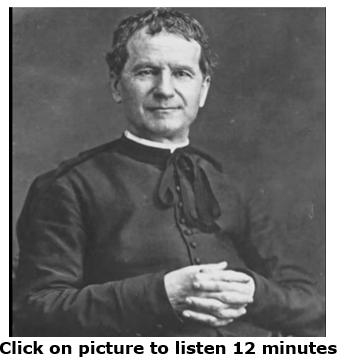
Fr. DON BOSCO EXPOSED THE DARK SECRET BEHIND ISLAM
I keep this one out here to view. Everyone should take the time to watch it. It will awaken you about the Muslim so-called religion (or should we call it for it is — a ‘cult‘.)
— And the truth the world forgot about the so-called Muslim religion.
Fr.Don Bosco, also known as John Bosco, was an Italian Catholic priest and educator, born on August 16, 1815. He founded the Salesian Society in 1859 to help disadvantaged youth, particularly boys, through education and community service. His teachings emphasized lovekindness, and the importance of education for young people, making him a beloved figure in Catholicism and a patron saint of youth. Don Bosco was canonized in 1934.

KATIE ZACHARIA PICKED FOR NEW WHITEHOUSE PRESS SECRETARY.


HERE’S WHAT THEY WERE LOOKING FOR AT ILHAN OMAR’S DC HOME

ILHAN OMAR RAID INDICATES SUBSTANTIAL EVIDENCE
THE U.S. TREASURY JUST OPENED THE DOOR TO GOLD
Treasury yields are surging, central banks are buying gold, and Washington is openly discussing inflation as a way to manage the debt. Could a gold revaluation be closer than most people think?

AMERICA’S 7 NEW ENERGY BREAKTHROUGHS ARE SHOCKING THE ENTIRE WORLD!
Why is the news media not talking more about these new energy sources? Is it because they hate president Trump so much that anything of progress or innovation is kept silent from the citizens? Simply put, they don’t want Trump’s administration to succeed.
A BATTLE IRAN DOES NOT WANT THE WORLD TO SEE

EUROPE IS ON THE VERGE OF COLLAPSE

7 European Countries on the Edge of Collapse: The Alarming Truth Europe Doesn’t Want You to Know

NEW TACTICS OF THE LEFT, EXTREMIST, DEMOCRAT LIBERALS
This is the only way they can get votes – just lie to the American people. What they do once elected is appalling. But you get what you vote for….
There is also news Leavitt may be joining FOX News. This could be the best thing that could happen to FOX.

THE GLOBAL DEBT CRISIS HAS BEGUN (WHY GOLD IS FALLING FIRST)
I was in the dentist not long ago and the nurse and doctor joked about how many scams there were about how to make money. They mentioned the Iraqi dinar and laughed. Then I mentioned silver and how silver has the potential to rise suddenly. They made a joke about it and pretended it was just another money-making scheme off the internet. Remember silver climbed from $25 an ounce to over $100 in a short time and then settled back to over $70. It recently climbed again over $100. Soon $100 will be the new norm. There is just too much going on financially to reset that silver at $300 an ounce cannot be a reality soon. This is how these metals work.
Am I telling you to buy silver? No, I do not give financial advice only tell you what I know from what I read. Of course, if you buy silver now you would have to wait for it to climb again and again and go through it process of ups and downs again until it settled to a new norm. You already missed the first phase. Will you miss the second?


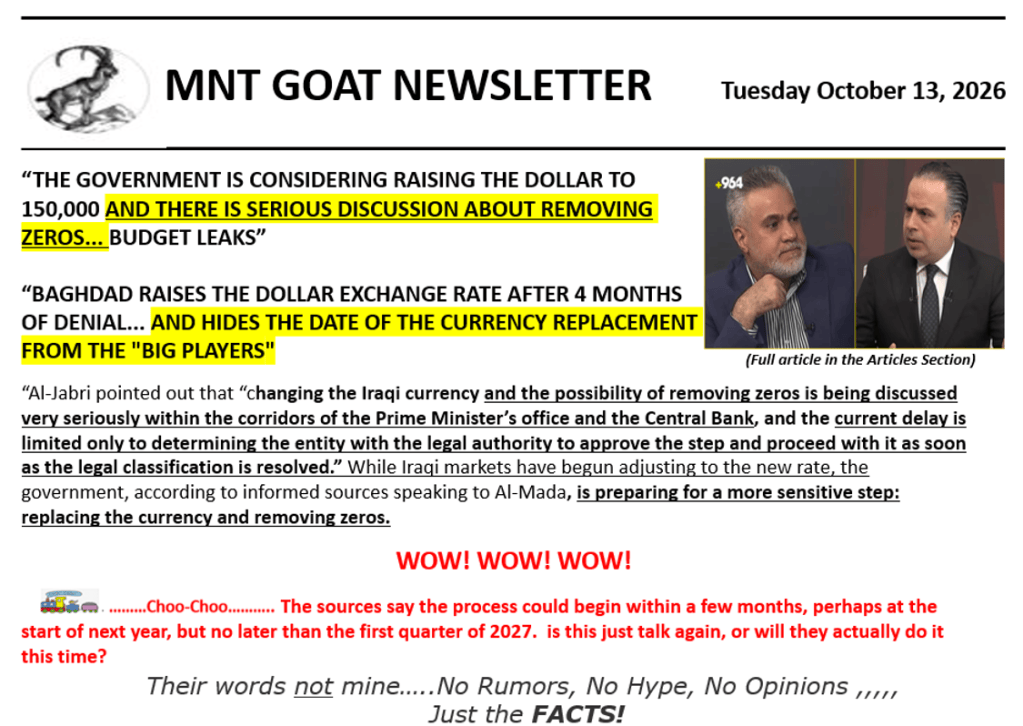
THE GOVERNMENT IS CONSIDERING RAISING THE DOLLAR TO 150,000 AND THERE IS SERIOUS DISCUSSION ABOUT REMOVING ZEROS… BUDGET LEAKS
Member of the Sadiqun parliamentary bloc and the parliamentary economic committee, Safaa al-Jabri, revealed a government plan to raise the official exchange rate of the dollar to 1,500 dinars instead of 1,310, in addition to proceeding with changing the Iraqi currency, potentially by removing zeros.
He also predicted that the 2027 budget revenues would exceed $110 billion. During an interview with journalist Laith al-Jazaeri on iNews channel, which was monitored by 964 Network, al-Jabri stated that Iraq has “emerged from its predicament,” accusing previous governments of pursuing what he described as populist policies, particularly regarding the proposed budget with a planned deficit ranging between 25 and 30 trillion dinars.
Al-Jabri said, “The size of the upcoming budget is changing due to the increase in customs and tax revenues, and achieving an increase of between 8 and 10 billion dollars in unprecedented domestic oil sales, with expectations that oil export sales will exceed 85 billion dollars, bringing total revenues to about 110 billion dollars.”
Al-Jabri explained that “the average daily oil sales price is currently stable between $80 and $82 per barrel, generating monthly revenues of around $5 billion,” adding: “Iraq has emerged from the bottleneck and the biggest economic crisis it faced as a result of the closure of the Strait of Hormuz and the cessation of Basra oil exports after finding solutions that have begun to gradually improve the situation.”
The member of the Economic Committee pointed out that “there is a proposal from the Minister of Finance to amend the official exchange rate to 150,000 dinars per 100 dollars, but there is no final decision yet, according to the leaked document of the budget proposal, whose planned deficit ranges between 25 and 30 trillion dinars.”
Al-Jabri pointed out that “changing the Iraqi currency and the possibility of removing zeros is being discussed very seriously within the corridors of the Prime Minister’s office and the Central Bank, and the current delay is limited only to determining the entity with the legal authority to approve the step and proceed with it as soon as the legal classification is resolved.”
The MP criticized the performance of previous financial policies, noting that “previous governments were populist, and budgets were prepared in a ‘copy-paste’ manner and on the ‘hand’ since 2006 for 20 years by the same person who progressed from Director General of the Budget to Undersecretary and then Minister of Finance,” referring to former Finance Minister Taif Sami, stressing that the current stage is witnessing corrective measures.
Al-Jabri added that “the Iraqi citizen ate bread during the current and previous year from the pockets of farmers who have not received the dues for marketing wheat until now, and the Al-Awais Company is demanding the dues for the food ration for the current and previous years, in addition to the existence of debts worth 33 billion on road and bridge projects, at a time when the Prime Minister canceled all the contracts of the previous government whose completion rate did not exceed 20%.”
*********************************************************************************************
ECONOMIST: RAISING THE DOLLAR EXCHANGE RATE IN THE BUDGET REQUIRES LEGISLATION, AND CURRENT STATEMENTS ARE MERELY TESTING THE WATERS.
(Mnt Goat: we already seen this statement in the heading did not pan out to be true. The rate was changed by the CBI)
Economic researcher Ali Tamr confirmed on Tuesday that the proposal to raise the dollar exchange rate within the budget comes as part of attempts to address the financial deficit. He explained that changing the exchange rate cannot be done through proposals or decisions, but rather requires a law voted on by the Council of Representatives.
Tamr told Al-Maalouma, “The proposal to raise the dollar exchange rate in the budget came as a result of the existing financial deficit, but it will not be implemented unless a law is passed by the Council of Representatives to become an enforceable decision.”
He added, “The data and statements circulating regarding raising the exchange rate may be to gauge public opinion in Iraq and assess reactions and the potential impact of the decision.” He pointed out that “the Iraqi public has become aware of the repercussions of raising the dollar exchange rate, especially since past experiences have not led to a permanent solution to the problem.”
Tamr explained that “the previous increase in the dollar exchange rate also occurred during a financial crisis, but the exchange rate did not return to its previous level after the crisis ended; rather, it negatively impacted the economic and living conditions.”
He pointed out that “all previous attempts aimed at achieving convergence between the official exchange rate and the parallel market rate have failed to close the gap,” noting that “repeatedly resorting to raising the exchange rate may not be the best option for addressing the fiscal deficit.”
He explained that “addressing the deficit should focus on increasing revenues, diversifying income sources, and maximizing state resources, rather than burdening citizens with the consequences of the financial crisis through measures that affect purchasing power. Furthermore, the issue of state funds and revenues must be addressed more effectively.” Iraq Banking Reforms
******************************************************************************************
THE CENTRAL BANK GOVERNOR TELLS PARLIAMENT: THE NEW EXCHANGE RATE IS FIXED AND CAN NEVER BE CHANGED.
(Mnt Goat: So here is the evidence it was changed by the CBI.
A parliamentary source reported on Thursday that the governor of the Central Bank informed members of the parliamentary finance committee that the exchange rate of the dollar would remain fixed at 1,500 dinars, stressing that it could not be changed.
The source told Shafaq News Agency that the Central Bank Governor explained to the committee members that any change in the dollar exchange rate within the general budget law would lead to a change in all the budget tables and items that were built on the basis of an exchange rate of 1,500 dinars per dollar.
He added that the Minister of Finance and the Governor of the Central Bank did not come to the House of Representatives building, while the Governor merely informed the members of the Finance Committee of the Central Bank’s position on the new exchange rate.
The parliamentary finance committee was scheduled to hold a meeting with the finance minister and the central bank governor to discuss the decision to change the dollar exchange rate and its repercussions, in addition to discussing the draft federal budget law, but the officials did not attend parliament.
The Speaker of Parliament decided to cancel today’s scheduled session, which was to include hosting Finance Minister Faleh Sari and Central Bank Governor Nizar Nasser Hussein to discuss the repercussions of the decision to raise the exchange rate of the dollar against the Iraqi dinar, and to settle for holding a meeting of the Finance Committee.
The Central Bank announced yesterday, Wednesday, the adoption of new exchange rates, according to which it set the price of buying the dollar from the Ministry of Finance at 1500 dinars, and selling it to banks at 1510 dinars, and to the public at 1520 dinars, starting from October 7, 2026.
(Mnt Goat: This is what happens when you don’t give the courtesy to work with the other branches of government on the exchange rate. This is why the CBI will NEVER change the exchange rate along, even though it technically and legally can. )
*********************************************************************************
MINISTRY OF FINANCE: THE DOLLAR EXCHANGE RATE HAS NOT YET BEEN DETERMINED; THE PROPOSED RATE RANGES BETWEEN 1400 AND 1500 DINARS.
(Mnt Goat: It appears that the CBI ‘jumped the gun’ and should have discussed this with both the Finance Committee and Parliament to get a final rate. As the article says it was not yet even finalized and could have ranged from 1400-1500. The CBI arbitrarily put it to 1500 without any discussions.)
The Ministry of Finance denied on Sunday that a specific exchange rate for the US dollar had been set in the 2027 budget, while indicating that the proposed rate of 1400-1500 dinars would likely be adopted.
The statement from the ministry, reported by Al-Maalomah News Agency, quoted the Minister of Finance as saying that the exchange rate had not yet been determined and that the proposed rate ranged between 1400 and 1500 dinars. The statement added that the diversification of oil export sources, the coherence of the government program, and the ability to cover the budget deficit were all factors in the budget.
It further explained that all contracts would be made permanent and salaries converted to Contract 315. The statement also noted that 100,000 contracts had been created in the budget, with 50,000 allocated to security forces and another 50,000 to civilian positions.
********************************************************************************
MALIKI’S BLOC: CALLS TO WITHDRAW CONFIDENCE FROM AL-ZIDI’S GOVERNMENT DUE TO THE RISE IN THE DOLLAR EXCHANGE RATE
MP Falah al-Khafaji, from the State of Law Coalition, revealed that there are parliamentary trends to withdraw confidence from the government of Prime Minister Ali al-Zidi if the decision to raise the dollar exchange rate continues, stressing that the decision surprised the House of Representatives and it was not informed of it beforehand.
Al-Khafaji said that the House of Representatives will host the Minister of Finance and the Governor of the Central Bank, with the possibility of summoning the Prime Minister, noting that the continued repercussions of the decision may push parliamentary voices to demand a vote of no confidence in the government.
He added that changing the exchange rate is a decision for which several parties bear responsibility, including the coordinating framework, the heads of political blocs, and the Minister of Finance, stressing that the decision was taken without putting in place solutions to protect the middle and poor classes.
He explained that most of the MPs were not aware in advance of the change in the exchange rate, despite the issue being raised in a limited way during the Finance Committee meeting with the Minister of Finance, who informed the MPs at the time that there was no intention to change the exchange rate.
He pointed out that raising taxes, customs duties and prices of petroleum products, in conjunction with changing the exchange rate, has led to harm to citizens and a state of stagnation in the markets.
The Cabinet had decided to amend the exchange rate of the dollar, so that the final selling price for citizens and non-bank financial institutions would be 1520 dinars per dollar instead of 1320 dinars.
(Mnt Goat: Looks like they did it. They changed the official exchange rate and just devalued the dinar. This is worse then during the pandemic period even.)
*********************************************************************************
AN ECONOMIST: 3 FACTORS PROMPTED THE GOVERNMENT TO RAISE THE DOLLAR EXCHANGE RATE
Economic expert Mustafa Hantoush revealed the reasons for the rise in the dollar exchange rate, pointing out that the decision came in light of financial pressures facing the state, including:
1. the decline in oil revenues and the closure of the Strait of Hormuz .
Hantoush said in a televised interview followed by Al-Sa’a Network, “Iraq’s revenues are in dollars, as its revenues in the 2027 budget are estimated at 90 billion dollars, and at a rate of 1320, it does not equal 117 trillion in the face of the size of operational spending and appointments.”
2,He pointed out that “going to a price of 1500 could bring revenues to 128 trillion,” explaining that “as long as the state does not know how to deal with the private sector, it will not have a source of revenue .”
He added that “due to the closure of the Strait of Hormuz, the collapse of oil prices, the depletion of the central bank’s reserves, and appointments, the state resorted to raising the exchange rate.”
***************************************************************************************
BASEM AL-GHARIBAWI: THE GOVERNMENT CHOSE THE EASIEST PATH BY DEVALUING THE DINAR.
Former MP Bassem Al-Gharibawi confirmed on Thursday that the measure taken by the government regarding raising the dollar exchange rate was not well thought out, indicating that the difficult economic conditions that Iraq is going through and the delay in salaries require taking multiple measures before resorting to burdening the citizen with the cost of treatment.
Al-Gharibawi told Al-Maalomah that “the citizen has become the primary target of government measures in every crisis the country faces,” noting that “the decision to raise the exchange rate was made without sufficient study of its repercussions, which will put additional pressure on the economy and could lead to a recession in the markets.”
He added that “before resorting to raising the dollar’s value, the government should have worked on controlling border crossings and combating waste and smuggling, in addition to searching for alternative revenue sources to help reduce dependence on oil revenues, instead of taking the easiest solution by raising the exchange rate.”
Al-Gharibawi explained that “Iraqi employees have lost more than a third of their purchasing power as a result of rising prices and exchange rate fluctuations,” questioning the ability of those with limited incomes, daily wage earners, and the poor to cope with the repercussions of the rising cost of living under the current economic conditions.
He pointed out that “there are questions about whether some political parties benefited from raising the exchange rate,” indicating that “the political class was aware beforehand of the possibility of raising the dollar’s value, and that some entities bought dollars before the decision, which led to an inflation of their wealth after the exchange rate increase.”
Al-Gharibawi questioned the rationale behind creating new positions, such as deputy prime ministers or other posts, at a time when the government acknowledges the country is facing difficult economic circumstances and is simultaneously raising the dollar exchange rate. He called for a reduction in government spending and unnecessary expenditures.
He noted that the repercussions of the decision have already begun to be reflected in market prices, warning of continued price hikes and worsening living conditions. He indicated that the continuation of these policies could lead to increased public anger towards the government.
***************************************************************************************
THIS EVENING, A GOVERNMENT-PARLIAMENTARY MEETING WILL BE HELD IN THE CONSTITUTIONAL HALL TO DISCUSS THE “EXCHANGE RATE”.
An informed source reported on Thursday that the House of Representatives will hold a joint government-parliamentary meeting regarding changing the dollar exchange rate.
The source told Shafaq News Agency that “a meeting will be held in the Constitutional Hall inside the Iraqi Parliament at 8 pm.”
He added that “the meeting will be attended by the Prime Minister, the Speaker of Parliament, the heads of the blocs, the Minister of Finance and the Governor of the Central Bank to discuss the issue of raising the dollar exchange rate and its repercussions.”
Today, a parliamentary source reported that the governor of the Central Bank informed members of the parliamentary finance committee that the exchange rate of the dollar would remain fixed at 1,500 dinars, stressing that it could not be changed .
The source told Shafaq News Agency that the Central Bank Governor explained to the committee members that any change in the dollar exchange rate within the general budget law would lead to a change in all the budget tables and items that were built on the basis of an exchange rate of 1,500 dinars per dollar .
He added that the Minister of Finance and the Governor of the Central Bank did not come to the House of Representatives building, while the Governor merely informed the members of the Finance Committee of the Central Bank’s position on the new exchange rate.
The Central Bank announced yesterday, Wednesday, the adoption of new exchange rates, according to which it set the price of buying the dollar from the Ministry of Finance at 1500 dinars, and selling it to banks at 1510 dinars, and to the public at 1520 dinars, starting from October 7, 2026.
***************************************************************************************
BAGHDAD RAISES THE DOLLAR EXCHANGE RATE AFTER 4 MONTHS OF DENIAL… AND HIDES THE DATE OF THE CURRENCY REPLACEMENT FROM THE “BIG PLAYERS”.
The framework was approved at Al-Hakim’s house… and (Al-Mada) revealed the plan to change the exchange rate in June.
Raising the dollar exchange rate to over 1,500 dinars may not be the last surprise Baghdad has in store.
While Iraqi markets have begun adjusting to the new rate, the government, according to informed sources speaking to Al-Mada, is preparing for a more sensitive step: replacing the currency and removing zeros.
The sources say the process could begin within a few months, perhaps at the start of next year, but no later than the first quarter of 2027.
But there’s another reason behind the timing.
Sources believe that replacing the currency could help track down at least $200 billion believed to be held by corrupt individuals. Therefore, according to these sources, the measure is being kept secret until now. Early talk of a currency change could give those with illicit funds time to act. They could buy dollars, real estate, or convert the money into assets that are difficult to link to the cash they will later be asked to exchange.
For this reason, the sources say, Baghdad wants the money to reach the point of exchange before the news reaches them.
THE DOLLAR COMES FIRST.
This potential move follows a decision by Baghdad regarding the dollar, a decision it had denied for nearly four months. Yesterday, the government announced that the selling price of the dollar to the public would become 1,520 dinars, compared to the previous 1,320 dinars.
In June, the government confirmed that there were no plans to print money or devalue the dinar to compensate for the liquidity shortage.
The Central Bank at the time denied any intention to adjust the exchange rate, after media outlets circulated a forged document indicating the possibility of raising the dollar price to 1,600 dinars.
According to Central Bank Law No. 56 of 2004, the exchange rate of the local currency against foreign currencies is determined by the Central Bank’s board of directors. However, the bank stated yesterday that the decision was made “in light of the current economic and financial circumstances,” and based on a recommendation from the Council of Ministers, with the aim of meeting the financial requirements of the general budget, relying on the provisions of the amended Central Bank Law No. 56 of 2004.
The Central Bank attempted to reassure the market that the decision did not signify a shortage of foreign currency. He stated that the bank’s reserves were “sufficient” to meet foreign trade financing demands, settle bank card payments abroad, and facilitate cash sales to travelers.
In the parallel market, however, the reaction was swifter than the official figures. The dollar surpassed 1,800 dinars, up from less than 1,500 before the amendment, while wholesale markets in Baghdad closed due to the price volatility. The decision came approximately three and a half months after Nizar Nasser Hussein assumed the position of Central Bank Governor, succeeding Ali Mohsen Al-Alaq in June.
For the government, the decision to raise the exchange rate by 20 trillion dinars is not without its clear benefits. Initial estimates indicate that the new exchange rate will add approximately 20 trillion dinars to the budget.
However, this figure comes at the expense of a larger one: a projected deficit of around 65 trillion dinars in the 2027 budget.
In response to the exchange rate adjustment, MP Miqdad al-Khafaji called on members of parliament to convene an immediate emergency session to compel the government to reverse the increase in the dollar exchange rate.
In a statement, al-Khafaji said the decision comes “at a time when political blocs are preoccupied with ministerial appointments and creating new positions that further burden the state budget,” adding that the exchange rate increase “adds a new burden to the Iraqi citizen.” He emphasized that raising the exchange rate directly leads to price increases and a decline in the purchasing power of employees and citizens with low incomes. He stated that “the public, already burdened by crises, cannot bear any new burdens.” He demanded that the interests and livelihoods of citizens be prioritized above all other considerations and that the decision be immediately reversed to avoid its repercussions on local markets.
Economic researcher and consultant Ziad al-Hashemi sees the matter from a different angle. For him, changing the exchange rate is not reform so much as it is “buying time” and delaying the path of financial reform. He says that genuine reform requires stringent measures and decisions that “the powerful will not accept.”
Therefore, according to al-Hashemi, the easiest option becomes devaluing the dinar and making the public bear the responsibility for the government’s financial and administrative failures.
This disagreement places the dollar decision within a broader economic plan that Prime Minister Ali al-Zaidi presented as a reform plan for the economic system. According to what was presented about the plan, it was supposed to be implemented in coordination with the US administration and include American investments in exchange for resolving the issue of weapons, a path that is now faltering.
Al-Mada was the first to reveal, in a report published on June 11, that the plan is based on three tracks: changing the exchange rate, selling indebted institutions, and recovering funds from corrupt individuals. The plan was discussed and approved at a meeting of the Shiite Alliance held that same month at the home of Ammar al-Hakim, leader of the Hikma Movement.
Since then, the government says it has recovered more than one trillion dinars, in the form of cash and real estate, through its anti-corruption campaigns.
Al-Zaydi says this money will be added to a new fund.
“We established the Generations Fund, and allocated 1.5 trillion dinars to it,” he said.
In a recent meeting with tribal sheikhs in Baghdad, al-Zaydi said that reforming the Iraqi economy requires attracting foreign investment, asserting that by 2031, Iraq’s oil production will reach 10 million barrels per day.
But Iraq is not living in 2031, and the government, according to previous statements, needs at least 10 trillion dinars monthly to cover salaries and public expenditures.
Oil constitutes about 90% of the budget revenues.
But al-Hashemi fears that a large portion of these savings will go toward funding an already bloated government apparatus. He believes that much of the difference resulting from exchange rate fluctuations will likely be used to further increase the number of employees in a government that already suffers from a significant surplus, with reports of new appointments.
The parliamentary finance committee had reported that approximately one million contract workers and temporary employees would be given permanent positions within the 2027 budget. Former MP Majid Shenkali believes these appointments are difficult to separate from the new financial calculations.
He stated that changing the exchange rate to cover the budget deficit, while the government continues to expand its regularization and appointment programs, represents a “complete disconnect from reality, both financially and politically,” amidst rapidly evolving regional and international developments.
A budget that pays the price for the past, and the initial figures for the 2027 budget reveal the extent of the pressure. According to the Finance Committee and experts, the budget amounts to approximately 218 trillion Iraqi dinars.
Oil revenues are estimated at around 144.720 trillion dinars. Public expenditures reach 217.239 trillion dinars, including 47.897 trillion dinars for investment spending and 169.342 trillion dinars for operational expenses. Salaries for permanent employees amount to 68.125 trillion dinars, an increase of 8.951 trillion dinars.
Al-Hashemi states in a post that the details of the new draft budget confirm that the Iraqi government has done little to overcome the painful repercussions of the war with Iran, and that it aims to burden the people with a large share of the suffering they “do not deserve.”
***************************************************************************************
THE DOLLAR RISES FIRST… BAGHDAD IS KEEPING THE DATE FOR CURRENCY REPLACEMENT SECRET FOR FEAR OF A MOVE BY “BIG PLAYERS”.
Raising the price of the dollar to more than 1500 dinars may not be the last surprise that Baghdad has in store.
As Iraqi markets began to deal with the new dollar exchange rate, the government is preparing for a more sensitive step, which is replacing the currency and removing zeros from it.
The process may begin within a few months, perhaps at the beginning of next year, but should not exceed the first quarter of 2027, according to Al-Mada newspaper .
The newspaper, in a report seen by Al-Sa’a Network, quoted its sources as saying that “replacing the currency could help to lock up at least $200 billion believed to be in the hands of corrupt individuals, and therefore the procedure is being kept secret until
now .”
She added that “talking too early about changing the currency may give those with illicit funds time to act. They can buy dollars, real estate, or convert the money into assets that are difficult to link to the cash they will be asked to exchange later,” indicating that “Baghdad wants the money to reach the moment of exchange before the news reaches it .”
She pointed out that “real reform requires strict measures and decisions that the big players will not accept,” adding that “the easiest option is to reduce the value of the dinar and hold the public responsible for the government’s financial and administrative failures .”
The report noted that “this dispute places the dollar decision within a broader economic plan that Prime Minister Ali al-Zaidi had presented as a reform plan for the economic system,” indicating that “it was supposed to be carried out in agreement with the US administration, and to include the entry of US investments in exchange for ending the arms issue, a path that is now faltering .”
He explained that “the initial figures for the 2027 budget reveal the extent of the pressure, and according to the Finance Committee and experts, the budget amounts to about 218 trillion Iraqi dinars,” indicating that “oil revenues amount to about 144 trillion and 720 billion dinars .”
He added that “public expenditures amount to 217 trillion and 239 billion dinars, including 47 trillion and 897 billion dinars for investment expenditures, and 169 trillion and 342 billion dinars for operational expenditures,” noting that “the salaries of employees on the permanent staff amount to 68 trillion and 125 billion dinars, an increase of 8 trillion and 951 billion dinars .”
He explained that “the details of the new draft budget confirm that the Iraqi government has not done much to overcome the painful repercussions of the war on Iran, and that it aims to burden the people with a large part of the pain that they do not deserve.
***************************************************************************************
AL-JALABI: WASHINGTON DOMINATES KEY IRAQI DECISION-MAKING POSITIONS, AND TRUMP IS PLANNING TO PLUNDER IRAQ’S WEALTH.
Zuhair al-Jalabi, a member of the Coordination Framework, affirmed that the United States continues to exert its direct hegemony and influence over political, economic, and even security decisions in Iraq, warning of US President Donald Trump’s plans to seize the country’s wealth and resources.
(Mnt Goat: Really? How can al-Jalabi dare to day this in the midst of trillions of dollars (not dinars) that has been stolen from Iraq due to corruption and most of it sent to Iran. What did it do for Iran? It paid for its military and nuclear ambitions. This is ironic.
Why don’t they first look in the their own backyard before mouthing off against America. Trump has repeatedly said any deals with Iraq will help Iraq to grow and beome very weathy but US investors must also make money. This is only common sense. Why would you invest if you can’t make any money? Oh who is Al-Jalabi? Of course he is an Iranian influence politician in the Coordination Framework. Go figure…. They would like everything to stay the same, wouldn’t they? To keep plundering Iraq all for themselves. The fact that Trump is stopping this they don’t like.
This brings us to our investment as we too are investors in the dinar and have been supporting their economy through hard times. Where is our payoff?)
In a statement to the Information Agency, al-Jalabi said, “American hegemony is no longer limited to the political arena or security presence, but has extended to the very heart of the Iraqi economy and the pillars of the country’s financial sovereignty.” He explained that “Washington controls vital sectors and imposes restrictions that hinder the state’s progress and the independence of its national decision-making.”
He added that “the Trump administration is clearly and blatantly seeking to establish complete control over Iraq’s funds, resources, and vital economy to exploit them for its own destructive agendas,” while simultaneously criticizing “the complete silence and submissiveness displayed by Prime Minister Ali Abdullah Saleh regarding this ongoing foreign encroachment on the Iraqi people’s resources.”
Al-Jalabi stressed “the necessity of adopting a firm and courageous national stance that breaks the shackles of foreign tutelage, ends subservience to Washington, and safeguards the country’s full sovereignty in economic, security, and political matters.
******************************************************************************************
AL-ZAIDI: FIVE FACTIONS HAVE AGREED TO HAND OVER THEIR WEAPONS, AND IRAQ AIMS TO PRODUCE 10 MILLION BARRELS PER DAY.
Prime Minister Ali Faleh al-Zaidi praised on Monday the tribes’ supportive stance towards the state and their contribution to maintaining order during difficult times, noting that no one who tries to weaken the state or threatens its existence will be allowed to do so.
Al-Zaydi said during his meeting with tribal sheikhs and dignitaries, according to a statement received by Shafaq News Agency, that the government avoided imposing international isolation on Iraq and extended its hand to the world for partnership, stressing the government’s work on establishing a successful economic identity through a budget of programs that focused on electricity infrastructure.
He pointed to the move towards building and strengthening the existence of a state that honors Iraqis, explaining that they are fighting an approach that views the state as an individual benefit at the expense of the interest of all segments of the Iraqi people.
He added that the current economic crisis has greatly affected the Iraqi economy, explaining that Iraq needs a beneficial international partnership, especially with major and economically advanced countries.
Al-Zaydi explained that reforming the Iraqi economy requires attracting foreign investments and the withdrawal of any foreign forces from Iraq, stressing that in 2031 Iraq’s oil production will reach 10 million barrels per day.
He continued, saying, “We established the Generations Fund and allocated 1.5 trillion dinars to it,” adding that “the funds recovered from anti-corruption operations will be added to the Generations Fund account.”
He affirmed: “We spoke with the Turkish side on multiple issues, and there is a withdrawal from the locations where the Turkish army is present inside Iraqi territory,” indicating that “we held talks with the Kuwaitis, and there is a sincere intention to resolve all bilateral problems and obstacles.”
He noted that 5 factions had agreed to hand over weapons, and 3 of them had already handed over their weapons, and dialogue was continuing with the others, pointing out that 500 billion dinars had been released monthly to pay the farmers’ dues.
According to Al-Zaydi, the project of one million residential plots will be completed and will contribute to solving the housing problem with full services, adding that he will start building new cities in each governorate, bearing its identity and history.
He concluded by saying that unifying ranks is required, and we must preserve Iraq’s honorable history and our strength by making decisions Iraqi, noting the effort to keep Iraq away from any consequences of conflicts in the region, and that the stability of our society and our people is our goal.
*******************************************************************************************
EXTENDING THE DEADLINE FOR HANDING OVER WEAPONS… WILL THE AL-ZAIDI GOVERNMENT RENEGE ON ITS MOST PROMINENT PLEDGES?
Questions are increasing in Iraqi political circles regarding the decision of Prime Minister Ali al-Zaidi’s government to back down from the September 30 deadline for resolving the issue of restricting weapons to the state, amid political interpretations that see the extension of the deadline as a retreat from one of the most prominent principles on which the government was founded.
Observers believe that restricting weapons to the state was not a secondary issue in Al-Zaydi’s government program, but was presented as one of the government’s main priorities, within the framework of consolidating state authority and ending any manifestations of weapons outside its official institutions.
According to these readings, failure to adhere to the September 30th deadline puts the government before a political test, especially since the date was linked to a phase that official discourse described as “Sovereignty Day,” coinciding with the end of the international coalition’s mission and the withdrawal of US forces from Iraq.
Observers believe that the scene that accompanied the celebrations of Sovereignty Day carried a political paradox, as some of those clinging to weapons appeared presenting their armed presence as part of the force that contributed to the withdrawal of American forces, which, according to them, put the government in a political and popular embarrassment, especially since the government’s discourse was simultaneously moving towards emphasizing that the decision of war, peace and weapons should be within the institutions of the state.
Observers believe that backing down from resolving the issue on the announced date may open the door to questions about the extent to which the al-Zaidi government is able to implement its basic commitments, especially since the weapons issue was one of the most sensitive issues in the relationship between Baghdad and Washington, and between the government, political forces, and armed factions.
The debate is not limited to the Iraqi interior, as observers believe that any setback in this matter may also be reflected in the shape of American policy towards the al-Zaidi government during the next stage, considering that Washington may reassess its approach to the relationship with Baghdad if it concludes that the government is unable or unwilling to implement its commitments regarding restricting weapons to the state.
On the other hand, extending the deadline may be interpreted from another perspective as a governmental attempt to manage a highly complex political and security issue, and to avoid a sudden shift to measures that could trigger an internal confrontation, especially given the entanglement of the issue with political forces and factions that possess broad influence.
Between these two paths, the Al-Zaidi government finds itself facing a delicate equation: either to proceed with implementing its pledge to restrict weapons to the state, even gradually, or to face political accusations of backtracking on one of the most prominent promises upon which its government was founded.
As the debate continues, the most prominent question in political circles remains: Does extending the deadline merely postpone the procedures for resolving the weapons issue, or is it an indication of a broader change in the approach of the Al-Zaidi government towards one of the most sensitive issues in the Iraqi scene?
*******************************************************************************************
DISARMAMENT IS NOT FREE… NEW MINISTRIES AND A RISE IN THE DOLLAR TO COVER ADDITIONAL EXPENSES
(Mnt Goat: Who runs the government, the prime minister once in office or the coordination framework?)
The factions will manage “artificial intelligence” and tourism? What?
The Coordination Framework was apparently surprised by the extent of the anger sparked by the decision to raise the dollar exchange rate.
According to Al-Mada, it began promoting the possibility of dismissing Ali al-Zaidi in an attempt to contain the public pressure.
Ironically, however, the decision was not a surprise within the Shiite alliance itself. According to informed sources, its constituent forces had agreed to raise the exchange rate before some of them found themselves facing the repercussions of a decision that now required political containment.
Since the end of last week, political and popular movements have been organizing demonstrations and protests against the measure, which has devalued the Iraqi dinar by about 15%.
In a late-night session of Parliament on Thursday, Prime Minister Ali al-Zaidi defended the decision, declaring himself solely responsible. However, this admission of responsibility, which appeared to be an attempt to end the controversy surrounding who made the decision, did not resolve the debate about its political motivations.
According to Ali al-Jurani, a member of the Hikma Movement, the dollar exchange rate increase originated from the Coordination Framework and received the approval of the heads of the political blocs and the State Administration Coalition.
Al-Mada newspaper revealed in a report published on June 11 that the economic plan being discussed among political forces is based on three tracks: changing the exchange rate, selling indebted institutions, and recovering funds from corrupt individuals. According to this information, the plan was discussed and approved during a meeting of the Shiite Alliance held that same month at the home of Ammar al-Hakim, leader of the Hikma Movement.
In this climate, the possibility of a vote of no confidence against the Prime Minister emerged. Falah al-Khafaji, a member of parliament from the State of Law Coalition, stated that several parliamentary blocs might move to withdraw confidence from al-Zaidi’s government if the decision to raise the exchange rate continues.
However, informed sources who spoke to Al-Mada believe that promoting the possibility of a no-confidence vote is also being used to try to absorb public anger and redirect attention to the fate of the government, rather than focusing the discussion on the decision itself and the parties that approved it.
Three options… but where is the austerity?
In Parliament, al-Zaidi explained that his government faced three unpalatable options to secure salaries and overcome the financial crisis: “forced savings and leaving employees to live on promises, distributing salaries every 45 days, or borrowing and plunging the country into debt.”
According to a statement from his media office, al-Zaidi said his government “took over the task with the economy under siege,” and that borrowing was not a suitable option given the size of the existing debt. He added that Iraq is going through “a dire situation and an undeclared siege” due to the war and the closure of the Strait of Hormuz, stressing that his government does not want to resort to further borrowing to avoid overburdening the economy.
In defending the adjustment of the exchange rate, al-Zaidi said that the difference in the previous dollar price “was being exploited by speculators,” emphasizing that the government is continuing its fight against corruption and that the economy must be treated with an “economic mindset.” He also announced that “good amounts”—estimated at more than $3 billion—of foreign currency will arrive in the coming days, confirming that the government will inject them into circulation.
But what sparked objections from economic experts was not only what the Prime Minister said, but what he did not address in his speech: reducing public spending, abolishing some privileges, reviewing salaries and positions, and investigating the areas of waste that drain public funds.
*******************************************************************************************
IRAQ RANKS 28TH GLOBALLY IN FOREIGN CURRENCY RESERVES AT $85 BILLION.
(Mnt Goat: Down from $110 billion dollars)
Iraq ranked 28th globally among the countries with the largest foreign exchange reserves out of 30 countries listed in the table, with a total of about $85 billion, according to a ranking published by the Canadian website “Visual Capital East” based on the latest data from the International Monetary Fund. According to the ranking, Iraq came after France, which ranked 27th with reserves of $86 billion, and before Romania, which ranked 29th with $78.2 billion, while Turkey came in 30th and last place with $76.6 billion.
China topped the list with reserves of $3.41 trillion, followed by Japan with $1.259 trillion, then Switzerland with $932.3 billion, Taiwan with $602.5 billion, and India with $543 billion.
In the Arab world, Saudi Arabia came in sixth place globally with reserves of $458.6 billion, and the UAE in 12th place with $251.4 billion, while Iraq came in third place among the top thirty countries with the largest reserves.
The classification, based on data from the International Monetary Fund’s International Reserves and Foreign Exchange Liquidity Database, indicated that foreign exchange reserves are a key tool for coping with economic shocks, supporting currency stability, financing imports, and servicing external debt. The classification excludes gold from foreign exchange reserves and is based on the most recent reporting periods available between mid-2025 and the second quarter of 2026.
********************************************************************************************
GOVERNMENT POLICY TO ADOPT THE IRAQI DINAR IN TRANSACTIONS WITHIN IRAQ
On Saturday, October 10, 2026, Mazhar Muhammad Saleh, an advisor to Prime Minister Ali al-Zidi, revealed a government plan to adopt the Iraqi dinar for transactions within Iraq.
Saleh said in a statement followed by “Ultra Iraq” that “there is a governmental trend to adopt the Iraqi dinar in transactions within Iraq in accordance with the relevant legal provisions, which supports confidence in the national currency and regulates transactions in the market,” as he put it.
Saleh spoke about “government oversight measures” and considered them “a fundamental pillar for controlling markets and limiting unjustified price increases, and confronting monopoly, speculation and exploitation of citizens’ need for food and consumer goods,” stressing that “the continuation of oversight campaigns, strengthening institutional coordination, supporting local production, facilitating the flow of goods and holding violators accountable, represent important factors for protecting the consumer and enhancing market stability.”
He pointed to “the importance of coordination between the concerned authorities to ensure the smooth flow of goods to the markets, in parallel with government measures aimed at facilitating trade and addressing obstacles facing the processing and distribution operations, which enhances market efficiency and contributes to price stability and the availability of basic materials,” as well as “the importance of adhering to the applicable legislation that regulates financial and commercial transactions,” indicating that “the integration of the work of commercial and regulatory bodies contributes to monitoring markets, detecting violations and applying legal measures against violators, which enhances fair competition and protects the purchasing power of citizens, especially those with limited income.”
The advisor pointed out that “price stability is not achieved by monitoring alone, but requires its integration with economic and supply policies and procedures that facilitate commercial activity, in order to support living, economic and social stability in Iraq.”
He also said that “effective oversight does not target legitimate business activity, but rather seeks to prevent monopolistic practices, price manipulation, and exploitation of economic conditions to achieve unjustified profits, while maintaining a balance between the rights of consumers and the interests of committed traders, and establishing a business environment based on transparency and fairness.”
On October 7, 2026, the financial authorities in Iraq announced a reduction in the value of the dinar for the third time in six years, bringing it to 152,000 dinars per 100 dollars, for the currency sold to the public, or the “end user”.
The Central Bank decided to adopt a new exchange rate for the dollar, according to a document issued by the bank, which stated: “With reference to the Cabinet’s decision taken in its twenty-second session on October 6, 2026, which included amending the exchange rates of the Iraqi dinar against the US dollar in a way that meets the relevant financial, economic and monetary requirements.”
He added: “Based on the provisions of the Central Bank of Iraq Law No. 56 of 2004, as amended, it was decided to adopt the following exchange rates:
- The purchase price of the US dollar from the Ministry of Finance: (1500) dinars per dollar.
- The selling price of the US dollar to banks: (1510) dinars per dollar.
- The selling price of the US dollar to the public: (1520) dinars per dollar.
The Iraqi parliament hosted Prime Minister Ali al-Zaidi to “clarify the details and necessities related to changing the foreign currency exchange rate.”
Al-Zaydi told the House of Representatives that “the government had three options: the first was to resort to mandatory savings and leave the employee to live on promises, the second was to distribute salaries every 45 days, and the third was to resort to borrowing and drown the country in debt, which it is already burdened with.”
Al-Zaydi revealed that “the difference in the dollar exchange rate was previously taken over by speculators,” adding: “I took over the task when the size of the public debt was more than 208 trillion dinars, and the government is required to provide 10 trillion dinars monthly, and despite the crisis, we provided the salaries.”
Al-Zaydi pointed out that “in the coming days, good quantities of dollars will arrive and we will inject them into circulation.”
************************************************************************************
THE ASSOCIATION OF PRIVATE BANKS REVEALS THREE PILLARS FOR BANKING REFORM.
The Association of Private Banks revealed on Monday three pillars of banking reform, noting that the banking reform plan is reviewed every six months.
The association’s executive director, Ali Tariq, told the Iraqi News Agency (INA): “The Central Bank has launched a central reform plan for 2025-2027, and this plan concerns private banks, which must implement it on several axes, including governance, the work plan, financial indicators, in addition to compliance and combating money laundering.”
He added that “the banks are working on this plan and reviewing it every six months, with the aim of all banks implementing it,” indicating that “there are paths to reform, whether reform individually, mergers, or outside the market.”
He added that “the banking reform plan is a large plan with many requirements that private banks must fulfill within the set timeframe.”
*********************************************************************************************
CENTRAL BANK: OUR RESPONSIBILITY IS TO MAINTAIN THE VALUE OF THE DINAR AGAINST FOREIGN CURRENCIES
The Central Bank of Iraq confirmed on Tuesday that its current mission is to maintain the value of the Iraqi dinar against foreign currencies.
The representative of the Governor of the Central Bank of Iraq, Samir Fakhri, said at the Middle East Forum for Research and Peace (MERI), held in Erbil, and attended by a correspondent from the Iraqi News Agency (INA): “The issue of the exchange rate and its relative importance differs from one country to another,” explaining that “the exchange rate is important for Iraq, because the Iraqi economy is rentier in nature and depends on dollar revenues.”
He added that “Iraq’s sources of income depend on external demand, and the most important equation in the Iraqi economy is government spending in dinars.” He pointed out that “the use of the dinar as a means of government spending is a fundamental driver, representing a component of aggregate demand, which is linked to oil revenues, and the exchange rate is the link to all of this.”
He added that “the central bank’s mission is to maintain the value of the local currency against foreign currencies,” explaining that “growth in the private sector boosts GDP and reduces demand for the dollar.”
He stressed that “every dinar spent by the general budget generates a demand for dollars through the central bank, given the limited contribution of local economic sectors to the gross domestic product.”
He stressed “the importance of working to develop the private sector and enhance its actual contribution to the gross domestic product, which will contribute to reducing the demand for the dollar,” noting that 60 to 70% of the dinars spent are returned in the form of demand for the dollar, while the remaining part accumulates within the central bank’s reserves.
He explained that “the Central Bank’s reserves are owned by the state, and the government represents the equivalent of the dinars that were spent through the exchange rate mechanism,” stressing that “Iraqi exports depend on crude oil by 98%, while oil revenues constitute more than 93% of total public revenues.”
*****************************************************************************
THE CENTRAL BANK CONFIRMS ITS VAULTS ARE FULL OF IRAQI DINARS
The Director General of the Statistics and Research Department at the Central Bank of Iraq, Samir Fakhri Naama, confirmed on Tuesday that the Central Bank’s vaults are full of dinars.
Naama said in a statement followed by (Al-Mada), “The vaults of the Central Bank of Iraq are currently full of dinars,” noting that “at no time has it been permissible to say that the Central Bank of Iraq does not have dinars.”
(Mnt Goat: Now I am really confused! ☹ Hasn’t the CBI been telling us for years that nearly 80-90% of the issued currency(3 zero notes) is outside the banking system. Today they are telling us that large amounts of this currency is actually inside the vaults of the Central Bank. Are they talking about the newer lower denominations yet to be issued? It would have to be or else this is a gross contradiction. I think they are.)
He added that “there is an impact on the poor from the change in the exchange rate, but not with the expected impact because the state will subsidize a range of goods,” noting that “prices will rise by a much smaller percentage compared to the amount of the change in the exchange rate.”
He added that “the bank’s reserves are in a comfortable position,” calling for dealing in dinars to reduce dependence on the dollar.
*************************************************************************************
THE CENTRAL BANK OF IRAQ: THE HORMUZ CRISIS FORCED AN INCREASE IN THE DOLLAR EXCHANGE RATE TO PROTECT RESERVES.
The Central Bank of Iraq revealed the economic and financial reasons that prompted it to adjust the exchange rate of the dollar against the dinar, stressing that the repercussions of the Strait of Hormuz crisis and the decline in oil revenues imposed increasing pressure on foreign reserves, and placed monetary policy before challenges related to financing government spending and maintaining financial stability.
These clarifications come at a time when the Iraqi economy is facing complex challenges as a result of its heavy reliance on oil to finance the general budget, coinciding with regional turmoil that has affected the movement of oil supplies and dollar revenues, bringing the issue of the exchange rate back to the forefront of economic and political debate.
Samir Fakhri Naama, Director General of the Statistics and Research Department at the Central Bank of Iraq, said during his participation in the ninth dialogue session of the “Miri 2026” forum in Erbil that the decision to amend the exchange rate represents, from the Central Bank’s point of view, the ideal solution to confront the financial shock resulting from the Strait of Hormuz crisis and to preserve Iraq’s foreign currency reserves.
Naama explained that the Iraqi economy differs from the economies of countries with diversified production bases, as it depends almost entirely on oil revenues, which constitute more than 93% of the state’s public revenues. This means that any disruption in oil production or export directly affects the government’s ability to finance its obligations.
THE HORMUZ CRISIS REVEALS THE FRAGILITY OF DEPENDENCE ON OIL.
According to the central bank official, the crisis related to the Strait of Hormuz during 2026 caused a negative shock to oil production and the revenues generated from it, which led to increased pressure on economic indicators and foreign reserves.
He pointed out that the repercussions of the crisis did not appear immediately in the first months, due to the nature of oil transactions based on forward sales, but they began to be reflected in the financial situation during the months of May and June, leading to a sharp decline in oil revenues, which he described as being close to a near-total halt.
According to an economic analysis, these statements reveal that the crisis was not only related to the movement of the dollar exchange rate, but also to a deeper imbalance between the dollar revenues entering the country and the government’s ongoing expenditures in dinars, especially salaries, operating expenses and other financial obligations.
Why did the central bank choose to adjust the exchange rate?
Na’ma explained the relationship between oil revenues and the dinar exchange rate, clarifying that every billion dollars converted into the local currency at a rate of 1,300 dinars per dollar provides the government with about 1.3 trillion dinars.
When the accounting price of the dollar is raised, the public treasury receives a larger number of dinars for the same dollar revenues, giving the government additional accounting power to finance expenditures denominated in the local currency.
However, this mechanism does not mean an increase in oil revenues in dollars or an improvement in the actual output of the economy, but rather represents a change in the dinar value of those revenues.
The price adjustment also has corresponding effects, most notably the increase in the cost of imported goods and dollar-linked services, and the possibility that part of this increase will be passed on to consumers, which makes the evaluation of the decision linked to the size of inflationary pressures and the ability of the authorities to manage them.
Naama explained that a large part of government operating spending returns to the market in the form of demand for dollars, which puts repeated pressure on the central bank’s reserves, especially when foreign inflows resulting from oil exports decline.
Government bonds and pressure on monetary policy
Naama addressed the mechanism for financing the government deficit through the issuance of bonds purchased by government banks, explaining that the central bank may intervene to exchange dinars in certain cases when those banks face difficulties in dealing with the bonds.
He pointed out that the presence of large quantities of local currency in the central bank’s vaults does not necessarily mean the availability of additional financial resources, as monetary obligations must be managed in a manner consistent with the economy’s ability to provide foreign resources and maintain monetary stability.
A key economic problem here is that expanding financing in dinars without a parallel growth in production and foreign revenues may lead to increased demand for the dollar, which will compound the challenges facing monetary policy in light of declining oil resources.
Will raising the dollar protect reserves or increase the burdens on citizens?
Naama stressed that the main objective of adjusting the exchange rate is to protect foreign reserves and ensure the continuation of economic activity, considering that the inflationary impact of this measure is less than the repercussions of alternatives that the state may be forced to adopt in crisis conditions.
However, this assessment raises questions about the ability of the Iraqi economy to absorb the effects of the adjustment, especially since local markets are heavily dependent on imported goods priced in dollars.
The Iraqi cabinet had approved on October 7 an amendment to the exchange rate, setting the purchase price of the dollar from the Ministry of Finance at 1,500 dinars, and the selling price to banks and financial institutions at 1,510 dinars, according to details of the decision reported by Reuters.
This move means that the government can obtain additional dinars in exchange for its limited dollar revenues, but in return it transfers part of the cost of the adjustment to the local economy through the increased cost of imports.
From an economic standpoint, the success of the decision does not depend on its ability to improve short-term government accounts, but rather on the stability of commodity prices, the central bank’s ability to meet legitimate demand for dollars, and the protection of citizens’ purchasing power.
Central Bank statements reopen the issue of foreign reserves
The monetary official’s statements gain additional importance when compared to a previous statement by the Central Bank, issued on September 19, 2026, in which it confirmed the adequacy of its foreign reserves to cover requests for financing foreign trade, bank cards, and travelers according to the approved mechanisms.
This does not necessarily mean there is a contradiction between the two positions; reserves may be sufficient to meet current demands, while future expectations require precautionary measures to maintain them.
However, this raises the need to disclose the latest data on foreign reserves, the extent of the decline they experienced during the crisis, and the approved estimates of their continued ability to finance Iraq’s dollar needs.
The disruptions to Iraqi oil exports during the Hormuz crisis add another dimension to these concerns, as transportation and export difficulties have led to a decrease in the quantities available to markets compared to pre-crisis levels.
The future of the dinar is linked to the fate of the Hormuz crisis.
Economic data indicates that continued disruptions in the Strait of Hormuz may keep pressure on Iraqi public finances, even with an adjustment to the exchange rate.
If oil exports continue to decline, the government will face the challenge of providing sufficient resources to cover its expenses, while the central bank may have to balance preserving reserves with meeting the demand for foreign currency.
An improvement in oil shipping and a return of exports to their normal levels would alleviate pressure on dollar revenues, although this alone does not guarantee a return of the exchange rate to its previous levels.
The current crisis reveals that the price of the dollar in Iraq is no longer just an indicator of market movement, but has become directly linked to the regional situation, the movement of oil, and government financial policy.
In conclusion, Samir Fakhri Nehme’s statements provide an explanation for the justifications the Central Bank relied on in supporting the exchange rate adjustment, but they leave important economic questions regarding the size of the consumed reserves, the duration for which the decline in oil revenues can be tolerated, and the extent of the decision’s impact on price levels.
The most prominent question remains: Is adjusting the dollar exchange rate a temporary measure to overcome the Strait of Hormuz crisis, or is it the beginning of a new phase of Iraqi monetary policy whose repercussions may continue even after the end of regional turmoil?
*********************************************************************************************
THE MONEY EXCHANGE UNION CONDEMNS THE SETTING OF THE DOLLAR EXCHANGE RATE AT 155,000 DINARS AND THREATENS A GENERAL STRIKE.
The General Syndicate of Exchange and Mediation in Iraq condemned on Sunday the video circulating and attributed to the Ministry of Interior regarding the buying and selling prices of the dollar in exchange companies, demanding that the ministry issue an official clarification regarding setting the dollar exchange rate in the parallel market at 155,000 dinars per 100 dollars, according to what was stated in the statement.
The union said in a statement seen by “ Al-Jarida ” that exchange companies of categories (A and B) do not receive cash dollars from the Central Bank of Iraq inside their premises, explaining that the delivery of dollars allocated to travelers is done through approved outlets at airports, in accordance with the applicable regulations and instructions.
She added that Class (C) exchange and brokerage companies have not received any cash dollars from the Central Bank since July 1, 2024, noting that their activity in the local market depends on buying and selling currencies according to market mechanisms, and not on obtaining dollars at the official rate from the Central Bank.
The union stressed that trading prices in the parallel market are subject to the supply and demand mechanism, questioning the possibility of obligating exchange companies to buy dollars from citizens at a price of 1545 dinars and sell them at a price of 1550 dinars per dollar, at a time when the market price, according to the statement, is 1650 dinars per dollar.
She warned that setting prices without clarifying the legal and regulatory basis could lead to market confusion and expose licensed exchange companies to pressure and complaints, calling on the Ministry of Interior to clarify the legal basis for the traded price and to differentiate between the dollar allocated for official purposes and the dollar traded in the local market outside of official mechanisms.
The union stressed its respect for the Ministry of Interior and the security services, and its appreciation for their efforts in maintaining security and enforcing the law, but it rejected, according to the statement, any measures that might affect the rights of licensed exchange companies or expose them to accountability outside the legal frameworks and instructions issued by the Central Bank and the competent authorities.
In a notable escalation, the union threatened to call for protest measures, including a general strike and a work stoppage in exchange and brokerage companies, if the pressure on companies continues without a clear legal basis, stressing that it retains its right to take the necessary judicial and administrative measures.
The union concluded its statement by emphasizing that licensed exchange companies are part of the Iraqi financial and economic system, calling for addressing imbalances in the exchange market through realistic solutions and institutional coordination, instead of holding companies responsible for price differences resulting from supply and demand conditions.
*****************************************************************************************
PROMINENT IRAQI CLERIC URGES DOLLAR SALARIES AFTER DEVALUATION
The Iraqi government should reconsider its decision to devalue the dinar and pay public employees in US dollars if the measure remains in place, senior leader in the Islamic Supreme Council of Iraq Sadr Al-Din Al-Qubbanji said on Friday.
Al-Qubbanji, who also leads Friday prayers in Najaf, expressed support for public calls to reverse the decision during his sermon, citing Iraq’s reliance on oil for roughly 90% of its revenues, compared with 3% from religious tourism.
Iraq’s new official exchange rate of 1,520 dinars per US dollar took effect on Wednesday, marking the country’s first devaluation since 2020, as disruptions to oil exports during the US war with Iran strained government revenues.
Under the revised structure, the Central Bank of Iraq (CBI) purchases dollars from the Finance Ministry at 1,500 dinars, sells them to banks at 1,510, and to end users at 1,520, compared with the previous official rate of 1,320 dinars. The adjustment raises the official cost of $100 by 20,000 dinars.
******************************************************************************************
AN ECONOMIST EXPLAINS WHY IT’S NOT POSSIBLE TO PAY EMPLOYEE SALARIES IN DOLLARS.
Economic expert Nabil Al-Marsoumi explained on Friday (October 9, 2026) the reasons why it is not possible to pay employee salaries in Iraq in dollars, noting that this step may deplete foreign reserves and limit the Central Bank’s ability to manage monetary policy.
Al-Marsoumi stated in a clarification followed by “Baghdad Today”, that foreign reserves are not free funds at the disposal of the Ministry of Finance, nor do they represent a financial allocation within the budget, but rather they are external assets managed by the Central Bank to achieve the objectives of monetary policy, foremost among which are price and exchange rate stability, ensuring the financing of imports and external payments, and enhancing confidence in the dinar and the financial system.
He added that the adequacy of reserves is usually measured by their ability to cover imports and external obligations, not by the number of months during which salaries can be funded.
He pointed out that paying salaries in dollars could, in his estimation, deplete the central bank’s cash reserves, estimated at about $76 billion, in just eight months, explaining that financing imports and paying salaries in dollars could require about $10 billion per month.
Al-Marsoumi explained that this step may limit the Central Bank’s ability to control monetary policy and the money supply, as well as it does not guarantee a decrease in demand for the dollar in the currency auction, with continued speculation to achieve quick profits, which may lead to a widening of the gap between the official exchange rate and the parallel rate.
He added that among the possible repercussions are the loss of part of the independence of monetary policy, the impact on one of the symbols of national identity and sovereignty, in addition to the problem of the inconsistency of the currency used in evaluating the assets and liabilities of economic units.
He pointed out that adopting the dollar for paying salaries will entail administrative and technical costs, including readjusting accounting records and converting prices, as well as losing part of the proceeds from issuing currency, and reducing the central bank’s ability to perform the function of lender of last resort for banks.
********************************************************************************************
Their words not mine…..No Rumors, No Hype, No Opinions ,,,,,
Just the FACTS!
Disclaimer: All information in this newsletter is not intended for investment decisions / purposes. Mnt Goat is not a financial analyst, planner, banker, attorney or associated in any role with giving out professional investment advice.
Auf Wiedersehen
Much love to ya all,
Mnt Goat
*********************************************************************************************


Leave a Reply