
a

Disclaimer:All information in this newsletter is not intended for investment decisions / purposes. Mnt Goat is not a financial analyst, planner, banker, attorney or associated in any role with giving out professional investment advice.
ABOUT THE NEWSLETTER:

April 21, 2026 Mnt Goat News Brief
Guten Tag everyone:
The RV saga continues with the election cycle. As we all should know the president is now elected into office and so the constitutional proverbial clock is ticking. They now have 15 days from April 11th to name the nominee for prime minister. Nouri al-Maliki is no longer the official nomination. This could happen as early as this week.
GIVE A GIFT TO MNT GOAT
I decided to allow everyone to give a Free-will GIFT to Mnt Goat on PayPal if you so desire. Here is the link below. Please show your appreciation for all the hard work I do.

I recommend $15-$20 dollars a month or whatever you can afford. Do you realize I write up to eight (8) Newsletters every month. This is like a second job to me. The only way I know that people are reading and appreciating all the FACTUAL news I bring is through their appreciation. If I do not receive equal appreciation for all the hard work I do, I will simply end the Newsletter and save myself endless hours at the computer. You do want to get paid for your job, don’t you? What makes my job any different? Tell me….. I am tired of this RV saga just as you are.
Let’s all try to chip in!

____________________________________
2 Corinthians 9:8
“And God is able to bless you abundantly, so that in all things at all times, having all that you need, you will abound in every good work.”
STATUS OF THE RV
I am warning everyone that today’s Newsletter is going to be a VERY long one again. I know, I know they are long and so why can’t I just cut them down and summarize them. Well, if you have been paying attention that is exactly what I have been trying to do. By the way…. have you supported my Newsletter? Remember this is like a second job for me I must do late at night after work is completed at the gasthaus. If you already have helped THANK YOU! If not, please try to help out.
However, the news from Iraq is just pouring out and so I want you to see the progression of how these events occur and evolve. They just don’t happen. They are driven intentionally. If I was to use a phase to summarize the deadlock of the elections in Iraq, I would have to say ‘Iranian corruption’. Oh… but you already knew that didn’t you?
So, again I will take you through a brief summary of what happened this reporting period of the Newsletter for the election saga and then some other matters of Iraq.
On April 11th the new president was installed which then began the constitutional requirement of 15 days to name the nominee for prime minister. As we all should know this has been the challenge as the Coordination Framework wants to put in a puppet prime minister who will obey Iranian orders inside Iraq. In the last election they thought al-Sudani would be their puppet however, he went way beyond what they wanted him to accomplish and so if he continues for a second term, they are afraid he will continue the reforms and this would restrict the Iranian ability to manipulate the economy and flows of dollars to Iran. One of the critical reforms is of course the currency reform.
Also al-Sudani just recently promised the US he would also take care of the PMF Iranian militias inside Iraq along with the known terrorist groups that have infiltrated the PMF. Al-Sudani said he had yet to come up with a plan, but he knows the consensus in Iraq among many politicians and the citizens is to disarm them and remove them. This of course did not sit right with the Iranian backed politicians manipulating the elections; thus they refuse to give al-Sudani a second term. They feel he betrayed them.
_____________________________________________
😊Let’s continue with information from al-Sudani on why he is being shunned from the elections even though he won more votes than any other candidate. The article is titled “LAST NOVEMBER, MILLIONS OF IRAQIS WENT TO THE POLLS IN A FREE ELECTION, AND MY COALITION MANAGED TO ACHIEVE THE HIGHEST NUMBER OF VOTES AMONG ALL THE LISTS” and is written by Al-Sudani himself. I highly recommend everyone take the time to read it. It says “this achievement was not just an electoral victory, but a clear popular mandate for a difficult but necessary path: maintaining Iraq’s stability in a highly dangerous regional phase, in parallel with building stronger institutional foundations, and launching a long-term economic recovery process.”
However, the popular vote alone in Iraq do not define the government as there are so many parties to vote for and thus they take votes away from any one party in getting an overwhelming majority. Parties then play favoritism and combine votes to form the largest block, which they believe is the Iraq constitution framework for the process to occur. However, the Supreme judicial Council has recently ruled against this process in favor of using the popular votes for any one party who has the most votes. This ruling so far has been ignored by the Coordination Framework; however, I firmly believe we have not yet seen the last of this ruling. Elections are going to change drastically in the future in Iraq after this five (5) month saga. This simply can’t continue each election year.
_____________________________________________
In today’s article titled “LATEST DEVELOPMENTS IN THE “SECOND TERM” THE SUDANESE “EXPELLED” THE AMERICANS 5 TIMES … BAHAA AL-ARAJI: NO VETO AND THEY WANT DISARMAMENT 2026-04-16″ we learn yet more of the unfair resentment towards al-Sudani and the lies being told about his actions as prime minister.
Bahaa al-Araji, head of the Reconstruction and Development bloc (al-Sudani’s block), denied the existence of an American veto on the nomination of Mohammed al-Sudani for a second term, despite the existence of “some resentment,” especially when he refused to receive the American chargé d’affaires five times during the war and bombing. Al-Araji revealed the existence of four American conditions that were communicated to the Shiites, the most prominent of which is the disarmament of the factions, as he put it in an interview with journalist Samer and included strong criticism of Nouri al-the 964 network, Jawad, which was followed by Maliki’s bloc, which is creating “a new lie.”
_____________________________________________
Then in the article titled “QANI: CHOOSING THE PRIME MINISTER IS A PURELY IRAQI DECISION” I could not agree more with Qani’s statement in the heading of the article. So why does Iran then interfere? We find a VERY hypocrite viewpoint again by Iranian backed elements about American intervention in the Iraqi elections.
I quote from the article: “The commander of the Quds Force in the Iranian Revolutionary Guard, Ismail Qaani, affirmed that “the selection of the prime minister is a purely Iraqi decision.” Qaani stated in a press release: “The Iraqi nation follows the leader of the martyrs, Imam Hussein (peace be upon him), in resistance and steadfastness, and Abu al-Fadl al-Abbas in loyalty.” Oh really? How amazing to say such garbage…. I find these kinds of statements hypocritical since Iran also in proven to be meddling in the Iraqi elections, in fact that is the cause of the holdup. Of course, commander Qaani wants the US out of Iraqi politiics so they can cement their proxy state with Iraq and continue stealing dollars. The pressure is even stronger now since the invasion of Iran began. By the way Smail Qaani is the new Quds forces leader after the Iranian general Quasim Soleimani was assassinated by the US years ago. Why do you think the US assasinated him?
_____________________________________________
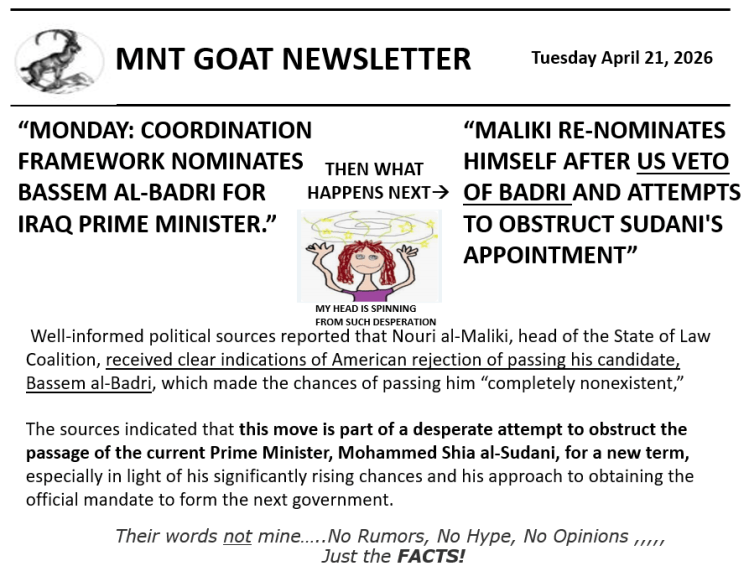
So, the meeting to determine the new prime minister was first supposed to happen last Saturday, then postponed until Sunday and then Monday. Now they are saying Wednesday. Then today this article pops out titled “COORDINATION FRAMEWORK NOMINATES BASSEM AL-BADRI FOR IRAQ PRIME MINISTER”. I find this article contradicting itself and so it is unreliable information. I think it meant to say they were considering al-Badri for prime minister again, but we already knew this. I quote from the article; “Iraq’s Shi’ite political alliance, the Coordination Framework, has nominated Bassem al-Badri as its nominee for the post of prime minister, a source from the bloc confirmed to Kurdistan24 on Monday.“ But then later in the article they go on to say that they will meet on Wednesday to select the prime minister. So, which is it? Did you or did you not already nominate al-Badri on Monday?
Again, I quote from the same article: “Later, Abbas al-Amiri, Secretary-General of the Coordination Framework, announced that the coalition has postponed the official declaration of its candidate for Iraq’s prime minister until Wednesday. Speaking to Kurdistan24, al-Amiri said the delay comes as internal discussions continue among the alliance’s leadership.”
_____________________________________________
Soon after the announcement of Badri this article pops out titled “SOURCES: MALIKI RE-NOMINATES HIMSELF AFTER US VETO OF BADRI AND ATTEMPTS TO OBSTRUCT SUDANI’S APPOINTMENT”. Well-informed political sources reported that Nouri al-Maliki, head of the State of Law Coalition, received clear indications of American rejection of passing his candidate, the current head of the Accountability and Justice Commission, Bassem al-Badri, which made the chances of passing him “completely nonexistent,” according to the sources.
The sources added that this fact prompted Maliki to re-nominate himself for the premiership, in a move described as an attempt at political blackmail and buying time, rather than a serious candidacy to compete.
Doesn’t this election saga make your head spin?

_____________________________________________
Next we need to take a look at the news in article titled “UNITED STATES: IRAQI GOVERNMENT-LINKED ENTITIES SUPPORT MILITIAS THAT THREATEN AMERICANS” I quote from the article: “It also accused parties linked to the Iraqi government of providing political, financial and operational cover to “Iranian-linked militias.” – “The embassy added that what it described as “Iraqi terrorist militias allied with Iran” continue to plan additional attacks against American citizens and US-related targets throughout Iraq, including the Kurdistan Region.”
Do you really believe for one second the US is going to signoff and allow the reinstatement of the Iraqi dinar under these conditions of the Iranians infiltrating into Iraq and causing havoc. How can president Trump convince big money backers to enter Iraq and do business? Trump will have to find a way to take care of these militias inside Iraq and prevent any reoccurrences of attacks and a resurgence of these militia. Perhaps the change in the Iranian regime is the answer for more than one reason. Remember also that it was intentional negligence by al-Maliki that led to ISIS coming into Iraq in the first place, thus the infiltration of the Quds forces followed and never left.
_____________________________________________
In the next article titled “WASHINGTON HAS HALTED DOLLAR SHIPMENTS TO IRAQ UNTIL A NEW IRAQI GOVERNMENT IS FORMED” we learn one of the measures the US is using to threaten Iraq to disarm the Iranian backed militia is to cut off shipments of dollars to Iraq. Now this term used ‘halted dollar shipments’ means something special as I will show you in a later article there are actually 3 tracks where the US can cut off the dollar. These current U.S. sanctions appear to be about the sanctioning of the actual airborne flights of paper dollars into Iraq.
“Saudi Arabia’s Al-Hadath TV quoted American sources as saying that Washington has decided to halt dollar shipments to Iraq until a new Iraqi government is formed.Iraq periodically receives shipments of its oil sales proceeds in dollars from the US Federal Reserve, to which these funds are transferred every two months, as part of an Iraqi-American agreement to protect Iraqi funds from claims by international creditors.”
Washington is pressing hard to prevent the formation of an Iraqi government loyal to Iran, and US President Donald Trump has officially announced his opposition to the nomination of former Iraqi Prime Minister Nouri al-Maliki.
Go figure –> “Iranian Quds Force commander Esmail Qaani publicly visited Iraq just two days before a planned meeting tonight of the coordination framework to nominate the name of the new prime minister.” Please don’t tell me Iran is not interfering in Iraqi elections!
_____________________________________________
Next I present an article that popped out almost immediately after the prior article. It is titled “AN ECONOMIST REVEALS THE MECHANISM FOR DISTRIBUTING IRAQI OIL DOLLARS AT THE US FEDERAL RESERVE.” This article explains the mechanism to distributing the DFI dollars in NYC banks back to Iraq from the sale of the oil.
I quote from the article: “Economic expert Ziad Al-Hashemi revealed on Monday the distribution map of Iraqi oil dollars deposited with the US Federal Reserve, confirming that the hard currency is distributed among 3 main channels: “Iraq 1”, “Iraq 2”, and airborne shipments”. My point is how much will these current U.S. sanctions of the actual airborne flights of paper dollars into Iraq hurt Iraq. Will it actually help Iraq more than hurt it in curbing the parallel market since the paper dollars will dry up. Maybe this is something that should have been done a long time ago? It will bring up the rate of the dinar.
_____________________________________________
In the next article will the lack of dollars on exacerbate the liquidity problem already facing Iraq? In the article titled “A LIQUIDITY CRISIS IS PUTTING PRESSURE ON IRAQ’S FINANCES; A GOVERNMENT ADVISOR PROPOSES TWO OPTIONS” we take a look at this issue of liquidity. Remember to that nearly 80% of the monetary mass for Iraq is outside the banking system. It is in stashes in Iraq home and businesses. Also don’t forget the dinars outside Iraq in our pockets. They will have to do something soon to retrieve these dinars back into the banks.
The financial advisor to the Iraqi government, Mazhar Muhammad Saleh, confirmed on Monday that the country’s public finances are facing a liquidity crisis as a result of declining oil revenues due to the repercussions of the Strait of Hormuz crisis, revealing two main options to address the revenue gap and ensure the continuation of government spending. (By the way this is also hurting the CBI reserves since they will have to take money to meet the shortfall.) Saleh told Shafaq News Agency that public revenues may not exceed 4 trillion dinars per month, compared to operating expenses estimated at about 8 trillion dinars, including salaries, pensions and social welfare. so, yes these sanctions on the dollars could greatly impact Iraq. If it continues long-term it will draw down the CBI reserves like it did during Covid. So, for Iraq it is crucial that this war with Iran end and end soon. Iraq will need high reserves (per IMF criteria) in order to reinstate the dinar.
_____________________________________________
Then Opps out pops this next article explaining alternatives to the petro-dollar in the article titled “ABU DHABI HINTS AT USING THE YUAN IF THE DOLLAR BECOMES SCARCE DUE TO THE REGIONAL CRISIS.” I quote from the article – “The Wall Street Journal reported that the United Arab Emirates has begun talks with the United States about obtaining a financial safety net in case a war with Iran leads to a deeper liquidity crisis in the oil-rich Gulf state, according to US officials.”
The newspaper quoted officials as saying that “Khaled Mohammed Balama, the governor of the UAE Central Bank, raised the idea of establishing a currency swap line with US Treasury Secretary Scott Bisent and officials from the Treasury Department and the Federal Reserve during meetings held in Washington last week.” Hey I have to tell everyone that currency swaps are very common practice in trading as they happen all the time. Is this a way that Iraq will be trying to bypass the stronghold the US has on it via the dollar sanctions, we just talked about. Go figure!
_____________________________________________
Then this article really hits it home on the same subject matter of sanctions on the dollar. It is titled “THE NEED TO RESTORE IRAQ’S POLITICAL AND ECONOMIC INDEPENDENCE BY SETTLING OIL REVENUES IN CURRENCIES OTHER THAN THE DOLLAR“. Come’on folks we are not stupid. The selling of oil for petro-dollars was intentional and now that Chapter VII sanctions are over Iraq should revert back to their independence off the dollar fully. This would make a great next step. But as we can see is Iraq really ready for this move as the US may still need the dollar shipments as leverage to get Iraq inline.
“Since 2004, due to US sanctions, Iraq has been unable to independently benefit from its oil revenues. With the start of the war between Iran and the United States, the closure of the Strait of Hormuz, and the imposition of restrictions on oil exports, Iraq can regain its political and economic independence by breaking out of the petrodollar cycle and selling its oil in currencies other than the dollar, for example, settling it in yuan.” For Iraqi’s international sovereignty, surely this would help if Iraq sold oil in dinars (petro-dinar). It would create a huge global demand for the IQD. They would be forced to reinstate the dinar. Remember we already read a proposal in the recent past for this new petro-dinar. So, this is not just a fantasy.
_____________________________________________
So, in terms of using the dinar to strengthen it’s value, we see in the article titled “INVESTMENT AUTHORITY: THE DINAR WILL BE THE SOLE CURRENCY FOR THE SALE OF RESIDENTIAL UNITS’ yet another idea to help booster the value of the dinar. It may seem a small thing but it is huge in that these housing units and condos are going up all over Iraq. They must keep trying to create a demand for the dinar and get off the dollar. Yes, it is an uphill battle after 20 years of the dollar.
I quote from the article – “The National Investment Commission affirmed the commitment of investment authorities in all governorates to implementing the applicable regulations and controls regarding the sale and lease of residential units within investment projects. These regulations stipulate the exclusive use of the Iraqi dinar in all sales and installment transactions, emphasizing the prohibition of dealing in any foreign currency.” Folks isn’t this what we do in our own countries. We use the currency of the country we live in to buy inside the country. This is a really good sign for Iraq and we need to see more and more of this. Remember a similar law was already established for buying automobiles. Do you remember it?
SUMMARY:
My takeaway from the news this period is that Nouri al-Maliki must be taken out of politics in Iraq. We can clearly see from all the confusion and instability he has caused trying to be subservient to Iran in getting his puppet in place as prime minister. From today’s news I still believe that al-Sudani will be voted in by parliament as the new prime minister and will get to form the new government (his cabinet).
The question still arises if al-Sudani will now even show any mercy to al-Maliki in granting a position in his cabinet to him after all the slander and hatred he has shown towards obstructing his nomination. We will see how this all plays out and if al-Sudani does in fact get the nomination. Really now…. I see no other option for the Coordination Framework as they are now boxed in a corner. People ask me what is taking this RV so long and now we are witnessing first hand yet another Iraqi saga that has taken them already over 5 months just to settle an election and form a new government. I can still remember the very bad taste of the eight years of Nouri al-Maliki and how he created such a division rather than unity for Iraq. We certainly do not want to waste yet another 8 years.
Meanwhile the clock is ticking, and Iraq moves farther and farther away from the discharge of all Chapter VII sanctions brought on by the 2003 invasion. We can clearly see in the news that Iraq wants to end the dollar dominance over their finances and use the dinar. This would give them great leverage on the international stage. Imagine if they were selling oil using petro-dinars. WOW! WOW! WOW! I ask myself why not? If the US can force them to use dollars then why can’t Iraq force the rest of the world to use dinars and sell oil only in IQD causing a huge demand for their dinar. Many countries conduct business this way and this is not so much a new idea only Iraq needs to execute on it.
I also want to remind everyone that televisions in Iraq are watching a series of videos on removing the zeros from the currency once again. These are current videos from forums talking to banking institutions. The citizens are more than aware now of what is about to happen, but we still h This is the Iranian issue that still lingers. I am hoping that the war with Iran will take care of this for us and Iraqis will come to their senses about Iran and they can envision a world without terrorism.
I will end this Newsletter today by saying that as normal the hype is resurrected whenever any talk of deleting the zeros occurs from Iraq. I just wanted to remind all my blog followers that we go to the bank when the dinar is reinstated. If you follow the plan from 2011 on how to get there, it means also to delete the zeros and issue the lower denominations first. At this time there does not have to be rate change at all. A 25,000 note today about $18 USD can have the exact same value as the 25 lower denomination. If you do the math that’s about 72 cents a dinar. Do you think citizens will want to bring in their stashes of notes at 72 cents? What is the incentive?
So, this game of deleting the zeros has to work out as one of two options:
1. Impose a strick deadline to turn in all the three zeros notes @ the even exchange. For instance a 25,000 note for a 25 note. Either swap them out now or they are worthless later past the deadline inside Iraq. Folks I just don’t believe the CBI would ever do this.
2, Okay so use the 72 cents per dinar on the swap out then it is still a huge revaluation from the 1/6 of a penny as of today. Honestly, I still can’t put my arms around all this intel guru talk about over $1.00. They are so stuck on a revaluation. Why? The 72 cents is a nice incentive, and it also matches along with what the CBI has told us. The CBI said there is not going to be any revaluation on the process to remove the zeros.
If they CBI executes on either option 1 or 2, really now who the hell cares! What we care about is that they do something and issue the lower denomination notes. Why? Because the plan of 2011 tells us that the reinstatement is to follow and we already know the rate of exchange for our dinars will be about $4.80 per dinar outside the country of Iraq.
I just want to end with saying that if this Iranian stuff does not get fixed in Iraq, then Iraq too will fall into this spere of non-investable and must climb out of it. This is what happens when Iran touches anything. I will warn you that they are almost there now without some drastic changes, such as with this election cycle. It was not so much the 2003 war that devasted the economy but instead the Iranians who came into Iraq afterwards filling the gap when the US pulled out, and even after 20 years later, Iranian influence has made it still skeptical for the larger investors. The country still is not rebuilt. This is all why we have not yet seen the reinstatement.
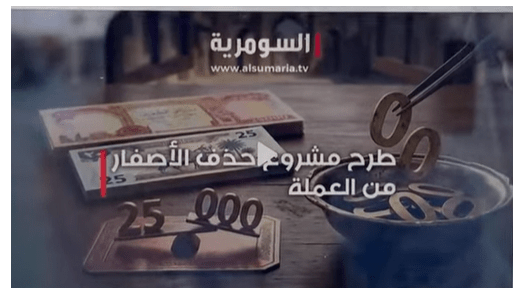
Click on picture to watch a recent video in Iraq of removing the zeros.
What do you think will happen next? (Leave a comment)
______________________________

________________________________________
Their words not mine…..No Rumors, No Hype, No Opinions ,,,,,
Just the FACTS!

These prophecies are more important now more than ever. They give us the strength, perseverance and hope that a better time is coming and that God’s Hand is at work behind the scenes. If you just take a second even to look around you at these past three election cycles, how can you deny that God is at work? Are you sleeping or what?
It is amazing and there is no other way that these events could have happened the way they turned out. But there is more to come, much, much more, I assure you! Now that God has his biblical David re-elected, we need to pay attention to what He does next.
NOTE: These prophecies just keep getting better and better, giving us HOPE of a brighter future. But the real reason why I listen to them is that we can actually see what God says He will do is taking place right in front of our noses. It is a confirmation to me that God is real and is still with us forever just as in biblical times.
Prophetic Words from the prophets: Julie Green
“The Globalist Are Turning On One Another”
Go to the 17:45 mark for the prophecy. From April 11th.

“Nations Will Shake Like Never Before ”
Go to the 14:39 mark for the prophecy. April 12th.

“The Two Tiered Justice System Will Collapse ”
Go to the 13:25 mark for the prophecy. Heard on April 18th.

Prophetic Words from the prophets: Hank Kunneman
“GOD IS OVERRIDING TERM LIMITS”
Let me add that my personal view of this prophecy may not mean what our first impression may be from the title. Could God give Trump a third term? Could God finally help to establish Constitutional term limits upon the Senate members? It may these are the issues God is going to fix but even if God does not go this far this is still an amazing prophecy. Let me explain.
What God may be saying is that he will decide term limits by eliminating the corrupt and the riff from Congress and the Senate right now. Yes, he will establish His own terms limits for them. There could be a number of factors that will make this happen. The first is that He already told us of the Angle of Death (Exodus 12:23) is coming again and will take many members of both houses. The second is that He told us the elections will be cleaned up, thus many will lose their seats in the upcoming election cycles.
From April 14th.
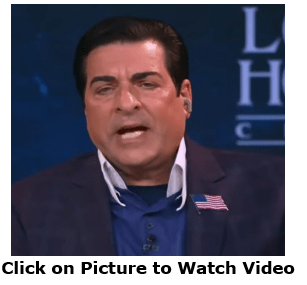
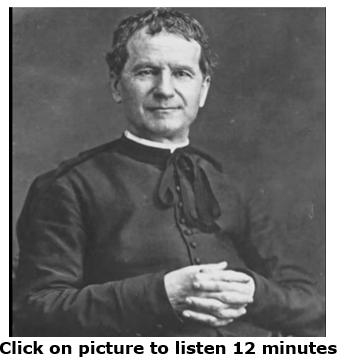
Fr. DON BOSCO EXPOSED THE DARK SECRET BEHIND ISLAM
— And the Truth the World Forgot about the so-called Muslim religion. Fr.Don Bosco, also known as John Bosco, was an Italian Catholic priest and educator, born on August 16, 1815. He founded the Salesian Society in 1859 to help disadvantaged youth, particularly boys, through education and community service. His teachings emphasized lovekindness, and the importance of education for young people, making him a beloved figure in Catholicism and a patron saint of youth. Don Bosco was canonized in 1934.
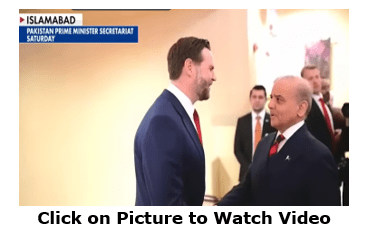
THE TALKS BETWEEN THE U.S. AND IRAN ARE GOING NOWHERE IN A HURRY AFTER ALMOST 2 WEEKS.
IT’S TIME FOR ACTION AND NO MORE TALKING. What does Trump have up his sleeve in saying the cease fire will be extended? Why is he now playing for time?
THIS WOULD BRING THE IRANIAN REGIME TO AN END…
THE WRITING IS ON THE WALL WITH THE UNITED NATIONS (UN), CAN YOU NOW SEE IT TOO?
The prophets tell us that the UN will leave NYC or better yet will be kicked out. This issue with NATO not supporting the US in Iran is the beginning of the end of the UN. When I first listened to this prophecy years ago I wondered how this could ever happen. But slowly I can clearly see the case why this might happen. The Trump administration is dismantling the UN bit by bit.
Remember Trump’s speech at the UN during his first term? Many in the audience smirked and laughed at him. Then during his second term (they thought he would never have) during his speech no one was laughing. They shut off his microphone and stopped the escalator. His is all symbolic on how they are trying to stop his movement. They see the defeat and exposure of this corrupt organization.
THE GREAT NORTH AMERICAN PROJECT
U.S. EXPECTED TO ACQUIRE GREENLAND ‘SOONER THAN PREDICTED’. How does Greenland fit into the plan. Is it dismantling the old-world order through trade and oil.
AUSTRALIA TOO IS HIT BY LACK OF COMMON SENSE AND RATIONALITY
The communist cult is still pushing ‘insane’ climate change agenda. This what is destroying our societies. Wake up to the FACTS!
LEBANESE WOMAN EXPOSES ISLAM
Most people don’t know real history and that’s part of the problem. For instance, was picking the date of 9/11 for the NYC terrorist attack coincidental? Was the US government involved some way in the 9/11 attack? Was the 1979 movement in Iran under the radical Islamic Jahad coincidental? Who was really behind this power transfer?
How is this all related to the current war with Iran? Will any peace treaty with Israel and the US ever work in the long run?
DO THEY THINK WE ARE STUPID? MAYBE WE ARE!
WHAT THEY DON’T WANT YOU TO HEAR ABOUT HAMAS & RADICAL ISLAM.
They are hiding the TRUTH from Americans on what the real cause of the Iranian war is all about. The nuclear stuff is just a weapon they pose to use to kill us. They are afraid that if they did tell the entire TRUTH it would gain too much popular support for the US and Israeli efforts to deal with Islam inside America, in the Middle East and the rest of the world. Yes, the rest of the world, especially Europe is also in denial and they too are already paying the price for ignorance and nonaction.
There are too many similarities to WW2, the Nazi movement and the refusal to believe that this is really happening.
LET’S CONTINUE ABOUT THE ISLAMIC THREAT.
How the hatred for the Christians and Jew evolved. It is time for the members of the Islamic cult (not religion) to realize they have been lied to.

HOW FAR SHOULD A COUNTRY GO TO SACRIFICE ITS NATIONAL IDENTITY AND VALUES JUST TO SATISFY A RELIGIOUS WHEN ITS CULT-LIKE ACTIVITIES CLASH?
Are you listening America?
Don’t be fooled by pressures for freedom of religion as it applies to radical Muslims.
Don’t be fooled that this is just a clash of cultures, it is much, much more that that.
Rather this is clash of ideology being used by the socialist communists to gain control over all developed countries. They are just using the Islamic movement to do it, only Islam is too dumb to see it and thinks they will be in control later. Hey… didn’t the globalists try this same ideology with Adolf Hitler only to be met with resistance by the free world once declared he was going to be the ‘supreme leader’ and not let the globalist have the spoils of war.

BLACKROCK — THE COMPANY THAT OWNS AMERICA
The prophets have told us that BlackRock, Vanguard and Statestreet will all fall.
“WHAT THE DEMOCRATS DID BEHIND CLOSED DOORS WILL SHOCK YOU”
Listen carefully… We must make up our minds what side we are on!
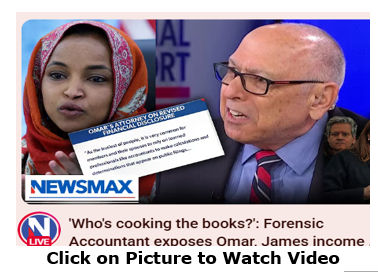
‘WHO’S COOKING THE BOOKS?
My question is how much corruption do they have to expose on Ihan before they finally expel her from congress?

I have created a brand-new “Post RV Workshop” page in the blog. I included my own personal tips on investing post-RV and also organizing and protecting your estate. Here is the LINK. Going forward I will only post new and exciting information and opportunities here on the Latest Newsletter as they come along. Later I will transfer it to the ‘Post RV Workshop’ page in subsequent Newsletters for your future reference.
Just so you know I absolutely DO NOT adhere to high-risk investments where you can lose it all in a flash. Look at it this way – you are going to have all this money from your dinar exchange. Then why blow it! Most of us investors waited decades for this RV to happen and so why would you even think about pissing is all away in some high-risk gamble of an investment. Yes, there are going to be scammers out there but let’s talk about legitimate investment opportunities only. These scammers can suck you dry and there is not a damned thing you can do about it.
Go to a legitimate wealth manager associated with your bank. Let the licensed experts advise you. Please, please stay away from idiots like MarkZ, TNT Tony, Bruce (on the Big Stupid Call), etc. , etc. Go to professionals. It doesn’t mean you have to follow everything they advise you but it’s a great start. Remember they too are selling investment products and get commissions.
Nothing new to report today. Please see the blog section on the other great news on this subject matter here LINK.

SUDANI: IRAQ IS NO LONGER A BATTLEGROUND… A NEW PARTNERSHIP WITH WASHINGTON AND BILLIONS OF DOLLARS IN INVESTMENT.
Prime Minister Mohammed Shia al-Sudani published an article in the American magazine Newsweek on April 17, in which he reviewed the most prominent features of the political and economic stage in Iraq, and the government’s vision to enhance internal stability and redefine international relations, especially with the United States.
Al-Sudani stressed that the election result represented a popular mandate for a difficult but necessary path to maintain Iraq’s stability in light of a very dangerous regional phase, and to build stronger institutional foundations and long-term economic renewal.
He noted that over the past two and a half years, and during three waves of regional escalation, his government had managed to keep Iraq out of the war, protect international personnel on its territory, and maintain the cohesion of the state.
He explained that the government brought companies such as ExxonMobil, Chevron, BP and GE Vernova back to Iraq through new commitments in the energy sector worth billions of dollars, in addition to attracting more than $100 billion in investments.
He explained that the current moment is the most appropriate to redefine Iraq’s relationship with the United States, noting that Iraq has always been viewed in Washington through the lens of crises, war and terrorism, while today it is a country that has proven its ability to withstand enormous pressure.
Al-Sudani spoke about the challenges his government has faced since the outbreak of the war in Gaza in October 2023, stressing that the goal was to prevent Iraq from being dragged into a conflict that was not of its choice, despite increasing pressure and escalation from multiple parties.
He added that the government has acted through direct engagement, issuing security directives and continuous political management to prevent Iraqi territory from becoming an open arena for regional war, while maintaining a firm objective of containing escalation and protecting stability.
He stressed that this position represents an exercise of sovereignty, noting that Iraq is more aware than others of the cost of becoming an arena for settling scores between others.
On the security front, he pointed out that the Popular Mobilization Forces were formed in response to the threat of ISIS, and that the government strengthened oversight and directed resources through official institutions, while refusing to turn exceptional arrangements into permanent alternatives to the state.
On the economic front, he affirmed that Iraq has rebuilt its economic position, with the return of major companies to develop oil fields and energy projects, in addition to the implementation of strategic projects such as the Total Energies and Qatar Energy project in Basra.
He stressed that Iraq has become more competitive and more attractive for investment, thanks to improved contractual terms, restored confidence, and the creation of a favorable environment for long-term investment.
He explained that Iraq possesses the fifth largest oil reserves in the world and is located in an important strategic location, which calls for dealing with it as a strategic opportunity in American policy.
He also stressed that Iraq’s partnerships will remain diverse, with continued cooperation with China alongside the United States, Europe, Turkey and the Gulf States, noting that Iraq’s geographical location and balanced relationships represent a strategic strength.
He touched on the development road project, which will make Iraq an important trade corridor and a bridge for trade, energy and diplomacy, instead of being an arena for conflict.
Al-Sudani called on the United States to adopt a more mature strategic framework towards Iraq, especially in the economic field, while protecting and encouraging American investments. He also stressed the importance of developing the security sector, enhancing intelligence cooperation, and combating terrorism, in order to support the state’s long-term capabilities.
He concluded by emphasizing that Iraq is working to strengthen its institutions, diversify its economy, and resolve the relationship between the state and armed groups in favor of the state, noting that what Iraq is proposing is based on partnership, interests, and mutual respect, and that the opportunity is available to build a more stable and interconnected future in the region.
*********************************************************************************************
LAST NOVEMBER, MILLIONS OF IRAQIS WENT TO THE POLLS IN A FREE ELECTION, AND MY COALITION MANAGED TO ACHIEVE THE HIGHEST NUMBER OF VOTES AMONG ALL THE LISTS.
By: Mohammed Shia Al-Sudani
This achievement was not just an electoral victory, but a clear popular mandate for a difficult but necessary path: maintaining Iraq’s stability in a highly dangerous regional phase, in parallel with building stronger institutional foundations, and launching a long-term economic recovery process.
However, elections alone do not define governments; actions are the true measure. Over the past two and a half years, and through three waves of regional escalation, my government has succeeded in keeping Iraq out of the throes of war, protecting international personnel on its soil, and maintaining the cohesion of the state in circumstances that have severely tested all its institutions.
At the same time, we were able to bring major companies like ExxonMobil, Chevron, BP, and GE Vernova back to Iraq, through billions of dollars in investment commitments in the energy sector, as well as attracting investments exceeding $100 billion. This record forms the basis of what I am presenting today.
Hence, the present moment is an opportune time to redefine the relationship between Iraq and the United States. Iraq has always been viewed in Washington through the lens of crises: wars, terrorism, violence by armed groups, and regional conflicts. It is true that these events are part of our modern history, and some of them still cast a shadow on our present, but they no longer represent the whole picture.
Iraq today is not just a country that is managed when crises intensify, but a country that has proven its ability to withstand enormous pressure, and has come to possess strategic, economic and political value that deserves deeper recognition by the United States.
Since October 2023, with the outbreak of war in Gaza and the subsequent wave of regional escalation, my government has faced a pivotal challenge: preventing Iraq from sliding into a conflict it did not choose.
This required not just restraint, but complex crisis management; the country witnessed attacks by armed groups on American military sites launched from Iraqi territory, an exchange of fire between regional powers, along with widespread public anger and multiple pressures towards escalation.
Under such circumstances, it would have been easy to slide into disintegration, collapse, and a proxy war. But that did not happen.
My government acted through direct engagement, security directives, and sustained political management to prevent Iraq from becoming an open arena for regional warfare. When the confrontation between Israel and Iran escalated in June 2015, Iraq affirmed that its territory and airspace would not be used to launch attacks against neighboring countries.
With the renewed escalation during Operation “Rage” in early 2026, the pressures intensified, as missiles targeted Gulf capitals, diplomatic missions and American interests were attacked, while armed factions called for Iraq to enter the war. However, our goal remained constant: to contain the escalation, protect Iraq’s stability, and prevent it from being drawn into a wider regional confrontation.
This stance was not passive, nor was it a lack of danger, but rather an expression of exercising sovereignty in the face of forces that sought to drag Iraq into a wider war.
Iraq, perhaps more than any other country in the region, understands the cost of becoming an arena for conflict based on the calculations of others.
Our mission was to protect the people, preserve state institutions, and prevent the country from sliding into a wider confrontation that would threaten our stability and the interests of our partners, foremost among them the United States.
This does not mean that the security challenges have ended. The Popular Mobilization Forces were formed in response to the threat of ISIS, and are associated in the minds of many Iraqis with real sacrifices at a critical moment.
But no serious state can accept the continued existence of multiple centers of security decision-making. The strategic objective must be clear: a sovereign security system in which decisions regarding war, peace, and the use of force rest exclusively with the state.
My government has approached this issue realistically, not with illusions. We have strengthened oversight, channeled resources through official institutions, and refused to allow exceptional measures to become permanent substitutes for the state. While progress has not been uniform, and work continues, the path forward is clear: strengthening institutions, consolidating the rule of law, and building a cohesive national leadership structure. This approach should be of interest to every international partner genuinely committed to Iraq’s success.
On the economic front, Iraq has witnessed tangible progress. ExxonMobil has returned to develop the giant Majnoon field, Chevron signed a management agreement for the West Qurna 2 field, BP activated a major contract in Kirkuk, while GE Vernova committed to adding 24,000 megawatts of electrical capacity.
Total Energy and Qatar Energy are also proceeding with a $27 billion integrated project in Basra that includes gas, solar power and seawater treatment.
These are not merely symbolic initiatives; they reflect a deeper transformation: Iraq has become more competitive, more attractive to investment, and more strategically important. Companies don’t return to a market of this size out of courtesy, but when they see improved stability and genuine partnership.
This is what Washington must realize. A country that possesses the world’s fifth-largest proven oil reserves, and is located in a pivotal geographical position linking future trade routes, should not be treated as a secondary issue, but as a strategic opportunity.
Iraq will maintain a diverse range of partnerships. China is an important economic partner, but Iraq’s future cannot depend on a single entity. Our interests require diversifying our relationships with the United States, Britain, Europe, Turkey, the Gulf States, and our regional neighbors. This is not a superficial balancing act, but a necessity dictated by Iraq’s location and nature.
This also applies to Iraq’s regional role. It is rare to find a country that maintains balanced relations with Washington, Tehran, Riyadh, Ankara, and the Gulf states simultaneously. This diversity is one of Iraq’s strengths, enabling it to serve as a bridge for communication, not an arena for conflict.
Hence the importance of projects like the “Development Road,” which connects the Grand Faw Port to Turkey and onward to Europe, positioning Iraq as a vital trade corridor. This project is not merely infrastructure; it is a vision for transforming Iraq into a hub for trade, energy, and diplomacy.
Therefore, the United States should approach this stage with a more mature strategic vision:
First, economically, by supporting and expanding American investments, particularly in energy and infrastructure.
Second, institutionally, by building a structured dialogue to develop the security sector beyond temporary crisis management.
Third, strategically, by developing more sustainable and professional intelligence cooperation and counterterrorism efforts.
Iraq today does not ask to be viewed through the lens of the past or fear, but rather to be seen as it is: a country that has held competitive elections, maintained a pluralistic political system, rebuilt devastated cities, and worked to avoid sliding into regional conflicts.
Challenges remain, yes. But that shouldn’t obscure what has been achieved, or what Iraq can offer.
What Iraq is offering Washington is not subservience, nor alignment at any cost, but a partnership based on mutual interests and mutual respect, with a sovereign state that has proven its resilience and seeks to build a more stable and interconnected future.
The opportunity is real.
The door is open. And the region won’t wait.
*********************************************************************************************
LATEST DEVELOPMENTS IN THE “SECOND TERM” THE SUDANESE “EXPELLED” THE AMERICANS 5 TIMES … BAHAA AL-ARAJI: NO VETO AND THEY WANT DISARMAMENT 2026-04-16
Bahaa al-Araji, head of the Reconstruction and Development bloc, denied the existence of an American veto on the nomination of Mohammed al-Sudani for a second term, despite the existence of “some resentment,” especially when he refused to receive the American chargé d’affaires five times during the war and bombing. Al-Araji revealed the existence of four American conditions that were communicated to the Shiites, the most prominent of which is the disarmament of the factions, as he put it in an interview with journalist Samer and included strong criticism of Nouri al-the 964 network, Jawad, which was followed by Maliki’s bloc, which is creating “a new lie.”
Bahaa Al-Araji: The issue of an American “veto” on Mr. Al-Sudani is a new lie that came from poles that rejected American intervention and a previous tweet by Trump. Therefore, we really don’t know whether to laugh at the matter or cry over it. This is the fate of Iraqis to have such politicians as these. The name of the candidate for Prime Minister will not be decided even at Saturday’s meeting, because the mechanism for deciding within the framework does not exist. So how will the matter be decided? For example, let’s say that there are four parties within the framework who oppose the appointment of Mr. Al-Sudani. The question is, how many MPs do these four have? When counting them, they do not exceed 30 MPs, while there are 136 MPs with Mr. Al-Sudani. The opposition to assigning Mr. Al-Sudani is due to fear, fear that he will capitalize on his successes.
Therefore, when they saw that Mr. Al-Sudani passed all the tests, they said that there was an American “veto” on his nomination.
Yes, there is resentment and reservations on the part of the Americans regarding Al-Sudani, for two reasons:
1.they wanted him to cut off the salaries of the Popular Mobilization Forces, and
2.the second reason is because of the off the salaries of the Popular Mobilization Forces, and the second reason is because of the statement he issued (granting the authority to respond to attacks).
Washington’s demands of the next prime minister are:
disarmament, good relations with the Arab world and the Gulf in particular, regulating relations with the Islamic Republic of Iran and building them on interests rather than interference, and giving priority to American companies in Iraq.
During the days of the war that was raging in the region, Al-Sudani refused to receive the American chargé d’affaires more than five times, because Iraqi blood was being spilled. Today we say frankly that the majority or all of those who were martyred have no connection to the factions or anything else. Some cannot distinguish these matters.
Al- Sudani is the Commander-in-Chief of the Armed Forces. Can’t he issue a statement? Or a protest? Or can’t he refuse to meet the ambassador? Why does he remain then? Tom Barrack, for the United States of America, is in charge of the Iraqi, Syrian and Turkish situation, and there is certainly communication and contact with him. According to what I hear about the man, he is keen on the strength of Iraq, and therefore he tried more than once to talk to the Kurdish brothers to resolve the issue of the presidency of the republic. He is the one who brought Trumo’s first message to Mr. Maliki, Therefore, the contacts that
********************************************************************************************
THE PRIME MINISTER’S ADVISOR EXPLAINS THE GOVERNMENT’S OPTIONS FOR ADDRESSING THE REVENUE SHORTFALL.
The Prime Minister’s economic advisor, Mazhar Muhammad Salih, clarified on Friday the government’s options for adopting a mechanism to address the revenue shortfall.
Salih told the Iraqi News Agency (INA) that “the government can rely on domestic borrowing, supported by a coordinated monetary policy, given the large reserves.”
He explained that “if reserves fall below the critical threshold, external borrowing is possible to maintain the development trajectory and stabilize domestic debt, half of which is held by official institutions, with 45 percent held by the Central Bank and the other half by Rafidain, Rasheed, and TBI banks.”
He added that “addressing this debt could be achieved by swapping it for real government assets, which would lead to economic diversification and partnership with the private sector.”
*********************************************************************************************
IRANIAN MEDIA: NO NEGOTIATIONS WILL TAKE PLACE AS LONG AS THE “NAVAL BLOCKADE” REMAINS IN PLACE.
Iran’s Tasnim news agency reported on Sunday that Tehran has not yet decided whether to send a negotiating team, stressing that no negotiations with the United States will take place as long as US President Donald Trump’s declaration regarding the “naval blockade” of Iran remains in effect.
The agency, which is close to the Revolutionary Guard, said that the exchange of messages between Iran and the United States continued during the past few days through the Pakistani mediator, following the end of the first round of negotiations.
She added that the exchange of messages was a continuation of the same path that took place during the first round, which, according to the agency, ended in failure due to what she described as “excessive American ambitions”.
She noted that the Pakistani mediator resumed exchanging messages after that round ended.
Earlier today, US President Donald Trump confirmed that his Vice President, JD Vance, would not be traveling to Pakistan to negotiate with Iran, citing “security reasons”.
In contrast, Pakistani officials reported tightening security measures in the capital, Islamabad, in preparation for hosting possible talks between Washington and Tehran in the coming days.
The Wall Street Journal also reported that the Trump administration expects a “breakthrough” in the ongoing negotiations with Iran in the next few days, amid American anticipation of Iranian steps in exchange for easing sanctions and military threats.
*******************************************************************************************
AN ECONOMIST WARNS OF THE DECLINE OF THE IRAQI DINAR DUE TO CURRENCY PRINTING POLICIES.
Economic expert Nabil Al-Ali called on the Central Bank of Iraq on Sunday to develop an urgent plan to contain the repercussions of monetary inflation, warning of a significant decline in the Iraqi dinar’s exchange rate as a result of current monetary policies.
Al-Ali told the Information Agency that “the government is currently relying on printing money to secure salaries and expenditures under the guise of the borrowing law,” explaining that “the continuation of this mechanism will put the Central Bank in a difficult position and may force it to deplete its reserves to cover the shortfall.”
Al-Ali stressed the necessity for “the Central Bank to withdraw the printed currency from circulation as soon as it is no longer needed, and to destroy or store it instead of recycling it.”
He indicated that “this measure is the only way to maintain exchange rate stability and prevent monetary inflation that threatens the purchasing power of citizens.”
(Mnt Goat: Sounds to me they are heading towards the Project to Delete the Zeros. What do you think?)
******************************************************************************************
AL-SAADI: THE CONNECTION TO THE US FEDERAL RESERVE REFLECTS A FLAW IN FINANCIAL MANAGEMENT.
Economic expert Rashid Al-Saadi confirmed today, Sunday, that the connection with the US Federal Reserve reflects a flaw in the management of money and requires reform, not a break.
Al-Saadi told Al-Maalouma News Agency that “Iraq’s continued involvement with the US Federal Reserve reveals a clear weakness in the management of funds and financial authority,” noting that “this file has not been managed professionally throughout the past years.”
He explained that “the heavy reliance on the US Federal Reserve reflects a flaw in the management of financial policy and a weakness in the institutions concerned with this aspect, which has made Iraq restricted by external procedures that control part of its funds.”
He added that “a sudden disengagement at the present time is not possible because that could lead to serious repercussions and economic disasters, especially since Iraqi funds are protected under the American decree, in addition to the existence of numerous international lawsuits related to the stage of Iraq’s entry into Kuwait, which may be activated and lead to the freezing of funds.”
He explained that “what raises questions is the US government’s interference in the mechanisms for protecting these funds, even though Iraq has the ability to manage its resources if the will and proper management are available.”
It should be noted that this matter requires serious follow-up and gradual correction of errors, and that improving management is the most important step at present to avoid any future crises.
*****************************************************************************************
THE “FRAMEWORK” FAILS THREE TIMES… WAS THE NEIGHBOR CALLED IN TO BREAK THE TIE BETWEEN MALIKI AND SUDANESE?
A $100 million spent to recycle faces rejected by America!
In a surprising political shift, Baghdad appeared to be moving beyond its traditional boundaries, resembling—according to analysts—an “alternative Islamabad” through which conflicting messages are exchanged between Washington and Tehran.
In this context, analysts argue that Iran, even at the height of regional escalation, does not treat Iraq as a file that can be withdrawn or retreated from, but rather as an ongoing sphere of influence extending from security to politics, and from factions to the process of government formation.
These analysts maintain that even if Tehran loses some rounds of the conflict, it remains a powerful force in the Iraqi decision-making equation, especially during government formation.
Qaani in Baghdad: A Sign at a Sensitive Time
In a notable development, information leaked Saturday evening from multiple sources about the arrival of the commander of the Quds Force in the Iranian Revolutionary Guard, Ismail Qaani, in Baghdad, in a visit described as unusual in its timing and context.
According to political analysts, this visit gains significance as it is the first since the recent military confrontations in the region, and it comes at a sensitive political juncture in Iraq, marked by repeated setbacks within the “coordination framework” regarding the selection of the next prime minister.
Independent politician and former MP Mithal al-Alousi interprets Ismail Qaani’s visit to Baghdad as more than just a fleeting diplomatic or security move; rather, it is a multifaceted political message that intersects at a crucial juncture in the Iraqi political process.
In an interview with Al-Mada, al-Alousi stated that the timing of the visit, “at a delicate moment of negotiation between Iran and the United States, carries a clear political implication: that Iraq is not part of arrangements being managed in other arenas, whether in Pakistan or elsewhere, and that the Revolutionary Guard is reaffirming its commitment to its role within Iraq, given its strategic importance to Iran.”
Al-Alousi adds that, from Tehran’s perspective, Qaani does not need direct meetings with the leaders of the “Coordination Framework,” explaining that “communication channels between Tehran and its allies in Baghdad operate continuously and around the clock, ensuring everyone is directly informed of the details. Therefore, the visit is not for managing communication, but rather to solidify its presence and convey the message that Iran is at the heart of the scene.”
He believes the message is not limited to the Iraqi domestic scene, but extends to Iran’s regional and international adversaries, stating that the visit “also carries a signal to Israel and the United States, indicating that the forces allied with Tehran in Baghdad still possess tools of influence, including drones and missiles, making them a bargaining chip in any negotiation or escalation.”
Ismail Qaani has led the Quds Force, the external arm of the Islamic Revolutionary Guard Corps (IRGC), since 2020, succeeding Qassem Soleimani, who was killed in a US strike near Baghdad airport earlier that year. Since assuming his position, Qaani has made frequent visits to Iraq, but announcements of his movements remain limited and infrequent.
Re-engineering the system
: Al-Alousi believes that what Tehran envisions as reshaping the political system in Iraq is linked to an attempt to ensure the continued flow of influence through what he calls the “minimum mobilization” of factions, which allows Iran’s regional movement between Baghdad, Tehran, Beirut and other arenas to remain in constant contact.
According to Al-Alousi, this approach relies on using local networks within Iraq as intermediaries in complex matters related to money, influence, and regional security, thus placing Iraq at the heart of a broader web of calculations.
In a related context, Al-Alousi points to movements within some Sunni political circles that have discussed investments and the allocation of funds estimated at over $100 million, aimed at supporting figures with controversial affiliations, in an attempt to reshape the balance of power within the next government.
He says that this course of action, if true, reflects an attempt to create a government based on “mutual political dominance” between internal and regional forces, supported by unannounced understandings between various parties.
Washington’s position: Rejection of armed factions.
Conversely, Al-Alousi doubts that Washington will accept these political formulations, whether through Qaani or anyone else, indicating that the American position is geared towards readjusting the rules of the game in Iraq, not reproducing them.
He affirms that the United States “will not accept the presence of armed factions within the governing equation,” and that the next phase may witness more decisive moves to hold accountable the networks of corruption and abuses associated with the administration of the state in recent years.
This comes as the “coordination framework” failed three times in one week to hold a decisive meeting to choose the next prime minister, amidst a clear division between American pressure pushing for the “dismantling of the factions,” and Iranian pressure that became evident with the arrival of Qassem Soleimani.
According to political circles, the complexities of the situation reveal a convergence of external pressures, one aspect of which revolves around the American rejection of any governmental formula that does not include clear steps toward “dismantling the militias,” versus escalating Iranian pressure that manifested practically with the arrival of the Quds Force commander in Baghdad.
In the midst of this clash, fingers are being pointed, simultaneously, at the teams of Nouri al-Maliki and Mohammed Shia al-Sudani, as the two main poles of competition, with indications that both sought to summon Soleimani in an attempt to resolve the deadlock or tip the scales in favor of one side over the other within the Shia political establishment.
Political circles had previously circulated accounts suggesting that Iranian Supreme Leader Ali Khamenei had recommended that Maliki be given the premiership. From a broader analytical perspective, Australian-based political researcher Ahmed al-Yassiri offers a sharp reading of the nature of Iranian influence in Iraq, asserting that the issue is “far beyond traditional political or security influence.” Al-Yassiri tells Al-
Mada that “ Iran has built a complex and intertwined network of influence within Iraq, distributed between security, which is managed by factions, and politics, which is led by parties, in addition to extensive cultural influence through seminaries, religious institutions, and Shiite community organizations.”
He adds that “this network does not operate in isolation, but rather in an interconnected manner; where security influence protects political influence, political influence secures economic influence, while economic influence fuels the cultural dimension.” He warns that this influence “cannot be easily eradicated, and may even persist even if the regime in Tehran changes,” explaining that “the forces associated with it within Iraq will remain active because the structure that has been established is deeper than just a transient political power.”
In assessing the repercussions of the recent war, Al-Yassiri believes that “Tehran’s insistence on including issues like Lebanon in any regional negotiations reflects its confidence in its ability to protect its influence in various arenas, whether it is in a position of strength or under pressure.” He adds that “Iran, even while suffering heavy blows, does not abandon its strategies, but rather rearranges them.”
Regarding Iraq specifically, Al-Yassiri asserts that “Tehran will not relinquish its influence under any circumstances, because this influence is built on a deep internal network, not on a political decision that can be reversed.”
Al-Yassiri, who heads the Arab-Australian Center for Strategic Studies, believes that “this reality was also evident in the election results, where the forces of the Coordination Framework achieved a clear victory, benefiting from various tools, including media influence and the ability to manage public opinion.” He adds that “the public was reassured through the issues of services and salaries, at a time when the factions rebranded themselves as a force for protection, not a force for conflict.”
Al-Yassiri concludes with a decisive diagnosis: “Iranian influence in Iraq is not merely the influence of a foreign state, but rather an integrated internal system. Therefore, reducing it – if it happens – will not be by an external decision, but by a profound internal change in the Iraqi public mood and a reshaping of societal consciousness, as partially occurred in the October protests.”
****************************************************************************************
THE SUDANESE HAVE AN OVERWHELMING MAJORITY IN THE IRAQI PARLIAMENT AND ON THE IRAQI STREET.
In a political scene characterized by complexity and ongoing tensions, the name of the current Prime Minister, Mohammed Shia al-Sudani, stands out as the most prominent and influential figure in the Iraqi political equation, not only within the parliament but also on the street, which now views his experience as a model of relative stability and executive management capable of dealing with accumulated challenges.
Despite this political and popular weight, a fundamental question strongly presents itself: Why doesn’t the coordinating framework move towards resolving the issue of the premiership by adopting the Sudanese option, in line with the indicators of parliamentary support and popular acceptance, and end the state of political deadlock that has exhausted the country?
The continued postponement and procrastination in making a decision not only reflects a state of hesitation, but may also be interpreted as a disregard for the will of a broad segment of voters, who have expressed, directly or indirectly, their support for stability and continuity, which is what the Sudanese represent at this sensitive stage.
In this context, the importance of adhering to the democratic principle of respecting election results becomes clear, especially given the official statements by some Shiite political forces asserting that the largest parliamentary bloc has the right to nominate the prime minister. This is a constitutional and political principle that should govern any subsequent agreements and should not be subject to interpretation or obstruction.
Granting the right of “veto” to small blocs or using tools of political obstruction to impose conditions that are inconsistent with the real balance of power represents a dangerous precedent that strikes at the heart of the democratic process, turning it from a representative system into an arena of power struggles that does not accurately reflect the popular will.
The Coordination Committee, as a key player in the political landscape, faces a true test regarding its commitment to prioritizing the national interest over narrow factional or partisan considerations. Supporting a widely accepted candidate could be a pivotal step in restoring public confidence in the political process and pave the way for a new era of political and executive stability.
Resolving this issue is not just about naming a prime minister, but about sending a clear message that political forces are capable of respecting the rules of the democratic game, and that they are ready to side with the will of the people, not with the logic of obstruction and polarization.
Ultimately, the question remains open: Will the coordinating framework respond to this challenge and translate its slogans into actions, or will political deadlock remain the most prominent feature of the Iraqi scene in the next stage?
*******************************************************************************************
SOURCES: MALIKI RE-NOMINATES HIMSELF AFTER US VETO OF BADRI AND ATTEMPTS TO OBSTRUCT SUDANI’S APPOINTMENT
Well-informed political sources reported that Nouri al-Maliki, head of the State of Law Coalition, received clear indications of American rejection of passing his candidate, the current head of the Accountability and Justice Commission, Bassem al-Badri, which made the chances of passing him “completely nonexistent,” according to the sources.
The sources added that this fact prompted Maliki to re-nominate himself for the premiership, in a move described as an attempt at political blackmail and buying time, rather than a serious candidacy to compete.
She explained that Maliki is well aware that he does not have any real chance of reaching the position at the present stage, as well as the impossibility of passing his candidate, but his move comes within the context of disrupting the ongoing agreements within the coordination framework.
The sources indicated that this move is part of a desperate attempt to obstruct the passage of the current Prime Minister, Mohammed Shia al-Sudani, for a new term, especially in light of his significantly rising chances and his approach to obtaining the official mandate to form the next government.
(Mnt Goat: Why is Maliki so dead-set against al-Sudani? He knows al-Sudani will work with the US to get rid of the Iranian backed PMF and the terrorist organizations inside Iraq. Al-Sudani is also working with the U.S. and the CBI to get the reforms and economic development to move Iraq ahead, something that Maliki also does not want. )
*********************************************************************************************
INVESTMENT AUTHORITY: THE DINAR WILL BE THE SOLE CURRENCY FOR THE SALE OF RESIDENTIAL UNITS.
The National Investment Commission affirmed the commitment of investment authorities in all governorates to implementing the applicable regulations and controls regarding the sale and lease of residential units within investment projects.
These regulations stipulate the exclusive use of the Iraqi dinar in all sales and installment transactions, emphasizing the prohibition of dealing in any foreign currency.
Hanan Jassim, spokesperson for the National Investment Commission, stated to Al-Sabah newspaper that this affirmation comes as part of its ongoing monitoring to ensure adherence to the approved regulations and enhance compliance levels, particularly in light of current economic changes and the fluctuations in the exchange market resulting from regional and international tensions. This aims to reduce informal foreign currency transactions and support the stability of the local market.
The commission clarified that this measure is based on applicable regulations and instructions, particularly Article (10), which stipulates the exclusive use of the Iraqi dinar for payments on housing units and their installments. It noted that observations and complaints had been received indicating that some entities were requiring transactions in foreign currencies, contrary to instructions. This constitutes a clear violation of official regulations and negatively impacts market stability and the protection of citizens’ rights. The commission stressed the necessity for investment companies implementing housing projects to refrain from demanding payment in any currency other than the Iraqi dinar, whether in sales or installment transactions. It affirmed that violating entities will be held legally accountable under the relevant laws.
She added that these measures come within the framework of supporting the state’s monetary policy and enhancing confidence in the national currency, as well as reducing fluctuations in the exchange market, especially in light of the unstable global economic conditions, which will positively impact consumer protection and ensure an organized and fair investment environment.
Jassim called on citizens to report any violations in this regard, stressing that she will continue to follow up on the implementation of instructions in coordination with the competent regulatory authorities, and take the necessary legal measures against violators, in order to consolidate the principle of the rule of law and enhance stability in the investment housing sector.
*********************************************************************************************
THE NEED TO RESTORE IRAQ’S POLITICAL AND ECONOMIC INDEPENDENCE BY SETTLING OIL REVENUES IN CURRENCIES OTHER THAN THE DOLLAR
Karim Al-Araj, expert and consultant in international economics.
Since 2004, due to US sanctions, Iraq has been unable to independently benefit from its oil revenues. With the start of the war between Iran and the United States, the closure of the Strait of Hormuz, and the imposition of restrictions on oil exports, Iraq can regain its political and economic independence by breaking out of the petrodollar cycle and selling its oil in currencies other than the dollar, for example, settling it in yuan. Iraq is among the world’s largest producers and exporters of crude oil. It possesses over 145 billion barrels of proven oil reserves, ranking fifth after Venezuela, Saudi Arabia, Canada, and Iran.
Image 1 – Countries with the largest proven oil reserves
In addition, it produces approximately 4.4 million barrels of oil per day, ranking sixth among crude oil producers, and with exports of 3.6 million barrels, it ranks fifth among the world’s exporters of this product. Annual revenue from these oil exports is estimated at around $110 billion; however, this revenue is indirectly transferred through the Federal Reserve to the Iraqi government and people.
Following Iraq’s invasion of Kuwait in 1990, the UN Security Council imposed sanctions on the country and, in Resolution 986, established the Oil-for-Food Program for Iraq. Under this resolution, Iraq was permitted to export its petroleum products, but the proceeds were deposited into an account at the United States Federal Reserve to be used for importing food and medicine.
Following the occupation of Iraq in 2003 and the formation of the Coalition Provisional Government led by the United States within the framework of the multinational forces in that country, the United States effectively assumed, based on Security Council Resolution 1483 of May of the same year, the executive, legislative and judicial responsibilities of the Iraqi government until June 28, 2004. According to Resolution 1483, the Coalition Provisional Government was responsible for managing the Development Fund for Iraq, which in turn replaced the United Nations Oil-for-Food Program.
Among the tasks of this fund were financing reconstruction, meeting the food and medical needs of the Iraqi people, providing equipment for the security forces, paying the salaries of civilian employees, and covering the expenses of various ministries in the country. However, after the drafting of the constitution and the formation of the Iraqi government in 2007, the United States continued to monitor the fund’s revenue sources under various pretexts, such as combating insurgency, al-Qaeda, and terrorism financing.
Based on this, since 2003, the United States has used this tool to control Iraqi oil revenues through its central bank, charging the Iraqi government for this service. This has resulted in the US government effectively controlling Iraq’s political and economic independence, forcing the country to spend its oil revenues on imports instead of directing them toward development. Last month, on February 26, 2026, a war broke out between Iran and the United States in the West Asia region (the Middle East). This attack, imposed on Iran under the pretext of combating nuclear weapons, led to Iran’s strategic closure of the Strait of Hormuz, through which more than 20 percent of the world’s oil depends, thus depriving Iraq of its ability to export its oil. Although this event represents a significant loss for the Iraqi government, given that 90 percent of its revenues depend on this source, it also presents a historic opportunity for the Iraqi government and people to sell their oil in currencies other than the dollar, such as the yuan, thereby ending US political and economic hegemony over Iraq and restoring its political and economic independence.
Based on this, the Iraqi government can take advantage of this opportunity by moving out of the cycle of selling oil in dollars and converting it to other currencies, for example, the yuan, and thus take an important step towards developing Iraq and restoring its political and economic independence.
*********************************************************************************************
WASHINGTON HAS HALTED DOLLAR SHIPMENTS TO IRAQ UNTIL A NEW IRAQI GOVERNMENT IS FORMED
Saudi Arabia’s Al-Hadath TV quoted American sources as saying that Washington has decided to halt dollar shipments to Iraq until a new Iraqi government is formed.
Iraq periodically receives shipments of its oil sales proceeds in dollars from the US Federal Reserve, to which these funds are transferred every two months, as part of an Iraqi-American agreement to protect Iraqi funds from claims by international creditors.
Washington is pressing hard to prevent the formation of an Iraqi government loyal to Iran, and US President Donald Trump has officially announced his opposition to the nomination of former Iraqi Prime Minister Nouri al-Maliki.
Iranian Quds Force commander Esmail Qaani publicly visited Iraq just two days before a planned meeting tonight of the coordination framework to nominate the name of the new prime minister.
*********************************************************************************************
QANI: CHOOSING THE PRIME MINISTER IS A PURELY IRAQI DECISION.
The commander of the Quds Force in the Iranian Revolutionary Guard, Ismail Qaani, affirmed that “the selection of the prime minister is a purely Iraqi decision.”
Qaani stated in a press release: “The Iraqi nation follows the leader of the martyrs, Imam Hussein (peace be upon him), in resistance and steadfastness, and Abu al-Fadl al-Abbas in loyalty.”
He added: “It is their right to form a government. Iraq is too great for anyone to interfere in its affairs, especially war criminals, particularly those who have committed crimes against humanity… The selection of the prime minister is a purely Iraqi decision.”
*********************************************************************************************
ABU DHABI HINTS AT USING THE YUAN IF THE DOLLAR BECOMES SCARCE DUE TO THE REGIONAL CRISIS.
The Wall Street Journal reported that the United Arab Emirates has begun talks with the United States about obtaining a financial safety net in case a war with Iran leads to a deeper liquidity crisis in the oil-rich Gulf state, according to US officials.
The newspaper quoted officials as saying that “Khaled Mohammed Balama, the governor of the UAE Central Bank, raised the idea of establishing a currency swap line with US Treasury Secretary Scott Bisent and officials from the Treasury Department and the Federal Reserve during meetings held in Washington last week.”
The officials added that “the Emirati side stressed during the talks that it has so far avoided the worst economic effects of the conflict, but it may need financial support if the situation worsens.”
The newspaper said, “These talks showed the UAE’s concern that the war would cause significant damage to its economy and its status as a global financial center, by depleting its foreign reserves and raising concerns among investors who considered it a stable and safe destination for their money.”
She added that “the conflict has damaged the UAE’s infrastructure in the oil and gas sectors, and disrupted its ability to sell oil using tankers crossing the Strait of Hormuz, depriving it of a major source of dollar revenues.”
According to officials, “UAE officials have not submitted a formal request to establish a currency swap line, an arrangement that would allow the UAE Central Bank to access dollars at a low cost to support the currency or boost its foreign exchange reserves in the event of a liquidity crisis.”
US officials explained that “the Emiratis presented the idea during recent talks as a preliminary and precautionary proposal.”
Some officials added that “the Emirati side argued that Trump’s decision to attack Iran had plunged his country into a devastating conflict whose effects may not yet be over.”
They said that “Emirati officials informed their American counterparts that if the UAE faced a shortage of dollars, it might have to use the Chinese yuan or other currencies in oil sales and other transactions.”
*********************************************************************************************
A LIQUIDITY CRISIS IS PUTTING PRESSURE ON IRAQ’S FINANCES; A GOVERNMENT ADVISOR PROPOSES TWO OPTIONS.
The financial advisor to the Iraqi government, Mazhar Muhammad Saleh, confirmed on Monday that the country’s public finances are facing a liquidity crisis as a result of declining oil revenues due to the repercussions of the Strait of Hormuz crisis, revealing two main options to address the revenue gap and ensure the continuation of government spending.
Saleh told Shafaq News Agency that public revenues may not exceed 4 trillion dinars per month, compared to operating expenses estimated at about 8 trillion dinars, including salaries, pensions and social welfare. He explained that the current crisis represents a short-term liquidity crisis resulting from an imbalance between incoming cash flows and fixed financial obligations, rather than a structural crisis in the state’s financial capacity.
He explained that the first option is to resort to internal financing through the issuance of short-term government debt instruments and the activation of open market operations in coordination with the central bank, to provide urgent liquidity that enables the state to meet its obligations, warning of potential inflationary pressures and risks to the exchange rate if these measures are not managed carefully.
He added that the second option is to borrow externally through international financial institutions or global capital markets by issuing international bonds or loans with sovereign guarantees, noting that this path supports foreign reserves and enhances the stability of the dinar, but it may be linked to reform conditions.
Saleh suggested adopting a mix of rapid domestic financing to cover immediate needs, and external borrowing later to enhance financial stability in the medium term.
He stressed that the success of this approach depends on controlling public spending, improving non-oil revenues, maintaining exchange rate stability, and restoring optimal oil export capacities.
He concluded by saying that the Strait of Hormuz crisis has once again highlighted the fragility of Iraq’s dependence on oil revenues, and the need to build more flexible and sustainable financial instruments.
*********************************************************************************************
UNITED STATES: IRAQI GOVERNMENT-LINKED ENTITIES SUPPORT MILITIAS THAT THREATEN AMERICANS
The US Embassy in Baghdad warned its citizens on Monday of continued security risks in Iraq, despite the reopening of airspace and the resumption of limited commercial flights, urging Americans not to travel to Iraq and to leave immediately if they are already there. It also accused parties linked to the Iraqi government of providing political, financial and operational cover to “Iranian-linked militias.”
The embassy said in a new security alert issued today, which was seen by Shafaq News Agency, that Iraqi airspace has been reopened, but air travelers through Iraq should be aware of the ongoing risks associated with missiles, drones and projectiles.
The embassy added that what it described as “Iraqi terrorist militias allied with Iran” continue to plan additional attacks against American citizens and US-related targets throughout Iraq, including the Kurdistan Region.
The US embassy accused “entities linked to the Iraqi government of providing political, financial, and operational cover to Iraqi militias allied with Iran,” and said they continue to plan attacks against US citizens and US-linked targets.
The embassy confirmed that the US mission in Iraq would continue to operate despite the mandatory departure order, noting that its services were limited to assisting American citizens, while warning against going to the embassy in Baghdad or the consulate in Erbil due to security risks.
The embassy renewed its Level 4 travel warning, which states “Do not travel to Iraq for any reason,” urging American citizens currently in the country to leave immediately.
Regarding exit options, the embassy noted that land routes to Jordan, Kuwait, Saudi Arabia and Turkey remain open, with long delays and local entry and exit procedures expected, as well as the possibility of higher airfares or cancellations at short notice.
The embassy also announced the suspension of all routine consular services in Iraq, including visa services, urging American citizens to communicate via email only in emergencies.
*********************************************************************************************
COORDINATION FRAMEWORK NOMINATES BASSEM AL-BADRI FOR IRAQ PRIME MINISTER
Born in Baghdad in 1964, Bassem Hazem Hamid al-Badri holds a PhD with distinction in agricultural policy, awarded in 2013.
Iraq’s Shi’ite political alliance, the Coordination Framework, has nominated Bassem al-Badri as its nominee for the post of prime minister, a source from the bloc confirmed to Kurdistan24 on Monday.
Earlier in the day, Kurdistan24 correspondent Dilan Barzan reported from Baghdad that most leaders of the Coordination Framework had gathered at the residence of Ammar al-Hakim. He noted that al-Badri—reportedly backed by Nouri al-Maliki—had also arrived at the meeting.
Meanwhile, Mushriq al-Fraiji, an official in the Reconstruction and Development Coalition, told Kurdistan24 that Coordination Framework leaders convened at al-Hakim’s office, where he heads the National Forces Alliance, to discuss resolving the selection of a prime ministerial candidate.
Later, Abbas al-Amiri, Secretary-General of the Coordination Framework, announced that the coalition has postponed the official declaration of its candidate for Iraq’s prime minister until Wednesday. Speaking to Kurdistan24, al-Amiri said the delay comes as internal discussions continue among the alliance’s leadership.
According to information obtained by Kurdistan24, disagreements over the distribution of ministerial positions in the prospective Iraqi government cabinet have prompted the Coordination Framework to extend its meetings over the next two days.
Born in Baghdad in 1964, Bassem Hazem Hamid al-Badri holds a PhD with distinction in agricultural policy, awarded in 2013. He worked for 15 years, from 1988 to 2003, as a researcher at Iraq’s Ministry of Industry and Minerals, and is fluent in both Arabic and English.
The Coordination Framework, which includes several influential Shi’ite parties, plays a central role in shaping Iraq’s political landscape. While its endorsement of al-Badri signals growing consensus within the alliance, broader agreement among other political factions will be essential for securing parliamentary approval and forming a new government.
*********************************************************************************************
AN ECONOMIST REVEALS THE MECHANISM FOR DISTRIBUTING IRAQI OIL DOLLARS AT THE US FEDERAL RESERVE.
Economic expert Ziad Al-Hashemi revealed on Monday the distribution map of Iraqi oil dollars deposited with the US Federal Reserve, confirming that the hard currency is distributed among 3 main channels: “Iraq 1”, “Iraq 2”, and airborne shipments .
Al-Hashemi said in a post on the “X” platform, which was followed by the “Al-Sa’a” network, that “the funds entering the (Iraq 1) account are used through 3 main channels. The first, which is the largest, is to finance Iraqi commercial transfers related to imports and government and private letters of guarantee, where these transfers are released from the Federal account (Iraq 1) to multiple accounts .”
He added that “the most prominent of these accounts is the JPMorgan account (correspondent bank), which in turn transfers the funds via the SWIFT system to the final beneficiary, which means that the funds remain within the United States and are not received by any Iraqi party within Iraq .”
He added that “the second track relates to delivering limited quantities of cash dollars to the Central Bank of Iraq, to be used for specific purposes such as travel, medical treatment and study, through monitored channels that are subject to multiple audits to ensure their accurate arrival. These funds arrive by air in the form of shipments spaced out over time, with an average of between 250 and 500 million dollars per shipment .”
He pointed out that “the third path is to transfer the surplus achieved, after completing all Iraqi financial obligations, from account (Iraq 1) to account (Iraq 2), to strengthen the Iraqi monetary reserve, protect the value of the dinar and create a financial buffer that supports the economy .”
He explained that “the Federal Reserve’s halt in sending dollars to Iraq only relates to cash shipments, which constitute only about 7% of Iraq’s total dollar holdings resulting from oil sales, while the dollar transfer system for financing trade and imports continues normally and without obstacles .”
He added that “these remittances are subject to strict scrutiny by multiple parties, which makes it extremely difficult for them to reach entities sanctioned by the US,” noting that “if the arrival of dollar cash to the Central Bank were to stop, it would have specific effects on travel, treatment and study, but the Central Bank is able to deal with it, but this may be directly reflected in the dollar exchange rate in the parallel market
*********************************************************************************************
Their words not mine…..No Rumors, No Hype, No Opinions ,,,,,
Just the FACTS!
Disclaimer: All information in this newsletter is not intended for investment decisions / purposes. Mnt Goat is not a financial analyst, planner, banker, attorney or associated in any role with giving out professional investment advice.
Auf Wiedersehen
Much love to ya all,
Mnt Goat
 LATEST MNT GOAT NEWSLETTER
You must be logged in to post a comment.