

Disclaimer:All information in this newsletter is not intended for investment decisions / purposes. Mnt Goat is not a financial analyst, planner, banker, attorney or associated in any role with giving out professional investment advice.
ABOUT THE NEWSLETTER:

January 27, 2026 Mnt Goat News Brief
Guten Tag everyone:
The RV saga continues with the election cycle. Who will become the next prime minister of Iraq? Constitutional deadlines have already passed. Meanwhile the CBI continues to plow ahead with currency reform, and we get some good news in this direction today.
GIVE A GIFT TO MNT GOAT
I decided to allow everyone to give a Free-will GIFT to Mnt Goat on PayPal if you so desire. Here is the link below. Please show your appreciation for all the hard work I do.

I recommend $15-$20 dollars a month or whatever you can afford. Do you realize I write up to eight (8) Newsletters every month. This is like a second job to me. The only way I know that people are reading and appreciating all the FACTUAL news I bring is through their appreciation. If I do not receive equal appreciation for all the hard work I do, I will simply end the Newsletter and save myself endless hours at the computer. You do want to get paid for your job, don’t you? What makes my job any different? Tell me….. I am tired of this RV saga just as you are. We are now down to addressing the Iranian militia in Iraq. This is a very good thing and had to happen sooner or later. The RV will not happen as long as Iraq is a proxy state of Iran.
Let’s all try to chip in!

____________________________________
Job 1:21
He said, “Naked I came from my mother’s womb, And naked I shall return there. The Lord gave and the Lord has taken away. Blessed be the name of the Lord.”
STATUS OF THE RV
Is it just me and do you feel it too? There seems to be a parallel going on between Iraq and the US in fighting corruption and the deep state resistance to it. It is as though the deep state is going after Trump in the US is just like the Coordination Framework Iranian group is going after al-Sudani and his policies. Both Trump and Sudani want to make their countries great again bu the other side likes the corruption status quo. The comparison is uncanny. I believe this amounts to evil and darkness going after the light? What do you think?
I have to yes there is Satan running free now throughout our countries. How did he get so free? I believe it is all based on lack of morals, values and principles of decency for your fellow human being. Instead greed and selfishness takes over. Politicians get this through power and control. All you need to do is to look at their policies and how they result in destroying any country they touch. So, Iran must stop any progress in Iraq that will inhibit their stronghold on the money. Control means more money to circumvent sanctions. But what will happen when Iran falls, and I assure you the current regime is going to fall.
☹ So, today is Thursday and does Iraq now have a new president? They told us that on Tuesday the nominee would be announced and the vote in parliament to ratify the candidate for office would occur. In the article titled “ANOTHER BLOW TO THE CONSTITUTION: THE FAILURE TO ELECT A PRESIDENT BRINGS BACK THE SCENARIO OF COLDLY DISREGARDING CONSTITUTIONAL REQUIREMENTS.” The constitutional process in Iraq has suffered another setback with the postponement of the presidential election session, despite the country nearing the end of the constitutional deadline. But what is the constitutional requirement? It states it in the article as:
“constitutional experts explain that Article (72/First/B) of the Constitution set the deadline for electing the President of the Republic at thirty days from the date of the first meeting of the new House of Representatives. Since the House held its first session on December 29, 2025, the last day of the constitutional deadline is January 29, 2026.”
Okay, so this deadline is today Thursday and they missed it. What is going on here? Didn’t we just read in my Tuesday 1/27 Newsletter that parliament explicitly stated they would hold the session on Tuesday and anything contrary was just rumor. I will tell you what is going on a few simple words: the election process is at a standstill since the US is not supporting what they are doing with these Iranian politicians getting elected or nominated for high offices. So they are scrambling and don’t know what to do now since they are long into the election process already. Do they dismantle what they already have done in the elections and then redo the elections all over again, spelling out the constitutional requirements of who can hold office in Iraq?
As investors in the Iraqi dinar we keep remembering those words of STABILITY and SECURITY that Dr Shabibi told us must occur first prior to any reinstatement.
So, Iraq MUST have a STABLE government and the country of Iraq must be SECURE from foreign intervention and conflict. Do you really think it is now and ready to move to FOREX? Anyone telling you that it is can also buy a bridge I have for sale, its located in Brooklyn NY….lol..lol..lol.
So far in this election saga we received lots of input from Washington on the Coordination Framework choice for prime minister of Iraq. Finally, we have input from President Trump himself on this matter and so I firmly believe Nori al-Maliki changes of prime minister are non-existent and I totally agree with the articles on this matter today. There are many articles about Washingtons response by Trump and I encourage everyone to go read them. They are all found in the Articles Section of the Newsletter today. Let me take you through the series of articles one at a time.
_______________________________
😊 In the first article titled “WHAT DOES TRUMP’S REJECTION OF MALIKI MEAN? AN ANALYST EXPLAINS TO IRAQ OBSERVER” we learned that “US President Donald Trump’s tweet, in which he openly attacked Nouri al-Maliki’s return to the premiership, has reshuffled the cards within the Shiite political establishment and opened a new door to conflict within the coordination framework, after it appeared that the internal settlement had been decided in favor of al-Maliki at the expense of Prime Minister Mohammed Shia al-Sudani.” Favoring al-Maliki still baffles me today based on his past record compared to al-Sudani’s record. It is obvious that the Iranian backed politicians are favoring the Iranian puppet state and are very desperate to take further control of Iraq to benefit Iran. There is no other logical, common sense reason why they would want al-Maliki back in control.
Political analyst Majashaa Al-Tamimi confirmed to Iraq Observer that “Trump’s tweet against Maliki has reshuffled the cards within the coordination framework.”
Al-Tamimi pointed out that this explicit rejection “raised the chances of the head of the Reconstruction and Development Coalition, Muhammad Shia’ al-Sudani, as he is the least costly option internally and the most acceptable externally.”
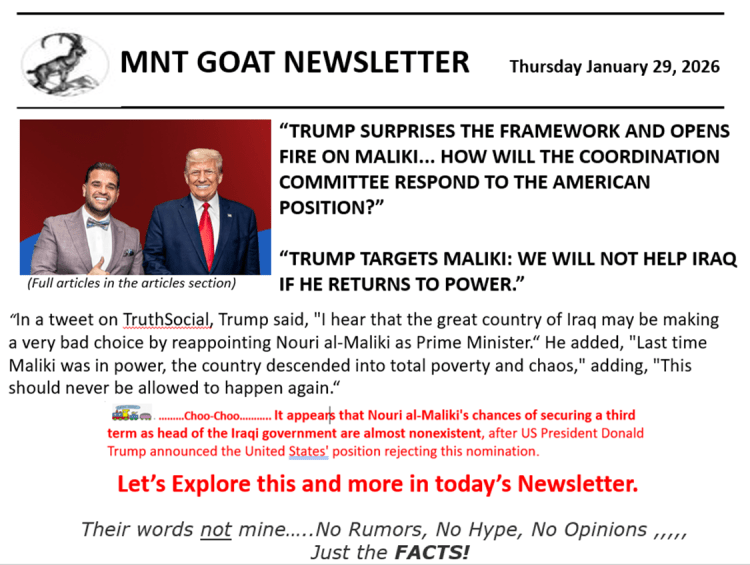
Then in the next article titled “TRUMP SURPRISES THE FRAMEWORK AND OPENS FIRE ON MALIKI… HOW WILL THE COORDINATION COMMITTEE RESPOND TO THE AMERICAN POSITION?” Again we learn that It appears that Nouri al-Maliki’s chances of securing a third term as head of the Iraqi government are almost nonexistent, after US President Donald Trump announced the United States’ position rejecting this nomination.
“We hear that the great nation of Iraq may be making the (very bad) choice of re-installing Nouri al-Maliki as prime minister.”
Why is Nori Al-Maliki such a bad choice? We also learn the reasons in this article, but we already knew this, didn’t we?
“Al-Maliki is considered the closest of those close to Iran and the spiritual father of the armed factions, as he is credited with establishing them before the events of “ISIS” and then officially announcing them under the umbrella of the Popular Mobilization Forces after the events of June 10, 2014, before the fatwa of the religious authority in Najaf regarding the sufficient jihad “.
Trump added in the article: “The last time Maliki was in power, the country descended into poverty and utter chaos, and that should not be allowed to happen again.” He concluded by saying that “if Washington stops helping Iraq, it will have no chance of success, prosperity, or freedom. “
“Nouri al-Maliki was accused by official Iraqi committees and popular gatherings of wasting about one trillion US dollars during his eight years in power, in addition to causing support for sectarian conflict and rhetoric, handing over a third of Iraqi territory to ISIS, as well as his rule being characterized by security chaos, human rights violations, widespread arbitrary arrests, the growing influence of secret informants, and other violations.”
Do you remember these days of al-Maliki 2007-2014? Why would the Coordination Framework even think about putting him back in control unless they are so corrupt and desperate to maintain Iraq as a puppet state for Iran they would do anything. Of course this only exposes the Coordination Framework for what they really are – Iranian supporters and a very corrupt political group. They must be dealt with or Iraq will not be able to have honest elections going into the future.
Can it get much worse than this?
_______________________________
☹ So, in this next article we learn of Nori al-Maliki’s response to President Trump’s recent tweets about him. The article is titled “MALIKI’S FIRST RESPONSE TO TRUMP: I REJECT AMERICAN INTERFERENCE… AND I WILL CONTINUE WORKING UNTIL THE END.” In it we learn that Nouri al-Maliki, the candidate nominated by the Coordination Framework for the premiership, responded to US President Donald Trump’s rejection of him, saying that he “will continue working until the end.”
Working until the end? What the hell does that mean? It means that al-Maliki will not concede to al-Sudani and will keep pushing to get into power anyway he can. He will say and do anything to get there.
Al-Maliki said in a post monitored by “Al-Jabal” that “we categorically reject the blatant American interference in the internal affairs of Iraq, and we consider it a violation of its sovereignty and contrary to the democratic system in Iraq after 2003, and an infringement on the decision of the Coordination Framework for choosing its candidate for the position of Prime Minister.”
A Reality Check for al-Maliki:
I don’t buy it! Oh… but it is okay for Iran, who is also in direct violation of Iraqi sovereignty, to interfere in Iraqi elections and internal affairs? Of course, Maliki does not look at Iran as a foreign country as his is loyalty is to Iran first and his warped mind cannot grasp the reality as it is about to come down hard on him and he knows it. This attempt for a third term as prime minister may be the final straw, the ending chapter to al-Maliki for good this time. God works in strange ways. If he does not back-off this will only result in his final days coming much sooner than later….enough said…. 😊
Other responses to Trump message to Iraq…
In the article titled “A POLITICAL EARTHQUAKE IN IRAQ: KHAZALI IS RELIEVED, HAKIM IS RIGHT, AND SUDANI IS PREPARING” we learn what the Dawa Party has to say. The Dawa Party responds with a verse about tyranny. Trump’s remarks about Iraq and its prime minister were not just “blatant interference,” as many described it, but a new way of speaking to Iraq as a “great country” and not just an area attached to the Iranian file.
The longest 48 hours since the beginning of the year, from the warning conveyed by the leader of the Wisdom Movement, Ammar al-Hakim, against the nomination of Nouri al-Maliki, to the “dispelling of all doubt” when Trump himself and his tweets descended upon the Iraqi scene and opened fire mercilessly on al-Maliki, who had been celebrating among his supporters hours earlier his imminent return to the palace. Not so fast Maliki….
“AL-MALIKI STRUCK AT THE IRANIAN AXIS,” BUT IT WAS TO NO AVAIL.“
Really? In the past few hours, Maliki’s team has tried to deal with the intense campaign that followed the American message. Spokespeople for the State of Law Coalition have spread out across the media to emphasize that Maliki is not subservient to Iran, but rather that he “struck the Iranian axis,” as leader Diaa al-Nasiri said, recalling Maliki’s complaint against Bashar al-Assad’s regime, but the matter was not useful. That’s an important point. Maliki is just all words and no action. Get it? Just because he spoke out again Iran makes to difference, nothing changed. He has no power and he knows it.
However, the coalition leadership has not yet given any indication of surrender. On the contrary, Minister of Youth and Sports Ahmed Al-Mubarraq, a close associate of Maliki, posted a Quranic verse, saying that he would not abandon the “true leader.” The post read: “They plot, and Allah plots, and Allah is the best of plotters. Abu Israa, day after day you prove that you are the true leader in a time of false leaders. We will not abandon you, for you are the right choice. He will continue to support Maliki.”
I find there is a parallel between the loyalist to Maliki (and his like) in Iraq to the democrats in the US. How can you stay so loyal to a party of hypocrites and corrupt individuals even when they are exposed openly and you have the proof. You can hear their lies and you have to be an idiot not to see how they are destroying your own country, yet you maintain loyalty to them just to spite someone else, who apparently is solving the mess their own party created. There is even no comparison from the work of al-Sudani and al-Maliki. Al-Sudani only had four years and the progress he made in that timeframe helped overcome the damage of Maliki. Do these people have no morals or values? Are they mentally retarded? How do they think prosperity and abundance comes, from stealing it (if you can)? Apparently these crooked people don’t feel they have any obligation to serve the people.
_______________________________
What is the mission does Mark Savaya have in Iraq? Our attention to this mission is presented in a few articles which I will present below titled:
- SAVAYA OPENS TWO FRONTS: WE WILL PURSUE SENIOR IRAQI OFFICIALS, THEIR FOREIGN PASSPORTS, AND THE GOVERNMENT ON OUR TERMS.
The US President’s envoy to Iraq, Mark Savaya, confirmed on Tuesday (January 27, 2026) that his team is working on the ground in Iraq to support efforts to form a new government and prevent Iranian-backed militias from coming to power, stressing that preparing to confront the corruption crisis in the country is no less important than the ongoing political and security battle.
I believe the new Iraqi constitution of 2025 states that politicians running for office must be an Iraq citizen. Why has no one challenged up to now these Iranians who were elected in parliamentary positions? Do you see part of the problem here?
- SAVAYA REVEALS THE TRUTH: IRAQ’S LOOTED FUNDS HAVE BEEN CONVERTED INTO REAL ESTATE AND FOREIGN NATIONALITIES WITH FAKE IDENTITIES.
Mark Savaya, the envoy of US President Donald Trump, made a series of fiery statements regarding the political and financial files in Iraq for 2026, revealing intensive American “field” movements aimed at redrawing the map of power and pursuing the whales of corruption. In a blog post on the “X” platform, which was reviewed by the “Iraq Observer” agency, Savaya stated that “an American team is currently working on the ground to support the formation of a new Iraqi government,” stressing that Washington’s top priority at this stage is “preventing Iranian-backed factions and militias from accessing positions of power and decision-making,” in a clear indication of a firm American approach to reducing Tehran’s influence in Baghdad. Can the US find ways to claw back these stolen funds? No wonder Iraq’s economy is so volatile and they have an issue meeting their budget. They are stealing the money not that they don’t have the funds.
- “SAVAYA: WE HAVE REACHED A COMPREHENSIVE UNDERSTANDING OF THOSE INVOLVED IN CORRUPTION AMONG SENIOR IRAQI OFFICIALS AND THEIR FAMILIES”.
The US envoy to Iraq, Mark Savaya, confirmed that a comprehensive understanding has been reached of the individuals involved in corruption cases in Iraq, noting that this includes senior government officials and their family members who have benefited from corruption funds. Savaya stated in a post on the X platform on Tuesday (January 27, 2026) that “while our team works on the ground in Iraq to support the formation of a new government and prevent Iranian-backed militias from gaining access to centers of power, it is equally, if not more, important to prepare for the corruption crisis in Iraq.”
Its no wonder why rumors are floating around of Savaya being dismissed from his mission in Iraq.
- “AN ECONOMIST WARNS: IRAQ IS IN THE EYE OF THE STORM, AND TEMPORARY FIXES ARE NO LONGER EFFECTIVE.”
Economic expert Manar Al-Obaidi warned on Tuesday that Iraq has entered a post-economic crisis phase, indicating that the country is now in the “eye of a real hurricane,” and that patchwork solutions or what he described as “painkillers” are no longer effective after the situation spiraled out of control. Al-Ubaidi said in a Facebook post, which was followed by Al-Sa’a Network, that “Iraq is no longer in the stage of warning or forecasting, but is in the heart of the storm itself, where no patchwork solutions or temporary painkillers are of any use,” noting that “things have gotten out of control, and Iraq today is in the vortex of a real hurricane .”
- “MARK SAVAYA SAYS ROADMAP UNDERWAY TO CONFRONT CORRUPTION CRISIS IN IRAQ”
Mark Savaya said a roadmap is being implemented to confront corruption in Iraq, track stolen funds, identify beneficiaries, and enforce accountability in coordination with US institutions, as Washington highlights Iraq’s stabilizing regional role.
- “SAVAYA: WE HAVE REACHED A COMPREHENSIVE UNDERSTANDING OF THOSE INVOLVED IN CORRUPTION AMONG SENIOR IRAQI OFFICIALS AND THEIR FAMILIES.”
The US envoy to Iraq, Mark Savaya, confirmed that a comprehensive understanding has been reached of the individuals involved in corruption cases in Iraq, noting that this includes senior government officials and their family members who have benefited from corruption funds. Savaya stated in a post on the X platform on Tuesday (January 27, 2026) that “while our team works on the ground in Iraq to support the formation of a new government and prevent Iranian-backed militias from gaining access to centers of power, it is equally, if not more, important to prepare for the corruption crisis in Iraq.”
There is also rumors out there of Mark Savaya’s dismissal from the mission in Iraq. He recently responded to these rumors:
On Friday (January 30, 2026), Ambreen Zaman, senior correspondent for Al-Monitor, confirmed that US Special Envoy to Iraq Mark Savaya denied the circulating news about his dismissal from his position, Zaman said in a statement published on her “X” account and followed by “Baghdad Today”, that she had contacted Savaya directly, who denied all the news circulating about his removal from his mission, indicating that this news is being promoted by “accounts linked to Iranian-backed factions”, in an attempt to create a media impression of the absence of the American envoy from the Iraqi scene. Go figure then Iranians are bastards. ☹
____________________________________________
😊 Onward to better news today in the article titled “EXPERT: THE CENTRAL BANK INTENDS TO ELIMINATE THE GAP BETWEEN THE OFFICIAL DOLLAR EXCHANGE RATE AND THE PARALLEL MARKET RATE.”
Economic and financial expert, Safwan Qusay, confirmed the Iraqi Central Bank’s determination to eliminate the gap between the official dollar exchange rate and its price in the parallel market, noting the existence of intensive specialized efforts to address the imbalances in the monetary and commercial system.
Qusay said, during his appearance on the “Free Talk” program on Al-Furat satellite channel, that: “The Central Bank is working to reduce the price gap to zero through well-thought-out procedures involving specialists aimed at controlling the movement of the dollar and limiting irregular speculation.”
He explained that “about 70 percent of the private sector is still outside the Skoda system, which weakens control over foreign trade,” noting that “the American company K2 is monitoring and tracking irregular trade in Iraq.”
“the transition of the Iraqi economy from a closed system to a free economy requires a clear roadmap and linking Iraq to clean and transparent global markets.”
Here is the best part of this article as it was revealed that there is a timetable and a road map that is ongoing with meetings with Oliver Wyman, stressing that the banks that were sanctioned have had restrictions lifted from them after complying with the Central Bank’s procedures, especially in the field of technology investment and banking governance.
______________________
SUMMARY:
I have to include a summary today since there is so much news. What does it all mean in this critical time for Iraq?
We may look at the news today as gloom and doom since it is going to delay the reinstatement and there is no doubt it will. But for how long?
Remember that the CBI and the GOI are on two paths. The emphasis now for the GOI is to seed a government that will work for Iraq and not to continue down the path of yet more corruption. Those involved must be weeded out and gone. Their stashes of money must be hunted down and clawed back to Iraq.
As far as the Nov 2025 elections go, Iraq will most likely either have to dismiss these 28 Iranian parliamentary members just elected and rerun elections in their districts or suffer the US sanctions. President Trump has already alluded to what these nasty sanctions could be and they are withholding payments to Iraq from the DFI fund accounts in NYC. This is the last of the sanctions that could really hurt Iraq and would crash their economy. Do even the crooked politicians want this? They too will suffer. Can the crooks buy time and go along with the US proposals to eliminate Iran from politics and then later find a way to renter once things cool down and Trump is gone?
We will most likely see articles about how this turns out. Stay tuned! They will emphasize citizenship and passport qualifications for these positions. These Iranian militia are not Iraqi citizens. This also applies to the newly elected deputy speaker. We still wait for the president to be announced and yesterday was the constitutional deadline. The way I see it they have essentially put the election going forward ON-HOLD until this prime minister nomination with Nori al-Maliki can be ironed out along with these parliament members.
Meanwhile there are measures behind the scenes taking place to work with Savaya, the US Treasury and consulting groups to weed out politicians who have stolen funds from Iraq much like in the US under Trump is doing to American politicians and stolen funds. The resemblance is uncanny!
Again, I have to dispel rumors from many of these RV intel gurus who are still persistent in telling their listeners that the CBI works independently and that they will reinstate when they are ready regardless of the elections and corruption. Are you a fool or what? They forget or don’t know that the CBI and the GOI work hand-in-hand. This independence only goes so far.
There is also the issue of the US either supporting or rejecting the approval to let the reinstatement go. Who elects the chairman of the IMF? It is the US enough said….
We know this is part of a much bigger “reset” of the financial system and that Iraq is the pivot country to be used to secure the main basket of currencies for the new peg. So, in this regard I explained many times to all my readers what has to happen first. There are five (5) main conditions. If you go back to my 9/16/25 Newslettter I describe the list for you in detail as given to me from my CBI contact. So, even today we read in the article titled ““EXPERT: THE CENTRAL BANK INTENDS TO ELIMINATE THE GAP BETWEEN THE OFFICIAL DOLLAR EXCHANGE RATE AND THE PARALLEL MARKET RATE” we learn that the CBI is still working on ending the parallel market not just contain it. In the past Ali al-Alaq has told us that the parallel market is under control and the variance was so small it could be handled, rather than eliminated it altogether. Now we see a difference in policy of the past in that it has to be eliminated altogether. What changed?
What changed is the impact on the dinar and the realization of the volatility of the dinar when any crisis arises. Basically, the CBI can’t control the dollars. There are too many of them outside the banking systems floating around in stashes in peoples homes. They take them out to the streets to the black-market money changers and sell them when times get hard. The CBI realizes that there is too many dollars outside the banking system and can’t claw them into the banks so easily. What will they do?
It is my estimation that the digital dinar is just around the corner and will solve this problem. The Project to Delete the Zeros will be part of the process in the solution implementation. It can be that source to bring these stashes of dollars into the banks. I can’t yet give you all the details as to the timing or how this would all work. But I will add the CBI has contracted with a news media firm to broadcast news about this process exclusively. They are now telling the citizens inside Iraq that this news media firm will be the source for information and NO OTHER SOURCE. My CBI contact has told me they are now working with this new media firm to develop videos for education in the upcoming news broadcast.
______________________________
We must continue to PRAY and PRAY hard that God watches over the US and safeguards this current administration in the process of eliminating corruption in both the US and Iraq. I am waiting for God to speak up about Iraq again through His prophets. We know that prophet Kim Clement already prophesized on two different occasions about the Iraqi dinar. Will God give us another one soon? We wait.
________________________________
I am waiting for God to speak up about Iraq again through His prophets. We know that prophet Kim Clement already prophesized on two different occasions about the Iraqi dinar. Will God give us another one soon? We wait.
What will this new year bring?
More than ever, we need to tune into the prophets during this new year! This is said to be the great year of the breakthrough in many aspects. Many of these past prophecies have yet to be fulfilled. They are now being repeated time and time again in prophetic word. What does this mean. I am told this means they are very close to fulfillment. Let’s see what the new year brings. Remember God’s prophet Kim Clement told us the Iraqi dinar and the middle east would change drastically. Can you see it now when Iran falls?
God uses his prophets in time of trouble. If you don’t think this nation and the world is in trouble – THINK AGAIN! If you can discern the fake from the good prophets, you can tie into something wonderful to guide you. But be careful there are many charlatans out there and we have witnessed these many bastards already in the IQD RV intel standpoint. Prayer also helps as it lets God know you are affirming as a human being what he is doing. You are essentially saying THANK YOU and please continue! These prophecies give us hope and comfort to know some higher power is looking after us. I have tried to bring you what I believe are some of the legitimate prophets for clarity. I hope they are giving you encouragement to stay focused on the TRUTH.
We pray-
A nice prayer from one of my blog followers. Thank You!
“Be still, wait on the Lord, my modern David will slay the so-called giant of Islam. It will fall they are already begging for mercy, but it will not come as they have sinned so greatly with their blasphemy, disregarded all warnings for the Lord and now HIS WRATH WILL CONSUME ALL WHO CURSE THE CHOSEN!!
______________________________

________________________________________
Their words not mine…..No Rumors, No Hype, No Opinions ,,,,,
Just the FACTS!
PRAYING WITH SINCERITY
Many may ask why their prayers are not being answered. Our new Shepard in Rome Pope Leo XIV has given us some direction.

You can purchase a nice pair of Rosary Beads here to pray:


These prophecies are more important now more than ever. They give us the strength, perseverance and hope that a better time is coming and that God’s Hand is at work behind the scenes. If you just take a second even to look around you at these past three election cycles, how can you deny that God is at work? Are you sleeping or what?
It is amazing and there is no other way that these events could have happened the way they turned out. But there is more to come, much, much more, I assure you! Now that God has his biblical David re-elected, we need to pay attention to what He does next.
NOTE: These prophecies just keep getting better and better, giving us HOPE of a brighter future. But the real reason why I listen to them is that we can actually see what God says He will do is taking place right in front of our noses. It is a confirmation to me that God is real and is still with us forever just as in biblical times.
Prophetic Words from prophet: Julie Green
“The World Has Reached A Boiling Point Were Things Will No Longer Stay The Same”
Go to the 18:28 mark. From Jan 18th .

WHAT DOES GOD HAVE IN MIND FOR GREENLAND?
WHAT WILL COME OUT OF IT FOR AMERICA? A mineral trapped in the earth will finally come out. This is a prophetic word from Hank Kenneman. Listen carefully! 😊

REMEMBER KIM CLEMENT’S PROPHECY 2010 ABOUT THE 3 NEW SOURCES OF ENERGY?
How is this connected to Greenland and Hank’s prophecy just given this week?
THE ENERGY CRISIS IS COMING TO AN END! Please first watch this video now to refresh your memory about Kim Clement 15+ year old prophecy on five new sources of energy; from the earth, from the sky and from the water. Do you see the connection? Then see how close we are to fulfillment of one of these new energy sources, this one from the land.

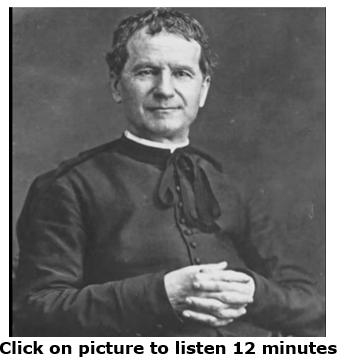
Fr. DON BOSCO EXPOSED THE DARK SECRET BEHIND ISLAM
— And the Truth the World Forgot about the so-called Muslim religion. Fr.Don Bosco, also known as John Bosco, was an Italian Catholic priest and educator, born on August 16, 1815. He founded the Salesian Society in 1859 to help disadvantaged youth, particularly boys, through education and community service. His teachings emphasized lovekindness, and the importance of education for young people, making him a beloved figure in Catholicism and a patron saint of youth. Don Bosco was canonized in 1934.
PRESIDENT TRUMP ANNOUNCES THE US IS PULLING OUT OF NATO, BUT WHY?
Do you want the true? Do you really want the Truth? Then pay close attention to what I am about to tell you. I will put this into simple terms for all to understand.
We must keep asking why. Why, why, why did Trump decide this move is in the best interest of the US? We must keep asking these vital questions and just don’t breeze over the headlines.
This Trump move is a drastic shift from the global elitist version of the world. I want everyone to remember what happened in Ukraine. NATO positioned warheads pointing at Russia in Ukraine. Really? Oh…. you didn’t know that?
After the end of the Second World War in 1945, during which the US and USSR had been allies, the USSR installed satellite governments in its occupied territories in Eastern Europe and North Korea by 1949, resulting in the political division of Europe (and Germany).
The US allies even had an early confrontation of the communists, as was the Korean War of 1950 to 1953, which ended in a stalemate. So, we must think reality and if the US would have made a major blunder invading Russia in 1945 when we couldn’t even win the Korean war.
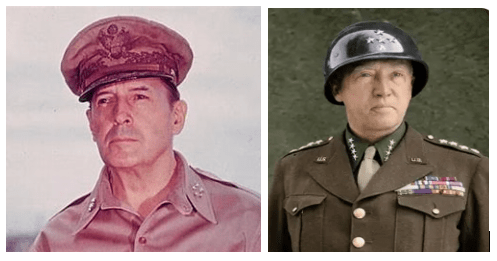
The fall of the cold war in 1991 took negotiating, and lots of it, and one item decided on was never to position NATO forces in this buffer zone of any of the former USSR WWII territorial concessions, if the USSR, is to be broken apart. This means Russia liberating all of these countries on its border. Russia had been using these countries as its’ buffer zone to protect their homeland from foreign invasions. This had occurred for decades since the end of WWII. Afterall when you heard strategic proposals from popular generals like Patton and MacArther with their talk of invading Russia post WWII, what do you want Russia to think? So, this protective barrier had been going on for over decades into the early 1990’s. Remember the goal of the elitists is to control the ENTIRE WORLD and its resources and so Russia, is included as part of their conquest.
The globalist think tank developed a 20 year strategy for the new Millenium. It included invading Russia and silently building up forces along its borders to isolate it. This violation of the 1991 treaty by NATO was just the beginning. Russia had to respond.
This was the driving force for Russia going into Ukraine. You may hear so much other ‘humanitarian’ rhetoric by the crooked news media channels. They must get the public to support it any way possible, even with lies. These treaties ending the cold war in 1991 and were simply violated by NATO, or should I say the globalist.
During President Trump’s first term he convinced NATO to back out and they did. War between Russia and Ukraine was averted. Then Biden took over and allowed NATO into Ukraine along with the missiles. This was a direct violation of the treaty. Can you blame Russia for invading? Hey folks, I got news for you…. war is not pleasent and people die!
But what was Russia’s real goal? Was it to kick NATO out of Ukraine? Yes, but you didn’t hear much about these FACTS and TRUTHS in the news, did you? Biden also desperately was told not want to expose the rest of world to the other corruption that was going on in Ukraine (biological warfare research, child trafficking, etc.) and his administration hoped by beefing up the Ukraine forces they could signal Russia to back off. Remember that we heard in the news that a lot of the billions of US aid went to NATO to supply weaponry such as drones. What the hell was NATO doing in Ukraine? There was talk from the UN to vote on whether NATO should enter Ukraine and help the Ukrainian government push Russia out. I’d like to tell you folks; NATO was already in Ukraine at that time. So, this was all just a pack of lies to try to make it legal going forward.
Well… this in itself proves that this is really all about NATO involvement in Ukraine. Crooked NATO then also became the protector of these nefarious operations to which the Ukraine was being used for, mostly to hide its work from the rest of the world. Ukraine had become a secret, dark cesspool for the elitist at a platform to conduct their global agenda.
Also, as far as breaking away from NATO, we must think about what just happened in Greenland. The US was threatened with NATO retaliation if it attacked Greenland forcefully. The EU supported it. Really? The US, being one of NATOs largest contributors, and you are going to attack it? Can you now see the split and the slow progressive move of the US from supporting this globalist idea of controlling the planet and with it the US sovereignty too?
The US is slowly breaking away from this globalist idea of controlling the planet. But it takes guts and it take a president with guts to do it. The ‘Make America Great Again’ slogan has become the US mantra and making America wealthy again not making the elitist rich through their global empire. Even Iraq, under al-Sudani has taken up the slogan of ‘Making Iraq Great’. For Iraq this slogan means a lot. It means a breakaway from the globalist vision for Iraq and to a more sovereign approach to national unity. Is this why we have seen this massive reform movement under al-Sudani take hold during his four-year administration? But what will happen should he (like Trump) not get elected for a second consecutive term? Of course, the globalist do not like Al-Sudani’s policies and so they are attempting to put their puppet Nori al-Maliki back in again as prime minister to tear apart all the progress and hard work made so far, just as Biden had done to the US when he followed Trump’s first term. Can you see what is going on here?
You must make these connections and not just read the news but absorb it and remember it. Then connect the pieces of what is really going on in Iraq, in the US as well as in Ukraine. It is all a ‘silent war’, hiding the truth with lies and falsified misconceptions by the news media of what is really taking place. And what is taking place is a pull-away from the globalist conquest to establish their One World Government. Even as the prophets tell us this One World Government may happen some day in the distant future, but this not the time and God is not going to let the dark powers rush it. Also, we don’t even know if the One World Government of the future will be a dark government at that time. All we know is what we see today in the UN and the elitist move to enslave mankind now. The prophets also tell us that the US will be an isolationist and will break away entirely from this idea of a One World Alliance move and Europe.
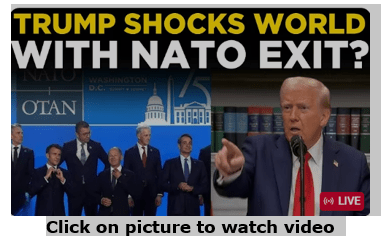
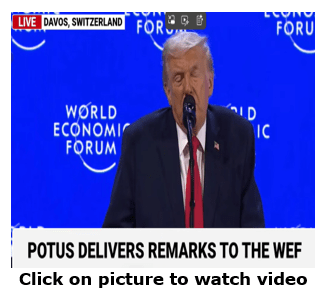
US PRESIDENT TRUMP DELIVERS REMARKS AT THE WORLD ECONOMIC FORUM, DAVOS, SWITZERLAND
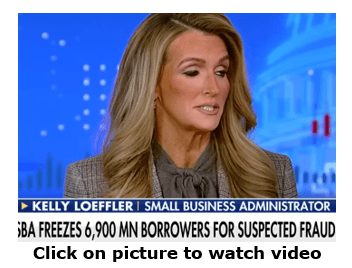
HANDCUFFS AND PRISON TIME COMING FOR MINNESOTA FRAUDSTERS
This is pandemic era fraud swept under the rug by the Biden administration. This was money that small businesses needed to survive and stay open. This was tax payer funds allocated to help them. So many never got the money or much less that they should as funds ran dry due to fraudsters.
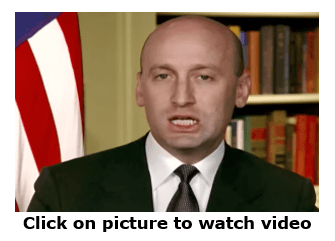
THE U.S. HAS ONLY ONE SET OF FEDERAL LAWS
If you want to change the law you must go through the legislative process. STATES CAN NOT RANDOMLY DECIDE TO DISOBEY FEDERAL LAW, it would be a breakdown of an orderly society and chaos would prevail which we are seeing in sanctuary cities. States are not an “island” and are part of the United States of America. Any governor or mayor who apposes these Unites States should resign or be impeached and banned from politics.
White House deputy chief of staff for policy Stephen Miller explains how federal law applies regarding Minnesota and illegal immigration. This mass migration scheme of the democrats is for votes and they only way they can stay in power. They are upset that Trump sees through the scheme and is shutting it down. Why not just have FREE elections and let the citizens decide. Yes, legal, bonified citizens voting because this is what the US Constitution says and the U.S. is a Constitutional Republic.
TRUMP’S NEW PLAN TO STOP THE ICE RIOTS

CLINTONS IGNORING SUBPOENA TO TESTIFY BEFORE CONGRESS
Are They Really In Trouble For Ignoring a Subpoena?

I have created a brand-new “Post RV Workshop” page in the blog. I included my own personal tips on investing post-RV and also organizing and protecting your estate. Here is the LINK. Going forward I will only post new and exciting information and opportunities here on the Latest Newsletter as they come along. Later I will transfer it to the ‘Post RV Workshop’ page in subsequent Newsletters for your future reference.
Just so you know I absolutely DO NOT adhere to high-risk investments where you can lose it all in a flash. Look at it this way – you are going to have all this money. Most of us investors waited decades for this RV to happen and so why would you even think about pissing is all away in some high-risk gamble of an investment. Yes, there are going to be scammers out there but let’s talk about legitimate investment opportunities only. These scammers can suck you dry and there is not a damned thing you can do about it. Go to a legitimate wealth manager associated with your bank. Let the licensed experts advise you. Please, please stay away from idiots like MarkZ, TNT Tony, Bruce on the Big Stupid Call, etc. , etc.
GOLD/SILVER RATIO: WHEN THIS RATIO SHIFTS, CRISIS FOLLOWS — AND IT’S HAPPENING AGAIN
What will it bring us this time?
EXPECT A GOLD AND SILVER PULLBACK TO HAPPEN
Here are a few of the other topics covered:
* TRUMP FLOATS ZERO INCOME TAX PLAN STARTING WITH BIGGEST REFUNDS EVER
*HOW MUCH MONEY CAN YOU GIFT WITHOUT PAYING TAXES?
*SILVER VAULTS RUN DRY AS SHORTAGE TRIGGERS PANIC. Physical silver not available to meet demand.
*15 THINGS TO DO IF YOU GET RICH ALL OF A SUDDEN
*15 ASSETS THAT ARE MAKING PEOPLE RICH/RICHER
*HERE’S HOW TO MAKE YOUR ASSETS INVISIBLE FROM CREDITORS
*HOW TO LOOK PENNILESS IN THE PUBLIC RECORD
*5 STATES CUTTING PROPERTY TAXES TO ZERO. WILL YOUR STATE BE NEXT?
*TRUMP REVEALS WHEN AMERICANS MIGHT EXPECT TO GET A TARIFF RELIEF $2,000 CHECK

EXPERT: THE CENTRAL BANK INTENDS TO ELIMINATE THE GAP BETWEEN THE OFFICIAL DOLLAR EXCHANGE RATE AND THE PARALLEL MARKET RATE.
Economic and financial expert, Safwan Qusay, confirmed the Iraqi Central Bank’s determination to eliminate the gap between the official dollar exchange rate and its price in the parallel market, noting the existence of intensive specialized efforts to address the imbalances in the monetary and commercial system.
Qusay said, during his appearance on the “Free Talk” program on Al-Furat satellite channel, that: “The Central Bank is working to reduce the price gap to zero through well-thought-out procedures involving specialists aimed at controlling the movement of the dollar and limiting irregular speculation.”
He explained that “about 70 percent of the private sector is still outside the Skoda system, which weakens control over foreign trade,” noting that “the American company K2 is monitoring and tracking irregular trade in Iraq.”
Qusay stressed that “addressing this issue requires collective management and high-level coordination to control the trade system, especially at border crossings,” indicating that “the transition of the Iraqi economy from a closed system to a free economy requires a clear roadmap and linking Iraq to clean and transparent global markets.”
He revealed that there is a timetable and ongoing meetings with Oliver Wyman, stressing that the banks that were sanctioned have had restrictions lifted from them after complying with the Central Bank’s procedures, especially in the field of technology investment and banking governance.
He pointed out that “the Skoda system actively contributes to strengthening the banking system and regulating foreign trade,” explaining that “controlling the entry of goods requires the adoption of advanced technological systems through long-term contracts.”
Qusay concluded his remarks by pointing out that “Iraq has taken decisions to ban the import of some goods, including gold and mobile phones, as part of a policy to regulate imports and control market activity.”
**************************************************************************************************
WHAT DOES TRUMP’S REJECTION OF MALIKI MEAN? AN ANALYST EXPLAINS TO IRAQ OBSERVER
US President Donald Trump’s tweet, in which he openly attacked Nouri al-Maliki’s return to the premiership, has reshuffled the cards within the Shiite political establishment and opened a new door to conflict within the coordination framework, after it appeared that the internal settlement had been decided in favor of al-Maliki at the expense of Prime Minister Mohammed Shia al-Sudani.
Political analyst Majashaa Al-Tamimi confirmed to Iraq Observer that “Trump’s tweet against Maliki has reshuffled the cards within the coordination framework.”
Al-Tamimi pointed out that this explicit rejection “raised the chances of the head of the Reconstruction and Development Coalition, Muhammad Shia’ al-Sudani, as he is the least costly option internally and the most acceptable externally.”
Al-Tamimi added that “the biggest strategic mistake made by those close to Maliki was promoting the idea that the Iranian Supreme Leader welcomed his return.”
On Tuesday evening, US President Donald Trump stated that the return of former Iraqi Prime Minister Nouri al-Maliki to head the government again was something that should not be allowed.
Trump said in a post on the Truth Social platform: “I hear that great Iraq may be making a grave mistake by bringing back Nouri al-Maliki as Prime Minister. Under Maliki’s previous rule, the country slid into the clutches of poverty and utter chaos, and this should not be allowed to happen again.”
He added: “Because of his policies and extremist ideologies, if elected, the United States will cease providing aid to Iraq. And if we are not there to help, Iraq will have no chance of success, prosperity, or freedom.”
Trump concluded his post by saying: “Let’s make Iraq great again.”
On Saturday, January 24, 2026, the Coordination Framework announced the nomination of Nouri al-Maliki, head of the “State of Law Coalition,” for the position of Prime Minister, considering him the candidate of the largest parliamentary bloc, while calling on the House of Representatives to hold a session to elect the President of the Republic in accordance with the constitutional timelines.
The Coordination Framework said in a statement: “Based on our national responsibility, and keen to complete the constitutional entitlements within a context that preserves the country’s stability and strengthens the state’s path, the Coordination Framework held an expanded meeting of its leaders, in Hadi al-Amiri’s office today, Saturday, during which the political situation and the next stage were discussed.”
The statement added, “After an in-depth and extensive discussion, the Coordination Framework decided by majority vote to nominate Nouri Kamel al-Maliki for the position of Prime Minister, as the candidate of the largest parliamentary bloc, based on his political and administrative experience, and his role in running the state.”
He continued, “The coordination framework affirms its full commitment to the constitutional path, and its keenness to work with all national forces to form a strong and effective government, capable of facing challenges, providing services, and protecting Iraq’s security and unity.”
The Coordination Framework called on the House of Representatives to “hold its session dedicated to electing the President of the Republic in accordance with the constitutional timelines.”
Iraqi Prime Minister Mohammed Shia al-Sudani had withdrawn from the race for the premiership, paving the way for his political rival Nouri al-Maliki, after a deadlock that lasted for more than a month within the Shiite bloc, during which the forces of the Coordination Framework were unable to decide on a consensus candidate, which led to an internal settlement that practically ended al-Sudani’s competition and brought al-Maliki back to the forefront of the scene.
*************************************************************************************************
TRUMP SURPRISES THE FRAMEWORK AND OPENS FIRE ON MALIKI… HOW WILL THE COORDINATION COMMITTEE RESPOND TO THE AMERICAN POSITION?
It appears that Nouri al-Maliki’s chances of securing a third term as head of the Iraqi government are almost nonexistent, after US President Donald Trump announced the United States’ position rejecting this nomination .
Trump said Tuesday evening that “the United States will no longer help Iraq if Nouri al-Maliki is chosen as prime minister,” and wrote on Truth Social: “We hear that the great nation of Iraq may be making the (very bad) choice of re-installing Nouri al-Maliki as prime minister.”
Trump added: “The last time Maliki was in power, the country descended into poverty and utter chaos, and that should not be allowed to happen again.” He concluded by saying that “if Washington stops helping Iraq, it will have no chance of success, prosperity, or freedom . “
The Coordination Framework, as the largest bloc in parliament, announced earlier this week the nomination of the head of the State of Law Coalition for the position of Prime Minister, even though Maliki is considered one of the most controversial figures in Iraq and faces widespread popular rejection .
Since last Saturday, Washington has not issued an explicit position regarding al-Maliki’s nomination for prime minister, and has been content with emphasizing its rejection of the formation of a government close to Iran and its armed factions in Iraq. Al-Maliki is considered the closest of those close to Iran and the spiritual father of the armed factions, as he is credited with establishing them before the events of “ISIS” and then officially announcing them under the umbrella of the Popular Mobilization Forces after the events of June 10, 2014, before the fatwa of the religious authority in Najaf regarding the sufficient jihad .
In addition to the American rejection of al-Maliki’s nomination, Shiite and Sunni political forces opposed this nomination. The Progress Party, led by Mohammed al-Halbousi, officially announced its rejection of the Coordination Framework candidate, Nouri al-Maliki, and stressed that it would not participate in any government led by a figure who brings back to the Iraqis’ memory sectarian conflicts, the growth of extremism and terrorism, the repeated crises, and international and Arab isolation .
While some parties within the coordination framework had reservations about this nomination, other forces rejected it. Perhaps the most prominent opponents of Maliki assuming a third term are the Wisdom Movement led by Ammar al-Hakim, in addition to reservations from the Asaib Movement led by Qais al-Khazali .
Political researcher Mustafa Al-Obaidi believes that the American position settled the matter and saved the opposition forces the trouble of taking action to put obstacles in front of Al-Maliki . Al-Obeidi told Al-Sa’a Network: “The matter of Maliki assuming the premiership has been decided after Trump’s stance. Everyone was waiting for this stance, which is the expected stance from Washington towards one of the most important Iraqi politicians close to Iran and its axis in Iraq . ”
He added that “preparations were underway internally through the political forces opposed to Maliki in order to form the blocking third to obstruct Maliki’s appointment and prevent a vote on his government,” noting that “these forces began a movement during the past two days to arrange the situation.”
Al-Obeidi explained that “Washington’s acceptance of Maliki, if it happens, will send a clear message that the United States is not serious about ending and reducing Iranian influence in Iraq,” noting that “Maliki’s early removal through the American position came largely as a result of the picture drawn by the American envoy Mark Savaya about Maliki and his closeness to the factions and Iran.”
Al-Ubaidi ruled out that “the Coordination Framework would issue any positions opposing or contradicting the American position regarding the nomination,” indicating that “if the Framework insists, under Iranian pressure, on passing al-Maliki, then Washington will not allow his government to succeed within one year of its formation.”
Before Trump’s stance on al-Maliki’s nomination, Asharq Al-Awsat newspaper revealed that the Coordination Framework had received an American message objecting to the mechanisms for nominating the prime minister-designate and other leadership positions. The newspaper indicated that a prominent leader in the Coordination Framework received a surprise American call informing him of Washington’s objection to the continued Iranian dominance over the mechanisms for forming the government. A prominent leader in the State of Law Coalition, which is led by al-Maliki, acknowledged that the American message had disrupted the latter’s nomination and made his path to a third term extremely difficult.
According to the Arabic newspaper, “The American message caused a sharp disagreement during a meeting of the coordination framework between those who oppose American interference in the appointment of the prime minister, and others who warn that nominating Maliki will create a tense relationship with Washington and will harm Iraq and its existing political system.”
It appears that the forces of the Coordination Framework, especially those who adopted the option of nominating Maliki, will be facing a major test and trial, after the American position became clear, which rejects any government that includes those close to Iran, according to what was stated by Mahmoud Azzo, a professor of political science at the University of Mosul, who suggested that the Framework would present another figure who enjoys international and specifically American support in order to avoid an upcoming crisis with Washington .
Azzou told Al-Sa’a Network: “The American position towards Iraq is linked to American positions in the Middle East, which coincide with the use of the maximum pressure policy towards the Iranian issue . ”
He added that “Washington is not only trying to rearrange Iraq’s situation in the region, but is also seeking to neutralize it completely from the Iranian issue so that American interests are not negatively affected on the one hand, and so that Iraq is not affected by any measures that Washington might issue against Iraq because of Iran . ”
He continued: “The framework forces will face a difficult test regarding the nomination of the next prime minister, as the matter is not related to the numerical bloc and the number of deputies, but rather to the extent of the acceptability of those nominated internally and externally, and this matter seems clear after the American rejection of the framework option and its candidate for the premiership . ”
Azzou predicted that “the coordination framework will begin maneuvering to replace its candidate for the premiership with others who enjoy acceptance and good relations with the United States,” suggesting that “the head of the Iraqi intelligence service, Hamid al-Shatri, is the closest to the position, especially since, according to the American vision, he is compatible with the Iraqi position towards the situation in the region in the future, as well as with the regional developments and tensions in the region.”
He indicated that “the forces that reject al-Maliki’s nomination, most notably the Wisdom Movement led by Ammar al-Hakim, will take the initiative and will be at the forefront of presenting the framework candidate and trying to convince the United States and the international community of him to assume the presidency of the Iraqi government in light of the developments and changes in the Middle East.”
The caretaker Prime Minister, Mohammed Shia al-Sudani, received a call from US Secretary of State Marco Rubio, who warned that the Iranian-controlled government could not successfully put Iraq’s interests first or keep Iraq out of regional conflicts.
During a phone call between US envoy to Syria Tom Barrack and Kurdistan Democratic Party leader Masoud Barzani, the US envoy expressed his displeasure with supporting any government in Iraq that is close to Iran, in an implicit reference to Barzani’s position supporting Nouri al-Maliki’s nomination for the Iraqi premiership.
In conjunction with the previous positions, the US President’s envoy to Iraq, Mark Savaya, confirmed that his team is working on the ground in Baghdad to prevent Iranian-backed armed factions from coming to power, noting at the same time that he now has a database of individuals involved, including senior government officials and their family members who have benefited from corrupt Iraqi funds.
Nouri al-Maliki was accused by official Iraqi committees and popular gatherings of wasting about one trillion US dollars during his eight years in power, in addition to causing support for sectarian conflict and rhetoric, handing over a third of Iraqi territory to ISIS, as well as his rule being characterized by security chaos, human rights violations, widespread arbitrary arrests, the growing influence of secret informants, and other violations.
(Mnt Goat: Can it get much worst than this?)
********************************************************************************
*************************************************************************************************
TRUMP TARGETS MALIKI: WE WILL NOT HELP IRAQ IF HE RETURNS TO POWER
US President Donald Trump spoke on Tuesday about the “bad choice” Iraq might make by reappointing Nouri al-Maliki as prime minister.
In a tweet on TruthSocial, Trump said, “I hear that the great country of Iraq may be making a very bad choice by reappointing Nouri al-Maliki as Prime Minister.”
He added, “Last time Maliki was in power, the country descended into total poverty and chaos,” adding, “This should never be allowed to happen again.”
Trump pointed out that “because of his crazy policies and ideologies, if he is elected, the United States will no longer help Iraq, and if we are not there to help, Iraq will have no chance of success, prosperity, or freedom. Make Iraq Great Again!”
It is worth noting that the Iraqi Coordination Committee decided a few days ago to nominate Nouri al-Maliki, head of the State of Law Coalition, for the position of prime minister.
*******************************************************************************************
MALIKI’S FIRST RESPONSE TO TRUMP: I REJECT AMERICAN INTERFERENCE… AND I WILL CONTINUE WORKING UNTIL THE END.
Nouri al-Maliki, the candidate nominated by the Coordination Framework for the premiership, responded to US President Donald Trump’s rejection of him, saying that he “will continue working until the end.”
Al-Maliki said in a post monitored by “Al-Jabal” that “we categorically reject the blatant American interference in the internal affairs of Iraq, and we consider it a violation of its sovereignty and contrary to the democratic system in Iraq after 2003, and an infringement on the decision of the Coordination Framework for choosing its candidate for the position of Prime Minister.”
He pointed out that “the language of dialogue between countries is the only political option in dealing with them, and not resorting to the language of dictates and threats.”
He added: “Out of respect for the national will and the decision of the Coordinating Framework guaranteed by the Iraqi Constitution, I will continue to work until we reach the end, in a way that achieves the higher interests of the Iraqi people.”
The coordinating framework had announced last week that the forces and parties under it had agreed to nominate Nouri al-Maliki to assume the presidency of the next Iraqi government.
On Tuesday, US President Donald Trump confirmed in a post on his Truth Social account his rejection of al-Maliki’s nomination to head the new Iraqi government.
Trump said, “I hear that great Iraq might make a grave mistake by bringing Nouri al-Maliki back as prime minister. Under Maliki’s previous term, the country slid into the abyss of poverty and chaos, and that should not be allowed to happen again.” He added, “Because of his policies and extreme ideologies, if he is elected, the United States will cease providing assistance to Iraq, and if we are not there to help, Iraq will have no chance of success, prosperity, or freedom. Let’s make Iraq great again!”
The US wields key leverage over Iraq, as the country’s oil export revenue is largely held at the Federal Reserve Bank in New York in an arrangement reached after the 2003 US invasion that toppled Iraqi leader Saddam Hussein.
*************************************************************************************************
AMER AL-FAYEZ: THE COORDINATING FRAMEWORK INTENDS TO HOLD AN EMERGENCY MEETING FOLLOWING TRUMP’S STATEMENT.
(Mnt Goat: Did the meeting do any good? Did Savaya drive home Trump’s point?)
A leader in the Coordination Framework, Amer Al-Fayez, revealed on Wednesday (January 28, 2026) that the framework may hold a meeting in the coming hours to discuss the statements attributed to US President Donald Trump, in which he indicated his rejection or non-acceptance of assigning the leader of the State of Law Coalition, Nouri Al-Maliki, to form the next government.
The winner told Baghdad Today that “the framework has not yet decided to hold any emergency meeting today, but it is possible to hold a meeting tomorrow or the day after tomorrow to discuss the situation,” indicating that “the rejection that was conveyed from Trump through a tweet attributed to him can be clarified through the available channels of dialogue with the American side, as the door to dialogue with the Americans is open and has not been cut off, and all options are available.”
He added, “We should not preempt events by changing our candidate, as political positions can change from the American side even if they are issued from the highest authority, and it is possible that the framework will then change its position or the Americans will change their position on the framework’s candidate,” noting that “dealing with these positions takes place within an open political context and not under immediate pressure to change the candidate.”
The winner explained that “the session to elect the president of the republic will be on Sunday, and we have enough time to determine any other option within the framework, as all matters are open, and an urgent meeting may be held in the coming hours to decide the position before the session date.”
The winner’s remarks came hours after statements by US President Donald Trump, in which he threatened to halt support for Iraq if Maliki returned to the premiership, accusing his two previous terms of plunging the country into “poverty and chaos,” and linking any future US cooperation with Baghdad to the form of the next government and the nature of the forces participating in it, especially those linked to armed factions, which added an additional external dimension to the course of internal negotiations regarding the formation of the government.
*************************************************************************************************
No solutions in sight
A HARSH MESSAGE FOR IRAQIS: THE TIME FOR WARNINGS IS OVER… IRAQ’S ECONOMY IS “OUT OF CONTROL” AND HAS ENTERED “THE EYE OF THE STORM”.
For months, Baghdad Today has treated Iraqi economic indicators as early warning signs of more dangerous phases looming on the horizon: successive jumps in the parallel market exchange rate, inflationary budgets, a growing deficit, a rapidly depleting reserve, and increasing pressure on the salaries of employees and vulnerable groups. With every economic report and investigation, the central warning was clear: if radical and swift solutions are not implemented, the country is heading toward a breaking point from which no palliative measures will suffice.
Today, economist Manar Al-Obaidi describes this moment with stark clarity: we are no longer in the stage of warning or forecasting, but rather “in the eye of the storm”; in a “real hurricane vortex,” as he says, where things have spiraled out of control, and talk of a financial crisis is no longer just an analytical luxury, but an existential question: What comes after the hurricane?
From monitoring indicators to acknowledging the “hurricane”
During the past period, the economic affairs department of “Baghdad Today” monitored an escalating path of all economic and financial crises: the parallel dollar exchange rate, which jumped to around 157,000 dinars per 100 dollars, then declined slightly without returning to comfortable levels; the pressure of imports through outlets that are not fully subject to the new mechanisms; the increasing reliance on the parallel market to finance trade with Turkey and Iran; and waves of increases in the prices of basic commodities, coinciding with talk of new or stricter taxes and fees.
In parallel, discussions about non-oil revenues revealed the extent of tax and customs losses, and the size of the gap between what can be collected theoretically and what actually enters the public treasury, under a dilapidated collection system, overlapping political, partisan and commercial interests, and a division in the management of ports between the center and the region.
According to Al-Ubaidi, these indicators are no longer mere harbingers of crisis, but rather signs that we have indeed entered a new phase. He says: “There has been much talk recently about the economic crisis and the financial situation, but reality compels us to move from describing the crisis to confronting what comes after it. We are no longer in the stage of warning or forecasting, but rather in the eye of the storm itself, where any patchwork solutions or temporary remedies are no longer effective.
Things, quite simply, have spiraled out of control, and Iraq today is in the vortex of a real hurricane.” This description is consistent with what “Baghdad Today” warned against in previous reports: that insisting on postponing reform, and relying on short-term solutions to buy time, turns the crisis from a situation that can be contained into a “hurricane” whose extent of losses is difficult to predict.
A crisis deeper than the numbers: a collapse of trust between the state and its citizens.
The danger of the current moment lies not only in the size of the deficit, the exchange rate, or the inflation rate, but also in the state of trust between the state and its citizens. Al-Ubaidi puts his finger on this very point when he links the depth of the crisis to the limits of the official institutions’ ability to address it alone: ”The reality indicates that the crisis has exceeded the capacity of official institutions alone to contain and resolve it, and has become a shared responsibility that falls on all influential parties in society. The fundamental reason for this is the loss of trust between the state and its citizens, which is the greatest challenge facing any genuine reform process.”
Today, as he points out, the only remaining link between the citizen and official institutions is the ability to meet immediate financial obligations: the monthly salary of the employee and retiree, payment of dues, financing of the ration card if it exists, and immediate response to any liquidity crisis.
Any talk of deep structural reforms, or “surgical operations” in the structure of the budget and public spending, will – logically – face widespread popular rejection, because the trust that allows society to bear the painful cost of any reform has not yet been restored.
This situation leaves the state essentially “captive” to a single option: continuing to deplete current and future resources to maintain a semblance of social stability by securing salaries at any cost, calming markets by any means, and postponing confrontation with major issues, from corruption to the budget structure. However, as Al-Ubaidi points out, this approach is nearing its end.
“Continuing with this approach—based on depleting current and future resources to secure this fragile thread of stability—is nearing its end. The ability to continue in this manner has reached its final stages.”
Between Ramadan, the dollar, and taxes… double the pressure on living standards.
The worsening crisis coincides with the approach of Ramadan, a period traditionally marked by increased demand for food and basic commodities. With a volatile and high parallel market exchange rate for the dollar, higher import costs, and talk of increased or stricter taxes and fees, any price hikes will be even more burdensome for low-income families.
This means that citizens today face a double burden: on the one hand, the rising cost of imported goods, particularly food, medicine, and basic commodities; and on the other hand, the increasing tax, duty, and customs burdens, both directly and indirectly through higher service costs.
In this climate, any slight disruption in the flow of salaries or delay in funding – as we have seen discussed in some ministries and departments – immediately turns into existential anxiety for a wide segment of society, not only because they depend on the salary, but also because alternatives are almost non-existent, and the private labor market itself is affected by any shock in the exchange rate or the size of aggregate demand.
After the hurricane: Social and security scenarios
Al-Ubaidi goes beyond describing the financial crisis; he links the failure to manage this stage with the possibility of it turning into a comprehensive social and security crisis: “This harsh test will reveal Iraq’s ability to overcome its ordeal. If it manages to maintain its unity and social cohesion, then it is stronger than all the economic and political challenges it faces. But failure to overcome this stage, which is a real possibility, portends a serious social collapse and a disintegration of the national fabric, and may extend – God forbid – to security dimensions.”
This warning is not unfounded; the country carries a heavy memory of past blockades, sanctions, and collapses. The difference today is that the nature of the crisis is different: there are no comprehensive sanctions on a closed state as in the 1990s, but rather a complex web of financial pressures, the risk of sectoral or banking sanctions, a parallel market that holds prices hostage, and an inflationary budget dependent on oil in a turbulent world.
In such an environment, any further disruption could open the door to:
The parallel and unregulated economy has expanded.
Increased social tensions,
-Expanding patterns of financial and market exploitation,
– Opening up security gaps in the most vulnerable areas.
From budget cuts to exposing corruption… what is the way out?
Faced with this bleak picture, Al-Obaidi lays out a clear – albeit difficult – path to escape the “whirlpool of the storm”: “There is no real way out of this vortex except through absolute candor and transparency. Starting with opening the file of public budgets from the first budget after 2003 until today, passing through reopening all corruption files without exception, revealing where public funds were spent and where they went, and holding accountable everyone who was negligent or lax in this regard.”
This means, practically speaking, that any realistic solution requires:
-A complete review of the course of public spending over more than two decades,
-Transparent auditing of budgets, contracts, and fictitious or stalled projects,
-Clear facts before the public regarding the fate of hundreds of billions of dollars that left the state treasuries.
Al-Ubaidi adds an important symbolic dimension: reducing the expenses of senior officials and the privileges granted to them, even if it is not a radical financial solution, because it carries a political and moral message to society: “Reducing the expenses of senior officials and the privileges granted to them – even if it does not constitute a radical financial solution – represents a very important moral step that contributes to reducing the gap between society and authority, and restores some of the lost trust.”
These steps, if coupled with genuine reforms to maximize non-oil revenues, control ports, unify customs tariffs, and rationalize spending, can reshape the relationship between the state and society on new foundations, based on transparency rather than deception.
THE DELAYED BUBBLE: WHEN DENYING THE CRISIS BECOMES MORE DANGEROUS THAN THE CRISIS ITSELF.
Al-Ubaidi’s latest message is very clear, and it aligns with what “Baghdad Today” has been warning against in its economic coverage: “Any attempt to lull the public into complacency, or to suggest that there is no need for real reforms, or to promote the possibility of paying dues in full and on time without cost, is nothing but an inflation of a bubble that is about to burst. Every bubble, no matter how long it lasts, is destined to burst… and then the consequences will be dire and their aftermath will be undesirable.”
In other words, denying the magnitude of the crisis, or being content with a temporary calming of the exchange rate, or a formal reassurance about salaries, without actual reforms in the budget, spending, revenues and fighting corruption, does not mean avoiding the explosion, but rather postponing it while amplifying its effects.
Between the warnings issued over months and the admission today that we are “in the eye of the storm,” Iraq stands before a crucial choice: either to courageously open the difficult files and restore confidence through full transparency and genuine reforms, or to continue managing the crisis with the logic of “patchwork” until the bubble bursts at the expense of the entire society.
At this moment, the question is no longer: Is there a crisis? But rather: Do we choose a painful reform of our own volition, or do we wait for a collapse that imposes prices on us that we cannot afford?
*********************************************************************************************
A POLITICAL EARTHQUAKE IN IRAQ: KHAZALI IS RELIEVED, HAKIM IS RIGHT, AND SUDANI IS PREPARING.
Trump forgets about Iran, and the Dawa Party responds with a verse about tyranny.
Trump’s remarks about Iraq and its prime minister were not just “blatant interference,” as many described it, but a new way of speaking to Iraq as a “great country” and not just an area attached to the Iranian file.
The longest 48 hours since the beginning of the year, from the warning conveyed by the leader of the Wisdom Movement, Ammar al-Hakim, against the nomination of Nouri al-Maliki, to the “dispelling of all doubt” when Trump himself and his tweets descended upon the Iraqi scene and opened fire mercilessly on al-Maliki, who had been celebrating among his supporters hours earlier his imminent return to the palace.
“AL-MALIKI STRUCK AT THE IRANIAN AXIS,” BUT IT WAS TO NO AVAIL.
In the past few hours, Maliki’s team has tried to deal with the intense campaign that followed the American message. Spokespeople for the State of Law Coalition have spread out across the media to emphasize that Maliki is not subservient to Iran, but rather that he “struck the Iranian axis,” as leader Diaa al-Nasiri said, recalling Maliki’s complaint against Bashar al-Assad’s regime, but the matter was not useful.
However, the coalition leadership has not yet given any indication of surrender. On the contrary, Minister of Youth and Sports Ahmed Al-Mubarraq, a close associate of Maliki, posted a Quranic verse, saying that he would not abandon the “true leader.” The post read: “They plot, and Allah plots, and Allah is the best of plotters. Abu Israa, day after day you prove that you are the true leader in a time of false leaders. We will not abandon you, for you are the right choice. He will continue to support Maliki.”
As for the account of the Dawa Party, it sufficed with another verse that warns against relying on tyrants: “Allah is the ally of those who believe. He brings them out of darkness into light. But those who disbelieve – their allies are tyrants.”
“THE WISE MAN WAS RIGHT.”
In the past few hours, the message conveyed by Ammar al-Hakim has faced much skepticism, especially within the State of Law coalition led by Maliki. Coalition officials said that the American message warning against Maliki’s nomination was not accurate. Maliki’s team assumed that President Donald Trump had other ways of conveying his ideas to Maliki without the need for “messengers.” The tone of the State of Law was not devoid of skepticism and the belief that the supposed American message was written somewhere inside Baghdad.
ASA’IB AHL AL-HAQ ENTHUSIASTICALLY BROADCASTS TRUMP’S BREAKING NEWS.
The factions and forces opposing al-Maliki’s nomination were led by the Asa’ib movement. The movement’s channel broadcast Trump’s statements in a series of breaking news bulletins on a rotating basis for a long period, while the media of the Hikma movement tried to distance itself and continue its usual programs.
Prior to that, Asaib deputies had hinted at the possibility of Maliki’s withdrawal and said that the movement had dealt responsibly with the American warning message conveyed by Hakim.
“IRAQ… A GREAT COUNTRY WITHOUT IRAN”
Trump’s brief statement was unusual in its context. It is one of the few times that Trump has spoken about Iraq as a “great country” and not as an appendage to the Iranian issue. Trump’s reasons for not nominating Maliki were not to accuse the man of being an Iranian agent, as many American officials usually do, but rather because “Maliki is a man with crazy policies and ideas that have destroyed Iraq, and therefore he is a bad choice that will make Washington stop supporting Baghdad.”
Most of the forces within the framework were with Maliki in the nomination, including armed factions and long-established parties. Then he received the “blessing” of the Supreme Leader of the Islamic Revolution, Ali Khamenei, while the leaders of the Wisdom Movement, Ammar al-Hakim, and Asa’ib Ahl al-Haq, Qais al-Khazali, continued to send messages and delegations to Tehran to verify Khamenei’s position, which returned identical each time.
(Mnt Goat: of course Iran supports Maliki as he is an agent of Iran and we have known this since his first term. He will destroy Iraq and set them back to 2003.)
“BAGHDAD… LOOK AT DAMASCUS”
The Trump administration, and especially its envoy Thomas Barak, is very interested in normalizing the situation in Syria in the region. If this is part of what Barak is looking for in the next prime minister, then Mohammed Shia al-Sudani may be among those closest to the White House’s mood, especially since al-Sudani was one of the first to initiate rapprochement with Damascus, defying harsh media campaigns from his allies and outside of them. It seems that al-Sudani’s team understood the ideas that Barak’s recent tweet revealed after his call with the leader of the Kurdistan Democratic Party, Masoud Barzani, in which the American envoy spoke of Iraq as an area linked to Syria as well. This reveals a shift in the American approach to the situation in Iraq, from considering it merely an Iranian issue to including Iraq within a new arc of ideas that moves over Ankara, Damascus, Beirut, and even Baghdad.
THE SUDANESE TEAM IS OPTIMISTIC
In rapid contacts made by the 964 network during the past hour, the Sudanese team appears optimistic but cautious: “We have done what we had to do. The Sudanese concession was serious and it was not a maneuver as some forces tried to suggest in order to drive a wedge between the Sudanese and Maliki. Now we may be waiting for Maliki to reciprocate the favor and for the rest of the framework forces to understand the reality of the situation and the challenge.”
The framework groups are now discussing the start of preparations for an urgent meeting. Some are considering holding it at the home of Ammar al-Hakim, the man who was right and whose account has been subject to much skepticism, while others are calling for the meeting to be held at al-Maliki’s home “to appease him.”
***************************************************************************************************
SAVAYA OPENS TWO FRONTS: WE WILL PURSUE SENIOR IRAQI OFFICIALS, THEIR FOREIGN PASSPORTS, AND THE GOVERNMENT ON OUR TERMS.
The US President’s envoy to Iraq, Mark Savaya, confirmed on Tuesday (January 27, 2026) that his team is working on the ground in Iraq to support efforts to form a new government and prevent Iranian-backed militias from coming to power, stressing that preparing to confront the corruption crisis in the country is no less important than the ongoing political and security battle.
In a statement published on his accounts and reviewed by Baghdad Today, Savaya said, “It is of utmost importance, indeed of utmost importance, to prepare to confront the corruption crisis in Iraq,” explaining that the required effort “must go beyond merely tracking the looted funds transferred abroad, to also include determining the final destination of those funds and how they will ultimately be used.”
He added that coordination with other institutions allowed his team to gain a “comprehensive understanding” of the people involved, including “senior government officials and their family members who benefited from corrupt Iraqi funds,” explaining that these funds “were not only used to purchase multiple properties in several countries, but were also used to obtain foreign nationalities and passports, sometimes under similar names, and in other cases under different identities, in order to evade tracking and accountability.”
Savaya added that “the majority of these cases are concentrated within the region, while others extend beyond it through citizenship-by-investment programs offered by some countries,” noting that the information currently available “greatly enhances the ability to pursue accountability, recover stolen assets, and cooperate with international partners to combat corruption at its roots.”
He pointed out that the harm of corruption “is not limited to the Iraqi people and undermining national security, but extends to enabling terrorist groups and fueling their activities in multiple countries,” stressing that he will work “in close cooperation with the US Treasury Department and the Office of Foreign Assets Control to ensure that all those involved are held accountable without exception, that no one is above the law, and that justice is achieved for the Iraqi people.”
It is worth noting that Mark Savaya is an Iraqi-American businessman of Assyrian origin, appointed by US President Donald Trump as special envoy to Iraq in October 2025, in a move described by analysts as part of an attempt to rearrange the relationship with Baghdad and to exert pressure on corruption and uncontrolled weapons.
Since taking office, Savaya has emphasized in several statements that corruption, not the militias themselves, is the “main obstacle” to Iraq’s stability, calling for the dismantling of “corruption networks” that fund armed groups through fictitious salaries, fictitious loans, and fake assets, according to recent reports in international media.
In a related context, Savaya had previously announced that the United States would conduct a “comprehensive review” of suspicious financial records and transfers linked to smuggling and money laundering operations that fund “terrorist activities and smuggling networks,” warning that the results of this review could lead to new sanctions against “malicious actors” inside and outside Iraq.
Trump’s envoy also stressed that the US administration views the corruption file in Iraq as part of a broader battle to curb the influence of armed militias linked to Tehran, noting that reducing the resources of corruption and money laundering networks is, in his view, a prerequisite for the success of any path to rebuilding Iraqi state institutions and consolidating its monopoly on weapons.
*************************************************************************************************
SAVAYA: WE HAVE REACHED A COMPREHENSIVE UNDERSTANDING OF THOSE INVOLVED IN CORRUPTION AMONG SENIOR IRAQI OFFICIALS AND THEIR FAMILIES.
The US envoy to Iraq, Mark Savaya, confirmed that a comprehensive understanding has been reached of the individuals involved in corruption cases in Iraq, noting that this includes senior government officials and their family members who have benefited from corruption funds.
Savaya stated in a post on the X platform on Tuesday (January 27, 2026) that “while our team works on the ground in Iraq to support the formation of a new government and prevent Iranian-backed militias from gaining access to centers of power, it is equally, if not more, important to prepare for the corruption crisis in Iraq.”
He added that “this effort must go beyond simply tracking the money that was looted and transferred out of the country; it must also identify the destinations to which that money went and how it was ultimately used.”
The US envoy noted that “through coordination with other institutions, we now have a comprehensive understanding of the individuals involved, including senior government officials and their family members who have benefited from Iraqi corruption funds.”
Savaya explained that “these funds were not only used to purchase multiple properties in different countries, but were also used to obtain foreign nationalities and passports; sometimes under the same names, and in other cases under different identities, with the aim of evading tracking and accountability in the future.”
He pointed out that “the majority of these cases are concentrated within the region, while other cases extend outside of it through (citizenship for investment) programs offered by some countries.”
Savaya emphasized that “this information greatly enhances the ability to prosecute and hold accountable, recover stolen assets, and cooperate with international partners to combat corruption at its source.”
The US envoy concluded by saying, “Corruption not only harms the Iraqi people and undermines national security, but it also enables terrorist groups and fuels terrorist activities in multiple countries,” stressing: “We will work closely with the US Treasury Department and the Office of Foreign Assets Control (OFAC) to ensure that all parties involved are held accountable without exception; no one is above the law, and justice will be served for the Iraqi people.”
*****************************************************************************************************
ANOTHER BLOW TO THE CONSTITUTION: THE FAILURE TO ELECT A PRESIDENT BRINGS BACK THE SCENARIO OF COLDLY DISREGARDING CONSTITUTIONAL REQUIREMENTS.
The constitutional process in Iraq has suffered another setback with the postponement of the presidential election session, despite the country nearing the end of the constitutional deadline.
This comes at a time when Parliament was expected to resolve this sovereign issue, amidst escalating political disputes, particularly within the Kurdish political bloc, and conflicting interpretations regarding adherence to constitutional timelines.
In a move that has raised widespread questions, the parliamentary session designated for electing the president did not convene, even though the constitutional deadline is in its final stages. This has revived fears of a repeat of past instances where deadlines were exceeded.
The Parliament’s media office announced the postponement of the presidential election session in a brief statement, without specifying a new date. Some members of Parliament stated that the postponement was due to the lack of necessary political consensus to hold the session, which has opened the door to various interpretations regarding the future of the process and the possibility of circumventing constitutional deadlines.
A Kurdish request for postponement:
According to official documents, the Kurdistan Democratic Party (KDP) submitted a request to postpone the session due to ongoing disagreements within the Kurdish political bloc regarding the presidential candidate. The lack of a final consensus that would allow for a decisive election session prompted the postponement to avoid the session’s failure or its holding without results.
The core of the crisis lies in the continued division between the two main Kurdish parties. The KDP has put forward its candidate, Fuad Hussein, while the Patriotic Union of Kurdistan (PUK) insists on its candidate, Nizar Amidi. Political mediation efforts have thus far failed to unify positions or agree on a compromise candidate, leaving the presidency hostage to the Kurdish-Kurdish dispute and its repercussions on the power balance in Baghdad.
Political analyst Ali Nasser, familiar with the issue of exceeding deadlines, stated that “adherence to constitutional deadlines has not been consistent in past sessions, as we have witnessed, on more than one occasion, exceeding these deadlines, sometimes by several months.”
Nasser added to Iraq Observer that “what distinguishes the current phase from its predecessors is the clear emphasis by the head of the Supreme Judicial Council, Faiq Zaidan, on the necessity of adhering to important constitutional deadlines, even though the Iraqi constitution does not explicitly stipulate penalties for exceeding these deadlines.”
Nasser explained that “divisions within the Kurdish political bloc have directly impacted the selection of the president, given the lack of a unified candidate from the two main parties,” noting that “these divisions coincided with the nomination of Nouri al-Maliki for the premiership, which has added a new layer of complexity to the political landscape.”
He added that “the agreements were supposed to be decided first within the Kurdish house, before moving on to discussing them with the Coordination Framework as the representative of the largest bloc, but the recent meetings, whether between the Coordination Framework and the Democratic Party, or with the Patriotic Union, did not result in setting clear deadlines or agreeing on final names.”
In this context, constitutional experts explain that Article (72/First/B) of the Constitution set the deadline for electing the President of the Republic at thirty days from the date of the first meeting of the new House of Representatives. Since the House held its first session on December 29, 2025, the last day of the constitutional deadline is January 29, 2026.
(Mnt Goat: This date is Thursday, today! ☹ )
They emphasize that the calculation of the period begins from the date of the meeting, not from the date of the vote, and that any interpretation to the contrary leads to an unjustified extension of a deadline explicitly stipulated in the constitution, noting that the procedural deadlines for nomination, objection and judicial resolution are part of this deadline and not added to it.
With open scenarios and the country entering the final days of the constitutional deadline, fears are growing that the continuation of political disputes will lead to a new postponement, which may open the door to another jump over deadlines, not only in the election of the President of the Republic, but also with regard to the appointment of the next Prime Minister, in a scene that indicates the weakness of political consensus, and the difficulty of managing constitutional entitlements within their specified timeframes.
***********************************************************************************************
MARK SAVAYA SAYS ROADMAP UNDERWAY TO CONFRONT CORRUPTION CRISIS IN IRAQ
Mark Savaya said a roadmap is being implemented to confront corruption in Iraq, track stolen funds, identify beneficiaries, and enforce accountability in coordination with US institutions, as Washington highlights Iraq’s stabilizing regional role.
As political negotiations advance and security challenges persist, a parallel and more sensitive battle is taking shape in Iraq: a comprehensive effort to confront corruption, trace stolen wealth, and restore accountability at the highest levels of the state.
Mark Savaya, United States Special Envoy to the Republic of Iraq, said that while teams are working on the ground in Iraq to support the formation of a new government and prevent Iranian-backed militias from rising to positions of power, an equally critical priority lies ahead: confronting the country’s deep-rooted corruption crisis and clarifying the fate of stolen Iraqi funds.
“While our team works on the ground in Iraq to support the formation of a new government and to prevent Iranian backed militias from rising to positions of power, it is equally and even more critical to prepare for confronting the corruption crisis in Iraq,” Savaya said.
He stressed that the effort must extend beyond tracking money looted and transferred outside the country, emphasizing the need to determine where those funds ended up and how they were ultimately used.
Savaya explained that through coordination with other institutions, authorities now possess a comprehensive understanding of the individuals involved in corruption cases, including senior government officials and members of their families who benefited from stolen Iraqi funds.
“These funds were not only used to purchase multiple properties across several countries, but were also used to obtain foreign citizenships and passports, sometimes under the same names and in other cases under different identities, in order to evade future tracking and accountability,” he said.
According to Savaya, the majority of these cases are concentrated within the region, while others extend beyond it through citizenship-by-investment programs offered by certain countries.
He noted that this information significantly enhances the ability to pursue accountability, recover stolen assets, and cooperate with international partners to confront corruption at its source.
Savaya warned that corruption does not only harm the Iraqi people or undermine national security, but also empowers terrorist groups and fuels terrorist activities across multiple countries.
“We will work very closely with the United States Treasury and OFAC to ensure that accountability is enforced on all wrongdoing parties without exception, that no one is above the law, and that justice is delivered to the Iraqi people,” he said.
The remarks come as the United States has praised Iraq’s growing role in promoting stability in Syria and across the wider region. In a response to Kurdistan24, the US Department of State described Iraq’s contributions as “indispensable” to collective security efforts and reflective of a “profound commitment to collective security.”
Amid intensified US-Iraq coordination, US Secretary of State Marco Rubio held a phone call with Iraqi Prime Minister Mohammed Shia Sudani, during which he commended Iraq’s leadership in managing the relocation of ISIS detainees from Syria to secure facilities inside Iraq. Rubio described the operation as critical amid instability in Western Kurdistan and stressed that Iraq’s stabilizing role depends on maintaining political independence.
As Iraq’s regional responsibilities expand, the push to confront corruption and recover stolen assets is being framed as a decisive test of sovereignty, justice, and long-term national security.
**********************************************************************************************
SAVAYA REVEALS THE TRUTH: IRAQ’S LOOTED FUNDS HAVE BEEN CONVERTED INTO REAL ESTATE AND FOREIGN NATIONALITIES WITH FAKE IDENTITIES.
Mark Savaya, the envoy of US President Donald Trump, made a series of fiery statements regarding the political and financial files in Iraq for 2026, revealing intensive American “field” movements aimed at redrawing the map of power and pursuing the whales of corruption.
In a blog post on the “X” platform, which was reviewed by the “Iraq Observer” agency, Savaya stated that “an American team is currently working on the ground to support the formation of a new Iraqi government,” stressing that Washington’s top priority at this stage is “preventing Iranian-backed factions and militias from accessing positions of power and decision-making,” in a clear indication of a firm American approach to reducing Tehran’s influence in Baghdad.
He added that Washington possesses a “comprehensive understanding” and precise identification of senior Iraqi officials and their family members involved in looting public funds. Savaya explained that US efforts will not be limited to tracking looted funds transferred abroad, but will also meticulously monitor how those funds were ultimately spent.
Savaya pointed to “new methods of evading accountability,” saying: “Corruption funds were not only used to buy luxury real estate in multiple countries, but were also exploited to obtain foreign nationalities and passports through investment programs, sometimes with different identities and names to disguise and escape future legal prosecution.”
The envoy stressed that corruption in Iraq “undermines national security and enables terrorist groups,” emphasizing that work is underway in close coordination with the U.S. Treasury Department and the Office of Foreign Assets Control (OFAC) to impose sanctions and hold all those involved accountable without exception.
Savaya concluded his remarks with a firm message: “No one is above the law, and we will work with international partners to recover stolen assets and ensure justice for the Iraqi people.
*************************************************************************************************
AN ECONOMIST WARNS: IRAQ IS IN THE EYE OF THE STORM, AND TEMPORARY FIXES ARE NO LONGER EFFECTIVE.
Economic expert Manar Al-Obaidi warned on Tuesday that Iraq has entered a post-economic crisis phase, indicating that the country is now in the “eye of a real hurricane,” and that patchwork solutions or what he described as “painkillers” are no longer effective after the situation spiraled out of control .
Al-Ubaidi said in a Facebook post, which was followed by Al-Sa’a Network, that “Iraq is no longer in the stage of warning or forecasting, but is in the heart of the storm itself, where no patchwork solutions or temporary painkillers are of any use,” noting that “things have gotten out of control, and Iraq today is in the vortex of a real hurricane .”
He asked: “Is there a crisis? What comes after the hurricane? What comes after the flood?” He pointed out that “this harsh test will reveal Iraq’s ability to overcome its ordeal. If it manages to maintain its unity and social cohesion, then it means that it is stronger than the economic and political challenges it faces. Failure to overcome this stage, however, portends a serious social collapse and disintegration of the national fabric, and may extend to security dimensions .”
He explained that “the reality indicates that the crisis has exceeded the ability of official institutions alone to contain and address it, and has become a shared responsibility that falls on all influential parties in society,” attributing this to “the loss of trust between the state and the citizen, which is the biggest challenge facing any real reform path .”
He added that “the almost only link today between the citizen and official institutions is the ability to meet immediate financial obligations, while any talk of future plans or deep structural reforms that require painful surgical operations will be met with widespread public anger and rejection, as long as trust is not restored first .”
Al-Obaidi pointed out that “the continuation of the approach based on depleting current and future resources to secure a thin thread of stability is nearing its end,” stressing that “the ability to continue in this way has reached its final stages .”
He stressed that “there is no real way out of this spiral except through absolute candor and transparency, starting with opening the file of public budgets from the first budget after 2003 until today, passing through reopening all corruption files without exception, revealing where public funds were spent and where they went, and holding accountable everyone who was negligent or lax in this regard .”
He pointed out that “reducing the expenses of senior officials and the privileges granted to them, even if it does not constitute a radical financial solution, represents a very important moral step that contributes to reducing the gap between society and authority, and restores some of the lost trust .”
He warned that “trying to lull the public into complacency, suggesting that there is no need for real reforms, or promoting the possibility of paying dues in full and on time without cost, is nothing but inflating a bubble that is about to burst,” stressing that “every bubble, no matter how long it lasts, is destined to burst, and then the consequences will be dire and undesirable.”
************************************************************************************************
AMONG THEM THE COLLAPSE OF THE DINAR… REPORT: THREE ECONOMIC CARDS IN TRUMP’S HAND TO “UNDERMINE” MALIKI’S RULE
A press report published by the Al-Sharq Economic website on Thursday, January 29, 2026, identified what it described as “economic pressure points” that US President Donald Trump could use to “undermine” Nouri al-Maliki’s rule, should he assume the premiership.
The report, which was followed by “Al-Jabal”, said that “Baghdad’s calculations regarding the possible return of Nouri al-Maliki to the Iraqi government have turned 180 degrees after the US president explicitly threatened Iraq that if al-Maliki, known for his leanings towards Tehran, were to enter the government through the door, US protection would immediately leave through the window.”
The website analyzed US President Donald Trump’s tweet in which he rejected al-Maliki’s nomination, saying that “Trump, who is known for his sharp tone, used three explicit threats in his tweet to express his opposition to al-Maliki’s election: no more aid to Iraq if he wins, no chance for Baghdad to succeed, and the country may sink into chaos and poverty.”
The report continued, “This threat should not be read in isolation, but rather within a much broader economic context where the United States already has cards above and below the table that it can use to pressure—and even paralyze—any government in Baghdad that is not to Trump’s liking, and oil, which finances about 90% of the state’s revenues, is at the heart of this equation.”
The report recalled al-Maliki’s rule, noting that it “witnessed a gradual negative shift in economic cooperation with Washington. In his early years, Iraq benefited from a high influx of oil revenues, but weak oversight of the banking system made the country an easy environment for dollar leakage, especially after the tightening of US sanctions on Iran. This put Baghdad on a collision course with Washington’s financial priorities, according to the British newspaper, the Financial Times. In the energy sector, despite launching major oil licensing rounds after 2009, the government tended to diversify partnerships towards Chinese and Russian companies, while Iraq continued its almost complete dependence on Iranian gas and electricity. This limited US influence and was reflected in the cooling of financial cooperation and the growth of Iranian influence at the time—a scenario that Washington fears will be repeated if al-Maliki returns to power.”
The website quoted economist Abdul Rahman Al-Sheikhly as saying that “if Maliki wins, there will be complications for the Americans in realizing the extent of Maliki’s ties to Iran, and this contradicts the American desire to cut off any communication between Baghdad and Tehran.”
However, Abdul Rahman Al-Mashhadani, a professor of international finance at the Iraqi University, disagrees with Al-Sheikhli’s analysis, as he believes – according to what was reported by Al-Sharq – that “the victory of Al-Maliki – or anyone else – will not affect those interests; because Al-Maliki will take into account that all centers of power are now concentrated in the hands of Washington, and he is unable to do without them.”
The report identified three economic cards that it said Trump could use to “play on Iraq’s nerves”: Iraqi oil money protected by a decision of the US president, as the United States has effectively controlled Iraqi oil revenues since the 2003 invasion by managing them through the Federal Reserve. The aim of this step at the time was to protect Baghdad from sanctions and accumulated issues from the era of former regime leader Saddam Hussein. Iraq’s oil export revenues in 2024 amounted to more than $95 billion, according to data from the Central Bank of Iraq.
As for the second paper, according to Al-Sharq, it is: “Restricting dollar transfers to Iraq, as happened in the last three years, when Washington sanctioned banks on the pretext of money laundering and financing terrorism, and to this day these banks are still subject to the sanctions imposed by the US Treasury Department and the US Federal Reserve.”
The third and final point, according to the website, is: “Indirectly causing the collapse of the Iraqi dinar and worsening social conditions by restricting access to the dollar, which will fuel inflation, especially since Iraq, during the two decades following the invasion, was unable to build an agricultural or industrial base that would meet the needs of the local market. 90% of the market’s needs are imported with hard currency, even those imported from neighboring Arab countries such as the UAE.”
The report stated, “Besides that, there are other indirect sources of pressure that Washington can use to besiege Iraq, most notably the threat of military aid. More than 70% of the Iraqi army’s armament is still of American origin, whether through new contracts or what the American army left behind after withdrawing from Iraq.”
The website quoted political researcher Nabil Al-Azzawi as saying in this context that “the coordinating framework that nominated Maliki must read Donald Trump’s message economically in light of the country’s current delicate situation, limited options, and lack of consensus.”
The report noted that “Iraqi investments in US Treasury bonds could also be restricted. According to data from the US Treasury Department, Iraq’s holdings of these bonds amounted to about $32 billion as of October 2025.”
The report continued, “According to Al-Sheikhly, another source of concern is the disruption of the work of intermediary American banks, such as Citibank and JPMorgan, which facilitate Iraqi trade and on which Baghdad relies for international transfers and the movement of funds to and from the country. Foreign investments may also be affected, as investors always seek political and security stability, which may be disrupted if Maliki assumes power against Washington’s wishes.”
Regarding the potential impact on the oil market if US threats against Iraq escalate, the Asharq report indicated that “so far, Trump’s threats against Iraq have not had any direct effects on the oil market, despite Brent crude prices rising to nearly $70 a barrel recently due to his intense pressure and military threats against Iran, something that could increase if Iraq becomes more involved in the conflict.”
The report noted that “any potential disruption to Iraqi oil flows could have a direct impact on the market, as Iraq is the second largest oil producer in OPEC after Saudi Arabia, and its production comes directly after Saudi Arabia and Russia within the OPEC+ alliance.”
According to Al-Sharq report, “If Maliki’s rise to power leads to disruptions in the sector, it may absorb part of the current oil surplus in the market.”
**********************************************************************************************
Their words not mine…..No Rumors, No Hype, No Opinions ,,,,,
Just the FACTS!
Disclaimer: All information in this newsletter is not intended for investment decisions / purposes. Mnt Goat is not a financial analyst, planner, banker, attorney or associated in any role with giving out professional investment advice.
Auf Wiedersehen
Much love to ya all,
Mnt Goat
 LATEST MNT GOAT NEWSLETTER
Leave a reply to whispershopefula0844856d3 Cancel reply