

Disclaimer: All information in this newsletter is not intended for investment decisions / purposes. Mnt Goat is not a financial analyst, planner, banker, attorney or associated in any role with giving out professional investment advice.
ABOUT THE NEWSLETTER:

December 18, 2025 Mnt Goat News Brief
Guten Tag everyone:
Bringing you more news. Is the cash shortage now a crisis?
GIVE A GIFT TO MNT GOAT
I decided to allow everyone to give a Free-will GIFT to Mnt Goat on PayPal if you so desire. Here is the link below. Please show your appreciation for all the hard work I do.

I recommend $10-$15 dollars a month or whatever you can afford. Do you realize I write eight (8) Newsletters every month. This is like a second job to me. The only way I know that people are reading and appreciating all the FACTUAL news I bring is through their appreciation. If I do not receive equal appreciation for all the hard work I do, I will simply end the Newsletter and save myself endless hours at the computer. I am tired of this RV saga just as you are. We are now down to the wire and the evidence is showing us the end is very near. I feel this would be a lousy time to end the Newsletter, but that is all up to you.
So, if you haven’t already shown your appreciation for December please reconsider.
Let’s all try to chip in!

____________________________________
Psalm 37:4
“Delight yourself in the Lord; And He will give you the desires of your heart.”
STATUS OF THE RV

________________________________________
If I were you, I would keep the champagne in the frig. The show is not over until the fat lady at the circus sings….. lol.. lol.. 😊 It is mid-December and the CBI may still go ahead with removing the zeros in time for a January release or in January. Oh… but remember it does not have to happen exactly on January 1st as there are thirty-one days in the month. They could also change the plan and remove the zeros in early January and release in late January. There are options.
There is much more evidence than not that everything is pointing to early 2026 for them to normalize the dinar and place it back on FOREX to trade. Today we put together yet more evidence.
The news today is also about the election and the progress of getting the new government seated. Again, there is some propaganda as many of the economists and former parliament members give their ‘opinion’ on the situation in Iraq. Remember that these people are isolated from reality as they live in luxury in Iraq and do not often go out to the streets to see how the citizens actually live. They feel privileged. They are paid off and take bribes to do the dirty work of the elite globalist. They are not patriotic or constitutionalists even though they pretend a lot. Their pockets are full of slush fund money. Yes, their overall attitude has been part of the problem all along with politicians just living in luxury off the system, surviving in their own sewers of reality and really do not care much about the people in their districts they are supposed to represent.

So, there is a firestorm of political corruption being exposed in the U.S. and in Iraq. Remember that this corruption had to be exposed so that under the Trump administration they finally could work closely with Iraq and move that country forward in the meantime U.S. companies getting a piece of the pie. Remember also this is all part of the reset in the financial system of the world. NO! This is not the globalist idea of their sinister reset, as theirs means more control over you through your money. This coming reset is about freedom, individual weatlh with prosperity and abundance for everyone. There will be prosperity for both the U.S. and Iraq. If you notice how Trump is working his deals, he mostly wants both parties to succeed. If we are going to get this RV is will be under the Trump administration.
In the news today we find the article titled “AL-ABADI RETURNS AGAIN… HIS BLOC: AL-MALIKI CONCEDED THE PREMIERSHIP TO US – BEHIND THE SCENES OF THE FRAMEWORK MEETING”. The Coordination Framework meeting discussed extensively the issue of deciding on a candidate for the position of the next Prime Minister.
The spokesman for the Victory Coalition, Salam al-Zubaidi, revealed on Tuesday the details of yesterday’s coordination framework meeting, indicating that al-Sudani is still clinging to the second term, but al-Maliki has no desire to assume the position of Prime Minister, and he supports the nomination of Haider al-Abadi for the position. I have to say who the hell cares what al-Maliki wants. His coalition got the least votes of all the large coalitions. I don’t know why the news even pumps what this idiot al-Maliki thinks. As far as I am concerned this ‘peanut-head’ should be locked up. He is a swamp rat. I still firmly believe that al-Sudani will get a second term, and we just have to go through the motions. For our investment this of course is who we want in power. I do not believe there is any other leader in Iraq that can do the job that al-Sudani has done for Iraq so far and will continue his progress. This means RV…
A NEW FINANCIAL PLAN INITIATIVE
😊So here we go some positive news for al-Sudani. The article is titled “THE FINANCIAL PAIN HAS REACHED ITS PEAK, AND IMPLEMENTING REFORMS NOW IS MERELY A PUBLICITY STUNT FOR THE SUDANESE – EXPERT”.
I wouldn’t exactly call it a “publicity stunt” as it does have merit and al-Sudani usually delivers on his promises. Remember this is typical to announce your plans for the next term of office at this time and so the author is being a bit harsh in the title.
Following the Economic Council’s decision on Monday to reduce government spending and maximize revenues, during a meeting chaired by Prime Minister Mohammed Shia al-Sudani, economist Ziad al-Hashemi said that the caretaker government’s presentation of a financial reform plan at the last minute aims to whitewash its reputation in its final days. He hopes this announcement will encourage political parties to reappoint al-Sudani for a second term and give him the opportunity to implement this plan.
Like president Trump, al-Sudani also makes good on his promises once elected. So this plan is see as the Iraqi government playing for time and trying to score last points in its favor with it’s proposing a financial reform plan to reduce spending and increase revenues!
😊Then we can already see movement on this new financial reform plan of al-Sudani in the recent article titled “THE CABINET APPROVES {REDUCING EXPENDITURES AND MAXIMIZING REVENUES}”. You can read about more details on his new plan that I mentioned in the last paragraph above. Oh… al-Sudani is not even elected and yet he is still working tirelessly to help the Iraqi people. Does this guy remind you of Trump or what? Yes, he is equalizing salaries, cutting unnecessary expenditures and exposing corruption spending. Sound familiar? His Cabinet yesterday approved the recommendations issued by the Ministerial Council for the Economy regarding reducing expenditures and maximizing revenues, as part of the al-Sudani’s new economic and financial reform program.
😊 😊 Then also in another recent article titled “A NEW FINANCIAL ROADMAP FOR IRAQ: THE SUDANESE GOVERNMENT BEGINS REFORMING SALARIES AND BENEFITS.” We read about the movement of al-Sudani’s new financial reform plan described as bold and unprecedented, the government of Prime Minister Mohammed Shia al-Sudani is moving towards redrawing the financial map of Iraq by opening one of the most sensitive and complex files: the file of salaries and senior privileges in the state. Oh boy does this sound familiar. This could be headlines in the news in America under president Trump.
In the article it says and I quote “the government is putting forward a reform vision aimed at streamlining spending and controlling operational expenses, with a focus on ending special privileges for presidencies and senior ranks, in an attempt to achieve financial justice, protect social stability, and ensure the sustainability of the general budget”
This article is VERY LONG but I encourage everyone to read it and absorb it. This new financial plan to cut expenditure and clean up this government is going to be the topic for a long time in al-Sudani’s next term.
Hey something is going on here…. Did you figure it out yet? Could this all be part of the ‘reset’ in action.
DIVERSIFY, DIVERSIFY, DIVERSIFY
😊 In this next article I am not going to dwell on this issue of diversification. We all should be aware of the need for Iraq to generate many more sources of income to support the economy besides oil revenues (petro-dollar). “THE CENTRAL BANK OF IRAQ ACKNOWLEDGES THE CRISIS: OIL PRICES AND LIQUIDITY WITHDRAWALS HAVE AFFECTED “CASH RESERVES”. The Central Bank of Iraq confirmed on Wednesday that the decline in oil prices and the withdrawal of liquidity from the markets are two factors that negatively affect Iraq’s hard currency reserves. We all should know that
“Iraq’s reserves are closely linked to the size of oil revenues, which makes them vulnerable to fluctuations in global oil prices. Also, the monetary sterilization carried out by the Central Bank to withdraw liquidity from the market has a negative impact, due to the need to utilize foreign reserves.” How many more of these oil cycles does Iraq have to deal with before their measures take effect and begin producing real revenues as “oil prices fell from $81 for the second quarter of 2024 to $69 for the same quarter of 2025, and consequently reserves decreased from 142.69 trillion dinars to 126.16 trillion dinars for the same period.”
Yes, it is just a matter of time before these measures put in place like the Development Road Project, Customs and Tariffs and other projects begin working together and in harmony to generate the jobs and revenues rivaling the oil revenues. Remember too that the oil revenues are doubling. Sorry but I have to compare this Iraq future progress to what is happening in the U.S. too, as the Trump administration is working hard to put in place tariffs and reign in financial corruption that will soon pay off big too. He is reforming the U.S. financial system and years from now it too will look entirely different. Don’t forget also that like al-Sudani with the Iranian threat, Trump is also slowly reforming the “political system” in the U.S. from the swamp rats. The same old is not going to be the same old anymore….
😊 Next I wanted to present this recent article in that it is good that the author Samir Al-Nassiri is also recognizes and is giving credit for the past four year reform progress in Iraq to the CBI in the article titled “MONETARY POLICY INDICATORS CONFIRM THE CENTRAL BANK WILL BE FIRST IN 2025”. Remember that the GOI does not work alone and needs the continued support of the Central Bank just as the Central Bank needs the continued support of the GOI. They must work in tandem along with the parliament to pass any needed bills to get the job done. This statement by al-Nassiri stuck me as very important in his article today and I quote – “In countries that adopt an institutionally managed economic system, each institution retains its independence and authority to manage economic affairs according to the methodology and philosophy that aims to achieve economic stability and the well-being of society.”
I especially liked what al-Nassiri had to say because true economic growth is all about serving the citizens and keeping the money flowing. With corruption the money is either taken out of the system or much of it flows to the top and stays confined. The economy thus is deprived of the capital needed for opportunities and fulfilling dreams.
Here we go yet another recent article on the same topic of monetary policy titled “SALEH’S STATEMENT: THERE IS NO LIQUIDITY CRISIS, AND THE GOVERNMENT IS PROCEEDING WITH PREPARING THE 2026 BUDGET.” Saleh is not talking about the stashes of cash kept from the banks so much as he is talking about preserving the CBI reserves. With $115 billion in reserves this is liquidity to be used for emergency situations that may crop up due to dropping oil prices once the budget is set.
The Prime Minister’s financial advisor, Mazhar Muhammad Saleh, said in a press statement that “governments usually resort to spending cuts when faced with pressures resulting from fluctuations in revenues or high current obligations, especially in rentier economies dependent on a single resource such as oil.” There are many other articles out there in the news telling the citizens there is a financial crisis. Is this really a financial crisis?
Saleh explained that “these measures come in light of fluctuating oil prices and increasing spending requirements, which necessitates discipline in managing liquidity.” In other words it should be a normal practice and not get pressured into over spending and borrowing money. You can’t just throw money at a problem and expect it to go away. Is this now what the democrats in the U.S. tend to do in a crisis instead of working to solve the root cause. Iraq does not want to follow this practice.
Regarding the preparation of the draft federal general budget law for 2026, he indicated that “the financial authority and the government have made significant progress in preparing it within the medium-term framework of fiscal policy,” expecting that “the draft will focus on achieving a balance between fiscal sustainability and development requirements.” Enough said on how they are thinking in Iraq on managing responsible spending. You can go read the rest of the article. It gives us a real good idea on how the government plans to spend money and overall manage the economy.
To me this last paragraph in the article is profound and I quote – He stressed that “the real challenge lies not in the size of the spending itself, but in its quality and efficiency, and in the ability of public finances to gradually move from the logic of crisis management to the logic of sustainable development planning.” Let’s look at how the democrats in the US tend to run the government when they are in control. Is it not all just crisis management, yet one crisis after another and let’s just throw money at it hoping it will solve it. Is this responsible spending? Is this responsible governance? I hope this is sinking in today?
NOW IN CRISIS MODE: ARE THE SMALLER DENOMINATIONS COMING?
What is the CBI waiting for?
Do you remember the article in my 11/4 Newsletter? It was titled “FINANCIAL EXPERT: PEOPLE DO NOT TRUST BANKS AND ARE STORING THEIR MONEY AT HOME.” We must tie in these articles to other articles from the recent past on this subject matter of stashed of currency in the homes. But is the ‘mistrust’ in the banking system the real cause of these stashes now at this time, or just part of issue? Let’s explore this today.
Then let’s tie this article to the article in my 11/20 Newsletter titled “IRAQ IS SET TO IMPLEMENT A NEW CURRENCY MECHANISM ON DECEMBER 1, 2025” . Do you remember it? Let’s take another look at now that we know much more since. But it did not get implemented on Dec 1st and so why? Could it be the elections and the issue with the Iranian militias? Remember once they implement this new currency mechanism there is no turning back. Everything must be in place for the financial entities to support it. My CBI contact has told me yesterday this date is now moved out until January 1, 2026. We should all understand why.
Here is the article again:

Also in my 12/2 Newsletter remember this article titled “THE CENTRAL BANK WANTS TO SOLVE THE CASH PROBLEM”? Central Bank of Iraq told us some types of currency, even less than 10,000 dinars, are not accepted from some banks, so the currency has accumulated among citizens. To solve this problem in the Central bank issued guidelines to private banks and currency dealers. The Central Bank of Iraq (CBI) has issued new guidelines and these institutions must deal with all types of Iraqi dinars, even worn out or damaged ones. Also the 250, 500 and 1000 Iraqi dinars are the least traded in the market, banks and currency dealers’ markets, and in some places are not accepted, so the small amount of money has accumulated among citizens. Today we also learn another reason why these notes are accumulating in their homes. It is because they are damaged and no one wants take the damaged notes.
The Central Bank of Iraq (CBI) had earlier said it had a shortage of cash, one of the reasons being the deterioration of the balance between the currencies, so they issued new guidelines and must deal with all types of Iraqi dinars. We were told about 15 trillion dinars are withheld by citizens. Economist Haider Sheikh said the central bank wants to solve the cash problem and eliminate the excuse of currency in transactions, so government offices and private banks have instructed to receive all kinds of money, because the money paid for salaries will not be in the market.
Previously, currency dealers and even some private banks accepted bills against the dollar at less than their value, but according to the new guidelines, bills will be accepted at the same value even if they are torn or old.
Okay, let’s keep going on this topic and tie in some more recent articles from the news this period of news.
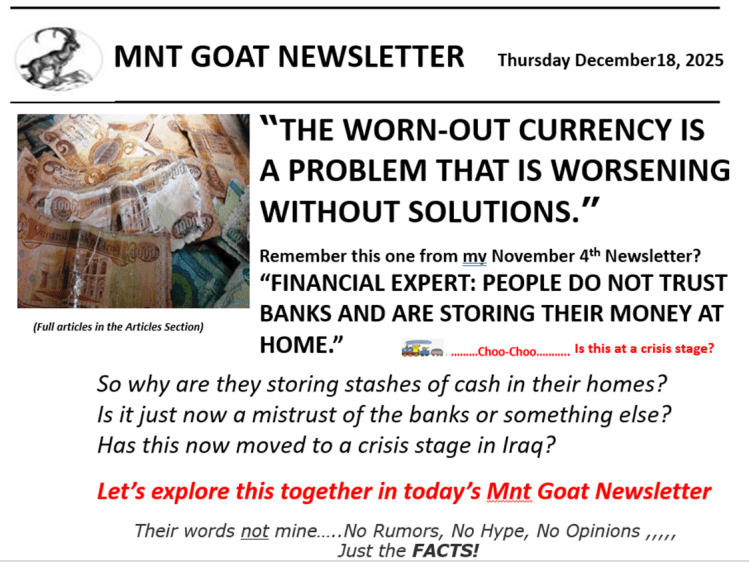
In the following most recent article in today’s news, it becomes apparent that something is going to happen shortly to fix this issue or there is going to be more serious implications. Yes, it is now a crisis for the public. It is titled “THE WORN-OUT CURRENCY IS A PROBLEM THAT IS WORSENING WITHOUT SOLUTIONS.” We have read many articles about the stashes of cash in citizens homes and how this cash is needed in the banks for loans. This cash is nearly 80% of the currency mass in circulation. This could also be why Iraq is holding steady on inflation being so low, this cash is basically withdrawn from circulation. In this article we hear of complaints about the situation and I quote from it –
“No one will take it from me,” Zainab al-Khafaji (an employee) kept repeating as she wandered among the shops near Sayed al-Halib in the Mansour district, before we asked her: “What is it that no one will take from you?” She replied: “Five thousand dinars torn up and glued back together.” She added: “I don’t know who gave it to me when I was shopping, and I tried to buy something with it again, but everyone refused it.”
Do you see that this is a crisis situation now? Why else would there be so many articles on this subject matter in the few months if not a crisis? Did you read just a few of the complaints?
Okay, so if no one will take these worn-out notes then what do the citizens do with them? They stash them at home and soon they pile up, as they have done. It is obvious that newer modernized polymer notes are in order and will not wear out so much. But is this the direction the CBI is really going in the first place? Is the goal not to go digital? But remember too that the CBI told us that cash is not going completely away for many years after this move to digital. Oh…. but there are solutions! The citizens must feel comfortable in any change and this must be handled carefully. I see a few things that are going to happen in the VERY near future and have to happen VERY SOON:
- Implement the Project to Delete the Zeros and issue the newer modernized notes
- Suck in these damaged notes stashes from the homes back into the banks.
- Implement the digital dinar, said to occur at the same time as the newer lower denomination roll outs.
In doing these monetary operations my CBI contact told me there must be a balance necessary to keep inflation low. In other words, I was told that when they suck in the larger three zero notes, especially the damaged ones, they must balance them out so as to keep the monetary mass as 1/3 of what it is today. This is going to be tricky and will take much planning. This is however all planned out and just waiting for execution of the plan.
Here is yet another complaint from the article and I quote –
“Omar Sami (a vegetable seller) says: “I suffer from this problem every day, whether when taking money from customers or returning the change to them. He added that many shoppers get angry when he refuses to take or return worn currency, and the most common phrase is: “What am I going to do with it?” or “It’s not working, exchange it.”
These worn-out notes are becoming a crisis because the CBI has told us they are not going to issue newer notes and we all know why. This makes the urgency of the currency swap out imperative that it happen VERY SOON. I can even imminent.
________________________________________
Having read my RV Status for this period when do you think the RV will happen?
______________________________

________________________________________
Their words not mine…..No Rumors, No Hype, No Opinions ,,,,,
Just the FACTS!
PRAYING WITH SINCERITY
Many may ask why their prayers are not being answered. Our new Shepard in Rome Pope Leo XIV has given us some direction.

You can purchase a nice pair of Rosary Beads here to pray:


These prophecies are more important now more than ever. They give us the strength, perseverance and hope that a better time is coming and that God’s Hand is at work behind the scenes. If you just take a second even to look around you at these past three election cycles, how can you deny that God is at work? Are you sleeping or what?
It is amazing and there is no other way that these events could have happened the way they turned out. But there is more to come, much, much more, I assure you! Now that God has his biblical David re-elected, we need to pay attention to what He does next.
NOTE: These prophecies just keep getting better and better, giving us HOPE of a brighter future. But the real reason why I listen to them is that we can actually see what God says He will do is taking place right in front of our noses. It is a confirmation to me that God is real and is still with us forever just as in biblical times.
I am bringing you three prophecies today all dealing with the coming massive shaking. In my blog for years, I talked about resolving the corruption first within both Iraq and the U.S. Don’t we see this now? The U.S. is not allowing Iranian influence within Iraq to takeover. It is going after these terrorist organizations that have taken hold through the militias. Remember that you are not being told everything that is happening behind the scenes. In the U.S. the reason why we are seeing many politicians deciding to not run for re-election office and instead they retire, is that accusations of corruption is on their heels. Watch how God handles these radical Muslim organizations in America. There is a new breed of politicians coming, some are already here. There is a new party(s) that will evolve. It is no longer going to be a two-party corrupt system.
Prophetic Words from prophet: Julie Green
“Wide Spread Outages Are Coming”
You can start watching the video at the 17:38 mark. From dec 13th.
“The Earth Will Shake Like Never Before”
You can start watching the video at the 17:00 mark. From Dec 13th.
I have been waiting for this period of time since the 1980’s when I first read about it in prophecies. The prophecy today coincides with two other prophecies I have heard decades ago. One is by Kim Clement delivered in 2014. The other is in a book called Phoenix Rising by Mary Summer Rain. So, when Julie Green talks about ‘birth pains’ in her prophecy today, my ears opened up, I paid attention. Then you have to listen to Clement’s prophecy to fully understand what Julie and Mary are talking about when God says the earth will be shaken. like never before. I believe this ‘shaking’ part can be viewed in two ways: literal massive earthquakes and the shaking of the corrupt establishment (through more exposure and justice) that finally breaks their backs once and for all.
We are at the end of 2025 and so it is uncanny, almost scary in what is in these prophecies today. I call this a ‘convergence of prophecies’ and I have been waiting for this period for so long. No, I do not welcome it, and I wish it did not have to happen, but it is now here, and God has a purpose for it.

KIM CLEMENT: A PROPHETIC WORD
“A WARNING THE FOR END OF 2025″
Will we see this prophecy now? We are at the end of 2025 and so is this shaking going to magnify? I think he is talking about Yellowstone National Park and its activity. Geologists say that this area used to be an ancient volcano that could blow and would destroy much of the surrounding area. God says through Julie Green’s prophecy today that God will limit the damage as it has the potential to destroy half of America in full force.
We are now witnessing the fall in the season of fall, that he mentions.
Listen how he talks about December, I believe it is the month we are in right now. God is going to release resources and we shall rejoice.

PROPHECIES FULFILLED—ANTI AMERICAN
We will have to face the radical Muslim communities situated in America sooner or later, but we will have to do something about them. Why not sooner. They have infiltrated America through lack of immigration law enforcement. More evidence that the leaders of these communities want more than to live free and raise families. They want control and power to instill Sharia law. Anyone who apposed it must die. This is their teaching. This is as radical as it gets.

POLITICAL FIRESTORM: RECORDS REVEAL STUNNING NEW DETAILS ON BIDEN-FBI WEAPONIZATION AGAINST POLITICAL OPPONNETS.
Like I have said before the reason why the Biden Administration along with the FBI could not substantiate any evidence or even talk openly about it thus to justify probable cause for a search warrant is that the evidence they were looking for would accuse themselves. They only used the classified document situation as a hoax to justify their actions and look for the files. They were trying to bury the TRUTH by obtaining these files which contain self-incriminating evidence against them. Get it? Oh… but do you really think Trump would be so stupid as to leave such evidence at his home in Mar-A-Lago? This evidence will come out and is slowly dripping out.
Today we learn what some of these files contained that Biden and Obama sent the FBI to find at Mar-A-Lago.

RESIGNATION NOTICE? – TAMPEX TIM WALZ
It’s coming! This guy might have been the Vice President of the United States. That’s a frightful thought…. It’s just a matter of time now before the corruption pressures the administration to dump this guy.
MYPILLOW FOUNDER MIKE LINDELL SAYS HE’S RUNNING FOR MINNESOTA GOVERNOR
Yes, he decided to be part of the SOLUTION and not part of the PROBLEM. There is going to be a new wave of politicians, and we can see their character arising out of the ashes left behind by politicians like Walz. We need to PRAY for these people as they rise to power to help this country.
IS THE FEDERAL RESERVE BEING REPLACED?
It’s coming – Scott Bessent reveals what should REPLACE the Fed Reserve. There may be some major changes next spring. Let’s see what happens. Isn’t this exciting?

THE EXPOSURE OF CORRUPTION IN MINNESOTA HAS ONLY BEGUN.
You simply have to see this video to get an idea on just how bad and corrupt Minnesota really is and this is only the beginning. God, through his prophets has said it will all be exposed and justice will prevail and so it is.

OPERATION ‘TWIN SHIELD’ IS WINDING DOWN AND HERE IS WHAT IT FOUND. JUST A TASTE…

LET THE CLOWN SHOW BEGIN…
HOW DID SHE GET ALL THAT MONEY?
For politicians on both sides of the isle we must begin to ask how they gained so much wealth in such short periods of time. For Ilan Omar it’s $30M in such a short period of time (3 years). Today let’s take a look at one in particular who put herself in the spotlight and deserves to be investigated along with others. Will this be her ultimate doom? Did she take some of that $1B “Feeding Our Future” welfare fraud money? How deep is she into this fraud? So how did she get all that money?

‘TREASON?’: ILHAN OMAR ACCUSED OF EXPLOSIVE CRIME
Is this all just hype? Can they really deport her? The pressure is building as more and more FACTS come out about who she really is and what she really represents.

CORRUPTION IN CALIFORNIA IS MUCH WORST THAN MINNIAPOLIS
Oh boy…. $24B missing! No one knows where it went? You won’t BELIEVE what the FBI just found on Gavin Newsom!!! Actually, it’s not so hard since we all know the guy is a dirtbag. so much for his governorship as a steppingstone to the Whitehouse. It’s so laughable I want to cry. How could this be happening in America?
By Dr. Steve Turely

SURPRISE! SURPRISE! HALF OF MINNESOTA VISAS ARE ‘FRAUDULENT’

LEAKED VIDEO OF ILHAN OMAR FUND RAISING RALLY RAISES SERIOUS QUESTIONS
What country is she really loyal to? Is it the U.S. or Somalia? Was Trump right?
This video should scare the pants off of everyone. Who the hell do these people think they are? Look carefully as Omar is beside him smiling and supports at what he says. This is her fund-raising rally.


I have created a brand-new “Post RV Workshop” page in the blog. I included my own personal tips on investing post-RV and also organizing and protecting your estate. Here is the LINK. Going forward I will only post new and exciting information and opportunities here on the Latest Newsletter as they come along. Later I will transfer it to the ‘Post RV Workshop’ page in subsequent Newsletters for your future reference.
Just so you know I absolutely DO NOT adhere to high-risk investments where you can lose it all in a flash. Look at it this way – you are going to have all this money. Most of us investors waited decades for this RV to happen and so why would you even think about pissing is all away in some high-risk gamble of an investment. Yes, there are going to be scammers out there but let’s talk about legitimate investment opportunities only. These scammers can suck you dry and there is not a damned thing you can do about it. Go to a legitimate wealth manager associated with your bank. Let the licensed experts advise you. Please, please stay away from idiots like MarkZ, TNT Tony, Bruce on the Big Stupid Call, etc. , etc.
TRUMP FLOATS ZERO INCOME TAX PLAN STARTING WITH BIGGEST REFUNDS EVER
The Trump administration is slowly rewriting the entire federal tax code.
Give it time as the country will finally realize that with the right-offs half the country does not pay income tax anyhow. It makes common sense that if you keep adding exceptions and eliminate taxes in the tax code, they why even have an annual filing process? Yes, we can see what is happening. A slow methodical breakdown and then replacement of how revenue is to be collected for the federal government in the near future. But these changes will have to get through congress and congress must remain within the conservative power base.


AL-ABADI RETURNS AGAIN… HIS BLOC: AL-MALIKI CONCEDED THE PREMIERSHIP TO US
BEHIND THE SCENES OF THE FRAMEWORK MEETING
The spokesman for the Victory Coalition, Salam al-Zubaidi, revealed on Tuesday the details of yesterday’s coordination framework meeting, indicating that al-Sudani is still clinging to the second term, but al-Maliki has no desire to assume the position of Prime Minister, and he supports the nomination of Haider al-Abadi for the position.
The Coordination Framework meeting discussed extensively the issue of deciding on a candidate for the position of the next Prime Minister.
Sudani is clinging to a second term, but Maliki has no desire to assume the position of Prime Minister and supports the nomination of Haider al-Abadi for the premiership.
The coordinating framework did not reach a final agreement on a single candidate, because the constitutional timelines gave the framework some leeway until the council convenes and its leadership and the presidency of the republic are elected, and the framework is keen not to exceed the constitutional deadlines.
The latest coordination framework statement carries political messages to Sunni leaders about the need to make their choice in the session.
***********************************************************************************************
THE FINANCIAL PAIN HAS REACHED ITS PEAK, AND IMPLEMENTING REFORMS NOW IS MERELY A PUBLICITY STUNT FOR THE SUDANESE – EXPERT
Following the Economic Council’s decision on Monday to reduce government spending and maximize revenues, during a meeting chaired by Prime Minister Mohammed Shia al-Sudani, economist Ziad al-Hashemi said that the caretaker government’s presentation of a financial reform plan at the last minute aims to whitewash its reputation in its final days.
He hopes this announcement will encourage political parties to reappoint al-Sudani for a second term and give him the opportunity to implement this plan. Al-Hashemi expressed surprise at what is happening in Iraq, noting that governments around the world present their financial plans at the beginning of their formation to address financial errors, improve the quality of spending, maximize returns, and formulate their financial policies in a systematic and disciplined manner. He emphasized that the financial pain has reached the core of the government, and only harsh and painful measures that harm the citizen above all others will suffice.
(After the axe has fallen) The Iraqi government is playing for time and trying to score last points in its favor, and is proposing a financial reform plan to reduce spending and increase revenues!
Governments around the world, at the beginning of their formation, present their financial plan to address financial errors, improve the quality of spending, maximize returns, and formulate their financial policy in a systematic and disciplined manner, but what is happening in Iraq is something else entirely!
For the past four years, the Iraqi government’s program has been based on expanding spending through a highly politicized budget, which has inflated salaries and subsidies, piled up government employees beyond the needs and capacity of state institutions, magnified the financial deficit and accumulated debts, and allowed corruption to operate freely!
All of this happened at a time when Iraq’s financial revenues from oil sales and other sources were decreasing, yet that government paid no attention to either internal warnings or international reports, all of which were sounding the alarm in the face of that government and warning it of the dangers of inflated spending in light of deteriorating revenue, but there was no response!
After the opportunities for reform were lost and the financial problem grew dangerously during the past years, the government now appears at the end of its lifespan with a financial reform plan after the financial pain reached the government’s core and nothing but harsh and painful treatments that harm the citizen before anyone else will work for it!
It is unclear how the caretaker government will implement its financial plan, as it is a government stripped of powers and does not have enough time to implement all those major reform measures. Who will implement, who will commit, and who will set the timelines for implementation, and we are on the verge of forming a new government!
It is highly likely that this government wants to whitewash its reputation in its final days by announcing the financial reform plan, perhaps as a way to encourage political parties to reappoint the current Prime Minister and give him the opportunity to implement his reform plan!
But in any case, the next government, whether the current prime minister is reappointed or someone else is appointed, will face a difficult financial test that will force it to implement more harsh and painful measures, in which financial austerity may be the order of the day for the next four years!
*************************************************************************************************
A NEW FINANCIAL ROADMAP FOR IRAQ: THE SUDANESE GOVERNMENT BEGINS REFORMING SALARIES AND BENEFITS.
In a move described as bold and unprecedented, the government of Prime Minister Mohammed Shia al-Sudani is moving towards redrawing the financial map of Iraq by opening one of the most sensitive and complex files: the file of salaries and senior privileges in the state.
The government is putting forward a reform vision aimed at streamlining spending and controlling operational expenses, with a focus on ending special privileges for presidencies and senior ranks, in an attempt to achieve financial justice, protect social stability, and ensure the sustainability of the general budget in light of internal challenges and accelerating global economic fluctuations.
On Monday, Prime Minister Mohammed Shia al-Sudani chaired an extraordinary meeting of the Ministerial Council for the Economy, during which a number of important decisions were made aimed at rationalizing expenditures and maximizing the state’s financial resources.
Regarding spending reduction measures, the Council discussed the allocations and salaries of the three presidencies, and the Prime Minister directed that an urgent review of this file be conducted, and that work be done to equalize the salaries and allowances of all employees of the Presidency of the Republic and the Presidency of the House of Representatives with the employees of the Presidency of the Council of Ministers, in a step aimed at achieving job fairness and reducing financial disparities.
Al-Sudani also directed the relevant committee in the Ministry of Planning to make the necessary update to the report on unifying the salary scale for all state employees, and to take into account the recommendations submitted in this regard.
The council decided to reduce the allocations for state employees’ travel by 90%, and to prohibit it except in cases of extreme necessity and with the approval of the relevant minister, in addition to reducing the rates of supervision and monitoring of new projects.
As part of reforming the social support system, the Council tasked the Minister of Trade with reviewing the ration card and reforming its mechanisms to ensure that it is directed to its actual beneficiaries from the vulnerable classes.
As for the procedures for maximizing revenues, the Prime Minister directed the ministerial committee formed under Cabinet Resolution No. (550) to reconsider the calculation of non-oil revenues in the Kurdistan Region of Iraq, which are currently deposited as a lump sum into the Ministry of Finance’s account, in coordination with the regional government.
The Council also stressed the need to support and enhance the implementation of the pre-declaration system in the Customs Authority in coordination with the Central Bank of Iraq, to strengthen electricity collection, to review the current tariff, and to adopt automation and electronic payment exclusively in all collection operations, especially in the electricity sector, the Baghdad Municipality, and municipalities throughout the country.
A clear roadmap for financial reform
In this regard, the Prime Minister’s Advisor for Financial Affairs, Mazhar Muhammad Salih, affirmed that the meeting of the Ministerial Council for the Economy with Prime Minister Muhammad Shia’ al-Sudani constituted a strategic milestone for setting a clear roadmap for financial reform, confronting the challenges of fluctuating oil prices, and reducing dependence on oil revenues.
Saleh told Al-Eqtisad News in a special statement that the meeting was dedicated to reviewing the reality of fiscal policy in Iraq, and the concept of fiscal consolidation as a tool to address the deficit and reduce the debt gap, especially internal debt, through re-engineering costs and controlling public spending, without resorting to shock measures or harsh economic surgeries, and in a way that preserves social stability.
He added that the Iraqi economy cannot remain dependent on oil revenues in light of global geopolitical fluctuations, noting that operational expenses constitute approximately 70% of total public spending, which necessitates a review of them according to clear and well-thought-out priorities.
Shocking figures
Iraq spends about 100 trillion dinars annually on salaries for employees and retirees, at least 40 trillion of which goes to senior officials.
The 2024 budget amounted to more than 144 trillion dinars, with a deficit exceeding 63 trillion dinars.
In Iraq, there are approximately 6,000 employees out of roughly 4 million who are classified as “special grades,” and this group receives the lion’s share of salaries. Parliament and previous governments attempted to “streamline spending” and establish a “salary scale,” but these efforts failed due to resistance from those holding “high salaries.”
Iraq faces several risks due to its economy’s dependence on “oil,” a commodity that is subject to political and security crises around the world.
The number of job grades for the positions of “Undersecretary” and “Director General” is estimated at more than 500 grades (A) and about 5030 grades (B), a number that exceeds what exists in Britain and America, according to experts.
Employees in Iraq are divided into 10 job grades, in addition to the special grade (A), and they are in positions such as: Undersecretary of a Ministry, Secretary or Advisor in the three presidencies, up to the grade of Ambassador.
The top grade (B) includes the functions of the general manager and senior supervisory tasks, and then the job grades are divided from the tenth sequence down to the first grade.
In addition, there are more than 20 ministers, and more than 300 deputies or undersecretaries, along with the three presidents (of the Republic – Parliament – Ministers), totaling more than 6,000 positions that consume nearly 40% of the state’s total salaries, divided into salaries, allowances, security protections, and travel allowances, according to experts.
Saleh returned to continue his speech, pointing out that “the principle of reform begins from within the state institutions, through reviewing the structure of salaries and privileges, especially in the higher presidencies, as it is a national and social message that confirms the state’s commitment to justice, and consideration of the conditions of the middle and poor classes.”
He explained that “the meeting addressed the existence of clear gaps in public spending and miscalculations in some areas of expenditure, in addition to unjustified support that constitutes a continuous burden on the budget, which requires adopting the principle of reviewing expenditures followed globally, through re-evaluating expenditure items, and deleting or reducing the items that lead to an unjustified expansion in expenditures.”
He explained that the decisions discussed were classified as either measures that could be implemented immediately, or others that required study and gradual implementation, in line with the state’s approach based on gradual reform and avoiding direct economic shocks.
Saleh added that this approach comes as part of early preparations to restructure the 2026 budget, in light of expectations that oil prices will fall to levels that may range between $50 and $60 per barrel, while emphasizing the need to ensure the provision of salaries, wages and pensions as a top priority, without compromising the requirements of development and services.
He stressed that the Iraqi economy has good cash flows, but it needs higher fiscal discipline and more efficient management of resources, to ensure that every dinar is spent in the right way, and to pave the way for a more stable and sustainable economy in the medium and long term.
Accurate financial data
In addition, financial expert Abdul Rahman Al-Sheikhli believes that the recent decisions came in response to accurate financial data aimed at strengthening the state’s financial stability, in light of a relative decline in public revenues compared to rising levels of spending.
He explained that public revenues in the first half of 2025 amounted to about 62 trillion Iraqi dinars, a decrease of nearly 6% compared to the same period of the previous year, with oil revenues declining by 3.4% and non-oil revenues by 14%, which necessitated a review of financial policies in line with these changes.
Al-Sheikhly explained that the Iraqi economy still relies heavily on oil as a primary source of revenue, with oil revenues reaching approximately 56.7 trillion dinars, equivalent to 91% of total revenues, compared to only about 6.2 trillion dinars from non-oil revenues during the first half of the year.
He stressed that these indicators highlight the importance of diversifying income sources and enhancing the flexibility of the general budget in the face of fluctuations in global oil prices.
The financial expert pointed out that the measures taken reflect a reformist approach to address a number of challenges, including high current spending, particularly salaries and wages which account for a large share of public expenditures, in addition to limited investment spending.
He pointed out that rebalancing operational and investment spending is an important step towards supporting sustainable economic growth and enhancing resource management efficiency.
Al-Sheikhli explained that these measures have potential positive effects, most notably improving public finance management and reducing the budget deficit by rationalizing unnecessary operational expenses and directing support to those who actually deserve it, especially with the development of the ration card system and support for the most needy groups.
He also stressed that strengthening electricity collection and expanding reliance on electronic payment systems will contribute to increasing local revenues and raising collection efficiency.
Sheikhly stressed the importance of implementing these steps wisely and with balance, ensuring the maintenance of public services and the continuation of investment projects, while simultaneously working to develop non-oil revenues and encourage investment in productive sectors. He emphasized that the success of these measures requires effective oversight and close cooperation among various state institutions to achieve the desired objectives without imposing additional burdens on citizens.
Al-Sheikhli concluded his remarks by emphasizing that proceeding with these financial reforms has become an urgent necessity to strengthen the resilience of public finances and reduce the deficit gap, noting that these measures represent a real opportunity to lay more stable and sustainable foundations for the general budget, and reduce its vulnerability to fluctuations in oil prices and changes in production and exports.
No previous government has dared to amend the salaries of the three presidencies, not due to a lack of conviction in the necessity of doing so, but rather because of the political complexities and high sensitivity surrounding this issue. Such attempts were typically met with unspoken resistance and behind-the-scenes political pressure exerted by influential forces.
Any move in this direction would be fraught with political risks and could open the door to conflict between influential blocs and parties.
This issue was also viewed as a “red line” that was difficult to approach, for fear of it being exploited politically or interpreted as targeting a particular site or institution. This prompted successive governments to avoid getting involved in it, and to be content with talking about reform without translating that into practical decisions.
However, raising this issue today reflects a shift in the reform discourse, an attempt to break the deadlock in files that have remained unresolved for many years, and to convey the message that financial reform must begin from the top before the base, in a way that enhances public confidence and affirms the principle of fairness in the distribution of burdens, especially in light of the current economic challenges.
****************************************************************************************
THE CENTRAL BANK OF IRAQ ACKNOWLEDGES THE CRISIS: OIL PRICES AND LIQUIDITY WITHDRAWALS HAVE AFFECTED “CASH RESERVES”.
The Central Bank of Iraq confirmed on Wednesday that the decline in oil prices and the withdrawal of liquidity from the markets are two factors that negatively affect Iraq’s hard currency reserves.
The bank said in a report, which was received by Shafaq News Agency, that “Iraq’s reserves are closely linked to the size of oil revenues, which makes them vulnerable to fluctuations in global oil prices. Also, the monetary sterilization carried out by the Central Bank to withdraw liquidity from the market has a negative impact, due to the need to utilize foreign reserves.”
The bank added that “oil prices fell from $81 for the second quarter of 2024 to $69 for the same quarter of 2025, and consequently reserves decreased from 142.69 trillion dinars to 126.16 trillion dinars for the same period.”
He pointed out that “the Central Bank’s withdrawal of cash liquidity from the market in order to maintain monetary stability led to an increase in cash receipts (i.e., the bank’s acquisition of dinars in exchange for selling dollars), from 18.37 trillion dinars to 21.66 trillion dinars for the same period (i.e., an increase in dollar sales), in addition to the practice of the general budget deficit, which has an impact on net foreign reserves.”
**************************************************************************************************
POLITICAL ENTITIES PROPOSE THREE PATHS TO ADDRESS THE FINANCIAL CRISIS IN IRAQ – URGENT
Former MP Mohammed Mahdi Al-Bayati presented three broad outlines for addressing the financial crisis that Iraq is going through, on Tuesday (December 16, 2025), while indicating that the next government will be facing complex and difficult issues.
Al-Bayati told Baghdad Today, “Iraq is actually suffering from a severe financial crisis whose repercussions have begun to appear in the past few months, which requires a serious effort to find objective solutions that have been proposed for years.”
He added that “the next government will face complex, difficult and critical issues at the same time, especially in the financial, economic and trade aspects.”
He explained that “reconsidering the tax file, managing border crossings, collecting services, addressing unnecessary spending in ministries, agencies and government institutions, as well as taking a serious stand regarding the high allocations for some job grades, especially the special ones, and addressing the file of non-oil revenues in general, represent important solutions to alleviate the impact of the financial crisis.”
Moving towards a diversified economy
Al-Bayati pointed out that “the accumulation of past years and the failure to develop economic trends capable of absorbing challenges, especially the repeated decline in oil prices, have begun to clearly affect the national economy, especially since more than 90% of the treasury’s revenues depend on oil sales.”
He stressed that “the transition to the principle of a diversified economy has become an urgent necessity, otherwise the country will be facing a critical financial situation,” emphasizing that “the financial file must be a priority in the next stage to ensure the flexibility and smooth payment of dues, especially salaries.”
Al-Bayati ruled out “taking a decision to raise the dollar exchange rate at the present stage,” explaining that “this issue is linked to other dimensions, including political ones,” noting that “activating the principle of non-oil revenues represents a top priority in the next stage.”
Financial deficit and weak non-oil revenues
On October 11, 2025, the Eco Iraq Observatory confirmed the existence of a financial deficit due to the country’s reliance on oil revenues, while monitoring the size of monthly spending and revenues.
The observatory said in a report received by “Baghdad Today” that “monthly public spending reached about 11.5 trillion dinars compared to revenues that did not exceed 10.5 trillion dinars, which indicates a clear financial deficit resulting from the state’s reliance on oil revenues and the weakness of non-oil revenues.”
He added, “The monthly public spending is 11.5 trillion, while the monthly revenues amounted to 10.5 trillion.”
He added that “oil sales in August amounted to $7.1 billion through the export of 104.7 million barrels, at prices of $65 per barrel,” believing that “the price per barrel will reach $60.”
The observatory added that “monthly oil revenues reach approximately 9.3 trillion dinars, while non-oil revenues did not exceed 2 trillion.”
************************************************************************************************
SALEH’S STATEMENT: THERE IS NO LIQUIDITY CRISIS, AND THE GOVERNMENT IS PROCEEDING WITH PREPARING THE 2026 BUDGET.
The Prime Minister’s financial advisor, Mazhar Muhammad Saleh, confirmed on Wednesday that there is no severe liquidity crisis in the short term, while indicating that the government is proceeding with the preparation of the 2026 budget within the medium-term framework of fiscal policy.
The Prime Minister’s financial advisor, Mazhar Muhammad Saleh, said in a press statement that “governments usually resort to spending cuts when faced with pressures resulting from fluctuations in revenues or high current obligations, especially in rentier economies dependent on a single resource such as oil.”
He explained that “these measures come in light of fluctuating oil prices and increasing spending requirements, which necessitates discipline in managing liquidity.”
Regarding the possibility of liquidity problems in the coming period, Saleh stressed that “the government is not expected to face a severe liquidity crisis in the short term, as long as oil revenues remain at their current levels and coordination between fiscal and monetary policies continues,” indicating that “continued pressure on operational spending may lead to a relative widening of the 2026 budget deficit, unless it is accompanied by controlling expenditures and strengthening non-oil revenues, especially tax and customs revenues.”
Regarding the preparation of the draft federal general budget law for 2026, he indicated that “the financial authority and the government have made significant progress in preparing it within the medium-term framework of fiscal policy,” expecting that “the draft will focus on achieving a balance between fiscal sustainability and development requirements.”
He added that “initial indicators suggest that investment and service projects will remain at the forefront of priorities, especially those related to infrastructure, energy and basic services, which will enhance economic growth and alleviate social pressures, while simultaneously striving to rationalize operational spending and improve its efficiency.”
He stressed that “the real challenge lies not in the size of the spending itself, but in its quality and efficiency, and in the ability of public finances to gradually move from the logic of crisis management to the logic of sustainable development planning.”
*******************************************************************************************************
PRIME MINISTER MOHAMMED SHIA’ AL-SUDANI CHAIRS A SPECIAL MEETING ON THE OIL AND GAS SECTORS.
Prime Minister Mohammed Shia Al-Sudani chaired a special meeting on Wednesday concerning the oil and gas sectors, in the presence of the Ministers of Oil and Finance, a number of advisors, and senior staff from the Ministry of Oil and SOMO.
His Excellency affirmed the government’s intention to review the financial and economic aspects and raise the efficiency of the Ministry of Oil’s sectors, as they are the main source of revenue for the state’s general budget.
The meeting discussed plans to develop crude oil production and exports, as well as efforts to achieve self-sufficiency and export petroleum products, and to determine the rates of local consumption.
The meeting addressed the localization of industries necessary for the oil sector, and the development of national capabilities in the public and private sectors in the fields of drilling, extraction, mechanical engineering, and others, in order to rely on national personnel in these aspects.
********************************************************************************************
MONETARY POLICY INDICATORS CONFIRM THE CENTRAL BANK WILL BE FIRST IN 2025
By Samir Al-Nassiri
In countries that adopt an institutionally managed economic system, each institution retains its independence and authority to manage economic affairs according to the methodology and philosophy that aims to achieve economic stability and the well-being of society.
Therefore, central banks receive special attention in most countries of the world as the sovereign and prudent economic institution concerned with achieving the above goal through the application of monetary policy tools and the realization of its objectives.
With the approach of the end of 2025 and the beginning of 2026, and following a review and analysis of the policies, programs, and procedures implemented by the Central Bank of Iraq in 2025—a year of political and economic challenges and crises, and numerous changes at the global and regional levels, which negatively and positively impacted the Iraqi economy—the Central Bank demonstrated its wisdom and efficiency in overcoming challenges and moving forward to achieve its objectives set for the next three years.
It also proved to be the leading economic institution in 2025. On this occasion, we must appreciate the outstanding efforts made by the specialized administrative and technical leaders and distinguished employees of the Central Bank who contributed effectively to the implementation of what was stated in the government program in Axis 12 (Financial and Banking Reform) during the years (2023-2025) and the Central Bank’s third strategy and the comprehensive banking reform project.
The launch of the financial inclusion strategy, the promotion of digital transformation, the activation of electronic payments, and the strengthening of cybersecurity. The Central Bank was able to achieve economic growth and stability in extremely complex economic, security, and political conditions, and was able to implement developmental, structural, and technological policies and programs, and take numerous measures in cooperation with the government to regulate foreign trade financing, control foreign transfers, integrate into the global financial and banking system, comply with international standards, and move to the electronic platform.
Achieving the main and sub-goals of its third strategy and starting to implement the comprehensive banking reform project according to the paths drawn up in cooperation with the global consulting firm Oliver Wyman to enable the banking sector to grow and develop and to be a solid, comprehensive, modern and flexible sector that works hard to build a rapidly growing national economy, contributes to development and investment, creates a cumulative increase in the gross domestic product, provides one million job opportunities for the unemployed, raises the market value of the private banking sector and achieves rewarding and sustainable returns for its investors. In addition to increasing foreign investment and achieving growth in financial inclusion, financing and deposits.
Analysis of monetary policy indicators as of the third quarter of 2025 indicates the building of foreign exchange reserves of around $100 billion. Gold reserves at the Central Bank recorded a significant growth rate of (64%), reaching a value of (27.552) billion dinars, equivalent to (173) tons during the same period, compared to a value of (16.817) billion dinars in the second quarter of 2024. The decrease in the issued currency contributed to a decrease in the inflation rate, which maintains the stability of the general price level, as the currency issued by the Central Bank recorded a decrease in the rate of (5.50%), reaching (99.681) billion dinars during the same period, compared to a value of (104.127) billion dinars in the second quarter of 2024.
The decrease in the inflation rate also indicates a decrease in the general price level, as inflation recorded a low rate of (76%), reaching (0.8%) compared to the second quarter of 2024, which reached (3.5%). This confirms that the Central Bank was able to build basic pillars for monetary and economic stability and achieve the most important objectives of monetary policy.
Therefore, I believe, with complete impartiality and transparency, that we should stand in respect for the efforts of the Central Bank and its distinguished staff who achieved the above.
*****************************************************************************************************
THE WORN-OUT CURRENCY IS A PROBLEM THAT IS WORSENING WITHOUT SOLUTIONS.
“No one will take it from me,” Zainab al-Khafaji (an employee) kept repeating as she wandered among the shops near Sayed al-Halib in the Mansour district, before we asked her: “What is it that no one will take from you?” She replied: “Five thousand dinars torn up and glued back together.” She added: “I don’t know who gave it to me when I was shopping, and I tried to buy something with it again, but everyone refused it.”
Al-Khafaji’s situation is like that of many citizens who suffer from the difficulty of making purchases with worn-out currency, unlike what happens, for example, in the Kurdistan Region of Iraq or neighboring countries.
Omar Sami (a vegetable seller) says: “I suffer from this problem every day, whether when taking money from customers or returning the change to them.”
He added that many shoppers get angry when he refuses to take or return worn currency, and the most common phrase is: “What am I going to do with it?” or “It’s not working, exchange it.”
Financial expert Thamer Al-Azzawi says: “The reason for not trading them is the difficulty of exchanging them, as one has to go to government banks and wait and go through other routine procedures.”
He added that “the solution to ending this phenomenon is to reach an agreement with exchange offices to exchange them with citizens, granting them facilities and privileges, or to resort to updating the currency as happened in many European and other countries, where plastic materials were used when printing.”
“The currency.”
Regarding the possibility of electronic payment as an easier alternative, Al-Azzawi said: “It is too early to say that electronic payment can replace cash. Yes, the experiment has been very successful thanks to the current government, but a large part of the citizens are still not confident in it and believe that cash is better and more reliable, even though the opposite is true.”
According to the Central Bank of Iraq, damaged banknotes can be replaced without penalty if the banknote is worn or damaged even if it is not torn and no parts are missing; if the banknote consists of two parts (with different serial numbers) and its area is similar to that of the original banknote and it is held together with adhesive tape; if the banknote is held together with one or more pieces of transparent adhesive tape along its length or width; if the banknote has a cut in more than one corner; if the banknote has a printing defect (in terms of design, size, color, or other security features that are present on genuine banknotes); if it contains stamps or writing that do not affect its external appearance; or if the banknote is missing less than
50% of its area.
However, the Central Bank confirmed the confiscation of damaged banknotes unfit for circulation if the banknote’s exterior has been altered by writing, drawing, printing, stamps, or if it contains adhesive material, or if the banknote has lost 50% or more of its area, or if it consists of two parts on one side. In the event that there is evidence that satisfies the Central Bank that the missing parts of the banknotes have been completely destroyed, they will be partially or fully compensated.
Completely. For his part, Subhi Hussein (a bus driver) says: “I have accumulated a lot of small denominations of 1000, 500 and 250 dinars, most of them damaged or with writings and other things on them.”
He added that many people pay with it under the pretext that they have no other, “which forced me to exchange it, but for a smaller value, because it is difficult to buy with it or exchange it at banks, as most banks refuse to accept it.”
Alsabaah.iq
*******************************************************************************************
THE CABINET APPROVES {REDUCING EXPENDITURES AND MAXIMIZING REVENUES}
The Cabinet yesterday approved the recommendations issued by the Ministerial Council for the Economy regarding reducing expenditures and maximizing revenues, as part of the economic and financial reform program. This comes at a time when the Prime Minister’s financial advisor, Dr. Mazhar Muhammad Salih, expects the state to achieve initial tax revenues of approximately 8 trillion dinars this year, representing about 50% of the total non-oil revenues estimated at between 16 and 17 trillion dinars, with the possibility of these revenues rising to 18 trillion dinars by the end of the year.
Saleh explained to Al-Sabah that these indicators reflect a gradual shift in the structure of public revenues away from total dependence on oil, as the government aims to raise the contribution of non-oil revenues to about (20%) of total public revenues, compared to less than (10%) in previous years.
The Ministerial Council for the Economy approved a package of decisions related to reducing spending and maximizing revenues, during an extraordinary meeting held on Monday, chaired by Prime Minister Mohammed Shia Al-Sudani.
The Council decided to equalize the salaries and allowances of all employees of the Presidency and the Parliament with those of the Prime Minister’s office. It also tasked the specialized committee within the Ministry of Planning with urgently updating the report on unifying the salary scale for employees, in accordance with the recommendations submitted on this matter. As part of the spending reduction measures, allowances for official travel for government employees were cut by 90%, and travel is now prohibited except in cases of necessity and with the approval of the relevant minister.
On the sidelines of the fifth regional conference of the Al Baraka Forum for Islamic Economics held in Cairo, the Governor of the Central Bank, Dr. Ali Al-Alaq, confirmed that Iraq has succeeded in reducing the inflation rate to about (1%), and increasing the size of foreign reserves, while maintaining the stability of the exchange rate, despite the fact that public finances depend on oil by more than (90%).
Alsabaah.iq
***********************************************************************************************
AL-MOUSSAWI: FORMING THE NEW GOVERNMENT MAY TAKE A LONG TIME.
MP Mukhtar al-Moussawi affirmed on Wednesday that forming the new government in Iraq faces significant challenges and will not be achieved quickly without the consensus of all political factions, whether Shia, Sunni, or Kurdish.
Speaking to the Information Agency, al-Moussawi stated, “The continuation of the current situation without serious and urgent action to resolve the political disputes related to entitlements and the nomination of candidates will lead to a lengthy delay in the government formation process.”
He pointed out that “reaching an understanding on the presidency is the essential and necessary first step, followed by an agreement on the Speaker of Parliament, so that a date can be set for the opening of the new parliamentary session.”
He explained that “these steps are part of a political system followed in many countries to ensure the smooth and transparent progress of the constitutional process,” noting that “the continuation of the current stalemate and the failure to reach a swift agreement will cause the government formation process to take more than two months, negatively impacting political stability and hindering the implementation of the government plans and programs that the country is awaiting.”
Al-Moussawi called on “all political parties to expedite reaching an understanding and prioritize the national interest over partisan and factional interests, in order to overcome the current crisis and finalize the formation of the government as quickly as possible.”
Almaalomah.me
***************************************************************************************************************
Their words not mine…..No Rumors, No Hype, No Opinions ,,,,,
Just the FACTS!
Disclaimer: All information in this newsletter is not intended for investment decisions / purposes. Mnt Goat is not a financial analyst, planner, banker, attorney or associated in any role with giving out professional investment advice.
Auf Wiedersehen
Much love to ya all,
Mnt Goat
 LATEST MNT GOAT NEWSLETTER
You must be logged in to post a comment.