


ABOUT THE NEWSLETTER:

May 29, 2025 Mnt Goat News Brief
Guten Tag everyone:
I have some good news for you today. No lies or speculation, just the FACTS. Many WOWs! Many smiling faces…..
GIVE A GIFT TO MNT GOAT
I decided to allow everyone to give a Free-will GIFT to Mnt Goat on PayPal if you so desire. Here is the link below.

Since 2013, I have taken my own time from my gasthaus business to research and document findings about the revaluation and reinstatement of the Iraqi dinar. At this time more than ever I do not need to spend my time doing all this. My time is hard to find, as I have to hold down two formal jobs already due to COVID just to keep the business going. So, I do it out of charity and love for YOU with the understanding that all of us do NOT have the time to go do our own research. We are busy with our jobs, our daily lives and raising our children. I am saying this takes time and is like a third job.
I recommend $10-$15 dollars a month or whatever you can afford. Do you realize I write eight (8) Newsletters every month. I have to investigate the news and try to pull out the FACTS, then pull off the articles from Iraqi news channels, translate them, talk to my contact in Iraq and then write and publish the Newsletter. Do you think perhaps a little gift might show some appreciation for all this hard work? Just asking…. Still only a hand full of readers help out each month. Enough said….. The future of the Newsletter depends upon you.
Let’s all try to chip in!


____________________________________
Psalm 37:4
“Delight yourself in the Lord; And He will give you the desires of your heart.”
I highly recommend most of you to watch this video today about how to bring wealth to you. Wealth is not something to beg for, it is already yours. All you have to do is reach out and believe it is yours. No more intel guru talk, just have faith. Psalm 23.

More news….
OMANI PROPOSAL FOR RESUMING IRANIAN-AMERICAN NEGOTIATIONS REVEALED
Ahmad Bakhshayesh Ardestani, a member of the Iranian Parliament’s National Security and Foreign Policy Committee, revealed on Monday that an Omani proposal had been submitted to Iran regarding its nuclear program. The proposal calls for a temporary suspension of uranium enrichment operations for six months as a preliminary step to resuming negotiations.
Ardestani explained that the proposal has not yet been accepted by Tehran, noting that the Iranian side fears a repeat of previous experiences, which saw increasing demands from Western powers after each positive step taken by Iran.
Ardestani added that Iran currently possesses approximately 300 kilograms of highly enriched uranium, which he estimates is equivalent to the capacity to produce 10 nuclear bombs, stressing that Iran’s red line regarding enrichment will not be crossed.
The Iranian MP pointed out that if an agreement is reached, Iran will continue enriching uranium at a level that exceeds its previous commitments under the 2015 nuclear agreement, indicating Tehran’s desire to extract further gains in exchange for any new concessions.
This development comes amid mediation efforts led by the Sultanate of Oman to revive nuclear talks between Iran and the United States, amid diverging positions between the two sides on uranium enrichment.
Iranian Foreign Minister Abbas Araqchi recently stated that the Omani mediator presented proposals to resolve some of the obstacles in the nuclear talks during the last round of negotiations, stressing that these proposals are still under consideration by the Iranian side.
Earlier on Monday, Iranian Foreign Ministry spokesman Esmail Baghaei denied reports of a possible interim agreement with the United States or a three-year freeze on the nuclear enrichment program.
The Sultanate of Oman has managed to hold five rounds of negotiations between Tehran and Washington, without announcing any real breakthrough on the nuclear issue.
This comes as US President Donald Trump said the United States had “good talks” with Iran, while Tehran maintains its refusal to make any concessions on uranium enrichment.
STATUS OF THE RV
No, the RV has not yet happened and the newer lower denominations are no yet out. If this is all you want from my blog you can leave it now. Thanks for watching….lol….
So, again today I need to go back to the past and let you take another peak at the situation of Iraq was in back then. This time only going back to 2014-2020, but that is far enough to get my point across to you today. Down below are three articles from the past. Please read them carefully. Can you compare the main issues back then to the reforms recently implemented over the past couple years needed to make all these changes in the Anti-Money Laundering (AML) efforts. But most importantly the impact these AML laws have had on advancing the efforts for Iraq to push ahead in the international arena.
So what situation was Iraq in during its past with money laundering and corruption?
Knowing what you are going to learn today about Anti-Money Laundering (AML) you can clearly see that there was absolutely NO WAY the Central Bank of Iraq was ever going to conduct the Project to Delete the Zeros or Reinstate the IQD any time back then. But are they in a situation now that they can do these events? Why hold this recent AML summit this week to give speeches by the CBI about all the progress if something has not changed drastically in Iraq?
Why did all these intel gurus, and you know exactly who I mean, keep telling you the RV was going to happen any day / every day for the last 20 years? So, now you can see who was bullshitting you over this RV and who is not. We all need to know the TRUTH and stop asking – What is the holdup? It should be obvious to you now that the TRUTH is, THERE IS NO HOLDUP. Get it? Oh…one can say it was the money laundering and you would be right. But many of you looked at the “hold up” in other terms, like a single event that needed to occur. I am getting a bit tired of those who keep asking this question yet can’t be bothered to learn about WHAT is happening in Iraq and WHY they are doing all these reforms. Basically, these are steps Iraq had to take to go global, to work with the international economies / financial world.
Remember the three “Pillars of Financial Reform”. How many times have I talked about these pillars already? If you read the White Paper you can also see very clearly that AML is a huge part of the reforms that needed to be in place. The reforms included AML laws, electronic banking, digital transfers, dealing with correspondent foreign banks, etc. All these events are interconnected, mainly to prevent money laundering out of Iraq.
So, we start the commentary off today by presenting these three articles from the past. These articles are long and of course I don’t expect you to read them in their entirety. I know everyone is busy with their lives, so I highlighted many of the important parts for you. All you need to do is skim the articles. Please look at the dates of the articles. I also added a few of my own comments in red.
___________________________________
Article 1 Begins Here:
WITH NEW LAWS AND SOME HELP, IRAQ TURNED AROUND ANTI-MONEY-LAUNDERING PROBLEMS
The Iraqi government was removed last year from an international watchlist
By Samuel Rubenfeld, Feb. 28, 2019
Iraqis celebrate the anniversary of the country’s victory over Islamic State, in the city of karbala. Seven years ago, Iraq’s financial system was beset by problems.
An estimated $800 million in U.S. currency was illegally flowing out of Iraq every week, Iraqi auditors told American investigators at the time. And the central bank governor was dismissed after corruption had become institutionalized within the country’s government and political system.
Iraq landed on international watchlists for money-laundering failures. Since then, however, the country’s efforts to combat illicit finance have improved, and international watchdogs have taken notice.
Cleaning up corruption in Iraq has been the central bank’s biggest priority since he came in 2014, Ali Mohsen Ismail Al-Alaq, the current Iraqi central bank governor, said in an interview. His efforts, combined with input from the country’s leaders and U.S. and international experts, have started to pay off.
“This earned us respect from international organizations and opened opportunities for global financial institutions to come in,” Mr. Al-Alaq said.
Iraq passed a law in 2015 that criminalized money laundering and terrorism financing. It created an anti-money-laundering council within the central bank. It also created an office for combating money laundering and terror finance. The council became the authority for supervision of compliance, while the office was tasked with handling suspicious activity reports.
“This was important to give us the way to deal with the problems we had at that time,” Mr. Al-Alaq said. The effort established the infrastructure needed to support the country’s anti-money-laundering and counter-terrorism-financing efforts, he said.
Iraq had an unstructured banking system after the invasion and dealt with a lack of capacity to combat money laundering, said Ayham Kamel, head of the Middle East and North Africa practice at the Eurasia Group, a political risk consultancy.
“Now, things are significantly improved and the government is in a place where it seeks to preserve the integrity and the safety of the Iraqi financial sector,” he said. “It will continue to adjust its regulations and procedures to ensure compliance with the broad standards of the international and financial community.”
Money-laundering convictions in Iraq rose dramatically, according to a 2017 U.S. State Department report.
In June, the Financial Action Task Force, a Paris-based international watchdog, took the country off its list of countries failing to tackle money laundering.
Ali Mohsen Ismail Al-Alaq, governor of the Central Bank of Iraq, said cleaning up corruption is a priority.
“Iraq has been dealing with some big problems over the years,” said John Sullivan, a former U.S. Treasury Department attaché to Iraq who now is a director with consultancy Financial Integrity Network.
“The government did a good job to get people to focus on what they needed to do under the FATF plan,” he said. They really have made progress against money laundering, Mr. Sullivan added, crediting Mr. Al-Alaq for the effort.
Article 2 Begins Here:
IRAQ’S CENTRAL BANK UNDER INVESTIGATION FOR ALLEGED MONEY LAUNDERING
Country’s Supreme Judicial Council also probing allegations of involvement in terrorist financing by Central Bank of Iraq, along with 13 private banks
Published date: 26 December 2020
Iraq’s Supreme Judicial Council is investigating the country’s central bank and 13 private banks over alleged involvement in money laundering and terrorist financing operations, lawmakers and officials have told Middle East Eye.
In response to a parliamentary probe that ended last month, the council is understood to be investigating cases of customs and tax evasion and potential fraud in connection with the foreign exchange auction run by the Central Bank of Iraq (CBI) and the 13 private entities.
A statement issued by the Supreme Judicial Council on Thursday said that the Rusafa Investigation Court, which oversees cases of integrity, money laundering and economic crimes, had decided to “bring in” the directors of the banks “for violating the procedures of the Anti-Money Laundering and Terrorism Financing Law (No 39) of 2015″.
“Biden will not change policy towards Baghdad, Iraq’s deputy prime minister says”
The statement did not mention any details of the “violations,” or the names of the banks involved. However, the Parliamentary Finance Committee revealed the existence of “suspicious operations” concerning officials in the CBI, who were reported to be aiming to exploit the foreign exchange auction.
MPs and bankers told Middle East Eye that the CBI, which does not deal with individuals, had become a hub for money laundering and currency smuggling due to weak supervisory measures.
To acquire US dollars, Iraq has an account with the Federal Reserve Bank of New York, which draws on Iraq’s vast oil reserves. As the Baghdad government sells oil in US dollars, it uses the currency to buy Iraqi dinars from the CBI in order to finance salaries and public services.
The CBI then sells the dollars to private banks with a mark-up of 10 dinars on the dollar. Instead of bringing the dollars back into the country, the CBI is understood to deposit it in foreign banks, outside of the country, in exchange for invoices presented by the private banks to cover imported goods, lawmakers and bankers told MEE.
‘False invoices for fake goods’
“The game is that these [private Iraqi] banks give false invoices for fake goods,” Mohammed Saheb al-Darraji, a member of the Parliamentary Financial Committee and the chairman of the parliamentary probe, told MEE.
“In other words, there are no goods for the money deposited outside Iraq, and this is money laundering, as the source of this money is unknown or illegal.
“The CBI has to investigate the invoices and impose fines. But the CBI has stopped checking bills since 2016, under the pretext that they are not responsible for this matter,” he added.
“The operation is deliberate. The CBI is ignoring this step due to bribes and political influence in order for the money laundering process to take place properly.”
‘There are no goods for the money deposited outside Iraq, and this is money laundering as the source of this money is unknown or illegal’
– Mohammed Saheb al-Darraji, chair of parliamentary probe
The investigative committee chaired by Darraji revealed that the period from 1 January to 1 September had seen the transfer of $27bn out of Iraq, while receiving no more than three percent of its customs revenues.
According to customs instructions, the merchant who imports goods from abroad must pay 15 percent of the value of the goods as customs, meaning that the annual customs revenues must reach 15 percent of the value of the sums transferred outside Iraq in dollars when it is transferred under the pretext of importing goods. “The customs revenues that Iraq is supposed to get are 15 percent of the value of the amount that was transferred, that is, $4bn. The actual receipt is only three percent, or $418m,” Darraji said.
“This means that the rate of waste reaches 12 percent. Where did this go?”
Until last week, the CBI used to buy $1 at 1,182 dinars from the Iraqi government and then sell it to private banks and financial transfer offices for 1,190 dinars.
Lawmakers and bankers told MEE that the private banks would then sell $1 to the final beneficiary at a price of 1,250 dinars, a difference of up to 60 dinars per dollar.
“The daily profit from this operation reaches $11m, while the monthly profit reaches $220m, while the annual profit reaches $2.64bn,” Sabah al-Saaidi, a member of the Parliamentary Integrity Committee, said in a televised parliament session last month.
“The only beneficiary of this operation is a group of private banks. Neither the government nor the citizen are beneficiaries of this process.”
Panic as prices rise
Most Iraqi political forces depend on illegal sources of funding, including through money laundering, commissions, extortion and oil and drug smuggling, lawmakers said.
There are at least 52 private banks in the country, according to the public records of the CBI, and most are either used or owned by political forces to participate in the foreign currency auction and conceal their funding sources, Parliamentary Financial Committee investigations revealed.
In an attempt to curb the smuggling of the dollar and reduce the annual budget deficit for 2021 – around $43bn – the Iraqi Ministry of Finance raised the dollar exchange rate to 1,450 dinars on Saturday, which immediately caused the prices of goods to rise sharply, causing panic among citizens.
Iraq hurtling towards a financial crisis that could leave millions unpaid.
While the government has defended the decision to devalue the dinar, which means it will get more Iraqi dinars from the central bank, the move threatens to spark popular demonstrations across the country.
A key adviser to Iraqi Prime Minister Mustafa al-Kadhimi told MEE that devaluation, tax increases and austerity measures were the “only option” to address the liquidity crisis after proposals to reduce public salaries had been rejected.
“The devaluation is a response to the urgent need to stop the collapse of the Iraqi economy, reduce the budget deficit and stop the bleeding of foreign currency – and this [is in response] to pressure from the World Bank and the International Monetary Fund,” the adviser said.
“Iranian and Turkish goods have been invading Iraqi markets, and the competing power of Iraqi goods… is almost non-existent, with complete reliance on oil sales. All these factors have forced the government to search for other financial resources to reduce the budget deficit.
“The country is heading for a real disaster and Kadhimi is trying to stop the bleeding with shocking measures,” the adviser added.
“All political forces know this and agreed to it, but they have actually started trading this issue, and a number of them have begun to mobilise demonstrations to protest against the government’s actions.”
Article 3 Begins Here:
IRAQ MPS SET TO APPROVE ANTI-MONEY LAUNDERING LAW
Members of Iraq’s counter-terrorism force take part in an intensive security deployment in Baghdad’s Al-Adel district October 28, 2014. The elite counter-terrorism unit was deployed to the streets of the capital Baghdad on Tuesday to chase sleeper cells, while heavily armed and masked members patrolled the streets of Baghdad’s Sunni neighborhood of Al-Adel to carry out vehicle checks and search for people who are wanted. REUTERS/Ahmed Saad
IRAQ IS STEPPING UP EFFORTS TO CURB MONEY LAUNDERING AND TERRORISM FINANCING.
Majda Mohsen, ZAWYA
July 21, 2015
Iraq is stepping up efforts to curb money laundering and terrorism financing.
Iraq’s parliament is expected to soon endorse a new law that aims to combat money laundering and terrorism financing, the government’s economic adviser said.
Mazhar Mohammad Saleh told TR Zawya that the draft law, which was approved by the cabinet in June, would be more inclusive than a 2004 law that was drawn up by the Coalition Provisional Authority. He said the new law would cover tax evasion, smuggling of antiquities and cash as well as corruption.
“The new law will draw additional policies, legislations and procedures to chase and trace money and smugglers through a national council,” Saleh said.
“It will also meet Iraq’s financial interest and open the way for the country to conduct economic activities at the international level,” he added. “Between 3-5% of Iraqi GDP has been lost due to smuggling during the past 10 years as a result of money laundering.”
(Mnt Goat – this last statement highlighted is exactly where I am going with getting into the details of the AML today. One thing leads to another. They needed sound AML laws in order to move ahead internationally.)
The Financial Action Task Force (FATF) said in June that Iraq has not made sufficient progress to stem money laundering and terrorism financing. It said Baghdad needed to adequately criminalise such acts, establish a legal framework for identifying, tracing and freezing terrorist assets, establish effective customer due diligence measures and a financial intelligence unit, introduce suspicious transaction reporting requirements and put in place a supervisory and oversight program for all financial sectors.
(Mnt Goat – yes, this is why we didn’t see and could not have seen the RV back then. Get it now?)
“Punishments imposed under the old law were ridiculous, with those convicted of money laundering facing no more than four years in jail,” said legal expert Tariq Harb.
The draft law is being introduced at a time when global efforts are being exerted to cut off the funding of militant group Islamic State, which has taken control of large swathes of Iraq and Syria, and whose main sources of revenue include bank looting and extortion, control of oil fields and refineries and cash smuggling.
The Iraqi government and several global financial institutions have taken steps to prevent banks in territories held by Islamic State from accessing the international financial system, FATF said in a report issued in February.
Building confidence
Naim Khudair, director general of the Anti-Money Laundering Office at the Central Bank of Iraq, said the government had pledged to pass new legislation for anti-money laundering and terrorism financing by October 2015.
“There are instructions to give special importance to monitoring bank transactions by politicians and their families in addition to monitoring their dealings in real estate and gold,” Khudair said.
Central Bank Governor Ali Al Allaq said the new law would help reassure foreign investors.
“The new law will facilitate the entry of big companies into Iraq and increase their confidence in the country’s economic environment,” he said.
The deteriorating security situation, poor governance and inconsistent regulations have kept Iraq at low ratings of global rankings for doing business, according to the World Bank.
Mithaq Al Hamidi, a member of parliament’s economy and investment committee, said that while it would prove difficult for Iraq to recover smuggled funds, the new law would have a greater impact in preventing illegal transactions.
MP Najeeba Najeeb, another member of the committee, said that the new draft law was backed by all political parties. But she said that more cooperation between the executive, legislative and judiciary branches were needed to tackle corruption and money laundering.
© Zawya 2015
END OF PAST ARTICLES
___________________________________
PLEASE READ THIS—-> Now let’s talk about the new stage that Iraq has entered, which incidentally, efforts were put on warp speed to complete the AML reforms as acceleration began in early January 2023. You have all seen it in the hundreds of articles I presented over these past couple years. If you can remember I keep harping on the issue of a suppressed Iraqi dinar from the real nominal rate using still the sanctioned de facto peg to the dollar. We know about what the TRUE rate of the dinar should currently be based on its assets. The IMF is going to a strict asset-based evaluation of currency values. This is a Basel requirement. So, what has been preventing this revaluation to the TRUE rate of the dinar? By reading this Newsletter today so far you have a pretty good idea that it was mostly the AML issue. I am not saying that other issues are also not important but when you look at them and study them overall, they too always come back to being a part of the AML efforts, i.e. banking reforms.
If you have been reading enough of these articles over the past two decades (like I have), we now get a sense of a real change. Call it a transition, yes, a transition taking slower than we want, but a sound transition away from those sanctioned days of Iraq since 1990’s. It is a new Iraq and it is here now not years from now. So, it puzzles me as to why the currency also does not NOW reflect this change. But I assure you it will, and it won’t be long until it does. We all need to just relax and hang-in to the end…. The AML efforts is sprouting great benefits to Iraq and allowing them to move ahead quickly now.
😊Looking at recent article titles “CBI CONFIRMS COMMITMENT TO COMBATING MONEY LAUNDERING IRAQ” from May 28, 2025, we read about an AML conference that took place in Baghdad (IraqiNews.com) – The Governor of the Central Bank of Iraq (CBI), Ali Al-Alaq, reaffirmed on Wednesday the country’s commitment to countering money laundering and terrorist funding in collaboration with international partners.
During his participation in a conference:
- Al-Alaq stated that Iraq is working with foreign partners to ensure compliance with international treaties on combating money laundering.
- According to Al-Alaq.Iraq has unique qualities in terms of financial data transparency and access required by authorities for monitoring currency flows outside the country,
- Al-Alaq explained that Iraq is cooperating on a global scale to exchange information through broad communication networks.
- Al-Alaq also stated that Iraq had some shortcomings that needed to be addressed, which the CBI did well by implementing suitable measures to decrease the dangers of money laundering and assure effective counter-terrorism financing.
😊😊Once we read about the UN praising Iraq for its efforts in AML in article titled “UNITED NATIONS: WE BELIEVE IN IRAQ’S RETURN TO ITS POSITIVE ROLE.” The United Nations Assistance Mission for Iraq (UNAMI) announced on Wednesday during the AML conference in Baghdad that “this conference represents an important milestone in Iraq’s journey towards transitioning to a state of law and institutions and positive interaction with efforts to combat money laundering and dry up the sources of terrorist financing.” WOW! WOW! WOW! He added, “The United Nations believes in Iraq and Iraq’s return, and believes that good governance, transparency, and international transition are not just slogans, but rather pillars toward a transparent economy that interacts with the region and the world.” Are they getting ready for the next step which is…….. RV time!
😊 😊In this next we see more of the fruits of Iraq’s labor in combating AML in the article titled “NEW PARTNERSHIP TO CONNECT THE MIDDLE EAST AND EUROPE VIA IRAQ”. I have to say if they are not about to go international after reading this article, I am a monkey’s uncle….lol….
Efforts to create a digital telecommunications corridor stretching from the Middle East to Europe through Iraq, offering alternative terrestrial connectivity options that provide higher levels of capacity, security and efficiency. According to a statement, the route will use terrestrial fibre connectivity that utilizes Iraq’s position as a digital gateway, creating more reliable services that are less susceptible to interruptions. It will pass through Turkey and make its way up to Frankfurt, Germany. The new corridor will act as an alternative to traditional subsea routes by bypassing some of the turbulent areas, ensuring seamless connectivity between the Middle East and Europe.
Mr. Sohail Qadir, CEO at ZOI, said:
“By working together, we will enhance regional and international connectivity, offering higher capacity, security, and efficiency for businesses, operators and hyperscalers across continents.”
😊Next in a recent article we see the positive results of the AML efforts. See article titled “IRAQ STOCK EXCHANGE REPORTS OVER 11B IQD TRADED IN STRONG FINAL WEEK OF MAY” dated May 29, 2025.
😊Then we read other recent articles praising Iraq for its efforts. One is titled “WASHINGTON PRAISES IRAQ’S REGIONAL ROLE AND AFFIRMS ITS SUPPORT FOR ITS STABILITY”. The United States on Tuesday commended Iraq’s regional role and its efforts to end tensions and crises. “the ongoing positive developments Iraq is witnessing at various levels, and the efforts being made to consolidate security and stability and strengthen the economy and investment.”
😊I find this next article amazing progress in the AML effort. You can read about it in the article titled “TRANSFORMATION IS A FINGERPRINT… “ESREFLAK” RESHAPES THE RELATIONSHIP BETWEEN CITIZENS AND MONEY.” It was reported that Iraq has achieved a qualitative leap in the electronic banking sector, ranking third in the Arab world in the number of bank cards issued, with a rate exceeding 46.5 cards per 100 people. This rate puts Iraq ahead of Jordan and Morocco, and close to the Gulf states, which have long led the field. They are telling us nearly half the population now have bank cards in Iraq. If you dare to remember that 10 years ago Dr Shabibi started this effort and it did not go very well. It stagnated and was very difficult to get people to go from raw cash to debit cards.
So, today they are telling us they were able to achieve such this progress based on a dual strategy that combined institutional support from the Central Bank of Iraq with popular support through awareness campaigns that met with a remarkable response, most notably the “Spend It” campaign, which sparked a wave of cultural change in the way people handle money. In a short period of time, the campaign was able to break through the walls of cash habits, replacing them with easy and safe digital options. A citizen named Haider Al-Zaidi tweeted on the “X” platform, saying: “This is the first time I have paid with a fingerprint and without cash at Abu Ammar’s store. Thank you to the #SpendYou campaign.

The campaign focused on the concept of simplicity of use and security of the experience, removing the psychological and cultural barriers associated with fear of financial technology, especially in a country where a large portion of the economy still operates in cash and on the margins of banking. “Asreflak” gained double power because it wasn’t just a top-down decision, but rather the product of a need from below. Field monitoring showed that people were ready to embrace this change, but were waiting for trust, and now they have found it.
What more can I tell you today?
😊I find this next article interesting because once again Iraq is reinforcing the decline of the dollar. This time a finance committee member is telling us the real reasons why the decline. See article titled “THE PARLIAMENTARY FINANCE COMMITTEE EXPLAINS THE REASONS FOR THE DECLINE IN THE DOLLAR PRICE: IT IS NOT DUE TO GOVERNMENT MEASURES.” Member of the Parliamentary Finance Committee, Jamal Kocher, considered on Tuesday that talk about measures taken by the government that contributed to the decline in the dollar exchange rate against the Iraqi dinar is “incorrect.” “There are many reasons for this decline, the most prominent of these reasons is the stagnation of trade and the decline in demand for the dollar in the parallel market.” Feel free to read up on the other reasons for the decline in the full article in the Articles Section of the Newsletter. Remember that the current CBI “official” rate if the dinar is still at 1320 although there is some fluctuations in the ISX market to 1300-1310. The goal is still to get the parallel dollar market even with the “official” rate.
It has not yet happened but is making progress every day in that direction.
😊 Okay so now that we talked about the successful AML efforts we see that the exposure of more potential wealth for Iraq. Let’s study the article titled “HUGE UNTAPPED WEALTH… IRAQ’S TOP 5 MINES”. Just be reading the title I say WOW! WOW! WOW! But I have already talked about these other minerals to you many times already. So, today we get more details about them in this article.
Iraq’s five most prominent mines reveal a map of mineral wealth that remains untapped due to decades of security challenges that have led to the neglect of these resources.
According to a report published by the Energy Platform, Iraq’s most prominent minerals include “sulfur, phosphate, and rock salt, along with strategic minerals such as iron, manganese, zinc, and lead.” The report indicated that “despite the dominance of oil in the economy, Iraq boasts vast mineral resources concentrated in a number of mines.”
So, again lets summarize some of the wealth:
- Oil revenues (realized and untapped)
- Customs and Tariffs (can rival the oil revenues)
- Tourism (hotels, holy shrines, pilgrimages, museums, etc)
- Agriculture exports
- Development Centers / Industrial Cities (soon to generate many exported products)
- Untapped minerals (sulfur, phosphate, and rock salt, iron, manganese, zinc, lead and some rare earth minerals.)
- Gold Mines in Iraq
- What did I miss?
In summary, if any of my readers are gloomy today this Newsletter should cheer you up. I wish I could give you a date and a firm rate for the revaluation, but this will never happen. But what I can give you is HOPE. I mean realistic HOPE with FACTS and TRUTH not some intel guru every day / any day bullshit. This AML effort was a critical part for Iraq and effected the three Pillars of Financial Reforms. If you read today’s articles, they all sound like reforms of the past. In other words, already completed.
Q & A
Periodically I want to inform my readers answers to their questions asked on the blog. So, I hope this is helpful to everyone today.
Question from clayrich6a2b498e66:
What update do you have from your contact, if any please.
Answer Mnt Goat:
Guten Tag Clayrich… I periodically talk to my contact in the CBI on Wednesday and sometimes on Saturday. I rely on my readers to help out in this expense as these calls are in addition to my fee for my cell phone calls within Germany/Europe. Today I gave a summary of what she told me yesterday. The news was all very good. She did say watch out for negativity as there are elements in Iraq that do not want the government of Al-Sudani to succeed or Iraq to progress. Yes, it is sad. These are dark elements trying to destroy all that is good in this world. I don’t know where you live but we see their dark agenda in Canada, USA, UK and Australia. If you have been watching the ongoing saga of Iraq it is a VERY PERFECT example of how they can come into a country, destroy it through embargos and UN resolutions, then make a ton of money off rebuilding it. In the meantime they find ways to steal as much as they can while the reconstruction is taking place.
Question John Tanner:
Thank you for all you do!
I just wanted to say that I have been watching the official currency exchanges and the rate has been fluctuating between 1308 and 1310 to 1 USD. That is higher than the official CBI rate. Won’t the CBI have to do another rate increase to keep up?
Answer Mnt Goat:
Guten Tag John. I first want to say that you are NOT watching the currency exchanges as the IQD is not yet trading on the exchanges. The “official rate is still at 1320 within Iraq. We must be careful. The Iraqi dinar is still in a sanctioned-like mode even though they have been “fully” released from UN Chapter VII sanctions. They are now trying to crawl out of a hole they were put into since 1990.
Now, if you mean to say a link from the FOREX back to the ISX then yet you may see fluctuations in the price of the IQD as the CBI is selling the IQD. This is where these internet venders and others buy the dinar they then sell through their sites. We also see a demand for dinar in trading. As the parallel market is slowly dissolved the rate is rising since these merchants can no longer get the dinar. Didn’t I tell you this would happen and just give it some time? Now we are seeing it happen. The dinar is rising. It is ONLY when the parallel market is at the CBI rate that we have been told the CBI plans to have one more revaluation of the “official” rate, watch again for inflation and if stable, then do the Project to Delete the Zeros. So why has it not yet happened? First of all the parallel is not at the official rate. I don’t know anything about some 10% rule? I am told the economy needs a bit more time but it will happen. I am also reminded to remember the price of oil just dropped and so the CBI must be cautious on adjusting the official rate at this time. The CBI also needs to see the budget tables come out of the cabinet as they are playing blind now and have to wait until this occurs too. We were just told that the budget table are likely in June to happen under the special session of parliament. All in due time, all in due time!
Telling you the TRUTH, you do want to know the TRUTH?
______________________________
What can we as investors do right now?
- Pray and pray that nothing will mess this up….
- Be very patient….
- Do not sell your dinar….
- No more intel guru talk….
- No more NESARA / GESARA crazy talk
- Stop listening to all these idiots as they are only confusing you more and more (especially TNT and “The Big Call” idiots.)
- Don’t over speculate and set unjustified expectations
Their words not mine…..No Rumors, No Hype, No Opinions ,,,,,
Just the FACTS!
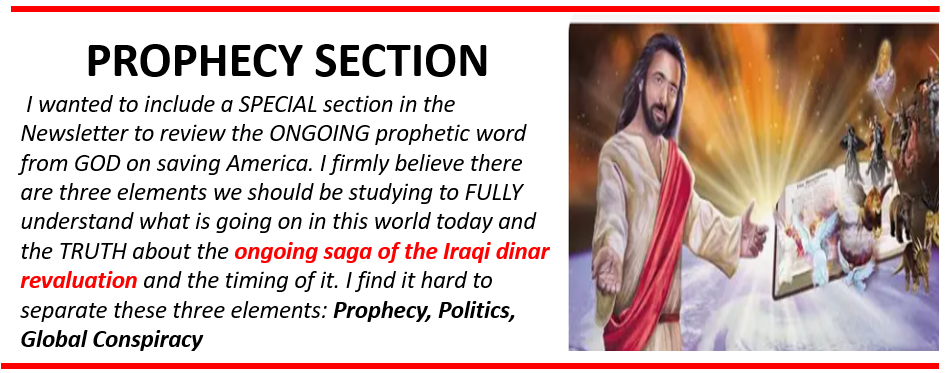

These prophecies are more important now more than ever. They give us the strength, perseverance and hope that a better time is coming and that God’s Hand is at work behind the scenes. If you just take a second even to look around you at these past three election cycles, how can you deny that God is at work? Are you sleeping or what?
It is amazing and there is no other way that these events could have happened the way they turned out. But there is more to come, much, much more, I assure you! Now that God has his biblical David re-elected, we need to pay attention to what He does next.
God told us it will be an “hypnotic November” and turbulent until June 2025 and so, isn’t it? Was He lying to us? Remember that these globalists satanic cult have had it too good for too long and are not just going to lay down and let themselves be destroyed. They are going to fight until the very end to maintain control over you. If all else fails, they will get more and more desperate to overcome the good trying to rebuild and free our nation.
NOTE: These prophecies just keep getting better and better, giving us HOPE of a bright future. But the real reason why I listen to them is that we can actually see what God says He will do is taking place right in front of our noses. It is a confirmation to me that God is real and is still with us forever just as in biblical times.
From God to the PROPHET: Julie Green
The prophetic words seem to be getting more powerful which usually means we are coming to a climatic period and intensity as to when events begin to happen.
“ “A Financial Earthquake is About To Hit This Nation”
Prophecy can be found at the 20:58 mark. From May 17th. ”

“Your Capital Is About To Drastically Change”
Prophecy can be found at the 19:50 mark. From May 25th.

How do these people know these things? Is it God speaking to them of the future?
How is all these prophecies related to the IQD revaluation?
First I need to add that God has given multiple prophecies already about the IQD revaluation and His form of the global reset. In each He specifically talks about Iran, Iraq and Southern Asia (Vietnam).
With the prophecies, unlike the RV saga, we hardly ever get a firm timeline, but we must stay faithful and know that God will be faithful to us and provide what he promises to his prophets and promises to us. Like the clean out of SCOTUS now coming about so will the RV.
Remember that, like us listening to these prophecies, the dark side also listens to them and constructs obstacles in an attempt to overcome them and stop them. This is intentional and we will soon learn of the truths behind why the RV was halted in 2012, besides what we already know. There were some very dark elements involved.
We know the RV of the IQD is unstoppable but it can be delayed and was delayed by these dark elements in 2012. I firmly believe this is what happened in 2012 when the CBI has an “unprecedented opportunity”, according to Dr Shabibi in his 2015 interview before his passing, to get the Iraqi dinar back online in the foreign currency exchanges.
I have been trying to explain to everyone many time already that this is when the criteria all changed under the Obama administration, thus we sit for another 13 years waiting for Iraq to meet this new stringent criterion. They did this in a well-orchestrated, corrupt plan to hold it up, but only after these corrupt U.S. politicians exchanged their dinar and no longer cared about Iraq.
Folks it has been 13 years since! Are we now also approaching the other 2 prophecies by Kim Clement telling of the wealth transfer, the reset and the coming PEACE in the middle east. I have presented these prophecies to you also many times in the past. These are all connected together. All the signs show that this may very well be the time now for Iraq.
But today the prophecy we are looking at is about SCOTUS and the judges stepping down will also have huge implications on many things. Also, the impact on Federal and district court judges. Let’s just sit back and watch it all play out, knowing that God’s Hand is at work.
Kim Clement piece from 2014 prophecy
2 Supreme Court Justices will step down. This is going to happen shortly.

_______________________________
PROPHECIES FULFILLED: How do we engage the prophecies? Are they really a voice from God? So, as we listen and time passes, we step back and analyze what happened and compare to the prophetic words spoken.




New

____________________________________
HOW DO WE KILL THE GIANTS OF DEBT, SOCIALISM AND SECULARISM?
Please, please listen VERY carefully to this prophecy. I cannot emphasize enough to spend the time to watch this one – “The Big E”. I am not saying its going to take 6-7 years to get the RV, but that the RV is part of the process along the way and will happen in the process of the prophecy fulfillment.
Do you remember these prophecies from 2007? This is our time now to fulfill these prophecies. So, let’s take a step back and rewind to review them. Then watch to see if Trump does orchestrate their fulfillment. I also believe this wiping out the debt is related to the new energy sources that are coming. In the meantime, the US will work at bringing down the cost of energy. But I believe this will only be a temporary measure until these new sources come.
Folks, I know you may be having a hard time seeing this, but all of this goes hand-in-hand with what we are looking for… the RV of the Iraqi dinar.

This prophecy is especially important and coincides with the more recent Feb 9th prophecy from Julie Green. Did you listen to it? WOW!
________________________________________
Pray, Pray, Pray & Pray some more!
Please try to remember to pray each and every day. In Hebrews 11:6, it underscores this principle of why we pray: “But without faith it is impossible to please Him, for he who comes to God must believe that He is, and that He is a rewarder of those who diligently seek Him.”
You don’t have to be Catholic to pray….lol..lol.. As a Christian, praying the rosaries for me is my way to pray and has had a significant impact on my life and focus during this Easter season and throughout the year. I find it is good to remember the Stations of the Cross during lent and what our savior did for us. In know many of you may not be Catholics or even Christians but try to take a different approach this Easter. Try to see what all the fuss is about Christ. Put yourself in Christ shoes (or should I say sandals) as an ordinary person in today’s world. You can quickly see that the nature of man has not changed very much and if Christ were born today, many would probably try to crucify him. Have we not learned anything?
We all know something has gone terribly wrong with our nation. A supernatural battle is taking place to determine the fate of America. In just twelve minutes a day you help bring forth a divine intervention to save our country using this book. Let us not forget to fast, meditate and pray for the salvation of America. There is an organization that is taking on this endeavor through helpful prayer guidance. This is what I plan to do. How about you?

Anyone can join the hundreds of thousands already involved in this rapidly-growing prayer
________________________________________

ELON MUSK LEAVES FAREWELL MESSAGE TO DOGE, TRUMP

STILL BELIEVE YOU DID THE RIGHT THING IN GETTING THE COVID VACCINE AND LATER BOOSTER SHOTS?
Oh… but my employer forced me to do it! Folks if you are dead it won’t make a bit of difference will it? Advertisements are still pushing to get vaxed. I find this so hard to believe the have not yet banned this vaccine. The TRUTH is slowly coming out about this pandemic and how it was handed. Is the mRNA technology safe for humans? Why was the vaccine rushed out and even after the deaths rolled in, they still did not ban it.

PARDON PAY-TO-PLAY? BIDEN ADMIN CAUGHT

HERE WE GO AGAIN….DOGE DISCOVERS $93 BILLION LAUNDERED IN DEO, TRUMP’S 50% EU TARIFFS

CONGRESS MOVES TO NULLIFY BIDEN’S AUTOPEN PARDONS—MASS ARRESTS (CHENEY, SCHIFF, HUNTER!)

THE BIDEN HEALTH COVERUP
They thought they would be in power forever by winning the 2020 election. They thought this was the election to win all elections. They planned to use two things to gain power and then to secure their power:
1.Fraudulent elections and 2. Immigration. Both are backfiring on them just as God told the prophets that it would. Are you paying attention to all this? It is all being EXPOSED. Now we are beginning to see the JUSTICE part.

POTENTIAL STAFFERS WHO OPERATED JOE BIDEN’S AUTOPEN HAVE BEEN IDENTIFIED, WILL BE SUBPOENAED

‘MAJOR SCANDAL’: CONGRESSMAN SAYS BIDEN AUTOPEN CONTROVERSY BIGGER THAN WATERGATE

‘TREASON’: TRUMP ZEROES IN ON BIDEN’S INNER CIRCLE

JUDGE JEANINE TO PROSECUTE CUOMO FOR DEADLY NURSING HOME COVER-UP!

MORE PROOF CONFIRMS SUSPICIONS THE BIDEN ADMINISTRATION SURVEILLED ITS POLITICAL RIVALS
Former senator Tulsi Gabbard under surveillance by air marshals. The TSA episode with Tusi Gabbard is going to eventually lead to the Federal Govt turning security of our Airports back to the states. It is already on the radar of DOGE. Remember these words. This is going to save the U.S. billions and not making the airlines any more or any less safer. Get it? Are you brainwashed already just to accept the control?
How many airline hijacks have we had? Wait for the truth to come out about what really happened on 911 and why. Really now remember the TSA employees not only get a paycheck, they also get a govt pension and healthcare,, etc… It is very costly to run but no one pays attention as we all just went along with it out of FEAR. Remember what I said about doing anything out of FEAR?
Yes, the Federal govt will give them some $$ to help the process of securing the airlines. But you can already see the abuse of the system. If you can abuse it, the corrupt will find a way! ☹ Tusi Gabbard is not the only political opponent or news media correspondent/critic that had been detained illegally and without due-cause at the airports. There are many, many more stories and someday it might be YOU!

TOM HOMAN CALLS HAKEEM JEFFRIES BLUFF ON CROSSING RED LINE WITH LAMONICA MCIVER

WHAT IS TRUMP’S ‘ONE, BIG BEAUTIFUL BILL’?
It is already passed Congress and the Senate. It is on its way to the executive for signature. to go into law. These are all campaign promises to the American people to which they voted on and elected the president on.


WHAT’S IN TRUMP’S ‘ONE, BIG BEAUTIFUL BILL’?

_______________________________________

LONG-STANDING PLAN: U.S. TROOPS TO BEGIN LEAVING EUROPE AFTER NATO SUMMIT

_______________________________________
WHY HASN’T TRUMP MADE SUCH DEALS WITH THE EU AS HE HAD IN THE MIDDLE EAST?

_______________________________________
ALBERTHA JUST OFFICIALLY ANNOUNCED ITS INTENT FOR SEPARATION FROM CANADA

_______________________________________
IN ROME BILATERAL MEETING: MELONI STEPS IN, ‘SEPARATES’ VANCE & EU CHIEF


CBI CONFIRMS COMMITMENT TO COMBATING MONEY LAUNDERING IRAQ
May 28, 2025
Baghdad (IraqiNews.com) – The Governor of the Central Bank of Iraq (CBI), Ali Al-Alaq, reaffirmed on Wednesday the country’s commitment to countering money laundering and terrorist funding in collaboration with international partners.
During his participation in a conference held in Baghdad on combating money laundering and terrorist financing, Al-Alaq stated that Iraq is working with foreign partners to ensure compliance with international treaties on combating money laundering.
Iraq has unique qualities in terms of financial data transparency and access required by authorities for monitoring currency flows outside the country, according to Al-Alaq.
Al-Alaq explained that Iraq is cooperating on a global scale to exchange information through broad communication networks.
Al-Alaq also stated that Iraq had some shortcomings that needed to be addressed, which the CBI did well by implementing suitable measures to decrease the dangers of money laundering and assure effective counter-terrorism financing.
The CBI said last month that Iraq is adopting an extensive reform strategy designed to make the country’s private banking industry a robust, innovative, and expansion-oriented system. The strategy aims to increase financial inclusion, boost economic growth, and provide stockholders with long-term returns.
Expanding financial inclusion throughout Iraq, improving the effectiveness and productivity of private banks, and creating a competitive, risk-resilient banking environment are the three primary aspects around which the reform program is built, according to a statement released by the CBI.
By implementing financial literacy initiatives, bolstering the legislative and regulatory framework, and enhancing depositor and creditor safeguards, the strategy seeks to rebuild public confidence in Iraq’s banking sector. Additionally, it will make financial services more accessible across the country.
The CBI plans to boost its anti-money laundering operations through the adoption of digital identification technologies.
**************************************************************************************************
HUGE UNTAPPED WEALTH… IRAQ’S TOP 5 MINES
Iraq’s five most prominent mines reveal a map of mineral wealth that remains untapped due to decades of security challenges that have led to the neglect of these resources.
According to a report published by the Energy Platform, Iraq’s most prominent minerals include “sulfur, phosphate, and rock salt, along with strategic minerals such as iron, manganese, zinc, and lead.” The report indicated that “despite the dominance of oil in the economy, Iraq boasts vast mineral resources concentrated in a number of mines.”
The platform stated in its report: “The mining sector in Iraq has been marginalized for decades due to political and security tensions. However, recent years have witnessed increased interest in revitalizing this vital sector. The Iraqi government is currently attempting to attract international investment to revive these mines, particularly with the move to diversify the economy away from its reliance on oil.”
She added: “Geological data and surveys indicate that Iraq possesses vast reserves of important ores such as sulfur, phosphate, rock salt, iron, and manganese, some of which are ranked among the largest in the world. International reports also reveal that Iraq holds the world’s largest reserves of free sulfur, in addition to significant reserves of silica sand.”
Energy highlighted the five most prominent mines in Iraq, which form a unique geological map that could position Iraq among the region’s leading mineral-producing countries.
Al-Mashraq Mine
The Mishraq mine is one of the largest natural sulfur mines in the world, containing vast reserves of natural sulfur close to the Earth’s surface. Sulfur is extracted from the mine by fusion and is used in the fertilizer, petroleum product, and water treatment industries.
According to Energy, “exploitation of the mine began in the 1960s and reached its peak in the 1970s, but ceased after 2003. Despite plans to rehabilitate it, the mine remains out of service. The mine consists of three fields. The first field’s reserves are estimated at 23.5 million tons, the second field’s reserves are 65.8 million tons, and the third field’s reserves are 224 million tons.”
The Mishraq mine suffered extensive damage during the ISIS era, when the group set fire to sulfur storage facilities in 2016, causing a rare environmental disaster.
Akashat Mine
The Akashat mine, located in Anbar Governorate, is one of the richest phosphate deposits in the Middle East, with total reserves estimated at more than 7 billion tons, making it one of the top five mines in Iraq.
She said: “The extracted phosphate is used in the manufacture of fertilizers, phosphoric acid, and animal feed, and its reserves in the western desert of Iraq are estimated at more than 10 billion tons.”
The mine includes an open quarry, a processing plant, and a railway line connecting it to the Al-Qaim plant. However, the infrastructure has been damaged by wars and terrorism, halting production for many years. Efforts are underway to restart the mine through investment partnerships .
Samawah Mine
The Samawah mine, located in Muthanna Governorate in southern Iraq, is “one of the five most prominent mines in Iraq specializing in extracting rock salt. The salt ore there is distinguished by its high quality and pure sedimentary composition, and is used in the food and chemical industries,” according to what the “Energy” platform reviewed.
She added, “The mine operates intermittently and is managed by the General Company for Mining Industries. It suffers from a lack of investment, but it covers a significant portion of the local market’s needs, with the potential to develop it into a regional center for salt exports.”
Iron and manganese
Sulaymaniyah Governorate in the Kurdistan Region has “promising areas for iron deposits, particularly in Qara Dagh and Birspi, where sedimentary rocks contain hematite and magnetite ores at concentrations ranging from 30 to 45%.”
Despite these positive indicators, according to the Energy report, “none of these mines have been commercially exploited yet. Manganese is found in areas such as Soran and Dohuk, but exploration is still preliminary. Factors such as the lack of infrastructure and transportation, in addition to weak financing, represent the most significant obstacles to developing these sites.”
Zinc and lead
The Ministry of Energy explained that “there are indications of the presence of good-quality zinc and lead deposits within MVT-type replacement carbonate formations in mountainous areas near the Turkish and Iranian borders, such as Mergasor, Zakho, and Qalaat Diza.”
“The main minerals there include galena and sphalerite, along with barite and fluorite. Despite the presence of these resources, the mines have not yet been exploited, but they represent a golden opportunity for Iraq’s future plans to develop the mining sector.”
****************************************************************************************
IRAQ STOCK EXCHANGE REPORTS OVER 11B IQD TRADED IN STRONG FINAL WEEK OF MAY
Jawad Al-Samarraie
May 29, 2025
Baghdad (IraqiNews.com) – The Iraq Stock Exchange (ISX) announced on Thursday (May 29, 2025) a robust trading performance for the fourth and final week of May. Over 11 billion Iraqi dinars in value was traded across more than 6 billion shares during five sessions.
The market demonstrated positive momentum, with key indices showing gains. The main ISX60 index closed the week at 1017.58 points, marking a 1.45% increase from its opening at 1002.79 points. Similarly, the ISX15 index finished higher at 1145.42 points, up 1.90% from its weekly start of 1123.69 points.
A total of 3,894 buy and sell contracts were executed on listed company shares throughout the week.
This active trading week underscores continued investor engagement in the Iraqi bourse, concluding May on a positive note for the market’s key performance indicators
****************************************************************************************************
THE PARLIAMENTARY FINANCE COMMITTEE EXPLAINS THE REASONS FOR THE DECLINE IN THE DOLLAR PRICE: IT IS NOT DUE TO GOVERNMENT MEASURES.
Member of the Parliamentary Finance Committee, Jamal Kocher, considered on Tuesday that talk about measures taken by the government that contributed to the decline in the dollar exchange rate against the Iraqi dinar is “incorrect.”
“There are many reasons for this decline,” Kocher told Shafaq News Agency, noting that “the most prominent of these reasons is the stagnation of trade and the decline in demand for the dollar in the parallel market.”
He added, “The halting of projects and the government’s failure to pay contractors, in addition to the growing tensions among the Iraqi public, have led to a significant decline in demand for dollars in the market.”
The dollar exchange rate in Iraq has been gradually declining over the past few weeks, falling to less than 140,000 dinars to $100 today, according to a Shafaq News Agency correspondent.
With the escalation of economic crises in a number of countries around the world, increased customs restrictions, and a decline in global trade, these turmoils have had a profound impact on Iraqi markets, according to economic observers. Weak global demand has led to a decline in the need for the dollar for imports, directly contributing to a decline in its local price.
******************************************************************************************************
THE SILENT LANDING… THE HIDDEN FACTORS THAT LED TO THE DOLLAR’S FALL IN BAGHDAD
May 2025 witnessed one of the most exceptional periods of volatility in the US dollar exchange rate against the Iraqi dinar. The dollar’s value declined gradually and dramatically, sparking a wave of questions in the market and prompting experts to deconstruct the reasons behind this sudden shift.
In this context, Nawar Al-Saadi, a professor of economics at Cihan University in Duhok Governorate, presented a detailed analysis of this decline to Baghdad Today on Tuesday (May 27, 2025), explaining that the phenomenon cannot be attributed to a single cause, but rather is the result of a combination of monetary, commercial, behavioral, and even regional political factors.
The market is saturated with dollars. Where did the surplus come from?
Al-Saadi says that the most notable thing is that “the supply of dollars has become higher than usual, but not because of the increase in oil revenues, as is believed, but rather as a result of other factors, most notably the increase in remittances from foreign companies and non-oil investments, in addition to reverse dollar smuggling operations from neighboring countries facing a shortage of hard currency.”
This “temporary flood” of dollars, as he described it, created a state of saturation in the Iraqi market, making the dollar more available than demand, thus driving its price down.
Citizen behavior has changed. Has the dollar lost its place in savings?
But the situation isn’t solely explained by the traditional supply and demand equation, but also by people’s behavior, as Al-Saadi explains, adding that “Iraqi citizens are beginning to lose confidence in the dollar as a savings instrument, not because it is weak globally, but because the dinar has begun to show stability and tangible gains.”
This shift prompted many to sell their dollars and convert them into dinars or gold, which contributed to increasing the supply of dollars and reducing demand for them, thus indirectly supporting the dinar.
The Central Bank intervenes… and absorbs liquidity
Al-Saadi believes that “the Central Bank of Iraq’s policy played a pivotal role in the situation,” explaining that the monetary institution reduced the money supply by more than 6 trillion dinars in just a few months, a move that falls within what is known as “liquidity absorption.”
This policy, according to his analysis, led to a reduction in the amount of dinars available in the market, which increased its value against the dollar and created a deflationary environment that helped control inflation and boost citizens’ confidence in the local currency.
Imports shrink… and the trade map changes
According to Al-Saadi, a significant part of the exchange rate decline is also linked to a decline in imports from some major countries, such as India, Turkey, and the United States, despite a notable exception in imports from China. This decline can be explained either by a decline in domestic consumption or by a reshuffling of spending priorities.
In both cases, demand for the dollar used to pay for imports declines, creating a relative surplus in the domestic market and putting downward pressure on the price.
Behind-the-scenes negotiations: Has demand for the dollar declined in Iranian trade?
What’s striking about Al-Saadi’s reading is his analysis of what he calls the “silent regional factor,” suggesting the possibility of unannounced negotiations between Tehran and Washington that have eased financial restrictions, leading to a decline in the need for dollars in some informal trade (between Iraq and Iran).
This decline, he said, reduced demand for hard currency, which was used to finance shadowy and opaque activities, which was reflected in the local market, resulting in an abundance of dollars and a decline in their value.
Will the decline continue? The future depends on two factors.
Despite this remarkable decline, Al-Saadi is not certain that the trend will continue in the long run, stating that the future of the dollar’s exchange rate in Iraq “depends on two factors”: the continuation of the current strict and stable monetary policy, and the Iraqi market’s ability to maintain the flow of hard currency, free from speculation or regional crises.
Al-Saadi concludes his analysis by warning that any disruption to these equations could return the market to square one, emphasizing that “trust is not built solely on policies, but also on continuity and transparency.”
******************************************************************************************************
WASHINGTON PRAISES IRAQ’S REGIONAL ROLE AND AFFIRMS ITS SUPPORT FOR ITS STABILITY.
The United States on Tuesday commended Iraq’s regional role and its efforts to end tensions and crises.
The Presidency of the Republic stated, in a statement received by Al-Mada, that “President of the Republic, Abdul Latif Jamal Rashid, received today at the Baghdad Palace, the Chargé d’Affairs of the US Embassy to Iraq, Elizabeth Trudeau.”
The President of the Republic affirmed “Iraq’s keenness to strengthen bilateral relations in various fields, in a manner that serves the mutual interests of the two countries and peoples,” pointing to “the ongoing positive developments Iraq is witnessing at various levels, and the efforts being made to consolidate security and stability and strengthen the economy and investment.”
He stressed the importance of concerted efforts to ease tensions in the region, stop conflicts and wars, and affirm the principle of regional and international cooperation.
For her part, Elizabeth Trudeau expressed “the United States’ aspiration to enhance bilateral cooperation on issues of common interest and support efforts to establish security and stability,” praising “Iraq’s regional role and its efforts to end tensions and crises.”
****************************************************************************************************
A WORD OF TRUTH FOR A MAN WHO HAS A RIGHT.. AL-SUDANI LEADS A REGIONAL AND INTERNATIONAL MOVEMENT TO STRENGTHEN INTERNATIONAL RELATIONS.
Since assuming office, Iraqi Prime Minister Mohammed Shia al-Sudani has led an active diplomatic effort at the regional and international levels. This effort aims to restore Iraq’s relations with its Arab and international surroundings and build a new, positive image for the country, within the framework of a foreign policy based on balance, openness, and constructive dialogue.
Since assuming office in late 2022, Al-Sudani has been keen to make diplomacy one of his most prominent tools in supporting the national economy. This is achieved by attracting foreign investment, expanding cooperation with various countries around the world, activating economic and trade partnerships, and raising the level of Iraq’s representation in international forums.
Al-Sudani’s movements included official visits to several important capitals, including Washington, Tehran, Riyadh, Ankara, Abu Dhabi, Paris, and Berlin, during which he held high-level talks with heads of state and senior officials, resulting in understandings and agreements in the fields of energy, transportation, security, education, and investment.
Indeed, Al-Sudani realizes that Iraq’s restoration of its regional and international standing cannot be achieved without changing the stereotypical image that has been entrenched about the country over the past decades. He is therefore working diligently to strengthen Iraq’s presence at international conferences, affirm its commitment to international conventions and the principles of good neighborliness, and seek to resolve disputes through peaceful means.
In this context, Iraq participated in important international conferences and initiatives related to climate, food security, combating corruption, and countering terrorism. The Prime Minister had a notable presence at these conferences, delivering several speeches that affirmed Iraq’s commitment to its role as a responsible regional actor, striving for stability and shared development.
Among the priorities of the Sudanese-led diplomatic effort are supporting the Iraqi economy by opening up to new markets, attracting capital and investments, and opening the door to bilateral cooperation in the fields of technology, energy, and infrastructure.
The Sudanese president has announced on more than one occasion that Iraq welcomes foreign companies wishing to invest, emphasizing the provision of a safe and stimulating environment, and encouraging the private sector to enter into strategic partnerships with its counterparts in friendly countries.
In addition to the economic dimension, Al-Sudani did not overlook the importance of Iraq’s role in calming regional tensions, as Baghdad has played a mediating role in a number of issues, including the Saudi-Iranian dialogue and security coordination with neighboring countries to confront the challenges of terrorism and limit drug and weapons smuggling.
The man also worked to raise the level of Iraq’s representation in international organizations and bodies, by nominating competent figures to fill important positions, and actively participating in sessions of the United Nations, the League of Arab States, the Organization of Islamic Cooperation, and others, with the aim of conveying Iraq’s voice and defending its interests.
In this report, we are not seeking to create media propaganda, as much as we want to emphasize the principle of “give each his due,” a principle we are keen to apply with everyone, including entities or figures with whom we disagree or differ. It is a word of truth about a man who has rights.
*****************************************************************************************************
BAGHDAD OR ERBIL? WHO CONTROLS IRAQ’S WEALTH?
Iran’s News Channels
The Iraqi Ministry of Oil declared two agreements between two American energy companies and the Kurdistan Regional Government of Iraq “null and void” due to their failure to obtain federal approval.
The tense relationship between Baghdad and Erbil has once again come to the fore after the Kurdistan Region of Iraq signed two massive gas field development agreements with two American companies worth more than $110 billion. This move sparked widespread political and legal controversy and brought to the fore an old question: Who owns the decision-making power over Iraq’s resources?
Political analyst Naseem Abdullah told Al-Alam TV: “The Iraqi constitution states in Articles 110, 112, and 121 that the management of oil resources is a joint management between the region and the federal government. This provision is explicit, as the 2005 constitution stated that these resources are managed jointly by the region and the federal government. Currently, the region has violated the constitution through its unilateral management, which constitutes a breach of it.”
The agreement, announced by the Prime Minister of the Kurdish region, Masrour Barzani , includes the development of massive oil and gas reserves in the Mizan, Topkhana, and Kordemir fields, potentially transforming Kurdistan into a regional energy hub. However, Baghdad, through the Ministry of Oil, quickly declared the agreement invalid, asserting that it violates the constitution and a ruling by the Federal Supreme Court.
Law professor Mohammed Adiq told Al-Alam TV: “Regarding the relationship between the Kurdistan Regional Government and the federal authorities, it is governed by Articles 110, 114, and 112. Therefore, the expired Kurdistan Regional Government must partner with the federal government in managing oil and gas and concluding oil contracts.”
On the other hand, Erbil believes its actions are legal and within its jurisdiction, citing the absence of a federal law regulating the oil and gas sector. It asserts that the revenues will benefit both Kurdistan and Iraq.
Kurdish political analyst Hussein Al-Jaf said, “What happened is not a new contract, but rather the transfer of ownership of the project, which was operating in oil, from Kurdistan to another company. Therefore, there is no such thing as a renewed contract.”
This sharp contrast raises a highly complex legal and political issue. While Baghdad champions sovereignty over resources, Erbil asserts that it is exercising a constitutional right that is absent from the national agreement.
The relationship between Baghdad and Erbil remains hostage to intense disagreements over resource management, with Baghdad insisting on centralized decision-making and Erbil insisting on its constitutional rights. The absence of a national agreement is evident, making every crisis a renewed conflict between Baghdad and Erbil.
******************************************************************************************************
US SUPPORT FOR UNIFYING BAGHDAD AND ERBIL BY EXPANDING LOCAL GAS PRODUCTION
The US State Department expressed support on Monday for Baghdad and Erbil to work together to expand domestic gas production.
The Foreign Ministry said in statements monitored by “Mil”, “We encourage Baghdad and Erbil to work together to expand domestic gas production as soon as possible.”
She added, “American and Iraqi interests are best served by a strong and resilient Iraqi Kurdistan within a federal Iraq.”
She added, “The United States supports American energy companies’ contracts with the Kurdistan Region of Iraq.”
**************************************************************************************************
AL-SUDANI: IRAQ HAS RETURNED TO LEADING THE ARAB WORLD, AND WE HELD MEETINGS BETWEEN IRAN AND THREE ARAB COUNTRIES.
Prime Minister Mohammed Shia al-Sudani said that his government held dialogue sessions between Iran and three Arab countries, stressing that the new Iraq will not accept being subservient to anyone.
In an interview with the Egyptian newspaper Al-Ahram, followed by Mail, Al-Sudani said, “We preferred to be a bridge for dialogue, not an arena for settling scores.” He explained, “We held meetings between Saudi Arabia, Iran, Jordan, Tehran, Egypt, and Iran.”
He added, “We remember Iran for standing with us in the 2014 war against ISIS,” noting that “what distinguishes Iraqis is their pride in their country, self-respect, and dignity, which do not allow them to be a prisoner or subservient to anyone.”
He continued, “We only want Syria to implement the agreements, maintain a unified and stable Syria, and confront terrorism.” He emphasized, “We have closed the gaps through which Iraq’s enemies were infiltrating, and we have succeeded in achieving accomplishments on the ground that have restored confidence to the citizen.”
He pointed out that “corruption was widespread, and efforts are being made to achieve progress, and citizens feel confident,” explaining that “the government’s performance has sparked interest among young people and new generations in the importance of participating in the elections.”
He continued, “We not only completed the infrastructure, and our efforts were not limited to construction and reconstruction alone, but we also built an information infrastructure,” noting that “Iraq has resumed its role in leading the Arab world.”
He stated that “the new Iraq does not accept being subservient to anyone,” stressing that “Iraq is strong and stable.”
*****************************************************************************************************
PRIME MINISTER’S ADVISOR: THERE IS NO FINANCIAL CRISIS IN IRAQ AND THE ECONOMIC SITUATION IS UNDER CONTROL.
The Prime Minister’s financial advisor, Mazhar Mohammed Saleh, confirmed on Wednesday that the circulating talk of a financial crisis in the country is “nothing more than rumors,” emphasizing the importance of hedging economic policies in light of the current international circumstances.
Saleh explained that the Iraqi economy relies on oil revenues to finance public expenditures by up to 90%, while government spending constitutes approximately 50% of GDP, which accounts for approximately 85% of total demand and economic activity.
He added, “Current indicators do not point to a financial crisis, thanks to prudent fiscal policies. However, global challenges, such as trade wars and faltering energy markets, require vigilance and caution to maintain the country’s prosperity.”
He pointed out that the oil market is entering the early stages of a price decline cycle, emphasizing that there is close coordination between fiscal and monetary policies to address these challenges through fiscal discipline and controlling revenues and expenditures, in parallel with financing measures that do not negatively impact public spending.
Saleh explained that Iraq has accumulated experience in dealing with oil cycles since 2014, and has succeeded in ensuring economic stability by providing salaries, pensions, and social welfare, supporting agriculture, and strengthening partnerships with the private sector within the government’s reform program.
He concluded by saying, “Securing liquidity to meet the country’s needs is a top priority. There is successful central financial management of this issue, and there are no current concerns in this regard.”
*****************************************************************************************************
UNITED NATIONS: WE BELIEVE IN IRAQ’S RETURN TO ITS POSITIVE ROLE.
The United Nations Assistance Mission for Iraq (UNAMI) announced on Wednesday that it believes in Iraq’s return to its positive role, while stressing that legislative compliance is the primary guarantee for the sustainability of the digital transformation .
The UN Secretary-General’s Representative in Iraq, Mohammed Al-Hassan, said in statements monitored by “Mil” that “this conference represents an important milestone in Iraq’s journey towards transitioning to a state of law and institutions and positive interaction with efforts to combat money laundering and dry up the sources of terrorist financing.” He praised “the choice of the title of this session (Challenges of Arab banks in complying with international laws and legislation and ways to meet the requirements of correspondent banks), which expresses a growing awareness among financial and banking institutions that restoring confidence and the efforts of international companies require adherence to the highest standards of transparency and accountability .”
He added, “The United Nations believes in Iraq and Iraq’s return, and believes that good governance, transparency, and international transition are not just slogans, but rather pillars toward a transparent economy that interacts with the region and the world.” He praised the efforts of the Central Bank of Iraq and the Iraqi Private Banks Association for “leading this positive movement .”
Al-Hassan called for “strengthening partnerships with international and regional financial institutions, including the International Monetary Fund, the World Bank, the Financial Action Task Force, the Economic and Social Commission for Western Asia, and others, in order to build national capacities that facilitate raising standards to keep pace with global requirements and requirements,” noting that “such partnerships are accompanied by benefiting from successful experiences in a number of Arab and non-Arab countries that were able to gain the trust of international institutions and peoples by adopting profound reforms capable of integrating Iraq into the global banking system in a way that serves its national interests towards sustainable development .”
He explained that “today’s conference serves as a platform for exchanging expertise and reviewing the applications of technology and artificial intelligence as practical tools for strengthening compliance organizations,” noting that “in light of the accelerating digital transformation, technology is no longer an option but an urgent necessity. If properly utilized, it can uncover suspicious patterns, enhance the accuracy of regulatory procedures, and accelerate financial risks .”
He stressed the need for “such technological development to be coupled with a transparent legislative and legal system. While digitization offers unprecedented possibilities, legislative compliance remains the primary guarantee for the sustainability of today’s transformation .”
***************************************************************************************************
PRESIDENT OF THE REPUBLIC: THERE ARE NO IRANIAN FORCES IN IRAQ, NOR ANY IRAQI FORCES IN IRAN.
Speaking to CNN Arabic
Iraqi President Abdul Latif Rashid denied on Wednesday the presence of Iranian forces inside Iraq or vice versa, noting that the matter is limited to a regular exchange of delegations to discuss common issues. He also reiterated that the absence of an oil and gas law is behind the outstanding issues between the federal government and the Kurdistan Region, during a television interview with CNN Arabic.
he Arab Summit is essential in the current circumstances. The Middle East and Arab countries are suffering from several problems, most notably the aggression against the Palestinian people and the internal situations in Sudan, Syria, and Lebanon.
There is a genuine intention on the part of the Arab countries and the countries of the region to end the suffering of the Palestinian people.
We must work to stop the fighting in Palestine, deliver humanitarian aid to the Palestinian people, and then develop a political roadmap for Palestinians to achieve their legitimate rights in accordance with United Nations resolutions.
Syria is an important country for Iraq in all social, religious, and cultural aspects. We are connected to each other, and we want good and strong relations with Syria. We want the Syrian government to take into consideration the Syrian people in all their diversity and ensure their representation.
We have a long border with Syria, and there are terrorists on the border, either alone or with their families of various nationalities. This security issue must be resolved amicably with the Syrian side.
We are working to resolve the border security crisis with Türkiye and the presence of its forces inside Iraq, especially given the Kurdistan Workers’ Party’s decision to pursue peaceful means to resolve the issue.
Our relations with Türkiye are good in terms of trade and diplomacy, and our trade is strong, amounting to tens of billions annually. We hope to resolve the security issue.
Our relations with Iran are long-standing, normal, and strong. There are no Iranian forces inside Iraq or vice versa. There is a constant exchange of delegations to discuss all existing issues.
Most of Iraq’s water resources come from Türkiye and Iran, and most of it comes from Türkiye. We need a fair share to meet the needs of the population and agricultural requirements.
Our relations with neighboring countries and the region, including Egypt and Jordan, are strong and solid, and there is an exchange of expertise and business to improve infrastructure.
Our relations with the United States are normal and good, and agreements exist between the two parties and are being studied jointly. The decision on whether or not to keep forces is left to the ongoing negotiations between the two parties.
We welcome the visit of President Trump and European delegations to the region to hear directly from the region’s leaders about existing problems and work to resolve them.
We hope that the ongoing negotiations between the United States and Iran will be successful and will benefit everyone.
Iraq is ready to serve as a mediator between Iran and the United States to ensure the success of negotiations, if requested.
The absence of an oil and gas law is behind the outstanding issues between the federal government and the Kurdistan Region. Negotiations are ongoing between the two sides to resolve issues such as salaries, oil, and other matters.
The elections will be held on schedule, and we are working to ensure that they are safe, stable, and fair, ensuring broad participation by the Iraqi people.
(60%) of Iraq’s population are young people, and they constitute the largest group. They must be supported, and we need their participation in supporting the political process, defending security and stability, and for them to be an interested part in solving problems.
**************************************************************************************************
NEW PARTNERSHIP TO CONNECT THE MIDDLE EAST AND EUROPE VIA IRAQ
Zain Omantel International (ZOI) has announced a partnership with Iraq’s Horizon Scope Telecom and the Iraqi Telecommunications and Information Company (ITPC), a government-owned company under the Iraqi Ministry of Telecommunications.
This partnership enables ZOI to create a digital telecommunications corridor stretching from the Middle East to Europe through Iraq, offering alternative terrestrial connectivity options that provide higher levels of capacity, security and efficiency.
According to a statement from ZOI, the route will use terrestrial fibre connectivity that utilises Iraq’s position as a digital gateway, creating more reliable services that are less susceptible to interruptions. It will pass through Turkey and make its way up to Frankfurt, Germany. The new corridor will act as an alternative to traditional subsea routes by bypassing some of the turbulent areas. The route will enable international businesses, telecom operators and hyperscalers to expand their reach via robust, low-latency infrastructure, ensuring seamless connectivity between the Middle East and Europe.
Mr. Sohail Qadir, CEO at ZOI, said:
“By working together, we will enhance regional and international connectivity, offering higher capacity, security, and efficiency for businesses, operators and hyperscalers across continents.”
Mr. Ahmed Abdulsalam, the Managing Director of Horizon Scope, said:
“Offering alternative terrestrial connectivity routes is a critical way to protect against infrastructure vulnerabilities, ensuring that enterprises can capture more opportunities and scale with reliable connectivity.”
Mr. Ali Y. Dawood, the Director General of ITPC, said:
“This partnership marks a significant milestone in strengthening Iraq’s position as a connectivity corridor, especially by providing an alternative path to Europe. We are committed to delivering connectivity solutions that the people of Iraq can trust and use to enable seamless global connectivity.”
*********************************************************************************************************
AN ECONOMIST ANSWERS THE FEASIBILITY QUESTION: HAS ELECTRONIC PAYMENT IN IRAQ ACHIEVED THE DESIRED RESULTS?
“Still not up to par?”
Economist Munar Al-Abidi raised a question about the feasibility of electronic payment in Iraq and whether it has achieved the desired results after its use in many government institutions.
Al-Obaidi said in a clarification received by Al-Jabal, “Has electronic payment achieved the desired results after two years of moving towards its widespread use in most state facilities and institutions?” He explained that “the importance of electronic payment in any country is not measured by its ability to reduce the volume of cash circulating outside the banking system, as real cash exists to fulfill its role in circulation, not to be physically stored within financial institutions.”
He added, “The true measure of success for electronic payment strategies is the extent of development of the trust structure in the banking system, which is accurately measured by the ratio of the broad money supply (M2) to the narrow money supply (M0).”
Al-Abidi pointed out that, “To clarify what these percentages are in a simplified manner:
Suppose a person has 100,000 dinars in cash:
- If the entire amount is kept in cash, M0 = 100,000.
- But if he deposits 30,000 on his electronic card and withdraws 70,000 in cash, then:
- M0 = 70,000
- M1 = 30,000
He pointed out that “if he transferred 15,000 dinars from his bank account linked to his electronic card to a fixed deposit at the bank, the indicators would be:
- M0 = 70,000
- M1 = 15,000
- M2 = 15,000″.
He pointed out that “the more people trust the banking system and electronic financial transactions, the more their electronic balances (M1) increase, and the more their confidence in the feasibility of banking investment increases, the higher the value of their long-term deposits and consequently the increase in (M2). It is not important the amount of money supply, whether inside or outside financial institutions, as much as their ability to move it effectively more than once and the ability to raise the value of M2 at the expense of M0.”
Therefore – and this is what Al-Ubaidi says – the effect of these meanings is as follows:
- A higher M1/M0 ratio indicates greater confidence in daily dealings with the banking system.
- A rising M2/M0 ratio indicates increased individual confidence in investing within the banking sector.
Al-Obaidi continued, saying, “Iraq’s data over the past two years, between March 2023 and March 2025, showed that the M2/M0 ratio rose from 1.11 to 1.25, an increase of 12.4%, reflecting an improvement in reliance on banking services and electronic payments. However, despite this improvement, the ratio remains low compared to other countries such as Saudi Arabia, where the ratio reached 6.4 during the same period.”
According to Al-Abidi, “An important question may arise: How can M2 be so much larger than M0?” He answered, “This can be done through the cumulative role of the banking system: If the person mentioned in the example deposits 15,000 dinars into his card account, and the bank re-lends 10,000 of them to another person who in turn re-deposits them, the total money circulating within the system becomes larger than the original monetary base, and thus the ratio of M2 to M0 rises. Therefore, when this ratio in Saudi Arabia is 6.4, this means that banking operations conducted on the same monetary mass are circulating quickly, which indicates the efficiency of the banking sector and its ability to gain the confidence of customers in the banking sector.”
He considered that “despite the positive growth in electronic payment indicators in Iraq, there is still a long way to go to reach global levels. However, the general trend indicates an encouraging gradual improvement in individual confidence in the banking system, albeit at a slow pace.” He explained: “Also, the M2/M0 ratio in March 2025 decreased slightly compared to February 2025 due to the decline in the value of deposits in the sector, which is an indicator that requires close monitoring and work to correct the ratio to be in a positive direction.”
He continued: “Measuring the success of electronic transactions must be subject to clearly adopted objectives, one of which is to bring the M2/M0 ratio to the 3-point mark by gradually reducing the money supply and withdrawing it from circulation, and increasing the number of deposits and banking transactions by pressuring private and public institutions to adopt banking transaction mechanisms, most importantly electronic payments, and providing appropriate incentives to customers to encourage them to continue using them.”
**************************************************************************************************
TRANSFORMATION IS A FINGERPRINT… “ESREFLAK” RESHAPES THE RELATIONSHIP BETWEEN CITIZENS AND MONEY.
Baghdad/Al-Masala: Iraq has achieved a qualitative leap in the electronic banking sector, ranking third in the Arab world in the number of bank cards issued, with a rate exceeding 46.5 cards per 100 people. This rate puts Iraq ahead of Jordan and Morocco, and close to the Gulf states, which have long led the field.
This progress was based on a dual strategy that combined institutional support from the Central Bank of Iraq with popular support through awareness campaigns that met with a remarkable response, most notably the “Spend It” campaign, which sparked a wave of cultural change in the way people handle money.
In a short period of time, the campaign was able to break through the walls of cash habits, replacing them with easy and safe digital options. Hashtags like #spendyours and #makeyouruseseasier flooded social media platforms, transforming from mere advertising slogans into real-life experiences shared by people.
Haider Al-Zaidi tweeted on the “X” platform, saying: “This is the first time I have paid with a fingerprint and without cash at Abu Ammar’s store. Thank you to the #SpendYou campaign, which taught me this feature and facilitated the procedures.” This is a common testimony among new users of electronic payment.
The campaign invested more in field presence than in billboards, entering popular markets and signing partnerships with restaurants, gas stations, and even food stalls, giving it a popular feel uncommon among official digital transformation campaigns.
The Central Bank of Iraq confirmed in its latest data that electronic payment transactions increased by 62% during the first quarter of 2025 compared to last year, with more than 15 million card and point-of-sale (POS) payment transactions recorded. This reflects widespread acceptance of a more reliable technical infrastructure.
The campaign focused on the concept of simplicity of use and security of the experience, removing the psychological and cultural barriers associated with fear of financial technology, especially in a country where a large portion of the economy still operates in cash and on the margins of banking.
The campaign was integrated into a comprehensive national vision for the transition to a cashless economy. However, it did not follow the traditional path of digitization, opting instead for gradualism and partnership, using a language relatable to the people and tangible services on the ground.
Most Iraqi cities have witnessed a growing demand for card and mobile payments. This trend is evident in transportation stations, small shops, and even kiosks, which now display signs reading “We support you, spend it,” a direct reflection of the shifting business and societal mentality.
“Asreflak” gained double power because it wasn’t just a top-down decision, but rather the product of a need from below. Field monitoring showed that people were ready to embrace this change, but were waiting for trust, and now they have found it.
************************************************************************************************
______________________________
Their words not mine…..No Rumors, No Hype, No Opinions ,,,,,
Just the FACTS!
Disclaimer: All information in this newsletter is not intended for investment decisions / purposes. Mnt Goat is not a financial analyst, planner, banker, attorney or associated in any role with giving out professional investment advice.
Auf Wiedersehen
Much love to ya all,
Mnt Goat
 LATEST MNT GOAT NEWSLETTER
You must be logged in to post a comment.